Sunday, March 05, 2006

Politics @ Princeton

"think tank"

Matt and Mike plan to tease me over beers this evening, about my alma mater, thanks to the cover story in the most recent issue of The Nation: Princeton Tilts Right by Max Blumenthal (March 13, 2006).

The article is about some well-funded conservative think tank based at the university, but getting no direct funding therefrom. If you're reading from overseas, don't confuse "conservative" with "conservationist" -- two separate memes.

Geeky aside: if looking back from the magazine cover i.e. from inside the depicted Ivory Tower (not really ivory), the tilt is actually to my left.

As the movie Why We Fight points out: think tanks have become pretty important of late, as government out-sources more of its brains, as well as its brawn, to become a pale ghost of its former self (like a ring wraith?).

Well, I guess that's participatory democracy in action. Plus thinking really doesn't cost that much (brains are quite energy efficient), so having a ton of money doesn't necessarily mean that much. Like, I've got my blogs, and they're world readable at no cost to me. So what if I'm not a billionaire like Bill?

But hey, what if Google gets taken over by Chinese ideologues and my blogs get deleted by busybody censors? There's always room for angst. Old Europe used to have an even more drastic remedy for talking heads it didn't agree with: it'd cut 'em off or strangle 'em (or just burn the whole body alive, at the stake).

The USA's founding fathers tried to curb those Old Europe reflexes (didn't succeed entirely), by enshrining freedom of speech in the U.S. Constitution. But did our founders forecast "artificial persons" having the same rights as the real ones, under the 14th Amendment? Obviously not. But then, they didn't foresee the Internet either, which makes my websites "but a mouse click away," on a par with ExxonMobil's.

I interviewed two candidates for Princeton this year, like I did last year. Impressive achievers, per usual. I didn't hear a lot about community service though. When do high school kids ever have the time to work with the less fortunate, the impoverished? Why doesn't our public school system provide these opportunities? Because there's no more poverty to worry about? Someday maybe. In the meantime, the wall around the privileged seems higher than ever these days, gated communities more the norm (like we had in the Philippines -- I lived in the somewhat ironically named Magellanes Village).

Anyway, as a radical middle guy, I know people will probably cull through my many postings looking for words to use against me, if and when those A & B modules ever start appearing in our nation's geometry classes. Showing synergetic geometry on television (like in a Global Data commercial): that'd be like a match to the fuse of Bucky Fuller's long-running Mission Impossible thread.

Well, my would-be critics'll find plenty of Urner-authored rants and diatribes, stuff to get angry about. Like just today, look what I posted to Quaker-P (more context in the full version):
There is leverage in having someone owe me a debt. There's also the hypocrisy of the USA pushing the IMF to force other governments to repay debts, at great cost to social programs, while it simply sinks deeper and deeper into debt itself, never really forcing the same dynamics internally.
Yes, social programs get cut (FDR era programming has been gutted), but just enough is meted out to forestall a massive popular uprising or backlash -- a day-to-day calculation, requiring close collusion with the corporate media. In the Third World, it's easier to use brute force intimidation, to make activists "disappear." ....
I have this portfolio of investments. It doesn't have to have the USA in it for my operations to be profitable. There's nothing the USA has that I couldn't get elsewhere. Or that's how it might come to seem, if present trends continue.
Besides, there's a sense of poetic justice in watching those USAers join the rest of "the developing world". I'm tired of watching this self-righteous "superpower" strut about on the world stage, arrogant and stupid. I would love to have it go down, but in a controlled and intelligently managed way, such that it doesn't set off its nukes, the way Americans do whenever they feel threatened (sniveling cowards that they are).
Wow! I sound like a dangerous dissident or something. But keeping to the middle way means hanging ornaments in a balanced fashion over time.

I veer left and right, but it's design science, more than politics, which supplies the gyroscope I steer by. I Engineer (downloading it now, from iTunes -- a song Matt turned me on to a long time ago).

Other developments:

Mom just called, about to fly off to the New Europe. Sunanda is back in town, from Costa Rica, Panama and Nicaragua, with lots of stories to share with Wanderers.

Wednesday, March 01, 2006

FEMA Villages?

I caught some Congress dude pointing to an aerial photo of manufactured homes (huge numbers of them) some 450 miles from ground zero (New Orleans etc.), on C-SPAN (flip flip flip).

He was making a lot of good points e.g. why is FEMA just sitting on these homes, while in the meantime stopping payment on hotel rooms?

OK cool, so Congress is waking up. I'm all for it.

The reason of course (for sitting on these homes) is there's this pervasive assumption among bureaucrats that people are undeserving of the valuable services they might provide.

You find this in India a lot: the greatest satisfaction is in denying others what they most sorely could use. It's a back-handed way of meting out justice (however sick and twisted that "justice" may be). At last, a way to punish, a way to be in control of others, to have some power.

Or on a stereotypical English estate: the biggest snob is the butler. If you buy there's this totem pole or ranking system, and you're three rungs up the ladder, then no way are people on rungs one and two going to get above you, come hell or high water. They're just scum of the earth after all.

In a democracy, we're less enamoured of any totem poles in the social stratification sense. Old timers get respect by default, because their "been there done that" quotient is likely higher. We acknowledge experience.

But in the lifestyle department, we take a more theatrical approach: people live on different stages, act out in different soaps. They're not atop one another. More like Universal Studios: the sound stages are laterally dispersed.

Does this make any sense at all? I think so.

In the social stratification sense, I consider myself as high as I need to be. I've got a middle income lifestyle and that's sufficient. I like being average in that dimension. Ram Dass was a teacher in this regard: "keep to the eight fold bath of the upper middle way" he said (like, I wouldn't mind having a jacuzzi -- might have to up the amps to my fuse boxes though).

And I use my disposable income to man a battle station. That's a luxury, privilege, freedom, and right that I have: to engage in battle, to make alliances, to practice the art of war ala Sun Tzu and Machiavelli. Bucky was my teacher, but not my only one.

Our democracy affords me this opportunity. Thank you Uncle Sam.

Tuesday, February 28, 2006

Levee Town

I watched lots of stats marshalling on my CBS TV last night, mostly about approval/dis of that Oval Office guy (oval like a cowboy hat they tell me -- so like how many gallons?). In this skit I imagine, some pollster's on the phone: "so whaddya think of the job our prez is doin'?" Ten minutes later, phone rings again: "so how 'bout now?"

It's those levees that've got my attention. Like, I wouldn't move back or invest if I thought The Flintstones were still in charge. Ol' Hurricane Harry of 2010 might obliterate my casino again. And what about those pumps? They tell me one of the last to croak was this 1929 jobber. True? Makes a good story anyway. And some giant screw of Archimedes by Leonardo himself, was still turning at 10 feet under (!) -- not that this helped much.

I recall some dinner conversation in Portland, many months before Katrina, where I soaked up some talk about those levees. New Orleans was a disaster waiting to happen, was the gist of it. I listened, wide eyed, incredulous, as if to some episode of Believe It or Not. Little did I realize how soon would come my chance to believe.

And at that St. Helen's viewing center north of here, they show this movie about Mt. Rainier having a bad hair day, shuffing off a glacier or two (no big eruption or anything, just a hiccup, or a sigh), and what that might be like. Picture a sudden river/tsunami smashing through used car lots, playgrounds, Burger Kings. Did the people evacuate in time?

And that IMAX movie: there's this pattern of earthquakes, marching rather predictably it seems, with Istanbul (or some suburb thereof) in the cross-hairs. The older mosques have already weathered a few and are still standing. It's the speculators who throw up the cheap apartments, cut corners against code, play dice with the lives of Allah's children.

Bottom line: many disasters have been queued by Mother Nature, a few of which we're even half expecting. God to humans: "you'll need to stay alert." Humans: (lost in some soap) "upgrading those levees will just have to wait Mr. Almighty Sir, we've gotta keep winning against those godless communists!" Satan snickers. Remember the story: angels were deeply jealous God had found this new love, these wingless humans, and the meaner ones (Satan the meanest) just love it when we goof up big time.

Another skit: journalists break into the Pentagon, inner sanctum, expecting to find all these maps of the Middle East, but it turns out everyone's focused on levees, earthworks, evacuation plans, other civil engineering. "We haven't been into war planning for years," some general confides sheepishly, "that's more a big business thing." Cutaway to Raytheon or other beltway bandit hide-out: now here's a real war room (very reassuring) and yep, a war with Iran might mean selling a few hundred cruise missiles through Congress (kaching!).

And hey, speaking of cruise missiles, did anyone even ask if the word "tomahawk" might be copyrighted? I bet they owe billions and won't pay. Them forked tongue lawyers never pay -- the Injuns learned that early -- far cheaper to just change the law.

Rrrring. "So how 'bout now?"

Sunday, February 26, 2006

Boosting Bandwidth

A Math World
(click for larger view)


So if a picture is worth 1K words, then 30 frames/sec = 30K words/sec. That's a lot of info.

Of course the real differences between frames may be small (static background). MPEG capitalizes on that. Gregory Bateson: information = differences that make a difference.

An MTV generation has grown up on fast cuts, slick editing, making music on a multitrack (if privileged), but then comes formal schooling and a sudden slow-down.

One can hear the gears shearing, the cultures clashing.

Like in math class: the... teacher... talks... really... slowly... as she squeaks out some chalkboard algebra, back to the room (spit ball, paper airplane -- anything to add bandwidth (starvation is painful)).

Nothing dances, nothing moves.

Typical adult response: kids have been spoiled by TV, can't concentrate, short attention spans, need drugs (the legal ones). Oh and Johnny, I'll be late coming home from work: watch TV or something.

How about we try meeting them at least half way? I'm thinking of math movies, DVD clips, flashy shorts with high production values. Abacus, subtract in base 10, then in base 8. Play Tom Lehrer's New Math in the background. Lots of video collage (mix in some history: sputnik, Eisenhower, Weisenheimer).

Then let kids dream up their own, editing/recombining from a growing stash of stock footage. Mix 'n match. Hip hop TV, and with some real academic content.

Slow down for talking heads, sure (caution: heads talking).

I'm not saying only teach this way. But at least let's give it a try. I've seen so few good examples to date (Power of Nightmares was pretty good, showed off lots of media literacy, but not much in the way of math).

I know this culture is capable of more, much more. We take pride in our media savvy, yet so often refuse to use it except to push an easy credit, consumer-based lifestyle, combined with fantasies of being one of those smart people on TV (some doctor, cop, or lawyer -- rarely a priest anymore, unless it's Robert de Niro on late night cable, or maybe TBN).

The rest of the world watches our endlessly dumbing it down and rightly wonders: how low will they go?

Sesame Street was something of a breakthrough, but Big Bird doesn't know anything about icosahedra, vectors, or complex numbers (or if he does, he isn't sharing).

Related posts:
Math on video.google.com (the early days) @ the Math Forum
Another Alien Curriculum
Follow-up thinking on edu-sig @ python.org
Follow-up thinking on math-teach @ Math Forum

Wednesday, February 22, 2006

Back from Catalina

Avalon in February
(photo by K. Urner, Olympus Stylus 500)


After a couple blissful days watching breaking waves on Catalina, a movie makers' haven, I'm back in the world of "breaking news" on airport monitors.

CNN's "Situation Room" aesthetic seems especially shrill, more like a panic room. Whatever happened to simply monitoring events vs. squeezing them for cheap thrills?

Last night CNN was all about fungus in our pillows, close ups of dust mites. I suggest buying a Kirby if that's your concern; they suck pillows big time.

Today we're all up in arms about globalization, as if there's no discernable difference between UAE and OBL (they're both "Arab" right?).

Some idiots blow up a mosque and now it's civil war -- seems there's a real appetite for it, an eagerness for the next disaster, the next spectacle. Will TV be used to fan the flames or cool them? The medium works wonders either way.

OK I'm venting a bit. I've come down with a mild case of misanthropy. I'll shake it soon I hope.

Saturday, February 18, 2006

Welcome to Reality

Writer / Director Stephanie Cooper
(photo by K. Urner)


Stephanie Cooper’s Welcome to Reality, a play in nine scenes, is set in Lone Oak, a small New England town wherein all the adults have committed to a rationalist / literalist mode of thinking, with two exceptions: a science fiction writer who speaks of his characters as if they were real, and a civil war buff who believes he was once a rebel captain (sometime before the car accident).

These latter two have no problem relating to Hannah, an eight year old with an imaginary friend, Mr. Teddy the giraffe.

But Hannah’s mother and grandmother take the majority view that an imaginary friend is but a stepping stone to madness. Hannah should be focusing on learning to count past 29 (she has trouble with 30). They and other townspeople conspire to drum the two quirky eccentrics out of town, because of their supposedly subversive influence on the children.

Ironically, many of these hyper-rationalist adults later prove defenseless against meme epidemics spreading through popular culture: Hannah’s father gets sucked in by the Left Behind series, and dissolves his family in order to preach about the coming Rapture in Washington, DC, while Hannah’s grandmother spends her life’s savings on a “Da Vinci tour” in France, organized around Dan Brown’s popular novel, The Da Vinci Code.

I took Stephanie’s theme to be the danger in not recognizing and nurturing the double-barrel nature of the human psyche. We’re designed to think both logically and mythically. Those who fail to responsibly mythologize as free-standing individuals tend to fall prey to mob mythologies created and propagated by others.

To stifle one’s powers of imagination, so evident in childhood, is to risk lowering ones immunity against oft times predatory and/or opportunistic belief systems in later life.

The actors, a cast of sixteen, put a lot of time and talent into this one-time performance of Stephanie’s senior project. Our venue: Ms. Brunel’s drama classroom at Whittier High School, on the evening of February 17, 2006.

Wednesday, February 15, 2006

American Islam

There's nothing to stop Islam from being a politically constructive player on the USA domestic scene. Malcolm X was a trail blazer in this regard.

These emerging schools needn't take direction from overseas. As a Quaker, I look forward to working with a pacifist branch that understands the Lamb's War, i.e. we're in a battle for hearts and minds, fighting against fear, corruption and tyranny. Outward weapons are for losers.

The Pentagon is shifting gears to focus less on nukes and more on psychological warfare, a positive development (long overdue), and not inconsistent with a warrior class value system, per many Asian examples.

The idea of a war for freedom and liberty isn't specifically Christian (indeed, many Christians hate our freedoms as surely as some Muslims do).

As a secular state, we're free to learn from Islamic schools about how to resist terrorism and parasitism in all their ugly forms.

Tuesday, February 14, 2006

Jihad

mosque in Alabama, by Temcor

Nuclear weapons = sin (pride, hubris, Satan -- see Paradise Lost).

Allah to humans: be loyal, disarm.

Monday, February 13, 2006

Mishima: A Life in Four Chapters (movie review)

A real joy on this DVD is director Paul Schrader's commentary, which frames what's already a multi-level puzzle box of art about art. The film weaves grayscale memories with color-themed theatrical excerpts from Mishima's works, within the outer frame of the artist's final performance, a kind of paramilitary maneuver and homage to bushido culture.

Mishima was a great post-WWII Japanese writer who, with the rise of film and television, morphed into a media celebrity and cult figure. He used his prominence to make a statement, signed with the blood of his own surreal and spectacular suicide, along with that of his adjutant, on November 25, 1972.

Scharder's postmortem commentary in November 2000, at the Lucas Skywalker Ranch, provides insights into the intricate dynamics behind the making of this 1985 film, which resulted in its being temporarily suppressed in Japan, where Mishima, survived by his widow, remained a controversial figure. Just making this film took guts, especially if one were Japanese (the foreigners were expected to be insensitive and reckless).

My thanks to Trevor Blake for putting me on to this film, and to Netflix for making it easy to come by.

Sunday, February 12, 2006

More Adventures in Quakerdom

informative brochure from an outward weaponry museum
(from the chronofile of Annis and George Bleeke)

Tara and I drove out Hwy 26 towards Mt. Hood, to Road 39 past Rhododendron, a small town with a cool relic: a junked articulated bus, extravagantly tagged, likely one of those Hungarian jobbers we used in Portland for some years (they proved a maintenance nightmare). MMM clerk Peter Ford and I snapped pix when going back to the Rhododendron food market in search of garlic and mustard (we found both).

Dawn stayed home to work on the books for MMM (which she converted from Peachtree to Quickbooks) and NPYM among others. I complained to Annis Bleeke that Quakers want too much for their dime, the way my wife gets chained to her computer like that. But of course this was not her doing.

I tried to help with her sudoku puzzle but it had a five-star difficulty rating and Annis, of sound logical mind, obviously didn't much need my help.

I studied her three ring binders, a chronofile of the Bleekes' FWCC adventures for those years when Annis was General Secretary. She had a lot of Africa pix. Annis and George helped me immensely with logistics in Lesotho in 2000, in the wake of the October 13 car accident; the estate sale went very smoothly thanks to them.

Anyway, while we were standing in line, waiting for food, Janet asked if I'd reconsider being the webkeeper for NPYM, now that Steering Committee had implemented some of my suggestions around boosting network security and smoothing turnover around the webkeeper position. I said OK. So my name goes back to nomcomm, and I'll likely be assuming my new duties soon.

Addendum: nope, nomcomm decided to go with someone else, which is good, as it looks like I'll be heading to Switzerland around the time of NPYM's Annual Session this year (combined with FGC).

Friday, February 10, 2006

Yes!

photo by K. Urner, Feb 10, 2006

I usually collect my bizmo pix over in Bizmo Diaries, but I'd just been posting on funding services for children, so I thought here might be apropos.

Outside In is one of our social service agencies working with youth.

Wednesday, February 08, 2006

Fund the Children?

I just got a solicitation call from a nonprofit tasked with publishing a directory of missing children, a kid finder, a locator of some kind.

It sounded extremely important, and apparently this directory is often used by Multnomah County social services, to assist in its job of providing assistance to juveniles and their families.

I did not offer to send any money. Why?

Because I think County services should get the taxes it needs to generate these directories minus any need to go begging.

That's a problem in this country: anyone with a worthy cause has to beg, while anyone with a sure-fire way to make dough, all ethics aside, is assured of a friend in Congress.

There's gotta be some happier medium, even without crossing that dreaded line into 20th century socialism. 20th century capitalism: it's your company that owns that computer, so use it to do company work, not personal work. Works great if you're a company prez like me, of some nebulous Global Data dot net.

Of course I don't want the guy who phoned me just now to lose his job. I want him to work full time helping with that missing children situation, not begging for hand-outs. Same with Congress, they deserve more freedom from special interests. Like, we make them need gobs of money, just to stay in the game, but then say "oh, but bribery is illegal."

In the original USA theory, elections could be run cheaply, and some worthy individual with drive, but shallow pockets, could get a crack at holding office. Holding office wasn't supposed to be an exclusively rich man's game, not even high office (we differed from Britain in that way). Not even exclusively men (still tends to be though, at least as long as it's war time).

That's all gotten stretched out of kilter by now. Elections were made super expensive (not to mention untrustworthy), and you had to be on the take somehow, just to get inside the beltway. Going back to the old ways won't be easy on any national level.

That's why I'm suggesting we start local and small. Like, let the County do its job, don't make it beg to save the children. Let's just save the children already. That's just our job, as older adults, s'been that way since prehistory (and not just if we're penguins).

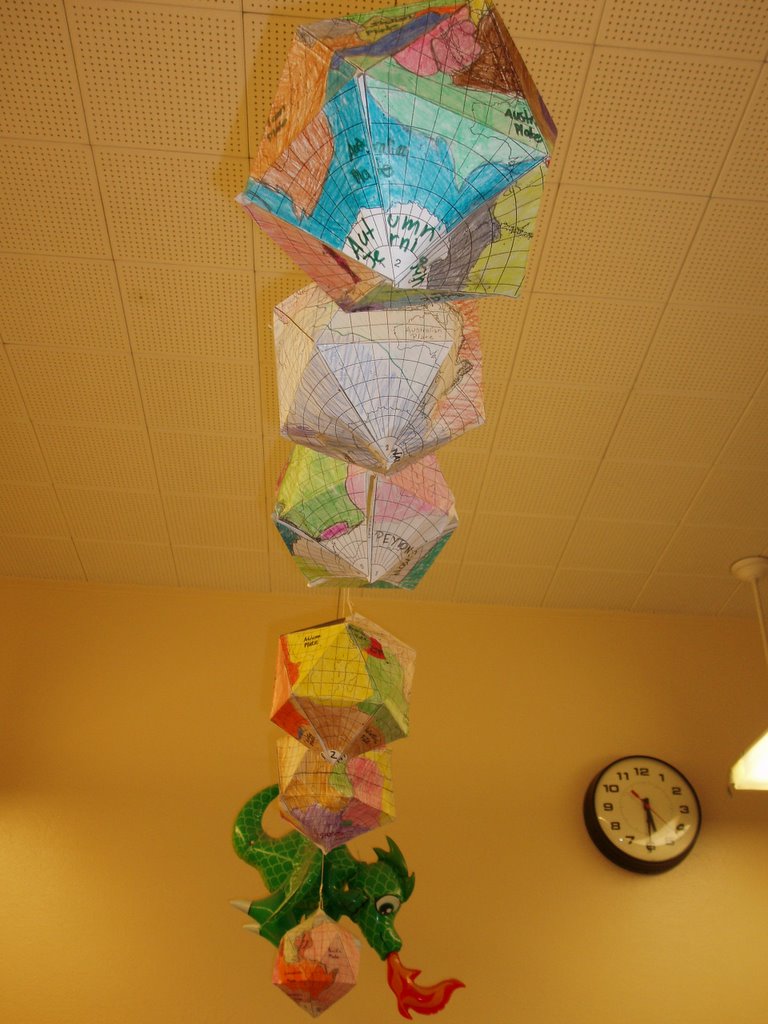
Icosa Globes

student projects suspended from the classroom ceiling
(photo by K. Urner)

Sixth graders in Portland study plate tectonics (Pangea, subduction plates, geological stratification, volcanoes and earthquakes) using these paper fold-up globes.

Tuesday, February 07, 2006

Congress at War

Congress keeps suckering for this "nation at war" hypothesis, and so eagerly swallows a lot of other bunk, in its mad scramble to please big ticket defense lobbyists.

Like, of course we're at war, the most profitable damn war the weaponry pros have ever seen: open ended, an inexhaustable supply of dispensible bad guys, enough religious righteousness to fuel a simmering armageddon to kingdom come. And so let's keep recruiting those extras, those fanatics we love to see killed.

But doesn't Congress have the power to say, "hey wait a minute, we're done with this war"? That's happened before. Wars get called off. People go back to being civilians. Soldiers come home from the front. Why isn't that happening? Doesn't anyone ever win eventually?

No, that's the whole point: Congress needs to keep certain people happy, come hell or high water (we've had a lot of both). So war it shall be, grimly, gravely, with much pageantry and show. A circus for the masses.

Welcome to Rome.

Sunday, February 05, 2006

History is Surreal

Nixon in China

Or there's this thread in Synergetics Dictionary (Applewhite): only the impossible happens.

This picture has the look of one of those posed propaganda posters, but for what episode of Alien World?

"Another day in the twilight zone" might be a good caption.

Saturday, February 04, 2006

Meeting @ Wired with Sam Lanahan

Sam and I had a jovial and convivial meeting regarding his latest explorations in the geometry of Flexblox. We had coffee, plus he had a scone, me a Guinness ("the better breakfast beer").

Then, using the Toshiba (my main machine, although KTU2 is behaving better lately) we oggled pavilions going up in Beijing for the 2008 Olympics. That bird's nest and bubble prism are breath-takingly bold.

I also used the opportunity to share some of my own strategy maps, which center around an old theme in this blog: OSCON versus NCTM. I use these two conferences to typify two directions in math/engineering: towards a bright future of open source and tech savvy kids; towards a dreary and pedantic world of more of the same (and lots of clueless adults grousing about how dumb the kids seem to be these days).

I'm sure NCTM doesn't appreciate being the symbol of all that is dreary, but just use your own powers of research and track down how many references to Medal of Freedom winner R. Buckminster Fuller you find in the last 20 years of "OK with NCTM" text books. How much synergetics-friendly mathematics?

The NCTM even changed its own logo to make it less likely to remind us of an octet truss.

Don't tell me these Stalinesque cover-ups of huge swatches of history only take place in totalitarian countries. Take any large enough bureaucracy of gutless enough wonders, and watch your edgy little design science curriculum turn into some "safe enough for everyone" pablum.

Fortunately, our nation is still free enough to not get all marching orders from pedantic and narrow-minded bureaucrats. We have many ways to bypass curricula which don't treat our students with the dignity and respect they deserve e.g. by short changing them regarding their heritage as Americans. We have the Internet. We have television. We have music. The future looks bright.

Thursday, February 02, 2006

Voting Machines

I caught Lynn Landes on The Ed Schultz Show, KPOJ AM, PDX, somewhere around 2:45 PM today. She's a journalist suing the civilian authorities to recover transparency in voting, and now has a docket number with the US Supreme Court.

From the sound of it, she's against using machines entirely, at least in their present form, which makes sense, as their transparency is near zero.

So could we ever ensure a computerized voting system was honest? I imagine ballot type objects, each with a unique ID, and able to reconstitute as printed objects any time we like. Plus the ID numbers collate under each candidate, forming a cross-check. Historians get to download the bulk data in some standard format and analyze the hell out of it.

We keep it anonymous by not linking ballot ID numbers to people -- which doesn't mean we lose control on how many or which people get to vote (it's just how they vote that we don't track, not how many times).

With this infrastructure in place, one could randomly create fictitious ballots with known content and shunt then through the system, having them originate with the real votes, indistinguishably therefrom, at the precinct level.

In the final count, we would see if our fictitious ballots had been credited properly, as we'd have their ID numbers, which would then become public as not-counted audit checks. Since the ballot stuffers would come from a black box (stored in more than one location, including with election watch dogs), no vote counter would have a way to tell them apart from bona fide votes. Any significant miscounting would show up in the postmortem, perhaps voiding the results.

American Express uses a similar technique to spike proprietary mailing lists; if your store sends junk mail to the list more times than it paid for, various bogus addresses get pinged too many times, and your store gets called on the mat.

An interesting design question: should we give individuals privileged access to their own ballot ID number? Then it's their secret to keep or reveal. I could go to the data base via web form, ballot ID in hand, and call up my own voting record.

Any changes to any of my votes would be immediately obvious to me, although without the printed receipt (not counterfeited) no one would have to believe me if it said I'd wanted Chicken Little for president.

Some people might keep their ballot receipts just long enough to verify their choices were recorded properly (the ID number links to candidates' names in the relational data base), then destroy them.

Here's an idea: since the NSA is getting more involved on the domestic front, thanks to Al Qaeda, why not have the NSA come up with some new voting machine infrastructure, or at least the specifications? A consortium of universities could assist with this project.

Network security is a key specialty at the NSA. If our ability to accurately count the votes is being impaired by some kind of behind-the-scenes skulldudgery, our USG security establishment should be all about uprooting that.

The integrity of our USA codes is undermined to the extent we're unable to establish an unbroken link to the actual will of we the people. The legitimacy of the courts themselves depends on protecting the integrity of this social contract.

Congress has seemed remarkably reluctant to take this bull by the horns and address the widespread concerns of ordinary Americans that our system is broken. Maybe the executive and/or judicial branches will show more backbone?

Monday, January 30, 2006

One: The Movie

Dawn and I caught this one at the Bagdad free of charge. Given the offgassing of fumes from the floor varnish in the soon-to-be pool table room (behind the big screen), management decided to forego the $3 admission and just sell refreshments.

The staff never dimmed the house lights, although I made a special trip to the counter with this request. The dimmer guy was on the phone. Oh well.

Anyway, as the liner notes and movie script spell out: some middle aged, middle Americans take it into their heads to get a DV cam and make a movie on the meaning of life. As might be expected, given no training or background, they come up with a hodge-podge.

The saving grace of this film is they manage to record some trully talented people sharing honestly and sincerely, including but not limited to several VBNs on the spirituality circuit (some of whom I'd read, but never seen, like Robert Thurman).

But the interviewers, being somewhat clueless and inane, tend to squander the opportunity by asking "big" questions instead of probing or insightful ones. Now if only we'd had Bill Moyers... There's also some storyboard about some guy on a "journey" (he rides buses and stuff).

In sum, this isn't very good reality theater, much as I admire the players.

My sense is there's tremendous talent out there, especially in the religious sector, ready and willing to rise to the occasion, but a lot of this talent goes untapped. We just don't have the needed directors yet.

The solution may be for more religious groups to see the making of film and television as a divine calling, and not leave it to others to get it right. A role model here might be Khyentse Norbu of Bhutan.

And let's script in more technology working to alleviate suffering in tangible ways. I'm tired of this ridiculous stereotype that spiritual people can't do engineering or use computers.

Add to all this dumbing down all those supposedly God-directed clowns brandishing firearms and making terrorist TV, and you can see why so many good people tend to marginalize religion as irrelevant at best.

Friday, January 27, 2006

Memo Re Google in China

Here's text I just posted to a private Forum I frequent. The Forum question was about recent news reports, of Google collaborating with aliens to dumb down its search engine service.

I think Google should play by American rules, meaning Bill of Rights and First Amendment. I didn't like it when Microsoft pulled that Chinese blog either, because it offended certain readers in China. Many other readers in China, including a small following of journalists, loved that blog, and were deeply hurt that Microsoft would get involved in Chinese politics, and side with some ruling faction against them.

If Chinese authorities want to dumb down the Google service, they shouldn't expect Google to do this work for them. They should build a new franchise, with pass-through to Google, and censoring of what comes back. This franchise should not use Google trademarks, except maybe to confess to clients that they're piggy-backing on a back end by some other company (truth in advertising).

Or you could just appoint some government minder to stand behind every Chinese student who wants to Google up Tiananmen Square, and use a cudgel.

See Wikipedia: Tiananmen_Square_protest_of_1989.

But it's the Chinese themselves who need to pay for all that extra manpower. Google has enough to do without worrying about local censorship rules. Push that off onto the clients, leave Google free to not dumb down its own service.

Kirby
Addendum: please feel free to send an email to Google if you're in China and can't google up this Blogspot post, Blogger being a Google service. Cc me if you like. Use my Gmail address.

Wednesday, January 25, 2006

Update from Winterhaven

I'm sitting at one of the Win2000 workstations in McCarty's computer lab, the place where I teach 8th graders on Tuesdays. I'm waiting for Tara to finish some project.

Earlier, I was painting a thumbnail of my vista here in PDX, sharing it with some community college math teachers, who could use some fresh thinking. Students have become increasingly bored and commensurately rebellious about the traditional math department fare. My sense is we've done way too little to rethink our pedagogy in light of what new technology is up to providing. My work here in Portland aims to make up for lost time. If you've been reading my blogs, you already pretty much know all about it. Geek TV, Saturday Academy and like that.

I'm looking at chartering various new schooling options, including for the home based, that will bring new opportunities into focus. The strategy is not to drum up funding so much as give clear definition to the curriculum, and have it fly on its merits. That might not be the best strategy in every context, but here in Portland, we've already been given funds, by Google (for open source development), by Bill and Melinda Gates (for redesigning high schools), and by Meyer Memorial Trust (a principal local player).

Monday, January 23, 2006

Another Quaker Story

Bruce Kaad was over today, another Ken Wilber fan, to pick up a ream of thank you letters going out to Friends and affiliated donors who'd been kind enough to kick in. I used Microsoft Word and Excel to do the job, plus this Brother MFC-8820D, a truly excellent piece of equipment.

Bruce is Treasurer of MMM, an uncompensated, rotating position, filled by nom comm through a clearness process in Business Meeting (technically another form of worship). My wife is their hired gun, TBC priestess of nonprofit books (the web site currently sports an Hawai'ian theme, an ironic lament given our rain forest weather (I'm not really complaining, much as I love Maui)).

We're expecting visitors from the Bend area, other side of the Cascades. Portland, as you know, is where the Willamette meets the Columbia, in buttes to the south (Mount Tabor, for example, but a short walk from here). We serve as a major sea port, though nowhere near as major as Seattle / Tacoma. We're not a very large city, are the biggest in a chain of cities and towns stretching further south along the Willamette: Salem, Albany, Corvallis, Madras, Philomath, Eugene.

Our principle exports are technological in nature, which is why the moniker Silicon Forest (as distinct from Silicon Valley). Our Hawthorne district saw the birth of such giants as Tektronix and ESI. The latter company inherited a first facility from Jantzen (swim suit company) and then passed it on to Quakers when required to move. Doug Strain was a big part of all that.

Another regional headquarters for high tech would be Spokane and its Gonzaga University. That's the home of Cyan, makers of the classic Myst series, and Uru.

Saturday, January 21, 2006

Web Wrangling

NPYM's nominating committee (nomcomm) approached me about webmastering for NPYM and I originally said OK.

Then it turned out the leadership had no keys to the website -- I'd have to go to whomever is being relieved of duty and beg for the keys (not that this is the actual soap -- the current webmaster and I are friends -- but it could be, procedurally speaking). Bad process.

NPYM needs to be able to change the locks at will. The outgoing webkeeper simply finds the web site subaccount has been rekeyed, while the new webkeeper gets the new keys by some channel. Keys to the master account, with control over the subaccounts, stays with a trusted inner circle (say the NPYM secretary and clerk).

Otherwise, what if we were infiltrated by a bogus webkeeper who then spray painted "work of the devil" all over our pretty NPYM website? More realistically, the webmaster might just start making all kinds of design decisions that don't jibe with our sense of who we are, and refuse to change course even in the face of negative feedback.

Is NPYM going to say "please kind sir, we'd like you to stop"? That's silly. That's the tail wagging the dog. Just decide it's not working out, change keys, restore from the backup. Should take about 30 seconds, once the decision is made.

The only way to really challenge NPYM at that point, once the web site is truly secure, is to define a schism, i.e. some breakaway rebel team says "we're the real NPYM." Happens all the time in religion. In politics too i.e. governments in exile. Or the rebels might just create their own namespace (which is how NPYM itself came into being, having "branched off" from PYM).

After finding out how ramshackle and unprepared the NPYM leadership was to do the job correctly, I started to reconsider. Do I really want to work this hard, starting from scratch with a bunch of amateurs?

My prior commitment is to Nirel, web wrangler for Wanderers. We've never paid her anything, and Wanderers itself is a full time job for Don, her dad (likewise uncompensated). This volunteer family does a dynamite job in my estimation. NPYM is back burner compared to Wardwells and Wanderers in my book, when it comes to advancing my design science agenda (Fuller School business).

So I changed my mind and said no to NPYM nomcomm. Some other time maybe.

Friday, January 20, 2006

Local Issues

So if you live in oil rich Qatar, far from PDX, you might not know much about our local energy grid. We plug in to Bonneville, started during the FDR administration, which was very heavily into public works. Our hydropower network extends back up the Columbia, which is frustrating to salmon (it was plenty hard even before all those turbines got in the way). We export a lot of this hydropower, including on ultra high voltage DC (don't touch).

So you might wonder, given all this, why we had Enron trying to run things up here, using PGE as a front company. Enron was a Texas thing after all. What's that got to do with Oregon? Texas was messing with California too. They tell me Texas has its own power grid, somewhat separate from the surrounding ones, so I'm not sure how they broker everything from Houston or Dallas or whatever. I think they wear big hats and chew stuff. Oregonians have a lot of lame ideas about Texans I think (I drove through there once, on Route 66 or one of those).

Here's something I heard about oil rich princes in Qatar -- this is hearsay and maybe isn't true. Anxious to try alcohol, but not old enough (because in Islam, you're never old enough), these guys with money to burn escape the scrutiny of their elders by boarding commerical jets and flying first class to Europe and places, home by evening ("yeah mom, I learned a lot in school"). The moral depravity begins even before they break out the wine and cheese. I mean, just look at those stewardesses, not properly covered. For shame!

Wednesday, January 18, 2006

Quality Time with Wanderers

Allen Taylor addressed Wanderers today, on the topic of large scale networks, the Internet in particular, about which he is writing a dissertation. His offer to write another edition of SQL for Dummies was recently accepted, other deals are in the offing. The guy stays busy, as does the rest of his talented family.

One upshot of this meeting: academics writing about the Internet and its networks should be clear about the distinction between the hyperlink topology and the physical topology. These are somewhat unrelated. Having a popular web page that a lot of people go to, seemingly more every day, is a more fluid kind of happening than swapping in a new switch, or having to set out in some fancy satellite-monitored ship, to fix a break in some cable (which sharks have been known to chew through). Allen is of course completely clear about this difference.

I was happy Julian could come by. We decided to take the Xmas lights off his statue outside, which prompted a couple Celilo Group staffers to come out and inquire about our doings: they own the lights, the sculpture is in their patch.

We reassured them we were just trying to make things easier for Terry, reducing the tackiness factor (Xmas lights are long out of season by now, and all that wiring spoils a handsome red molecule in daylight) -- I said this while leaning on a railing, which started to give way ("please accept my apologies for destroying your building -- I love the Chinook Book").

Then Julian came by my place to look at geometry puzzles and my Barrel Tower again (a gift from the sculptor). Julian was privileged to meet with Ken in his SoHo studio in 2005.

Dave Fabik also joined us this morning, our token Quaker with helicopter gunship experience.

Monday, January 16, 2006

Crime Scene: Pakistan

Fragment of breakfast conversation, over waffles (abbreviating from memory)...

Kirby: there're these giant engines out there that do nothing but look up domain names all day, called DNS servers. You give 'em a domain (like google.com) and they hand you back a number (like 192.168...).

Dawn: sounds more intelligent than missile guidance systems.

Tara: yeah, missiles don't have to do as much.

Kirby: Yep. Although it's a missile making the headlines today [see Oregonian]. It's out and out murder of course, and whoever did it should go to jail for life, but they hide behind the CIA, saying "the CIA did it" (sarcastic voice, impersonating a dumb-ass).

Dawn and Tara: [laughter]

Saturday, January 14, 2006

Quotable Quotes

The computer revolution is about acceleration -- which is necessary to keep global humanity from all the train wrecks that could happen if we kept thinking in such a plodding, low bandwidth, parochial kind of way (not very presidential).
... if I do say so myself. From this morning, in one of the two threads I've sequenced off my "summit with Terry" post.

The TV revolution is/was about the same thing by the way (accommodating globalization by boosting bandwidth). Now that these two technologies are converging, the speed-up is even more noticable (Alvin Toffler: accelerating acceleration (wow, a non-zero third derivative)).

And it's not like our brains can't handle it. There's nothing low bandwidth about life in the jungle, what with those lions 'n tigers 'n bears, oh my!

The printed word was a bottleneck in many ways. Some learned to suck meaning from text through a fat pipe (mostly strong reader elites in the humanities), but many folks never developed these skills.

The newer media help level the playing field -- especially if we keep widening the circle of those empowered to roll their own.

Here's another quotable quote (Bucky this time):
Marshall McLuhan told me the first day he met me -- on one of the early Doxiadis cruises -- 'I am your disciple.' He held up copies of No More Secondhand God and Nine Chains to the Moon and said 'I've joined your conspiracy!'

McLuhan has never made any bones about his indebtedness to me as the original source of most of his ideas.
E.J. Applewhite, Synergetics Dictionary, Vol 2, pg. 592, card 4. ISBN 0-8240-8729-1 (one typo fixed) -- my copy a gift from the author.

Followup note to media students: grab the CBS Evening News broadcast on the Monday after this post. Like some episode out of Alien World compared to what viewers were used to. These TV editors were very good at their jobs, even back then, and knew how to whip up these promising new looks; oft times the shape of things to come. [remark added Jan 20]


:: click for larger view ::

Friday, January 13, 2006

Shake Up

I'm demoting KTU2 to "problem child" status. She never fully recovered from Yeti Bubbles and I haven't the time to mess with her mind any more (before you human rights people get all bent out of shape: she's a computer). The more portable Toshiba here is now my "main machine" with KTU2 as irksome sibling (not really her fault I allowed that troll to go on a RAMpage -- plus Windows was never that robust to begin with).

I never solved the firewire problem on the camcorder either. Art had some good advice about that: get an El Cheapo on eBay just to play the Hi-8s, and move 'em all to digital ASAP.

Also, we need to do something about the commercials. Tara and I were laughing at that stupid doc with med students re-enactment during the news last night, all these white coats mouthing off about side effects. And that other one: let's count the stethoscopes. Really, the medical profession is looking pretty tawdry these days, with nothing better to do than hawk pills on TV. There used to be some guidelines; deregulation means the freedom to act like jerks in so many cases.

The B2B picture is likewise pretty dim. Where're all those high tech computer graphics that advertise some glimmer of awareness? I'm not surprised Iran has lost faith in the west (or North Korea for that matter). I have too, on many fronts (lawyers too slow, get ensnarled in unnecessary processing at the drop of a hat) -- so we're moving some defenses to stronger bastions. Doesn't PDX also have daily flights to Japan? Northwest Orient right? I'm up for more sushi (we could meet downtown -- all you can eat).

Update: according to The Oregonian (Jan 12, pg. 1), Portland may be getting an optical fiber network soon (I thought we had one already). Nothing has shown up in Google News about Baghdad getting one. I don't think Portland should have one before Baghdad does, at least in the universities, nor any USA city really (although I'm sure in reality many are already pigging out on all that extra bandwidth ("all you can eat" while others starve is the American Way right? (I know, I know, I'm another one of those goddamn bleeding hearts))). Whatever happened to "you break it you buy it"? Or is your money not worth the paper it's printed on?

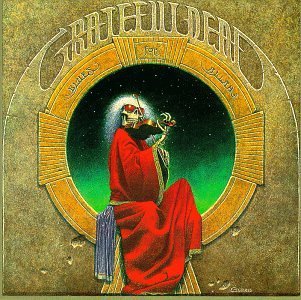
Thursday, January 12, 2006

Islamic Art

album cover, Blues for Allah
Grateful Dead

Sunday, January 08, 2006

The Power of Nightmares (movie review)


Tagline: idealistic humans, ill-prepared for future shock, look for ideological solutions, but end up being tortured and/or committing atrocities instead.

The narrator's thesis is that politicians, finding their happy talk wouldn't fly, switched to scary talk to keep a grip. Their failing futurism was roughly Johnson Era liberalism and the War on Poverty. When that war seemed lost (witness Detroit), and Vietnam proved a debacle, the Chicago-based neocons fanned out and dove deep, aiming to rebuild a storyline around battles America could actually win for a change.

Getting the new script enacted would require educating the CIA about the real Russian mindset, an apparently hopeless task until Casey came along, a blessing in disguise. Plus they had to mobilize an army of traditionally apolitical church people by stoking their hatred of gays who pee on the crucifix (Pat Robertson's image).

These strategies eventually paid off, as the USSR eventually did exit the world stage, taking its hated Berlin Wall along with it. Mission accomplished. Finishing off in Afghanistan and Iraq would make the world safe for democracy, once people like Clinton and Bush Sr. (future golf mates) could be shoved to the sidelines.

In the meantime, Sayyid Qutb and his disciples, in reaction against this same vacuous liberalism (Jahiliyyah), inspired a long-running jihad, feeding the neocon dream of an evil worth lionizing, then killing.

And the battle continues to this day, with politicians grooving on all the raw fear they get to work with. The media likes it too (war sells). Everyone gets guns, kicks back and enjoys the ride -- except the bad guys and sore losers like Michael Moore.

The narrator, backed by an army of talking heads, counters that the USSR imploded for reasons unrelated to neocon heroism, and that a globally organized Al Qaeda is largely a media myth based on an earlier Mafia example (law enforcement needed a known quantity to go up against).

Soon, the narrator promises, the politicians will run out of gas. However, minus any new futurism to replace the failed one, one wonders if this is really cause for celebration. I guess we're back to vacuous liberalism again, and future shock part two (bird flu anyone?).

The editing was pretty slick, with lots of funny juxtapositions and embedded messages. Rumsfeld plays his usual Strangelovian self, showing us those vast Al Qaeda undergound apartments, computer equipped and well ventilated -- hysterical.

We liberals in the audience (upscale art museum venue, medium sized auditorium, fairly well packed) squirmed a bit at the suggestion Kissinger was really on the right track after all. Plus the CIA's talking heads (fun to see Bearden again) got to speak on the side of sanity and have the last word -- a curious role reversal since those crazy 1960s.

Thursday, January 05, 2006

Serving from Algebra City

Algebra City is of course a nickname for Baghdad. Mark Shiley's film has these poignant scenes of a computer class (both male and female students) trying to learn it all from chalkboards, given Earth, Inc. (stupid to the core) has deprived them of any real computers. Our cradle of civilization without any decent IT -- it's just mind-boggling.

The way to counter-recruit against terrorism is through positive futurism. Hamas shows two faces to the world, a brighter happy face (more like Wal*Mart's) and a dark ugly face (ski masks, AK-47s). Al-Qaeda ("the base") has the same dual nature: as a comforter and a killer. USAers sometimes pretend they're above sponsoring terror in such a two-faced guise, but of course "whiteman" is known the world over for his forked tongue happy talk (thanks to a lot of B-grade -- and a few A-grade -- Hollywood movies). So yeah, it's a really familiar pattern: olive branch or arrows, take your pick.

Baghdadees are crying out for more olive branch, having been shocked and awed way more than any population deserves. Robust civilian infrastructure would serve the cause. Even just an announcement of plans to run more optical fiber (like in Korea) would be helpful. Why not give key religious leaders an early preview of Viiv? This is affordable high tech they might use to leap ahead of the competition, by advertising the true merits of Islam, a religion sorely in need of true warrior-protectors these days (and better PR).

Bona fide Islam should not be confused with these low budget crackpot snuff movies the CIA puts out as misinformation. Islam should fight back against such terrorist porn, another propaganda tool used by inimical divide-and-conquer strategists (the same ones fomenting so much Sunni-Shiite sectarian violence). But how is Algebra City to fight back with both hands tied behind its back? This isn't a fair fight. Every time Iraqis get some decent media, the Coalition shuts it down, or the Pentagon throws another bomb. I dunno about you, but I call that cowardly.

Wednesday, January 04, 2006

Tragedy in West Virginia

According to current versions of events, command center communications were intercepted and misinterpreted, leading families to believe their loved ones were still alive after all these hours in the mine -- only one was. Friends and families were put on a terrible rollercoaster, going from cautious hope, to elation, to devastation.

In retrospect, I see more encryption should have been used, to insulate people from the raw intelligence. You need a layer of interpretation and analysis in between. The doctor comes out and explains the situation. More details will be available later, to the most curious with a need to know.

Update: according to the CBS Evening News tonight, the rescue team did use code.

Sunday, January 01, 2006

Middle School Geography

browsing Portland's sewer system

The web site I've been working on these last couple of days is more for a computer class than a geography class, but computers now do geography in a big way. Really, the way we used to artificially divide the curriculum into separate subject areas doesn't hold as much water today. Technology is exerting an enormously integrative influence.

What with computer maps, hand-held GPS devices (including some cell phones), more publicly available aerial photography, more travel and tourism, we're becoming increasingly geographically aware as a species. This trend obviously needs to be reflected in our grade school curricula.

I earlier threw together a simple quiz program to test one's knowledge of the USA state capitals (plus a few territories). Here the focus was the behind-the-scenes SQL engine and server-side scripts. Kids need to know about the ubiquity of databases. That's where we store all this geographic data, these latitudes and longitudes, street names and so on.

Where are the sewers? Your municipality should have that info in electronic form, or be working on getting there. Where are the gas lines? World game players need to know.

Likewise our map of the human genome, tons of other biological information, all lives in databases. Indeed, the location of species (in time as well as space), their internal layout, in terms or organs, nerves and so on, is just more geography, if you want to look at it that way.

Understanding GPS also requires an understanding of the satellite constellations, and that gets us thinking about Earth in its solar system context, and the galactic context beyond that. In this sense, geography encompasses both biology and astronomy.

Footnote: Dave Ulmer invented geocaching.

Saturday, December 31, 2005

MOTD


Fuller Projection
(click here for PDF version)

Re domestic spying: so how *is* the NSA supposed to interpret "domestic", when the Fuller Projection shows This Land is Our Land (merry little tune). -- K. Urner, Synergeo #25562

Friday, December 30, 2005

New Years Fireworks


I recombined a lot of my Math Forum themes into some year end polemics, hoping to spark some interest in our open source agenda for the new millenium. Having the ball in Times Square be a 3-frequency geodesic certainly helps (10ff+2; V+F=E+2; N:2N:3N and like that).

But newspaper editors don't seem to have much time for a high tech math-science spin (fullerenes, viral shells, octet truss...), especially one that could snowball. Can't have that. Better to recycle the usual stories we always get around this time of year (booze etc.).

Sunday, December 25, 2005

We Win?

Dave Ulmer signaling from his desert bizmo
(self portrait)

Monday, December 19, 2005

Presents for Iraq

If I could wave a magic wand and give gifts to Baghdad (to share with environs of course), I'd probably put the following under the tree: Office and Home Depot outlets (substantial ownership in both chains, including stateside), a SeaWorld (Iraqis choose the site), lots of steady, cheap electricity (they can certainly afford it), membership in Costco, a new science museum (like OMSI), Netflix.

These gifts would be delivered irregardless of religious affiliation or sexual orientation.

In the USA, Xmas is a commercial/secular holiday, on which religions piggy-back. Jesus was not likely born on December 25 and in any case the gift-bearing Magicians showed up later (ritually on Epiphany, January 6).

The USA traces its origins to many Roman institutions (evident to anyone visiting Washington, DC), including Saturnalia. None of which is to say there's anything wrong with Christians piggy- backing on our secular holiday, as long as they don't mind sharing it with the rest of us.

Thursday, December 15, 2005

Thinking Globally

Fuller Projection

This recent call from some president in Iran for Israel to vanish from the world map might be construed as a proposal to make more use of the Fuller Projection, whereon all nations have disappeared.

The idea here is it's all Israel, while the frequently-heard accusation that Jewish networks seek global domination is less a source of paranoia than of hope. Mature schools of thought, many found within Judaism, are indeed committed to the long term viability and sustainability of Spaceship Earth, our promised land, for millenia to come.

Our USA operating system is up to the same thing: providing robust, secure infrastructure for our global dominion. Certainly many pro Russians think intelligently about their ship, and act accordingly wherever they may be. Space-minded Chinese call it Our Land.

The Fuller School encourages thinking globally. We want whole systems thinking, global management philosophies, people who think in big picture terms. Letting your mind get boxed in by some arbitrary political boundaries just dumbs you down, artificially constrains your horizons.

So, how will the new Persian power plants fit in to the regional grid and how will the IAEA be assured that no weaponization is happening? These are supranational concerns. Let's use a Fuller Projection to brainstorm some answers. Let's make our Iran a safe and secure world.

Mid-level managers who still need to cling to some jigsaw-puzzle nation state approach to global thinking are welcome to do so, have plenty of other maps to choose from to sustain their patterns of thought.

Tuesday, December 13, 2005

Design Science

Terry Bristol and I had a high level meeting of the minds in my living room this afternoon. He said I needed more Christmas tree lights, and I agreed.

Bigger still, however, was my realization that his "intelligent design science" (a kind of science that's comfortable with teleological / purposeful language) and my "design science" (absorbed through years of immersion in the Fuller School), come close enough to form a closable cosmic gap.

Lots of big names in philosophy, many of them Greek, got tossed about. Terry's account of a certain Native American training (and rite of passage) reminded me a heck of a lot of est, in terms of sharing the same "getting it" experience.

Using the language of synergetics: Terry sees that an eternal war of incommensurability (987.061) might give rise to two competing orders, such that awareness of otherness becomes critical to the integrity of any science or core set of beliefs. There's always that complementary / missing 720 degrees (omnidirectional halo concept), a seed for negative Universe (the antithesis of Universe), both arising from the same cosmic integrity, what Ervin Laszlo calls Metaverse. Awareness of cosmic otherness begets a dialectic and synergy (symbolized for Bucky by a bow-tie).

Anyway, good meeting, good outcome, and worth saving as an operational part of my control room.

Related reading:
Invisible Landscape Series (by me): [1] [2] [3] [4] [5]
Questions for ID Propenents @ Math Forum
More re ID @ Math Forum

Monday, December 05, 2005

Another Meeting @ Wired

Trevor and I had dinner at Fujin this evening, compared notes with the owner and son about petty thievery in China (its current shape, ever shifting). I googled with my cell (466452), looking for Serenity in PDX (Trevor is enthused about it, I've yet to catch it). Met Derek on the corner of 39th, enroute to Chinese. Bid Trevor adieu at a 75 bus stop across from FixMyDeadPC.

I've been active around cyberspace per usual today, but also doing a lot of hospital work, coding in FoxPro, working on Excel spreadsheets.

Earlier this morning, I read up on music making using contemporary components and software. Some of the best GUI interfaces come from musicians. I'm consulting for a locally based pro, ready to move into the new era.

Tomorrow I'll be teaching Python some more. We started with "hello world", moved to data structures (lists and dictionaries), types (primitive and collections).

Last night, I wrote some notes about an ACM paper on pedagogy around computer programming (teaching coding to kids).

Monday, November 28, 2005

PDX: Open Source Capital

So I'm in a small coffee shop. Terry is at the house, with another business associate and my wife the bookkeepper for ISEPP, as a consultant.

Terry wishes the plan to rennovate the property next to Pauling Campus, the renting office repair store, into a Cafe Philosophicus or like that, might materialize. Just needs the $100K.

Don's asking "how" (his name will appear this time).

So PDX was in some write-up in Christian Science Monitor today, as an up-and-coming hub of the global open source network, thanks to the hard work of so many geeks (aka software and hardware engineers), trying to write some benign-enough science / fiction.

Terry just walked in. Our meeting resumes...

Derek appears.

Sunday, November 27, 2005

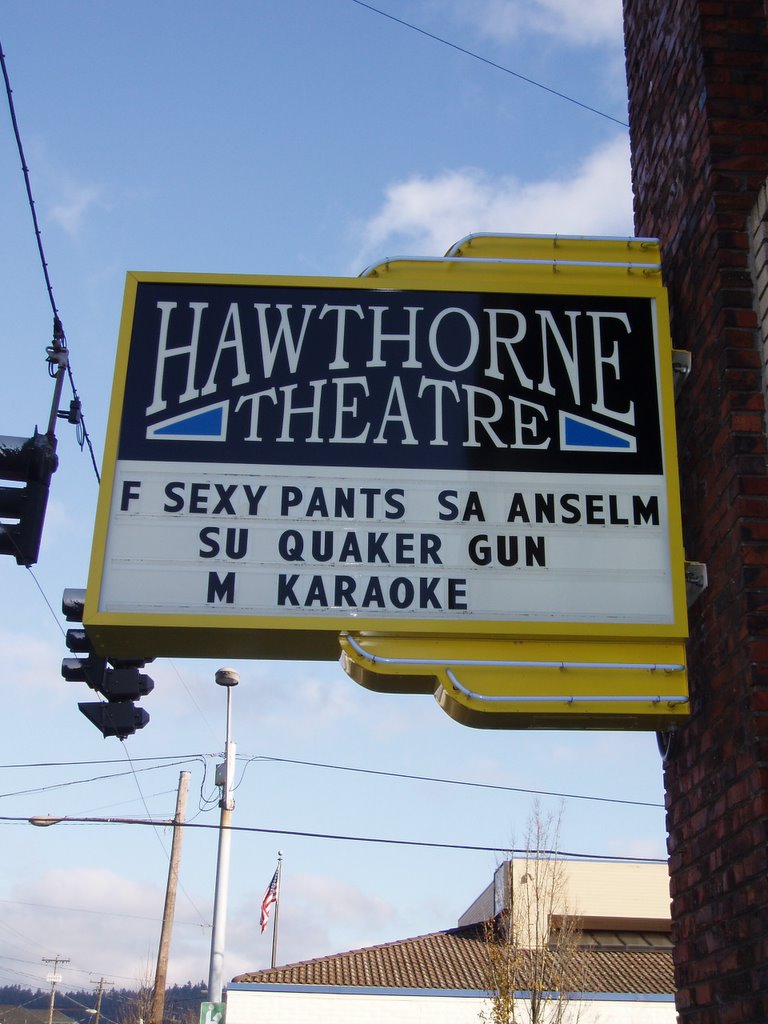
Quaker Gun


"insanely difficult to use effectively"
(photo by K. Urner @ Europython 2005)

Songs of Non-Violence?

"now playing..."
(K. Urner, Olympus Stylus 500)

Sunday, November 20, 2005

More Map Talk

Just because the Fuller Projection is by definition nationless, at least in its most pristine, least dumbed down form, doesn't mean we don't see the barbed wire, concrete barriers, armed guard kiosks and so on.

World Game players may very well carry passports (complete with RFID) or find workarounds (like staying home). Plus as any pilot knows, the no fly zones don't just follow national boundaries. Our targets of interest may have no visible presence except on our maps.

Whenever people pour into the streets to register their views, in Beirut, Tehran, New York or wherever, that's of course visible to satellites as well. One way we play the game is by massing ourselves in open areas, such as at Woodstock or Burning Man.

So it's not like we're waiting for any political events to occur, before we start displaying global data in the Fuller format. We've been doing it for years.

Once you have your global data sets in compatible electronic format, its fun to mix and match them, including across time. What dinosaurs lived in your local area code? How might we assign zip codes to off shore floating cities? The permutations are endless.

Monday, November 14, 2005

Memo re The Map

In my view, Snyder is a damned good cartographer and I have no problem using his algorithm to populate global data displays making use of Fuller's preferred layout, with uninterrupted landmasses (one layout among many).

I'm aware of cheap imitations of the Dymaxion or Fuller Projection, which slice into Japan or wherever, and I know would-be World Game players would be dismayed by such a dumbing down. Competent players want access to the real deal, I understand that.

I'm also aware that Fuller's algorithm, as computerized by Bob Gray starting with Fuller's simulations, expressed with Polynesian-style artifacts, might be used to replace Snyder's in some contexts, giving different gaussians (i.e. the triangles are still distorted, but in a different way).

Mostly, I'm interested in just cutting through the BS, such that open source global data displays, of relevance to NGOs especially, don't involve diverting precious resources from field offices and control rooms already fully engaged in serious-minded service on the front lines.

We don't have the time/energy to spare to ensure compliance with a lot of complicated EULAs. That's why we use Ubuntu/Gnome and like that: we're short of money on paper, and yet we're performing vital high tech services on behalf of omnihumanity nevertheless.

The Fuller Projection should be immediately accessible to such remotely deployed individuals, as well as to school kids in their safe 'n secure classrooms, complete with relevant data overlays.

Our school's objective is to foster competent planning and collaboration skills, such as we've been learning and benefitting from in the open source community more generally. Let's keep up the good work while making GIS/GPS more integral to our thinking.

Monday, November 07, 2005

Headline: GENI Out of the Bottle

I found a Plone site about the Iraqi economy, including news and views regarding regional hookups, stretching as far away as Europe (e.g. through Turkey). That's encouraging. The global grid gets mentioned in this blog, and in neighboring blogs. The buzz around GENI is not new.

Critical Path project (high priority): network the high voltage long distance distribution grids, to facilitate buying and selling of power. ENRON failed to elucidate the vision, got side tracked into attacking California, getting caught in off shore language games around tropical fish 'n stuff. Maybe not really the smartest guys in the room. More of those at Google.

Wednesday, October 26, 2005

Control Rooms?

Notably absent from coverage of a FEMA response, or lack thereof, to recent hurricanes, has been any view of a control room. Apparently FEMA has no central nervous system it feels proud enough to show off, no Hollywood-style NORAD or Mission Control ala Houston.

Relief engineers don't huddle over monitors, tracking the progress of this or that mobile relief convoy, with a big screen up front sharing overview. Nor do we see such centers on TV when disaster strikes around the world, e.g. in Pakistan or Guatemala.

TV news rooms come closer, give a sense of a high tech hub receiving reports from journalists around the world. The evening news is a tip of the iceberg sampling of top stories, but there's a sense of thousands more hours going to some archive for later retrieval and review.

But news rooms field spectators, watchers. The ethic of journalism is not to participate, but to report. In nervous system terms, news rooms receive pleasure and pain signals, but have no direct way to trigger a motor response. We hope other control rooms get the message.

Of course a lot of control and situation rooms don't get much TV exposure. Demolition engineers punch up real time satellite imagery, video feed from drones and so on and battleships have their bridges. When it comes to command and control, Pentagon style, wreaking havoc is the name of the game. Our script writers and scenario planners tend to be apocalyptic and/or vengeful in their thinking, anxious to fight human enemies, not weather, earthquakes, fire, famine, drought or poverty.

World Game still takes a back seat to war games, in the fantasy lives of so many children, when they imagine what a safer, more secure world might be like. Control rooms focused on disaster relief and monitoring civilian infrastructure don't really enter their consciousness. Instead they dream of overwhelming fire power, missile defense, ray guns on orbiting space platforms, zapping Earth-bound terrorists on the run.

We have the technology to play World Game for real, but our thinking remains immature, stuck in yesteryear's science fiction. Not enough grown ups. Not a new problem.

Thursday, September 29, 2005

Baghdad, City of

We may legitimately expect great advances in civilization from Baghdad, once the dust settles. Muhammad ibn Musa al-Khwarizmi lived in Baghdad, according to an online Britannica. I was just checking into that a few minutes ago. I hear Greenspan favors still teaching the long division algorithm in K-12. I'm certainly not averse.

Did I ever mention my job at Georgetown University, refiling Arabic language texts to their rightful shelf positions? The job required at least knowing the regional alphabet. At the time, I kind of did, thanks to a course I almost failed at Princeton. I also used the time to read more about James Joyce (the Hugh Kenner connection), and naval history (this is closer to the time when Fuller's whimsical/poetical Critical Path was still new).

Let's keep working on getting Imperial Rome out of the picture. Old Glory, in symbolizing a fight against British Imperialism in the 1700s, knows something about beating back illegitimate tyranny. Democracy and self-determination at the local level go hand in hand.

We understand that a stable world system doesn't require power to apex in any one apex. Tower of Babel was for a reason: to keep Man where he belongs, out of the control room (within those limitations, we do as much as we responsibly can, and then some).

Saturday, September 17, 2005

Return to the Moon?

Mom pointed out an interesting juxtaposition of stories on the front page of The Oregonian today: the rural southeast feels bypassed by federal aid agencies; NASA wants to return to the moon.

I have Google set to sweep newsmedia for any mention of the OMR stadium-shaped city idea. Turning stadiums into cities seems to be a favored solution to date, but that doesn't seem very practical in the long run.

If NASA could build us a spanking new moon base (a dot-mil operation), maybe it could help us brainstorm about new high tech ecovillages right here on Spaceship Earth. We civilians (remember us?) could use some help from the aerospace sector.

But NASA may not have the imagination for it, may not have the "right stuff." OK, so how 'bout The Mouse in Orlando? EPCOT used to mean Experimental Prototype Community of Tomorrow, before the language lawyers changed it to Epcot (deliberately meaningless) and disgused the BuckyBall with the wave of a magic wand (camouflage?).

Monday, September 12, 2005

More on Mathematics

I've gone back to Internet brainstorming with other math heads, trying to find a way to engage the media more successfully in high def, high bandwidth, prime time pedagogy, i.e. how do we live up to the promise of TV as a medium for education? Obviously it needs to be entertaining as well. The two go together, positive synergies are inherent.

Inventors always dreamed it might be used for good, even as they cringed, bracing for worse. Well, we know what worse looks like, but there's still plenty of bandwidth for better. And we've had a lot of excellent television. I've often been awed by the talent, the writing, the whole shebang.[1] Not on every channel nor every program mind you. But sometimes TV just blows me away, the way some books and movies do, or some dreams.

A lot of thinkers have focused on "symbol dances" as a genre to focus on, by which I mean multimedia language games that have, as their content, some of the alpha/numeric, iconic, ideogrammatic, and variously stylized glyphs of our or other cultures. Like, flash the ancient greek letters and say them. Sigma, phi, pi, theta. Ro ro ro your boat. But with Flash as in Macromedia, as in Shockwave, as in Sesame Street with Big Bird -- and Evil Bert (not really evil -- that was a joke from the political sphere, some kids won't remember).

I've played with Flash myself, and come up with primitive examples of what I'm talking about. But I'm no super incredible artist when it comes to some sophisticated art-making technologies. I write pretty well. But I'm no great prodigy when it comes to animation (I like to think I add to the team, but I'm not as good in all positions, obviously).

[1] "shebang." WordNet 1.7.1. Princeton University, 2001. Answers.com GuruNet Corp. 13 Sep. 2005. http://www.answers.com/topic/shebang

Wednesday, September 07, 2005

More Global Data

Of course another stargate that's opened (metaphor) is between New Orleans and Amsterdam, Louisiana and the Netherlands. I was pleased to see so much set in the Netherlands in Quicksilver, however twisted that telling. Such wonderful canvases.

People elsewhere on the globe are starting to get more of a picture of what the heartland of America is like. The logistics are poor here. Like, look at our dikes. Kids in Holland stare at the TV agog: so America is like this stone age place, like in The Flintstones?

Sunday, September 04, 2005

OMR?

Is now the time to dust off shelved megaproject proposals, e.g. Old Man River City (OMR)? Trevor brought this up at our meeting yesterday -- seemed apropos.

This stadium-shaped A-frame features terraced living, with apartments taking the place of bleachers (obviously its scale dwarfs ordinary football stadia), plus a cover.

I updated a web page on my site with a pictured scale mockup (see Bucky Fuller's Critical Path, 1981 for more details).

On synergeo (Yahoo eGroup) some guy thought I was talking about replacing New Orleans with this leviathan, but I'm more thinking how to bring something on-line that'd be faster to start using (it could go up in sections), while employing companies starting now, thereby giving folks some options (shades of New Deal thinking).

The eventual fate of New Orleans needn't hinge on what we do or don't do in the East St. Louis area.

And we might have learned something in Baghdad about building in transparency (sorely lacking in that context).

The tsunami story isn't over yet either, by a long shot. Disaster relief could and should be one of the world's principal industries (like the body's immune system), fading into construction, communications, health care and education at the civilian end of the spectrum.

Emergency response becomes part of the military way, what with its chain of command and experience with heavy equipment. Restoring order means reverting to a natural state of nonviolent civilian living. Putting out fires is the name of the game -- not starting them.

I don't know if OMR is just a solution looking for a problem here, but bouncing back from Katrina with megaproject proposals, one of which would be rebuilding New Orleans itself (a daunting task), is a healthy response. However, going to the moon wouldn't be that relevant (thinking back to Hurricane Camille, which came shortly after Apollo 11).

Floating city ideas should also be revisited while we're at it, with realistic attention to natural disaster possibilities. Not every technology is suitable to every ecosystem -- presumably we know that much by now.

Friday, September 02, 2005

Katrina (aftermath)

Tracking with CBS, I saw that segment about the big banana shipment, a fully loaded container ship, getting tossed inland, meaning very bruised bananas. Tremendous loss of hard work, careers built over a life time. Fishermen, their boats ruined, so carefully maintained and fussed over all of their fishing boat lives. Pets gone. Children. Heartbreak in the heartland.

New Orleans and Baghdad have opened a kind of stargate between them, as both have suffered so many untold disasters, and now have armed national guard troops trying to restore order. The public now feels they're in competition: how could you provide for Baghdad and not for us?

A hurricane of destruction was willed by men against Baghdad, whereas Katrina was not of men. These crises do not have the same causes, and yet the shapes are similar. War and natural disasters have always borne some resemblance. And the Red Cross administers in both contexts.