Monday, August 29, 2016

Code School Evening

DSCF8358
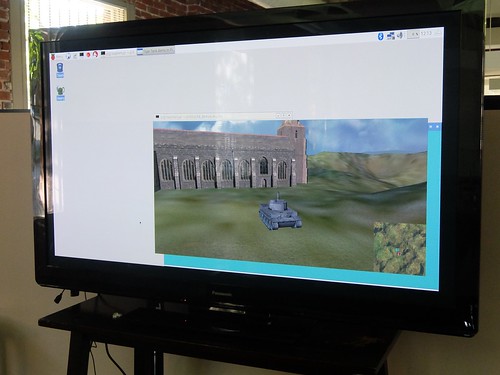
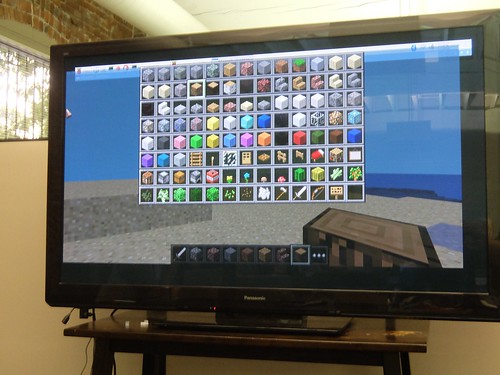
minecraft-based demo of on-board GPU

The new bike has a nifty pump, which I used tonight, to get back over Tillikum.  Then I walked it home, slanting through to Palio in Ladd's, up Harrison passed St. David of Wales, and the LDS campus.  Home before 9:30 PM, with a bright red rear light the whole way, even when walking.

Ladd sisters, of the family for which this Addition is named, before my time, used to have a photography school way up the Gorge on a houseboat.  The Columbia Gorge had only recently opened to a new form of tourism involving scenic photography as a hobby.

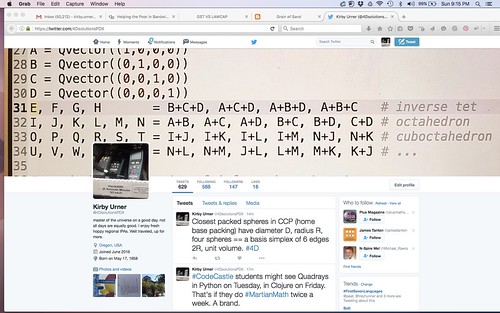
At the code school tonight I fired up the Pi again, on the HDTV. I had my 4D stills.  Ray traced.  I say 4D as a kind of branding, not referring to Time.  Ben had a new Pi too, same make and model, and he and another guy helped me catch up on Minecraft a little, at least in create mode.  Peter Farrell is still ahead of me there.

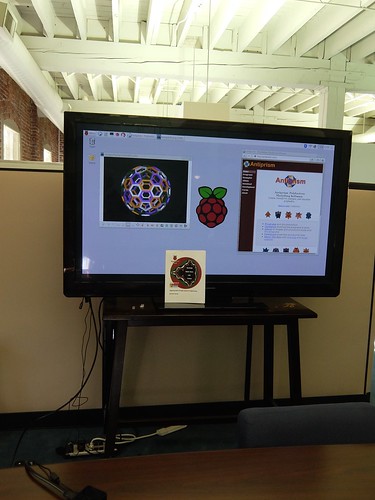
These 4D shapes are ordinary convex polys, generated using the geodesic program in Antiprism, a suite of tools by Adrian Rossiter.

I've been working on getting his C++ to compile on the ARM chip in a small Raspberry Pi 3, Model B. The thing boots off its GPU which doubles as a sort of BIOS.  The Pi3D module, imported within Python, seems to be getting full value from said Graphics Processing Unit.  Farrell's Hacking Math Class, uses Pi3D quite a bit, also the turtle module.  Wifi is also built in.

I also compiled Povray, a program I used in Windows a lot, way back in the days of CompuServ.

Now that this tool chain is working, I can do something like this...

geodesic -c 1 -f 6 > output.off
off2pov render_me.pov output.off
povray -Irender_me.pov

That's roughly how it goes, minus some switches. I get a PNG file out the end, suitable for tweeting.  Some of the STEM teachers already have a stack of Pis and are looking for worthy projects.  I've been filing my reports.

I introduced myself quickly as "a lobbyist" as we went around the circle, mentioning my work with the teachers, especially high school math teachers.

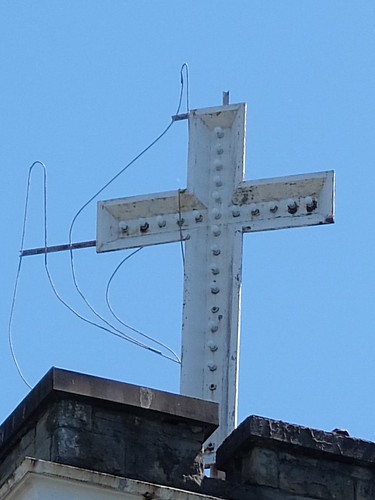
I had Peter Farrell's book in my briefcase, strapped to the bicycle.  It sits next to my Pi Station in the CodeCastle as well (I've also used CodeCastle with reference to a certain neighborhood "ghost church", but that's still speculative fiction at this point).

Someone brand new to Portland, just moved here, expressed his intent to dive into Natural Language Processing more. We talked about Elisa, Racter (another "convo-bot"), the Tom Sawyer corpus, and setting up a measuring protocol of some kind.  The algorithm could measure negativity in some way, for example.

This wish for a protocol is characteristic of Nat's project as well, relating to motion and profiling autistic features. Nat and I have followed up a bit since our meeting, regarding the recently proved Kepler Conjecture, seeing as how the proof bridges mathematics and computer science, a theme in my lobbying for Measure 97.

(Art + Code + High) * School = 
Art School + Code School + High School

Here's a way for teachers to generate more synergy amongst themselves, from which their students might benefit.

I'm back in the world of bicycle tubes and tires, not a bad world to be in.  It got me there just fine, even with the slow leak.  Coming back, I needed the walk anyway.

Regarding Antiprism, I don't currently use antiview, the included highly capable viewer, because the flavor of OpenGL used on the Pi was not Antiprism's target OpenGL or development platform.  Antiview compiles, just isn't displaying content correctly. That's OK.  Having povray working gets me where I want to go.
DSCF8350
antiprism + povray on a Pi 3

Wednesday, August 24, 2016

Geeking Out

Visit to the VA


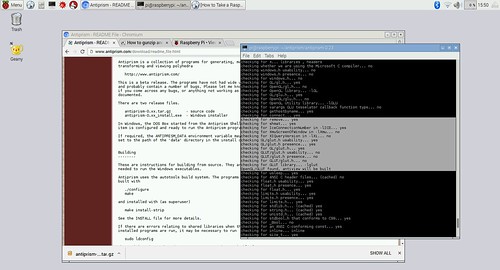
Down in the basement, in the VML, I've got the Raspberry Pi cranking on installing a free GLUT. That's a library Adrian Rossiter depends on for his antiprism, or at least the antiviewer component thereof.  He thinks it might work.  I promised to update him on my progress.

So far the installation is going well, thanks to these clues for installing freeglut3-dev, after which ./config, with no other switches, reported "good to go" on antiviewer.

2016-08-24-155017_1824x984_scrot

Carol (WILPF) is out with Barbara (WILFP), at Denny's, "the America I believe in" as Carol put it, going out the door.  She doesn't believe in this "other America" they're outing by snailmail.

She's getting around more slowly, I think still quite strong.  She needs another checkup tomorrow.

I met with Friend Leslie last night to sort out health care issues, and then Nat, an expert on autism.  I suggested he check this Youtube by EBN for all the characteristic movements it invokes, through the magic of video editing.

I held court at The Bagdad, these two appointments back to back.  Leslie connects to FCNL, the Quakers' lobby.

Although I've found ways to install gcc 6.1 or one of those, the gcc version on standard Jessie (the Raspian distro) should be OK, says Adrian.  I'll go downstairs and resume operations in a sec.

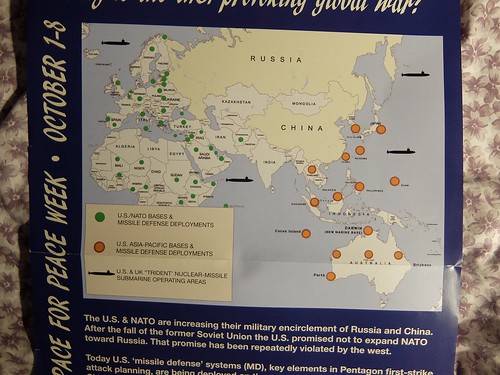
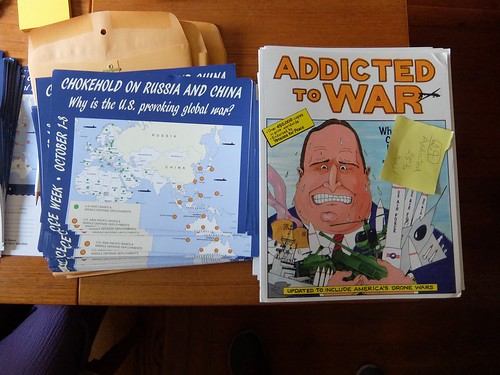
Carol and Barbara work with WILPF (Womens International League for Peace and Freedom), over a century old by now.  Mom went to their Centennial in The Hague.  They're mailing around the poster shown below.

Funny how what used to be treasonously cynical criticisms of the Pentagon have now become marketing memes.  "Animosity towards Russia is good for business".  Yeah right.  "Yes it's a jobs program."  "Yes it's 1984, did you have any better ideas?"

I see a lot more promise in the space program, where we continue in the tradition of Apollo-Soyuz.

I'm surprised the DoD still finds many scientists willing to sacrifice their reputations for what's empirically speaking a dumb campaign.

Around the Beltway you'll find anything for a price I suppose.  Maybe that's why more think tanks have moved west (e.g. Stanford)?

Leave the legalized / sanitized media to practice their pseudo-science and witch doctor rattling (no offense to real witch doctors).

Yesterday I paid a visit to the Veteran's Administration hospital and got the above pictures.  My friend served in Vietnam, but he's not disabled but for the dental problems.  He's therefore only eligible for tooth extractions at above market rates.

If Americans don't want as many refugees to seek refuge here, there's always being more up front about how we're poor. Uncle Sam is broke and it shows.  Why come here of all places?  I think many refugees know that, and are staying put or walking elsewhere.

This morning I worked with NPYM's cloud provider to get to the bottom of an email glitch that's been driving our Secretary wild.  We may have gotten to the bottom of it finally, a faulty Mx record on their end.  Time will tell.  I was on the phone for some time, bouncing around in tech support world.

World news:  attack on the American University in Kabul, where one of our Thirsters is on the faculty; big earthquake in Burma; another in Italy; teenage girl in a cross walk hit by driver with suspended license doing like 50 mph on Hawthorne Blvd.

DSCF8076

WILPF PR

DSCF8164

Sunday, August 21, 2016

Refugees / Camping

I've been writing on QuakerQuaker about the "camping" meme, more.

Back on the infamous Forum 206, since tied off, but still publicly archived, I wrote a lot about "scouting".  They go together.

Lifestyles involving "camping" and "scouting" would seem in the cards for much of humanity, and has been normative for millennia.

"Outdoor lifestyles" are marketed as voluntary activities to a privileged few.  Most campers are not in their refugee camps by choice.  Many were born there (like Kiyoshi on Heart Mountain).

Given advances in technology, "living outdoors" doesn't need to always invoke the same mental pictures, drawn from centuries gone by.

I'm finding Twitter rather impoverished when it comes to projecting positive lifestyles that seem more like camping than city living.  Is this perception a consequence of whom I follow?  I don't think so.

The culture is fixated on driverless cars, drones, and AI-everything. Dreams from Silicon Valley.

As I express on QuakerQuaker, I'm not sure if we're still able to take on geodesic domes and spheres like we saw in Montreal in 1967.

We've not moved ahead in architecture that much?  We had a golden age, now passed?

However, I'm thinking we could bring those back and do more experiments ala the Garden of Eden domes in Cornwall.

The gardening tenters work within, in a climatron.  Maybe they have other shelters as well.  Living conditions are improving.

Unless we show ourselves these projections, they won't gel.  Showing ourselves only war scenarios prepares us for those, hardens our hearts.

As the Paul Allen Museum of Science Fiction in Seattle exhibits:  our fantasies about the future are more than idle entertainment.

My essay explores the notion of transplanting colonies en masse, but with a game plan.

I'm not some pyramid schemer selling the notion of getting individually rich and retiring in Beverly Hills somewhere.

A large camp of refugees in Costa Rica is determined to try its luck further north, and what I gather through WILPF in Ojai, and through my mom, that this camp is collectively projecting such a future.

Would more movies help?  Who makes documentaries for refugees, showing them what the realities are.  Letting the world understand we're all in the same boat, not rich versus poor, might spark more of that spirit of innovation.

America is a nation of refugees already.

How might refugee camps be upgraded?  That's addressing the root causes of war and so is waging the war.

In suggesting we make camp life less miserable I'm not being altruistic or selfless, so much as strategic and tactical.  War talk is too moralizing though, as it preys on "extreme criminals".

I focus on bases as well, a kind of "camp" though more about "campaigning".  We have refugees here as well.  The para-military encampments have their refugees also.

Rather than "divide and conquer" pitting "vets" against "refugees" or "homeless", we need to tune in the homeless vet refugee.

Silicon Valley is seeing the writing on the wall.  We wanted a lot of automation to save ourselves from drudgery.  Semi-autonomous communities that do more of their own farming would do well with high tech.  So how do we get there from here?

DSCF8015

Friday, August 19, 2016

Addendum Regarding SSL / TLS

My previous post in this blog is about a world readable tiny web application I'm using for work, to teach the basics of web dev in Python.

The specific micro-framework solution I'm using is named Flask, a free and open source project, BSD licensed.

How long I'll keep my teaching demo going in it's present form I don't know; that's a business decision depending on more businesses than mine.  For example, I'm using the PythonAnywhere service as my host.

Flask is a WSGI application, which is like the DB API for talking to SQL databases, except in this case to web servers.

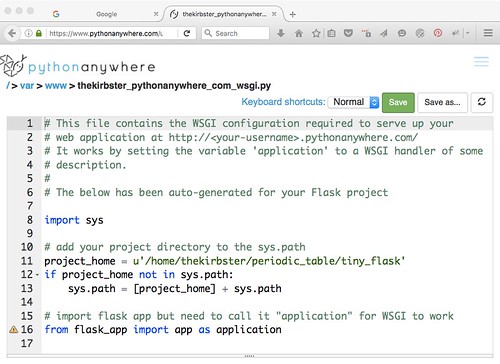
The Flask application is imported and renamed from "app" to "application" in the auto-generated script below, which also provides a path to my codebase, here added to sys.path if need be:

wsgi_config

Anyway, notice I'm using HTTP and not HTTPS when serving from my PythonAnywhere account.

The added "S" is for "secure" and the difference will likely be signified graphically with a little picture, an icon, of a say a padlock, next to the URL (web page address) in question.

The "secure icon" appears once handshaking has established a mutual understanding about what encryption algorithm to use, a multi-step process carried out automatically between the client and server.

Otherwise, if plain old HTTP is used, the browser may show an "I" for "FYI" and that well tell you "not secure" i.e. not using HTTPS.

Different browsers have different ways of graphically signifying whether or not encryption is being used.

Talking over the wire in HTTP or HTTPS does not actually require a "browser" on the client end, as many web API calls are possibly coming from simple scripts.

My API models talking with both types of clients, in JSON to the latter, in HTML to the former.

My goal in the forty hours (or less in some cases) is more to establish a strong reading knowledge of Python in particular, and this Flask app marks our foray into that territory.

In my discussion of the application, I'd likely take this opportunity to dive back into encryption as again relevant to our "API economy".

I say "again relevant" because more than likely we'll have already waded through the code of something more like my "Permutation class".

My Permutation class is Python class designed to show off operator overloading capabilities while introducing the Group Theory notion of a "permutation", a "scramble" of objects mapped to themselves in some different order.  I used a Python dictionary wrapped in a class.

"A 'scramble' of objects" sounds like encryption already, right? :-D  Or shuffling a deck of cards.

If the purpose of a website is simply to sit there like a book on the shelf in a public library, pretty much put there for the purposes of public inspection, then I'm not concerned if it's using HTTP and not HTTPS.

What's more important than "which protocol" is that we keep in mind that there's a difference.  Driving the unencrypted APIs into an underground API economy would be ironic, no?

On the other hand, in a presentation taking us more deeply into web dev in particular, less focused on generic Python, one might dive more deeply into the specifics of TLS, as Cristina Formaini does in the linked presentation above, in my "tweet".

My focus in sharing Python in forty hours is somewhat like Amit Saha's in that my audience might be high school math teachers seeking to integrate more coding skills into their chosen field.

Wednesday, August 17, 2016

Dissecting a Flask App

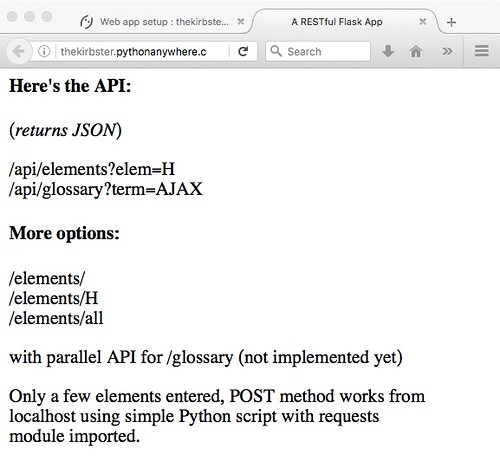
elems_app

"How might I share content to the world through some web thing?"

I'll show you how we might do that in Python.

http://thekirbster.pythonanywhere.com is where I'm serving my example.

The source code is on Github.  Also:  see Addendum (followup blog post).

The engine sitting behind the HTTP listening port is a WSGI process named Flask, which is an already completed project that just needs to be hacked on (customized).

flask_app.py, the custom Flask process (written in pure Python), routes (dispatches) incoming web requests (web addresses, URLs) to Python functions.

Each function develops an appropriate response, either as HTML (styled for human browsers) or JSON (bare bones data, more for machine readers).  We call this a web API.

HTML or "hypertext markup language" is what your web browser is designed to render into web pages, possibly interactive thanks to JavaScript, if you have your JavaScript engine turned on.

JavaScript is also known as ES (ECMAScript) and is not the same as Java.

Python also talks to SQLite databases on the server, to look up and serve the requested information. The application also handles POST requests, with a simple hard-coded string for authentication.

Add chemical elements to the Periodic Table database (Elements table) or new terms to the Glossary database (Glossary table).  No delete or update features have been implemented, as a goal is to keep the application's anatomy fairly simple.

I'm using Python "context managers" to open and close the database files, as needed.


In my forty hour Python course, I take you through building a context manager using contextlib, from the "batteries included" Standard Library.

Forty hours is about right to develop a strong reading knowledge of Python, which in turn provides enough traction to keep improving your own code through practice.

SQLite is also included in the Standard Library, as sqlite3.

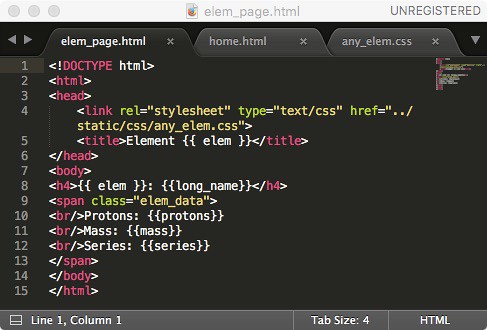
The HTML is developed through a Flask component named Jinja2, which allows Python to pass content from the database into a web page that's being built.

Jinja2 uses templates as raw material, very like HTML files, which in turn link to Cascading Style Sheets (CSS files) and any JavaScript (.js files) we might need.

The well-known Django framework, also in Python, is quite similar to Flask in structure, and also includes a templating engine.  Web2py is another one.

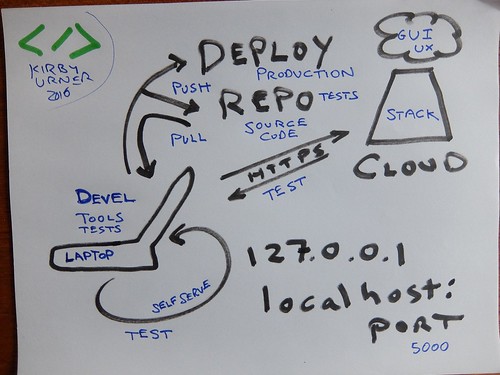
A standard development process for writing these things is to have your localhost serve a developer version, the one you hack on, then practice (A) keeping the Github version up to date and (B) maintaining a world readable cloud instance.

We also do a lot with Jupyter Notebooks during the forty hours (or less if the course is accelerated).

DSCF3099

Monday, August 15, 2016

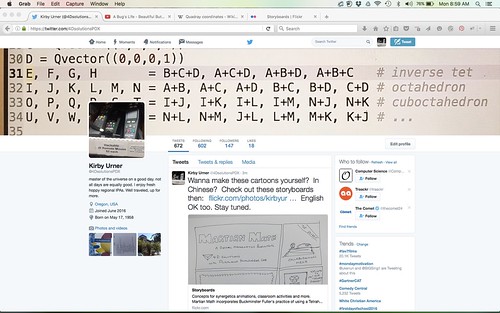
Martian Math in Chinese?

4dsolutions


Chinese Peace Corps


Saturday, August 13, 2016

Basement Revolutionary

DSCF7842


John Taylor, the retired regional planner from Indonesia, working on his autobiography, took Carol and I out to Maru last night, our favorite local Japanese restaurant.   

Maru was quite busy on a Friday night, however we were seated quickly and enjoyed stellar service and menu items.  I had Tokyo Ramen with IPA.  We shared Korean cold sesame noodles and some tofu delights.

Earlier in our story, when John was thinking twice about whether his HP Notebook computer was good enough for such authoring, Patrick and I had suggested buying an "inexpensive" or even "junk" computer just for the duration.

Loading it up with Office Libre and leaving the beast behind when heading back to Jakarta.

The operating system is legally free, as are office-related applications.  I've added a Chromium browser to mine.  The device came from Amazon already loaded with Office Libre, two flavors of Python, and Wolfram Language.

However, John is on a tight schedule and catching up on Linux technology is made no easier by the absence of these technology magazines from many stores that used to carry them.  The campaign to dumb us all down, into "mindless consumers" is endless and quite effective.

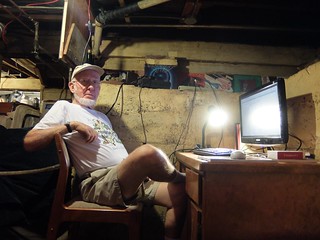
Given the photo op studio I'd created anyway, that very morning, the Verboton Math Lab (VML), I could load up a copy of his autobio from a USB stick.  It all went smoothly.  I'd purchased two 16 gig USB sticks earlier, for under $8 each, at Fred Meyer's.

He enjoyed posing for my diorama as it were:  a Quaker revolutionary (in the sense of overcoming the idiocracy's collective degeniusing).

Per Lindsey's advice from Kathmandu, it's an average Portland basement, not impermeable to groundwater when it rains heavily.  Water pools.  Our last house, the rental around the corner, was so much worse, in terms of permeability.

There's nothing permanent about a Pi-station necessarily, plus I'm free to use the Air down there too.

We're enjoying a heatwave at the moment and the basement is cool.  I don't run airconditioning and rarely heat.  Our climate is like that.

Besides, I'm busy waving Pis around as less dumbing down that what Church of TI says you should use.  TIs don't come with Office Libre.

I've featured the XO (One Laptop per Child) as a "basement revolutionary" of sorts in earlier chapters, and that it was, in the sense of "covert game changer".

You may remember raising expectations that laptops would become way more affordable, and in the hands of more children, was a goal, and the XO set a higher bar in terms of quality (swivel screen), and a lower one in terms of price.

The market enjoyed a significant reshaping as a result of this newly achieved price point, mixed with an effective marketing campaign (G1G1).

The Pi is somewhat in the same lineage, but is just the guts of a computer, sans peripherals, not a laptop per se.  I understand it will run Windows, just have that on the SD card when it boots up.

Basement Revolutionary

Thursday, August 11, 2016

Broadband Church Networks

Transceiver Station Location


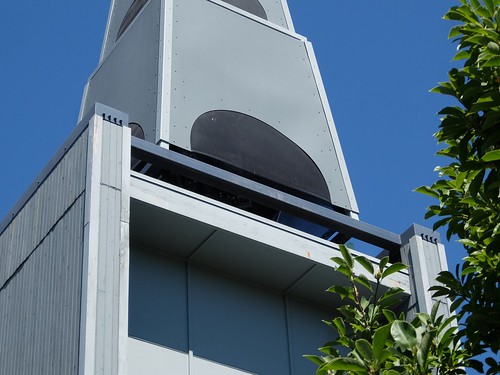
Comm Tower

Further reading: Re: US District Court 6 versus FCC

Tuesday, August 09, 2016

Disarm Day 2016

Disarm Day 2016


For further reading:
Disarm Day in PDX (on QuakerQuaker)

Monday, August 08, 2016

Indo Expo

Indo Expo 2106

Glenn and I were curious about this Expo and Jobs Fair, and so took the Yellow Line out to the Expo Center.

If in tourist mode, then right off the train, check out the subtle memorials to the days when Japanese were proving economically successful, especially as vegetable growers.

Other farmers were jealous of the Japanese (or "Japs" for short) and wanted less competition and more land.  WWII gave them exactly the excuse they needed, to confiscate the lands and own all the vegetables.

Today's Expo was about "vegetables" as well, cannabis in particular.  Prohibition has only been repealed in a few states as of this writing, to the degree where only a tiny minority of US Americans might legally enjoy what God put freely on this Earth.

Lots of money and jobs are stemming from this boom economy, however most states have no such opportunities as the Feds are still criminalizing it, like they used to do with booze.  The repeal of the 18th Amendment, in the form of the 21st, did nothing to make cannabis less of a controlled substance.

However, tax-starved states and municipalities recognize a cash cow when they see one.  Since they're allowed to get money from gambling and selling alcohol, why not from marijuana as well?

The presidential candidates, meanwhile, are about as silent on the issue of rolling back Prohibition as they are about US colonialism in Puerto Rico.

We might tie our story back to the theme of unwanted competition at this point.

When US corporations started large scale farming in Hawaii, they found themselves up against those productive Japanese again.

Japanese were uppity and believed they had human rights.  The solution was to bring in more Puerto Ricans and Filipinos, who would work harder for lower wages.

In a later chapter, the GM-type corporations would again become heatedly anti-Japanese, as their local car industry started feeling the competition.  Demonizing Japanese was in vogue once again.

Of course Korea, still smarting from America's supporting Japan after the war, in keeping Korea partitioned, is not inclined to support Japan all that much either.  Korea is a lot like Russia in asking why America stayed so friendly with the Nazis.

Because history is messy?  Many Nazis were good at STEM and the military industrial complex needed more lethal weapons, the better to fight anti-colonialist nationalists or "Communists". Guatemala, El Salvador, Nicaragua, Grenada... and that's just in the "backyard" (where a lot of the fruit and vegetables come from).

Lets remember that many "governments" (i.e. the "gangs in charge"), if wanting to stay eligible for Drug War money (to buy weapons), which the US dispenses with largess, need to kill, maim and imprison their own people, just like the Big Daddy USA does.

Having extorted money for weapons from drug-using US Americans (mostly prescription, pushed on TV), the USG then uses it in Afghanistan to destroy lucrative opium crops, and cocaine crops in Latin America.  Ruthlessly destroying the competition is what "capitalism" is all about.

This ongoing destruction of infrastructure and local economies is done in the name of Christianity as well in many cases, as religion hates competition from medications.  Priests alone must do the healing.  Remember what Marx said about "opium of the people"?  Exactly.

Other insecure religions besides Christianity fear the competition, from entheogens in particular.  Only the officially designated and approved authorities should mediate between the masses and the many varieties of religious experience.  That usually means psychiatrists, or priests, not shamans.

Demonizing drugs not authorized by state licensed practitioners, the ones who play the game and pay for the privilege, is the point of endless propaganda campaigns.

Now that Oregon has licensed its growers and sellers (many of them), there's a ceasefire in the demonizing, as there's money to be made.  The bankers are especially miffed, as they're under pressure from the Feds to not play on the "wrong side". But then which side is the losing side?

Years of Prohibition turned US Americans into criminals and scofflaws pretty much across the board.  As Americans, we're used to thinking of laws as tools of oppression, meant to be broken, with pride and a clear conscience.  Laws against interracial marriage were about dividing and conquering the workforce.  In retrospect. Apartheid looks like Jim Crow which looks like Nazi Germany.

The stereotypical cannabis users (or "stoner") has not even a smidgen of guilt or remorse for indulging in such "depraved" (i.e. "sinful") activity.  They're typically not bombing and terrorizing others, so actually feel morally superior to those doing the bidding of company slave masters.

The USG is relatively easy to demonize on the other hand.  It's really hard to see why anyone would want to be a US president.  Why have something that ugly on one's resume?  Who wants to brag about being a warlord?

Wednesday, August 03, 2016

Accelerator Project (continued)

Tank Meets Church in Pi-Ville

Readers of this blog may remember a certain Business Accelerator downtown near Tillakum Crossing.

Anyway, I rode my bicycle there on Monday. I had Tinkerbell for years, a blog character, then a rebuilt racer Lindsey tricked out (lost on the front line, doing FNB duty).  This new one has no name yet, is a gift from Flextegrity Sam.

We rode together, the bike and I, to the Monday Night Flying Circus venue.

Portland Python Users Group at Urban Airship is a monthly event, and has been concerned about standing room only occasions, judging from announcements I've seen.

Thursdays have been a teaching night for me, however Mondays have been a go.  My PPUG (and before that PORPIG) reviews occur throughout my blogs.


This time:  given the new bicycle, I didn't trust myself with the Air, so packed a tiny Pi with all peripherals but the screen.  Said Raspberry Pi is a lotta bang for the buck anyway.

I was showcasing its GPU on the HDTV using the Python 3.x version of the Pi3D library, running python3 CodeCastle.py and like that.  I was but one exhibitor among many, not giving a lightning talk or anything, though we're looking at adopting that format, at least for a time slice.

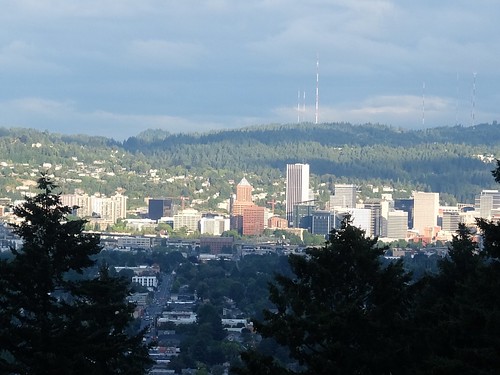
From Mt. Tabor

Tuesday, August 02, 2016

Bugs in Synergetics

Fuller had to retract a dream come true volume five sphere, arrived at in Volume One of Synergetics.

Volume Two, also published by Macmillan, had the course correction: the volume five rhombic triacontahedron (RT5), not a sphere, and not to be confused with either the RT5+ (a little bigger) nor the SuperRT, its phi-up big brother.

RT5 = 120 T modules (volume exactly 5), T volume = A, B volume.

RT5+ = 120 E modules (volume at exactly unit-sphere radius), same shape, different surface:volume ratio.

Mind the Gap.

SuperRT is the one comprised of an Icosahedron criss-crossed with its dual dodecahedron (pentagonal, i.e. Platonic). The Icosahedron has the recognizable 18.51... for its volume.

These two have tetravolumes we may express with Phi as a factor as well:

Icosahedron = 5 Φ2 √2
Pent. Dodecahedron = (Φ2 + 1) 3√2
SuperRT = 15√2

We believe in intersecting Platonic pairs (duals) if that's OK i.e. not too not-Platonic a relationship.

The tetrahedron (volume 1) self-intersects to form a cube.  The octahedron, and said cube (duals) beget the rhombic dodecahedron, with volumes 4, 3 and 6 respectively.

That late discovery of RT5 vs. RT5+, or T and E mods respectively, did not expunge the record of his earlier barking up a different tree. Or was it the same tree, just better rendered on second pass?

Either way, he needs to acknowledge his mistakes, with Volume One already gone to press.  The two volumes are meant to be interleaved, based on section numbers.  He's able to perform a kind of primitive version control, checking in patches.

Synergetics 985.01 marks the start of a trouble spot.  The powering is off by three, with S3 accounted as just S.  He gets close to a volume five sphere using S3 to the third power, and takes full advantage.

Then later, he confesses to a subconscious demon nudging him down this tortured path, while the exigencies of life keep him mired in denial. I'll add some blank lines for readability:
This operation is recorded in Sec. 982.55 of Synergetics 1, where I misconceptualized the operation, and
(without reviewing how I had calculated the constant for converting XYZ to synergetics)

redundantly took the number 1.192324,

which I assumed (again in mistaken carelessness) to be the third-power value of the synergetics-conversion constant,

and I applied it to the volumetric value of a sphere of unit vector diameter as already arrived at by conventional XYZ-referenced mathematics, the conventional XYZ-coordinate volumetric value for the volume of a sphere of radius 1 being 4.188,
which multiplied by 1.192324 gave the product 4.99__

a value so close to 5 that I thought it might possibly have been occasioned by the unresolvability of tail-end trigonometric interpolations, wherefore I tentatively accepted 4.99 as probably being exactly 5,

which, if correct, was an excitingly significant number as it would have neatly fitted the sphere into the hierarchy of primitive polyhedra (Sec. 982.61).

My hindsight wisdom tells me that my subconscious demon latched tightly onto this 5 and fended off all subconsciously challenging intuitions.  
Robert Grip saves the day, and with youthful enthusiasm, shows up bearing a water-bearing sphere, just to snap him out of his daydream-fixation:
At this point a young associate of mine, Robert Grip — who was convinced that I was misconvinced — and who knew that I would alter my position only as confronted by physically demonstrable evidence, made a gallon-sized, water-holding tetrahedron and a sphere whose diameter was identical with the prime vector length of the tetrahedron's edge. The water content-the volume of the sphere was indeed 4.43 units  — 0.57 less than 5.
"...convinced that I was misconvinced"...  nice one.

So then begins the saga of the E module, and its relation to the T module.  That's about where David Koski, still a young guy in Santa Monica, fades in with the phi scaling.

Meanwhile the A, B, T, E and S modules (the latter another gold mine of relationships, unexpectedly — VE:Icosa :: S:E is how it goes, volume-wise) settle in for the long haul as no longer just new kids on the block.  They've become playmates.

Understandably, Fuller was grabbing as much low-hanging fruit as he could in those two volumes, not wanting to miss glaring areas of application for his new tetravolume-based conceptioning.

He was avowedly and proudly intuitive, permitting himself to speculate, sometimes wildly, an in the name of science or future science.  Future generations could mine it for what it was worth.

He knew a period of assessment was ahead.  Buckminsterfullerene was a posthumous discovery, a fitting dot for the prior period, of just getting it out there.  Wolfram did something similar with A New Kind of Science.

He didn't want to be accused of not reaching for the stars.  He cast his nets widely, with a little help from Ed Applewhite.

Readers such as myself and David Koski inherited a story already well-along in the telling.

These bugs were already being talked about, and written about as the curtain went up on our chapter.  I'm not revealing new information, as we've seen, woven into the pages of Synergetics itself, shared on Internet since the 1990s, by Robert Gray.

Monday, August 01, 2016

API Economy

Tiny Flask App

The above is for my next class, me driving, during which we'll spiral back for a tour of "the API Economy", by inspecting the guts of a tiny Flask app, mirroring Apigee Academy principles of API design.

It's not that my app is a model for big companies, as it's too small to really mean anything.  A few chemical elements from the Periodic Table sit in a SQLite database.  Depending on which URL one uses, this data comes back as either HTML or JSON.

Not much too it.  That's the point.  The class has crash coursed its way through eight sessions, up through decorators and generators in Python.

It's about developing a reading knowledge, not necessarily walking up to a blank IDE canvas and spatting out the next Django or Web2py.  "Learn to read music even better than you can play it", might be the flavor of my approach.

Yes, I do my commas and periods "wrong", outside the quotes.  We had a Friend named Thatcher Robinson who wrote an eloquent manifesto in favor of this new convention and I fairly consistently adopted it.

Saturday, July 30, 2016

The Brainiac


Where is the brain?  In the head of course.

However, the meaning of a word is not a "thing in a place"; the meaning of "brain" is far from fixed or constant.

The myths that swirl together with science (gnosis) move "brain" (its meaning) along a trajectory, creating an arc in semantic space.  In this mix:  computers, the cloud, a "singularity" (in some myths).  Meme soup.  Alphabet soup.  Google.

I'm listening to Ray Kurzweil chatting with Neil deGrasse Tyson. I'm glad Ray is more in the utopian than distopian lineage, more like Bucky in that regard.

The reality of the cloud is helping people appreciate what used to be known as the noosphere, zeitgeist or world spirit, ala Schopenhauer, Teilhard de Chardin, other transcendentalist writers.

Poetry anticipates the future because language is a computation with weighted variables (the weights shift).  Music anticipates how the melody might go.  Thomas Paine.  Prophecy.

Ray portrays humanoids as trapped in their own skulls for the last two million years.  I'd suggest that reading and mass publishing created a proto-cloud well before "outward electronics" sped it up.  Scholarship has benefited from these exponential curves.  MEMEX.

I say "outward electronics" to distinguish our hand-held devices and supercomputers from "inward electronics": not designed by humanoids, but helping to comprise them.  Part of the mix.

The inward electronics joins together through "language" (another word of shifting meaning) to create the "meme soup" of culture.

Then outward electronics, following Moore's Law, came along to speed up the thinking, to harness more brain power in collective endeavors.

Our power to self organize is what's increasing.  We know we have the technical wherewithal to improve living standards (end world hunger), however we lack the Will (the ability to mobilize collectively).  Humanity is semi-paralyzed, retarded.

What about the collective unconscious of the Jungians and such?  A lot of that is accessible to awareness once the swirl is seen for what it is:  a collective computation.  We might as well just talk about "the computer" as in Synergetics.  A solo cogito, chugging along, does not a railway system make.

The mix of cellular and silicon circuits makes for a living pattern, call it a "spiritual machine" if you wish (you may not wish), living in the sense of changing and adapting, or "computing" in other words.  We're there now, however our language may not be.  Software is thinking, laying new track, switching.

Ray thinks the software is converging to a better tomorrow.  With acceleration comes less tolerance for puzzle pieces not fitting, or, alternatively, a shorter lag time before fitting them in.  AI is proving helpful, because of RI (real intelligence) making use of it.

DSCF7159

Thursday, July 28, 2016

Grizzly Man (movie review)


I borrowed this DVD from Glenn several days ago.  As it wasn't a rental, it went to the back of the queue.  I'd not realized Werner Herzog was the director, a pleasant surprise.  He's a masterful filmmaker, and narrator (storyteller).

The film doesn't beat around the bush about what happened to Timothy and his friend Anne, more mysterious, as to why she stayed.  She wasn't as suicidal around bears as Timothy, who tempted fate for a living.

The angle Herzog picks up on is not Timothy's controversial lifestyle (waltzing with bears), but his talents and technique as a filmmaker.  Herzog treats him respectfully as a peer.

In showing the many takes of the same scene, one might mock or denigrate a brave soul.  As a fellow director and filmmaker, Werner leads a lay audience to water, and some really beautiful music (the DVD comes with a full length feature on scoring the audio track, thumbs up).

Given almost eight billion people, and bears a true rarity, in relative terms, having at least one man daffy and lonely enough to go trans in this way, is a statistical possibility (as we see).

The locals, who've been keeping track for thousands of years, understand that taboos are for a reason.  Tempting a fate is a great way to someday meet said fate.  Treadwell is saying "bring it on" to this Bear World.

His life turns into a grim tale and sends a warning to children, but without a retraction of the loving attitude.  We're free to love foxes and guard their habitat.  Whether that means chasing them or sleeping with them is another matter.

Domestication has worked with some species.  Humans have found some understanding with other wild creatures.  These relationships are not static.  We could do more to cultivate our relationships with fellow travelers.  Religions have their work cut out, not just the sciences.

Werner is contrasting a hippie clown aspect with a more serious cowboy, in sampling the many talking heads from Timothy's scenario.  Treadwell was part of an ecosystem in the human world just as surely, with children a big part of it.

In watching Herzog's sampling of Treadwell's unedited hundred or more hours, I was grateful for the deep dive into a loner's life, and struck by the young age of the intended audience.  Timothy was creating raw material for documentaries he'd share with children.

In meeting his fate so fatefully, he upped the rating, from G to something closer to R.  Herzog wisely keeps us from having to relive the full ordeal, but does manage to communicate horror.  The grizzly story turns grisly.  And children still love the foxes and bears -- except the mean ones.

Mom & dad and my sis went to a private farm north of Lesotho where the caretaker developer allowed lion cubs to roam freely, including among the guests.  He'd cage them or move them out when old enough to do serious damage.

Mom doesn't know how that scenario turned out.  Carol, Julie and Jack only briefly overlapped it.  A lion cub jumped up on their table, in their presence, knocking it over, and ate their tuna fish sandwiches.  That's what tourists were paying for I guess.

Monday, July 25, 2016

EPCOT West

From an Art Colony

I used the term "EPCOT West" in a somewhat tongue-in-cheek manner, some years ago, to refer to Portland's Dignity Village, a collection of ad hoc shelters near the airport, adjacent to a prison.  Experimental Prototype of Tomorrow was the original meaning of EPCOT, if anyone remembers, before lawyers changed it to the more meaningless Epcot, which means nothing at all.

Those of us who've flown around the world some number of times are likely used to flying over vast "shanty towns", often referred to as "informal neighborhoods" by city planners.  US Americans define themselves in terms of not seeing these in North America, the US being "the wealthiest nation on Earth".

Actually "planning" informal neighborhoods seems oxymoronic to practitioners in the field, as they're by definition "unplanned".  The typical urban response is to criminalize "tent cities" in terms of what ordinances they violate.  However the numbers keep growing and the jails are full.

However, criminalization and warehousing people for profit does attract a form of capitalism.  Warehoused people with no human rights may be used as forced labor.  The institution of slavery is thereby restored, but in not calling it that, those implementing the system get their euphemisms and their cheap goods.

When actually feeding and providing a modicum of health care to the warehoused collateral becomes cost prohibitive, a typical final solution is to have the work camp become a death camp of sorts.  Crematoria are established.  Those removed from tent cities in urban areas are bused or trucked, or made to walk, to these out-of-sight out-of-mind prison camps in desolate areas.

Planning for tent cities, providing infrastructure for watching films, learning languages, engaging in work / study programs, is more the Global U approach, where all housing is student / faculty housing, regardless of grade.

This more humanitarian approach is deemed "liberal" in that it relies much less on the mass criminalization of poverty and death camps.  Whether one may afford to be "liberal" depends a lot on one's theory of economics.  The more Malthusian one's outlook, the less liberalism looks affordable.

The DC think tanks and Beltway consultancies are not especially liberal in outlook.  Their recipe for dealing with collateral is to assume miserable conditions in the tent cities will fuel resentment and a wish to fight back with physical violence.

Given the Beltway controls all the best weapons, this solution works well.  The public sides with "law and order" against "insurgents" and, if it shares the Malthusian view, cheers from the sidelines as the Apache helicopters, remotely controlled drones or whatever, strafe and bomb the shanty town denizens.  We've seen these policies carried out both in Panama and in Gaza.

The DC consultancies see "overpopulation" not "militarism" as the biggest issue to deal with.  In fact "militarism" and "overpopulation" fit hand in glove.

The Global U curriculum, relatively liberal, sees higher living standards as the primary and most effective form of birth control and family planning.

DC sees "higher living standards" as unaffordable and prefers to stockpile weapons for its preferred method of "adult abortion" (aka "homicide") i.e. the willful termination of human scenarios well after birth.

Here in Cascadia, relatively less militarized, the liberals have yet to completely embrace the death camps solution.  A lingering Global U curriculum, less Malthusian in outlook, still struggles to assert itself, gaining the ire of the Beltway, which resents the delays.

The Occupy Movement, e.g. OPDX in Portland, was all about setting up intentional tent cities wherein self-governance could be tried.  People spontaneously assumed their roles, choosing arm bands to signify in what capacity they might be consulted.  I worked in Food Services as one of several engaged in Logistics.

The liberals think if they gain experience mixing high technology (e.g. cellphone apps) with a more minimalist lifestyle — which still includes watching movies — then the Global U might continue to counter DC's militarism and implement its work / study.

DSCF7103
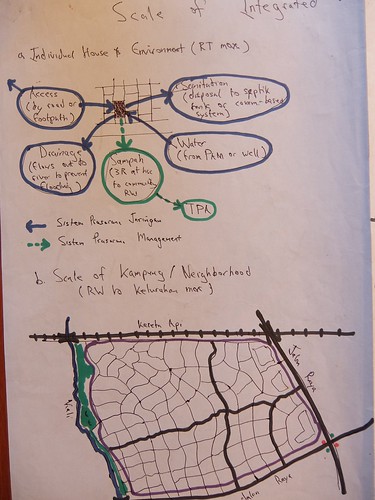
:: informal neighborhood in Indonesia, by John Taylor ::

Sunday, July 24, 2016

Rotten Apples


Saturday, July 23, 2016

Chicken Littles

One might think those into exploring the logical foundations of mathematics would have their interest piqued by the suggestion of a different way to model multiplication of two or three numbers.

We learn from childhood that a "square" number is like 2 x 2 whereas 2 x 2 x 2 is a "cubic" number.  But who dictated the two rods of length two needed to be at 90 degrees?

Suppose we placed them at 60 degrees, might that be an area of 4 as well?  Could 2 x 2 x 2 = 8 be shown with three rods emanating as if from the corner of a regular tetrahedron instead?  These are not hard questions to think about actually.

by Hollister (Hop) David
(with attribution to me)

R. Buckminster Fuller, with something like 45 honorary doctorates (meaning these institutions gave him a free degree to help prove its worth to others, as a standard-setter), considered the efficacy of measuring in tetravolumes one of the most important mathematical discoveries of his career.

He built up a whole philosophy, as mature as any one person might fashion in a lifetime, around the tetrahedron, at the center of his metaphysics but also of his numeric and geometric computations.  The domes came out of that work.

Did any philosophers pick up on these cues?  Or did they cop out by saying Fuller was an architect and it's the geodesic dome he'll be remembered for, not the mathematics?  Then maybe the next step is to attack his originality in that area, and use the word "charlatan" a lot.


I picked up on the core philosophy, as did a very few others.  We've made some further discoveries since.  That's exciting for us.  But is "a very few" enough?

Given how much of the American Dream for a better tomorrow was wound up in Fuller's brand of global utopianism (cite Disney World's EPCOT's Spaceship Earth), doesn't it appear these deliberately short attention spans, and a willingness to parrot "the authorities" might have other, deeper motives?

Lowering expectations for the future seems more in line with what the Great Tragedy Directors have in store for Spaceship Earth.  They've already scripted out their version of an End Times, and anything even remotely hopeful and utopian represents a disruption of their timeline.

How long do we keep postponing Armageddon?  There's some impatience to get on with it.

Philosophers with a longer view of tomorrow get shoved to the sidelines by the distopian schools.

To check whether your own school is distopian, more a part of the problem than a part of the solution, find out if any of Fuller's Synergetics is ever excerpted and discussed.  Is it on any syllabus whatsoever?

Consider jumping to a different school, with a stronger philosophy department, if not.

Friday, July 22, 2016

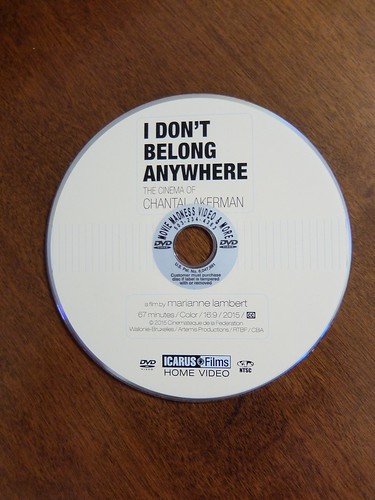
I Don't Belong Anywhere (movie review)

About Chantel Ackerman

I'd not heard of Chantel until about a week ago, when I watched one of her documentaries.

Not all her films are documentaries.  She'll weave stories from thin air as well, with made-up characters played by actors.

The really long camera takes, which give one time to reflect and listen to one's own mental chatter, define another end of the spectrum from the fast-cut, more heavy-handed storytelling of most filmmaking.

The camera just watches and listens, while the viewer has to look and hear, more like in real life. However that doesn't mean the frames are haphazard.  She's extremely meticulous.

Her style reminds me of both Iron Ministry and Songs from the North.

I arrived late to Wanderers as a consequence of finishing this week's viewing homework.

The conversation was truly wandering, with lots of chatter about crypto-currencies.

However the main theme was again gemstones, thanks to Steve Mastin (who brought some), with Glenn Stockton chiming in.

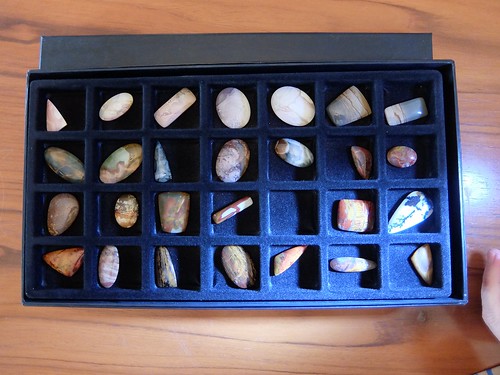
Gem Stones

Monday, July 18, 2016

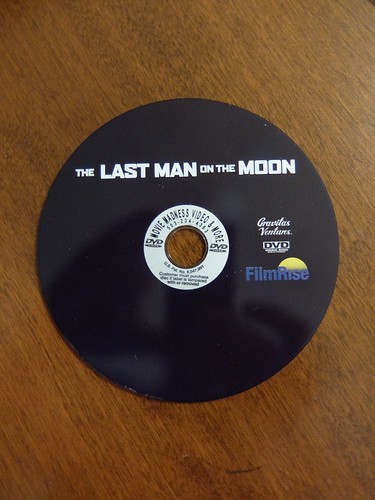
The Last Man on the Moon (movie review)

DSCF7034

Friend Denny phoned from PDX, just back from Shanghai, with the Republican Convention high on his list of events to follow.  That helped tip my scales away from heading down to the code school for Flying Circus this evening, my usual Monday evening activity.

I did work on #CodeCastle though, most significantly jumping onto a Pyret listserv to provide some overview, CC UMC (United Methodists).


Why not work on my class for tomorrow (teaching code) and study the newly rented documentaries, plus tune in the unfolding political show via various media (radio, TV and Twitter for starters).

People of my generation, who lived through the Apollo moon landings (I was in Rome for Apollo 11), will see the long road behind us in the high tech ruins of Cape Canaveral.

The Saturn V launch pad is now a relic. The mixture of futurism with decaying past, makes for a surreal combination.

People of my ethnicity, strongly discouraged from weapons training, were pretty much barred from gaining experience with the kinds of aircraft considered a precursor to NASA training.

I knew from an early age I'd never be accepted in that inner circle, but I was an avid tracker and backer of the space program nonetheless, and am still to this day.  Besides, I wore glasses.  Test pilots have perfect vision.

Eugene Cernan was maybe not as good on the bombing range as some of his friends, but at least he got to experience the G forces and show onlookers he had the right stuff.  He went in and out of San Diego on aircraft carriers.  I wasn't clear where all these bombs got dropped.  Hawaii maybe.

I hope someday those willing to train to work aboard spacecraft will find a civilian pathway open to them.  Actually we've reached that point already.  I often catch myself wishing for what has already come true.

The fact that humans were able to reach the Moon and return safely bolstered confidence in the species and ushered in new flavors of futurism, including the positive-accentuating utopianism of Bucky Fuller, which I glommed onto.

Critical Path is a lot about Apollo, including in the mythological sense of escaping superstition and nightmares.  So many disciplines, working together!  Apollo also seemed an exercise in socialism, in the sense of people co-owning public assets to accomplish something together, not that capitalism didn't play a role.