Monday, May 30, 2016

Pycon 2016

Pycon 2016

I'm feeling somewhat dense today, as in slow, relative to the various speakers I've been listening to.

The talk on the basics of Git (which I use) went by too fast.  Writing an interpreter for PHP in RPython... amazing that any solitary Joe could take that on and get real results.  RPython is a reduced version of Python that's designed to run a lot faster.  PyPy is implemented in RPython, which latter has become more of it's own project than it used to be.

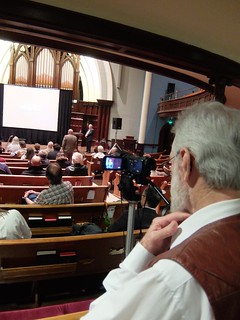
The morning keynote, presented by Dr. Lorena Barba, was philosophical in tone and felt more like a home base.  She was highly focused on the work of Fernando Flores and Terry Winograd as a context for how the Python community might carry the torch forward, in the education space especially.

Bring the language of open source, which includes workflows (like on Github), into the wider culture, which of course would include the business world.  Players make requests, commit, confirm delivery, register satisfaction -- or not, the flowchart varies.  Sometimes players renegotiate the terms of the agreement.

The language-action perspective (LAP) would graph as an influence on the Forum as well.  One of my house guests went through that program recently.  As an est grad, I was welcome to the Sunday wrap-up.

Erhard, the creator of est, worked with Fernando Flores back in the early 1980s.  The Hermenet chapter.  I was following from a distance, from Jersey City.

The Forum is highly language-oriented.  What gets in the way of achieving desired results may well be a "buggy grammar", using "grammar" in the Wittgensteinian language-games sense.  Participants are challenged to be more reflective about their operating system.

Fernando was imprisoned for a period, after serving as Finance Minister of Chile when a military coup happened.  Barba is one of his long time students and fans.  I was glad to see these dots being connected, betwixt open source and an idealistic regime.

Ian Benson was certainly into some of this same philosophy, with his Sociality initiative.  His project was not focused on any particular device, challenging the PSF to find a specifically Pythonic angle.  I see he's made progress with the Cuisenaire rods.

Followup:
Pycon 2016 Concludes
EduSummit / Pycon 2016
Ergonomics 
 

Thursday, May 26, 2016

PPUG 2016.5.26

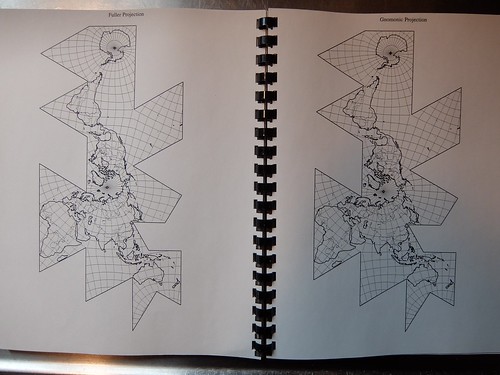
Fuller vs. Genomic Projections

I'm at the Portland Python User Group at Urban Airship (@PDXPython), the main Python user group in town, though the Monday Night Circus @ <guild /> is also well attended, and more informal. Some of the same people go to both (hi Ben).

Here we gather for presentations and sometimes pizza.  Tonight Cloudbolt Software is getting to sponsor.  The pizza is not here yet.

Trevor does a better job of archiving the Bucky stuff in the meticulous fashion researchers require.  The Linus and Ava Helen Pauling collection at Oregon State, with the Douglas Strain Reading Room, showed me what a state of the art archives is all about.

Trevor is uber diligent even in the absence of much funding, which is characteristic of those who bring order to Fuller's work.  Not being paid is part of what makes it work, hard work.

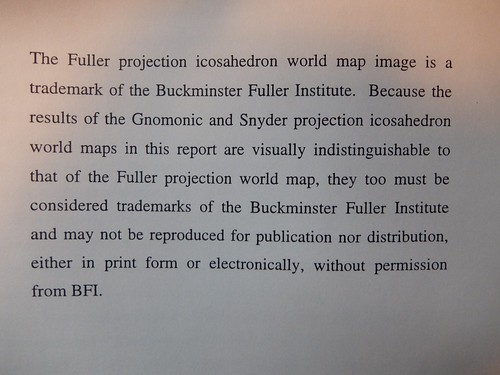
I'll plan to get him these materials uncovered above.  The paper by Dr. Bob Gray shows how the characteristic arrangement of continents that go into making up the Fuller Projection is really what makes it stand out.

Using the Snyder or Genomic Projection algorithms, as distinct from Fuller's, results in mathematically measurable differences, but to the naked eye, the distortion is about the same i.e. minimal (compared to a Mercator, which takes the flat Earth perspective to an extreme).

Dr. Ernest Bonat, Senior Software Engineer, will address us tonight, on the topic of Implementing MVC Arcitecture in Python for Data Analysis.  He works full time at Intel, but does data analysis consulting on the side.

He's here to tell us about his stack, 64-bit Windows based (Core i7, 16 GM RAM).  Getting all the software in one place is his goal:  Anaconda is his solution.  He's Cuban, not Italian -- he wanted us to know.  Eclipse IDE / PyDev plugin / EGit plugin (free) is a good one.  Microsoft is providing quite a lot for free these days, community edition everything, Python tools for Visual Studio, SQL Server etc.

I've used Eclipse a lot, our defacto IDE at O'Reilly School, but since getting Anaconda I've been practicing with Spyder a lot.  PyCharm is an old standby as well, and popular with this audience (we did a show of hands).  I'm glad he's showcasing Eclipse.

Pycon is next week, May 28 through June 5th.  This particular Pycon, organized directly by the Python Software Foundation, is the largest annual gathering for the community using and developing the open source Python programming language.  Steve Holden got the ball rolling on Pycons.  EuroPython was first.

Steve is not coming to Pycon this year, which is unfortunate.  I'll be hosting Henrique from Brazil as my guest.

Cloudbolt is looking for a full stack engineer.  The pizza has arrived!

I heard some grumbling that Bonat's version of MVC is treating Visualizations more as reports (final output) than a full interactive GUI controlled by the end-user.  In web development, the visualization is more or less synonymous with the web page presentation itself.

Ernest's end users are client-recipient of the data analysis, not the real time users of a custom GUI.  Ernest himself is happy running his source code directly, given everything is so well organized.  For him, Eclipse itself is the GUI.  The data went from .csv files into pandas.  This was not Big Data in the sense of mapreduce or Hadoop.

Dr. Bonat was certainly right to emphasize unit testing and TDD.  When it comes to job interviews, he's looking for well commented, documented solutions that come with unit tests.  I need to keep that in mind as a job hunter.

The Lightning Talk was also interesting and statistical in nature, though also more number theoretic.  How many digits does it take to represent a natural number 1/n, including one digit to designate "repeating"?  For example 0.5 is 1 digit for 1/2,  whereas 0.333... for 1/3 would be 2 digits, as the 3 repeats.

The speaker, who's name I missed, showed us several plots, including varying the number base.  Bases of a 2nd power, like 4 and 9, have special properties apparently.  Primes especially often take as many digits as in the base to represent the number.

On the way to the meetup I was communicating with Trevor about getting him the above materials.  I also sent him this link to recent writing, on 4D vs. 4D vs. 4D, a theme of my enthno-mathematical investigations.

Trademark Layout

Tuesday, May 24, 2016

Monday's Game of Pinball

Great Math Kit!

I decided to give the Code School a break from my presence this Monday, having ascended Dog Mountain and thinking to just kick back and not go anywhere.

However an event at PSU caught my attention and I grabbed a bus, only to find the published time on the poster had no bearing on reality.  The doors to the Smith Ballroom were still locked as of 6:17 PDT.

If you were already going with the flow as a PSU student, that wouldn't much matter, however in trying to land coming in from the outside, as a member of the general public, I just got confused, encountering locked doors, and took Tri-Met home again.  Having my cell phone die also restricted my degrees of freedom (in terms of ways to pay or find a ride).

I'd bounced around the 'hood earlier that day, testing the legs for new aches and pains, and contemplating a haircut.  I need to stay in interview mode, which I'd say I am, and plan to shake hands.

A thing I read on my smartphone told me the top ten things to do every day and one of them was shake hands a lot.  Another was do your chores.  I wonder if I can find that article again in this fish tank we call the Web.  I didn't bookmark it.  Found it.  Really?  Just men?  Oh, I see.

Anyway, no haircut occurred as Sam Lanahan was soon to come over with a shipment of Flextegrity, the remnants of "Big e" as Glenn and I called it, a spiral, now cut in pieces.  There's a project afoot to do something new with it.

Sam took us to Portland Fish House where we discussed philosophy and the Lanahan family heritage back through Baltimore to the original US citizen who'd arrived from Ireland as the name suggests.  The Lanahan distillery burned in the great fire that wiped out much of the harbor area.  San Francisco and Chicago also had great fires, as did London (at least one).

As you may have guessed by now, my use of "pinball" was metaphorical.  However a new pinball parlor has just opened, where Mt. Tabor Theater used to be.  I have every intention of paying a visit.  Patrick attests the machines are in great shape and in wide variety.

Playing computer games was another item on that list of ten.  Anyway, "lists of ten" are all over the place if you're into the genre.  I'm sure you can find one or make one up, that reinforces whatever habits you're keen to reward.

Glenn is reading that heavy German philosophy featuring Bubbles, Globes and Foam.  Given his fascination with the Geoscope (aka Macroscope) as a concept, the syllabus is fitting.  He wrote the author's name on a napkin for Sam, whereas I recommended Culture and Value by Ludwig Wittgenstein.

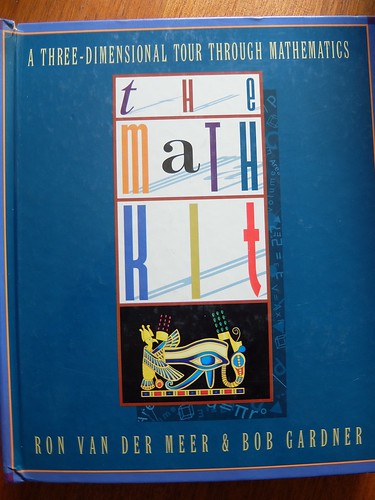
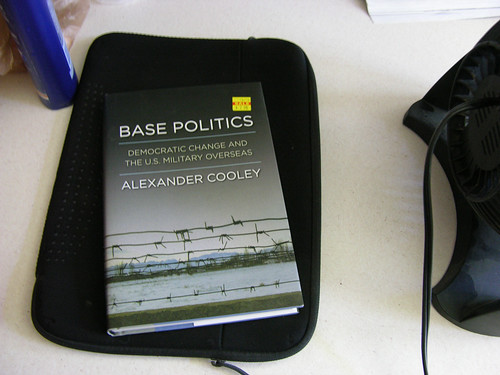
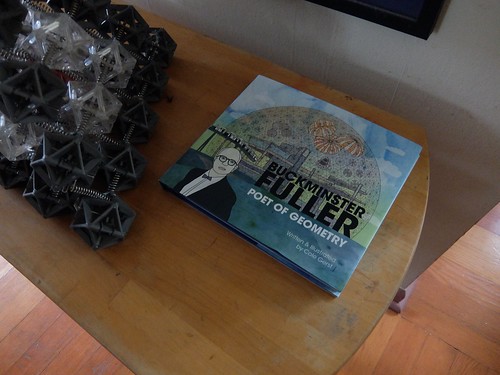
Glenn also showed me this great Math Kit book (photo above) rescued by a dumpster diver. And speaking of dumpsters, I should mention I also drove to Beaverton with a load of styrofoam for recycling.  Quite the game of pinball.

Thursday, May 19, 2016

Captain America: Civil War (movie review)

DSCF5628
:: bagdad interior ::

I think what we're supposed to get is Captain America is more than ambivalent about joining some United Nations, much as Brits feel conflicted about the European Union.  What if the UN picks the wrong bad guys, or fails to act when bad guy pillage is immanent?  The Avengers are leery of trusting anyone's judgement but their own.

However, shades of The Incredibles, ordinary mortals are sick and tired of their "collateral" status, as in "collateral damage".  The collateral rises up and says "enough is enough already" and asks the Avengers for a modicum of accountability.  Captain America has his moral qualms about this.  For one thing he's harboring a terrorist, his friend that gets activated by keywords.

I came to this movie with a sieve-like memory, a lot of the sand having trickled away.  Like I could not understand how that Mandela-talking prince could have superpowers until later it was explained to me his part of Africa was where the unobtanium was mined.  Then it all made more sense.

Other important plot elements maybe went by in a blur, as I was focusing on the ridiculously-on-steroids cartoon-like physics of it all (Marvel is originally a comic book publisher remember, only recently a studio).

That's the difference between film in a theater and a Marvel comic:  when reading, one may pause to puzzle, even cross-reference and refresh.  In a real time first viewing, a lot of information comes at ya, and there's always the risk of dropping some balls.

That's not as big a deal as it sounds however, as the movie is designed to be rented and/or owned at a later date, and when playing back, even pausing, is OK.

Viewing with controls can be a lot more like reading a comic book than taking it in at the theater.  The Marvel movie-makers reward those who pay twice: once for the once-through as a blockbuster, and then again for more reflective analysis, in a home theater context.

Another plot element I didn't quite get is why the liquid blue stuff was allowed to travel with Mr. and Mrs. Old Person on some back country road.  Is that how we'd treat plutonium?

Some terrorist swoops in and rains on their parade, but what institutional wheel-turning put them alone on a such a desolate road, with such stuff in the trunk in the first place?  They might have hit a deer, leaving it to some random hiker to discover the blue liquid's worth on e-Bay.

What risk management protocols were being followed?  Was this whole operation ISO-compliant? I guess in 1991 they didn't really have such standards.

Thursday, May 12, 2016

Thirsters 2016.5.12

DSCF5366

I was unclear what the topic would be, but a friend on Facebook was suggesting I go.  My house guest, here on business, was game to come along and sample our subculture.

As luck would have it, Don's former student Mark was by.  We'd had a day on the boat together some years ago.  Don visited Mark in Guatemala that time, and talked to Wanderers about it.  The presentation was on recent developments in Guatemala.

In particular, our speakers included a forensic anthropologist, well-versed in crime scene discovery, and a mother-daughter team who had attended a part of a recent trial, brought by victims of abuse against the perps.

What was new in this case is (a) the defendants were military officers in the Guatemalan armed services and (b) they were found guilty by a court in Guatemala itself.

The steady flow of refugees from American states has everything to do with the culture of impunity they've permitted, frustrating the movement to eliminate slavery.

DSCF5365

People in the US complain about immigration without understanding the dynamics behind people pushed off their ancestral lands, people who might have rather stayed put.

These women, now in their 70s and 80s, had been enslaved during the Reagan Era, when violence against native peoples was at an all time high across the board.

As the government effort has been to assist a property-owning class engaged in land grabbing, much as in the US, the Guatemalan military has been cast against native peoples as an enemy, and slave women have traditionally been among the spoils of war, just ask the Romans.

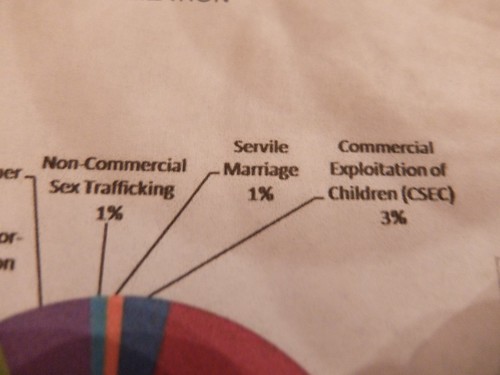
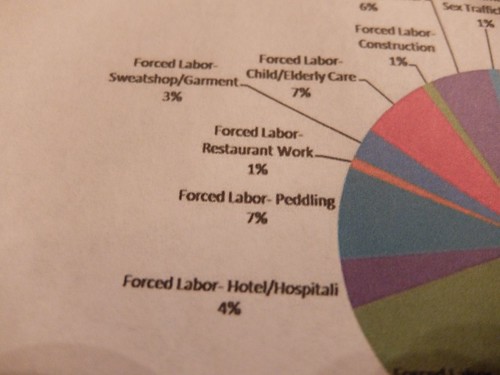
I asked if this recent guilty verdict in anyway imperiled business as usual around US bases, both at home and abroad, where a sex industry abounds, but without being seen as outright slavery.

The exiled people of Kwajalein and Bikini come to mind, as among those pressed into servitude and dependence, after having their ecosystems poisoned by radio-toxins.

Upon arriving home, I couldn't find my XQ-1, the camera I use for all these pictures.  That resulted in over an hour of searching high and low, retracing my steps, driving back to the venue.

I found it, finally, on the floor in the back seat area of the Nissan.  I'd looked under the front seats but hadn't spied it lying there.  I surmise it fell out of my coat pocket.

More Summer Reading

Wednesday, May 11, 2016

More Americana

Breakfast Stop

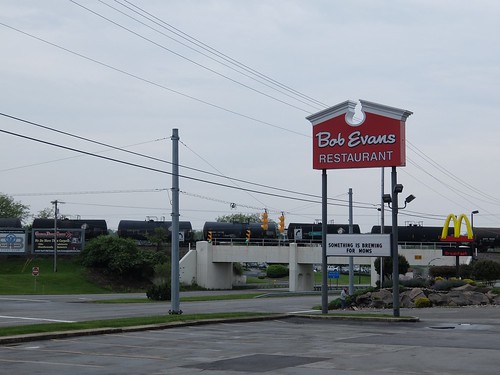
Another time in Richmond, I stayed at a Best Western and shot a picture across I-40 to the north.  On this trip, I was in that picture, at the Bob Evans, looking back.  Dawn preferred Bob Evans to Cracker Barrel, both mid-west phenomena (restaurant chains), extending on into the southeast.

What I have to keep remembering is how much closer the so-called "mid-west" is to the Atlantic coast, in comparison to its distance from the Pacific coast.  It's only a day on the road to Washington DC, whereas it's three times further to Portland.

I used Google Maps to plot a route from Champaign, Illinois to Portland, Oregon.  The computer said we'd have to drive a day and seven hours.  That's if we were in a Google car and could sleep a lot of the way, only slowing for gas and brief pit stops.  A crewed bizmo could do the job, though ideally the schedule is not that hectic.

My route from Champaign to the Budget rental car return at the St. Louis airport took me through Springfield, Illinois.  On the way out I'd stopped in Decatur for lunch.  The Abraham Lincoln Museum was well attended, especially by kids arriving by the bus load.  My schedule was tight and I was low on coins for the parking meter, which had failed anyway, as it turns out.  Shades of Detroit.  I took hurried pix in the Gift Shop by way of keeping souvenirs.

We hear a lot about Greece and its dire financials, but lets talk about Illinois.  Here's another state out of money, completely in the hole.  To whom does Illinois turn?  The Federation as a whole is even deeper in the red and mostly just likes to make rules it won't pay the states to comply with.  The old social contract is wearing thin in that sense.

The European Union is projected in US media as being in trouble, but as the Lincoln museum reminds us, it's the US union that's been through some tough times recently.  The EU has had nothing quite like the US Civil War (which was anything but civil).  This is not a nation that gets along with itself.  The breakdown into eleven states helps make sense of the jumbled war of words happening through talk radio, other social media.

Skywest operates a relatively new service for Alaska Airlines that got me from the St. Louis airport to PDX in under four hours.  We got in early and had to wait for our gate to free up.  I noticed an Icelandair parked at the concourse.  How long have we had direct flights to Iceland I wonder?

I sat next to an Illinois farmer, his wife across the aisle.  Their daughter is a professor at OSU and just had a first baby.  They'd been out before, but not frequently.  He didn't know what "IPA" was (as in "India Pale Ale").

I said the Brits invented this kind of beer to help prevent spoilage in the hotter Indian subcontinent, adding more hops than usual as a preservative.  In the Pacific Northwest, more fresh hops get infused later in the process, which actually shortens the shelf life of the beer (with refrigeration, which the Brits did not have in those early days, aging slows).

With the fresh hops IPA, the whole point is to drink it down soon after it's kegified.

I had a beer on the plane and another at Beaches, from whence I sent a note to Lindsey, as we'd earlier planned to talk around now, but then she realized there was no point renewing her cell phone contract, given where she'd be.  For the most part I'm not doing beer but for ceremonial and diplomatic occasions.  This whole week was about diplomacy.


Anywhere, America

Friday, May 06, 2016

Revisiting the Heartland

A year ago at this time, I was still with the O'Reilly School, and was lucky to get sent to the US Distance Learning Association (USDLA) annual conference in St. Louis.  Before the conference started, I rented a car and drove to Richmond, Indiana, via Champaign, Illinois, to visit my daughter.

This year, I'm following much the same script, minus the conference, to be at Earlham College for Tara's graduation.  I rented a car at the St. Louis airport, visited with greyhound and cat-owning friends (Afghan restaurant!), then headed to Champaign, where our code school used to have an office.

The original school was started by fans of the late Jerry Uhl, a professor at the University of Illinois, based in Champaign-Urbana, and was then purchased by O'Reilly Media and repurposed to be a code school.  I joined the faculty after this purchase, as a Python teacher, when the founding principals had already moved to Sepastopol.

Many memories came flooding back once I was back in the mid-west, reminders about the cultural currents, the geography.

I imagined being on assignment for National Geographic, visiting a master upholsterer (and his apprentice Lorri, my former supervisor), a new microbrewery (Triptych), a food cart (Dragon Fire) serving oven-baked pizza.  I've been greedily snapping pictures.  St. Louis has its special Provel cheese and Fleur d'Elise, in addition to the Arch and Climatron.

A most important technique, when it comes to cultural immersion, is to surf through radio stations, listening especially to Country and Christian genres, in addition to talk radio.  The freeway miles fly by faster with the radio on.

"The Donald" had just won the Indiana primary a few days before I arrived, with Cruz and Kasich pulling out of the race to become the Republican Party nominee.   Tonight, he's in Eugene, Oregon and Lindsey left me a garbled voicemail (lots of crowd noises in the background), reporting from the anti-rally, as she's in Eugene as well, freshly returned from Florida, in route to Nepal.

A year ago, when I was attending the conference, those big earthquakes hit Nepal.  Lindsey was in Kathmandu at the time, staying in a fifth floor guest room.  She's heading back.  When her voicemail came in from the anti-rally, I was in the process of meeting my mom's plane from DC.  Tara and I drove to the Dayton International Airport, in Ohio, to meet her.

Carol has been on the road for many more miles than I, earlier this year going from LA to Seattle by van, and more recently from Atlanta to Cape Code, Boston, New York and DC. Doing all the driving is Ellen Thomas, a long time activist very focused on the obscure House Bill 1976, introduced in 2015 by Rep. Eleanor Holmes Norton [D-DC-At Large].

The newspaper I read over breakfast in Decatur was not buying into "Islamophobia" and was encouraging more of a live and let live attitude. Refreshing.

Tara had been looking forward to a sushi extravaganza, in celebration of her graduation with honors in Physics and Philosophy, with a minor in Computer Science.  We enjoyed Yamato, with her friend Kristin (not a seafood fan, but other dishes available).  What a feast!  Congratulations Tara!

Saturday, April 30, 2016

Code School + Gift Shop

Designing an on-line Gift Shop is often the last thing a small business wants to take on, as their professional interest is likely not in learning to code such a thing.

Companies like Weebly and Rakuten are about solving the Supermarket Math problem of making it easy to have a website, including one that features a shopping cart with checkout features.

On the other hand, a Code School is where people go precisely to learn how to implement such services as an on-line Gift Shop, and moreover schools traditionally come with "swag" advertising their brand (T-shirts, hoodies, mugs, backpacks and so on).

So the question becomes:  does a given Code School "eat its own dog food" and roll its own Gift Shop, or does it outsource to CafePress or whatever?

In order to show the world that Code School students are learning the skills, any number of virtual Gift Shops might be kept on the shelf (on the rack) for students to hack on.  A way of building one's profile is to showcase one's contributions to said projects.

Some of these on the shelf shopping applications will actually do front line duty in real time.  A given Code School might swap out the Ux on occasion.

An existing open source project, such as Shoop, Oscar or Cartridge written in Django + Python, might be a good starting place.  Students learn by modifying an existing project.

Other applications may permit a kind of "virtual shopping" wherein shoppers "practice" using the Ux for free, a way of testing features and building community, with virtual money against virtual goods.

These prototype test beds might only face in-house, but why not make some public facing, as well as open source?  Good advertising, kudos to the school, if the shop shares some good ideas and/or interesting implementations thereof, perhaps even in "exotic" computer languages, such as Haskell and Go.

However, there's a more elaborate plan lurking just beneath the surface here.  Lets remember Friedrich Froebel, the inventor of Kindergarten, and his strategy of connecting the schooling process to gifts.  Bucky Fuller attended such a school and had an early breakthrough with the "peas-works" gift, leading to gaining the privilege of patenting the "octet truss" in the 1960s. [1]

As a student moves through schooling, rewarding that student's progress with gifts makes a lot of sense.  Gifts may be tools of the trade, like a microscope or telescope, faster bandwidth, better access to the Internet, a personal workspace, an office.

In the military, people say "rank has its privileges".  These privileges may be granted without need for cash awards.  Code Schools might think in terms of linking various milestones to specific rewards, perks or privileges.

[1]  Cole Gerts, Poet of Geometry, 2013 Option-G Visual Communication ISBN 978-0-615-87344-2, page 13.


DSCF4721

Sunday, April 24, 2016

Best Practices


DSCF4621
:: Wat Buddhatham Aram ::

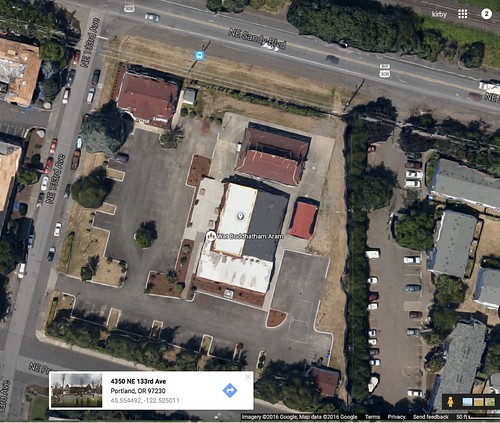
This afternoon I attended a final presentation by Alan Potkin, during this April, 2016 trip to Portland, this time to elders of the Laotian community at a local Buddhist temple, on NE 133rd and Sandy.  He'd presented to Wanderers at the Pauling House on Hawthorne, and to Thirsters on E Broadway, in the previous week.

I've driven by that temple campus many times, usually on my way to or from Costco, on NE 138th, but this was my first time to see the inside.  Alan used a screen and computer projector, and we enjoyed amplified sound, both for his voice and the recorded video segments, including some in Lao.

A treat I'd not experienced before was Alan's head first dive into the epic Ramayana itself, while scrolling through the temple murals his team had helped to recreate.

The story (ພຣະລັກພຣະຣາມ) is known to some Laotians, and Wikipedia calls it the "national story", but it is perhaps not as core to the national storytelling as among some other Buddhist and Hindu nations, elsewhere in Asia?  I'm no authority on these matters myself.

Alan had rescued another version he found tucked away in a cabinet of a forgotten old wat, forty three holy books in the khom language, which he's hoping to see translated into ordinary Lao.  Only those schooled in the older traditions, such as monks and other scholars, can read khom.

When it comes to mega-projects, such as hydro-dams, or smaller, Dr. Potkin's message is pretty simple:  making big changes to the landscape or seascape should entail making a detailed record of what it was like before the changes.  Take inventory, be thorough.  That's a best practice.

He does not automatically assume the more strident position of the most negatively impacted by such projects, that said developments must not occur.  His position is more nuanced.

The trade-offs need to be addressed case by case, in light of clearly presented information, and if a project is to go ahead, then at the very least what the place was like before and after must be well-documented, using techniques used by museums and interpretive centers to communicate to the general public.

Keep updating the exhibits, about the Hanford cleanup for example (like OMSI had), with follow-up information, at intervals. Alan keeps checking back on the projects he tracks, so long as he's able, updating his document database. Outcomes research is also essential.

Turgid phone-book-sized reports are insufficient to get the info across, any museum curator could tell you that.

Given today's cyber-tools, a virtual museum is an affordable requirement, complete with oral histories, videos, and an inventory of flora and fauna and their migration patterns, and their roles in peoples lives.  Alan thinks the Bonneville Power Administration made at least a decent attempt of building such an archive, before Celilo Falls went under, thanks to the Dalles dam.

One of Alan's favorite lessons revolves around a certain World Bank dam that was hastily retrofitted with a fish ladder that never worked, a last minute token attempt to compensate for the vast tonnage of edible protein that was about to be cut off, a fish migration cycle not fully appreciated.

The fish ladder never worked; it was built to the wrong scale for the migration in question.  The dam is only able to produce about 40 megawatts of juice, and serves as an ongoing monument to the World Bank's ineptness, at least back then. 

Have things improved?  Look for those on-line museums of "before the project" exhibits, with detailed information about the local lifestyles, food sources, patterns of trade.  If you don't find any such exhibits, assume the answer is no, it's business as usual.

I got through Costco for under $100, including the $1.50 hot dog + soda pop.

Wat on Sandy

Monday, April 18, 2016

Work / Study Notes

MathPiper in Action

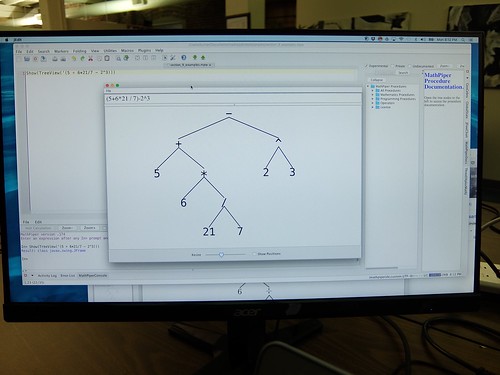
I used some of my time at the meetup tonight to follow Ted Kosan's homework assignment, as I'd agreed on the listserv (i.e. in front of witnesses) to enroll in his work / study program.  

He's going over the basics of a computer algebra system (CAS) which begins by parsing an expression into a tree, as shown above.

He's sharing a JEdit-based framework he wrote and shares with the general public under a GNU v2 Open Source license.

The Document Object Model is tree-like in having nodes containing more nodes.  A Tree is a subtype of Graph and is typically a first recursive data structure (think "fractal").

"Phi is the first Fractal" one might suggest as a mantra, on the basis of its self-referencing proportionality.

I'd started the day's meetings with Mr. Stockton (Global Matrix) wanting to share some Graph Theory, showing me the same nodes edge-connected in two different ways.

What could I learn from this picture?

The first graph was like spokes around hubs with longer distance connections between the hubs.

The second graph was more like connecting all neighbors to nearest neighbors.  No spokes were evident, more like a quilt or lattice.  Same nodes.  Different stories regarding their relationships.

The first graph might be "cell phone provider" (some nodes represent "towers"), whereas the second graph might display "who borrows sugar from whom".  I might assume the same geographic layer for both in this story, whereas graphs need not be geographic at all (just topological).

Visitors to the code school tonight included a German-speaking duo, from Austria and Switzerland respectively.  I talked with the Swiss guy who sat next to me, about his bioinformatics work, training computers to get better at diagnostics.

I explained about my work with tetravolumes in Clojure, inside MathPiper.  He also liked my Nonsense Numbers.

I learned about ternary logic, discussed in Knuth (I'll look it up) and an early Russian prototype named Setun.  Ternary logic is non-boolean, yet a logic nevertheless.  I've been pointing out that even True and False based languages have Null and/or Undefined but that's not what "ternary logic" means exactly.  I'll be doing some more self-study.

Another topic already in the wind, that I learned about only recently, is clockless chips, meaning CPUs that are less clock-driven, more asynchronous.

We've had something of a paradigm shift in that respect at the software level.  I'll be looking for parallels in the literature.

I demonstrated doing symbolic calculus to another attender deep into Doing Math with Python (a new title).  He'll be getting to all that in a next chapter anyway.

An old student of mine (from Accelerated Intro) was there when I arrived, and is currently enrolled in one of the evening boot camps going on in the Business Accelerator building.  I'm glad.

With Sheri (the director) I discussed the Gift Shop meme, a way for any code school to showcase its own ability to source an on-line swag store, shopping cart model.

An on-line Gift Shop is precisely the type of application students come to code school to learn to code, so the Eat Your Own Dog Food aspect is evident.  I came away with a T-shirt myself.

A code school might stock any number of partially developed Gift Shop variants, some as group projects, some starting out solo.  Having a working project on the front lines does not imply other solutions do not exist.

We'll always have need for a "next Gift Shop" if only to give students and instructors opportunities to hack on something well-understood (like anatomy lessons).

Speaking of gifts, my thanks to Benjamin for cluing me about pathlib and py.test.

Wednesday, April 13, 2016

A Pep Talk of My Own


Emmanuel on math-thinking-l immediately saw a connection to Pyret, I wonder why. :-D

Sunday, April 10, 2016

Pep Talks

I'm reviewing these four presentations in the order in which I viewed them.

First comes Steven Witten, a really talented guy with a love of spatial animation and a willingness to share his craft.  Peter Farrell, who uses Pygame to similar ends, clued me about this talk.


Now comes some sober and intelligent advice from John Allsopp, a web developer noticing the trade-offs between mastery / learn-ability and short term convenience at the latter's price, of added complexity.

In the rush to "get it done" we may condemn ourselves to "perpetual infancy".


Dovetailing with the above, comes this talk from New Zealand by Scott Hanselman, a guy from Portland, Oregon (I don't know him (yet)).

He works for Microsoft, which has come a long way in Open Source, since the early days of Sara Ford.

The storytelling here is high quality.  Like John (above), he gives the ten thousand foot historical view.


BTW, TypeScript, on which Angular2 is based (JavaScript in the cloud), is Microsoft's baby, while Angular itself is one of Google's.

I followed Scott somewhere else (on Youtube that is) before he went on to Poland (Scott gets around):


Whereas I don't share his specific disciplines regarding emails and so on, given a different life situation and modus operendi, I'm respectful of the need for self-discipline, whatever shape that takes.

Both of Scott's talks are quirky and state of the art at the same time.

Bravo on all four.

Thursday, April 07, 2016

National Beer Day

DSCF4218

I wonder if CBS Evening News, Western Edition, will have picked up on the beer day meme.  So many memes, so little time (under 20 minutes, subtracting commercials, right?).  I just returned from Hop House where I met up with Glenn Stockton (Global Matrix) and Patrick Barton (Portland Energy Strategies).

I picked up a Vortex magazine, somewhat ironically about the gentrification of the Portland scene (ironic because Vortex is so slick and glossy, and reminds us of the government-sponsored rock concert set up in 1970, partly as a diversion to keep angry hippies away when Nixon came to Portland that time — I wasn't around anyway).

One good thing that happened while Nixon was president was those needing kidney dialysis were given a government dispensation and allowed to live, at least a little while longer, on the government taxpayer tab.

My friend Nick Consoletti, indigent, a wanderer, and a walking encyclopedia of useful cultural information (memes again) had his life prolonged by some months thanks to this Nixon Era program, which would likely go unfunded in today's climate.

I saw our mutual friend Quinn, who organized the memorial service, running by Glenn and I (summit meeting) on Mt. Tabor.

Yes, Glenn wants to fire up more awareness of his Global Matrix meme and since he's all about global data displays, I thought:  what better project for the Global Data Corporation (GDC), a meme I've been using since the 1980s at least?

GDC was not incorporated using "white man law" (in the Federal jurisdiction).  I guess we'd call it "off shore"?  Anyway, I added a new Github subfolder about it this morning, containing some buried PR for Glenn's initiative.  Other PR is buried even more deeply.

Speaking of "buried", did you know the official word for where the urns are kept (containing ashes) is called a columbarium?  That's funny.  "Bury 'em" (an alternative way).  Given my first name, Kirby, is sometimes translated as "Kirk By" i.e. "By the Kirk" as in Churchyard ("Kierkegaard"), I sometimes say "Kirby means cemetery".  So then "Urner" sounds likewise funereal.  But it isn't.

More fitting with "Urner" is URI, or "universal resource index".  Some writers found that too pretentious or something and "URL" (as in "Uncle URL" — I had an Uncle Earl, married to Aunt Betty my grandma Margaret Reilley's husband) became more common.  Either way. the World Wide Web was invented in Switzerland (CERN) where the Canton of Uri is.  That's where "Urner" comes from (Urner = person from Uri).

Speaking of Urner, Kirby, I'm a complete idiot sometimes.  Like today I was preoccupied thinking about who knows what (not me) and wandered away from the cash back I'd requested at the supermarket.  Those were the most expensive Diet Dr. Peppers I ever purchased. I also confessed on Facebook and publicly resolved to make it up by giving up beer for two weeks at least.  $5 / pint x 8, plus it'll actually be good for me.

Really, I don't need to drink beer, which mainly contributes to my stupidity and waistline both.  An old theme in these blogs. I'd be better off savoring the memories.  Yes, the IPAs are really great here, one should definitely try one or two — and I have, many times.

Friday, April 01, 2016

Another Bubble Tea

I have newly acquired a taste for Bubble Tea, and have therefore made Fat Straw on Hawthorne a next hangout.  They know their process.  I'll need to explore more permutations.

The USPO miss-delivered and envelope so I walked it down to the corner market in question, procuring some drinking supplies, which I made use of on Patrick's porch.

He's deep into species recognition issues and realizes human eyeballs on the problem, experts identifying known specimens, will help with machine learning.

His projects could staff an entire company.  He tends to work on that scale.

Out of pocket for health insurance in April:  $1,313.77 for myself and one dependent.  I had to state my case vociferously that March was covered as well.  No that's not an April Fools Day joke.

This posting was though -- a lot less feather-ruffling than last year's post, about an upcoming Pycon in Cuba, which ironically turned out to be true enough.

Wednesday, March 30, 2016

Boot Camp Continues

DSCF3963

I'm somewhat under the gun in my boot camp experience, dashing through a couple Roger Penrose videos, reporting to mathfuture, dashing out to buy a Python-meets-biology book, and so on.

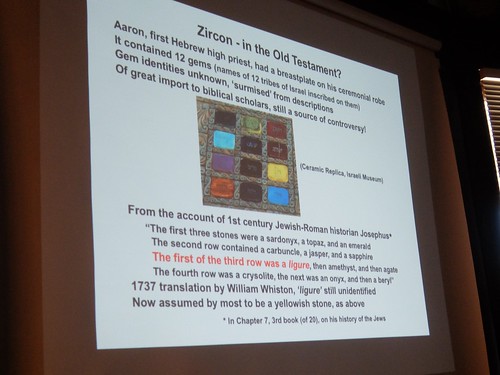
In the midst of all that, I was privileged to drop in on Wanderers, where Steve Mastin was holding forth on zircon, a mineral comprised of the element zirconium, an odd-man-out element with a cation that doesn't crystallize well with the others.

Among these would be Uranium and Thorium, which contribute a lot to zircon's properties, up to making Zirconology, in part about studying chronology.

Zircon's several ways to decay give ways of dating the mineral, a side-benefit of a long-running polonium-related controversy, again with Biblical connotations (see below).

Given earlier civilizations did not use our Periodic Table or understanding of atomic physics, their jargons don't follow ours that closely, and in the case of zircon that's especially true, as in manifests in a wide variety of colors, from vermilion to blue.

In theory it's colorless but in the wild a colorless zircon is a rare find, though some of the colored ones turn colorless with heat treatment, rather commonly applied.  Just how a given specimen of zircon will respond to heat treatment is something of a gamble.

Blue is highly prized, though honey-colored is more its trademark.  Dick Pugh brought an example, as did Steve but I only had time to take a look at Mr. Pugh's, then was on my errands.

A passage in the Torah about some battle vest, or breast plate, and the twelve stones thereon, probably overlaps our modern definitions. We'd expect to find a specimen of zircon thereon, along with beryl, emerald and some others.

Don't expect me to name all twelve, though if you dig you might find something more like a complete listing in the slides.  Steve does a lot of homework to create these talks.

I left around the same time as Jon Bunce, off to Powell's for said biology book.  Boot camp continues, with a five mile hike, including steep inclines, bruised ankles be damned.

The impromptu meetup with Dr. DiNucci at Common Ground was apropos, as concurrency concepts,  taught through cooking in groups (as with Food Not Bombs) is topical within my code school network.  Aside from a Horse Brass half order of Fish 'n Chips, I'm mostly subsisting on Soylent today (version 1.5).

The documentary on Puerto Rico looks interesting (rented from Movie Madness).  We don't see many code schools there yet.

Back at my workspace, I made sure VPython is still working.  Given the dependency on wxPython, I need to use Python 2.7, and a "Framework" 2.7 at that (to provide access to the main display).  So far so good.  Things are coming together.

DSCF3979

Saturday, March 26, 2016

Preparing for Bootcamp


Given I work in the code school industry, videos like this get my attention. Would be bootcampers should take a look at the different "stacks" the schools offer. Not every path to becoming a full stack web developer is the same. Do you want JavaScript top to bottom? Check the MEAN stack. Were you hoping for Python? We have those stacks too.

Your code school may well be associated with some "accelerator program", that's par for the course. Code schools often affiliate with startup incubators.  That makes sense.  Finding students of the latest tools is not always easy.  That's where code schools come in, especially those willing to stay nimble and encourage experimentation with the newer tools.

Experimenting with newer tools does not require abandoning tried and trusted curricula.  The devil is in the details.  Blending old and new requires alchemy.  Attracting creative students helps further the process along, as mentors tend to answer to their students most of all.

Wednesday, March 23, 2016

EthnoMath


John Searle points out that although Wittgenstein has become increasingly influential in the humanities, in anthropology for example, he wrote extensively about the philosophy of mathematics.

"All math is ethno-math" is one of my slogans.  Mathematics is anthropological.  The universities keep these departments separate, true, but that's an ethnic thing.

I go back to Wittgenstein's remarks on the foundations of mathematics and fit in some different language games showing how indeed there's room to break the hold of "squaring" and "cubing" as words for 2nd and 3rd powering respectively.

We're combating the bewitchment of our intelligence by means of language. We might call that counter-intelligence i.e using language games to extricate ourselves from other language games.  Sometimes we apply "counter-spin".

Using triangles and tetrahedrons to model 2nd and 3rd powering respectively is a break with the past, and was pioneered by R. Buckminster Fuller in his Synergetics, but philosophers have failed to grapple with his ideas much in the ensuing half century.

RBF has not yet been accepted into the canon of thinkers it's OK to write about, as an academic philosopher, although I've seen evidence in Nature this state of affairs might be changing.

The high level of neglect of this cultural heritage is an anthropological phenomenon, some of it explicable as backlash against Fuller's own pointed critiques of over-specialization, which left many an over-specialist feeling on the defensive and resentful.

Once we get to a unit-volume simplex (tetrahedron) we have a "concentric hierarchy of polyhedrons" with more whole number volumes than our culture is accustomed to sharing with its young.

How the concentric hierarchy merges with a sphere packing abstraction opens a lot of doors in the imagination.  One learns about the octet truss and its complementary tetrahedrons and octahedrons of relative volume 1:4, with twice as many of the former as the latter.

These important concepts integrate more densely and more smoothly than when cubes and right angles so dominate the picture.

E.J. Applewhite, one of Fuller's chief collaborators, once told me he loved the Wittgensteinian bridge I was building to the Bucky stuff.  He was CIA though, not an academic per se.  Again, we're talking anthropology here.

Sunday, March 20, 2016

Pycon Cuba

DSCF3696

We're seeing a spike in the PSF Cuba working group postings thanks to President Obama's impending visit to Havana.

I've been keeping Thirsters up to date, somewhat a redundant exercise given the python-cuba listserv archive is public anyway.

Wednesday, March 16, 2016

Wanderers 2016.3.16

DSCF3535

The listserv announced an Open Forum for today which is the default mode we go into, if we're not scheduled to receive a presentation.

I brought along David Prideaux's No Big Bang, a self published work, just acquired last night from the author, for show and tell purposes.  We had another retired Tri-Met guy here this morning.

Glenn Stockton gave a presentation on some of his more recent research.

He's found some "gears" in Plummer's Cosmic Mind book, on loan from me, that relate to his addressing scheme for the concentric hexapents.

I brought up Cantor's writings on addressing N-spaces, if discrete.

Very dense Turtle trails will give a 1D+ approximation of a 2D surface, much as a Labyrinth fills a circle with its sequential trail.

Given storage units in an XYZ pattern, where Z = floor and XY = row/column, one may also number them sequentially, perhaps in a hexadecimal sequence, or pick any contiguous segment of Unicode codepoints.

Euclidean geometry is all about labeling points e.g. A, B, C... one doesn't need (x,y,z) tuples especially since said points may be in motion (yet their identity remains intact).

A hexadecimal 1D addressing scheme mapping to XYZ cells (storage units, voxels) is typical in computer science.  Video RAM is sequential yet what we're watching is a movie.

Dredging up Cantor's writings on these topics is not mindlessly mouse-click easy right?

I came across his stuff at Powell's.  Such thinking was in the wind during his time, feeding into the "fractal frenzy" that was to follow (Julia, Mandelbrot et al), then Chaos Mathematics (still going strong).

Friday, March 11, 2016

The Security of Things

DSCF3423

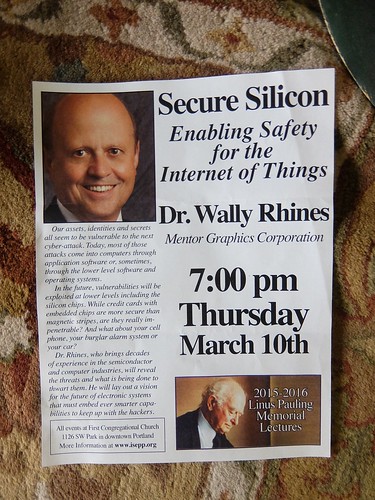
Wally Rhines is no mere bystander, and well beyond the engaged journalist, when it comes to understanding the risks to our security presented by this Internet of Things.

As the CEO of Mentor Graphics, Wally is at the helm of one of the few companies the makes the tools that make tools that make the chips those Things contain.  Chips as in "micro-miniaturized circuit boards" designed to perform reliably and in a trustworthy manner.

What one industry sees as an embarrassing vulnerability, another will see as an exploitable hack.

The black hats challenge the white hats to do their jobs correctly, by breaking into their stuff in ways that should and could be prevented.   The black hats are making a point:  you need to stay on top of your game.

When only white hats abound, some will need to don black just to keep the skill sets up to snuff, the reflexes fresh, much as a human body will do when training to remember past insults.  Memories get built.

Anti-virus software tends to be a huge database of signature byte strings.

Wally started his talk pointing out that humans owned an ever smaller percentage of IP numbers in that most of them belong not on "whois" people but "whatis" things (one could say).

You don't need to register as a "who" to be a toaster or refrigerator in somebody's household.  IPv6 gives us plenty of addresses to spread Things around.

How are chips signed?  Do we want them signed?  What would the signature mean?

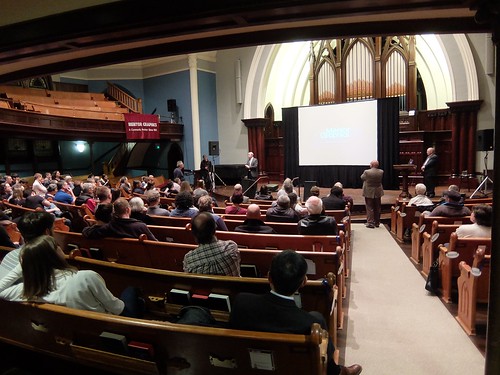
We're only beginning to answer these questions.  CEOs yak about these topics a lot.  Wally is on the road quite a bit, sharing these and other, more technical, slides.

DSCF3382

The overall schema is an inverted pyramid in that the most widespread exploits involve various forms of social engineering, trickery around phishing and phoning in with false identities, milling about in smoking areas and befriending employees.

These kinds of security breaches may get wide publicity but affect fewer individuals than mega-downloads of supposedly confidential info.  Sometimes social engineering leads to deeper exploits.

In one experiment, USB sticks were scattered in the parking lot, apparently dropped by mistake.  How many finders-keepers types would insert these sticks in their own machines?  Depressingly many.

Get yourself a quarantined box you're prepared to let fry, if you're wanting to do hobby forensics.  Sure, random memory sticks might have interesting content but that doesn't mean accepting candy from strangers is suddenly a good idea.

Mass downloading exploits, as have been successfully conducted against Anthem Healthcare and the IRS (I've got files with both, so I'm a victim), may rely on security holes in the infrastructure itself, at the base of which are these all-important chips, signed and unsigned.

What if the chip itself is doing surveillance tasks supposedly for customer maintenance and satisfaction but with the side effect of providing a side door into private circuits?  What if the chip itself is hackable?  These kinds of vulnerability may be the hardest to find and yet affect the most people in the long run.

How might a customer verify that a purchased chip does just what the documentation says it does, and no more?

For example the Apple iPhone is currently vulnerable at least in principle but the Apple CEO is working overtime to close that gap.

Pretty soon, what the FBI is asking for will not be engineeringly feasible, whereas today one could enslave people to force the opening.

A safe is meant to be safe and many designs for software safes are in principle, mathematically, uncrackable, unless of course one gets very lucky with some wild guess, less likely than winning the lottery three times in a row.

Once the paper is out of the safe there's no guarantee it's still valuable.  Securities are more vulnerable to shifting markets that crackable safes.

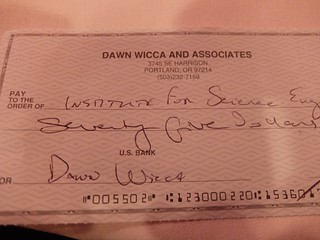
I took a ceremonial US Bank check from Dawn Wicca and Associates to commemorate Dawn's years as a bookkeeper for ISEPP, during a golden age.  She died on St. Patrick's Day on 2007, and I'm thinking about her quite a bit.

Some of the donation was actually paying for a signed copy of Terry's new book, which I'm taking to Quaker Men's Group as worship-reading (also known as slow reading).

DSCF3393


I was allowed to bring a guess and offered seats at the Heathman Dinner to a couple people, neither of whom could make it that night (Patrick joined me for the talk itself).  I had a great time anyway.

Glenn has been working on his "elevator speech" for Global Matrix and tried it out on Wally, who's eye was drawn to the NSA crypto-analyst line towards the end.

Clearly Glenn was familiar with white and black hat territory.

Glenn on Camera

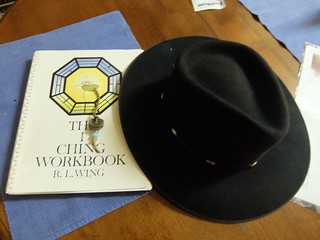
I think I'd already left the scene by then, somewhat ironically sporting the black Stetson that Glenn gave me.  I'd actually gone back to the car for it during Q&A, because I'd forgotten my bank check also.  I moved the car closer to the venue.

Q&A was still going on when I got back.  Wally was generous with his time.  He appreciates these golden opportunities to engage the general public.

I'm more of a social engineering hacker than a hardware guy I'd say, and I'm more the kind to leave bread crumbs, make it a treasure hunt, like with geo-caching, perhaps with product placement worked in.

Sure, there are times I'd like to have been a fly on a wall, but I understand about authorized access and tend to steer clear of areas restricted against my kind.
DSCF3355