Tuesday, March 07, 2017

Psychotherapy

Clinton Street Crossing

Today was day two of two in my annual pilgrimage to my auditor. Jody Francis used to be my ideal CFO, still is, though we were never in business together. She ran Fine Grind around the corner from me, and was a source of a religious experience that time at a Quaker retreat (just me, and AAA, left my lights on in a camp ground). She appeared to me as a bright star, probably Venus.

In this life, Dawn Wicca ran our partnership, from the ground up. We later married, keeping separate checking, which the business paid into, 50-50. She was a skilled and honest bookkeeper and I kept up my end of the bargain working for myriad non-profits, towards the end a large Catholic hospital system. After she died, I tried to keep the partnership going, an oxymoron I found out. The IRS saw double when I claimed personal income to the partnership as well. Nikki helped me sort it out.

Nikki is my H&R Block accountant. She works with many, which keeps her in shape. Every aspect of the tax code gets exercised. What an amazing pile of code that is, one could spend a lifetime, a career, looking into it. Nikki has done that. I have not. To file a Schedule C, take advantage of this or that, even get a refund by itemizing, is a daunting process. Even the 1040 EZ is quite a chore.  So yes, I ate my costs as a very legitimate business expense, and will claim them next year, if I survive.

4D Solutions is what remains of Dawn Wicca and Associates. I resurrected it in the wake of losing my full time job as a code school mentor at OST.  Since 1980, Dawn and I had been a partnership, then after she died of cancer, I went solo.  I had my eye on a next partner but was too confused.  Then Lindsey Walker moved in, a political refugee from Savannah, Georgia seeking asylum in Asylum District. I actually claimed her as a dependent one year, as more family member than renter (I was never interested in being a landlord per se). She traded digs for a car she no longer believed in driving, so that worked out.  DMV has the records on "torture taxi" (the Nissan).

Even as O'Reilly was closing its code school (OST), I was picking up work with California. A forward-thinking professional development program found me through LinkedIn and picked me up as a Python mentor.  I'm still doing that kind of thing in 2017. I also work with kids, having been certified to do so by the local archdiocese.

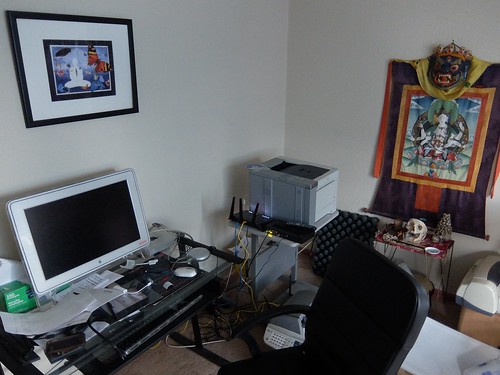
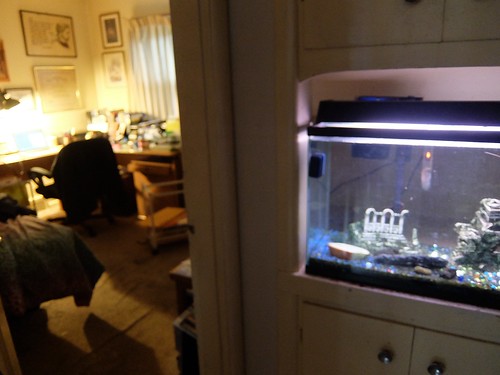
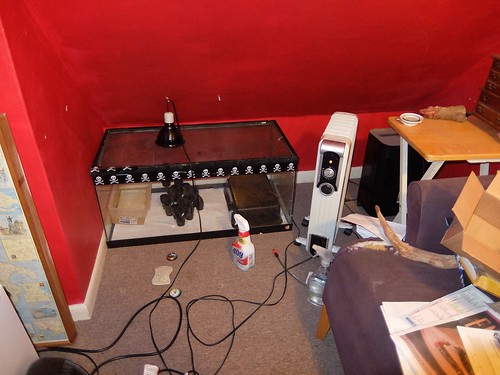
I claimed the Buddha Room and Snake Cave as office space, though I think of the Blue House as some moored ship of the line and all business in that sense, even the galley and heads. Those rooms account for about 20% of the floor space and barely paid the fee for the form, but at least I've carved out some self employment space. I did not claim Carol's WILPF office given it doubles as sleeping quarters at least some months of the year.

Perhaps 4D Solutions will be taken seriously, as the Oregon Curriculum Network fountainhead or whatever, you never know.  The 4D story is mostly told in esoteric art history books. I've been proposing to offer more teacher training, other services.  I'm more into a math + code hybrid, something of an exotic butterfly, even in the Silicon Forest context.

Speaking of esoterica, I don't try to reflect Food Not Bombs work on the books. Food slated for the dumpster is not usually accounted as "income". Americans are allowed to have guests, and entertain them, without registering as a BnB. I don't need to claim "movie nights" as a business expense either, as I'm not charging money.
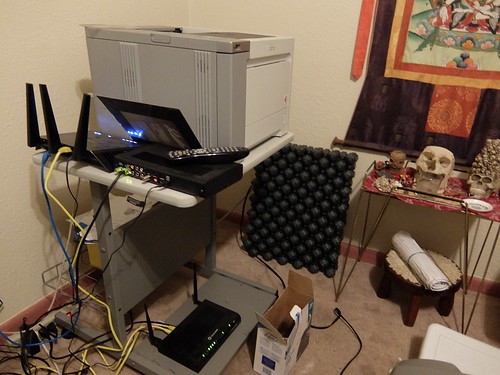
Buddha Room

:: Buddha Room ::

Thursday, March 02, 2017

Learning with Data

In printed textbooks, the need to save paper dictates that data sets remain small, lets say under 1K of data, just to fit. Analysis has a different flavor when you get to look at it and reason about it row by row, and we do that in Python using SQLite, part of the Standard Library.

However lets skip over what flavor of SQL or noSQL and refocus on data, and how it no longer needs to be small.  Nor must it be enormous just for the hell of it.  On edu-sig in Python.org, I've been yakking about "rich data structures" such as: the Periodic Table of the Elements; a Glossary of Terms; Assorted Polyhedra.  Recently added: a database on roller coasters.

Let me boast the advantages:  we're taking traditional classroom poster data, stuff already hanging on the walls, and distilling it to reinforcing content that we interact with through our computers, as well as through our own senses.  We read them as files, starting from maybe JSON or XML (those are well known data exchange formats).

Tables are nothing new.  Rows and columns, so-called arrays, became multi-dimensional in the guise of NumPy, or in the computer language J, which has them natively. The data languages all have them now, as a type.  As many axes of address as you like.  A lot like SQL or noSQL, a database in itself.

The complaint that switching to tables and SQL is some severe departure from reading and writing of old is stemming from nostalgia for when we could afford to wait in a long line for our money. ATMs to the rescue. For those, you need the tables to exist electronically, but otherwise it's just like the ledger books of our colorful past.  Lots of people use paper today, nothing wrong with that, has its advantages. Not either / or.

The point being:  now that literacy within industry does require doing homework, the need to pay ourselves to keep learning seems obvious, and as we practice, it helps to have rich data structures to hack on, and many of us have those and are currently hacking away.  I'm not at all as fast as some when it comes to drilling down in some XML file using elementtree or whatever.

Indeed, I'm the king of non sequiturs some might say, however I grew up on film and know about jump cuts, flashbacks, not just plodding linear.  Norman O. Brown and all that.  Ad copy is likewise choppy.

J comes from a collaboration among Kenneth and Eric Iverson, and Roger Hui, not that I know the whole story. I immersed myself in J awhile back, having first cut some teeth on Kenneth's APL (A Programming Language), which I really grooved on.  J did not disappoint, in terms of what it made possible.  I grabbed some of its group theory too, when I pitched my tent in nearby Python Nation.  Kenneth found a couple typos in my Jiving in J essay (I was honored, to have the attention of his genius).

Another double plus for using classroom poster data, as a topic in learning to code, is we're not intruding on anyone's privacy.  Science has shared the Periodic Table with generations already. We don't need Hydrogen to sign a release.  I'm not in denial about security and privacy, on the contrary I'm suggesting data that's the least sticky.  That stuff at least, will be super easy to come by.

Monday, February 27, 2017

Circuit Rider

On Belmont

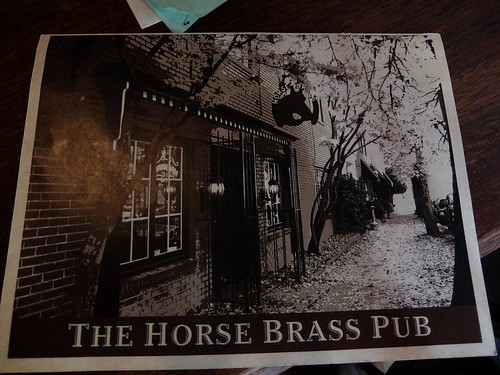
Patrick was kind enough to give me a heads up about the Ninkasi Festival at Belmont Station. I had the Greg Palast movie to return, so headed out on foot by Movie Madness. Although this tap room and retail establishment started out near to Horse Brass on Belmont (hence the name) as retail only, it moved to Stark Street, just a block down from the Quaker meetinghouse.

I've met with Friends at Belmont Station quite a few times, sometimes to go over math concepts, as I'm known to float around in math tutor space. However this time I was sharing perspectives with Patrick about some hefty RFPs he's been looking at (Requests for Proposals). I've been looking at them as well.

Before November of last year, I was hell bent on ramping up professional development classes for Portland teachers. I got the idea from doing PD for Californian IT workers, in a program geared for the already-employed.

My venue, I hoped, might be a neighborhood community center, a church with a lot of floor space. The idea still haunts me, however Measure 97 didn't pass, and even if it had, there's no consensus that teachers want or need PD from the likes of myself or Patrick.  We bill ourselves as Python mentors, based on some years with the O'Reilly School of Technology, plus other gigs.  Between us, Barton and I have quite a bit of experience.

Glenn and I work on the Global Matrix stuff, which overlaps in that we're looking to display global data using the age-old hexagonal grid motif, with twelve pentagons in the mix.  These threads are not unrelated, in light of HP4E, one of my longest running media campaigns ("Hexapents for Everyone").

The Trimet Trip Planner said I could be at PDX Code Guild if I made it to Glisan, north of Stark, passed Burnside, by 6:24 or so, and I did, having only the one Ninkasi thanks to my host. The bus 19 took me within a couple blocks of 2626 SW Corbett, no transfer needed.  Pretty nifty.

Sheri said she was baking cookies just for me (I think she'd seen on Twitter that I was making my way there). I caught up a little with Ben and collected the T-shirt I'd ordered from one of the other code schoolers some months back. The purpose of Flying Circus in part is for experts to huddle with novices and help them through hurdles. I got to do some of that, as an expert in both Python and JavaScript.

Wow, a modern browser sure does a lot, in terms of allowing for inspection, setting breakpoints and so on.  Ben really helped a lot.  Sheri knows her way around that Trimet Trip Planner developer API, or is getting there (I'd never seen it before, would like to use it more myself).

Since the voter suppression scheme revealed in the Palast movie had involved deliberately sloppy SQL, I was keen to share some of the details.  Election technology, like FinTech, is a subset of IT.  Code schools have a natural fascination with voting and voting technologies, especially in this age of blockchains.

I stayed late enough to need another e-Ticket to get back, not a problem. I walked down to Tillikum Crossing and hopped an Orange Line, transferring to the 4 at Clinton Street. I was back at Blue House in no time, ready for janitorial duties.

Pooh Cup

Thursday, February 23, 2017

Filling In

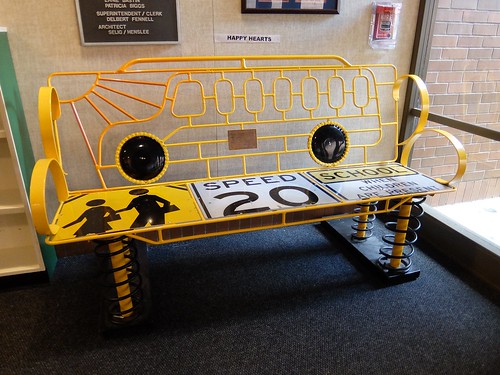
School Bus Bench

Speaking of "hollow schools" (below), Bridgeport Elementary is not one.  The hollow schools of which I wrote are sometimes useful as gymnasium equipment, I don't deny it.  Some even foster community.

Anyway, one of my team needed a sub and I'm on call to some level, we're not yet sure to what level. Usually I try to keep the day clear when I'm on in the evening, as I was tonight, closed circuit, with my adult peers.

However, I'm wanting to be a team player and what better way to get into shape than visit an elementary school in Tualitin and lead an after school hour in MIT Scratch, for Coding with Kids?

What tested my resolution to stay chill, beyond reports of impending ice rain, was the sudden power outage, a kind of flickering, and then a whole 90% gone, but the snake's aquarium heater still heating.  What?

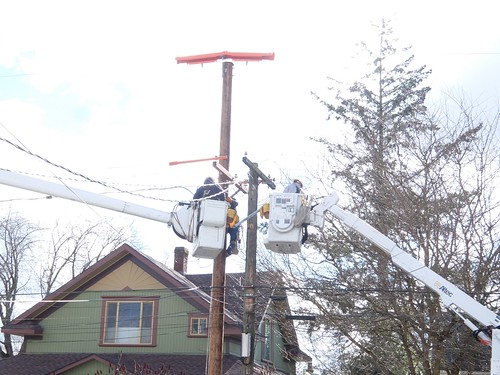
I dashed to the fuse box, forgetting the phone flashlight, but seeing clearly enough nothing seemed enough out of place to explain the phenomenon.  Then it dawned on me:  the three trucks outside my door working on the electrical pole across the street.

DSCF3661

That's right: today of all days was the one a new taller pole was slated to replace the older one.  Portland General Electric (PG&E) had a team of linesmen, plus traffic control people, on the job, fortunately making quick work of their part of it.

Some infrastructure is lower on the pole, probably Comcast and/or CenturyLink, with cable and/or fiber. That stuff stayed on the older pole, which they also sawed off, to maybe half of its former height.

Fortunately for my peace of mind, the power had come back on before I backed out of the driveway. Also fortunately, the expected icy rain was not the occasion for a jam-up on I-5.  I got back from Tualitin in time for some last minute prep for class.

My students said kind things in the chat window, which I didn't save at the end of the day.  Patrick joined us again, for more of a speaking role than last time.  He gave a presentation on his snake trap, the one he's offering to folks in the Florida Everglades, for testing.

Like any inventor, Patrick needs feedback loops that amplify more than dampen, if his invention is to get off the ground.  As Quakers put it, we learn to follow God's will "experimentally" i.e. by means of trial and error.  Mistakes teach us a lot.

I've long been thinking "two teachers per classroom" changes the ratio, plus didn't philosophers of old often present subject material in the form of a dialog?  Sportscasters have hit upon conversational banter as a way to impart fluency.  Patrick and I have been eager to give co-teaching a whirl.

I've found it useful to cross-fertilize across my adult and kid gigs to some degree.  I'll pare down an adult Python module, then enhance it in Codesters for the kids. 

Then I'll run that same Codesters application for my adult audience, an exhibit in their world, regarding how kids these days learn to code (MIT Scratch, phasing in Codesters on the way to a cloud-based host, is one approach).

I had Steve Holden on my Python show a few weeks ago.  He brought along some hardware devices from the UK, to control using MicroPython on a chip.  Passing the screen around adroitly is an athletic ability in itself.

Sunday, February 19, 2017

Hollow Schools

The emerging trend in the high tech economy is to provide unemployed or underemployed workers, college students, curious teens and others, with many "hollow school" options, meaning the exercises are canned, and no teachers are present.

Work through an automated textbook (web-based), and you'll pop out the other end of the pipeline with the needed skills.

That's a theory, quite unproved.  It'll work for some people, as most fad diets do, and those are the people you want giving glowing testimonials. "I did the WorkForce Training [tm] and now I'm making one hundred K!"

Is academia the source of this dream? I'd say more it's from publishing. We need students / customers to "work through" our material. The teachers are no longer in real time, just look it up on Stack Overflow if there's a problem, or maybe we set up bandwidth for students to help each other, perhaps awarding them extra credit somehow for so-doing.

The messy business of keeping a faculty alive is what's left to the university in this picture.  The publishers siphon off students and furnish some credential based on "working through" their offerings.  States find it easier to work with publishers, which are businesses, than with universities, which are not as eager to get behind self-gutting platforms.

Where a more intelligent government + university system might step in, is with experiments to reverse the model, and pay students, instead of making students pay. If learning JavaScript + HTML + CSS is so vital to the economy, then lets bleed out a stipend, an allowance, could be to cyber-currency wallets on the cellphone (university provided?).

Pay teachers and students both, as they'll be exchanging roles all this time anyway. I may learn React and/or Angular from you (both JavaScript), but then I'm a Python teacher and will teach you Flask.  Besides, it's work to study.  Work-study is what we do for recreation, cradle to grave.

"Where does the money come from?" you ask.  That's a question for general systems theory, the answer being "from the sun" (current = currency at the root of it all). Some economists may have competing answers but GST is more of a science than Econ is.

If you want to limit how these work-study program credits might be used, that's what FinTech is all about.  Pay students to learn JavaScript in currency exchangeable for groceries but not booze. If you're studying biology, earned credits might be towards a catalog of microscopes and related equipment.

At the O'Reilly School of Technology (OST), our PR was contra-MOOC in the sense that we didn't think a 1:10000 teacher-student ratio was all that workable.

Not that there's anything wrong with watching Youtubes. One may learn plenty from passive viewing, as well as from reading. But when does another human evaluate the quality of your own work? Are you tested only by machines?  What's the workflow?  Is the school you're in hollow?

Do you think by watching doctor shows you become a doctor?  Do we get computer programmers from robograders? What's the fail rate? What's the theory?

At OST we were more wanting to duplicate the Renaissance 1-on-1 apprentice model, where, in joining the JavaScript guild, one gets paired with a guru, a guide, someone who will work with you directly and think about your code with you. A co-programmer of sorts.

The whole thrust of Extreme Programming + Agile was "those who work alone don't develop as team players."  Which is not to say working alone is unimportant. There's no either/or here.

The irony in this picture is hollowed out schools are scrambling to deal with the unemployment problem created by letting go of all the teachers by hollowing out all the schools.

We think faceless bureaucracies are now in position to roll over the apprentice model.  Finally, we don't need to worry about teachers i.e. innovators and researchers, people who study for a living.

We can freeze our pot of gold curriculum into that end of the rainbow skills training we believe is out there, and all our unemployed will get their $90K full stack developer jobs. Solution provided!

Yeah right. Count me a skeptic.

Thursday, February 16, 2017

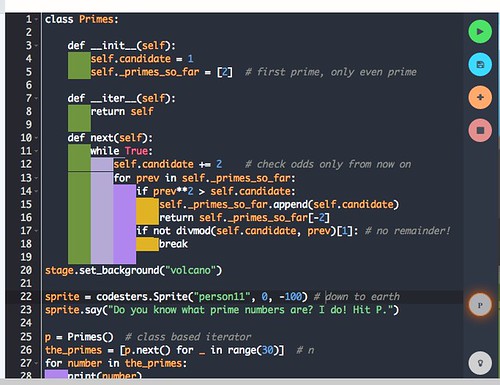
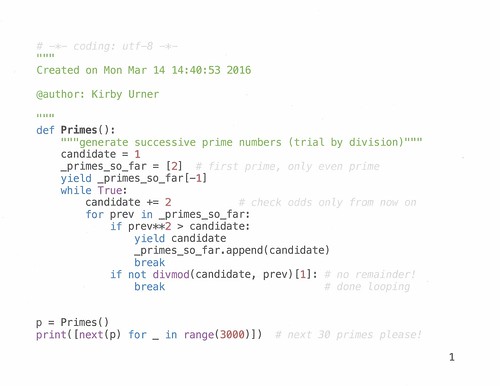
Prime Numbers

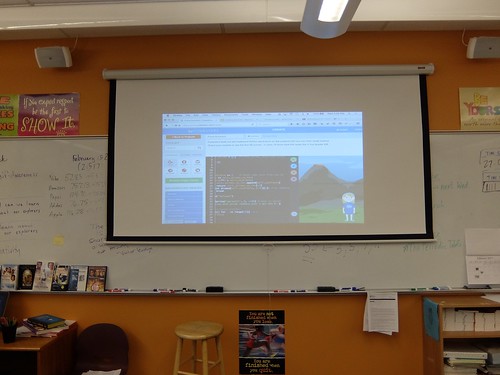
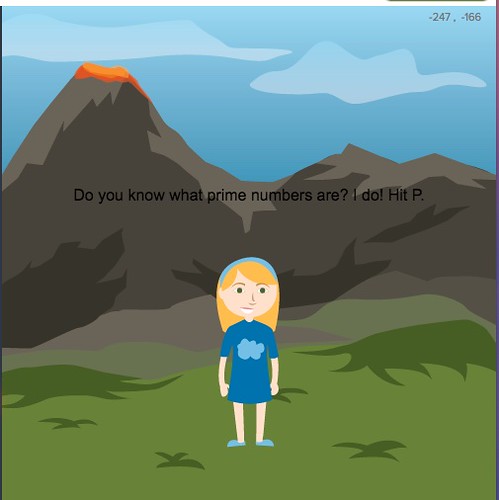
Solution in Codesters

DSCF3530

codesters_primes_2

Code on Paper

Wednesday, February 15, 2017

Rabble Babble

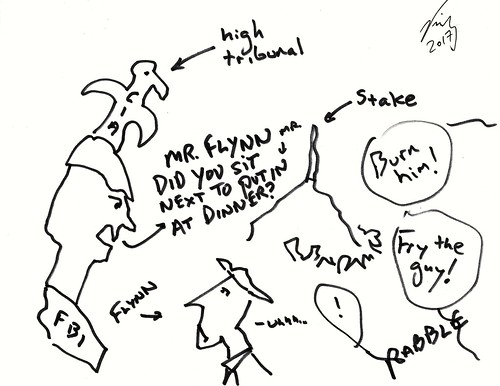
flynn_cartoon

political cartoon, 2017

Kirby Urner on Facebook:

The USSA is now so fascist they'll put you in jail for calling a Russian diplomat, even if you're a private citizen about to be in government. Take the following action: 

1. Call all the Russians you know and leave a message: "help us, we're turning into mindless idiots in the USSA!" 

2. Call the Russian ambassador and apologize for the knee-jerk sanctions applied because RT happens to be better than CNN. 

3. Call your lawyer and tell her or him what you have done as an American Patriot. Sign the Patriots Roster for brave people only (you know who you are). 

4. Cut and Paste this to all your friends, especially in Russia, let them know we need their help ("was the USSR this bad?")

Wednesday, February 08, 2017

Code School Business

Pedagogical Devices

At a Wanderers I didn't chronicle, I met up with Nathan DiNiro again, someone I know from an O'Reilly Foo Camp as well. He's well connected in the open source medical records world, a thread in these blogs going back to my job at St. Vincent's hospital, as a consultant.

That's where I cut my teeth in the world of gathering biomedical data points for anonymized sharing, an important aspect of outcomes research.

I worked for the Center for Outcomes Research, and built both CLAIR and CORIS (the former for the cath lab, the latter for the cardiac operating room).

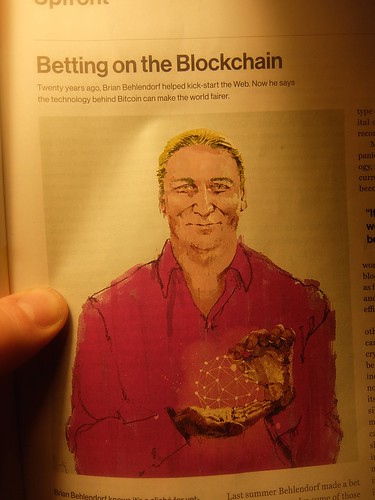
Both Nat and Glenn are familiar with a HyperLedger project. I read a recent article about that at Glenn's this morning in the MIT Technology Review, before backing up my teacher supplies to do a Codester session in Lake Oswego. Last night I was doing my night school gig.

The HyperLedger relates to blockchain, at the heart of bitcoin. The idea of keeping medical records safe in the sense of private, yet shared enough to hook people up with medical studies, is something of a holy grail, and some teams are going after it. Nathan's project is called Youbase, about which you'll find Youtubes.

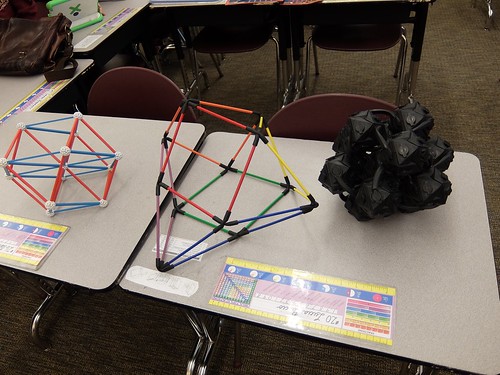
My teacher supplies included a Vector Flexor, never opened. That was a trademark or hallmark of anyone sharing "the Bucky stuff" back when that happened. It's a rubber-joins and wooden dowels affair that shows the Jitterbug Transformation (JT).

Some of you following me in Facebook may have seen my floating the "JT on RT" meme, which I explain on Medium.

Over on QuakerQuaker, I've been talking about trucking again, and my project to make driving the Kabul to Istanbul freeways a for-credit academic program, for "Global U" students. What characterizes the US and EU are the open borders among states and the freedom to drive freight from A to B without queuing for customs again and again.  Africa would like to see more of that too, as well as the Stans.

I use the term "Global U" (global university) somewhat how I use "Chinese Peace Corps": no specific institution or group is singled out, as these are more umbrella terms, metaphors, than particular entities.  They work together sometimes.

from MIT Technology Review

Monday, February 06, 2017

Apollo Project

If rumors are true, that US president Trump has appointed a moon landing denier as a science advisor, then I say hallelujah.  Whether the moon landings were a hoax or not is what the young people on Youtube want to talk about. Most of them were not alive at the time, and have grown up in a world of pretty realistic CGI. Add grainy television, covering over any gaffs, and wow, what a way to save money, when we finally "go to" Mars, right?

Me? I'm still a true believer, think we saw Apollo unfold pretty much as advertised. But that's not the point, what I think. Do I wade in with my hours of rebuttals? No. Am I glad to see the US government reflecting peoples doubts? Yes.

What may be closer to the truth is Apollo is the new stand-in for Nine Eleven, which is still fresh in our minds and the topic of so many Youtubes. Every theory is a conspiracy theory, no matter how you cut it.  In an age of Photoshop and CGI, of course the public is eager to debate what might be agreed upon, that's their right. Having seen Hunger Games, "false flag" is on everybody's lips.

Yes, I'm aware that some people might be holding their breaths for full disclosure about UFOs. DT will demand a thorough tour of Area 51 and then tweet about the frozen aliens.  As many adults have forgotten how many of their peers entertain such possibilities, as never knew in the first place. At least letting us know what's out there, in terms of belief systems, should be the State Department's job, not just National Geographic's, or the FBI's.

I'm reminded of a cocktail party conversation yesterday, with a student of cults, which doesn't mean she's not also a practitioner. She's not one of those who studies something with an eye to wiping it out. Most cults don't have that long a half life to begin with, as they revolve around specific personalities, which come and go.  Once a cult lasts long enough, or gets big enough, it qualifies to be a religion. That's how we think in Asylum District.

Lets talk about the cults and acknowledge them, not sweep them under the rug. But then some holier than thou "at least I'm not in a cult" might be more of a namespace issue than anything.  import this. Python joke.

My point being, cults are frequently characterized by how they grapple with the big conspiracy theories of our day, and do they sustain their own.  What stories do these religions, or mini "designer religions" tell?  How much scientific scrutiny and/or skepticism will they tolerate?  The answers vary case by case.

If there's an inner circle knowingly keeping a detailed truth from becoming public, that the moon landings never happened, then that's a cult, and a powerful one, as I'd say most of us were successfully fooled (as I said, I'm still a true believer, partly because actually going to the moon might have been easier than pretending it were doable). Where and how? It's one thing to say "it's a trick" and quite another to know what the trick was.

What makes these debates so interesting are precisely Apollo's archetypal attributes as a chief of rationality. He marched into Delphi and took over the oracular franchise, banishing and in some accounts slaying the old Python that used to run the place.  The rationalists had displaced Athena by some accounts, a direct offspring of Zeus. Or had they?  These battles stay eternal in some dimension.

Were a major achievement of the rational mind, namely the moon landings, named for its icon, to morph in retrospect into something more occult, dead ending in the murky realm of PR and special effects, then Western Civilization, so called would be charting a new course with respect to the Greek pantheon.  Youtubers sense the high stakes and resent how "mainstream media" doesn't let them participate except as viewers.  Adding to the ranks of talented producers might be the way to hang on, if you're a more traditional broadcast network.

Put another way, I think the lameness of the NIST response to pressure in the case of Nine Eleven has greatly lowered peoples tolerance for suspended disbelief. They feel deceived, even without knowing what's true. That sensation rubs off on Apollo, casting shadowy graffitti across his pedestal. "If we can't believe you about Nine Eleven, how can we believe you about Apollo?" is the question that's being asked.

Tuesday, January 31, 2017

AFSC on the War in Syria

I was checking the AFSC website recently to see what the "Quaker KGB" was saying about the war in Syria.  The advice is typically Quaker: agree to stop pouring in weapons, look for other ways to resolve differences.  Weapons are profitable of course, but those taking advantage of tensions and helping them escalate may not look heroic or noble in the rear view mirror and some people still care about reputation (legacy).

People wishing to be respected as hard-nosed realists, with a strong grip on reality, will often resort to talking weapons, their procurement, shipment and operation. It's part of the currency of sovereignty, a way to signify independence as in "no one gets to push me around".  Governments will amass weapons as a way of saying "you can't make me".

However, the "laws of physics" or "generalized principles" we might call them, don't coerce in the way people coerce each other. When people are trying to assure themselves they're not under attack by some enemy, either without, or within, they may question what's willful and what's fate.

In writing history, we're free to project almost superpowers on various players in our narratives, attributing to them powers of foresight and acumen they probably did not have. Quakers have the advantage of believing in "higher intelligence" meaning they're not always as paranoid about what may appear an organized set of developments. Patterns happen. No need to blame the ETs.

Everyone wants the war in Syria to end except maybe those who hate God and hate Islam. Some psychopaths have a strong urge to feed fires, exacerbate conflicts, see violence expressed, if not by themselves, then by proxies.

I'm a Quaker, but also one to delve into psychology as a STEM discipline.  I've been studying up on the Borromean Rings in Lacan (French philosopher) for example, linking those rings to the three mutually intersecting Phi rectangles of the MAA icosahedron (to take one special case).  Spatial geometry is what links me to so-called Western Civilization, and is likewise a road to Islamic architecture and designs (likewise Western by educated accounts).

I'm not with AFSC these days.  In chapters passed, I attended Corporation meetings in Philadelphia as a representative of my Yearly Meeting (North Pacific).  I also worked locally on the Latin American Asian Pacific program (LAAP), which was mostly about improving cultural relations among diverse ethnicities.  I came to LAAP from having helped with Asian-Pacific Issues News, an obscure AFSC journal.  Lets call it Asia Desk work, or more accurately Pacific Rim.

Sunday, January 29, 2017

Page Turner

Operating Manual

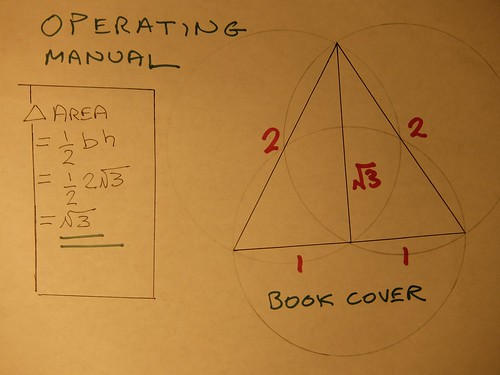
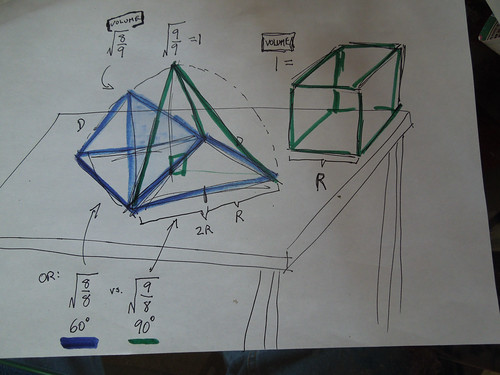
I was reminiscing with David Koski recently, about the "operating manual" he placed flat open on the table, triangular book covers, just the one page.  The edges of the book covers, including hinge, are all two, the diameter of a unit sphere.

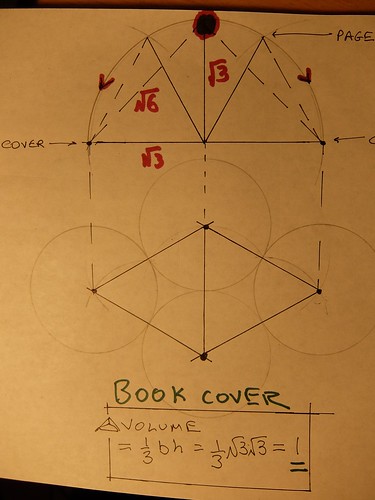
Imagine a page swinging back and forth, wagging, a triangle just as big as both book covers. It has an eye hook at the apex, something for taut string to pass through, should we want to emphasize this sixth edge of the two tetrahedrons. Yes the "page" can stay stiff. This is a moving sculpture I'm describing.

The two tetrahedrons have this page as their wall-in-common. As the page wags back and forth, two neighboring tetrahedrons co-vary and thanks to "base times height" have equal volume.  One may be a regular tetrahedron, with the other more a wedge, yet they'll both have the same volume, whatever we set that to be.

Right Tetrahedron of Volume 1

Imagine holding three ping pong balls in a triangle, a fourth one in the valley between. That's a starting place. Now take one of those balls (of radius R, diameter D) and pivot it around any two-ball valley to assume an angle of 90 degrees to the no-longer-touching furthest ball.  That's √6, ball center to ball center (longer than 2 for sure).

The equilateral triangle of edges 2, both page and two book covers, has a vertical mid-edge to opposite vertex altitude of √3. The Pythagorean Theorem hasn't changed.

The right triangles defining each book cover have legs 1, √3, and hypotenuse 2. Area?  Base times height over two = 2 * √3/2 = √3 per each book cover.

So what's the volume of each right tetrahedron defined by the single page pointing straight upward, at 90 degrees to the book covers open flat?  The string from each book cover apex, to the eye hook in the page, is √6.

Even without that fact, however, we have the base, √3, and we have the height, also √3.  Multiply those together and divide by three, per volume of tetrahedron formula, and we have 1.  Exactly.

Having achieved a volume of one, lets switch to a corresponding cube of edges R, with R being the radius of diameter D spheres.  Our original tetrahedron, recall, started with four of those.  Then we spread a pair further apart. Anyway, our cube of edges R has a volume identical to each of the two right tetrahedrons just described.

What do we do with this fact?  The starting tetrahedron of four closest packed ping pong balls was where we start when measuring volume in our Synergetics namespace, perhaps branded as Martian Math in your neighborhood.

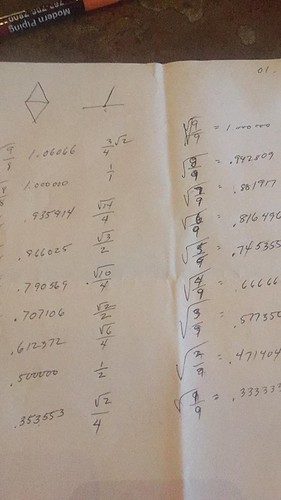
The right tetrahedrons associated with the vertical page each have a larger volume, by a factor of the √(9/8), about 1.06.  We may want to use this constant when switching back and forth between two volumetric evaluations of the same vista, in doing unit conversion.

Green Tetrahedron Volume == Green Cube Volume
:: from Martian Math storyboards ::

Koski Data
:: calcs by D. Koski ::

Wednesday, January 25, 2017

School Teaching

I've been deeply involved in work-study, about 50% work, 50% study, which was my goal. The work that I do is teaching. I'm an andragogue (teach adults) by night, and a pedagogue (teach kids) by day.

It's the latter work I'm just starting, meaning I've still got a ways to go when it comes to mastering MIT Scratch and Codesters, even though I'm pretty well versed in pure Python (above average anyway).

The studying part is more eclectic and harder to describe. I think of myself as an anthropologist quite a bit. I'm an avid consumer of culture.  Remember Bucky Fuller (whom I write about often in these journals) and Marshall McLuhan were good buddies

There's a Fuller title that's very like a McLuhan book, what is it again? I Seem to be a Verb.

Sunday, January 22, 2017

I, Robot

I reconnected with Russian mysticism, as some call it, thanks to a pile of books for sale at Multnomah Meeting. I've since traced prior ownership, of these four volumes, from a set of six, by Maurice Nicoll, to  Friend Marson ("the Marsonite" I sometimes call him, a Peace Corps vet).

I'm referring to Psychological Commentaries by the Scottish Jungian, also a disciple of one "Dr. O" i.e. P. D. Ouspensky. Where did Dr. O enter our story before? In Linda Dalrymple Henderson's book, about non-Euclidean geometry and modern art. Ouspensky was branding around 4D, an icon which the young Bucky Fuller took on as well. Einstein was flying this banner. The 20th Century was looking propitious.

As I've been clear about in other blog posts, we have multiple meanings of '4D' in play here, but let me avoid that whole thread and get back to the Russian mystics.

Nicoll suggests we get back to developing our essence in later life, after maturing through the earlier stages. We have a fully formed personality by then. We've worked out with the reality principle. Put another way, our egos are fully developed and now we're ready to go the next step as it were, to reach for wisdom.  How is that done?

The Russians want us to confront our robotic nature, our mechanical side. That's not always easy for US Americans because "robotic behavior" is usually demonized as somehow totalitarian (which it may be). Using "robotic" without a negative spin, with reference to human behavior, is akin to making "porn" somewhat meaningless, as when we talk of "train porn" (admiring trains, thinking of a Barcamp talk by the late Igal, PDX geek, worked with Patrick a little).

Let me take a well run (smoothly clerked) Quaker business meeting as my model.  The people in attendance all have considerable experience, personalities fully formed.  Kids would usually be off elsewhere, in a program of some kind. Business meeting is all adult stuff, pretty much, awfully dry for little kids especially. Nursing mothers are certainly welcome.

In saying the meeting went like clockwork, I'm not making a negative characterization. However if I say that Friends were robotic in their practice, that sounds insulting, like I'm saying "unimaginative" or "dull" (without the spark of life etc.). That's the cultural divide I'm facing, in translating these Psychological Commentaries into the language of my locale. "Robotic" is a term of admiration.

The resolution of my puzzle is perhaps through the example of Muhammad Ali, a man of schooled reflexes who could hold his own both inside and outside of the ring.  He professed the discipline of Islam in later life, however he came to that religion already self-disciplined.  In Afro-American subcultures, "machine dancing" is a recognized art form, influenced and enhanced by some of Michael Jackson's maneuvers.

Through "machine dancing" we move to the martial arts and all those routines people go through when working for that next colored belt, the next level.

True, Dr O. and Maurice want us to see, in our robotic nature, those features we may at first project on others, when we fail to "remember ourselves" as they say in their jargon.  I'm not suggesting that Friends all convert to such thinking.  However I do think it worthwhile to remember our deeper culture and apply that in our daily lives. Teachers like Maurice did not do all that writing out of sheer boredom. They were working towards a less violent world, less indulgent in negative states, from which great misery arises.

For those not familiar with Ouspensky, one of his famous maxims is "man cannot do" which is on the face of it meaningless. I'd say the program is meant to apply what Nicoll calls "the shock of consciousness" which is an experience of extreme determinism and epiphenomenalism wherein all humanity appears to be on autopilot. Walt Whitman's The Sleepers is a soliloquy of great compassion, by someone with a body electric, another robot in other words.

Friday, January 20, 2017

Amortizing

I was watching one of those reviews of Uber, where they try to talk a would-be driver out of the deal, based on various starting assumptions.  One thing people forget to do is continue discounting the value of what to them is valuable equipment.

In my case, for example, I have this creaky-old 2011ish Mac Air that's been my workhorse through thick and thin.  It has no health insurance.  I could send it in for refurbishing at some expense, but in the accounting world I'd have been creating a savings account based on the obvious need for a next computer someday.

OK, so I'm thinking in that direction. All I need to do is slip in the ice one more time, as they say.  I'll be starting another class soon though and as long as she's still running (the Mac Air), I'm going to keep her on my desk. She's wheezing though. Her fan is off kilter. The severity of the wheeze comes and goes. I know it could get so much worse.

Speaking of loss, did I mention the fish that are going or have gone?  We decided the horse faced loach was a goner quite awhile ago, when he failed to appear even at the usual low frequency. More recently, my top-feeder has died. Lower temperatures may have been to some extent to blame. Fish don't last forever though. Turnover is built in to their design.

Alexia is studying bookkeeping at the college level, having gained some practical experience working with her mother, Dawn, my wife and business partner.  She was good at accounting and really understood the clients she worked for.  She had already taken on another partner and split off the bookkeeping in a way that could continue, after DWA was reduced to a checking account.

One of the DWA aliases, registered with the bank so people could write checks to it, still can, was 4D Solutions, which I map to 4dsolutions.net on the web.  Behind my logo lives the Oregon Curriculum Network (OCN), which I consider my not-for-profit way of helping Oregon in particular.  It's not that anyone in particular has adopted this material. I'm more just joining the throng of earnest scholars who took to the web, like fish to water.

Probably my most ambitious project, considered as a business plan, is Coffee Shops Network (CSN). Under that heading comes a "charitable gambling" operation that converts winnings at games into charitable donations to the coffee shop's list of charities it supports. A donut company might give you the token, with purchase, to try your skill in some way, and then back up your performance with charitable giving on your behalf. You've won the right to commit the donut company's dollar to the cause you've championed.

GST used to be about "fundraising thermometers" a lot, on the web. That certainly happened, in the form of Kickstarter, GoFundMe and all the rest. I've been pretty strong at predicting things, but that's what hindsight is good at seeing.  We get to be right about stuff.  We get to be wrong about stuff.

Talking with Alexia about bookkeeping a little has reminded me of amortization as a concept. Lots is coming back to me. I also used to write about Global Data the corporation a lot.  Going back in time in my blogs gives some examples of that. The goal was and is to provide a lot of global data to the world, however in practice it's Google we usually think about.

My style of thinking is somewhat informed by those years looking at the Hunger Project and looking at some of the Fernando Flores stuff around that same time. His thinking was centrally featured at the 2016 Pycon here in Portland, when one of his students delivered a keynote. I'll insert my recent tweet about that.


Hey, right on cue, as I write about things breaking or falling apart, my kitchen sink just stopped draining. After wrenching apart some pipe, I've discovered wherever the blockage is, it's below the standard trap. Not good. Especially with guests coming.

Wednesday, January 18, 2017

Blockchain Voting

I was bringing up blockchain voting in a Quaker forum, as an example of a promising technology. Farm house Friends still put more faith in old fashioned paper balloting with visible counting, and in a one room school house, this can work.  Perhaps paper ballot counting scales much further, without limit, for the sake of discussion.

Blockchain has excited people for different reasons. What a financial playing field requires is a set of rules that are self-enforcing, in the sense that cheating should be next to impossible, even in theory. With strong encryption, such schemes became feasible.  Gambling casinos are a first good example, as they depend on the mathematics of probability to stay profitable, not on sleight of hand, even if stage performing magicians are among the attractions.

The example most cited up to now is Bitcoin, which came with clever terminology and a self funding model of a self booting currency.  "Bit miners" around the world would learn of the different transactions at different times, more how Facebook works. Not every Friend sees updates to your profile at the same time, but after awhile, everyone knows about them.

The question then becomes, which sequence of events, which chronology, is real?  Instead of making the players prove their case, each one hiring an army of lawyers (good for middle men), a contest is held (about every ten minutes), of a brute force nature, meaning if your computer is capable of monster computations, you win the contest often enough to make transaction-tracking worth your while.

If your bitcoin miner computer wins the contest, it's paid some bitcoin, and its version of events (of transactions, their sequence) gets added to the globally shared blockchain, the one true narrative account. The point of doing it this way is precisely to rely on some shake of the dice that no one controls. Agreement gets created. Trust builds that the transactions are secure.

Micro-payments between individual parties becomes possible, without the usual and more expensive amount of overhead. Sending remittances home, from family members working abroad, is one of the most used applications of this technology.  The currency converts into bitcoin at the source, and out into perhaps some other currency at the intended destination.

How does all this apply to voting though?  That's an excellent question.  Lots of talented social engineers have been exploring the ramifications of blockchain technology on electronic voting.

Before Measure 97 went down to defeat, on the State of Oregon ballot (November, 2016), I was having fantasies of showcase facilities where rotating groups of students, with faculty (more advanced students) could come to learn about the new tech.

However I hadn't thought through who goes where exactly. The mostly unused Sunnyside Methodist Church (or "ghost church") had given me some ideas. I was thinking in terms of teacher training, having watched over my dad's shoulder (he was an education system planner) and having some sense of the workflow.

In other words, say you're at Cleveland High School and learning about how polling and voting works, or doesn't. The school has some voting machines and equipment for counting ballots, with the school routinely bringing questions to a vote. "Who believes in UFOs?"  Yes, that's a poorly designed question, however if the goal is to work out with equipment, the point of the question may not be the point of the exercise.

We go through a lot of effort to authenticate here and there.  To our banks.  To our medical service providers.  One would think a citizen of a nation is by definition entitled to specific on-line services, including the right to vote in various elections by means of a smartphone application.  The fact that the USG gives us no means to authenticate as citizens to perform our civic duties, is evidence that USA OS is still more on paper than a socially engineered reality. Lets hope better days are ahead.

Some readers may have been inwardly objecting, from the top, that Quaker practice is not about voting, so why would blockchain voting be pertinent in a Quaker forum in the first place.  To clarify, I'm accepting that Quakerism does not define the public sphere and that my civic duties as a voter do not fall outside the scope of my duties in general.

Monday, January 16, 2017

War Studies

DSCF2938

That famous folk song that goes "ain't gonna study war no more" seems clearly in the back of the mind of our writer, Friend Wolf Mendl, as he opens with a defense: "Why would a Quaker, a subclass of Pacifist, study and/or play war games?"  Obviously, in order to end it (outward war), in favor of world game instead, he says in translation to 2017-speak.

Lets remember George Fox was looked up to as a leader of the type you'd want to follow in battle. England found it frustrating that some of its bravest had a strong penchant for non-violence, but as the pamphlet points out, that's more the Chinese way, of Sun Tzu. Overt force is just gross, compared to the subtle thrusts of his martial art.

Friend Mendl, then quotes Clausewitz (more often cited than read) in saying the political has to guide the military is a truism, as "the political" is simply what thoughts go through our minds as we set about with our planning. What's the ideological glue that coheres this massive attempt at cooperation? What follows is almost robotic, and gets faster and more precise with practice, which is what drilling is all about.  Martial artists are always looping through their moves in various hypertoon scenarios.

We get to Kissinger and ample citations to a dogma that military might makes for influence on the world stage. That truism, combined with a lot of zero sum game misassumptions endemic to English speakers, but not only English speakers, has led us to the threshold of mutually assured destruction, a cliffhanger for sure.

Back to my point about George Fox as cut from cloth similar to that of a military leader, I think Quakers around Oliver Cromwell's time, on through William Penn, got some appreciation from the war rooms for at least having done some homework. They didn't walk in and immediately start kneeling or handing out pamphlets or other inappropriate behaviors (pouring lamb's blood on everything). They speak knowingly of the chessboard (if not a go board) and have constructive things to say.

This Pendle Hill Pamphlet (#247) contributes in that tradition. Having come out several decades ago, there's no hint of our curriculum changes in the lower grades around geometry, bringing the context of world game to American literature, as E. J. Applewhite predicted and helped make happen. I'm not saying every public or private school shares anything about all of the focal points my own students all know about. Not in early 2017.  However the garden had been planted, the memes released, much earlier in the 1900s. Osmosis takes time. At least Quakers were doing their homework.

Wednesday, January 11, 2017

Wanderers 2017.1.10

Honored Guest

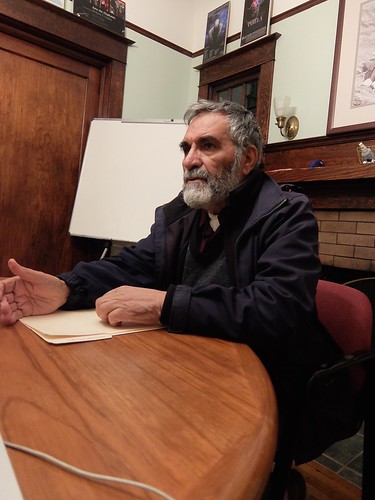
Our honored guest at Wanderers last night is an extremely intelligent and diplomatically skilled dude. I've met a few of these Afghani-Americans with a foot firmly planted in both worlds, that of the US, and that of contemporary Afghanistan.

Dr. Monammad Khan Kharoti is a medical doctor, a surgeon, with a strong understanding of the cultures he's dealing with.  His focus, since well before 9-11, has been providing schooling for Afghans, for girls as much as for boys.  The Taliban have never objected to that agenda.  The facilities are internally gender-segregated and religious texts are not eschewed, as has been the Western standard until quite recently.

Khoroti sees two scourges in Afghanistan: illiteracy (which leads to incapacitating ignorance) and the misfortune to have been associated with Osama bin Laden, which turned the US from friendly to definitely hostile.

Offering free tours of the US to small groups of Taliban, through the State Department, just to learn about the differences first hand, would go much further towards establishing a peace than misguided attempts at military takeover.  Ideologies spread by osmosis, not bullets, which only harden the hearts of those shot at.

We reminisced about the good old days when the world was less in turmoil.  I took a commercial bus for ordinary folks from Peshawar to Kabul that time, through the Khyber pass, with my mom and dad. We had no reason to be fearful in the 1970s.  From Kabul we flew to Tashkent on Aeroflot, then on to Moscow and St. Petersberg, then Helsinki no problemo.

Those were the golden years maybe? Any way back to that?  The trucking industry needs the routes from Istanbul to Kabul to work without obstruction.  Kabul isn't far from Islamabad after that.

Kharoti is well respected by the Taliban.  He's clearly acting in the best interests of the people he serves. His integrity goes unquestioned.


Monday, January 09, 2017

More About Martians

presentation at NIST

I've been on a CC or two with Istvan as I recall, as I was in communication with Ed Applewhite about the time he wrote The Naming of Buckminsterfullerene for Chemical Intelligencer, which Dr. Hargittai edited.

I'm still taking this one in, about the Martians of Science, Istvan's name for his fellow Hungarians advising the Manhattan Project.

Me on Facebook:
I remember when Edward Teller spoke at Princeton. Students hissed a lot. They do that at Princeton, like a viper pit or something, could be unsettling. They did the same thing with James Schlesinger as I recall, another GST guy. No hissing at Isaac Asimov's packed talk as I recall, nor at Nader's (an alum).
Certainly economists compete with one another to become stars in their own field, but the discipline as a whole still…

Given my interest in Martian Math, with input from Applewhite, it makes sense that I'd be doing this homework.

Speaking of NIST, I've enjoyed a recent exchange with Friend David Chandler on the awaited results of a next study (not by NIST, a peer review thing). NIST has findings of consequence for future building designers, given WTC7's structural failure from fires.  I'm following from a distance.

Sunday, January 01, 2017

Andy Warhol Exhibit

Andy Warhol Exhibit

I've been speculating on Facebook that a combination of "cosplay" (costume play), rebellion against arbitrary dress codes ("no head covering") and the emergence of more fairy-tale job titles ("security princess") is going to make the business world quite a bit less boring, in terms of people making fashion statements.

Not that the "business world" even today is a monolith.  In high tech we dress down whereas those "motivated by money" tend to "dress for success".

My own outfit has drifted towards Urban Cowboy with Magnetic Mittens. I've got a P-coat and a Stetson (a little discolored from the weather), and these nifty mittens that fold back to give me fingers, more precise than gloves especially when it comes to smartphones.

I don't have to take my mittens on and off as I ride the bus, at risk of losing them.  Out come the fingers and the smartphone.  I get on with my work.

The hat stays home a lot.  I have a Python logo sweater, gray or black, as an intermediate layer, given we're averaging around water's freezing point, with frequent thawing and melting.  Snow rarely piles up here for very long.

I was heading towards the bus stop the other day, going to see the Andy Warhol exhibit before it leaves town, and letting ten quarters jingle in one of the magnetic mittens, my bus fare.

In a moment of absent-mindedness, I brought out the fingers, I think to wave at someone, and the ten quarters went flying, meaning I was on my hands and knees on the sidewalk picking them up.

When I got to the bus, I was short one quarter but then found a disk in the lining of the mitten I was mistaking for the tenth quarter.  I told the bus driver a just needed a minute to get it out.

But of course the disk was actually the mitten magnet. I must have lost one of the original ten.

Fortunately, my associate had an extra quarter and I explained to the bus driver how I'd made a mistake.  Kinda funny.

Now you might think I shouldn't be bothering a busy city bus driver with meaningless drivel about how what I thought was a quarter was actually a mitten magnet.

I will respond in my own defense that the bus was following another of the same number and was therefore approximately empty.

Just two of us and the driver sailed over the Hawthorne bridge (figuratively speaking) and into town.

The next thing that happened was the PDX Crow Choir (not paid, not human) did their 5 PM raucous caucusing.  The sky and trees were host to great numbers of crows.

In Italian cities it's maybe pigeons and Portland certainly has those, and a few seagulls.  But this time of year the crows own the south Park Blocks, where the Portland Art Museum is.

Again on Facebook, I was showing off my knowledge of arcane English and referring to this large gathering as a "murder" of crows, as that's the technical word for a collection of crows, much as we have a "flock" of sheep, a "herd" of cattle, and a "grunch" of giants.

At lunch today at Dick's Kitchen on Belmont (with pictures of Dicks, such a Tracey and Nixon) my eating partner agreed that "alchemist" sounds less cynical than "spin doctor" for a business card, not that I have either card.

Job titles are getting weirder, that's for sure, and not just in the Capital of Weird (sorry Austin).  Both jobs involve PЯ (PR + propaganda) which is also storytelling.

Thursday, December 29, 2016

Countermeasures

some USers remain skeptical...

The Obama White House did not need to wait until the requested analysis was completed, before showing it means business when it comes to punishing perpetrators.

Like when we first heard reports from Syria, of chemical weapons being used: the White House knew immediately who was behind the attack, and barreled ahead big time, UN investigation be damned.

What Russian spies helped uncover, about the Democratic Party, apparently proved so heinous and repulsive, that the public recoiled en masse and joined the Trump train to drain the swamp.

So the question now is whether the Russians did us a favor.  That remains to be seen.  USers have at least learned an important lesson:  we're a Banana Republic like everyone else, not immune from foreign meddling.

This historic revelation, that Russia forever changed the course of American history, using tricks well known to Nigerian bankers, is going to have repercussions around the world.

Some surveys suggest USers themselves remain skeptical of the seventeen intelligence agency consensus, the same "intelligence community" that made both Colin Powell and George Tenet, and eventually the US president, seem so like idiots on the world stage.

I understand why the president-elect is reluctant to sign his name to this narrative.  Anyone hoping to "make America great again" would think twice about surrendering to this tail of defeat.  Russia is more of a world power than we realized maybe.

Given what we now know about the DNC, might that be a good thing?  Time will tell. Obama himself, judging from a last press conference, seems to think a new grass roots movement will help rebuild its image, in the wake of the latest rout.

Trump has been saying all along the Obama administration was being outplayed by Putin.  He's been hankering for a fresh start, without the baggage of so many botched opportunities.  With the US losing momentum with its "regime change" agenda, this might be a time to figure out a new strategy?

Me? I voted for Hillary because I supported the plan with Iran to create thousands of new American jobs in transportation.  The Iran Deal is good for American workers.

As we learned from Susan Lindauer (a CIA asset in the lead-up to 9-11), Iraq was prepared to buy millions of Made in the USA automobiles before Colin Powell messed up and persuaded us to attack the wrong country. The weapons testers were not happy with that Iraqi offer and railroaded us into war without telling us about it.

Lets not keep making the same mistake in thinking DC really has our best interests at heart.  If that were true, we wouldn't be where we are today.


Tuesday, December 27, 2016

More Core


Three cheers for MIT Scratch, a great learning environment for young coders.

This project provides a quick recap of some of our core concepts.

Remember, the canonical Martian tetrahedron has edges of a full diameter, whereas the Earthling cube has edges = radius, so only half the length.  Even so, the cube holds more concrete.

Most of this core content should be review by now, if you're in middle or high school.

Thursday, December 22, 2016

New Conspiracy Theories


As we all know, the network of shopping mall and department store Santas is primarily an intelligence gathering tool of the retailers, who pay top dollar to find out what's hot and what's not in the minds of children each year.  Is Minecraft still mentioned as often?  With what frequency does a kid somewhere on a Santa say "Lego" (Ogel wants to know).

Not mentioned are the more specialized Santas, able to predict US foreign policy months in advance, simply by resonating with the parents, through their kids.  The tallies get fed to machine learning algorithms back in the homeland, code named Ogel, and out pops some highly refined anticipatory policy analysis.  As you might imagine, these more sensitive Santas sometimes make enough to live on the entire rest of the year!

The next new wrinkle, already under development at MIT, will be the AI Santas, marketed as OK for adults to sit on and confess to (picture Eliza on steroids).  An electronic brain the size of Watson's will dispense therapeutic advice while meanwhile telling Big Pharma where to hit a goldmine this year.  Is it uppers or downers that most adults crave?  And that's just the tip of the iceberg.  Ask your doctor!

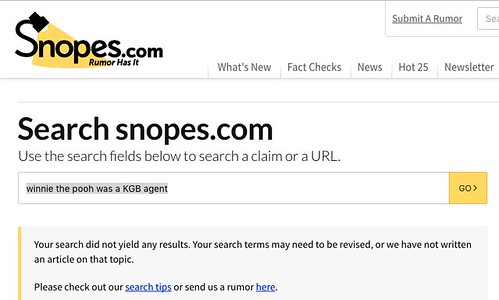
On a related topic, count me a skeptic when it comes to Winnie-the-Pooh's secret identity as a KGB agent. That he would secretly blackmail Christopher Robin while keeping up the "silly bear" act as a front, seems beyond ridiculous.  The notion that Christopher had deep insecurities around gender that could be exploited by Pooh to turn him against the GCHQ (let alone MI6) is the projection of American FBI investigators, still mostly male, and as usual unable to see passed their own homophobia (their pet "issue" since Hoover).

However, if requests for "Pooh Bears" sees some unexplained resurgence, i.e. even in the absence of a new Disney film, I'm prepared to look again at the evidence.  Even if it turned out to be true (stranger things have happened) this intel would be on the stale side in any case, Christopher having long ago reached an age when he could overpower Pooh in any inevitable fight to the death.  Even Piglet (supposedly Pooh's handler) would have had a hard time intervening, once Robin decided to exact his revenge.

Coming full circle, and while we're naming names, I expect the Santas Network has already been tasked with keeping a lookout for any resurgence of interest in Eeyore.  Pooh may have supplied the muscle, but Eeyore was rumored to be the real brains of the operation, and second to none when it came to sapping morale.

The life insurance industry pays a premium for tracking such indicators, even if Langley is more interested in Barbies (that's their prerogative), or if the UK, the more mature culture, cares more about lamp posts and wardrobes.  There's no accounting for taste sometimes.

I checked Snopes before sharing these rumors on Facebook, just to let my friends know that I'm aware of the False News aspects to this story.  Like I said, I'm a skeptic myself.  However, some of you out there may know more than I do, and when it comes to fighting to defend freedom, better safe than sorry, right?

Checking for False News

SIGINT

Monday, December 19, 2016

Blue House Tour

Lets focus on the office spaces in this one.  I'm not showing the Raspberry Pi 3 workstation in the basement because it's accessed through the local network.  No one needs to go down there to see its screen, which I may just unplug and use elsewhere.  Or not.  It's usable as a temporary office as is.

The Winter Office might sound like it's for winter use, and that would make sense, but I'm thinking it more as the cold office that has links to the outside world.  It's under the upper deck we restored.

Winter Altar

Because the Winter Office may run at freezing temperatures, I keep it behind a closed door, running a space heater to heat the Downstairs Office (there's a whole-house furnace but in this day and age I consider running that an unnecessary luxury).

A fish tank right outside has only a small heating device, so I abet that with warmer ambient air, though on a fluctuating schedule.

Downstairs Office + Fish Tank

Finally, the Upstairs Office: also with a cold blooded creature, the pet snake.  This is where I do a lot of my work.

I'm able to sleep there on a futon if I need to, turning my bedroom into more of a guestroom if that's desirable.  I've had a few guests, from Brazil and Indonesia.  The upstairs has its own restroom.

Snake Habitat

Under the guest room (the Downstairs Office also doubles as a guest room), I have a large workspace equipped to share media.  People come over to watch DVDs sometimes.

When the temperature is suitable, I may quit my office and work there instead.

When others come over to work on projects, a question is whether they need a computer.  In that case, the Winter Office might be a best bet, as it has a guest account already set up.

Mostly I'm just supplying fast Wifi, including 5G in the Upstairs and Winter Offices.  We share a smaller bandwidth channel elsewhere.  People bring their own devices (BYOD), like at a coffee shop.

Gotta Have Coffee

Sunday, December 18, 2016

Back on that Python Train

Pythonic Vista

By "Python Train" I mean the succession of versions, fine to come in from the top i.e. no reason to go back and learn older ones, unless you inherit responsibility for older code.  I've got quite a bit of 2.x on the web, at Oregon Curriculum Network.

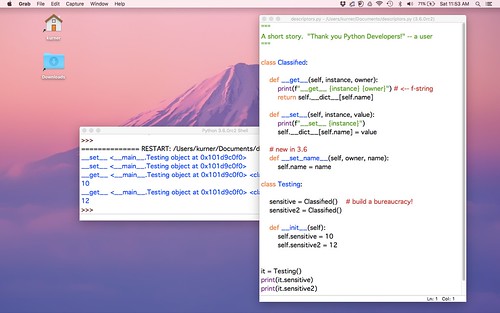
However 3.6 is out, final release candidate, with the first official non-candidate set for release on the 23rd.  I've learned about formatting strings from Chris, CTO at PDX Code Guild.

But only recently, in coming late to various debates, did I get a longer run-down of new features, which inevitably include many other less new ones I'd been overlooking.

Since I'm in the teaching biz and like any professional have to keep doing homework, working on updating skills with latest new wrinkles, I'm taking advantage of snow days, with power, to bone up and stay with it.

There's a sense of being on a moving train here.  Time to move along.  Inertia.

We always do a Hanukkah party this time of year, though we're Quakers and all that. Great traditions. good times, great peeps. My family is all spread out.  White Christmas in Portland (actually not yet, this is in the lead up to), snow and ice both.

Of course I'm thinking of Lindsey's "...get on that train" lyrics (and melody).  She later moved it to Spanish.  I caught a version for Youtube some years ago.  Merry Christmas Lindsey wherever you are. I hope we cross paths sometime in 2017.

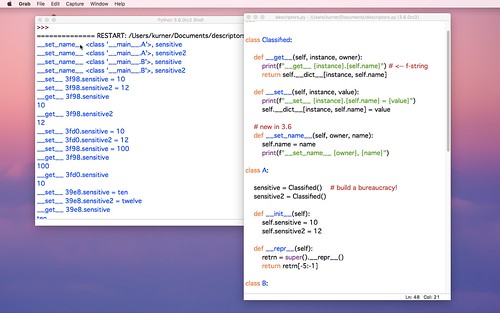
For those of you squinting at the code above (click picture for original, bigger), yes, all "clerks" (what I'm calling them) named "sentinel" or "nigel" or whatever, will file to the same key.

Before you throw up your hands and yell "bug!" or "security risk!" or whatever, remember a use case where we have freeway cams all along the highway.  All cams file to "see it!" and all users of "last_seen" have it in them already, no need to "subscribe" (you did that by naming the clerk as the others did).

The version below assumes we need to keep each value stored with its specific instance, including across types (instances serve as unique keys regardless of type).  What you need from your clerk type varies with use case; Python gives you the "hooks" (the places to fill in the script).  For consenting adults (one of the tag lines).  Batteries included.  Fits your brain.

The takeaway is one does need a clear head, to keep track of what "self" means when several classes have instanced the clerk as a class-level name.

The clerk has a window orthogonal to the type structure, or "the committees" one might say, is privy to what goes on across instances.  Must it keep all those instances straight?  Or is the goal to share information?  Or both?  The language is more about allowing than dictating your designs.

So just remember to document clearly and tell a compelling story to future maintainers, or they'll end up rewriting it just to keep track of what's going on.  Don't just assume the code "will speak for itself" — to you it might, but remember the other people in the room.

Clerk Objects

Thursday, December 15, 2016

A Tale of Two Tunnels

Max on the Move
:: Max line ::

When boring from both ends under the Tualitin Hills, under the cemetery (some bodies moved), the zoo, and the Rose Garden, the engineers used a combination of explosives and a tunnel-digging machine, custom designed, big and expensive.

The tunnelers from east and west would need to meet somewhere in between, for the Robertson Tunnel to take track, then trains, and they did, not without some delays, three cheers for getting the math right.

The Max trains (in Portland, Oregon) use those tubes (one each way) day in and day out.

I get a similar vibe, of two tunnels needing to meet, when I read the papers (understood to be "pixelated papers" more often than not, with moving bits — ads mostly — like in Fantastic Beasts).

The tunnel from the left is looking for Russian spies, the ones capable of steering the offended egos of proud hackers and libertarians.  The tunnel from the right is maybe looking for high rolling internationalist bankers in the long run, but in the short term is hot on the trail of a ring of pedophiles.

Where these stories meet is probably where Russian spies hack in to their victims' computers and plant incriminating evidence.  Didn't we hear something like that on the Alex Jones channel? He was blaming John Podesta as I recall.

I think the PizzaGaters have a point though:  if this is the topic that really most interests that many readers and viewers, then the so-called mainstream media needs to go beyond Snopes and really show the PizzaGaters where they'll need to defend their worldview, even as they advance it.

Saying "pedophilia is real" is no defense, as we just went through over a decade, more like two, of talking about the reality of pedophilia among some professional Catholics. Those stories were and are the focus of any number of mainstream stories, talk shows, documentaries, exposes.

We can't say the "corporate media" (and/or NPR) turns a blind eye to the whole phenomenon.

We grownups are expected to love children, just not in a twisted sexually exploitative way.  Freud revealed (made OK to talk about) child sexuality.

The so-called "unconscious" is having a harder time finding places to hide in the 21st Century, given all the open secrets.

Lets not forget so-called honor killings, genital mutilation, and forced sterilization as concomitant causes of outrage.

Is it that the mainstream media is hoping to keep its more genteel profile and appeal to tea-cuppy Victorians by remaining aloof from the tabloid world, more lurid and sensational?

Journalists are groomed to see such "entertainment news" as the opposite of professional.  Academics write in knowing tones about the post-truth world, but without themselves participating in the mudslinging, getting down and dirty debating "what's a proved fact and what's mere hearsay".

PizzaGaters want to know:  does Comet Ping Pong really have a basement or not, and if it does, are there tunnels? A tour on camera with owner's consent, might've forestalled the lone gunman showing up to "self investigate" on his own.  Snopes claims it's hard to find claims concrete enough to debunk, though it does keep updating its page on the topic.

But then the hero lone gunman, there to rescue the kids, was reviled as a crisis actor (just look at IMDB right? — he'd done some dabbling in acting, then must've gotten really committed). The gunman was roundly dismissed as a paid actor, by the very mob he claimed to represent (that's irony for ya). Crisis actor theories permeate the 9-11 literature as well.

In my view, if the US president is willing to dignify the Russian spy story with a full report, due in January, then we might as well dive in to the specific allegations and collect whatever debunkings more publicly and officially, while finding what truth is to be found.

What's real and what's Photoshop?  We only get this in dribs and drabs.  Partly how conspiracies gain momentum is they fill with meme viruses of questionable factoids never flagged by the true believers' immune systems. They have no antibodies.

What's just a picture out of the blue, with an incriminating caption?  What's innuendo?  A lot of noobs won't know what that means.

Don't we have a calling to educate the young?  For that reason I've referred PizzaGate to the forensic societies, as more grist for the mill.  What constitutes a compelling argument?  Constant repetition?

The sleights of hand used to fill the echo chamber with "common knowledge" need to come to the light of day. Yes the Nazis used such trickery, but so does just about everybody else with a knack for PR.

Lets not pretend only one fighter in this ring knows how to use psychological techniques.  Wrestlers trash talk and self-promote as a part of their job description.  So do chess masters, in more subtle ways (thinking of Bobby Fischer versus Boris Spassky).

If the mainstream press doesn't role up its sleeves and tackle the allegations more directly, beyond saying they're False News, then we're going to have to credit Russian intelligence for doing all the heavy lifting for us, in bringing corruption to light. Accusing them of causing the leaks, without refuting what the leaks are used to purportedly prove, only gives them more power.

The PizzaGate people already look up to Wikileaks for all the emails, which they insist are Google-verified and so on.  The technology gets respect.  Should President Donald Trump pardon Julian Assange then?  Otherwise won't it look like he's afraid to help a hero in battle (the presidential campaign) because he's hiding something about the Russians helping? The debate rages.

The Russians are coming out heroes in this chapter, in having apparently put pedophiles on the radar of a once unaware US public, now out for blood.  Stories about pedophile priests on NPR were not enough.

I'm not saying this is the outcome that's fated.  I am saying that going after Russian spies while failing to pander to the mostly younger generation of "investigator and researcher" is going to self-fulfill a lot of prophesies.

Give PizzaGate the respect it deserves, as a phenomenon, for exercise.  Then maybe we'll be ready to revisit 9-11, long overdue for a more public re-examining.

Me? I voted for Hillary, mostly as a favor to President Obama, who asked me to (me and everybody eligible).  I'd asked him to not start a foolish, endless war with Iran.  He obliged, attacking Libya and then Syria instead.

But just about anyone running for president except maybe Bernie is seen as a warmonger out here in Cascadia.  That's just DC's culture, going back a couple hundred years (through Taft, McKinley and Andrew Jackson to name a few Manifest Destiny heads).

DC as a City (of Morons, with a Beltway) is the province of arms dealers in the business of showcasing and selling WMDs, and not much else they do serves to compensate.  Make peace or go down to defeat.  Right now, DC is choosing defeat, as making peace is much harder.

I see Iran as sanely anti-nuke weapon (not power) while I see nuke-heads as drunk with a phony sense of their supposed "superpowers".  I'm sure that makes me some kind of globalist, and it's true, I believe Planet Earth is a globe (spherical) and that we have only our science fiction (which includes science) and PR (tools of persuasion) to keep our various civilizations thriving thereon, God help us.

Sunday, December 11, 2016

Yesterday...

Storm Consequence

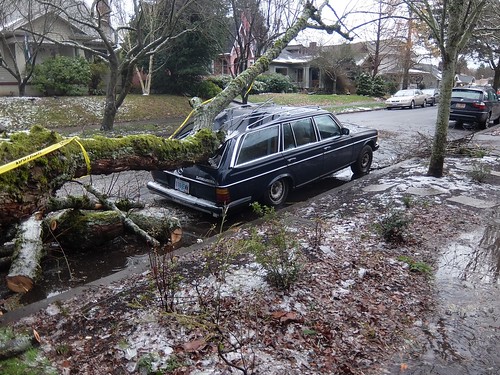
Yesterday was post snow storm, meaning frosty winds had turned the flurries to ice, over-burdening trees, many of which dropped their branches, to the street, to the ground.

Given I had no fixed plans for Saturday, and have a long-standing interest, through AFSC etc., in how Washington (District of Columbia) imposes European-style colonial powers in the territories, I wandered by public transit to the church, ate a bagel, took some pictures, apologized to Pedro on the way out for causing a stir.

One of the agreements was no photography, but I came late and no sign was posted so blithely broke the rule. Someone had the presence to interrupt proceedings and call me out on it, and I acknowledged up front I'd come late and was clueless.

Anyway, I put the camera away and made my exit, using the same bus ticket.

Indigenous migration flows of humans, somewhat mediated by weather patterns, have mixed with the waves of immigration to create a migrant farm worker ecology, with many social ills, hardly a utopia.  Now a stronger sense of nationalism is encouraging all nations to wall themselves off.

Some professors of nationalism may think going to wall systems is a return to normalcy, but they're thinking more of castle ramparts, Hadrian's wall at the most.  We've never really tried fences.  Human migration patterns have always been at odds with political storytellers, or at least often have been.

The commitment to wallify becomes a new test of humanity's patience for this latest invention of some 200 nation-states, many more if we count the virtual and not-UN recognized.  The nation-state memeplex has been swept up by marketing, creating Rogue Nation this (beer brand) and Cyber Nation that (Cyberia).

Twilight zone states, such as Palestine, Tibet, Kurdistan and maybe Cascadia, all cast long shadows in the quantum foam.

Anyway, that Louisiana Purchase was really a good deal.  President Jefferson was conflicted in how he might make the nation grow like magic, on paper.  Where does the rubber meet the road?  Creating more of the USA territory was akin to creating a national bank:  smoke and mirrors.

In this case, a war in Europe led to bookkeepers sliding Louisiana Territories from Spain to France, and France being really hard up for cash, given Napoleonic Wars (right?).  Selling spoils of war with Spain to immediate cash advantage, in a war against the rest of Western Europe (including Russia), seemed a shrewd move at the time.

Why not sell all that land to the Americans?  France would still get a piece of the action in New World business (as would Spain).

Humans had learned to think globally and were divvying it mentally into what was theirs and their king's, with not much long term agreement, lots of bookkeeping, narrative accounts.  The time zones had not been figured out yet, nor the grid of airports with three-letter codes.  Latitude-longitude was getting a stronger grip, with the hexa-pentagon tilings of today (in computer games mostly) still esoteric.

Speaking of narrative accounts, I'm looking forward to a lecture on Homer Davenport, an influential political cartoonist of his day, and horse raiser.  His imported Arabians somehow account for Mr. Ed on television.  Maybe I'll get that story straight this time.

How happy are humans about wallification and fencification?  Travel and migration has always been about more than tourism.  Getting away from weapons testers is another strong motivation.  Drug wars crash lives.  Slavers seem to capitalize on owning you in exchange for getting you through some gate.

The USA is caught in the middle of this questioning as West Region especially has been known for its wilderness and wildness.  Walling in the nations will feel more like one global government than ever, but then where will all the rebels go?

Dictates of biology beget rebels, dissidents, divergents, geniuses and so on.  The nations, with the cushion of virtual nations, need to not be too brittle, which sometimes happens when the logic gets overly calcified (as in skeletal).  Credibility is strained.  Look what happened to the Soviet Union.