Wednesday, May 11, 2016

More Americana

Breakfast Stop

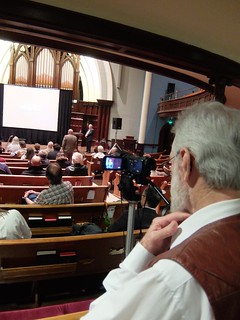
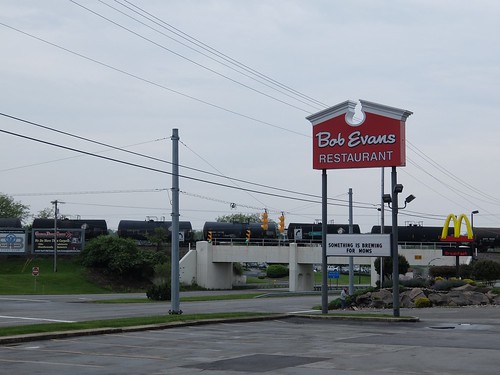
Another time in Richmond, I stayed at a Best Western and shot a picture across I-40 to the north.  On this trip, I was in that picture, at the Bob Evans, looking back.  Dawn preferred Bob Evans to Cracker Barrel, both mid-west phenomena (restaurant chains), extending on into the southeast.

What I have to keep remembering is how much closer the so-called "mid-west" is to the Atlantic coast, in comparison to its distance from the Pacific coast.  It's only a day on the road to Washington DC, whereas it's three times further to Portland.

I used Google Maps to plot a route from Champaign, Illinois to Portland, Oregon.  The computer said we'd have to drive a day and seven hours.  That's if we were in a Google car and could sleep a lot of the way, only slowing for gas and brief pit stops.  A crewed bizmo could do the job, though ideally the schedule is not that hectic.

My route from Champaign to the Budget rental car return at the St. Louis airport took me through Springfield, Illinois.  On the way out I'd stopped in Decatur for lunch.  The Abraham Lincoln Museum was well attended, especially by kids arriving by the bus load.  My schedule was tight and I was low on coins for the parking meter, which had failed anyway, as it turns out.  Shades of Detroit.  I took hurried pix in the Gift Shop by way of keeping souvenirs.

We hear a lot about Greece and its dire financials, but lets talk about Illinois.  Here's another state out of money, completely in the hole.  To whom does Illinois turn?  The Federation as a whole is even deeper in the red and mostly just likes to make rules it won't pay the states to comply with.  The old social contract is wearing thin in that sense.

The European Union is projected in US media as being in trouble, but as the Lincoln museum reminds us, it's the US union that's been through some tough times recently.  The EU has had nothing quite like the US Civil War (which was anything but civil).  This is not a nation that gets along with itself.  The breakdown into eleven states helps make sense of the jumbled war of words happening through talk radio, other social media.

Skywest operates a relatively new service for Alaska Airlines that got me from the St. Louis airport to PDX in under four hours.  We got in early and had to wait for our gate to free up.  I noticed an Icelandair parked at the concourse.  How long have we had direct flights to Iceland I wonder?

I sat next to an Illinois farmer, his wife across the aisle.  Their daughter is a professor at OSU and just had a first baby.  They'd been out before, but not frequently.  He didn't know what "IPA" was (as in "India Pale Ale").

I said the Brits invented this kind of beer to help prevent spoilage in the hotter Indian subcontinent, adding more hops than usual as a preservative.  In the Pacific Northwest, more fresh hops get infused later in the process, which actually shortens the shelf life of the beer (with refrigeration, which the Brits did not have in those early days, aging slows).

With the fresh hops IPA, the whole point is to drink it down soon after it's kegified.

I had a beer on the plane and another at Beaches, from whence I sent a note to Lindsey, as we'd earlier planned to talk around now, but then she realized there was no point renewing her cell phone contract, given where she'd be.  For the most part I'm not doing beer but for ceremonial and diplomatic occasions.  This whole week was about diplomacy.
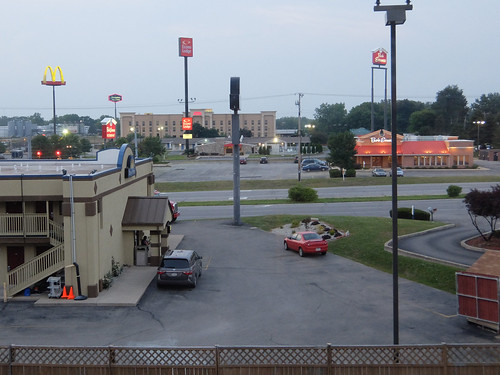

Anywhere, America

Friday, May 06, 2016

Revisiting the Heartland

A year ago at this time, I was still with the O'Reilly School, and was lucky to get sent to the US Distance Learning Association (USDLA) annual conference in St. Louis.  Before the conference started, I rented a car and drove to Richmond, Indiana, via Champaign, Illinois, to visit my daughter.

This year, I'm following much the same script, minus the conference, to be at Earlham College for Tara's graduation.  I rented a car at the St. Louis airport, visited with greyhound and cat-owning friends (Afghan restaurant!), then headed to Champaign, where our code school used to have an office.

The original school was started by fans of the late Jerry Uhl, a professor at the University of Illinois, based in Champaign-Urbana, and was then purchased by O'Reilly Media and repurposed to be a code school.  I joined the faculty after this purchase, as a Python teacher, when the founding principals had already moved to Sepastopol.

Many memories came flooding back once I was back in the mid-west, reminders about the cultural currents, the geography.

I imagined being on assignment for National Geographic, visiting a master upholsterer (and his apprentice Lorri, my former supervisor), a new microbrewery (Triptych), a food cart (Dragon Fire) serving oven-baked pizza.  I've been greedily snapping pictures.  St. Louis has its special Provel cheese and Fleur d'Elise, in addition to the Arch and Climatron.

A most important technique, when it comes to cultural immersion, is to surf through radio stations, listening especially to Country and Christian genres, in addition to talk radio.  The freeway miles fly by faster with the radio on.

"The Donald" had just won the Indiana primary a few days before I arrived, with Cruz and Kasich pulling out of the race to become the Republican Party nominee.   Tonight, he's in Eugene, Oregon and Lindsey left me a garbled voicemail (lots of crowd noises in the background), reporting from the anti-rally, as she's in Eugene as well, freshly returned from Florida, in route to Nepal.

A year ago, when I was attending the conference, those big earthquakes hit Nepal.  Lindsey was in Kathmandu at the time, staying in a fifth floor guest room.  She's heading back.  When her voicemail came in from the anti-rally, I was in the process of meeting my mom's plane from DC.  Tara and I drove to the Dayton International Airport, in Ohio, to meet her.

Carol has been on the road for many more miles than I, earlier this year going from LA to Seattle by van, and more recently from Atlanta to Cape Code, Boston, New York and DC. Doing all the driving is Ellen Thomas, a long time activist very focused on the obscure House Bill 1976, introduced in 2015 by Rep. Eleanor Holmes Norton [D-DC-At Large].

The newspaper I read over breakfast in Decatur was not buying into "Islamophobia" and was encouraging more of a live and let live attitude. Refreshing.

Tara had been looking forward to a sushi extravaganza, in celebration of her graduation with honors in Physics and Philosophy, with a minor in Computer Science.  We enjoyed Yamato, with her friend Kristin (not a seafood fan, but other dishes available).  What a feast!  Congratulations Tara!

Saturday, April 30, 2016

Code School + Gift Shop

Designing an on-line Gift Shop is often the last thing a small business wants to take on, as their professional interest is likely not in learning to code such a thing.

Companies like Weebly and Rakuten are about solving the Supermarket Math problem of making it easy to have a website, including one that features a shopping cart with checkout features.

On the other hand, a Code School is where people go precisely to learn how to implement such services as an on-line Gift Shop, and moreover schools traditionally come with "swag" advertising their brand (T-shirts, hoodies, mugs, backpacks and so on).

So the question becomes:  does a given Code School "eat its own dog food" and roll its own Gift Shop, or does it outsource to CafePress or whatever?

In order to show the world that Code School students are learning the skills, any number of virtual Gift Shops might be kept on the shelf (on the rack) for students to hack on.  A way of building one's profile is to showcase one's contributions to said projects.

Some of these on the shelf shopping applications will actually do front line duty in real time.  A given Code School might swap out the Ux on occasion.

An existing open source project, such as Shoop, Oscar or Cartridge written in Django + Python, might be a good starting place.  Students learn by modifying an existing project.

Other applications may permit a kind of "virtual shopping" wherein shoppers "practice" using the Ux for free, a way of testing features and building community, with virtual money against virtual goods.

These prototype test beds might only face in-house, but why not make some public facing, as well as open source?  Good advertising, kudos to the school, if the shop shares some good ideas and/or interesting implementations thereof, perhaps even in "exotic" computer languages, such as Haskell and Go.

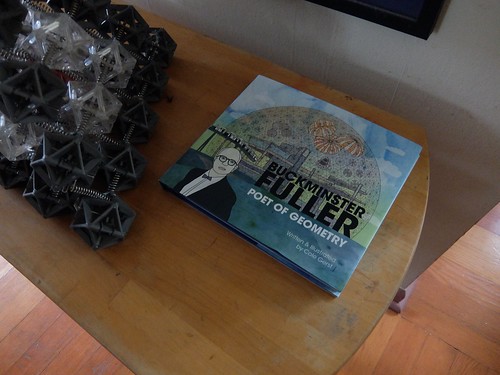
However, there's a more elaborate plan lurking just beneath the surface here.  Lets remember Friedrich Froebel, the inventor of Kindergarten, and his strategy of connecting the schooling process to gifts.  Bucky Fuller attended such a school and had an early breakthrough with the "peas-works" gift, leading to gaining the privilege of patenting the "octet truss" in the 1960s. [1]

As a student moves through schooling, rewarding that student's progress with gifts makes a lot of sense.  Gifts may be tools of the trade, like a microscope or telescope, faster bandwidth, better access to the Internet, a personal workspace, an office.

In the military, people say "rank has its privileges".  These privileges may be granted without need for cash awards.  Code Schools might think in terms of linking various milestones to specific rewards, perks or privileges.

[1]  Cole Gerts, Poet of Geometry, 2013 Option-G Visual Communication ISBN 978-0-615-87344-2, page 13.


DSCF4721

Sunday, April 24, 2016

Best Practices


DSCF4621
:: Wat Buddhatham Aram ::

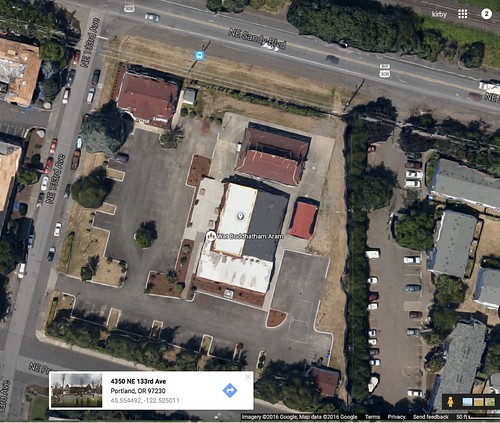
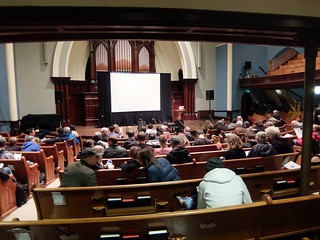
This afternoon I attended a final presentation by Alan Potkin, during this April, 2016 trip to Portland, this time to elders of the Laotian community at a local Buddhist temple, on NE 133rd and Sandy.  He'd presented to Wanderers at the Pauling House on Hawthorne, and to Thirsters on E Broadway, in the previous week.

I've driven by that temple campus many times, usually on my way to or from Costco, on NE 138th, but this was my first time to see the inside.  Alan used a screen and computer projector, and we enjoyed amplified sound, both for his voice and the recorded video segments, including some in Lao.

A treat I'd not experienced before was Alan's head first dive into the epic Ramayana itself, while scrolling through the temple murals his team had helped to recreate.

The story (ພຣະລັກພຣະຣາມ) is known to some Laotians, and Wikipedia calls it the "national story", but it is perhaps not as core to the national storytelling as among some other Buddhist and Hindu nations, elsewhere in Asia?  I'm no authority on these matters myself.

Alan had rescued another version he found tucked away in a cabinet of a forgotten old wat, forty three holy books in the khom language, which he's hoping to see translated into ordinary Lao.  Only those schooled in the older traditions, such as monks and other scholars, can read khom.

When it comes to mega-projects, such as hydro-dams, or smaller, Dr. Potkin's message is pretty simple:  making big changes to the landscape or seascape should entail making a detailed record of what it was like before the changes.  Take inventory, be thorough.  That's a best practice.

He does not automatically assume the more strident position of the most negatively impacted by such projects, that said developments must not occur.  His position is more nuanced.

The trade-offs need to be addressed case by case, in light of clearly presented information, and if a project is to go ahead, then at the very least what the place was like before and after must be well-documented, using techniques used by museums and interpretive centers to communicate to the general public.

Keep updating the exhibits, about the Hanford cleanup for example (like OMSI had), with follow-up information, at intervals. Alan keeps checking back on the projects he tracks, so long as he's able, updating his document database. Outcomes research is also essential.

Turgid phone-book-sized reports are insufficient to get the info across, any museum curator could tell you that.

Given today's cyber-tools, a virtual museum is an affordable requirement, complete with oral histories, videos, and an inventory of flora and fauna and their migration patterns, and their roles in peoples lives.  Alan thinks the Bonneville Power Administration made at least a decent attempt of building such an archive, before Celilo Falls went under, thanks to the Dalles dam.

One of Alan's favorite lessons revolves around a certain World Bank dam that was hastily retrofitted with a fish ladder that never worked, a last minute token attempt to compensate for the vast tonnage of edible protein that was about to be cut off, a fish migration cycle not fully appreciated.

The fish ladder never worked; it was built to the wrong scale for the migration in question.  The dam is only able to produce about 40 megawatts of juice, and serves as an ongoing monument to the World Bank's ineptness, at least back then. 

Have things improved?  Look for those on-line museums of "before the project" exhibits, with detailed information about the local lifestyles, food sources, patterns of trade.  If you don't find any such exhibits, assume the answer is no, it's business as usual.

I got through Costco for under $100, including the $1.50 hot dog + soda pop.

Wat on Sandy

Monday, April 18, 2016

Work / Study Notes

MathPiper in Action

I used some of my time at the meetup tonight to follow Ted Kosan's homework assignment, as I'd agreed on the listserv (i.e. in front of witnesses) to enroll in his work / study program.  

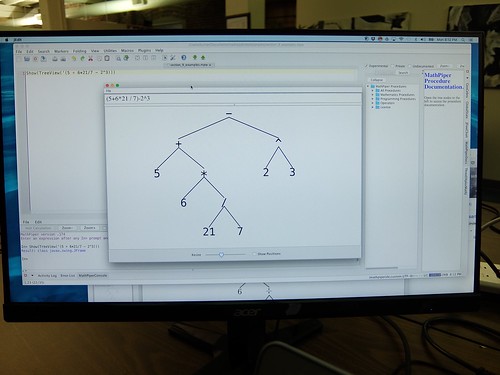
He's going over the basics of a computer algebra system (CAS) which begins by parsing an expression into a tree, as shown above.

He's sharing a JEdit-based framework he wrote and shares with the general public under a GNU v2 Open Source license.

The Document Object Model is tree-like in having nodes containing more nodes.  A Tree is a subtype of Graph and is typically a first recursive data structure (think "fractal").

"Phi is the first Fractal" one might suggest as a mantra, on the basis of its self-referencing proportionality.

I'd started the day's meetings with Mr. Stockton (Global Matrix) wanting to share some Graph Theory, showing me the same nodes edge-connected in two different ways.

What could I learn from this picture?

The first graph was like spokes around hubs with longer distance connections between the hubs.

The second graph was more like connecting all neighbors to nearest neighbors.  No spokes were evident, more like a quilt or lattice.  Same nodes.  Different stories regarding their relationships.

The first graph might be "cell phone provider" (some nodes represent "towers"), whereas the second graph might display "who borrows sugar from whom".  I might assume the same geographic layer for both in this story, whereas graphs need not be geographic at all (just topological).

Visitors to the code school tonight included a German-speaking duo, from Austria and Switzerland respectively.  I talked with the Swiss guy who sat next to me, about his bioinformatics work, training computers to get better at diagnostics.

I explained about my work with tetravolumes in Clojure, inside MathPiper.  He also liked my Nonsense Numbers.

I learned about ternary logic, discussed in Knuth (I'll look it up) and an early Russian prototype named Setun.  Ternary logic is non-boolean, yet a logic nevertheless.  I've been pointing out that even True and False based languages have Null and/or Undefined but that's not what "ternary logic" means exactly.  I'll be doing some more self-study.

Another topic already in the wind, that I learned about only recently, is clockless chips, meaning CPUs that are less clock-driven, more asynchronous.

We've had something of a paradigm shift in that respect at the software level.  I'll be looking for parallels in the literature.

I demonstrated doing symbolic calculus to another attender deep into Doing Math with Python (a new title).  He'll be getting to all that in a next chapter anyway.

An old student of mine (from Accelerated Intro) was there when I arrived, and is currently enrolled in one of the evening boot camps going on in the Business Accelerator building.  I'm glad.

With Sheri (the director) I discussed the Gift Shop meme, a way for any code school to showcase its own ability to source an on-line swag store, shopping cart model.

An on-line Gift Shop is precisely the type of application students come to code school to learn to code, so the Eat Your Own Dog Food aspect is evident.  I came away with a T-shirt myself.

A code school might stock any number of partially developed Gift Shop variants, some as group projects, some starting out solo.  Having a working project on the front lines does not imply other solutions do not exist.

We'll always have need for a "next Gift Shop" if only to give students and instructors opportunities to hack on something well-understood (like anatomy lessons).

Speaking of gifts, my thanks to Benjamin for cluing me about pathlib and py.test.

Wednesday, April 13, 2016

A Pep Talk of My Own


Emmanuel on math-thinking-l immediately saw a connection to Pyret, I wonder why. :-D

Sunday, April 10, 2016

Pep Talks

I'm reviewing these four presentations in the order in which I viewed them.

First comes Steven Witten, a really talented guy with a love of spatial animation and a willingness to share his craft.  Peter Farrell, who uses Pygame to similar ends, clued me about this talk.


Now comes some sober and intelligent advice from John Allsopp, a web developer noticing the trade-offs between mastery / learn-ability and short term convenience at the latter's price, of added complexity.

In the rush to "get it done" we may condemn ourselves to "perpetual infancy".


Dovetailing with the above, comes this talk from New Zealand by Scott Hanselman, a guy from Portland, Oregon (I don't know him (yet)).

He works for Microsoft, which has come a long way in Open Source, since the early days of Sara Ford.

The storytelling here is high quality.  Like John (above), he gives the ten thousand foot historical view.


BTW, TypeScript, on which Angular2 is based (JavaScript in the cloud), is Microsoft's baby, while Angular itself is one of Google's.

I followed Scott somewhere else (on Youtube that is) before he went on to Poland (Scott gets around):


Whereas I don't share his specific disciplines regarding emails and so on, given a different life situation and modus operendi, I'm respectful of the need for self-discipline, whatever shape that takes.

Both of Scott's talks are quirky and state of the art at the same time.

Bravo on all four.

Thursday, April 07, 2016

National Beer Day

DSCF4218

I wonder if CBS Evening News, Western Edition, will have picked up on the beer day meme.  So many memes, so little time (under 20 minutes, subtracting commercials, right?).  I just returned from Hop House where I met up with Glenn Stockton (Global Matrix) and Patrick Barton (Portland Energy Strategies).

I picked up a Vortex magazine, somewhat ironically about the gentrification of the Portland scene (ironic because Vortex is so slick and glossy, and reminds us of the government-sponsored rock concert set up in 1970, partly as a diversion to keep angry hippies away when Nixon came to Portland that time — I wasn't around anyway).

One good thing that happened while Nixon was president was those needing kidney dialysis were given a government dispensation and allowed to live, at least a little while longer, on the government taxpayer tab.

My friend Nick Consoletti, indigent, a wanderer, and a walking encyclopedia of useful cultural information (memes again) had his life prolonged by some months thanks to this Nixon Era program, which would likely go unfunded in today's climate.

I saw our mutual friend Quinn, who organized the memorial service, running by Glenn and I (summit meeting) on Mt. Tabor.

Yes, Glenn wants to fire up more awareness of his Global Matrix meme and since he's all about global data displays, I thought:  what better project for the Global Data Corporation (GDC), a meme I've been using since the 1980s at least?

GDC was not incorporated using "white man law" (in the Federal jurisdiction).  I guess we'd call it "off shore"?  Anyway, I added a new Github subfolder about it this morning, containing some buried PR for Glenn's initiative.  Other PR is buried even more deeply.

Speaking of "buried", did you know the official word for where the urns are kept (containing ashes) is called a columbarium?  That's funny.  "Bury 'em" (an alternative way).  Given my first name, Kirby, is sometimes translated as "Kirk By" i.e. "By the Kirk" as in Churchyard ("Kierkegaard"), I sometimes say "Kirby means cemetery".  So then "Urner" sounds likewise funereal.  But it isn't.

More fitting with "Urner" is URI, or "universal resource index".  Some writers found that too pretentious or something and "URL" (as in "Uncle URL" — I had an Uncle Earl, married to Aunt Betty my grandma Margaret Reilley's husband) became more common.  Either way. the World Wide Web was invented in Switzerland (CERN) where the Canton of Uri is.  That's where "Urner" comes from (Urner = person from Uri).

Speaking of Urner, Kirby, I'm a complete idiot sometimes.  Like today I was preoccupied thinking about who knows what (not me) and wandered away from the cash back I'd requested at the supermarket.  Those were the most expensive Diet Dr. Peppers I ever purchased. I also confessed on Facebook and publicly resolved to make it up by giving up beer for two weeks at least.  $5 / pint x 8, plus it'll actually be good for me.

Really, I don't need to drink beer, which mainly contributes to my stupidity and waistline both.  An old theme in these blogs. I'd be better off savoring the memories.  Yes, the IPAs are really great here, one should definitely try one or two — and I have, many times.

Friday, April 01, 2016

Another Bubble Tea

I have newly acquired a taste for Bubble Tea, and have therefore made Fat Straw on Hawthorne a next hangout.  They know their process.  I'll need to explore more permutations.

The USPO miss-delivered and envelope so I walked it down to the corner market in question, procuring some drinking supplies, which I made use of on Patrick's porch.

He's deep into species recognition issues and realizes human eyeballs on the problem, experts identifying known specimens, will help with machine learning.

His projects could staff an entire company.  He tends to work on that scale.

Out of pocket for health insurance in April:  $1,313.77 for myself and one dependent.  I had to state my case vociferously that March was covered as well.  No that's not an April Fools Day joke.

This posting was though -- a lot less feather-ruffling than last year's post, about an upcoming Pycon in Cuba, which ironically turned out to be true enough.

Wednesday, March 30, 2016

Boot Camp Continues

DSCF3963

I'm somewhat under the gun in my boot camp experience, dashing through a couple Roger Penrose videos, reporting to mathfuture, dashing out to buy a Python-meets-biology book, and so on.

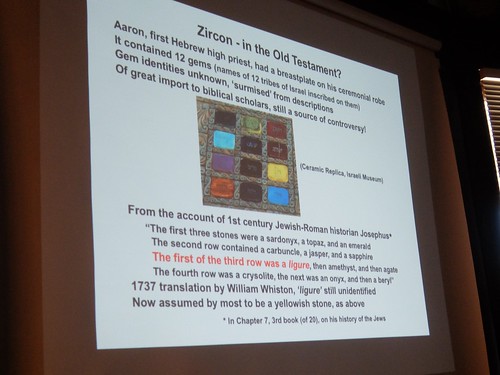
In the midst of all that, I was privileged to drop in on Wanderers, where Steve Mastin was holding forth on zircon, a mineral comprised of the element zirconium, an odd-man-out element with a cation that doesn't crystallize well with the others.

Among these would be Uranium and Thorium, which contribute a lot to zircon's properties, up to making Zirconology, in part about studying chronology.

Zircon's several ways to decay give ways of dating the mineral, a side-benefit of a long-running polonium-related controversy, again with Biblical connotations (see below).

Given earlier civilizations did not use our Periodic Table or understanding of atomic physics, their jargons don't follow ours that closely, and in the case of zircon that's especially true, as in manifests in a wide variety of colors, from vermilion to blue.

In theory it's colorless but in the wild a colorless zircon is a rare find, though some of the colored ones turn colorless with heat treatment, rather commonly applied.  Just how a given specimen of zircon will respond to heat treatment is something of a gamble.

Blue is highly prized, though honey-colored is more its trademark.  Dick Pugh brought an example, as did Steve but I only had time to take a look at Mr. Pugh's, then was on my errands.

A passage in the Torah about some battle vest, or breast plate, and the twelve stones thereon, probably overlaps our modern definitions. We'd expect to find a specimen of zircon thereon, along with beryl, emerald and some others.

Don't expect me to name all twelve, though if you dig you might find something more like a complete listing in the slides.  Steve does a lot of homework to create these talks.

I left around the same time as Jon Bunce, off to Powell's for said biology book.  Boot camp continues, with a five mile hike, including steep inclines, bruised ankles be damned.

The impromptu meetup with Dr. DiNucci at Common Ground was apropos, as concurrency concepts,  taught through cooking in groups (as with Food Not Bombs) is topical within my code school network.  Aside from a Horse Brass half order of Fish 'n Chips, I'm mostly subsisting on Soylent today (version 1.5).

The documentary on Puerto Rico looks interesting (rented from Movie Madness).  We don't see many code schools there yet.

Back at my workspace, I made sure VPython is still working.  Given the dependency on wxPython, I need to use Python 2.7, and a "Framework" 2.7 at that (to provide access to the main display).  So far so good.  Things are coming together.

DSCF3979

Saturday, March 26, 2016

Preparing for Bootcamp


Given I work in the code school industry, videos like this get my attention. Would be bootcampers should take a look at the different "stacks" the schools offer. Not every path to becoming a full stack web developer is the same. Do you want JavaScript top to bottom? Check the MEAN stack. Were you hoping for Python? We have those stacks too.

Your code school may well be associated with some "accelerator program", that's par for the course. Code schools often affiliate with startup incubators.  That makes sense.  Finding students of the latest tools is not always easy.  That's where code schools come in, especially those willing to stay nimble and encourage experimentation with the newer tools.

Experimenting with newer tools does not require abandoning tried and trusted curricula.  The devil is in the details.  Blending old and new requires alchemy.  Attracting creative students helps further the process along, as mentors tend to answer to their students most of all.

Wednesday, March 23, 2016

EthnoMath


John Searle points out that although Wittgenstein has become increasingly influential in the humanities, in anthropology for example, he wrote extensively about the philosophy of mathematics.

"All math is ethno-math" is one of my slogans.  Mathematics is anthropological.  The universities keep these departments separate, true, but that's an ethnic thing.

I go back to Wittgenstein's remarks on the foundations of mathematics and fit in some different language games showing how indeed there's room to break the hold of "squaring" and "cubing" as words for 2nd and 3rd powering respectively.

We're combating the bewitchment of our intelligence by means of language. We might call that counter-intelligence i.e using language games to extricate ourselves from other language games.  Sometimes we apply "counter-spin".

Using triangles and tetrahedrons to model 2nd and 3rd powering respectively is a break with the past, and was pioneered by R. Buckminster Fuller in his Synergetics, but philosophers have failed to grapple with his ideas much in the ensuing half century.

RBF has not yet been accepted into the canon of thinkers it's OK to write about, as an academic philosopher, although I've seen evidence in Nature this state of affairs might be changing.

The high level of neglect of this cultural heritage is an anthropological phenomenon, some of it explicable as backlash against Fuller's own pointed critiques of over-specialization, which left many an over-specialist feeling on the defensive and resentful.

Once we get to a unit-volume simplex (tetrahedron) we have a "concentric hierarchy of polyhedrons" with more whole number volumes than our culture is accustomed to sharing with its young.

How the concentric hierarchy merges with a sphere packing abstraction opens a lot of doors in the imagination.  One learns about the octet truss and its complementary tetrahedrons and octahedrons of relative volume 1:4, with twice as many of the former as the latter.

These important concepts integrate more densely and more smoothly than when cubes and right angles so dominate the picture.

E.J. Applewhite, one of Fuller's chief collaborators, once told me he loved the Wittgensteinian bridge I was building to the Bucky stuff.  He was CIA though, not an academic per se.  Again, we're talking anthropology here.

Sunday, March 20, 2016

Pycon Cuba

DSCF3696

We're seeing a spike in the PSF Cuba working group postings thanks to President Obama's impending visit to Havana.

I've been keeping Thirsters up to date, somewhat a redundant exercise given the python-cuba listserv archive is public anyway.

Wednesday, March 16, 2016

Wanderers 2016.3.16

DSCF3535

The listserv announced an Open Forum for today which is the default mode we go into, if we're not scheduled to receive a presentation.

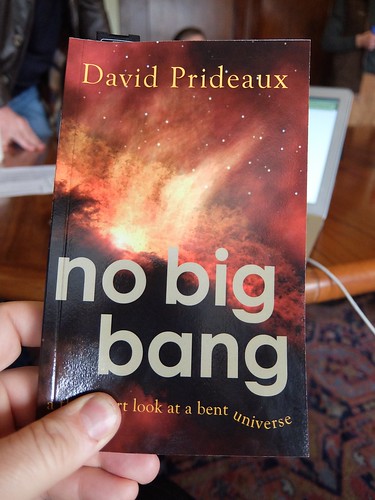
I brought along David Prideaux's No Big Bang, a self published work, just acquired last night from the author, for show and tell purposes.  We had another retired Tri-Met guy here this morning.

Glenn Stockton gave a presentation on some of his more recent research.

He's found some "gears" in Plummer's Cosmic Mind book, on loan from me, that relate to his addressing scheme for the concentric hexapents.

I brought up Cantor's writings on addressing N-spaces, if discrete.

Very dense Turtle trails will give a 1D+ approximation of a 2D surface, much as a Labyrinth fills a circle with its sequential trail.

Given storage units in an XYZ pattern, where Z = floor and XY = row/column, one may also number them sequentially, perhaps in a hexadecimal sequence, or pick any contiguous segment of Unicode codepoints.

Euclidean geometry is all about labeling points e.g. A, B, C... one doesn't need (x,y,z) tuples especially since said points may be in motion (yet their identity remains intact).

A hexadecimal 1D addressing scheme mapping to XYZ cells (storage units, voxels) is typical in computer science.  Video RAM is sequential yet what we're watching is a movie.

Dredging up Cantor's writings on these topics is not mindlessly mouse-click easy right?

I came across his stuff at Powell's.  Such thinking was in the wind during his time, feeding into the "fractal frenzy" that was to follow (Julia, Mandelbrot et al), then Chaos Mathematics (still going strong).

Friday, March 11, 2016

The Security of Things

DSCF3423

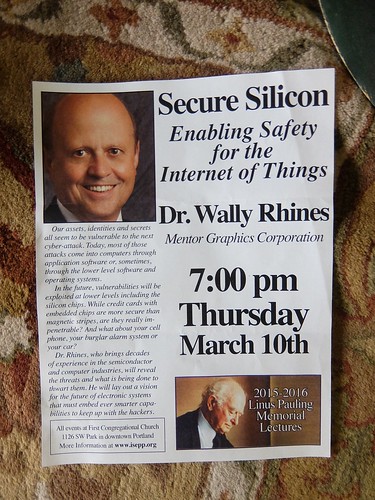
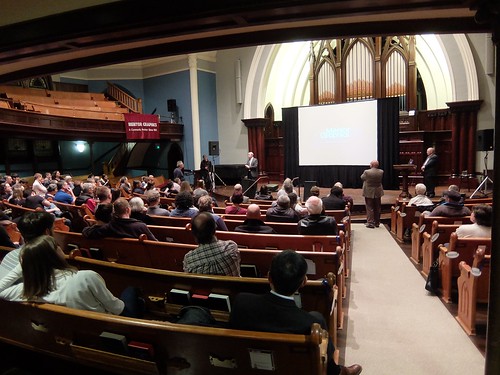
Wally Rhines is no mere bystander, and well beyond the engaged journalist, when it comes to understanding the risks to our security presented by this Internet of Things.

As the CEO of Mentor Graphics, Wally is at the helm of one of the few companies the makes the tools that make tools that make the chips those Things contain.  Chips as in "micro-miniaturized circuit boards" designed to perform reliably and in a trustworthy manner.

What one industry sees as an embarrassing vulnerability, another will see as an exploitable hack.

The black hats challenge the white hats to do their jobs correctly, by breaking into their stuff in ways that should and could be prevented.   The black hats are making a point:  you need to stay on top of your game.

When only white hats abound, some will need to don black just to keep the skill sets up to snuff, the reflexes fresh, much as a human body will do when training to remember past insults.  Memories get built.

Anti-virus software tends to be a huge database of signature byte strings.

Wally started his talk pointing out that humans owned an ever smaller percentage of IP numbers in that most of them belong not on "whois" people but "whatis" things (one could say).

You don't need to register as a "who" to be a toaster or refrigerator in somebody's household.  IPv6 gives us plenty of addresses to spread Things around.

How are chips signed?  Do we want them signed?  What would the signature mean?

We're only beginning to answer these questions.  CEOs yak about these topics a lot.  Wally is on the road quite a bit, sharing these and other, more technical, slides.

DSCF3382

The overall schema is an inverted pyramid in that the most widespread exploits involve various forms of social engineering, trickery around phishing and phoning in with false identities, milling about in smoking areas and befriending employees.

These kinds of security breaches may get wide publicity but affect fewer individuals than mega-downloads of supposedly confidential info.  Sometimes social engineering leads to deeper exploits.

In one experiment, USB sticks were scattered in the parking lot, apparently dropped by mistake.  How many finders-keepers types would insert these sticks in their own machines?  Depressingly many.

Get yourself a quarantined box you're prepared to let fry, if you're wanting to do hobby forensics.  Sure, random memory sticks might have interesting content but that doesn't mean accepting candy from strangers is suddenly a good idea.

Mass downloading exploits, as have been successfully conducted against Anthem Healthcare and the IRS (I've got files with both, so I'm a victim), may rely on security holes in the infrastructure itself, at the base of which are these all-important chips, signed and unsigned.

What if the chip itself is doing surveillance tasks supposedly for customer maintenance and satisfaction but with the side effect of providing a side door into private circuits?  What if the chip itself is hackable?  These kinds of vulnerability may be the hardest to find and yet affect the most people in the long run.

How might a customer verify that a purchased chip does just what the documentation says it does, and no more?

For example the Apple iPhone is currently vulnerable at least in principle but the Apple CEO is working overtime to close that gap.

Pretty soon, what the FBI is asking for will not be engineeringly feasible, whereas today one could enslave people to force the opening.

A safe is meant to be safe and many designs for software safes are in principle, mathematically, uncrackable, unless of course one gets very lucky with some wild guess, less likely than winning the lottery three times in a row.

Once the paper is out of the safe there's no guarantee it's still valuable.  Securities are more vulnerable to shifting markets that crackable safes.

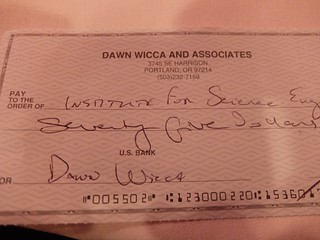
I took a ceremonial US Bank check from Dawn Wicca and Associates to commemorate Dawn's years as a bookkeeper for ISEPP, during a golden age.  She died on St. Patrick's Day on 2007, and I'm thinking about her quite a bit.

Some of the donation was actually paying for a signed copy of Terry's new book, which I'm taking to Quaker Men's Group as worship-reading (also known as slow reading).

DSCF3393


I was allowed to bring a guess and offered seats at the Heathman Dinner to a couple people, neither of whom could make it that night (Patrick joined me for the talk itself).  I had a great time anyway.

Glenn has been working on his "elevator speech" for Global Matrix and tried it out on Wally, who's eye was drawn to the NSA crypto-analyst line towards the end.

Clearly Glenn was familiar with white and black hat territory.

Glenn on Camera

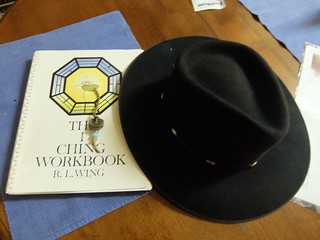
I think I'd already left the scene by then, somewhat ironically sporting the black Stetson that Glenn gave me.  I'd actually gone back to the car for it during Q&A, because I'd forgotten my bank check also.  I moved the car closer to the venue.

Q&A was still going on when I got back.  Wally was generous with his time.  He appreciates these golden opportunities to engage the general public.

I'm more of a social engineering hacker than a hardware guy I'd say, and I'm more the kind to leave bread crumbs, make it a treasure hunt, like with geo-caching, perhaps with product placement worked in.

Sure, there are times I'd like to have been a fly on a wall, but I understand about authorized access and tend to steer clear of areas restricted against my kind.
DSCF3355

Sunday, March 06, 2016

A Tale of Two Movies

DSCF2464

My intent in going to Movie Madness this time was to find something on the Platonic Year.  Glenn is into timeline visualizations, cartoons if you will, that illuminate the meanings behind some of our astro-myths, such as the perennial see-saw between Orion and Draco if I have that right.

Anyway, the star to the north best pegging the Earth's axis is not always Polaris, not everyone knows that.  The planet wobbles, like a top (precession).  Then there's the rotation about the galaxy to consider, another cycle.

I went straight to the Special Interest section, seeking an armload of video goodies, only to not find what I was looking for.  I should take Glenn with me next time.  Having walked all that way, I didn't want to leave empty handed, and so Covert Affairs (season one) and Jabberwocky jumped out at me on the way out.

I'd been reading about Terry Gilliam's life at Powell's recently, snapping pix from his scrapbook, newly published.  Jabberwocky was a puzzle piece in that regard, his next project after Monty Python and the Holy Grail and set in the same period.

A main theme is "framing" in the sense of painting, a canvas, with a frame.  Artists Hieronymus Bosch and Dutch Masters inspired the filmmakers to stage reminiscent tableaus, adding the same comedy device used in Python:  contemporary people projected into an alien past.

"Framing" in another sense drives the plot.  Quoting the tagline:  "A young peasant, with no interest in adventure or fortune, is mistaken as the kingdom's only hope when a horrible monster threatens the countryside."  The young peasant is framed by fate, caught up in events in a bigger story.

Covert Affairs is similar to Jabberwocky in wanting to capture the iconic frames of spydom's Langley, an institution that tries to stay low profile, like some Bureau of Public Roads, so that the public imagination remains unshackled (unfettered) by too much that's banal and mundane.  The lighting and atmospherics make for some classy shots, of BMW derrieres, of HP computers running Windows (or was that Ubuntu, as in Chappie?).  Think:  a cleaned up Archer.

The screenwriters got a tour of Langley, thanks to the PR department, once the pro-CIA nature of the project became obvious.  The whole point is to glamorize with a cosmopolitan brush.  What institution doesn't want such treatment, from some of the world's best cosmeticians?  Every evil queen likes her lying mirror, until the day it says Snow White looks better, or has a purer heart.

The script writers know that avid viewers would catch any laptop or cell phone leaving or entering the building and police against making such basic errors (no GPS devices allowed).   Where these people get their guns once outside the parking lot is unclear.  Mostly they don't need guns because few go into the field.  They certainly don't get badges.

The ones who do get to romp through the countryside are mostly rogue or ex or whatever.  Few Langley-ites really get to see Colombo (Sri Lanka) up close, unless on vacation (no gun required in that case).  Best to get your travel years in before joining the Agency.

One of my pet peeves is how we use television to replace reality with fantasy across the board, and then expect adulthood to just magically happen.  Seeing the workplace through screen-writer eyes is often confusing to job seekers, especially twenty-somethings who grew up on TV and now have only fantasies to go on.

How could one possibly be a real cop if one's main influences were TV shows, like Hawaii Five-O?  Or a doctor?  Or a lawyer?  Or a soldier?

By the time LA and its film industry is finished with it, it's not really a documentary is it?  One has great sets, entire offices inside the studio, and more money to build them with than the makers of Jabberwocky ever dreamed of having.  Or is it that Toronto, where this play is staged, is so much more affordable?

The LA dream machine is like a Jabberwocky in consuming all that's real in its path, and turning out beautifully packaged framed substitutes.  The world becomes more toy-like and Barbified.  That being said, I may rent Season Two.

DSCF2203

Sunday, February 28, 2016

Stranger Than Fiction (movie review)

This piece of fiction, a comedy, does what a lot of fiction does:  it sidesteps the implications of its twisted reality, or avoids letting us in all the way (another way of putting it).

Dustin Hoffman, the literature professor, and the novelist, hell bent on killing off her main characters, have a special relationship owing to their both understanding plot devices, common twists.   The novelist's assistant is also in on the scheme (another meaning of "plot").

Will Farrell, playing the IRS agent, is relatively out of it (clueless) himself, but comes to understand it's up to him to make something of his narrative.  Just going "by the numbers" means leaving everything to fate.  He starts to take bolder action once the reality of his own mortality really gets under his skin.

The film was made in Chicago, as "Any City" (not specifically identified).  Although a very different movie, I had to remember Sacha Baron Cohen in The Dictator, another case of opposites attracting.

The "anarchist" Farrell falls in love with has a bakery that gives off a Portland vibe, radiating its proud independence and rebellion from the fragile left brain number world.

Will's is the weaker gender or "hemisphere" in this model.

I stopped the DVD player to show the Food Not Bombs flyer prominently posted on the bakery bulletin board.  Some thought went into the decor.

Shades also of Trueman Show, maybe?  How is it that others are more in on the plotting than our hero?

What's amazing is how seamlessly Will's evident psychosis meshes with the rest of reality.  As the audience of a fictional film, we get sucked in as the readers, i.e. the viewers, being initiated into an unfamiliar metaphysical setup.

But as viewers we're not omniscient (my earlier point), as we're left wondering how it all works.  But then "they lived happily ever after" is as problematic is "little did he know".  The former is more of a "fade out" convention i.e. "here is where our story ends" whereas the latter more often gets the ball rolling, plot-wise (as here).

Another reading is it all occurs in the mind of the novelist, obsessed with mortality herself, and suffering from writer's block, a threat to her identity as a writer.  She's exploring her on power to create the narrative, both her own and that of others.

I've often wondered if the higher laws or patterns of occurrence we sense, the poetic part of life, might be as physical as Newton's laws.

At the quantum level, we have a grammar, followed with no exceptions, yet might we say the principles at that level no more determine the plot than grammatical rules force the way a novel unfolds?

To commit to perfect grammar is not to surrender to fatalism or determinism, as a writer.

Having checked out this film on the recommendation of one of Lindsey's religious studies professors, we went on to review some of the camera work she had done around Occupy, and the Right to Sleep (perchance to Dream) too.

Tuesday, February 23, 2016

Python Versus Python

Python Versus Python

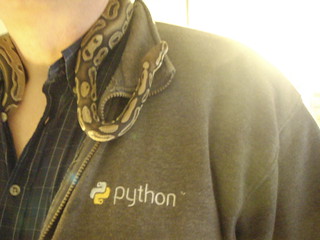
Patrick's family is the proud owner of a python, named Maya (ours is named Barry), which on occasion has escaped, sometimes thanks to owner carelessness (it happens).

Finding a missing python in one's house is no easy proposition, and Patrick was on the Internet in a hurry, the first time it happened, seeking advice.

His search terms dredged up some savvy answers, like place tin foil strategically, sit quietly in an easy chair, and listen intently.

His search terms also took him to pages about the scene in the Florida Everglades, where raccoon, opossum, bobcat and deer populations have plunged dramatically, whereas the python population has been exploding.  Is there a correlation?

How did pythons come to invade Florida? The pet industry moves exotic animals around the world, and these tend to escape, and find each other  If the surrounding ecosystem is congenial, the species becomes established.

Patrick used to work at a national lab (Sandia) and is a trained problem solver.  When BP accidentally uncorked an oil well in the Gulf, Patrick was right away building prototype solutions in his backyard, ready to jump in and help if he could.

Pythons are difficult to find.  They're camouflaged and excellent hiders  They're cold blooded, so drones using infrared are not likely to pick them up.

Empirical experiments, which Patrick shared, suggest people do not find pythons in the wild efficiently.  They're not a great food given the mercury levels.   There's not much motivation to slog through the Everglades looking for hard-to-find snakes.

Florida's wild life managers have been casting about for more ideas about how to manage the python population.  Patrick has been developing a solution:  a new model of snake trap.  He's studied the existing 12 patents for snake traps, which are mostly indiscriminate in what they trap.

John Humphrey's large reptile trap (US8407931) is discriminant for large, heavy animals.  I have something similar (not as long) that I got at a garage sale, thinking to "have a heart" vis-a-vis the attic squirrels.

Patrick wants to bring affordable AI into the equations, building a better snake trap that could provide (1) unattended mode for months (b) discriminate to catch only pythons (c) allow remote human intervention (d) provide a means of doing population research in the wild.

The trap is both tubular and modular, with a catcher up front and an attractant at the back, i.e. bait.  Patrick is looking at various urine scents, dispensed freshly.

The Python computer language is a strong player when it comes to image analysis tools and Patrick's algorithms figure out, from a snapshot in the "boudoir" module, whether the trapped animal is indeed a python or not.

Those administering the trap will decide if it's a death trap.  Rather than have the python stuck in the trap, decaying, a poison that doesn't have aftereffects, such as Warfarin (used on rats), might do the job.  After a quick injection, the python is free to leave.

Keeping the apparatus powered is a challenge in itself.  The Raspberry Pi, an off the shelf computer, is too power hungry to keep on around the clock.  An Arduino board, far lower in power consumption, is triggered by the capturing module to boot the Pi, so the photo-identification phase may occur.

A communications grid is contemplated:  the traps relay information back to headquarters by means of an ad hoc mesh network, using B.A.T.M.A.N for example.

Patrick's research continues.  He has a provisional patent and prototyped components.  He's hoping to test and refine his device in Gainsville, Florida.  He's in communication with the wild life managers.

We had a lively Q&A session.  Glenn wondered about the applicability to CRISPR technology to the python problem, a genetic engineering approach that was the focus of the most recent ISEPP lecture, which I missed. Or how about a TNR program for pythons?

Python Branding

Wednesday, February 10, 2016

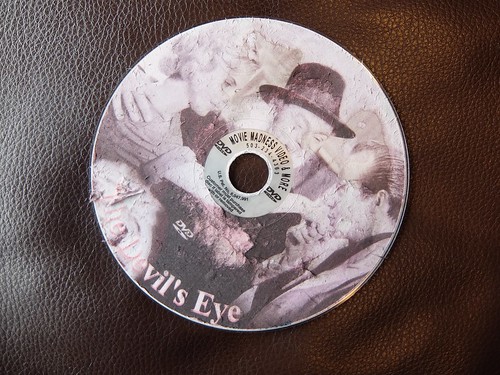
The Devil's Eye (movie review)

DSCF2954

We seem to have embarked on an Ingmar Bergman retrospective, with the Seventh Seal and now another religious parable, playing up similar memes.

We don't get Death this time, as a character, but the Devil himself.  Given the title, we might think his eye problem is less prosaic than a mere sty, which he seems unsure about and needs a mirror to half-discern.  The Devil, being vain, strives to see himself in his own wretched glory, and thereby hangs a tail, er tale.

The Devil is consumed with desire for the wholesome soul of a young maiden, still alive, on Earth, and thinks he has just the man to get it for him:  the corrupting Don Juan, accompanied by his likewise wily vassal.  Both are already denizens of Hell, so this offer of a foray back to Earth comes as a welcome invitation and both prove eager to rise to the challenge, plus a demon is sent after them, just to supervise.  The demon hangs out as a black cat, when not in male form.

The film portrays itself as a Divine Comedy, not unlike a midsummer night's dream, a parable with stock characters in which we may see ourselves reflected.  A naive dad, the vicar, a Ned Flanders type, does not see his daughter as a grownup, nor life in general from that standpoint.  He comes across as the clown, gent of somewhat stunted development, yet unwittingly a prime mover of events.

The vicar's wife, weary of living with such a child-like husband, is open to someone new.  The vassal senses this opportunity and his scenario plays out in parallel to Don Juan's,.  The demon goes after the vicar, trying to shake his faith in human nature.  The vicar proves to be quite a challenge, with an agenda of his own.

The happily engaged couple, the vicar's daughter and her boyfriend, between whom Don Juan's inserting himself would be disruptive, likewise have an unwitting air about them.  Everything seems so planned, so by the book, with the stock players unused to reflecting deeply, going through the motions, eager to do what's expected of them.

With Don Juan on the scene, Hell bent on hot pursuit, our female protagonist is plunged into self examination of her own values, and her cogent self assessment seems exacting enough to take some wind from Don Juan's sails.  She's inwardly loyal, or says she is.

Given Don Juan seems unable to penetrate her emotional armor, a merely physical "love scene" would seem extraneous and perfunctory, beneath his pride.  He would prefer to discover true love in his own assessment of what that looks like, a move perhaps uncharacteristic for him, but a breakthrough in spiritual maturity.  Don Juan finally up to the level of pining for someone other than himself.

The Devil is predictably upset by this outcome.  Don Juan has grown in stature and comes closer to matching the Devil himself in his capacity for despair.

Don Juan has attained a kind of proud boredom and disinterest in his own eternal abuse, which involves endlessly striving to seduce, yet always waking up at the brink of victory, in some perpetual Ground Hog Day of devilish design.  He addresses the Devil almost as an equal, as a consequence of his own most refined sense of "designer sin" and its high price tag.

Thursday, February 04, 2016

Resurgence

I think a lot of us are putting down our soup spoons to listen to NPR hype the future of women in combat roles, a new freedom and liberty they've long been begging to have.

Now that women have equal rights, is the premise, it's time for them to start paying the ultimate price more often.

The Selective Service must be feeling the pinch of only half the should-be-eligible population getting registered and this media campaign was long in the making.

Patriotism, common code words (they kept saying "existential"), and stellar examples of that  unquestioning attitude that makes a good soldier, get strutted out on what sometimes gets called "liberal radio", and we pause to listen, noticing this new voice of a next Pepsi generation (perhaps coached by some oldsters).

Of course the US is composed of diverse ethnic groups, not all of whom celebrate combat roles as the higher service.  Diplomacy takes a lot more skill and isn't for everyone either.

When it comes to "special operations" the military has no monopoly and what's more, never will, as thinking and acting in that unquestioning way exacts a price.  But we have real talent at the top, that's true too, so best of both worlds then?  Too pollyanna?

Anyway, those women who've been chomping at the bit to prove themselves in this all American way (since before the Revolution at least) now have reason to celebrate.  I advocated years ago we give them their own submarine (fleet?).

Whether some possible future world will have the smarts to not always be holding a gun to its own head ("weapons of mass suicide") is debatable, but we may still hope.  Submarines without WMDs are not unthinkable.  Women might prove braver in that sense, less self-destructively trigger-happy?

The spin is this is a victory for feminism.  The real question is are we seeing equal pay for equal work in a statistically meaningful way?

If women are still getting the short end of the stick in civilian society, yet are being rushed to the front lines, that bespeaks of human rights violations.  I look forward to the analysis.  Women and minorities have a long history of abuse in America.  I recommend Kindred by Octavia Butler on that score.

Sunday, January 24, 2016

The Seventh Seal (movie review)


This much-written-about classic by Ingmar Bergman is embedded within every film school curriculum and overview documentary I would suppose.  The Story of Film:  An Odyssey, certainly cites it.  For all that hype, had I ever see this movie start to finish?  Not for credit certainly.

The plot is set in medieval Sweden and appropriately follows a formula, popular at the time (and later), of a small troupe on a pilgrimage, eventually braving dangers together, and in this case, witnessing a witch burning in progress.

The fragility and ineptness of the entire belief system of the day is exposed, almost to the point of comically, in a somewhat Monty Pythonic (satirical) manner ("bring out your dead!").

Ironically, they are being punished by God, for being so forgivably clueless.  Fools are not exempt from the laws of nature however, and Death reaps souls aplenty.

The pilgrimage begins with the Knight and Squire, just back from the crusades, soon joined by Death, who stalks the Knight throughout the film, playing him at chess.  The Squire turns out to be the most learned and free thinking of the bunch and challenges the Knight's belief system in a teasing manner.

The Squire is chivalrous in rescuing a Damsel in distress, from a wicked thief who used to be something of a church authority, the one who encouraged the Knight and Squire to venture abroad on their crusade in the first place.  The Damsel joins the party, as does a troupe of three actors:  the Clown, his beautiful young Wife, their Director, and the baby Michael.

The Clown is perhaps closest to God in having visions all the time, which make him seem the most foolish, though his Wife listens and loves him.  The Clown is in good physical shape given he practices his moves all day, though his juggling is pathetic, what we see of it anyway.  He hopes Michael, their son, will grow up to become a juggler too.

The Wife is not so sure that's a good career choice for their boy.  Maybe he could be a Knight?  The Knight warns that's not much fun either.

The Knight is beset with existential concerns.  He wants answers.  What was the point of his pointless crusade, at the end of the day?  Helping the church burn women at the stake?  The Squire is especially repulsed by the whole business.

The Knight is initially open to the idea the "witch" might have some answers, given her supposedly close relationship with the Devil.  Then he sees she's just delusional, shaking her own faith as well.

In challenging Death to a game of chess, he delays his own demise long enough to win a reprieve for the small family he comes to care about.  The Clown, his Wife and Baby, escape Death for now, thanks to a combination of the Knight's nobility and the Clown's psychic powers.

The world (Sweden) is not a nice place, beset with the Black Plague.  Many are sure these are the End Times.  When Death arrives at the Knight's castle, where our party (minus the Clown family) has gathered, the Damsel seems most drawn to her next world, meeting Death with a look of anticipation.

The Knight rejoins a loyal spouse, who tended the castle all these years, awaiting his return, and yet he is far from overjoyed.  He's too tired to be capable of much emotion.  After his epiphany over cream and strawberries with baby Michael's family earlier, he has become exhausted.  He knows this small party is doomed (the chess game did not go well) and so remains emotionally distant.

There's a subplot with the Director, seduced by the Iron Smith's spouse.  These two, the Iron Smith and his unfaithful Wife, also join the party, rounding out the characters and providing contrasts.  Compare married life for these two versus that of the Clown and his significant other.

The different personality types, at different places along life's journey, all travel together, with Death on the heals of each one.  Like a medieval audience, we learn from these characters, confronted with challenges and adventures.  We feel called to contemplate our own life's journey.

Closing on the theme of Life as Chess (a strategy for winning over death for an interval), let us hear from Benjamin Franklin circa 1750 on the value of learning it:
“The Game of Chess is not merely an idle amusement; several very valuable qualities of the mind, useful in the course of human life, are to be acquired and strengthened by it, so as to become habits ready on all occasions; for life is a kind of Chess, in which we have often points to gain, and competitors or adversaries to contend with, and in which there is a vast variety of good and ill events, that are, in some degree, the effect of prudence, or the want of it. By playing at Chess then, we may learn”  [ source ]

Wednesday, January 20, 2016

Cultural Illiteracy

Special Type

When businesses moved from file cabinets stuffed with mostly typed and hand-written documents, to digital media, most adults got left behind.  Basic reading and writing was relegated to SQL and/or noSQL, which in turn lives behind web forms.  Spreadsheets are "what if" or "read only", like most web pages, making cube farmers the new peasants, illiterate and outside the bastion, not part of the 0.01%.  If a spreadsheet is also writable, then it's too mutable to matter (unless "what if").

In other words, if you're ignorant of SQL, you're incapable of even the most basic clerical functions associated with our current global / local civilization.  You're a peasant (cube farmer?) in the older sense, not like in Cuba where an agrarian engineer might use NumPy on Linux to map out the plantings and compute the return.  Not all peasants are digitally challenged.  But in the USA, where public schools usually share nothing of SQL, the depth of ignorance is deep.

Case in point:  I've always used CenturyLink for Internet access, including as an ISP back to US West days, then through the Qwest period.  I recently upgraded from DSL to optical fiber, but guess what?  I'm treated as a consumer of Prism TV services and no static IP is available in my network.  They don't expect me to host a computer or serve web pages from my house?  Why?  Because I'm just another dumb American who knows neither how to read nor write (in the business sense).

If you're just another dummy, then what you want piped to your house is News Weather and Sports so you can lie there like a couch potato, get fat, and die.  Woo hoo, what a great life that was, right?

Back in the day, the ancient Egyptians had a pyramid society (pun intended) with peasants at the base, then craftsmen, then military, then finally scribes and inner circle courtiers surrounding the Pharaoh.  Switching to China, we imagine the Emperor, surrounded by eunuchs.  The scribes were the ones who knew the SQL of their day.  To peasants, record-keeping was what it seemed like to us, a lot of cryptic hieroglyphics.  But the eunuchs knew the power of clerical work (clerking) when it comes to effective admin.  Fast forward:  So why do you think they call it "Unix"?  That's a joke for insiders.

We've returned to such a society.  The cube farmers who just use Microsoft Excel all day are piss ignorant with no scribe-level business skills.  They're mostly kept alive in meaningless jobs (feeding pens) so they'll consume and pay bills in a service economy.  The economy depends on pointless shopping and meaningless services.  If your life develops enough meaning to where you can't be trusted to mindlessly consume then you're a threat and a good-for-nothing.  Preventing the spread of static IP is a first line of defense against literacy making a come back.

Friday, January 15, 2016

Techno-Morality: A Linus Pauling Memorial Lecture

DSCF2589

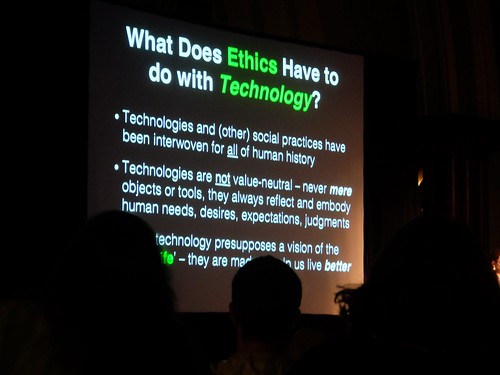
How is techno-morality different from morality more generally?  The virtues Dr. Vallor ticked off sounded familiar:  courage, humility, wisdom, magnanimity... I'd add fortitude, the ability to persevere in the face of adversity.

For example, when I tried to upgrade my copy of PyDev recently, the Python developers' plug-in for Eclipse, the screen dump showing error messages might have demoralized a lesser version of me.  But with the right mental attitude, I was able to focus on the documentation and "just do it" as they say around NikeTown.

Being a geek requires cultivating a kind of athleticism, along with a kind of self-congratulatory mechanism that are together conducive to making repeated attempts.  If at first you don't succeed, try, try and try (and try) again.

But who said being a geek was what Shannon was interested in?

I'd say she is one though, interested or not, that much was clear.  She mentioned liking to study the The Walking Dead for its philosophical insights, and I can see why.  That show pushes us to vicariously experience "life at the limits" as Walter Kaufmann would say.

Underground comics have been for ages a place to study the philosophical implications of a society gone off the rails or pushed to extremes in one dimension or more (Batman's Gotham is another paradigm use case).

Lets put it this way:  when the Internet first hatched from its dinosaur ARPA egg and started to reach the teaming masses, a need for "netiquette" or "Internet etiquette" was born.  But etiquette is so much lesser a word than "virtue" or "code of ethics" or even "code of conduct".  Netiquette includes such style guidelines as staying away from ranting in all uppercase letters in one's communications, a practice derogatorily referred to as "shouting".

Etiquette connotes manners, civility, not making a fool of oneself, whereas Ethics goes deeper and reflects character in a more telling way.  We all see a need for Netiquette, i.e. rules of the road, noticed if broken, so how much more so, then, should we accept a need for techno-ethics more generally.

To answer my opening question, then, what Dr. Vallor was acknowledging and addressing is the exploding set of possibilities, hitherto science fiction, technology might realize or has realized already.

Our decisions, vis-a-vis our technologies, are having more complicated ripple effects such that our powers of judgement are called upon as never before.  An ethical sense is what stands between a life worth living, and everything turning so ugly (as in The Walking Dead) that going on has become of questionable worth.

Fermi's Paradox is that we just aren't seeing many signs of intelligent life out there, and this becomes hard to explain given how hard we're looking.   "Where are all the people (intelligent life forms of any kind)?"

One possible explanation is developing high technology is almost always a prelude to a kind of crisis or singularity that removes said civilization as a source of positive radio noise.  Are we seeing evidence (in the silence of space) that species of our abilities are fated to be short-lived?

Shannon is ultimately in the business of risk assessment or even triage.  Looking ahead, at possible threats, such as a cosmic body smashing into the planet, what does it make sense to fear most, fear a lot, fear less?

Having a "fear profile" that maximizes one's chances takes discernment and homework.  For example she didn't think AI robots were about to stage a coup as the more intelligent / entitled half.  Much more likely, our cavalier reliance on silly algorithms would take us out.

We're more likely to perish thanks to machine stupidity than smarts, in other words.  We'll shoot ourselves in the head, figuratively speaking, i.e. start a nuclear war, simply out of carelessness.

The future is seemingly more opaque given complexity which is where the humility comes in.  Even as Vallor was outlining some of her own chief fears, she was quick to back off claiming that her perspective was the last word.  She made no claims to omniscience (refreshing, in a philosopher).

The audience was very engaged as questions of ethics with regard to technology are prevalent and galvanizing.  She had been to a middle school earlier that afternoon and the kids were eager to articulate about the issues.

We can all point to use cases, such as a doll that records what children are saying to it so that adults might listen in later.  Is that an invasion of privacy?  What is "right sharing" as Quakers might say?

What is characteristic of philosophy when it comes to ethics is there seems a less well-developed set of pathologies where an absence of ethics is concerned, in comparison to what the medical profession has crafted.  When it comes to the anti-virtues, what has philosophy to compare with DSM V?

What shocks many a virtuous adult about the Internet is its lewdness and carnival atmosphere, its peep show / freak show aspects.

Such noir aspects of cyber-life are as likely to attract the attention of psychiatrists as philosophers.  But then spin doctors of all stripes are attracted by extreme phenomena.  For every virtue, a host of sins beg for our concerted attention.

DSCF2586

Sunday, January 10, 2016

Critical Path

evening_gig

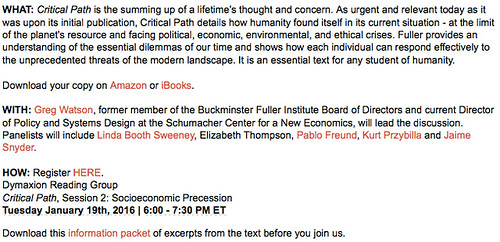
I'd join this reading program, hosted by the BFI, led by one of its board members, however I'm booked for a gig of my own that same evening.  Malesh.  Another time maybe.

Critical Path comes between Synergetics and Grunch of Giants, and follows the Hegelian pattern of some Pure Logic giving rise to History (a narrative telling, with a point of view, or many, polarized, and partially overlapping), which latter telling seems pretty twisted, leaving us worried Synergetics might not be the last word in the logic department ("ongoing corkscrewing" more likely -- it's not defining itself as a terminus).

Or is complaining about "weird and twisted" a deliberate miss-framing of a poetically licensed work?

Like what's this about humans specializing towards Idiocracy, passing monkeys going the other way, towards Planet of the Apes?  How did we get beamed here as information again?

Fuller's stars don't just shine at night, they program, for lack of a better word.  Lets at least agree their information is structured, if only spread out over signature frequencies.

The elements "talk" (broadcast) and why shouldn't they?  Spectrometers pick up information on what stars are made of.  Clearly the stars do inform the planets, in ways more than just by helping to drive photosynthesis.

In later chapters, Fuller definitely plays the Cold Warrior, moving his chess pieces around his global World Game board.

But then isn't "cold war" just more "cryogenics" in a synergetical sense, something meticulous and computational, like game theory?

How much of this is more smoke and mirrors?  How much enciphered?  Is "explorations in the geometry of thinking" a little bit like living through Lost?

They're always taking us down blind alleys, these tale-twisting bardic old people (Tribal Elders).  Some level of suspicion is not out of place, if only as a defense of a personal namespace.  We each give voice to a Universe, Carl Sagan a case in point.

Bucky shares lots of good inventions.  Like that's a really cool idea for a Geoscope in view of the UN building in NYC.

His plan for the US Expo Pavilion in Montreal was similar but ended up featuring the pure geometry of the dome (a slice of a geodesic sphere actually) instead.

The District of Columbia (WDC) crowd grew leery of Expos after that, given their fall from sophistication in some new cycle of American thought.

The USG peeled off from the Worlds Fair organization, following a different drummer, following Orlando perhaps i.e. Disney's EPCOT would be the permanent tribute to America's exceptionalism.  Or did America vanish into the singularity of Tomorrowland even before the USSR did?  Let historians debate such questions.

The Geoscope / Mapparium now have their software incarnations ala Google Earth and Terraserver, with ESRI providing a Dymaxion-skinned view, not a requirement, where global data is concerned, but certainly a nice-to-have.

Some schools of hermeneutics consider it impossible to have "literal truths" about the uber-murky past or future, not because we don't know the literal truth so much as our language is not designed to express it.

The box we think in is pretty strict and quickly stops makings sense when outside of.  These schools see myth not as a substitute for truth, but as an encoding for which no key is yet available, but yet may prove decipherable to some degree, to professional oracles and others similarly predisposed.

The stuff about humans and dolphins inter-twined is meant more as a friendly arm around a fellow mammal, a set of species the seagoing have long spun yarns about.   

Critical Path has its whales, required in any oceanic myth aiming to spring up from first principles, embracing at least some of what we know.

Wednesday, January 06, 2016

Home Economics

A pattern for me, when thinking about concurrency, is to gravitate to cooking in a large well-equipped kitchen with multiple chefs.  I should thank Dave DiNucci for connecting these dots for us at a Wanderers presentation.

I folded laundry while watching the "wicked smart" CBS Evening News (alluding to the last story about seeking the authentic Boston accent).  Meanwhile, I shouted to my dog downstairs that I'd be back down shortly (she gets lonely, and can't walk, let alone climb stairs).  All multi-tasking.  Reality runs in parallel even if we imagine "now" time slices in sequence, integrating the differences.

The Gathering of Western Young Friends was also influential, in developing my appreciation for an institutional kitchen.  This group of Quaker-Pagans sought out remote retreat center camping facilities that would allow the customers to take over logistics in a big way.

We brought in our own supplies and orchestrated the meals.  It helped that a few of us (not me so much) were serious foodies, the kind with their own knife rolls.  Some had cooked professionally.

Fast forward to Food Not Bombs.  When one joins a food prep team as an anonymous stranger, with others on the team also unknown to one another, with the ingredients for that day also somewhat luck of the draw, then collaboration powers inevitably get developed (unless there's a breakdown).  People have an ability to self-organize, given optimum conditions (e.g. the prospect of a healthy meal as a reward for task completion).

I was able to book our Quaker meetinghouse on Stark Street for a year of such experiments.  We pulled it off every Thursday.  My house was a hub for bicycle trailers coming and going.  We had some room for inventory, both at my house and in the meetinghouse basement (just a single box in the latter location).  My blogs chronicle this chapter and suggests one's habits have a way of perpetuating themselves, have a kind of inertia of their own.  Isn't that why we call them habits?

The most powerful habits are habits of mind, which may encounter the least resistance.  Physical habits maybe change, but in thought we have freedom, including the freedom to get stuck in a rut.  Learning to get free of thoughts that comprise a mental prison more than a path to liberation is a life-long challenge.

We need fast reflexes to get by.  Habits of thought are not in and of themselves "bad" so much as "potentially worth countering" -- usually with other habits.  We learn to consciously cultivate new habits as a way of dampening obsolete ones.

In team sports, coaches strive to impart the habits associated with team work.  In my essay on Home Economics for MathFuture, I stress the similarities between athleticism and multi-tasking with others in a well-equipped kitchen.  Sailing a boat likewise requires working as a crew.

Every successful enterprise needs team players with an ability to work together, developed over time through practice.  Home Economics, as much as any team sport, might become a basis for infusing these skills more widely through what we call school.

Jay Rinsing Burley

Friday, January 01, 2016

Think Outside the Box

Those of us working in the neighborhood of Common Core and STEAM (STEM + Anthro, or Art in most accounts), might appreciate "outside the box" as a fine meme to build on.

How?

What do you picture when you picture a box?

No doubt a rectilinear affair no?  Not a tetrahedron certainly.  But why not?

The tetrahedron is the paradigm container, with minimal edges and faces.

Forget practicality, think about conceptuality.

We'll get back to practicality, with the same Cube in a spanking new context.

We might spin it as "break free from the box" in the sense of the box's shape

We're free of our stereotype of "a box".  The blinders have come off.

What difference does it make, to be free of the "box shape"?  Think about it.