Monday, June 20, 2016
Golden Rule (Part 2)
Part One of this story took place in the Quaker meetinghouse on Stark Street, however the seaworthy boat in question was around longer, per plan, and various scenarios intersected, as mentioned in my Facebook profile. Lew Scholl got a ride thanks to conversations at the Solstice Party (Wanderers) that I missed. Meliptus got involved.
Part Two was in Vancouver, Washington and featured several guest speakers, including my mom, for whom I served as chauffeur. I hadn't realized the famous Leonard Peltier had a son named Chauncey, an Oregonian. The Veterans for Peace organized and promoted this public-welcome event, in a room designed precisely for such public occasions in a Clark County public utility building.
I could give a lot more detail, however I took this opportunity to dive into Twitter more concertedly, part of my boot camp training, so I'll recommend poking around in @thekirbster at some point, scrolling back to this timeframe, if wanting to get more of a blow-by-blow as it were (more of the "as it happened" action).
Helen was a main presenter and mom gave us three reasons for hope: the Ban Treaty (percolating); the city mayors of the world (good at saying no to would-be nukers); Marshall Islands taking a stand (as a victim of nuking wanting to see conditions of the NPT enforced).
Mom also links that wistfully-toned folk song, Last Night I Had the Strangest Dream to the Kellog-Briand Pact in a funny way, reminding us truth is stranger than fiction (it wasn't a dream at all).
Sunday, June 19, 2016
Songs from the North (movie review)
I learned quite a bit from this documentary by a South Korean, doing a kind of anthropology that doesn't apply overbearing spin at every turn. She takes very long camera shots, to the point where her subjects get uncomfortable, as may the viewer (the equivalent of staring, however she's getting permission, usually). The opening shot, of some kind of circus act, prepares us for her style, which I'm not objecting to, only describing.
She's not without opinions or views, though when it comes to politics she turns it over to her dad to talk about his friends who went north out of idealism. In her dad's view, whatever Communism means, mainly a society among equals, is not what's practiced by "the Kims" and the cult of personality developed around them by orphaned and existentially traumatized children, now adults with children of their own.
The filmmaker suggests North Korea's freakishness is due to a freakishness of another kind: we all know what Americans are like. We hear an American talking about wartime supply lines, and a goofball general wondering, like MacArthur, why his troops were held back in any way. "We had the atomic weapons and could have done whatever we wanted to up there" he says, leaving us to wonder what "we" wanted to do, and about what exactly. General Westmoreland's Vietnam was still ahead, as was the hit movie and then TV show, MASH.
The Japanese oppressed the Koreans terribly, and then the Americans came in and sliced the country into two, along a parallel that North Korea's Kim Il Sung never accepted. His efforts at reunification brought nothing but more retaliation from the Americans who had meanwhile become friendly with both Japan and Germany (vanquished foes make good friends). Following world affairs has never been easy.
The North Koreans eye East Germany as prototypical. How East Germany got incorporated into the EU might serve as a model for their own reunification as a peninsula. Yoo's dad encourages the North to build up its economy, which, as Communist, should be its first priority, but he sees them mostly doing political calculations instead. The North Korean geeks are worried, that if a merger backfires, they'll be blamed and treated as internal threats, simply for being most like their counterparts (geek culture is cross-cultural because the Internet is uber-permeable).
We're left with Yoo's strongest impression: this is the loneliest country on earth, in a twilight zone of only a short history shrouded in myth. Neither the underground test nor the satellite launch looked all that believable but I'll leave it to the experts on Wikipedia to argue whether these have anything to do with real phenomena. Why should the rest of the world tease and taunt a lonely child? Why be so childish? Yoo's eye is compassionate, neither apologetic nor angry. She didn't start the fire.
:: flash forward to 2018 ::
Friday, June 17, 2016
Slowing Down?
I heard speculation today that the looming uncertainty around the Brexit vote helped stay the Fed's hand regarding hiking interest rates. If that filtered through to me, I figure many are saying it.
I'd add there's an element of projection here though, in terms of the US pot calling the UK kettle black, in that there's looming uncertainty around the US presidential elections as well.
If one is running a business, making plans for the future, these known unknowns add up, on top of unknown unknowns that will always be there.
I hadn't realized to what extent Gibraltar was involved in the calculations, in terms of its staying in or leaving the EU as well. I'd been focused on Scotland and sentiments there.
Effects of the Intel layoffs are noticeable locally. I just heard about WalMart. Unemployment figures may also have played a role in giving the Feds more reason for hesitation.
Merchants in wholesale and retail have to be looking ahead to the Christmas season around now, anticipating how things might go until then. Pundits were saying the presumptive Republicans had a greater chance of winning the presidency if the nation were gripped by fear of terrorism.
That was before Orlando, which many presumptive Republicans blame on a foreign state that mostly lives in people's minds at the moment (no borders, no passports, no currency, no embassies...). If there's a line between a mental state and a political state, I'm not seeing it at the moment.
Although the media are looking at gun control, which is no back burner issue, the matter of actually barring Muslims from entering the country will require suspending the Bill of Rights will it not?
Congress shall make no law respecting an establishment of religion, or prohibiting the free exercise thereof. If practicing the Islamic religion is grounds for deportation, wouldn't that be a law prohibiting the free exercise thereof?
I'm not the only one who remembers General Hayden's remarks on Bill Maher, the big headline on February 26 of this year. He suggested the military would need to disobey any orders that directly conflicted with their Constitutional responsibilities.
What will be the demand for teddy bears and security blankets, come Christmas, if we're looking at martial law and/or troops urged to protect the existing US Constitution? The question has to be in the back of some minds, even high up at WalMart.
People in the US are not used to a situation like in Egypt, where the Constitution was in abeyance for many years. The new Egyptian Constitution is only about two years old, not over two hundred.
Actually, Constitution Daily says only that the question of constitutionality is open to debate. A political movement tried to ban anyone of Chinese heritage from entering, not a ban based on religious beliefs. That gets cited as a precedent.
Hysteria about martial law is coming from other corners. Youtube has many shrill clips predicting a power grab to give president Obama a third term. FEMA camps feature in many of these. Combine the US election with Brexit, and there's a lot of fear in the air. Many businesses slow down in such a climate.
I'd add there's an element of projection here though, in terms of the US pot calling the UK kettle black, in that there's looming uncertainty around the US presidential elections as well.
If one is running a business, making plans for the future, these known unknowns add up, on top of unknown unknowns that will always be there.
I hadn't realized to what extent Gibraltar was involved in the calculations, in terms of its staying in or leaving the EU as well. I'd been focused on Scotland and sentiments there.
Effects of the Intel layoffs are noticeable locally. I just heard about WalMart. Unemployment figures may also have played a role in giving the Feds more reason for hesitation.
Merchants in wholesale and retail have to be looking ahead to the Christmas season around now, anticipating how things might go until then. Pundits were saying the presumptive Republicans had a greater chance of winning the presidency if the nation were gripped by fear of terrorism.
That was before Orlando, which many presumptive Republicans blame on a foreign state that mostly lives in people's minds at the moment (no borders, no passports, no currency, no embassies...). If there's a line between a mental state and a political state, I'm not seeing it at the moment.
Although the media are looking at gun control, which is no back burner issue, the matter of actually barring Muslims from entering the country will require suspending the Bill of Rights will it not?
Congress shall make no law respecting an establishment of religion, or prohibiting the free exercise thereof. If practicing the Islamic religion is grounds for deportation, wouldn't that be a law prohibiting the free exercise thereof?
I'm not the only one who remembers General Hayden's remarks on Bill Maher, the big headline on February 26 of this year. He suggested the military would need to disobey any orders that directly conflicted with their Constitutional responsibilities.
What will be the demand for teddy bears and security blankets, come Christmas, if we're looking at martial law and/or troops urged to protect the existing US Constitution? The question has to be in the back of some minds, even high up at WalMart.
People in the US are not used to a situation like in Egypt, where the Constitution was in abeyance for many years. The new Egyptian Constitution is only about two years old, not over two hundred.
Actually, Constitution Daily says only that the question of constitutionality is open to debate. A political movement tried to ban anyone of Chinese heritage from entering, not a ban based on religious beliefs. That gets cited as a precedent.
Despite the recital by both sides of competing court precedents, the Supreme Court has never decided specifically whether a religious preference could be a valid basis for exclusion of all of those who follow a given faith.The Bill of Rights is not specifically mentioned.
Hysteria about martial law is coming from other corners. Youtube has many shrill clips predicting a power grab to give president Obama a third term. FEMA camps feature in many of these. Combine the US election with Brexit, and there's a lot of fear in the air. Many businesses slow down in such a climate.
Tuesday, June 14, 2016
Wanderers 2016.6.14
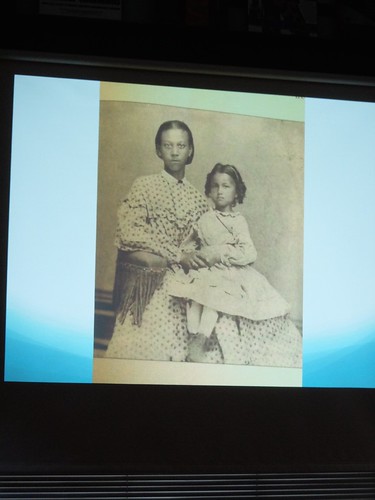
Peter Miller told the story of the Fisk Jubilee Singers, founded by his great-grandfather, circa 1871 to 1878. Fisk University in Nashville was a post US Civil War institution that helped popularize a new sound, pre recording industry.
Peter has some memorabilia from the period, family heirlooms.
I watched the first half of CBS Evening News tonight, which was about the interweaving of the Orlando massacre with charged political talk. There's no coherence only sorrow in this picture, circuitry gone haywire.
I've been active on Twitter of late, more than usual. My "geek ethnicity" takes me into social media, such that when Microsoft bought LinkedIn recently, I got lots of tweets about it, from the geeks that I follow.
I tweeted about my taking public transport, to and from Flying Circus yesterday.
Somewhat as a joke: I invented (in my own mind at least) the recursive term "phobophobia", the fear of having phobias, or perhaps catching the more contagious ones.
"I'm phobophobic" I could say at a party. Sounds funny. But "parties" and "funny" are not a chief order of business around now, given the terror. Sorrow songs, not Jubilee songs, fill the airwaves.
Watching Mason's Lost Girls last night, a re-enactment (not a documentary) adds to my sense of "crazy world" (Spaceship Earth = Hospital Ship). Koyannisqatsi.
George White, Peter's great grandad, was born in Franklin, New York, 1838, the son of a blacksmith. He left home at sixteen and eventually found work as a teacher and choral director.
When the Civil War broke out he rushed to Cincinnati's defense. He then signed up with the Union Army and was in many battles, dwindling to only a hundred and forty pounds at six foot five.
He ended up in the orbit of Fisk University, an enterprise he could support and that eventually led to the Jubilee Singers.
Ella Shepherd became the heart of this enterprise, of Cherokee as well as Afro-slave heritage (her mother was sold away as a slave a couple times, though they were eventually reunited).
The choir went on many grueling road trips, and became a real money-maker for Fisk, as well as other institutions.
I'm tracking the Brexit referendum through Twitter too, and like many in my network, wonder if Scotland feels chained to a jumper. What if Scottish folks prefer to stay in the EU, but maybe opt out of NATO?
Scots don't get much benefit from obeying the Trident submarine conqueror-invaders, as some see them. The Nukehead Nations are on the wrong side of history these days. Nations remaining innocent of nukes get more respect. Those who cling to them seem stupid.
Of course suggesting "Scotland", an inanimate object, has "feelings" is venturing into the realm of corporate personhood. What used to be a mere metaphor might today have legal implications.
Most people still understand nation-state talk as a shorthand, not a metaphysics, nor a theory about the sentience of AI monster-creatures.
We had a number of musicians in the audience tonight, who asked intelligent questions. Jubilee Singers past and present, may be found on Youtube.
Here's Peter's preamble, circulated ahead of the presentation:
JUBILEE! In 1871 a bedraggled group of ten black students from Nashville'sFisk University, among the first black colleges founded after the Civil war,set out for Ohio to try to save Fisk from bankruptcy by giving concerts.when these Jubilee Singers disbanded, they were professional, world-travelled adults, having brought the Negro spiritual to the knowledge of the wider world, singing before American presidents and European monarchs. They had raised $150,000 to save Fisk and other black colleges from disbanding, and to build the Fisk campus. Illuminated by careful records and by letters and diaries of the singers, it is an improbable story of success over adversity and an illuminating saga of race in America. My great-grandfather, George White, was the Jubilees' founder and leader, and their story was an important part of my family heritage growing up in the Jim Crow south.
Monday, June 13, 2016
Putting a Lid on It
Imagine an operation with two vectors as input, called "close the lid". Given v1, v2 as lengths with an included angle, the 3rd length is determined, meaning the area in question is unique, determinate. Run the operation on v1 and v2, called "close the lid" and every time, v3 is the same length and A is the returned Area. A triangle.
Now extend this operation to three vectors not in the same plane. They "fan out" from the same starting point, a common origin, and point to three points in space (given the common origin, we have four points total, not forgetting the observing camera is a point as well, and whatever light sources...). The tetrahedron is unique, with V the Volume. "Closing the lid" makes sense here as well.
Given we already have a formula that returns a tetrahedron's volume, given six edge lengths, it's pretty easy to modify that to where three edges get determined by subtracting pairs of input vectors. Given |v1|, |v2| and |v3| as inputs, the three lengths we need, in addition, to put a lid on it (on the tetrahedron) will be: |v1 - v2|, |v1 - v3| and |v2 - v3|. In not forcing these lengths independently, but computing them as a consequence, we ensure the six edges are "legal" i.e. such a tetrahedron really exists (important for our algorithm to work right).
Consider three vectors from (0, 0, 0, 0), the origin of the Quadray Coordinate System (Chakovians), with vectors (1, 0, 0, 0), (0, 1, 0, 0) and (0, 0, 1, 0) pointing to three corners of a regular tetrahedron from its center. Lets define the quadrant of said tetrahedron to be our 1/4 unit, where all six edges of the canonical home base are defined by edges D of the IVM ball packing.
That's a lot of jargon, so if this is a new-to-you namespace, follow some links for a stronger ability to tune in. Basically, four quadrays divide space into four quadrants, just as the XYZ basis vectors and their reflections create the eight octants of the Cartesian scaffolding.
In some of the comics and cartoons I've been working on (manga and anime), we introduce "close the lid" triangular and tetrahedral treatments as how "Martians" learn math in some science fiction narrative (we're not requiring true belief in specific ET stories, which may get quite ornate, featuring many species).
The Martian Math narrative helps build a story line wherein more details get remembered, such as how the Martians and Earthlings agree to use a conversion constant between their respective models. They need to pour concrete after all, given they're collaborating on a canyon dam.
The R-cube of the Earthlings (unit volume for them) and the D-tetrahedron for the Martians (unit volume for them) are within shouting distance of "same size" i.e. the 2nd root of 9/8, although not unity (about 1.06), obviously, is close enough for quick and dirty back-of-the-napkin type operations, as when sharing a booth in the company diner.
Friday, June 10, 2016
Exploding Diagram
Clearly when it comes to sharing the experience of a rhombic triacontahedron exploding into 120 E-modules (were they named something else before?), a JavaScript library such as three.js is a goldmine.
I'm awed by Ricardo Cabello's skill-set here. He has picked a steep trail and climbed steadily, with a little help from collaborators.
The E-modules are so named within the canonical context of nested polyhedrons, with a focus on the Jitterbug Transformation, so named by R. Buckminster Fuller, and cited officially by some mathematicians.
The cuboctahedron (we can call it that, no problem (Fuller uses other names too)) "torques down" (rotate-contracts) into an icosahedron with the same edge-lengths, yet with more faces (20, not 14). The VE (as Fuller calls it) has 24 radial and 24 circumferential edges (hence "vector equilibrium"), as the eight tetrahedrons comprising it are "hinge-bonded".
Let the aforesaid cuboctahedron (VE) be defined by 12 uni-radius balls (r=R) around a nuclear ball of diameter D (2R = D). In Synergetics this thing has volume 20 in being comprised of 8 tetrahedrons and 6 half-octahedrons, of volume 1 and 2 respectively (8 x 1 + 6 x 2 = 8 + 12 = 20).
By jitterbugging the cuboctahedron, making it torque, we get this icosahedron of volume ~18.51 (there's a phi-based expression) that still needs to be phi-reduced, meaning all edges multiplied by 0.618... to get us the rhombic triacontahedron (RT, 30-diamond-faced) of diameter, you guessed it, D.
The E-modules are R-deep to the center. The aforementioned nuclear ball, and all the others, are "shrink wrapped" by the E-modules' rhombic triacontahedron (faces inter-tangent to contained ball). Each of the 30 diamonds contributes four "pizza slices" or "wedges" pointing inward to a common center.
Inversely (in the sense of reciprocally), the E-module RT scales up by phi (1.618...) to give what Koski and I call the "super-RT" (because bigger), the long diagonals of which are this 18.51... volumed icosahedron (the short diagonals form its dual, the pentagonal dodecahedron).
Readers attempting to follow all this may be stuck back at the cuboctahedron of volume 20 and its constituent tetrahedrons of volume 1. "All math is ethno-math" and in this neck of the woods, a cube of edges 2nd root of 2, diagonal two (2R), has a volume of exactly 3, not 2nd root of 2 to the 3rd power as from school we'd expect. How could this be?
Choosing a cube as the model of 3rd powering was a choice and our mathematics today derives from making that choice. However we know mathematics to be a branching tree-like structure, or maybe a graph, in that where there's a road not taken, we may sometimes go back and take it, exploring an alternative branch.
Our model of 3rd powering along this other road is not the cube, but the tetrahedron.
Picture starting with the corner of a regular tetrahedron, perhaps starting with XYZ's 90-90-90 and simply changing the angles to 60-60-60. Instead of building out in a parallelepiped (such as a cube) when multiplying, just connect the tips of the three rods of lengths A, B, C directly ("close the lid") to trap the corresponding volume ABC (or A to the 3rd if all three lengths equal).
A regular tetrahedron of edges D has volume one. Reduce edges to 0.5 (or R) and the volume drops by 0.5 to the 3rd power, to 1/8.
Likewise when starting with the icosahedron of volume ~18.51 and multiplying all edges by 0.618, volume goes down by 0.618 to the 3rd power. So-called phi-scaling, of E-modules but also S-modules, other modules (U, V, W) is where David Koski's "playing with blocks" fits in.
For example, not directly mentioned in Synergetics (the original two volumes) is that the cuboctahedron to icosahedron volume ratio, is the same as the S:E module volume ratio. How to morph an E into an S is another "Koski cartoon" or scenario.
Back to the cube of exactly volume three, edges 2nd root of two: assume in XYZ the cube of edges R is the unit of volume (R=1; 1x1x1 = cube) whereas in the IVM (alternative scaffolding), the tetrahedron of edges D is the unit of volume (D=2R; 1x1x1 = tetrahedron).
We have a ratio then, between these two unit volumes, the 2nd root of 9/8. That's how much bigger the R-edged cube is, in terms of volume. It'd take fewer XYZ cubes than IVM tetrahedrons to fill a cuboctahedron of edges D. 20 x (2nd root of 8/9) would be the answer.
T-mods and E-mods are angularly identical, and so one might think distinguishing by scale is immaterial, given the 4D sculpture under discussion is not pegged to any particular size or time. However, given surface:volume is not a constant, T and E are indeed distinguishable.
As pointed out in the above video, not everyone relates to "pure geometry". Starting the video with a sports car, maybe with a basket ball in the back seat, could kick things off. Every so often, we could dissolve to something more "real".

I'm awed by Ricardo Cabello's skill-set here. He has picked a steep trail and climbed steadily, with a little help from collaborators.
The E-modules are so named within the canonical context of nested polyhedrons, with a focus on the Jitterbug Transformation, so named by R. Buckminster Fuller, and cited officially by some mathematicians.
The cuboctahedron (we can call it that, no problem (Fuller uses other names too)) "torques down" (rotate-contracts) into an icosahedron with the same edge-lengths, yet with more faces (20, not 14). The VE (as Fuller calls it) has 24 radial and 24 circumferential edges (hence "vector equilibrium"), as the eight tetrahedrons comprising it are "hinge-bonded".
Let the aforesaid cuboctahedron (VE) be defined by 12 uni-radius balls (r=R) around a nuclear ball of diameter D (2R = D). In Synergetics this thing has volume 20 in being comprised of 8 tetrahedrons and 6 half-octahedrons, of volume 1 and 2 respectively (8 x 1 + 6 x 2 = 8 + 12 = 20).
By jitterbugging the cuboctahedron, making it torque, we get this icosahedron of volume ~18.51 (there's a phi-based expression) that still needs to be phi-reduced, meaning all edges multiplied by 0.618... to get us the rhombic triacontahedron (RT, 30-diamond-faced) of diameter, you guessed it, D.
The E-modules are R-deep to the center. The aforementioned nuclear ball, and all the others, are "shrink wrapped" by the E-modules' rhombic triacontahedron (faces inter-tangent to contained ball). Each of the 30 diamonds contributes four "pizza slices" or "wedges" pointing inward to a common center.
Inversely (in the sense of reciprocally), the E-module RT scales up by phi (1.618...) to give what Koski and I call the "super-RT" (because bigger), the long diagonals of which are this 18.51... volumed icosahedron (the short diagonals form its dual, the pentagonal dodecahedron).
Readers attempting to follow all this may be stuck back at the cuboctahedron of volume 20 and its constituent tetrahedrons of volume 1. "All math is ethno-math" and in this neck of the woods, a cube of edges 2nd root of 2, diagonal two (2R), has a volume of exactly 3, not 2nd root of 2 to the 3rd power as from school we'd expect. How could this be?
Choosing a cube as the model of 3rd powering was a choice and our mathematics today derives from making that choice. However we know mathematics to be a branching tree-like structure, or maybe a graph, in that where there's a road not taken, we may sometimes go back and take it, exploring an alternative branch.
Our model of 3rd powering along this other road is not the cube, but the tetrahedron.
Picture starting with the corner of a regular tetrahedron, perhaps starting with XYZ's 90-90-90 and simply changing the angles to 60-60-60. Instead of building out in a parallelepiped (such as a cube) when multiplying, just connect the tips of the three rods of lengths A, B, C directly ("close the lid") to trap the corresponding volume ABC (or A to the 3rd if all three lengths equal).
A regular tetrahedron of edges D has volume one. Reduce edges to 0.5 (or R) and the volume drops by 0.5 to the 3rd power, to 1/8.
Likewise when starting with the icosahedron of volume ~18.51 and multiplying all edges by 0.618, volume goes down by 0.618 to the 3rd power. So-called phi-scaling, of E-modules but also S-modules, other modules (U, V, W) is where David Koski's "playing with blocks" fits in.
For example, not directly mentioned in Synergetics (the original two volumes) is that the cuboctahedron to icosahedron volume ratio, is the same as the S:E module volume ratio. How to morph an E into an S is another "Koski cartoon" or scenario.
Back to the cube of exactly volume three, edges 2nd root of two: assume in XYZ the cube of edges R is the unit of volume (R=1; 1x1x1 = cube) whereas in the IVM (alternative scaffolding), the tetrahedron of edges D is the unit of volume (D=2R; 1x1x1 = tetrahedron).
We have a ratio then, between these two unit volumes, the 2nd root of 9/8. That's how much bigger the R-edged cube is, in terms of volume. It'd take fewer XYZ cubes than IVM tetrahedrons to fill a cuboctahedron of edges D. 20 x (2nd root of 8/9) would be the answer.
T-mods and E-mods are angularly identical, and so one might think distinguishing by scale is immaterial, given the 4D sculpture under discussion is not pegged to any particular size or time. However, given surface:volume is not a constant, T and E are indeed distinguishable.
As pointed out in the above video, not everyone relates to "pure geometry". Starting the video with a sports car, maybe with a basket ball in the back seat, could kick things off. Every so often, we could dissolve to something more "real".
Thursday, June 09, 2016
Mesopotamia
Decades of intervention (including but not limited to invasion) and hacking away with blunt tools, have left the infrastructure in a shambles, such that the illusion of governments providing protection and civil services, has gone away.
The illusion was not very persuasive in the first place for a lot of the affected peoples. The national governments ignored them, much as the political machine in Chicago ignores southern Illinois.
The status quo today is armed gangs and warlords, some with NATO backing, others with other backing, all fighting one another and trampling on the human rights of civilians, the so-called collateral.
Blowing up hospitals, attacking medical vehicles, is considered routine. There's no legality to these actions on any side. No one has time to consult the lawyers anymore. They take too long to think it through. Many of these lawyers are unarmed and therefore of no account in the eyes of the warlord deciders.
The collateral has done its best to flee the scene with NATO's warlords not really lifting a finger to help them. No evacuation convoys, or hospital ships, mostly just journalists and bloggers with their cameras, standing by observing and reporting on all the children attempting to swim, after their rubber rafts have overturned.
We see a lot of hand-wringing, a lot of people drowning, between adverts on television. The ones who don't drown get to walk to Europe. NATO calls this self-organized walkathon "destabilizing" and appears to blame Russia for all the bombing, like of Libya and so on.
Those helping the collateral escape the war zone (or escape detention for trying) are branded predatory, since no authorized charity is there to help. The Red Cross doesn't know how to operate watercraft is my understanding.
Meanwhile the Grunch keeps spoon feeding its audience with baby food pabulum regarding all these ghostly unbelievable nations that only exist because National Geographic shows them on its globes.
We're supposed to keep believing in Iraq and Syria, but not Kurdistan, Israel but not Palestine. It's too confusing, but as long as one has faith in the corporate media, we'll be rewarded.
Hardly anyone knows what "the Grunch" means anyway, as they believe as they're told, as good doobies are wont to do. No one tells them about any "giants" making off with all the cash, and paying for all this storytelling they're believing.
"Let the dweeb journalists pander to their corporate masters while we consume the advertised goods. That's our job as viewer-voyeurs" is the attitude. "Tell us more unbelievable stories about these 'nations' we're meant to believe in. We'll buy on faith."
We're already taught by organized religion that "blind faith in nonsense" is a religious virtue and we'll be rewarded in heaven for it. The news media let us practice for life in heaven, by respecting their authority.
The collateral was largely left to fend for itself all this time, or was herded into detention camps. These camps may prove to be dead ends, as although they're billed as temporary, there's only slow turnover, with some detainees getting stuck in the pipeline for years before they die, like at Gitmo.
Those with access to weapons are trouncing the unarmed. Somehow it's considered heroic and brave to slaughter the innocents with precision weapons guided by satellite. The voters like the spectacle. Bread and circuses.
Welcome back to the Roman Empire. Being a superpower is such fun ain't it? You get to kill at will, sometimes for no other reason than out of boredom and low ratings. Killing is thrilling and is all part of making America great again.
Washington DC is a special city in that it gets to order up bombings pretty much anywhere it likes. The Pentagon is under tremendous pressure to use up its ordnance, as replenishment means job security for Iron Mountain companies, many of them nonprofits.
Distributing ordnance from the private sector, to the theater, is the job of many "heroic" individuals. Raining down death on the unarmed is well-compensated work.
The audiences back home love the "mil porn" they get in exchange for their taxes. The "violence voyeurs" buy bigger and brighter screens and cheer on their favorite gangs, sporting whatever decals.
The so-called Holy Land has always been a theater for gladiatorial Hunger Games and blood sport. Nothing much has changed in over two thousand years, beyond the lethality of the weapons.
God signaled with a rainbow though, that He'd keep His temper under control next time, dim-witted though we be. We've got only the one ark to place our stock in, and it's spherical. Some are eyeing Mars as a next world to "conquer" (do a number on), however terraforming this one still takes most of our attention.
Tuesday, June 07, 2016
Naked (movie review)
Great voyeur camera, inviting us to judge, then challenging our judgments. I stuck around for the comments track, or at least some of it.
The two best parts, dialog-wise: the riff on the impending Apocalypse, to the security guard; and the encounter with the two Scots, maybe brother and sister? Language barriers among Anglophones.
Both skits were hilarious.
Apparently the director has evolved a technique for working with actors, based on lots of improv and rehearsal, that keeps them in the dark about the big picture, helping them stay innocent of the corrupting omniscience of filmic consciousness.
The film is billed as a comedy, but then isn't Kill Bill likewise over the top? Gothic funny. Like Psychoville.
I got a strong Eleanor Rigby vibe, watching all these lonely people, their comings and goings. The anti-hero is definitely a wanderer, and very British (like Eleanor).
As observer, I got into like an R. D. Lang mode. He was the psychologist who moved in with his patients, the better to "get crazy" from the inside.
Lang was a boyhood hero of mine, back when I imagined growing up to become a psy something-or-other.
Rated NC-17 or thereabouts, for nudity and language. Not a recent film.
Picked at random, because Movie Madness gives me the freedom to do so.
Friday, June 03, 2016
Thirsters 2016.6.2
Given Peter Farrell's experience as a Peace Corps volunteer, it made plenty of sense to invite him to this Portland meetup started by Bob Textor and friends, Bob having been instrumental in getting said Peace Corps off the ground. As a latecomer to Thirsters, another invitee, I was not close to Bob but his graph of friends has definitely overlapped mine quite a bit. I'm a friend of the Peace Corps too, continuing our Urner family faith and practice over the years.
Although our family sometimes hosted Peace Corps folks still in the field, maybe coming or going somewhere else, none of us were ever actively enrolled. My dad was an urban and regional planner by training, an interesting discipline which gained him entre to the inner workings of decision-making around the world. I was going through the international school curriculum for much of that time, then visiting by myself, or with a new family from Portland, after four years in a fancy university. My sister would also visit and sometimes we'd overlap.
Peter, in town for Pycon, brought along his Math through Programming book. Like me, but with many more years experience at it, Peter is a classroom math teacher, as well as a private tutor. I was full time with a private secondary school for two years, a great job I performed at well, however I was eager for wider experience and peeled off after that.
I've been in classrooms as a "gig meister" off and on ever since, and the O'Reilly job was very much full time, but not in "meat space" as it were, or rather the people around me, in the museum coffee shop, were not my students. My students were in coffee shops or offices or work / study spaces of their own, who knows where (sometimes I'd come to know, as we exchanged communications).
For example, one of my students was in Afghanistan or maybe in Kyrgyzstan by then, which brings me back to the Thirsters, as Maria Beebe was eager to obtain Peter's content, both for her own family, and for the computer centers they'd set up throughout Afghanistan as well, with assistance from USAID. Iranian contractors were also offering some competing free services, and I'm sure some opted to go with theirs instead, or with both, hard to know.
The more general topic was whether the three Rs (Reading, wRiting, and aRithmetic) were overdue for replacement by the "three Cs" (Comprehending, Critiquing and Computing). That's jargon I was using around Pycon, where we held another eduSummit. Lots of changes are in the wind these days, what with the Microbit going out and so on. I'm not saying we're in the concluding chapter of something. The threads are ongoing.
Peter and I met and parted near Lloyd Center. In just a couple days he's pretty much mastered the basics of Portland's transport system. The opening keynote by Brandon was place-based, good at sharing some of the timeline, the history of the Lloyd District. I was impressed that the PSF had really done some serious homework, which paid off in terms of Pycon being so well organized.
The sprints are continuing as I write this. I'm back out on the pavement though, knocking on doors, shaking hands (figuratively speaking for the most part as all job and gig seeking seems to be Web based). 4D Solutions has always had a way of drumming up clients, usually by word of mouth.
Monday, May 30, 2016
Pycon 2016
I'm feeling somewhat dense today, as in slow, relative to the various speakers I've been listening to.
The talk on the basics of Git (which I use) went by too fast. Writing an interpreter for PHP in RPython... amazing that any solitary Joe could take that on and get real results. RPython is a reduced version of Python that's designed to run a lot faster. PyPy is implemented in RPython, which latter has become more of it's own project than it used to be.
The morning keynote, presented by Dr. Lorena Barba, was philosophical in tone and felt more like a home base. She was highly focused on the work of Fernando Flores and Terry Winograd as a context for how the Python community might carry the torch forward, in the education space especially.
Bring the language of open source, which includes workflows (like on Github), into the wider culture, which of course would include the business world. Players make requests, commit, confirm delivery, register satisfaction -- or not, the flowchart varies. Sometimes players renegotiate the terms of the agreement.
The language-action perspective (LAP) would graph as an influence on the Forum as well. One of my house guests went through that program recently. As an est grad, I was welcome to the Sunday wrap-up.
Erhard, the creator of est, worked with Fernando Flores back in the early 1980s. The Hermenet chapter. I was following from a distance, from Jersey City.
The Forum is highly language-oriented. What gets in the way of achieving desired results may well be a "buggy grammar", using "grammar" in the Wittgensteinian language-games sense. Participants are challenged to be more reflective about their operating system.
Fernando was imprisoned for a period, after serving as Finance Minister of Chile when a military coup happened. Barba is one of his long time students and fans. I was glad to see these dots being connected, betwixt open source and an idealistic regime.
Ian Benson was certainly into some of this same philosophy, with his Sociality initiative. His project was not focused on any particular device, challenging the PSF to find a specifically Pythonic angle. I see he's made progress with the Cuisenaire rods.
Followup:
Pycon 2016 Concludes
EduSummit / Pycon 2016
Ergonomics
Thursday, May 26, 2016
PPUG 2016.5.26
I'm at the Portland Python User Group at Urban Airship (@PDXPython), the main Python user group in town, though the Monday Night Circus @ <guild /> is also well attended, and more informal. Some of the same people go to both (hi Ben).
Here we gather for presentations and sometimes pizza. Tonight Cloudbolt Software is getting to sponsor. The pizza is not here yet.
Trevor does a better job of archiving the Bucky stuff in the meticulous fashion researchers require. The Linus and Ava Helen Pauling collection at Oregon State, with the Douglas Strain Reading Room, showed me what a state of the art archives is all about.
Trevor is uber diligent even in the absence of much funding, which is characteristic of those who bring order to Fuller's work. Not being paid is part of what makes it work, hard work.
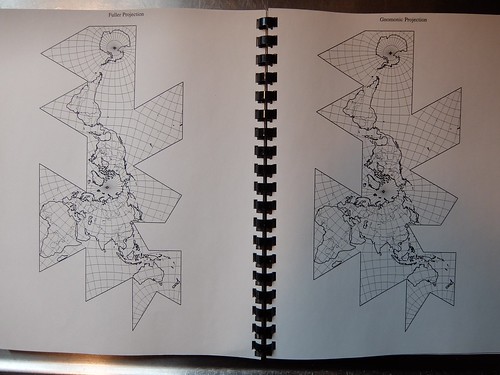
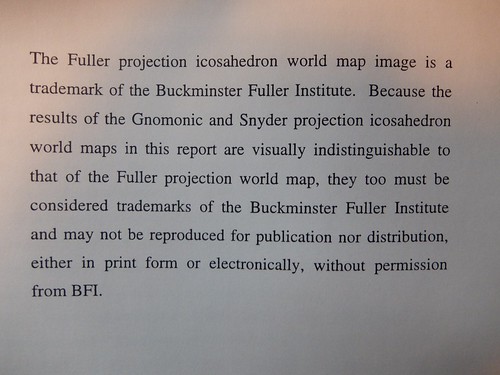
I'll plan to get him these materials uncovered above. The paper by Dr. Bob Gray shows how the characteristic arrangement of continents that go into making up the Fuller Projection is really what makes it stand out.
Using the Snyder or Genomic Projection algorithms, as distinct from Fuller's, results in mathematically measurable differences, but to the naked eye, the distortion is about the same i.e. minimal (compared to a Mercator, which takes the flat Earth perspective to an extreme).
Dr. Ernest Bonat, Senior Software Engineer, will address us tonight, on the topic of Implementing MVC Arcitecture in Python for Data Analysis. He works full time at Intel, but does data analysis consulting on the side.
He's here to tell us about his stack, 64-bit Windows based (Core i7, 16 GM RAM). Getting all the software in one place is his goal: Anaconda is his solution. He's Cuban, not Italian -- he wanted us to know. Eclipse IDE / PyDev plugin / EGit plugin (free) is a good one. Microsoft is providing quite a lot for free these days, community edition everything, Python tools for Visual Studio, SQL Server etc.
I've used Eclipse a lot, our defacto IDE at O'Reilly School, but since getting Anaconda I've been practicing with Spyder a lot. PyCharm is an old standby as well, and popular with this audience (we did a show of hands). I'm glad he's showcasing Eclipse.
Pycon is next week, May 28 through June 5th. This particular Pycon, organized directly by the Python Software Foundation, is the largest annual gathering for the community using and developing the open source Python programming language. Steve Holden got the ball rolling on Pycons. EuroPython was first.
Steve is not coming to Pycon this year, which is unfortunate. I'll be hosting Henrique from Brazil as my guest.
Cloudbolt is looking for a full stack engineer. The pizza has arrived!
I heard some grumbling that Bonat's version of MVC is treating Visualizations more as reports (final output) than a full interactive GUI controlled by the end-user. In web development, the visualization is more or less synonymous with the web page presentation itself.
Ernest's end users are client-recipient of the data analysis, not the real time users of a custom GUI. Ernest himself is happy running his source code directly, given everything is so well organized. For him, Eclipse itself is the GUI. The data went from .csv files into pandas. This was not Big Data in the sense of mapreduce or Hadoop.
Dr. Bonat was certainly right to emphasize unit testing and TDD. When it comes to job interviews, he's looking for well commented, documented solutions that come with unit tests. I need to keep that in mind as a job hunter.
The Lightning Talk was also interesting and statistical in nature, though also more number theoretic. How many digits does it take to represent a natural number 1/n, including one digit to designate "repeating"? For example 0.5 is 1 digit for 1/2, whereas 0.333... for 1/3 would be 2 digits, as the 3 repeats.
The speaker, who's name I missed, showed us several plots, including varying the number base. Bases of a 2nd power, like 4 and 9, have special properties apparently. Primes especially often take as many digits as in the base to represent the number.
On the way to the meetup I was communicating with Trevor about getting him the above materials. I also sent him this link to recent writing, on 4D vs. 4D vs. 4D, a theme of my enthno-mathematical investigations.
Tuesday, May 24, 2016
Monday's Game of Pinball
I decided to give the Code School a break from my presence this Monday, having ascended Dog Mountain and thinking to just kick back and not go anywhere.
However an event at PSU caught my attention and I grabbed a bus, only to find the published time on the poster had no bearing on reality. The doors to the Smith Ballroom were still locked as of 6:17 PDT.
If you were already going with the flow as a PSU student, that wouldn't much matter, however in trying to land coming in from the outside, as a member of the general public, I just got confused, encountering locked doors, and took Tri-Met home again. Having my cell phone die also restricted my degrees of freedom (in terms of ways to pay or find a ride).
I'd bounced around the 'hood earlier that day, testing the legs for new aches and pains, and contemplating a haircut. I need to stay in interview mode, which I'd say I am, and plan to shake hands.
A thing I read on my smartphone told me the top ten things to do every day and one of them was shake hands a lot. Another was do your chores. I wonder if I can find that article again in this fish tank we call the Web. I didn't bookmark it. Found it. Really? Just men? Oh, I see.
Anyway, no haircut occurred as Sam Lanahan was soon to come over with a shipment of Flextegrity, the remnants of "Big e" as Glenn and I called it, a spiral, now cut in pieces. There's a project afoot to do something new with it.
Sam took us to Portland Fish House where we discussed philosophy and the Lanahan family heritage back through Baltimore to the original US citizen who'd arrived from Ireland as the name suggests. The Lanahan distillery burned in the great fire that wiped out much of the harbor area. San Francisco and Chicago also had great fires, as did London (at least one).
As you may have guessed by now, my use of "pinball" was metaphorical. However a new pinball parlor has just opened, where Mt. Tabor Theater used to be. I have every intention of paying a visit. Patrick attests the machines are in great shape and in wide variety.
Playing computer games was another item on that list of ten. Anyway, "lists of ten" are all over the place if you're into the genre. I'm sure you can find one or make one up, that reinforces whatever habits you're keen to reward.
Glenn is reading that heavy German philosophy featuring Bubbles, Globes and Foam. Given his fascination with the Geoscope (aka Macroscope) as a concept, the syllabus is fitting. He wrote the author's name on a napkin for Sam, whereas I recommended Culture and Value by Ludwig Wittgenstein.
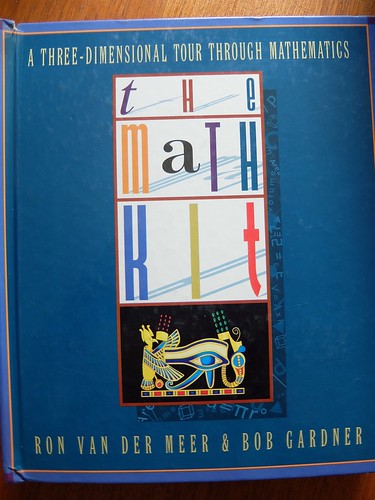
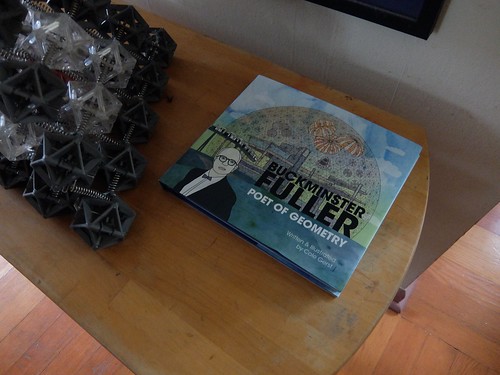
Glenn also showed me this great Math Kit book (photo above) rescued by a dumpster diver. And speaking of dumpsters, I should mention I also drove to Beaverton with a load of styrofoam for recycling. Quite the game of pinball.
Thursday, May 19, 2016
Captain America: Civil War (movie review)
I think what we're supposed to get is Captain America is more than ambivalent about joining some United Nations, much as Brits feel conflicted about the European Union. What if the UN picks the wrong bad guys, or fails to act when bad guy pillage is immanent? The Avengers are leery of trusting anyone's judgement but their own.
However, shades of The Incredibles, ordinary mortals are sick and tired of their "collateral" status, as in "collateral damage". The collateral rises up and says "enough is enough already" and asks the Avengers for a modicum of accountability. Captain America has his moral qualms about this. For one thing he's harboring a terrorist, his friend that gets activated by keywords.
I came to this movie with a sieve-like memory, a lot of the sand having trickled away. Like I could not understand how that Mandela-talking prince could have superpowers until later it was explained to me his part of Africa was where the unobtanium was mined. Then it all made more sense.
Other important plot elements maybe went by in a blur, as I was focusing on the ridiculously-on-steroids cartoon-like physics of it all (Marvel is originally a comic book publisher remember, only recently a studio).
That's the difference between film in a theater and a Marvel comic: when reading, one may pause to puzzle, even cross-reference and refresh. In a real time first viewing, a lot of information comes at ya, and there's always the risk of dropping some balls.
That's not as big a deal as it sounds however, as the movie is designed to be rented and/or owned at a later date, and when playing back, even pausing, is OK.
Viewing with controls can be a lot more like reading a comic book than taking it in at the theater. The Marvel movie-makers reward those who pay twice: once for the once-through as a blockbuster, and then again for more reflective analysis, in a home theater context.
Another plot element I didn't quite get is why the liquid blue stuff was allowed to travel with Mr. and Mrs. Old Person on some back country road. Is that how we'd treat plutonium?
Some terrorist swoops in and rains on their parade, but what institutional wheel-turning put them alone on a such a desolate road, with such stuff in the trunk in the first place? They might have hit a deer, leaving it to some random hiker to discover the blue liquid's worth on e-Bay.
What risk management protocols were being followed? Was this whole operation ISO-compliant? I guess in 1991 they didn't really have such standards.
Thursday, May 12, 2016
Thirsters 2016.5.12
I was unclear what the topic would be, but a friend on Facebook was suggesting I go. My house guest, here on business, was game to come along and sample our subculture.
As luck would have it, Don's former student Mark was by. We'd had a day on the boat together some years ago. Don visited Mark in Guatemala that time, and talked to Wanderers about it. The presentation was on recent developments in Guatemala.
In particular, our speakers included a forensic anthropologist, well-versed in crime scene discovery, and a mother-daughter team who had attended a part of a recent trial, brought by victims of abuse against the perps.
What was new in this case is (a) the defendants were military officers in the Guatemalan armed services and (b) they were found guilty by a court in Guatemala itself.
The steady flow of refugees from American states has everything to do with the culture of impunity they've permitted, frustrating the movement to eliminate slavery.
People in the US complain about immigration without understanding the dynamics behind people pushed off their ancestral lands, people who might have rather stayed put.
These women, now in their 70s and 80s, had been enslaved during the Reagan Era, when violence against native peoples was at an all time high across the board.
As the government effort has been to assist a property-owning class engaged in land grabbing, much as in the US, the Guatemalan military has been cast against native peoples as an enemy, and slave women have traditionally been among the spoils of war, just ask the Romans.
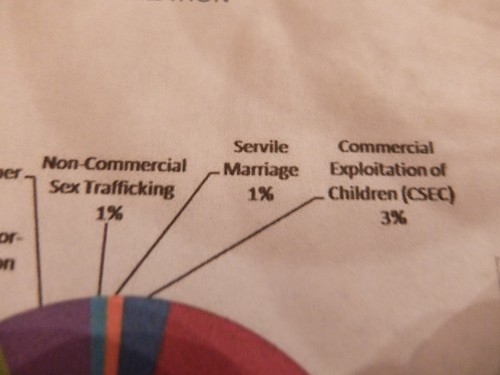
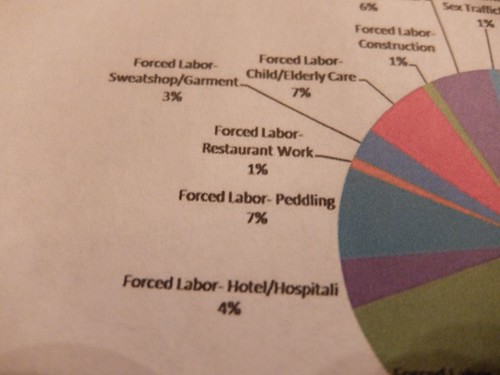
I asked if this recent guilty verdict in anyway imperiled business as usual around US bases, both at home and abroad, where a sex industry abounds, but without being seen as outright slavery.
The exiled people of Kwajalein and Bikini come to mind, as among those pressed into servitude and dependence, after having their ecosystems poisoned by radio-toxins.
Upon arriving home, I couldn't find my XQ-1, the camera I use for all these pictures. That resulted in over an hour of searching high and low, retracing my steps, driving back to the venue.
I found it, finally, on the floor in the back seat area of the Nissan. I'd looked under the front seats but hadn't spied it lying there. I surmise it fell out of my coat pocket.
Wednesday, May 11, 2016
More Americana
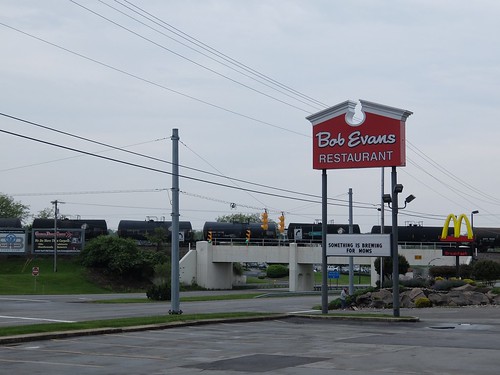
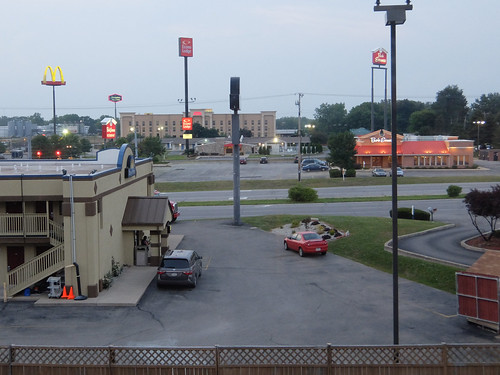
Another time in Richmond, I stayed at a Best Western and shot a picture across I-40 to the north. On this trip, I was in that picture, at the Bob Evans, looking back. Dawn preferred Bob Evans to Cracker Barrel, both mid-west phenomena (restaurant chains), extending on into the southeast.
What I have to keep remembering is how much closer the so-called "mid-west" is to the Atlantic coast, in comparison to its distance from the Pacific coast. It's only a day on the road to Washington DC, whereas it's three times further to Portland.
I used Google Maps to plot a route from Champaign, Illinois to Portland, Oregon. The computer said we'd have to drive a day and seven hours. That's if we were in a Google car and could sleep a lot of the way, only slowing for gas and brief pit stops. A crewed bizmo could do the job, though ideally the schedule is not that hectic.
My route from Champaign to the Budget rental car return at the St. Louis airport took me through Springfield, Illinois. On the way out I'd stopped in Decatur for lunch. The Abraham Lincoln Museum was well attended, especially by kids arriving by the bus load. My schedule was tight and I was low on coins for the parking meter, which had failed anyway, as it turns out. Shades of Detroit. I took hurried pix in the Gift Shop by way of keeping souvenirs.
We hear a lot about Greece and its dire financials, but lets talk about Illinois. Here's another state out of money, completely in the hole. To whom does Illinois turn? The Federation as a whole is even deeper in the red and mostly just likes to make rules it won't pay the states to comply with. The old social contract is wearing thin in that sense.
The European Union is projected in US media as being in trouble, but as the Lincoln museum reminds us, it's the US union that's been through some tough times recently. The EU has had nothing quite like the US Civil War (which was anything but civil). This is not a nation that gets along with itself. The breakdown into eleven states helps make sense of the jumbled war of words happening through talk radio, other social media.
Skywest operates a relatively new service for Alaska Airlines that got me from the St. Louis airport to PDX in under four hours. We got in early and had to wait for our gate to free up. I noticed an Icelandair parked at the concourse. How long have we had direct flights to Iceland I wonder?
I sat next to an Illinois farmer, his wife across the aisle. Their daughter is a professor at OSU and just had a first baby. They'd been out before, but not frequently. He didn't know what "IPA" was (as in "India Pale Ale").
I said the Brits invented this kind of beer to help prevent spoilage in the hotter Indian subcontinent, adding more hops than usual as a preservative. In the Pacific Northwest, more fresh hops get infused later in the process, which actually shortens the shelf life of the beer (with refrigeration, which the Brits did not have in those early days, aging slows).
With the fresh hops IPA, the whole point is to drink it down soon after it's kegified.
I had a beer on the plane and another at Beaches, from whence I sent a note to Lindsey, as we'd earlier planned to talk around now, but then she realized there was no point renewing her cell phone contract, given where she'd be. For the most part I'm not doing beer but for ceremonial and diplomatic occasions. This whole week was about diplomacy.
Friday, May 06, 2016
Revisiting the Heartland
A year ago at this time, I was still with the O'Reilly School, and was lucky to get sent to the US Distance Learning Association (USDLA) annual conference in St. Louis. Before the conference started, I rented a car and drove to Richmond, Indiana, via Champaign, Illinois, to visit my daughter.
This year, I'm following much the same script, minus the conference, to be at Earlham College for Tara's graduation. I rented a car at the St. Louis airport, visited with greyhound and cat-owning friends (Afghan restaurant!), then headed to Champaign, where our code school used to have an office.
The original school was started by fans of the late Jerry Uhl, a professor at the University of Illinois, based in Champaign-Urbana, and was then purchased by O'Reilly Media and repurposed to be a code school. I joined the faculty after this purchase, as a Python teacher, when the founding principals had already moved to Sepastopol.
Many memories came flooding back once I was back in the mid-west, reminders about the cultural currents, the geography.
I imagined being on assignment for National Geographic, visiting a master upholsterer (and his apprentice Lorri, my former supervisor), a new microbrewery (Triptych), a food cart (Dragon Fire) serving oven-baked pizza. I've been greedily snapping pictures. St. Louis has its special Provel cheese and Fleur d'Elise, in addition to the Arch and Climatron.
A most important technique, when it comes to cultural immersion, is to surf through radio stations, listening especially to Country and Christian genres, in addition to talk radio. The freeway miles fly by faster with the radio on.
"The Donald" had just won the Indiana primary a few days before I arrived, with Cruz and Kasich pulling out of the race to become the Republican Party nominee. Tonight, he's in Eugene, Oregon and Lindsey left me a garbled voicemail (lots of crowd noises in the background), reporting from the anti-rally, as she's in Eugene as well, freshly returned from Florida, in route to Nepal.
A year ago, when I was attending the conference, those big earthquakes hit Nepal. Lindsey was in Kathmandu at the time, staying in a fifth floor guest room. She's heading back. When her voicemail came in from the anti-rally, I was in the process of meeting my mom's plane from DC. Tara and I drove to the Dayton International Airport, in Ohio, to meet her.
Carol has been on the road for many more miles than I, earlier this year going from LA to Seattle by van, and more recently from Atlanta to Cape Code, Boston, New York and DC. Doing all the driving is Ellen Thomas, a long time activist very focused on the obscure House Bill 1976, introduced in 2015 by Rep. Eleanor Holmes Norton [D-DC-At Large].
The newspaper I read over breakfast in Decatur was not buying into "Islamophobia" and was encouraging more of a live and let live attitude. Refreshing.
Tara had been looking forward to a sushi extravaganza, in celebration of her graduation with honors in Physics and Philosophy, with a minor in Computer Science. We enjoyed Yamato, with her friend Kristin (not a seafood fan, but other dishes available). What a feast! Congratulations Tara!
Saturday, April 30, 2016
Code School + Gift Shop
Designing an on-line Gift Shop is often the last thing a small business wants to take on, as their professional interest is likely not in learning to code such a thing.
Companies like Weebly and Rakuten are about solving the Supermarket Math problem of making it easy to have a website, including one that features a shopping cart with checkout features.
On the other hand, a Code School is where people go precisely to learn how to implement such services as an on-line Gift Shop, and moreover schools traditionally come with "swag" advertising their brand (T-shirts, hoodies, mugs, backpacks and so on).
So the question becomes: does a given Code School "eat its own dog food" and roll its own Gift Shop, or does it outsource to CafePress or whatever?
In order to show the world that Code School students are learning the skills, any number of virtual Gift Shops might be kept on the shelf (on the rack) for students to hack on. A way of building one's profile is to showcase one's contributions to said projects.
Some of these on the shelf shopping applications will actually do front line duty in real time. A given Code School might swap out the Ux on occasion.
An existing open source project, such as Shoop, Oscar or Cartridge written in Django + Python, might be a good starting place. Students learn by modifying an existing project.
Other applications may permit a kind of "virtual shopping" wherein shoppers "practice" using the Ux for free, a way of testing features and building community, with virtual money against virtual goods.
These prototype test beds might only face in-house, but why not make some public facing, as well as open source? Good advertising, kudos to the school, if the shop shares some good ideas and/or interesting implementations thereof, perhaps even in "exotic" computer languages, such as Haskell and Go.
However, there's a more elaborate plan lurking just beneath the surface here. Lets remember Friedrich Froebel, the inventor of Kindergarten, and his strategy of connecting the schooling process to gifts. Bucky Fuller attended such a school and had an early breakthrough with the "peas-works" gift, leading to gaining the privilege of patenting the "octet truss" in the 1960s. [1]
As a student moves through schooling, rewarding that student's progress with gifts makes a lot of sense. Gifts may be tools of the trade, like a microscope or telescope, faster bandwidth, better access to the Internet, a personal workspace, an office.
In the military, people say "rank has its privileges". These privileges may be granted without need for cash awards. Code Schools might think in terms of linking various milestones to specific rewards, perks or privileges.
[1] Cole Gerts, Poet of Geometry, 2013 Option-G Visual Communication ISBN 978-0-615-87344-2, page 13.
Sunday, April 24, 2016
Best Practices
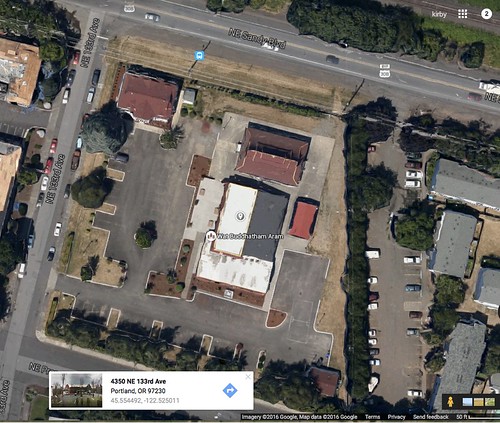
:: Wat Buddhatham Aram ::
This afternoon I attended a final presentation by Alan Potkin, during this April, 2016 trip to Portland, this time to elders of the Laotian community at a local Buddhist temple, on NE 133rd and Sandy. He'd presented to Wanderers at the Pauling House on Hawthorne, and to Thirsters on E Broadway, in the previous week.
I've driven by that temple campus many times, usually on my way to or from Costco, on NE 138th, but this was my first time to see the inside. Alan used a screen and computer projector, and we enjoyed amplified sound, both for his voice and the recorded video segments, including some in Lao.
A treat I'd not experienced before was Alan's head first dive into the epic Ramayana itself, while scrolling through the temple murals his team had helped to recreate.
The story (ພຣະລັກພຣະຣາມ) is known to some Laotians, and Wikipedia calls it the "national story", but it is perhaps not as core to the national storytelling as among some other Buddhist and Hindu nations, elsewhere in Asia? I'm no authority on these matters myself.
Alan had rescued another version he found tucked away in a cabinet of a forgotten old wat, forty three holy books in the khom language, which he's hoping to see translated into ordinary Lao. Only those schooled in the older traditions, such as monks and other scholars, can read khom.
When it comes to mega-projects, such as hydro-dams, or smaller, Dr. Potkin's message is pretty simple: making big changes to the landscape or seascape should entail making a detailed record of what it was like before the changes. Take inventory, be thorough. That's a best practice.
He does not automatically assume the more strident position of the most negatively impacted by such projects, that said developments must not occur. His position is more nuanced.
The trade-offs need to be addressed case by case, in light of clearly presented information, and if a project is to go ahead, then at the very least what the place was like before and after must be well-documented, using techniques used by museums and interpretive centers to communicate to the general public.
Keep updating the exhibits, about the Hanford cleanup for example (like OMSI had), with follow-up information, at intervals. Alan keeps checking back on the projects he tracks, so long as he's able, updating his document database. Outcomes research is also essential.
Turgid phone-book-sized reports are insufficient to get the info across, any museum curator could tell you that.
Given today's cyber-tools, a virtual museum is an affordable requirement, complete with oral histories, videos, and an inventory of flora and fauna and their migration patterns, and their roles in peoples lives. Alan thinks the Bonneville Power Administration made at least a decent attempt of building such an archive, before Celilo Falls went under, thanks to the Dalles dam.
One of Alan's favorite lessons revolves around a certain World Bank dam that was hastily retrofitted with a fish ladder that never worked, a last minute token attempt to compensate for the vast tonnage of edible protein that was about to be cut off, a fish migration cycle not fully appreciated.
The fish ladder never worked; it was built to the wrong scale for the migration in question. The dam is only able to produce about 40 megawatts of juice, and serves as an ongoing monument to the World Bank's ineptness, at least back then.
Have things improved? Look for those on-line museums of "before the project" exhibits, with detailed information about the local lifestyles, food sources, patterns of trade. If you don't find any such exhibits, assume the answer is no, it's business as usual.
I got through Costco for under $100, including the $1.50 hot dog + soda pop.
Monday, April 18, 2016
Work / Study Notes
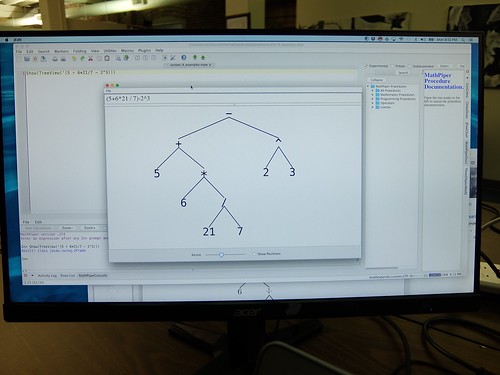
I used some of my time at the meetup tonight to follow Ted Kosan's homework assignment, as I'd agreed on the listserv (i.e. in front of witnesses) to enroll in his work / study program.
He's going over the basics of a computer algebra system (CAS) which begins by parsing an expression into a tree, as shown above.
He's sharing a JEdit-based framework he wrote and shares with the general public under a GNU v2 Open Source license.
The Document Object Model is tree-like in having nodes containing more nodes. A Tree is a subtype of Graph and is typically a first recursive data structure (think "fractal").
"Phi is the first Fractal" one might suggest as a mantra, on the basis of its self-referencing proportionality.
I'd started the day's meetings with Mr. Stockton (Global Matrix) wanting to share some Graph Theory, showing me the same nodes edge-connected in two different ways.
What could I learn from this picture?
The first graph was like spokes around hubs with longer distance connections between the hubs.
The second graph was more like connecting all neighbors to nearest neighbors. No spokes were evident, more like a quilt or lattice. Same nodes. Different stories regarding their relationships.
The first graph might be "cell phone provider" (some nodes represent "towers"), whereas the second graph might display "who borrows sugar from whom". I might assume the same geographic layer for both in this story, whereas graphs need not be geographic at all (just topological).
Visitors to the code school tonight included a German-speaking duo, from Austria and Switzerland respectively. I talked with the Swiss guy who sat next to me, about his bioinformatics work, training computers to get better at diagnostics.
I explained about my work with tetravolumes in Clojure, inside MathPiper. He also liked my Nonsense Numbers.
I learned about ternary logic, discussed in Knuth (I'll look it up) and an early Russian prototype named Setun. Ternary logic is non-boolean, yet a logic nevertheless. I've been pointing out that even True and False based languages have Null and/or Undefined but that's not what "ternary logic" means exactly. I'll be doing some more self-study.
Another topic already in the wind, that I learned about only recently, is clockless chips, meaning CPUs that are less clock-driven, more asynchronous.
We've had something of a paradigm shift in that respect at the software level. I'll be looking for parallels in the literature.
I demonstrated doing symbolic calculus to another attender deep into Doing Math with Python (a new title). He'll be getting to all that in a next chapter anyway.
An old student of mine (from Accelerated Intro) was there when I arrived, and is currently enrolled in one of the evening boot camps going on in the Business Accelerator building. I'm glad.
With Sheri (the director) I discussed the Gift Shop meme, a way for any code school to showcase its own ability to source an on-line swag store, shopping cart model.
An on-line Gift Shop is precisely the type of application students come to code school to learn to code, so the Eat Your Own Dog Food aspect is evident. I came away with a T-shirt myself.
A code school might stock any number of partially developed Gift Shop variants, some as group projects, some starting out solo. Having a working project on the front lines does not imply other solutions do not exist.
We'll always have need for a "next Gift Shop" if only to give students and instructors opportunities to hack on something well-understood (like anatomy lessons).
Speaking of gifts, my thanks to Benjamin for cluing me about pathlib and py.test.
Wednesday, April 13, 2016
Subscribe to:
Posts (Atom)