Aimeé Ford Conner gave me the Earthala meme. Project Earthala is one of those high tech ecovillage communities we wonder if we'll ever live to see, even if only on reality TV.
I'd make mine a by-invitation sanctuary for weary travelers I've met along the way (Aimeé and Peter included). It's not like you have to live there permanently -- but some would want to.
We'd have TV-out, i.e. you could subscribe to our shows, already edited for content. Journalists might be invited to give alternative inside scoops, or sneak in or whatever.
Anyway, you know if there's a "mine" there'll be a lot of "not mines" -- so you needn't worry if my Project Earthala isn't on your itinerary. You'll have other stops in other villages, just as fun and good.
Sunday, August 13, 2006
Friday, August 11, 2006
Bee Season (movie review)
A talented family with all its physical needs met, freely explores metaphysical issues.
These don't seem the happiest people in the world, but hey, karma is like that (lots to work through, and moving too quickly may be dangerous).
Each cast member takes a few steps along an inward/outward journey.
I wish more families were free to work out at this level, instead of spending so much time scrabbling for food, water and shelter. Moving too slowly may likewise be dangerous.
These don't seem the happiest people in the world, but hey, karma is like that (lots to work through, and moving too quickly may be dangerous).
Each cast member takes a few steps along an inward/outward journey.
I wish more families were free to work out at this level, instead of spending so much time scrabbling for food, water and shelter. Moving too slowly may likewise be dangerous.

Thursday, August 10, 2006
On the Waterfront
 facing the hawthorne
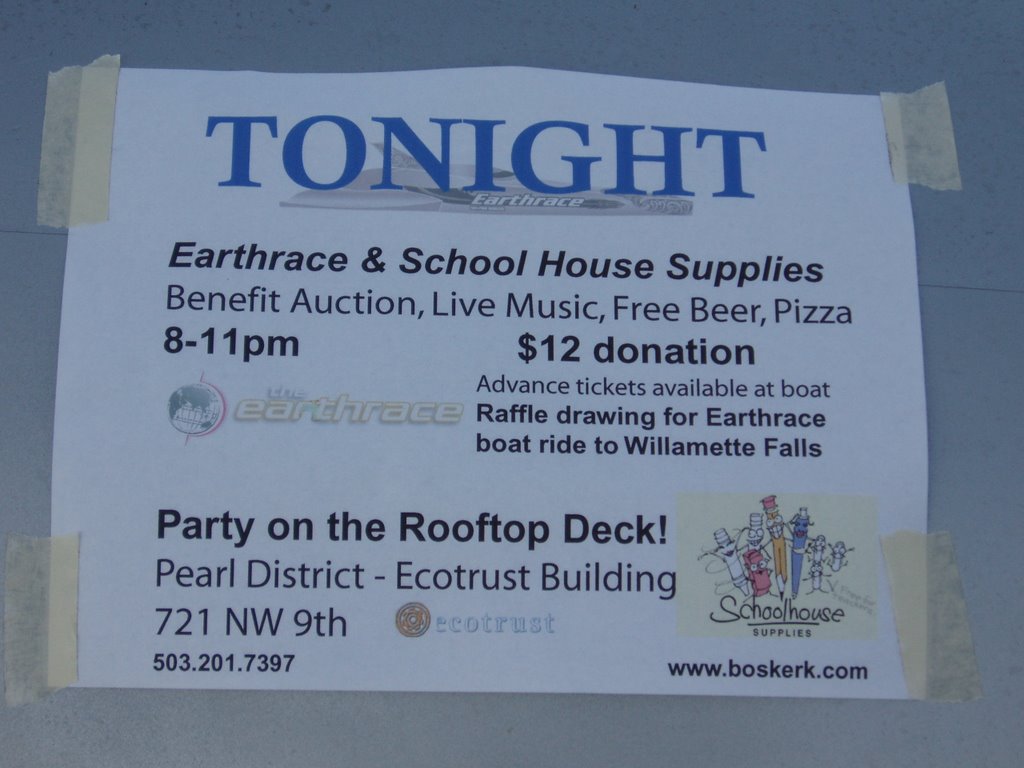 notice of party
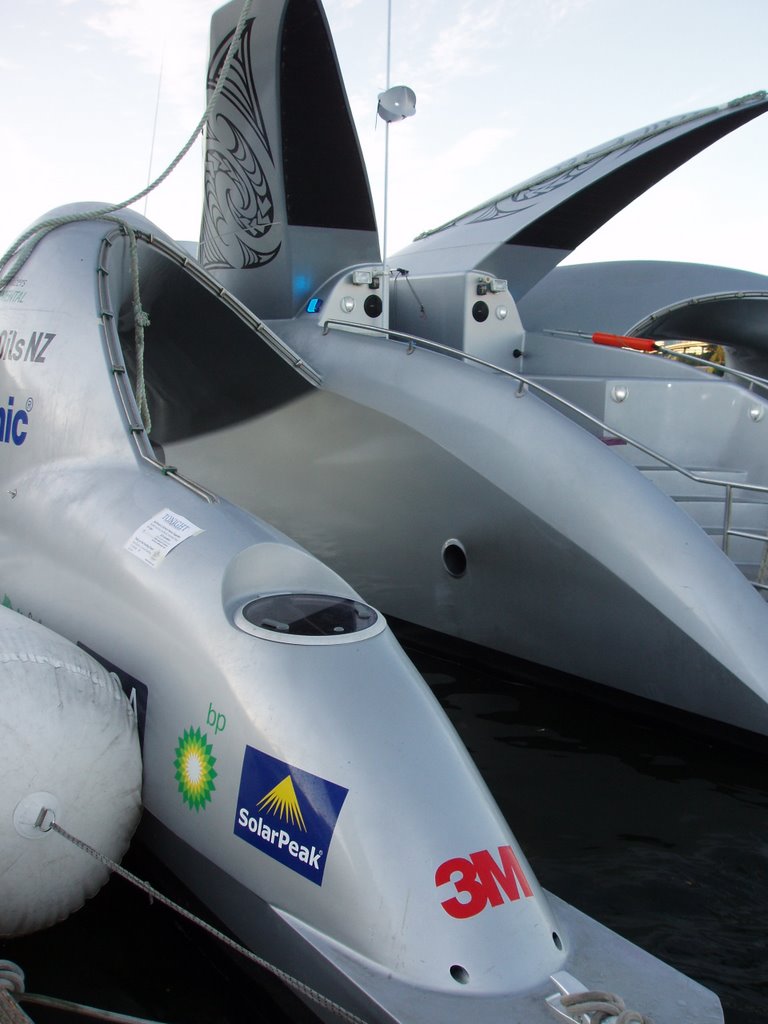 context of notice (taped to hull)
photos by K. Urner
Wednesday, August 09, 2006
HexaPent Housing
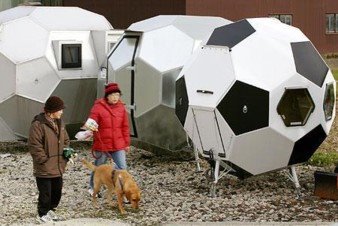
Trevor forwarded this link to my del.icio.us inbox.
People with claustrophobia wouldn't want time in these, even with flatscreens showing World Cup action.
But as working prototypes, they fit well in a Bucky Works context.
We need more low impact dwelling machines or "pods" with "feet" -- some models helicopter deliverable, and some to work around oil fields in the Alaskan tundra.
Tuesday, August 08, 2006
Eternal War of Incommensurability
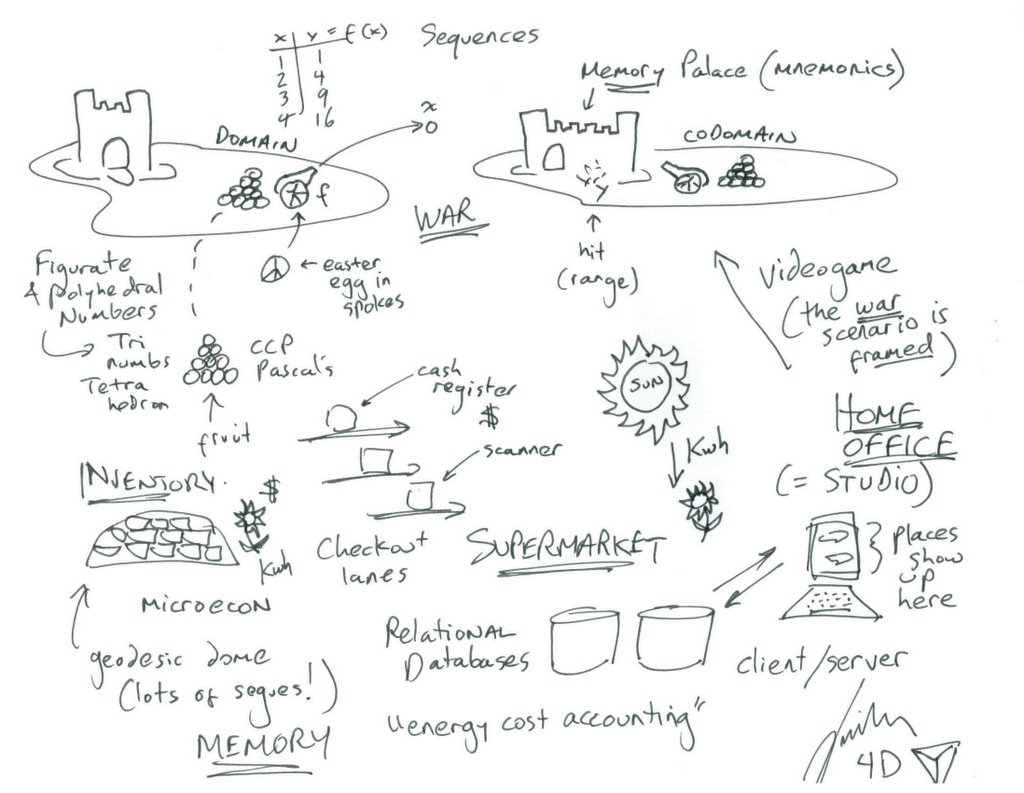 A Math World
(click for larger view)
Although I maybe wasn't thinking this when I drew the above, the two Kingdoms depicted could as well be the two Kingdoms described below. See: Synergetics 987.044 & neighborhood, plus Incommensurable Icosahedra from my ISSN: 1059-1486.
Original context of the drawing: Boosting Bandwidth.
Memo to Wanderers
Posted to the wwwanderers.org Yahoo eGroup (added some HTML):
Received: by 10.78.165.13 with SMTP id n13mr1980834hue;
Sat, 05 Aug 2006 13:58:53 -0700 (PDT)
Date: Sat, 5 Aug 2006 13:58:53 -0700
To: wwwanderers@yahoogroups.com
Content-Type: text/plain; charset=ISO-8859-1; format=flowed
From: "kirby urner"
RE:
Dieter Kotschick
The Topology and Combinatorics of Soccer Balls (American Scientist, Volume 94, pg. 350 -- July-August of this year).
Glenn Stockton's name appears in Math Forum in connection with his gifting me a photocopy of the cited article @ Pauling House (Wanderers' Meeting), followed by a quick recap of its contents FYI:
Having finally seen Da Vinci Code for the first time last night (read book a long time ago) I was surprised at how little it did to exploit a rich set of geometric relationships. Fibonaccis were not tied to Phi very clearly, despite Pentacle.
Of course for a non-specialist audience, there's only so much you want to get into.
A mental schema I use:
Kingdom A:
Periodic Crystal Lattices:
Sphere packing schemes: SCP, BCC, CCP
Rhombic Dodecahedron, octet truss (A.G. Bell's "kites")
http://worldgame.blogspot.com/2006/07/math-they-wont-teach-you.html
Kingdom B:
Aperiodic Lattices & Five-Fold Symmetry:
Icosahedron, Pentagonal Dodecahedron, Hexapents
Penrose tiles
http://www.4dsolutions.net/ocn/hexapent.html
In Fuller's scheme, these two neighboring Kingdoms are bridged by the so-called Jitterbug Transformation, which transformation I would expect to incorporate into some of our archived mathcasts (re: Math Casting see: http://mathforum.org/kb/thread.jspa?threadID=1425804&tstart=0 and of course my ToonTown proposal for PDX, a potential source for such vidclips).
Kirby
Received: by 10.78.165.13 with SMTP id n13mr1980834hue;
Sat, 05 Aug 2006 13:58:53 -0700 (PDT)
Date: Sat, 5 Aug 2006 13:58:53 -0700
To: wwwanderers@yahoogroups.com
Content-Type: text/plain; charset=ISO-8859-1; format=flowed
From: "kirby urner"
RE:
Dieter Kotschick
The Topology and Combinatorics of Soccer Balls (American Scientist, Volume 94, pg. 350 -- July-August of this year).
Glenn Stockton's name appears in Math Forum in connection with his gifting me a photocopy of the cited article @ Pauling House (Wanderers' Meeting), followed by a quick recap of its contents FYI:
Having finally seen Da Vinci Code for the first time last night (read book a long time ago) I was surprised at how little it did to exploit a rich set of geometric relationships. Fibonaccis were not tied to Phi very clearly, despite Pentacle.
Of course for a non-specialist audience, there's only so much you want to get into.
A mental schema I use:
Kingdom A:
Periodic Crystal Lattices:
Sphere packing schemes: SCP, BCC, CCP
Rhombic Dodecahedron, octet truss (A.G. Bell's "kites")
http://worldgame.blogspot.com/2006/07/math-they-wont-teach-you.html
Kingdom B:
Aperiodic Lattices & Five-Fold Symmetry:
Icosahedron, Pentagonal Dodecahedron, Hexapents
Penrose tiles
http://www.4dsolutions.net/ocn/hexapent.html
In Fuller's scheme, these two neighboring Kingdoms are bridged by the so-called Jitterbug Transformation, which transformation I would expect to incorporate into some of our archived mathcasts (re: Math Casting see: http://mathforum.org/kb/thread.jspa?threadID=1425804&tstart=0 and of course my ToonTown proposal for PDX, a potential source for such vidclips).
Kirby
Saturday, August 05, 2006

Wednesday, August 02, 2006
Tuesday, August 01, 2006
Advice to Synergetics Teachers
I find one of the first things I need to get into, when lecturing on the Concentric Hierarchy (a semi-regular gig), is the Synergetics Constant thread.
Amateur mathematicians are disbelieving that a cube of edges sqrt(2) could possibly have a volume 3, as their mental model of powering is entirely cube-based. The pro mathemeticians understand the possibility of an alternative model, but Fuller's is alien and they have better things to study.
So Fuller has readers go through this whole exercise of looking at growing/shrinking tetrahedra, then triangles, to see how the 3rd and 2nd powering relationship (vis-a-vis a changing scale factor, applied to edges) doesn't change. Double the edges, eight-fold the volume, just like before.
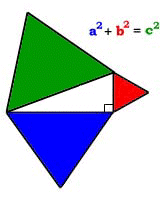
Likewise, the Pythagorean Theorem admits to more than the standard square + square = square interpretation. That could be any shape (say a silhouette of Pythagoras [1]), as long as the proportions are properly metered (the shapes are all similar, such that shape + shape = shape).
Once we've been through this, and people realize the cube thing is cultural, it becomes a lot easier to dissect said volume-3 cube into a tetrahedron (either one) and its four 1/8th octas. Said tet = 1, so the remaining 2 (1+2=3), distribute among four 1/2 volumes, 8 of which give the volume- 4 octahedron and so on.
Then its long and short diagonals on the volume 6 dodeca and we're almost done. 12-around-1 for the volume 20 cubocta, embraced by the 2-frequency cube (x8 the original 3 volume = 24), and the jitterbug, to capture the five-folders (pentagonal dodeca, icosa, and rhombic triaconta mainly).
With that out of the way (the concentric hierarchy, which bow-ties in two Universes (positive and negative)), we get to the next standard objection: "but so many polyhedra are left out of account! What about all the Archimedeans, the zonohedra, the this that and the other?"
I have two answers for that:
(1) no one is stopping anyone from expressing Archimedeans in terms of A & B modules, E modules or whatever, or inventing modules of their own. Yasushi Kajikawa did some of the most important and pioneering work in this domain (published in the Japanese edition of Scientific American), before moving on to disaster relief shelter solutions (his focus at the SNEC summit @ Russell's in DC). Plus David Koski pioneered recursive self-construction of the T-mod (Ed forwarded his stuff to Stanford).[2]
(2) Second answer: Bucky's Synergetics is not intended as some comprehensive survey of all matters geometric. He salutes Coxeter, yes, as the paradigm geometer of our age, then dives head first into philosophical system-building, more in the tradition of Hegel and Kant (plus I apply my signature post-linguistic-turn Wittgensteinian spin). Don't think of Synergetics as a math book at all, and you'll be miles ahead of your peers, still struggling with a lot of misleading imagery.
So, to recap: explain how "the cube is cultural" to keep your momentum through the concentric hierarchy, which is conceptually satisfying once gotten (keeps your audience with you, even if skeptical), then handle the objection that Synergetics is neither comprehensive of geometry as a whole, nor finished in terms of what we might do with it (duh).
To help free their heads from musty and mystifying math associations, remind them it's really literature in some philosophical domain (note the citation to Plato) -- or do what I do and classify it as American Transcendentalism, a product of the 1970s Renaissance, a lot fed by the Apollo Project. Comparison to Poe's Eureka are more than apt, as E.J. Applewhite signified in his last public address (2004 Bucky Symposium @ GWU).[3]
Also, try to remain cool-headed and don't launch into any diatribes about how anyone calling themselves a "math teacher" should already know all this by now, as Fuller's early synergetics constant stuff was published circa 1950. Statistically speaking, it's less and less likely that your audience will have overlapped Bucky in any lifetime scenario sense, many of them having been born since the 1980s. Go with the Universe you're given, not the one you wish we'd had. Accept reality (even if it is only special case).
Notes:
[1] I saw this bust-of-Pythagoras demo @ OMSI one time (our local science museum, back when it was still adjacent the Zoo), plus similar teachings on the walls of Winterhaven (not my doing), a local public school and technology magnet (somewhat different spin than Benson's, also for techies).

[2] "Playing with Blocks"
[3] Ed @ GWU
More on the synergetics constant (3rd powering thereof)
Amateur mathematicians are disbelieving that a cube of edges sqrt(2) could possibly have a volume 3, as their mental model of powering is entirely cube-based. The pro mathemeticians understand the possibility of an alternative model, but Fuller's is alien and they have better things to study.
So Fuller has readers go through this whole exercise of looking at growing/shrinking tetrahedra, then triangles, to see how the 3rd and 2nd powering relationship (vis-a-vis a changing scale factor, applied to edges) doesn't change. Double the edges, eight-fold the volume, just like before.
Likewise, the Pythagorean Theorem admits to more than the standard square + square = square interpretation. That could be any shape (say a silhouette of Pythagoras [1]), as long as the proportions are properly metered (the shapes are all similar, such that shape + shape = shape).
Once we've been through this, and people realize the cube thing is cultural, it becomes a lot easier to dissect said volume-3 cube into a tetrahedron (either one) and its four 1/8th octas. Said tet = 1, so the remaining 2 (1+2=3), distribute among four 1/2 volumes, 8 of which give the volume- 4 octahedron and so on.
Then its long and short diagonals on the volume 6 dodeca and we're almost done. 12-around-1 for the volume 20 cubocta, embraced by the 2-frequency cube (x8 the original 3 volume = 24), and the jitterbug, to capture the five-folders (pentagonal dodeca, icosa, and rhombic triaconta mainly).
With that out of the way (the concentric hierarchy, which bow-ties in two Universes (positive and negative)), we get to the next standard objection: "but so many polyhedra are left out of account! What about all the Archimedeans, the zonohedra, the this that and the other?"
I have two answers for that:
(1) no one is stopping anyone from expressing Archimedeans in terms of A & B modules, E modules or whatever, or inventing modules of their own. Yasushi Kajikawa did some of the most important and pioneering work in this domain (published in the Japanese edition of Scientific American), before moving on to disaster relief shelter solutions (his focus at the SNEC summit @ Russell's in DC). Plus David Koski pioneered recursive self-construction of the T-mod (Ed forwarded his stuff to Stanford).[2]
(2) Second answer: Bucky's Synergetics is not intended as some comprehensive survey of all matters geometric. He salutes Coxeter, yes, as the paradigm geometer of our age, then dives head first into philosophical system-building, more in the tradition of Hegel and Kant (plus I apply my signature post-linguistic-turn Wittgensteinian spin). Don't think of Synergetics as a math book at all, and you'll be miles ahead of your peers, still struggling with a lot of misleading imagery.
So, to recap: explain how "the cube is cultural" to keep your momentum through the concentric hierarchy, which is conceptually satisfying once gotten (keeps your audience with you, even if skeptical), then handle the objection that Synergetics is neither comprehensive of geometry as a whole, nor finished in terms of what we might do with it (duh).
To help free their heads from musty and mystifying math associations, remind them it's really literature in some philosophical domain (note the citation to Plato) -- or do what I do and classify it as American Transcendentalism, a product of the 1970s Renaissance, a lot fed by the Apollo Project. Comparison to Poe's Eureka are more than apt, as E.J. Applewhite signified in his last public address (2004 Bucky Symposium @ GWU).[3]
Also, try to remain cool-headed and don't launch into any diatribes about how anyone calling themselves a "math teacher" should already know all this by now, as Fuller's early synergetics constant stuff was published circa 1950. Statistically speaking, it's less and less likely that your audience will have overlapped Bucky in any lifetime scenario sense, many of them having been born since the 1980s. Go with the Universe you're given, not the one you wish we'd had. Accept reality (even if it is only special case).
Notes:
[1] I saw this bust-of-Pythagoras demo @ OMSI one time (our local science museum, back when it was still adjacent the Zoo), plus similar teachings on the walls of Winterhaven (not my doing), a local public school and technology magnet (somewhat different spin than Benson's, also for techies).
[2] "Playing with Blocks"
[3] Ed @ GWU
More on the synergetics constant (3rd powering thereof)
Saturday, July 29, 2006
Wednesday, July 26, 2006
Screen Credits
In mixing programming with telecasting, we're able to code up objects that display themselves on television, by scrolling names and job titles for example, such as at the end, or even beginning, of a segment.
We'd like to go further in this direction, as the game people already have, so that our library of reusable video objects (dynamic, not static screen widgets, and with many of them read only, in terms of final output) naturally grows within the context of various shows (like the reusable movie sets building up in Morocco).
I'm pondering the problem of internationalizing screen credits. A local credits object might pull from the Irish spelling of the names, while displaying unicode alternatives in parentheses (Arabic, Farsi, Japanese, Hebrew, Greek...).
Then, in each of those locales, the primary language spelling (usually phonetic, as in Arabic), followed by the Chinese ideographs or whatever. This would look better than trying to caption credits, which often move by rather quickly.
We could also leave it more up to the actor or grip: which spelling would you favor, in this Middle Eastern locale? Some have a high profile mark or glyph they'd like shown (like a company logo).
My name in Cyrillic? I'd rather see the whole of Synergetics in that alphabet, something fun for my bookshelf -- I could get an in-cyrillic credit for one of the on-line mirrors (job title).
These dynamic spelling conventions for job titles, crew members, would require a player to have a more finely ground idea of locale than most DVD players currently.
My model also included over-the-net lookup, of some of the info, but only because the video itself was coming by that vehicle.
We'd like to go further in this direction, as the game people already have, so that our library of reusable video objects (dynamic, not static screen widgets, and with many of them read only, in terms of final output) naturally grows within the context of various shows (like the reusable movie sets building up in Morocco).
I'm pondering the problem of internationalizing screen credits. A local credits object might pull from the Irish spelling of the names, while displaying unicode alternatives in parentheses (Arabic, Farsi, Japanese, Hebrew, Greek...).
Then, in each of those locales, the primary language spelling (usually phonetic, as in Arabic), followed by the Chinese ideographs or whatever. This would look better than trying to caption credits, which often move by rather quickly.
We could also leave it more up to the actor or grip: which spelling would you favor, in this Middle Eastern locale? Some have a high profile mark or glyph they'd like shown (like a company logo).
My name in Cyrillic? I'd rather see the whole of Synergetics in that alphabet, something fun for my bookshelf -- I could get an in-cyrillic credit for one of the on-line mirrors (job title).
These dynamic spelling conventions for job titles, crew members, would require a player to have a more finely ground idea of locale than most DVD players currently.
My model also included over-the-net lookup, of some of the info, but only because the video itself was coming by that vehicle.
Sunday, July 23, 2006
Math Makeover Ad

So, does your school teach this?
No?
So, maybe it's high time you
Question Authority?
(animated gif brought to you by the Fuller School)
No?
So, maybe it's high time you
Question Authority?
(animated gif brought to you by the Fuller School)
Saturday, July 22, 2006
Civilian Technology
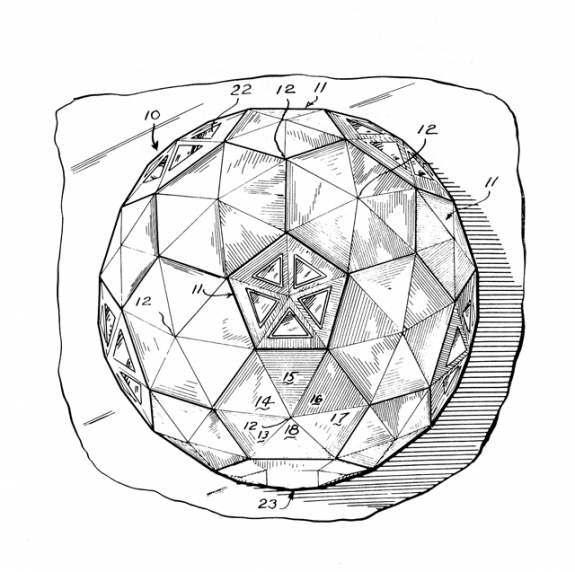 Hexa-Pent (1974)
U.S. PATENT - 3,810,336
From Synchronofile by Trevor Blake:
The Geodesic Hexa-Pent is called a Geodesic Pentagon and Hexagon Structure in patent 3,810,336 (14 May 1974). The patent was granted to Shoji Sadao and assigned to Fuller & Sadao, Inc. Shoji Sadao was a former student of Fullers. Sadao was involved in the creation of the icosohedral Dymaxion Map (known as the Raleigh projection) and in the creation of the Expo ‘67 dome in Montreal. In Inventions, Fuller claims that the Hexa-Pent dome was developed by Sadao and jointly named by Sadao and Fuller. The Hexa-Pent dome is preceded by patent 3,114,176 of Alvin E. Miller (17 December 1963). The Hexa-Pent dome was featured in the May 1972 issue of Popular Science magazine. The plans for the dome advertised on page 139 of this issue represents the only time Fuller himself sold dome instructions to the general public.
Thursday, July 20, 2006
War Story
According to the nation-states model, undisciplined civilians hate each other's guts so much that, left to their own devices, there'd be all out, uncontrolled mayhem, spearheaded by vigilante gangs.
However, some civilians, being wise, knew themselves well enough to delegate populations of brave soldier, trained in the arts of war, to boldly venture into harm's way on their behalf, and in order to restore the peace -- and all because the civilians had failed in their most essential duty (to not lose it).
The job of these delegate populations was to contain the fighting, by keeping the civilians out of it. They would target each other, and fight military to military. The motto of the professional armed forces: let us do the fighting. Nice theory.
This model started breaking down big time in the 20th century. Many militaries began targeting civilians directly, including from submarines. The Age of Terror was upon us. Civilians got to work on their bomb shelters (or used the underground).
Nowadays, we have only the remnants of the old nation state system. Armed militias, flying various flags, go berserk and trample civilians under foot. The violence is uncontained. The idea of a "professional soldier" (a descendent of "chivalrous knight") is now more a fantasy than an on-the-ground reality.
Might we put humpty-dumpty back together again, even at this late date? The few remaining pros in the military still have hopes along these lines. Protecting civilians (from themselves if necessary) remains an honorable calling.
But will the civilians climb out of their intellectual squalor and start dealing with reality again? A lot of evidence suggests that they will.
The nation-state theory still has some workable elements, even if the global context makes the whole notion of nations seem more quaint and antique. Just because it's old doesn't mean it can't still operate on some level.
However, some civilians, being wise, knew themselves well enough to delegate populations of brave soldier, trained in the arts of war, to boldly venture into harm's way on their behalf, and in order to restore the peace -- and all because the civilians had failed in their most essential duty (to not lose it).
The job of these delegate populations was to contain the fighting, by keeping the civilians out of it. They would target each other, and fight military to military. The motto of the professional armed forces: let us do the fighting. Nice theory.
This model started breaking down big time in the 20th century. Many militaries began targeting civilians directly, including from submarines. The Age of Terror was upon us. Civilians got to work on their bomb shelters (or used the underground).
Nowadays, we have only the remnants of the old nation state system. Armed militias, flying various flags, go berserk and trample civilians under foot. The violence is uncontained. The idea of a "professional soldier" (a descendent of "chivalrous knight") is now more a fantasy than an on-the-ground reality.
Might we put humpty-dumpty back together again, even at this late date? The few remaining pros in the military still have hopes along these lines. Protecting civilians (from themselves if necessary) remains an honorable calling.
But will the civilians climb out of their intellectual squalor and start dealing with reality again? A lot of evidence suggests that they will.
The nation-state theory still has some workable elements, even if the global context makes the whole notion of nations seem more quaint and antique. Just because it's old doesn't mean it can't still operate on some level.
Tuesday, July 18, 2006
Back to Work
OK, so now that we're done having a good laugh at the remarks of Senator Ted Stevens, who likened the Internet to "tubes", "not a truck", we should admit that he's right. Tubes are a good metaphor, as are hydraulics more generally.
The money system, the freeway system... all good public works, and likewise compared with tubes in their day (the London underground system is quite literally tubular).
Bascially what Congress needs, and what the American people need, is the same thing: expediently expeditious updates through new (and old) adult education circuits.
The earlier idea, of competent lawmakers conceptually equipped to tackle the big issues of our day, has been replaced, by one of people in future shock, wondering how it got to be 2006 already (and wouldn't it be easier to go back to 19??, and refight some stupid war we all lost already? -- not!).
But we're ready and willing to learn. We've got flatscreen TV, microwave popcorn, couches. We're The Simpsons (or sims) ready to slurp it up and get a clue. Just your "how things work" basic briefings would be fine, and useful in the context of all the reality TV that's going on. Don't let Hollywood phonies control it (they'll just slap on some superficial veneer).
Lots of clever animations. Lots of metaphors. Tubes, trucks, whatever. Bring 'em on.
The money system, the freeway system... all good public works, and likewise compared with tubes in their day (the London underground system is quite literally tubular).
Bascially what Congress needs, and what the American people need, is the same thing: expediently expeditious updates through new (and old) adult education circuits.
The earlier idea, of competent lawmakers conceptually equipped to tackle the big issues of our day, has been replaced, by one of people in future shock, wondering how it got to be 2006 already (and wouldn't it be easier to go back to 19??, and refight some stupid war we all lost already? -- not!).
But we're ready and willing to learn. We've got flatscreen TV, microwave popcorn, couches. We're The Simpsons (or sims) ready to slurp it up and get a clue. Just your "how things work" basic briefings would be fine, and useful in the context of all the reality TV that's going on. Don't let Hollywood phonies control it (they'll just slap on some superficial veneer).
Lots of clever animations. Lots of metaphors. Tubes, trucks, whatever. Bring 'em on.
Monday, July 17, 2006
Garbage Collection
In part, that's to answer the question "what does Python bring us?".
A little history is in order here: runtime memory has been expensive and scarce, and one of the worst crimes was to write resource hog programs that took more memory than necessary.
Now, some applications unavoidably require gobs of memory, but the least you can do, as a programmer, is explicitly deallocate what you've allocated. Free up the resources you're not using when you're done with them. Don't make other processes do all the work to clean up and reclaim.
Put simply: clean up your own messes.
What garbage collection supplies, is an automated bookkeeping service for determining what bits of memory are ready for recycling. The coder doesn't have to worry so much about being a memory hog, as the virtual machine on which the coder's code executes, is already quite resource aware. When it allocates from the heap, it does so with strings.
In Python, when a list, tuple or dictionary is no longer referenced, it simply goes away. The garbage collector comes along (exactly when usually isn't your concern) and cleans house.
Clever programmers will now insist that garbage collection is for sissies. If you want lean and mean code, do your own allocating and deallocating.
But the truth is, we don't always want our code lean and mean. Sometimes we like comfortably fat Python, well fed. Maybe it just ate a goat.
Anyway, it's easier for us to be lazy a lot of the time. Hackers, meet Slackers. Slackers, Hackers. Shaking hands all around.
Python fills a niche, is not all things to all people. Use it when it's smart to use it, but always be open to using something else if/when the situation demands it.
A little history is in order here: runtime memory has been expensive and scarce, and one of the worst crimes was to write resource hog programs that took more memory than necessary.
Now, some applications unavoidably require gobs of memory, but the least you can do, as a programmer, is explicitly deallocate what you've allocated. Free up the resources you're not using when you're done with them. Don't make other processes do all the work to clean up and reclaim.
Put simply: clean up your own messes.
What garbage collection supplies, is an automated bookkeeping service for determining what bits of memory are ready for recycling. The coder doesn't have to worry so much about being a memory hog, as the virtual machine on which the coder's code executes, is already quite resource aware. When it allocates from the heap, it does so with strings.
In Python, when a list, tuple or dictionary is no longer referenced, it simply goes away. The garbage collector comes along (exactly when usually isn't your concern) and cleans house.
Clever programmers will now insist that garbage collection is for sissies. If you want lean and mean code, do your own allocating and deallocating.
But the truth is, we don't always want our code lean and mean. Sometimes we like comfortably fat Python, well fed. Maybe it just ate a goat.
Anyway, it's easier for us to be lazy a lot of the time. Hackers, meet Slackers. Slackers, Hackers. Shaking hands all around.
Python fills a niche, is not all things to all people. Use it when it's smart to use it, but always be open to using something else if/when the situation demands it.
Saturday, July 15, 2006

Thursday, July 13, 2006
Robots @ OMSI
I reupped our family membership with OMSI on Monday, between visits to our Portland Knowledge Lab -- informally so-called -- and the Lucky Lab.
Tara went looking for Aibos, and found a case with them, none moving. The most animated robot, an arm, was assembling 2D puzzles from triangular tiles, in a race against half-heartedly playing-along humans.
The other main source of animation was an exhibit full of ants, asking us to think about how rules so simple an ant could follow them, might lead to emergently interesting properties, a so-called "hive mind".
I thought it was kind of cheating to use ants, since a hallmark of robots is that humans make 'em, at least indirectly. Yes, "by human design" may mean trading away some quality and sophistication, but in exchange we earn the right to have some pride in our work (unless, of course, we're simply slapping trademarks on naturally-occuring designs, adding little from our own humanity).
Bernie-the-geochemist has me persuaded that private industry long ago left most universities in the dust vis-a-vis critical path R&D. However in being more secretive and proprietary (vs. open source like academe) private companies ensure that realistic futurism stays locked away from prying eyes.
That's not necessarily a good thing, if those were positive toys. We could've inspired more hope in our young -- with working prototypes, not just artists' conceptions.
I bet Sony could have staged a dynamite exhibit about robots, or at least gotten more focus for its pioneering research. So many good toys stand waiting in the wings, while bus-loads of school children see only obsolete futures based on decades-old research.
Tara went looking for Aibos, and found a case with them, none moving. The most animated robot, an arm, was assembling 2D puzzles from triangular tiles, in a race against half-heartedly playing-along humans.
The other main source of animation was an exhibit full of ants, asking us to think about how rules so simple an ant could follow them, might lead to emergently interesting properties, a so-called "hive mind".
I thought it was kind of cheating to use ants, since a hallmark of robots is that humans make 'em, at least indirectly. Yes, "by human design" may mean trading away some quality and sophistication, but in exchange we earn the right to have some pride in our work (unless, of course, we're simply slapping trademarks on naturally-occuring designs, adding little from our own humanity).
Bernie-the-geochemist has me persuaded that private industry long ago left most universities in the dust vis-a-vis critical path R&D. However in being more secretive and proprietary (vs. open source like academe) private companies ensure that realistic futurism stays locked away from prying eyes.
That's not necessarily a good thing, if those were positive toys. We could've inspired more hope in our young -- with working prototypes, not just artists' conceptions.
I bet Sony could have staged a dynamite exhibit about robots, or at least gotten more focus for its pioneering research. So many good toys stand waiting in the wings, while bus-loads of school children see only obsolete futures based on decades-old research.
Saturday, July 08, 2006
Smart Cars 2
So Tara was asking if "smart car" means they talk to you, like some of these GPS units. I explained it was more in reference to the buyer being smart for choosing it, over some fuel-inefficient gas hog.
However, this did lead to speculations about what "autopiloting" cars might be like.
I suggested "robot freeways" and add-on dashboard controls, that'd let a car go into "zombie mode" such that freeway computers would steer.
You could dial in "Chicago" and doze off, confidant that your vehicle would be routed safely and smoothly through the robotic freeway system, all the way from LA.
However, most of the time, you'd pilot your vehicle yourself, just like old times (even use a stick shift if you prefer -- Razz has a stick).
The old I-net might be the backbone of our smart car system, but only in some lanes and on some routes.
Fun science fiction anyway, worth projecting on the big screen. Actually, a lot of prototyping has already occured. People have been fantasizing about "smart cars" for a long time by now.
Some of the first smart cars might actually be more like smart trucks, used mostly for inert and inanimate freight -- and the occasional test pilot, thrill seeker, or quality assurance engineer.
Like when testing roller coasters, we use crash dummies, other proxies, until we're satisfied with the safety of the equipment.
However, this did lead to speculations about what "autopiloting" cars might be like.
I suggested "robot freeways" and add-on dashboard controls, that'd let a car go into "zombie mode" such that freeway computers would steer.
You could dial in "Chicago" and doze off, confidant that your vehicle would be routed safely and smoothly through the robotic freeway system, all the way from LA.
However, most of the time, you'd pilot your vehicle yourself, just like old times (even use a stick shift if you prefer -- Razz has a stick).
The old I-net might be the backbone of our smart car system, but only in some lanes and on some routes.
Fun science fiction anyway, worth projecting on the big screen. Actually, a lot of prototyping has already occured. People have been fantasizing about "smart cars" for a long time by now.
Some of the first smart cars might actually be more like smart trucks, used mostly for inert and inanimate freight -- and the occasional test pilot, thrill seeker, or quality assurance engineer.
Like when testing roller coasters, we use crash dummies, other proxies, until we're satisfied with the safety of the equipment.
Wednesday, July 05, 2006
HexaPent

Four freedoms of the global grid: to vary frequency, orientation, altitude, to fold/unfold. The viewer has yet additional freedoms.
The latitude/longitude grid gives the illusion of regular quadrilaterals (squares) nearest the equator, and furthest from the two poles where longitudinal gore tips meet.
The global matrix, backward-compatible with lat/long, gives the illusion of regular hexagons in regions furthest from the 12 pentagons. Irregularities are more evenly distributed.
Both grids fold/unfold, using various algorithms e.g. Fuller's and Snyder's.
Related links:
Fuller's Geoscope Project (global data displays)
Glenn Stockton's Global Matrix Project (Math Forum citation)
Subscribe to:
Posts (Atom)
