Wednesday, August 19, 2026
Civilian Life
Sunday, August 16, 2026
The Odyssey (movie review)
I took in The Odyssey at a packed 2 PM showing at Hollywood Theater in the Hollywood District of Portland, Oregon, AD Aug 15 2026.
I’d recently had a conversation at Sapphire Hotel in which I agreed a lotta movies these days were sequels of sequels, and inside some Universe of partially overlapping sagas, leading many would-be viewers to feel left out (my attitude toward Game of Thrones, which still sits unwatched in my DVD collection).
The commitment to get into a whole fictional universe-in-progress seems too big, especially in light of RealWorld [tm] making its demands. For example, I was gonna stay outta first run movie houses til the war was over and prioritize doing homework around nonfiction, also harder to find during wartime.
Well, I decided pretty quick the war was over, at least in terms of knowing who the losers were, although that had been pretty clear going in. Back to Plato’s Cave — a place eerily foretelling regarding our ScreenWorld of today.
Imbalance vs-a-vs the gods means aberrational with respect to the generalized principles, and when the divergence gets extreme, there’s hell to pay, in the form of nightmare scenarios, many of them surreal.
As the movie opens, Odysseus is already in an afterlife of sorts, a kind of heaven, yet he’s haunted by flashbacks, and tormented by his own role in bringing an end to civilization.
He feels personally responsible for the destruction of Troy, and for creating so many loose ends in the form of insufficiently honored dead.
Calypso is his healer and therapist. She feeds him ancient wisdom, symbolic lotus leaves, which he craves. She teachers him to let go, meaning to be less of a control freak. Big wheels are turning. Like Odysseus don’t be so vain as to think it’s only about “little me” (Odysseus does have a big ego, befitting a dude of his status and stature).
To heal, Odysseus must first just forget for a while, and enjoy some R&R. Then, once he’s recovered sufficiently to due process work, a re-enters the nightmare to rescue his loved ones: his wife, son, dog, and loyal servant.
This time he must not allow himself to get detoured by Agamemnon’s path, which didn’t end well for Agamemnon either. The plot line focuses a lot on Odysseus’s son, Telemachus, and the latter’s quest to figure out if his dad is ever coming back. A lot rides on that question. Telemachus gets to chat with Agamemnon’s brother.
Catering to Agamemnon’s ego is what got all those soldiers stuck living as beach bums for ten years, their seige of Troy, before Odysseus managed to think up the Trojan horse ploy, which involved taking advantage of the Trojans’ love for Athena. He’d abuse their loyalty to Athena against them. That move would take its toll.
Once Athena personally witnessed his later (much later) confession to his wife, that he had been an evil perp who had needed therapy (seven years with Calypso), he was eligible to take the next step, this time with Penelope, to sail away westward (her idea in the first place), leaving the throne of Ithaca to their son, and tying off any any loose ends. After vanquishing the suitors, who had it coming.
In the closing scene he foretells of new civilizations that would arise to replace his dying civilization of readers. His story would in the meantime be passed ahead by means of song by the illiterate. And as we know in hindsight, the art of reading would arise again, along with this new art of making movies. Some applause at the end.
Thursday, August 13, 2026
Laika Crows
I use this Gmail app that insists on knowing that formatting text into a narrower column is not OK, and the first letter of the next line must be capitalized, because of the hard line break.
There might be a buried setting to turn that off. A lotta software engineers make their living being way too helpful, cuz their job depends on feature bloat. This might be my opportunity to get back into using Vim — but is there a Vim app for the iPad.
Something primitive, then cut and paste to Gmail for adding pix?
Part of it is Gmail seeks to be faithful to HTML under the hood and line breaks were always dicey on a web page of indeterminate dimensions.
OK, boring. What’s been happening (also boring, to a lotta browsers flitting by — at a “hi bye” rate)?
The Laika Crows (about 30) were unveiled and I encountered four of them in one outing, scoring pictures of the first three, the last espied through a Max train window, in the plaza next to Big Pink (rose-colored office tower).
Cutting and pasting from my Gmail outbox:
Here I’m taking the line breaks back out, a Blogger provides its own margins.
The crow pix were from my bicycle-based Wandering with another Wanderer yesterday. Another Gresham Loop.
Saturday, August 08, 2026
Spider-Man: Brand New Day (movie review)
I’d declared a moratorium on having frivolous summer fun enjoying first run blockbusters as long as the City of Morons was on a global rampage to prove itself relevant. Today though, I got the same vibe Tim Dillon was sharing, that we’d turned a page and smarter cities were taking over the decision making, so I dipped into The Bagdad for the latest Spidey movie (I’ve seen a bunch of em).
I saw a lotta plot parallels with the latest ET movie, in that the Department of Damage Control was much like the evil agency seeking to exploit ET tech.
That’s a common theme: anything powerful, like the Nazi ideology, needs to be harnessed and redirected, hence Operation Paperclip and the birth of NASA, which JFK then refocused away from Los Alamos style phallic missile play to a moon-focused Apollo Program, effectively making the most admired job (that of astronaut) seem civilian instead of military.
Apollo-Soyuz threatened a lotta personality cults, distracting the rank and file from wanting military style glory. Vanity dictated a solution be found. But I digress.
Peter Parker is very lonely, because he has these unrealistic spidey powers no one else has. Sure, there are other circus freaks out there.
He’s got company. Just no good friends, as anyone with superpowers is likely villainous (back to Department of Damage Control), whereas Parker is a stereotypical “good guy” (his character has always been “a protagonist” in the Ancient Greek sense of the word i.e. noble, heroic).
Peter really wants to get back with MJ and is somewhat the obsessed stalker. But in wiping her mind for her own protection, he wiped out the old MJ. The new MJ is kind to him, but not madly in love, not up to reciprocating his tender feelings (I shoulda said “spoiler alert” but y’all coulda predicted this twist).
Then Peter meets a different girl with powers rivaling his, and so another villain at first, predictably.
But after a Vulcan mind meld of sorts, they both realize they have more in common than not, so why not be on the same side against the City of Morons (or the NYC-based equivalent)?
The subplot is Peter is entering a next chapter in becoming more like an adult spider, which is kinda gross. Younger viewers will recognize the onset of puberty is being alluded to, much like in Inside Out 2. Hormones.
Peter is doing his best to tamp it down, by means of a neck implant (he and MJ are both genius level in biochemistry), as his becoming more spidery is really messing up his game, and taking a toll on his self control. He even hurts (not fatally) an innocent cop, one of the good guys, in a blind rage.
What he really needs is some R&R, but the situation he faces (MJ is in danger) is way too dire. Heroes need an heroic journey, ways to prove (and develop) their metal. Marvel comics (akin to manga) know the formula.
Did I mention the Hulk gets to be a star too? This is the MCU (Marvel Comics Universe) after all.
I’m not being negative or dismissive when I say “formula”. Movie alchemy is based on casting the right spells at the right time, thereby being bewitching and giving audiences their money’s worth (as a dude with a senior-priced ticket, in a cool theater on a hot day, I did not feel ripped off).
Upon discovering his female counterpart (his anima in Jungian terms) he’s freer to loosen up about his true identity. His closest friends get to know what’s behind the mask. He reintegrates into society more successfully, realizing he’s appreciated (so not so alone after all).
By the end, he has regained his equilibrium, and is ready for a next movie, perhaps with more friends. The franchise must go on. Stay tuned.
Wednesday, August 05, 2026
Friday, July 31, 2026
Wednesday, July 29, 2026
Monday, July 27, 2026
Another Loop
Cycling requires pretty good awareness, especially at crossings but at all times really. No one talks about AI bicycles, thankfully. However people do go on "autopilot" which means they forget to stay conscious about what they're doing. Usually that results in a wrong turn, which inspires higher consciousness. Other times: fender benders.
Saturday, July 25, 2026
Of Manga and Mangos
This title for this post came to be even before I embarked on today's Wanderer circuit, taking in the new-to-me Gresham Library (East County branch) and checking out some titles. I went by bus and Max.
Thursday, July 23, 2026
Sunday, July 19, 2026
Show & Tell Item
I had no expectation of finding this on the WalMart dog aisle. We were taking a shortest distance to the registers, having selected our groceries. But wait! Look at this! Quado.
Friday, July 17, 2026
City Planning
Monday, July 13, 2026
July Twelve
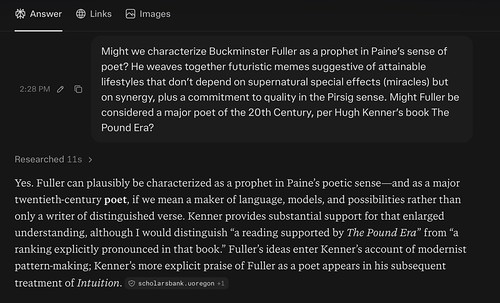
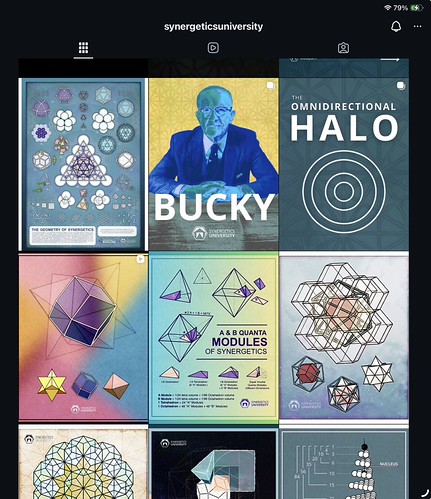
July the 12th, Bucky Fuller's birthday, will be coming around the every year not long after Summer Solstice, the start of the Summer Term @ School of Tomorrow. We'll be thinking of more ways to celebrate as time goes on.
Saturday, July 11, 2026
Reading Substations
An electrical substation is laid out just like a schematic. Engineers, left to their own devices, don’t add much cruft. Yet they’re fascinating in their functionality. I’ve long been in the habit of noticing them, even pausing and taking pictures, but not having learned much in middle school about em, I was failing to look back.
I finally regressed to what should have been in my high school curriculum (if not middle school): the anatomy of a substation. Not just what it does (steps up voltage for long distance transmission; steps down voltage for end user loads) but its anatomy: air gap disconnectors; gas-infused circuit breakers; oil-cooled transformers.
Where this puzzle piece fits, for me, is into my School of Tomorrow curriculum, brought to you by Oregon Curriculum Network and my own little 4D Solutions. I’ve called it Martian Math, which is meant to signal the science fiction stories one finds therein.
We use sci-fi in place of fairytales, if there’s a difference. One such story features ETs wanting to work with Earthlings on a hydro-dam project and needing to learn how the Earthlings learn maths, so as to make ET-Earthling communications more productive.
Tuesday, July 07, 2026
CodaComb
Newspaper people have a natural understanding of templates, much as lawyers do. Or call them MadLibs. Fill in the blanks. Forms. In web world, we submit em.
Sunday, July 05, 2026
Minions 3 (movie review)
I'd seen the preview for this one at Toy Story 5 but didn't quite realize how soon it'd be coming out.
I walked by Fox Tower in downtown Portland on the off chance I'd wanna take in a film before fireworks. Minions and Monsters was just about to start. Why not? I've always found Minions movies entertaining.
Given the Film Studies focus of these blogs, wherein I interleave movie reviews such as this one, looking to connect the dots, this Minions fits perfectly into the syllabus. Because it's about the history of film-making, Hollywood in its golden era most especially (1920s - 30s), around the time films transitioned from live music accompaniment to "talkies".
The upshot is noobs learn a lot about film-making culture and history, while oldsters appreciate all the allusions mixed with satire, the knowing use of film canards and cliches. Charlie Chaplin, Buster Keaton... and Dort (rhymes with dork), the hilarious Martian robot egomaniac with a crush on the suffragette. Wow, small world. Into this world barge the Minions, ever in search of a "big boss" they can serve as minions do. A faction breaks off to support Dort, whereas the bad guy bank robber on a horse is the other candidate.
The Minions make it big in Hollywood and are living the high life, when the talkies era obtrudes. Minions can't convincingly should like the characters they play. The Humphrey Bogart character just doesn't cut it (my favorite scene? -- during the "homage to noirs" part).
The self-aware "play within a play (within a play...)" dynamic is worked deftly with the closing credits reminding us that minions made this film (Jeff Bridges among them).
So where do the "monsters" fit in? Is Dort a monster? No, Dort is his own thing.
The story there is one of their interim Big Bosses was a Gandalf or Dumbledore type, a wizard with a book of magic spells, out of which one could summon major demons (monsters). However this book of spells is not the only source of monsters. Per a well-worn trope, monsters may also be thawed out, if you know where to find their hidden ice caves (one of the demons knows).
The monsters have their assigned roles in the ensuing blockbusters.
The entire story is bracketed within a museum visit to a hall of fame, and the tour guide lady wants to be sure the lore gets passed on intact. She then tells the story of a lifelong friendship between two creatives, Henry and James (minions) whose imaginative powers will eventually make the Hollywood chapter work.
This is all a prequel to the Gru chapters, which are foreshadowed but come later.
Saturday, July 04, 2026
C Suite Hotels
If you’re a denizen of Geekdom then there’s a high probability that, whether or not you’ve been on one (I’ll say I haven’t, unless I count… nah), language-specific cruises, like C-lang Gang to Alaska, exist.
Even less rarified are the organized retreats where sprinting happens, meaning a cohort agglomerates to advance a software project they prolly work on together remotely, but now, all together in meat space, high bandwidth, they can prolly really crack some eggs if that’s an expression.
Fast forward and we’re thinking C-Suites Hotels, a chain of resort locations geared for C-language geeks in particular, which might or might not include C++ depending on the establishment. Some geeks will be comfortable in both C++ and C language lounges, gabbing fluently around the relevant food and beverage options.
Based on my experiences around OSCON, I’d suggest mono-language resorts and/or assisted living facilities, would be self defeating as the whole idea is to stimulate novel thought patterns, or at least that’s why many people are there. So we might express our resort’s offerings more in terms of a ballpark or blend. There might be a shared focus, such as Synergetics (a kind of computational geometry) that attracted a variety of geek guests.
I got to be in a geek retreat around Plone, a descendent of Zope, one of the early object storage databases, ahead of its time in some ways, maybe beyond in others (aren’t we all). Here’s some LLM prose about that ecosystem.
Wednesday, July 01, 2026
Natural Language Accelerators
I had an interesting conversation with a peer this morning, which touched on where things might be going with the various MEMEX type devices, chatbots and so on.
Of course MEMEX is not a term of art in current shoptalks, but does come to us from the 1940s with the right connotations and expectations. Rather than clinging to LLMs + LMMs as the presumed architecture, or otherwise overfitting, we bring back an old bottle ready for new wine.
MEMEX was a term coined by Dr. Vannevar Bush, the original National Science Foundation chief, when describing his vision of today’s AI but in terms intelligible at the time. Microfilm was a big part of it.
Everyone knows the direction in computing is towards ever smaller (vs ever larger) leading Bucky Fuller to propose his UMC (his ultra-micro computer), whereby human subjects might become pinheads in a good way, as metaphysical components within some “hive mind” or “zeitgeist OS”.
The picture on many drawing boards is of massive centralization in the cloud (much talk about data centers), whereas many social engineers are planning for the individual school-level MEMEX, picturing both a physical campus and a virtual sphere in Cyberia (cyberspace), in user space.
The logical boundaries for a typical school would be inclusive of theater and sporting events, debating events, any number of extracurricular, as well as curriculum-related, activities (chess club, glee club… specifics are obviously per school).
Year books, course readings, pages for faculty (active and retired), pages for students, past research… all would be raw material for the MEMEX, the computer that makes sense from a bewildering variety of saved goodies, with more always being added.
My expectation is Princeton’s MEMEX will be usable by alumni and in aggregate alumni across classes will represent the bigger slice of the pie, based on demographics. Those currently enrolled are the pipeline into the alumni tiger tank (where we tigers hang out).
However, similar to what happened in the music industry, with barriers to entry falling, thanks to the technology, a smaller personal MEMEX is also forecast and indeed is what many are busily building right now today, after which they make public videos about it. To what degree these individual onboard models are given agency varies of course.
Clearly we’re in a transitional period with AI, where many small experiments provide the feedback the bigger solution providers will need, if their relatively large scale affordances are gonna be considered affordable, meaning worth their cost.
Many possible scenarios we simply cannot afford, only fantasize about, and maybe get people to pay for anyway, as they share the same fantasy without critical insights into the practical feasibility of whatever crazy plan. Groupthink is like that. People feel safe and secure as long as they’re not alone i.e. as long as they have a critical mass of true believer subscribers to whatever vision (one would hope for more than a mere vision).
Those with a stronger sense of the Reality Principle serve to help filter out the truly crazy schemes. Some do get through though, and those involved find out the hard way why they should never have gotten funded in the first place. By the time that becomes obvious, it’s too late to course correct, while meanwhile the crazy think tank professors who dreamed this stuff up, are off to other assignments. There’s no one to call.
When the game is to try many things, going with fast and small over slow and big, the consequences of a scenario failing or wiping out will be manageable as well as instructive.
Some plans look like they could work and one only realizes in hindsight about some of the obvious flaws.
Learning from one’s mistakes is of prime importance, in order to avoid one of those doom loops we always hear about, wherein a failure to realize what’s self-defeating is in itself a blind spot in the analysis.
Sunday, June 28, 2026
Investigating English
Let’s look some more into English, in the sense of “investigate”, a verb already colored, by me, for me, by the Wittgensteinian corpus. I’m referring to an Austrian philosopher, first name Ludwig, who also spent a lotta time around military hospitals, as well as in academic settings.
Mostly LW preferred staying by himself (he secluded himself in Scandinavia somewhere) and thinking deeply about language and how words mean. Our contemporary philosophy owes a lot to this thinking, in synergy with the thinking of others.
The verb that comes to mind this morning is “to rationalize” which usually means “to contrive a rationale in retrospect” when something, likely unbidden, is already a fait accompli yet maybe still in need of some justification, explanation, or excuse. When one endeavors to “rationalize” whatever, one strives to fit whatever into some schema whereby it seems planned, intentional, or at least explicable, and therefore more acceptable.
From the previous paragraph you may gather, correctly, that rationalizations often ring hollow, as they’re used to justify the unjustifiable sometimes. So there’s a negative connotation to the word, as rationalizations have a poor reputation.
But you might wonder, seeing how “rationalize” is so close to “rational” and also “reasonable” in semantic space that it’d have more of a luster to it, more of a positive connotation. Finding ways to make something seem more reasonable in retrospect should not be judged a weakness. It’s when the reasoning seems “forced” and/or “sketchy” that the proffered rationalizations are adjudged “empty”.
I’d say our ability to rationalize in the sense of “smooth over by applying one’s reasoning powers retroactively” is a part our ability to self heal. In other words, there’s nothing necessarily wrong with making the best of new developments by incorporating them into one’s emerging sense of reality.
The active inferencer, or inferant, seeking to minimize uncertainty (free energy), is always using the wisdom of hindsight to retell a tale already told.
Revising is not a crime as there’s always more than one way to tell a story when facts underdetermine the spin we put on them. Sometimes the retelling seems phony, no question. We call that “putting lipstick on a pig”. A poor excuse might be a considered a failure to sufficiently rationalize. No rationale seems to work.
We’re taken to task for being “revisionist” sometimes, as thats another verb (“to revision”) with a bad reputation.
But here too: isn’t revisioning a responsibility more than a sin?
Both rationalizing and revising may be part of a healthy self-updating process.
Don’t deny yourself the privilege of seeing events, or even your whole life, in a new light, given the advent of new information, new experiences. A willingness to revise is often called “being open minded” which in most walks of life is at least given lip service as a positive. To be “closed minded” is to be “stuck in a rut”.