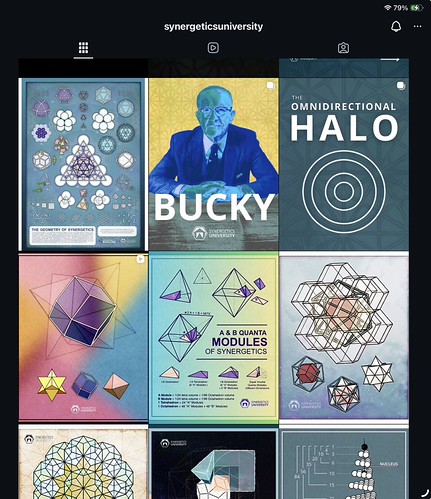
When sharing a Bucky bio, perhaps making one up on the spot, LLM-style, there’s that 1927 pivotal moment to talk about. Fuller began to dwell on this low point in Chicago, from an egoic point of view, later on, seeing it as transformational.
Elsewhere he brings up his relationships both with Al Capone and with J.P. Morgan bankers, saying he could appreciate their respective worldviews. Empathy is not just overhead when it comes to modeling and therefore actively inferring tomorrow’s developments. One’s ability to create models of others’ viewpoints is more like a crucial skill.
However, empathy alone is not guaranteed to give birth to a coherent system; for that one needs another kind of resolve: commitment to doing one’s own thinking, not outsourcing one’s ability to self encode, not to talking head authorities, not to chatbots, not to other family members. One’s angle, one’s perspective, deserves its own custom built namespace, and that’s self generated from the inside out, more than from the outside in.
In my own telling, I’m likely to liken Fuller’s transformative experience to that of Eckhart Tolle. In Tolle’s telling, he’s reached the conclusion he can no longer live with himself, followed by the insight that he’s the one suspending disbelief. He was free to disbelieve, so to speak, and that’s what happened.
A question might be how to model such moments in terms of variable free energy, what Karl Friston talks about under the topic of Active Inference, likewise an evolving namespace, recycling words such “habit” and “stubborn” and “policy” in connection with one’s choice of action.
In both Eckhart’s and Bucky’s tellings, we encounter a volatile mix of self loathing and self pity, a gunpowder that ignites an inner explosion. A psychological configuration is experienced as a kind of dead end.
Both men became famous teachers who kept retelling their respective stories.
One doesn’t necessarily have a coherent narrative at the ready, unless planning a grift ahead of time. Once these stories become developed, they tend to have a lot of commonalities. William James, a curator of such experiences, might have called them “religious” but that’s an optional shoptalk.
In Fuller’s case, the resolve to do his own thinking meant freeing his inner scholar to return to its studies, ala Education Automation. He wanted all those dymaxion toyz for himself as well, and knew only the economies of scale could make that practical; they’d need to be mass produced. To that end, his world was in need of more designing engineers with an holistic enough approach to be realistically anticipatory.
How might we enable for scholars to return to their studies? An obstacle in the path of many would-be scholars, especially young ones, is conscription. States, like neighborhood gangs, give themselves that privilege.
A military career seems to hold out the promise of better toyz, higher living standards, even at the cost of higher risks. That’s why some states choose a “use it or lose it” approach to war-making: a circular form of justification makes wars and weapons of war a fait accompli, not a circuitry to question and maybe switch off.

