Saturday, November 28, 2015

Athena's Sail Makers


A subculture that saw a lot of importance in triangles might have two well known means to multiply. Imagine saying "three by two" and meaning not a ninety degree rectangle with opposite edges three and two, but a sixty degree triangle with edges three and two, the third side closing off said area, of six triangular units.

Either way, with ninety or sixty degrees, we have a model.  Both operations may be quite familiar within a culture, the triangular way having more to do with textiles and sail making, or weaving covers for domes.

What models of multiplication have we now?  Remember how complex numbers do it, on the Argand Plane.  Their real and imaginary parts project to XY, giving length, and these quantities multiply to give another length, and yet it's their angles (say alpha and theta) that add.

So we already have multiple models for multiplication.  Adding our sixty degree based operation just reinforces the same freedom:  to have "multiplication" mean various recipes.  Matrices "multiply".  So do we.

I like associating the sixty degree based model with matters maritime, as sailing the high seas has always involved triangles, as well as economizing ("more with less").  The maritime tradition takes off into aerospace in later decades, incorporating NASA's Apollo Project with its mythical associations, of rationality, lucidity, intelligence and so on.  People spontaneously accept geodesic domes as normal, when NASA does them.

The advantage of our triangular picture of two by three, if you don't know, is that two by three by three (nine by two) becomes an eighteen-volume tetrahedron, two thirds of the three by three by three tetrahedron of volume twenty seven, all facets equiangular.

A third number joining the multiplication takes us from surface to volume, just as in the rectilinear case, but by this route we come to a unit volume that's tetrahedral instead of a cube.  Our subculture works with that too.  They don't suffer from either / or thinking the way a dogmatist might.

Might we / they want such a unit volume tetrahedron for some reason?  In Synergetics, we certainly do, and that's why we boot up with a triangle in the first place:  as a first step towards a rational and/or whole number volumes "concentric hierarchy" of nested concentric polyhedrons.  One twenty fourth will prove another important rational number, the volume of A, B and T modules for starters.

Not that in adding all these whole numbers we thereby banish incommensurability (irrationality) or the surds.  We still have convergent series and the algebra of Phi is as strong as ever.

You know the drill (maybe): the Icosahedron of edges PV (prime vector) which is two PVR (two times unit ball radius) has a volume of 5 Φ√2. The unit volume sphere still has Pi in it too (easily memorable):  π √2.

Philosophically speaking, we may not want to suggest that "nature is using Pi" (to how many digits?) even if Greek letters provide a convenient notation.  Numbers are approximations of realities, not the other way around.

Sails and sailing might be associated with a female goddess religion.  The conspiracy literature has already done a lot of work for us, in gathering the similarities between the Eve and Athena myths.

Athena is a goddess of war, like Mars in some ways, but preferring strategy to brute force, and wisdom to hormonal imbalance.  Her victories tend to be "at sea" i.e. over the horizon from visible land, meaning invisible to the landlubbers.

The ocean, these days, has become cyber-space (a space of steering, triangulation, and whole systems thinking).  We could say that Athena wins with better music, if at all possible.  She prefers to solve with psychology.  Military leaders came to Delphi for the advice, however enigmatic, not outward weapons.

Telling the story of this subculture, this ethnicity, should not pose too great a threat to existing STEM courses, given Anthropology is well able to merge narratives.  Let STEM become STEAM for the purposes of enlivening our sense of history.

Deliberately forgetting our metaphysical heritage would be the greater danger.  We should aim to remember, and in a context that's more than a jumble of semi-meaningless and unmemorable factoids.

Tuesday, November 24, 2015

Cider House

Quadrays

One might logically surmise I'd been here before, a new establishment just blocks from my house.  But other times I've tried, I've found it really crowded, as in no seating.  At least they're doing a good business.  Given my no beer diet, this was an appropriate place to meet up with Trevor.

Trevor's experience doing archive work began in earnest with his tackling the writings of one George Walford and his peers regarding their newly invented subject of Systematic Ideology.  When I first met Trevor, decades back, he was already steeped in that project.

He has continued to grow in that role, more recently sifting and compacting the Buckminster Fuller Virtual Institute collection by Joe Moore.  Next to Applewhite, Joe was one of the key archivists of Fuller-related "collateral" as Ed referred to such materials.  Ed had worked with Bonnie on other aspects of the same challenge.  Joe chose Trevor as an heir for his collection.

This time, when we met at Cider House, Trevor had taken on at least two more projects, one for the City of Portland, involving a special collection within the library, with some very rare and great books (even an ancient stone tablet) and another involving papers donated to an academic institution by a famous columnist alum.  He'd flown back east in connection with the latter project.  He loves his new Apple watch.

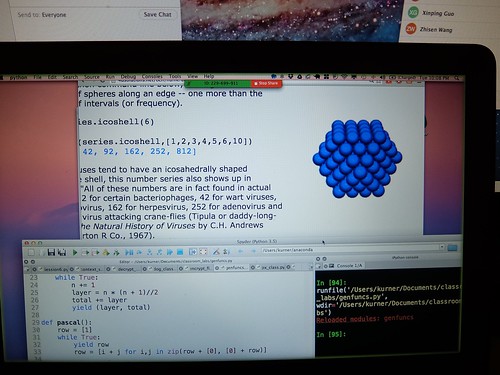
I kept it to one dry cider < 7% alcohol as my Internet radio show was soon to begin.  That's not really what it is, it's a class that I'm teaching by sharing audio and my screen, in real time.   Tonight we looked at Python generators, using triangular, tetrahedral and icosahedral numbers, Pascal's Triangle, then Fibonacci numbers for a lab.  The time went by quickly.  I somewhat lost track of it.

One of Trevor's older websites had become so popular that it fit Google's profile of a spam site.  How could one person be that prolific?  Rather than fight the shunning that occurred, being listed as a spam site, he took that as a cue to drastically reshape the content.  That's life on the Web:  rolling with the punches and morphing if need be.

I meant to work in Lucy today, in my talk on classes having ancestor classes.

STEM Class 2015

Monday, November 16, 2015

Steve Jobs The Lost Interview (movie review)

Let me immediately disentangle this interview from the docudrama running in theaters now, which features a Steve Jobs character, interpreted by an actor.  I haven't seen that one yet, but expect to at some point.

No, I was milling about at Quakers, chauffeuring mom (packing for Whittier), and ducked into Movie Madness, per longstanding habit.  I've been looking for Going Clear by Alex Gibney, which I'll watch and review next.  Gibney has done a documentary on Jobs also, which I hope to see soon.

Jobs is still with NeXT in this interview, having suffered the painful break with Apple.  He's anticipating Apple's demise, with the next big thing clearly not happening there.  Apple would bring him back as their chief after this interview, as interviewer Paul Sen reminds us.  The rest is history (I'm writing this on a Mac Air, great machine).

Jobs is very succinct in his telling.  He fell in love with computers early, giving a story not unlike Neal Stephenson's in In the Beginning..., then talks about the Three Things they showed him during his now legendary visit to Xerox-Parc, the Seat of Genius in this story.

He only saw and understood the first of the three things, at first:  the GUI.  Anyone seeing a graphical user interface for the first time knew that would be the future.  The Terminal would become one of the windows.

The two other things they showed him, which he didn't get at first:  object oriented programming, and networking.  He would grow into those visions later.  NeXT was all about developing and extending the former.  He's quite right about what we should expect from the Web, a decade ago.  A lot of us were.

He certainly seemed to me to have his ego under control or is that calling the kettle black?  He's quite happy to stand up for high quality and does the hip-hop thing of dissing his rivals, upholding his side in a rivalrous tale.  That's par for the course and translates to athletics.  But hey, this is just the one interview -- lots of jabber about Jobs in the background in November, 2015.

Windows was maybe more plebian, but somewhat paved the way for Free and Open Source by prepping a generation to be unafraid of hardware guts in open cases.

Macs were intentionally a lot harder to break into and mess with.  The IBM side of the business, with its PC clones, did a lot to make Linux happen, and Linux is still happening.  IBM was happy to provide source code as well (the case of SCO).

I sometimes forget I'm not using Linux when in my Terminal window on the Mac Air.  How did it go again? Was Darwin a port of FreeBSD?  Time to check Wikipedia.  I think of Windows versus POSIX as backward versus forward slash cultures (\ versus / e.g. C:\ vs. /bin).  We call that os.sep (separator) in Python and let the host operating system supply the value.

Wednesday, November 11, 2015

Wanderers 2015.11.11

I made it to Wanderers this morning.  This group has met in the Linus Pauling House for many years, settling on a Tuesday night, Wednesday morning weekly format, often just a wandering conversation, whoever's there spinning it one way or another.

I remember as a little kid looking up at "grownups" (much taller) and listening to them talk.  I noticed this form called "conversation" could twist and turn quite a bit, depending on whom were the talkers. Other times there'd be "an agenda" and the talk might be less free form.

Carol took off on the bus for Pioneer Place, where Veterans for Peace were holding their annual vigil for Armistice Day, a name that recalls the war is against outward war; we haven't given up by accepting Endless War as our "evermore" end fate (to quote the raven).  The goal all along has been to get beyond outward war, even if we still fight about stuff.

A few people really groove on outward war though.  The simulations have been getting better and better.  Perhaps with the next version the few holdouts will give in and go out and buy a console.

Today the conversation wandered through the geography of Oregon, where some of us (not me) were well traveled.  Yes, I've seen the Canyonville Museum, been to Fossil, but these were once in a lifetime experiences for me, whereas for many long time Oregonians, this is all more of a familiar stomping ground.  I'm lucky if I make it either to the coast or over the mountain to the high desert, like to Mount Scott in Terrabonne.

OSCON is earlier this year.  I don't know if I'll make it to Austin, but I'm checked in as a proposals reader again.  Open Source is not to be taken for granted, oxymoronic though that sounds (doesn't Open Source mean Free -- so why not take it for granted?).

Free as in freedom (vs. "free" as in beer) requires protection, and I understand Veterans who say freedom is worth fighting to preserve, even when that means engaging in outward wars.  I'm not the backseat general who sees how it all could have all worked out better with me calling all the shots.  I keep calling shots though, some of them.  I have a front row seat on some "operations" (doctors call them that too).

The local news tonight talked about the Blob, which may be starting to dissipate.  We haven't been hearing much about the Blob on televised media, or at least I haven't, so I'm glad to see more of that information getting out, KOIN the one breaking the news.  Charlie Rose anchored the CBS News that followed.  I left the radio on downstairs, along with the space heater, for the dog, and retreated up to my direct broadcast TV.  I also pay for some of the same stations through CenturyLink.

Saturday, November 07, 2015

Winning Ways


Friday, November 06, 2015

Spectre (movie review)

old_neighborhood

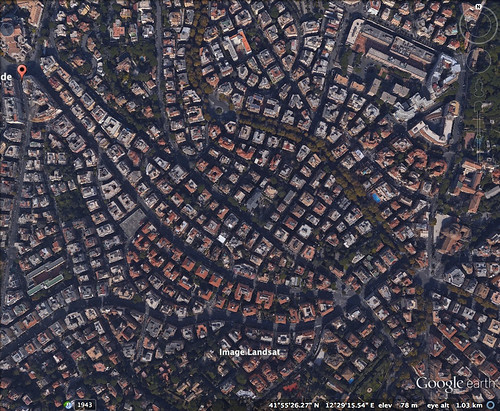
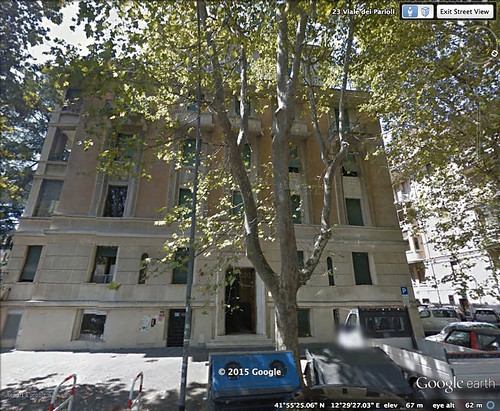
I started watching Bond movies in middle school at the Teatro Archimede (no longer in business) in a high density suburb of downtown Rome, near Piazza Euclide (red balloon on image), our family apartment being near Piazza Ungeria, Viale Parioli Twenty-Five (closer to right edge, across from that roof-top swimming pool).

You may imagine I was nostalgic for Rome, a great city for a car chase.  Bond stuck behind that Cinque Cento... hilarious.

I think we were all afraid the cars would blast into St. Peter's basilica itself, which would have been in poor taste most likely, and the franchise wisely steered clear, though does allude to the priesthood in passing.

I remember taking my daughter to her first Bond film in Santa Fe.  Dawn was on oxygen and Apria helped us orchestrate some high tech logistics.  Santa Fe under snow is something else.  This new Bond guy was just getting going with Casino Royale.

I had a lurking suspicion I might have missed one and I did, Quantum of Solace, but this episode maintains continuity with the last, not breaking the storyline, and keeping with Daniel Craig.

A lot of the "intelligence lore" is converging to the same plot lines anyway:  automation is putting even these pros out of business.  They plan to phase out all the "double ohs" with their too human judgements.  Computers are taking over, along with minions and drones.

Lets cut to the BBC radio interview (replayed in the US) of two disguised-voice MI6 types, having more fun around this movie, assuring the public that the real spies of the British intelligence apparatus are quite the opposite of Bond in so many ways, but especially in brashness.  Whatever happened to self-effacing?  Bond keeps making a spectacular spectacle of himself (luckily for movie-goers).

However, this "we're just goody-two-shoes government servants" line plays into the poking and prodding these spy thrillers get away with.  The Marvel Comic style projection, with moments for uncomplicated self reflection by almost robotic characters (that's a compliment) is a good fit for the big screen and its hoodwinks and hi-jinx.  The more serious-minded derive their thrills in other ways, through John le Carré (a pen name) perhaps.  Different strokes for different folks.  Some read Tom Clancy (not me).

The suggestion that all this trashing of real estate and pouring through expensive merchandise, in addition to loss of life, has to do with sibling rivalry, family feuding, is a great statement on history.  I'm reminded of another spy novel of sorts, The Jew of Linz, which makes all of WWII a closet brawl between two school boys (young Adolf and Ludwig, Hitler vs. Wittgenstein) who presumably couldn't stand each other (the record is open to interpretation) -- and the rest is history as they say.  Makes a good story, as many spy stories do.

Our Portland audience at Cine Magic Theater was entertained, with a burst of laughter when the violence turns to sex per an abrupt and well worn formula.  That's the Bond brand, meant as light fare with some gorgeous photography and lots of beautiful people.

Back to movie magic, the seemingly seamless blending of reality and imagination is pushed to the state of the art in Bond films.  The London landscape is as plastic as Narnia's, it sometimes seems.


Viale Parioli, 25
:: former family digs, top floor right, with terraces ::

Wednesday, October 28, 2015

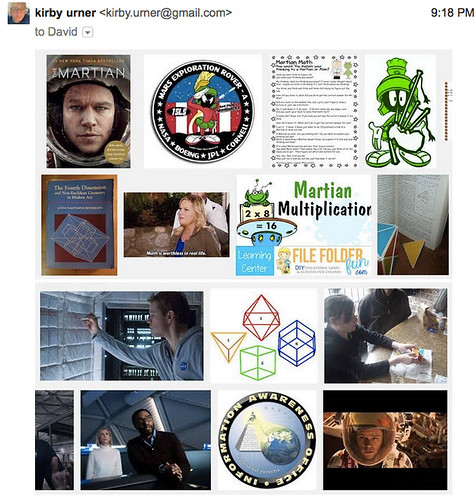
Martian Math Storyboards


Going viral...

Masthead

DSCF1690


For Further Reading:

Sunday, October 25, 2015

Computer Lore


Thursday, October 22, 2015

Black Panthers: Vanguard... (movie review)

I finally got to this, having naively shown up on opening night thinking I could just waltz in and buy a ticket.  That was a gala event, for which I had not planned in advance.  No matter, Hollywood Theater, a nonprofit with members, let this important new documentary run for quite a few days.

I found it helpful to tightly focus on the Panthers through this period, but was always aware, since I was alive through some of this, of how much else was going on in parallel.  How Black Panthers related to Black Muslims and Malcolm X is discussed even less than their relationship with Black Christians and Martin Luther King.  The Panthers were more secular, less likely to invoke God in their speeches.  They simply wanted higher living standards and freedom from oppression.

With mass movements like this, mob psychologies, the so-called leaders act as tone and trend setters, but then the real inertia comes from the rank and file, people looking to be a part of something bigger than themselves. Not much vetting goes on sometimes as players are thrown together by circumstance.

This out-of-control snowballing effect was evident in the case of the Panthers but also in the case of law enforcement.  J. Edgar Hoover helped set the tone with Cointelpro, but it was up to individual police departments to "get creative".  Effectively micromanaging from the top, with this much going on concurrently, is somewhat impossible.  Would be public figures ride the wave, and use the media to help them do so, as another category of celebrity.

The former Panthers, police, journalists and historians, interviewed for this film have the benefit of a lot of hindsight.  If people had only had the luxury of being this reflective at the time... if only. Quakers intersperse a lot of silence for a purpose.  People need that time to reflect and to hear one another's voices in a safe environment.  They also need ways to debate and challenge one another without resorting to physical violence.  William F. Buckley, to his credit, worked at providing such a forum, an alternative to violence.

Speaking of Buckley, the segment on the park in Chicago segues smoothly to the famous Buckley-Vidal altercation.  Eldridge Cleaver delivered the speech in that park, and had left the scene before violence erupted, however he was charged with inciting said violence.  He decided he'd be better off in Algeria, where he started an international chapter of the Black Panther movement.

The commitment to Free Huey (Newton) from prison was a big part of Panther psychology and when he was finally let free, he was an icon.  However all that prison time had shaped him in ways that distanced him from his fans.  The party tried to consolidate around Bobby Seale, who ran for mayor of Oakland, and when that didn't work, things fell apart.  Huey had become abusive and tyrannical.

One could say the Panthers lost in their bid for a revolution, however big wheels turn slowly.  Nixon, the law and order president, turned out to be a crook (in addition to the usual war criminal, what most warlords are) and to this day the right to openly carry guns on public property (not private necessarily) owes a lot to the Black Panthers.

Their work in Chicago to build bridges with poor whites, so-called hillbillies from Appalachia, has paid off in some dimensions.  And backwater Oregon, where being black is no longer illegal, now has peaceful ties with Hanoi.  Today we have the Internet, and infiltration was always a two way street.

Watching this documentary in tandem with a few others, such as Neverland, the one about Patty Hearst and the Symbionese Liberation Army, would help open more windows on a complex timeline.  Historians are still putting together these vistas.  The US Versus John Lennon would be another good one to watch in close proximity.  No one documentary gets the whole picture of course.  History is non-simultaneously conceptual, meaning there's no single snapshot synopsis (obviously).

Today was much higher in pain and stress than anyone had planned, mostly for Carol, my mom (age 86).  She managed to gouge her leg quite deeply getting out of the car, fortunately at a hospital.  What was supposed to be a routine thirty minute checkup turned into a visit to the ER for sutures and a tetanus shot (as well as for the blood test she'd originally come in for).  I'm required to report this event to my car insurance company or risk Medicare not covering any of the costs, according to the hospital.  Mom is OK.  We're still planning that trip to Corvallis tomorrow.  Followup from Corvallis:  Farmers says they'll cover it.

Monday, October 19, 2015

Religious Teachings


The talking animals in this namespace ("Noah's Park") seem remarkably incurious as to the origin of a buried treasure that comes to light.

The hypothesis it was placed there deliberately to inspire future experiments is one definitely worth exploring, but what else might it mean?  Is it a relic of a past civilization?

That the wings could have metaphorical significance is not proposed, nor does anyone care to speculate as to how this statue actually did come to be in the pond.  Is it some kind of trick, like a faux fossil in the mud?

Clearly none of the animals present have the skills to manufacture such trophies.  If this really is the complete namespace, then divine origins are as good an explanation as any.  We may accept "God-given" as axiomatic. Honk is right to seek its meaning.

At least the mysophobic camel takes this sign from God seriously, as some form of communication, and attempts to do God's will, by trial and error.  As the dutiful empiricist, seeking his true niche (a cleaner place) he does his homework, practices science.

Yes, Honk the camel is the most faithful, the most loyal to God in the face of skeptics who have never felt the tug of the divine.  Honk is perhaps the Moor, the Arab alchemist, the Kabbalah scholar who seeks to know God's secrets first hand.

The authority figure or imam, a frog-faced individual named Ponder, does not dispute the sign's divine origin, nor really offer much of an alternative interpretation.  Yet he tut tuts the camel's empiricism, smug in his all-knowing attitude.

The frog recommends the camel keep the statue once the wings have symbolically broken off (a reminder of the dead-end nature of ego pride), but then seems uncertain as to whether he, a mere frog, has comprehended God's will himself.  Any show of humility is more than welcome at this point.

Children exposed to this material will have an easier time ignoring loose ends, such as "what did the sign from God really signify?"  Did it foretell that birds, another species, would one day collaborate to form an airline, creating friendly skies for this camel?   This would seem far fetched but in retrospect apparently it did.

A hidden teaching was in due course revealed:  go ahead and give up on dreams of greater powers obtained through your own efforts and loyalty to God, and instead let your friends help you compensate for your obvious weaknesses.

Your approach to God will be indirect, mediated by others (the birds) whom God made to ply the sky.  Be satisfied with your base nature (as a camel).  Don't aspire to be in some way above your station or "beyond your light" (as Quakers might put it).

Depend on your community to prop you up, in exchange for learning your lesson and in future adopting their same incurious / unquestioning attitude, and lack of aspiration.  Learn to restate the obvious ("camels don't fly") over and over, as a kind of mantra, while avoiding all manner of speculative experimentation as empty vanity.  Be a dolt.

Saturday, October 17, 2015

Diplomatic Gaffs

There's some loudmouth general on the Official Washington press release circuit who is probably making life harder for diplomats, in saying he expects to have permanent bases in Afghanistan, just like in Okinawa, Korea and Germany.

Generals may be too busy administering bureaucratically intensive Iron Mountain activities to bone up on recent history.  The granting of bases to the US was always with a veneer of sovereignty to paper over any sense of perpetual empire and hegemony as officially the New World Order (as purveyed by one District of Columbia).

That face-saving rhetoric was thin, as in hollow, but now that it's nakedly controverted, there's no way to restore the mask.  The sugar coating has now dissolved away, leaving only the bitterness of strong medicine -- or was it really a toxic poison?

The nightmare has by now become official policy.  "We're not trying to solve these problems, we're making them pillars of our institutions, our way of life" is the new line.  The War on Terror, as many predicted, is to be hard-coded, with AQ, IS and the Taliban the now eternal justification for ongoing combat (with a fallback to China and North Korea).

The US military is now frankly admitting it has no plans to scale back, meaning what were once called "zones of insecurity" are actually its source of security, with many "fighting seasons" ahead (just like "football season"!).  That's a meal ticket right there.  War is indeed a racket, feeding on deliberately induced fears, inflamed to hatred by war-monger PR.

Keeping Okinawa a theme park and playground for US forces is tantamount to job security complete with R&R and that's what Iron Mountain is all about (i.e. military socialism).  The military is the US jobs corps, with the least bang for the buck (in terms of dollars per livable lifestyle -- especially when lives lost or taken is factored in).

We have an Islamic bank in Whittier, part of Greater LA.  If some people want a Sharia Court satellite channel where they voluntarily put their cases and relationships under the care of Judge Imam and his code, so what?  It's not like there's a shortage of bandwidth.  We have orthodox everything in New York City already.  Lawyers are trained to merge management systems, like what US Airways and American are doing.

Some women really would prefer not to go to school, given learning from home is a viable option.  More of the men might want to stay home as well.  Lifestyles abound and the freedom to choose one is the freedom to practice and believe.  Weren't those the rights the US military was pledged to protect in the first place?  How was denying Taliban their religious freedom in any way a Constitutional value?  What is the end goal with respect to that orthodoxy?

Culture wars should be fought (debated) through one's culture, whereas wanton dismemberment and execution ala Vietnam is the antithesis of really having one.  Arguments around the dinner table are what's civilized (All in the Family), and tensions between generations over how best to adapt.  Civilian life is hard work and trying to find short cuts through violence only postpones that work getting done.  We end up back where we started, just with more haunting memories and yet deeper regrets.

Official Washington cannot be trusted to not say stupid things, is the (new?) global perception, heightened by the risks taken by political campaigners, on the Republican ticket especially.  The Russians, in contrast, have their new network of intelligence centers, one in Algebra City, where supposedly they're sharing IT skills with their new-found friends.  Iraqis have found a new way to fight back maybe?

Once the superpower mentality was allowed to reveal its innate slowness and complacency so directly, it became a farcical embarrassment.  Public opinion has intuitively recoiled, at least in some hard currency markets.  Is it good PR to fund scary clowns?  Matters of taste are at stake as always, but then having standards for quality was never trivial.

In stating the Pentagon position is so weak in Afghanistan that it must be extended indefinitely, like in Korea, like in Germany, the general is projecting weakness on a global scale.  The US clings to its supremacy more out of self-deception than reality.  That's why it's called a complex.  That's why the air is leaving the balloon.  The executive branch especially, is way over-extended.

The US is less truly capitalist than a mixture of cowardly capitalist and military socialist.  The military provides the "safety net" (full of holes) and a measure of social mobility, while the cowardly capitalist fears any government competition in the civilian sector (NGOs especially, but really anything well-managed and more multi-dimensional in its wealth-creating than "money driven" is perceived as a potential threat, Open Source included).

Bernie Sanders could probably create more space for his brand of "socialism" were his public attuned to the fact that they already live in the midst of a socialized wealth distribution system, called the US military.  As long as one signs up to fight for cowardly capitalists, one has one's meal ticket punched indefinitely.

More Summer Reading

Wednesday, October 14, 2015

A STEM Exercise


Use biological organic chemistry language to translate the language of some ET asked to report on the chemical structure and function of:  a traffic intersection in a human city.
"The sapien exoskeleton conveyances alternate arterial traction (rubber-street friction) in response to controlling red and green frequencies emitted from the electro-signaling neurons."
In other words:  "Cars stop and go in response to traffic signals" (or "to robots" as we say in South Africa, where traffic lights are robots).  I may presume the ETs understand the sapiens have a molecular-mechanical interface ("steering wheel, gas pedal...") whereby said signalling gets implemented by motor action.

They'd have to catch examples, if only on slides, of "car crashes" resulting from some disconnect twixt the "red light" and the "brake" (an enzyme, embedded in the membrane twixt "passenger compartment" and "engine compartment").

Clearly quantum mechanical randomness was at work.

[ They (the ETs) would probably not have the science to figure out that the sapien going "against traffic" was talking on its "cell phone" (yet another neuronal network for meme delivery). ]

Now draw the diagram, then do the animation.  Of course the human translators are highly intuitive and their interpretations, though often quite similar, will have unique elements.

Our capacity to communicate with these ETs continues to improve.

Monday, October 12, 2015

Synergetic Shoptalk

Synergetics sometimes takes flak for Fuller's including a model of DNA as a triple helix, whereas of course it's only a double helix.

The triple helix does occur in nature, in collagen for example, used to weave fabric in the skin for example.

These are not replicatory fibers, lets be clear i.e. not every helical structure implies direct involvement in mitosis.  Collagens get manufactured within cells.

Given the importance of "colloids" in Korzybski's General Sementics, I think we could use the Synergetics triple helix as a bridge to / from that title / namespace.

Fuller's uses "tactile" in the sense of "feel" i.e. visceral "gut level" intuitions versus having "visions" or "seeing" a truth.

"Seeing" versus "Feeling" is contrasted within Synergetics shoptalk as Eulerian (topological) versus Gibbsian (tactile).   Synergetics remains psychological in its meanings, which is why it continued to hold Applewhite's interest.  "Explorations in the geometry of thinking" was the subtitle (emphasis added).

We both feel and see our networks (texts, tissues) and sense their level of "bondedness" as liquid, solid, gas -- with fluid the home base / happy medium for life.  One of the Synergetics animations symbolizes gas, fluid, solid using vertex, hinge and face bondings of the tetrahedron respectively.
1054.50  Polyhedral Bonding: Willard Gibbs' phase rule treats with the states of the environment you can sense with your eyes closed: crystallines, liquids, gases, and vapors. Euler's points, lines, and areas are visually described, but they too could be tactilely detected (with or without fingers).  
1054.51  The mathematicians get along synergetically using Euler's topology alone. It is the chemists and physicists who cannot predict synergetically without using Gibbs' phase rule.
Is this meaning merely mnemonic?

In a tactile sense, these different bonding modes emulate (simulate) the degrees of freedom characteristic of these three phases of matter, and even of thought.  We speak of logical foundations under-girding more fluid prose, which supports yet more gaseous / cloudy styles of thinking, more uninhibited and speed-of-light.

But then logic may be too brittle, as in less flexible, so "foundations" may not be quite the right metaphor when dealing with crystal cores.  Fuller was not a fundamentalist.  The fluid phase was the least eccentric in his book, the zero, with solid and gas a -1 and +1 degree of freedom respectively.

An Eulerian (topological) cartoon is applied to a Gibbsian (tactile) intuition, by Bucky.  I think he'd say the move is synergetic (yielding of new insights), and not just mnemonic (aiding memory).

Sunday, October 11, 2015

Saturday, October 10, 2015

Integrated Learning

Fluent Python

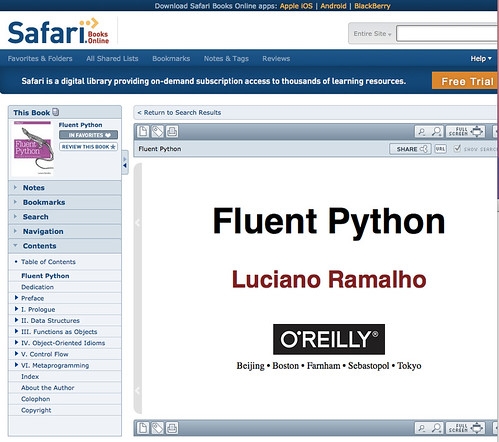
I've got my nose back in Luciano Ramalho's Fluent Python this morning, in Safari On-line.  I caught two of Luciano's talks at OSCON this year, and have downloaded their recorded versions.  The book itself has been a bestseller in its category on Amazon.

I've always want to see a concise Pythonic narrative that ties back to underlying C code and here I'm finding that.  For example Luciano does a great job describing the hash table algorithm behind dicts and sets, and then links directly to source code, where we find these comments:
The basic lookup function used by all operations.
This is based on Algorithm D from Knuth Vol. 3, Sec. 6.4.
Open addressing is preferred over chaining since the link overhead for
chaining would be substantial (100% with typical malloc overhead).

The initial probe index is computed as hash mod the table size. Subsequent
probe indices are computed as explained earlier.

All arithmetic on hash should ignore overflow.

The details in this version are due to Tim Peters, building on many past
contributions by Reimer Behrends, Jyrki Alakuijala, Vladimir Marangozov and
Christian Tismer. 
Having a link directly to Knuth's The Art of Computer Programming in the comments for the Python dict object grounds a specific source code implementation in the computer science behind it.  Great for digital mathematics teachers in need of heuristics.

I have that Knuth volume upstairs. What a great way to learn. Plus I have the Python REPL (pronounced "reh-pull") open in another window.

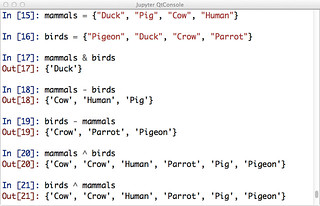
In going over the set data structure and its operations, I was thinking back to New Math and elementary school, when set notation was making its early entry into kid consciousness.  This was unfamiliar material to most teachers and much of it was junked in the ensuing backlash.  But we had no REPL back then (a few lucky college kids had ISETL maybe?), what if we'd had one?

set_ops
:: a duck is not a mammal! ::

But in 2015, why not boot a Python interpreter at some point when typing has been mastered?  Learn about union, complement, difference, intersection all over again.  It's just like New Math, but with more machinery to back it up.  I call it Gnu Math.

Speaking of typing, my friend Glenn reminded me why he can't type effectively, even after a lifetime as a typist:  most keyboards don't allow resting fingers on keys whereas in his time with NSA he had to pound through ten-ply fan-fold.   When he tries to type on a keyboard, he floods his own text with errors.  So frustrating!

Maybe there's some steampunk solution where an old mechanical Royal typewrite type keyboard is wired up as a USB peripheral?  My retired college professor friend Chuck Bolton never seemed to master the new keyboard either.  The Royal sits proudly in the living room.

In sharing Python with art history students or journalists, what's more important than exhaustive practice or keyboarding is an appreciation for the layers of culture, the ecosystem.  How does C source code relate to Python and what's a hash table?  That's enough of a story for one article.

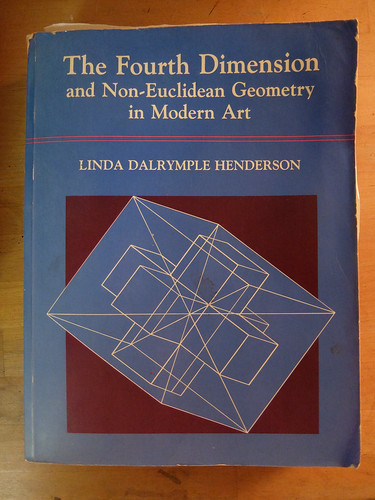
Why I'm addressing art historians these days has to do with the '4D meme' in the art world since the late 1800s, the core topic of another book I sometimes reread and review:  Linda Dalrymple Henderson's The Fourth Dimension and Non-Euclidean Geometry in Modern Art.

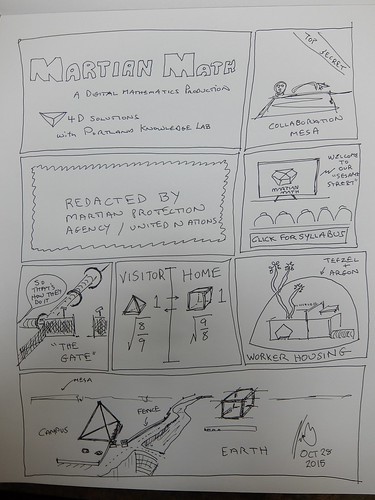
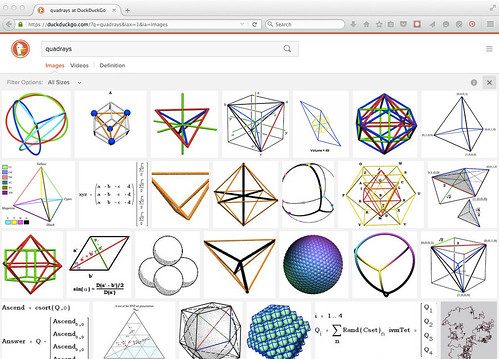
Through Python, I introduce art history students to the topic of Quadrays or Q-rays, needing no more than some high school XYZ mathematics, thereby helping to anchor the '4D' meme as Fuller used it. I also introduce Q-rays in Martian Math a curriculum field tested with high and middle school students at the Reed College and Portland University campuses.

DSCF0953

Wednesday, October 07, 2015

A Breakdown in Self Discipline

DSCF1054

Carol and I drove to Tom's this morning, which isn't far.  Walking is good for her, but today it was raining and this time three years ago she came down with pneumonia, after insisting on giving a speech on a bright October 2012 day in the park.  She had to be hospitalized and was on oxygen for months after that.  So we take care and not push it.  This year she went to Des Moines.

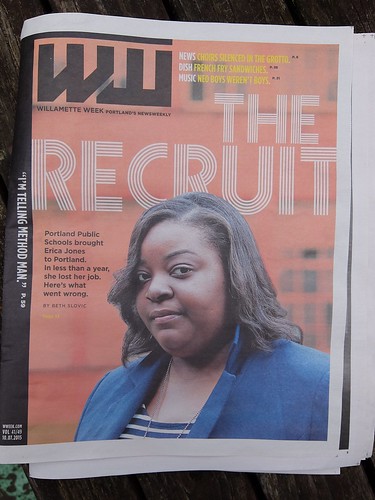
Anyway, at Tom's, an eatery, we had our breakfasts.  Per usual, I wolfed mine, being part wolf, at least in spirit (but also in eating behavior), so had time to spare.  Rather thank yak away, letting hers get cold, I went out for a Willamette Week, new on Wednesdays.

The cover article was really interesting.  Portland knows it's "too white" in some dimensions but is still trying to figure out in what way.  Lots of feedback circuits have been set up, and I think it's sinking in day by day, but to accelerate the process, PPS (Portland Public Schools) has put its shoulder to the wheel and tried to get some real Diversity going.  Some active recruiting has occurred.

The article is a first person account by one of the main guinea pigs in this experiment, Erica Jones, from Georgia.  Although the experiment may sound like a failure the way she tells it, I think it tells of a talented and brave person making a difference and filing her report.  Mission accomplished.  PPS and WW readers learn a lot, the whole point from the start (to learn).  The protagonist gets to retire to an easier lifestyle free from PPS pathologies (they'd made her sick), so a happy ending.

I recall on a jumbo jet, international in flavor, wherein we were all taking our seats, preparing for take-off.  Then some loud-mouth all-American white kid came on board, running his mouth incessantly in some fantasy world about terrorists and bombs, complete with sound effects -- unpleasant chatter to say the least.

What was most amazing though, was his parents seemed to see no reason to have erased this behavior before bringing him on an international flight, subjecting fellow travelers to nerve-grating spew.  It's not like this was an infant.  And that in a nutshell is what astounded this teacher:  the schools had no effective means of working with a lack of discipline and disrespect (there's a difference between "respect" and "obsequious" which any English teacher might go into).

But then to speak up on behalf of the kids, I'd say the school they're placed in really is more like a penitentiary in that the brainwashing forced through those text books is really quite obsolete and not matched to the needs of current generations.

The curriculum is way behind and kids have that intuitive resentment that stems from feeling warehoused, like refugees anxious to get somewhere better, to some Promised Land, and feeling delayed by fences and border guards.

The teachers take on the sheen of prison guards.  But that's hard to articulate when you're a kid and when kids before you all went to school and a lot of 'em thought the same thing.  Only juvenile delinquents hate school right?

However, we can give objective shape to their deprivation.

Do they teach you to cook (yes in some cases)?  Including for big numbers?  What history do you get and what civics?  How many voting machines does your school have and how often do they get used?  Do you ever get away from light pollution?

I'm not saying I know the outcome in all cases.  How about tetra-volumes, do your math books cover that?  They do?  Excellent.  I bet in some private Quaker schools they're already introducing at least a sidebar on Quadray Coordinates, designed to keep those philosophical debates alive (to be revisited in later years).

I've recently connected with another "hacktavist" youth group willing to take on more parallel / alternative schooling.  That's not a new pattern I realize.  Black Panthers did the same.

When some mainstream system or curriculum breaks down, others grow up around it, sometimes to become mainstream themselves.  This has happened often in history.  It's not necessarily a crisis, or calamity, not an apocalypse (except maybe in some technical religious sense with positive connotations -- check with your local religious authorities).

When change needs to happen, it tends to happen in some way, even if not the ways planned, and change often needs to happen.  Rule of thumb:  improving one's powers of anticipation and responsiveness is usually a likely possibility compared to the relative likelihood of stopping change cold in its tracks.

With all our new abilities to flip classrooms and provide professional development, more teachers could be like me, not responsible for a student's everyday behavior, which I don't monitor.  The teachers and students are not in the same room.

Studying for real also means time alone, as in a study carrel, not just in collaboration.  That's what you learn in college if not before.  Packed into rows and columns, in a classroom, with all present supposed to be connecting the same dots at the same time... why force that?  Why is such enforced regimentation even a selling point?

Having a safe personal workspace is what's paramount, if learning is really the priority.  If warehousing is the priority, why not just say so and drop the pretense?

Just having a locker is not sufficient.  When does this student just get to sit and read, undisturbed, or just meditate, free of distraction?  Do motion studies like in Elephant (cameras follow each student).  Develop stats.

Homework is great in theory, if you really have a home that fosters study.  Many homes do not.  Losing all interest in reading is a sign of serious brain rot.  Measure "time reading" as seriously as you measure "calories eaten" at least (over eating is more of a real danger, though over reading at the cost of degrading physical health is also a real condition).

The word "gymnasium" is right:  reading and reflecting are a form of working out.  Keeping fit is not just about swimming laps.  Watching TV is informative.  This is not an anti-TV rant.  However making TV (video / audio) is even more informative.  Does your school help you learn to do that?

As when writing or jamming, you may be lifting from other sources, making links.  Sharing camera shots, including segments, is not a crime when the licensing is deliberately liberal.  Citing sources is much appreciated and lends credibility but in some forms of journalism, sources get concealed, for their protection.

Does your school cover these basics then?

Tuesday, October 06, 2015

Men Without Honor

Official Washington got disgraced by its military again today, a bunch of unprofessional uber-cowards.  No one in the Pentagon resigned.  The Secretary of Defense still gets a paycheck.  Disgusting.

An inveterate glutton for war toys, way beyond reason, and with zero self control, Washington has made the mass killing of civilians a somewhat routine event.

This most recent massacre was much worse than in Roseburg obviously (do the numbers), but with the same cause:  mental illness, an inability to face reality, unrestricted access to weapons by those who shouldn't have them.

The perps in this case used a monster death machine against defenseless Doctors Without Borders and their hospital.  The logistics were so bad that phone calls from the hospital made no difference to "central command" (a headless chicken).

President Obama said nothing public about it.  He's going to Roseburg, Oregon, apparently because only American lives matter, whereas his own sickly mercenary forces murder children routinely.  The hypocrisy is palpable.

Some slob with stupid medals all over his chest tried to make it all better with his lame excuses, but of course WDC lost this stupid war long ago in the hearts and minds sense.  Who needs an enemy when you have goons like these running the show?

Lets see if anyone takes any responsibility whatsoever for this obvious war crime.  I'd reckon the loss to WDC in the billions over this, but that city has negative money anyway and will never repay, bankrupt as it is, morally as well as financially.

Flags at half mast?  Why have them on the pole at all?  Definitely the Pentagon should take theirs down, at least for a few symbolic minutes.  Show some public remorse maybe?  Just a tiny bit?

In any case, stop claiming to represent the American people already!  Your services are neither required nor admired.  Your cowardice will echo through the annals of history.  Citizen diplomats disavow this war and the perps behind it.

Just because one wears a military costume doesn't make one a respectable human being.  More is required.

I somewhat expect the story to morph such that the "Afghani forces" who supposedly requested the strike were actually Taliban infiltrators looking for ways to embarrass central command and make it appear like a headless chicken -- a way to deflect criticism and make the Taliban share the opprobrium.  The story has already morphed away from NATO itself making the request.

Everyone knows NATO can be tricked into doing just about anything, if one just acts and sounds like a warlord.  Finding a way to blame "the terrorists" would be the typical response here.  Lets see if that's how it plays out.

Why an organization so easily duped should be allowed access to war planes would be the next question but that's easy to explain:  no background checks required, just a credit card and the signatures of a few paid-for well-paid elected officials.  Talk about corruption!

Sunday, October 04, 2015

My Comment on QuakerQuaker

Yeah, it's hard to not get cynical about religion once one sees how it's harnessed by the temporal powers to their own ends.  Emperor Constantine learned his lesson:  if you can't beat 'em, join 'em, i.e make the Roman Empire officially Christian and you'll have the tools to keep growing. 

Mass produce Christian baubles for the gift shops, and the faithful will follow you blindly, as their "blind faith" (so very similar to blind loyalty to one's King) is built right in as a virtue, at least in the more decadent brands of pyramid scheme hierarchy. 

Obedience, not defiance, is what to cultivate in the masses.  Any religion able to do that is worth more than gold. 

Religion is used to create that state of reverence and solemnity, gravitas.  The Cross gets planted on some South American beachhead, and voila, miracle of miracles, this is now Papal Property.  Amazing.  It's downright Biblical!

Unfortunately for emperors and dictators, crime bosses of all kinds, Christianity is not quite tame enough to support a Borg Cube forever.  Whereas most humans seem eager to the point of desperate to surrender their free will to experts, professionals, pundits of all stripes, a tiny minority seems hell bent on doing its own thinking.  Irreverent Quakers pop up, questioning authority, refusing oaths of loyalty.  WTF!?  Where does the operator's manual say how to deal with Quakers?

As a result of such obstreperousness, micro-fractures emerge, and every so often, we get a meltdown, like the 100 years war twixt Catholics and Protestants [exemplary of a "meltdown" not saying Quaker caused -- KTU ].  Or the Civil War in the US.  Or maybe even something good happens.  A shakeup in world religions might be just what the doctor ordered.

For whatever reason our species refuses to settle into any one Kingdom or Reich.  I consider this hopeful and positive.  The Tower of Babel is maybe my favorite Bible story.  Silly humans, thinking they could create One System to Rule Them All.  Ain't gonna happen.

Thanks to some divine spark within common humanity, the peasants, handed a gun and a picture of their God, sometimes disobey their "superiors" and refuse to kill the enemy, seeing through the manipulation.  They see The Man behind the curtain, and, like Smedley "Fighting Quaker" Butler say out loud that War is a Racket.

However, to see religion as a tool of social control is not to see the falsity of all religion.  Cynicism of that variety is simply too easy.

Rather, the many religions and psychologies, not to mention philosophies, do indeed give us insights into something both collective and transcendent about the individual human mind. 

One could simply say "religion is the power of God's mind combined with the human being's endless ability to distort it".  The idea that humanity is simply a distorted image of what true angels must be like is an old one and I think I'll land it there for now -- a friendly / familiar airport.

[original context:  comment re So What's So Terrifying About Christianity? ]

Saturday, October 03, 2015

Art History

DSCF0953

Glenn Stockton has purchased the latest edition of Linda Dalrymple Henderson's book, The Fourth Dimension and Non-Euclidean Geometry in Modern Art.  I have an earlier edition (depicted above).

She's expanded her introduction considerably for the new edition, looking at published works at least up through 2009.

Linda is correct in lumping Bucky with those claiming to work in a fourth spatial dimension, versus time, and quotes him regarding the tetrahedron providing his own justification for such terminology.

In Synergetics, simply turning a right angle number of degrees (90), going around a street corner, is not escaping into "another dimension".  A turn of 89 or 91 degrees would be no less significant, were true dimensions at stake.

Rather, we start with Kant and an admission of volume or space as a priori, with the passage of time thrown in to give the grammar of change.  Things take up room and persist in doing so -- that's our experience in a nutshell.

How many spatial dimensions is volume?  The conventional answer is three, building up by right angles, through height, width and depth.

Fuller's answer is to throw a tetrahedron into the picture as a whole ab initio, and to argue its faces and vertexes bespeak a primitive fourness.  "A tetrahedron shouts four!"

That's about all he's saying -- almost too simple to make it into the history books.

If you want the 3ness of 3D, look at each of the two complementary zig-zags or "cobras" that make any Tetrahedron, a Z of three connected vectors.  But the four points so connected define the alternative "other" Z, so 3 + 3 = 6 is more like it, but sure, a Z might be used for addressing purposes, giving 3-tuples. Space is "Z-D" (but what number is that?).

The conventional description of volume as "3D" relies on a "jack" of X, Y and Z axes, each one a next dimension.  From this "jack" (vs. a "caltrop") we get 3-tuple addresses.

A fourth orthogonal is problematic (in the sense of oxymoronic), however 4-tuples are not, and these n-tuple data structures may be "projected" to something visual in ordinary space.  nD phase spaces have their Z-D analogs. 

A ball of n spokes from the center, whether orthogonal or not, may be declared "independent" with sliders set each to a specific level.  That's a "point" in an nD phase space.  Tighten the rules a bit, and you get a manifold or metric.

Fuller's math is not investing in having any "hypercross" of four orthogonals.  The tetrahedron pure and simple anchors our talk of 4D in this logical model, not in some sleight of hand or science fiction. One may use 4-tuple quadrays isomorphically with 3-tuple XYZ rays.  The caltrop spans Z-space (Z + N = Tetrahedron).

Developing an alternative 4D namespace is not to find fault with, nor invalidate, anything by Coxeter, the grand master of multi-dimensional polytopes to whom Synergetics is admiringly dedicated (with permission).

Frequency (time/size involvement), added to angle (pure shape), gets us to five dimensions if we wish to avail of such tools, i.e. a tetrahedron persisting in time-size, the stuff of scenarios in "Scenario Universe" -- make sense?

Energy added to pure Platonic form (4D) is more the Synergetics template.

When we have room for multiple namespaces, including exotic remote ones, such alternative beginnings get more room to breathe and show off their advantages, if any.

Synergetics itself, once booted, helps us keep our minds open, to multiple namespaces.  Systems, fully omni-triangulated, may be plentiful, like bubbles, produced quickly and in great numbers.  Stay tuned.

Thursday, October 01, 2015

Journalistic Shorthand

DSCF0838

In journalistic shorthand, adapted from diplomacy, they say "Assad must go" or "Saddam must go" (Saddam, Qaddafi and Assad were all on the short list they tell us), but of course in reality that's code for a whole administration, extended families, neighborhoods, sections of town.

Were we to decree that so-and-so could no longer be Mayor of Portland, Bud Clark for example, that might affect the people of Goose Hollow.

So when we hear talk about trying to remove "Assad", lets remember we're talking about institutions and organizations, a complicated motherboard, circuitry.  One doesn't swap out a leader like a light bulb or other simple component, it's not like that.

The diplomats all say the goal is to broker a deal with various parties at the table but it sounds like WDC doesn't want Assad at the table even to begin with.  Given that NATO / EU / US has already taken out Saddam and Qaddafi, the question is when will it stop?  What was the window?

Of course there's a ton of history to go over, if TV viewers ever have the patience for it.  There's no way to learn anatomy in thirty seconds.  Wasn't it Walter Cronkite who said his biggest fear was that so many people just got their news through him?

All we're in a position to do in Portland is welcome new refugees.  That's what Willamette Week is about this issue, introducing some new families.

No one asked Cascadia if / when to commence bombing; that decision was made by quite a few self-appointed authorities and a smattering of elected ones.  Their comic book language ("Assad must go") says nothing reassuring about their grasp of the situation.   Shorthand is too short sometimes.

Lets talk about what's going on in Iraq a lot more maybe?  What's the view from Baghdad?  I'll dig into that some, but for the most part I know they'd prefer we stay out of it and just deal with the collateral damage.