Sunday, March 06, 2016

A Tale of Two Movies

DSCF2464

My intent in going to Movie Madness this time was to find something on the Platonic Year.  Glenn is into timeline visualizations, cartoons if you will, that illuminate the meanings behind some of our astro-myths, such as the perennial see-saw between Orion and Draco if I have that right.

Anyway, the star to the north best pegging the Earth's axis is not always Polaris, not everyone knows that.  The planet wobbles, like a top (precession).  Then there's the rotation about the galaxy to consider, another cycle.

I went straight to the Special Interest section, seeking an armload of video goodies, only to not find what I was looking for.  I should take Glenn with me next time.  Having walked all that way, I didn't want to leave empty handed, and so Covert Affairs (season one) and Jabberwocky jumped out at me on the way out.

I'd been reading about Terry Gilliam's life at Powell's recently, snapping pix from his scrapbook, newly published.  Jabberwocky was a puzzle piece in that regard, his next project after Monty Python and the Holy Grail and set in the same period.

A main theme is "framing" in the sense of painting, a canvas, with a frame.  Artists Hieronymus Bosch and Dutch Masters inspired the filmmakers to stage reminiscent tableaus, adding the same comedy device used in Python:  contemporary people projected into an alien past.

"Framing" in another sense drives the plot.  Quoting the tagline:  "A young peasant, with no interest in adventure or fortune, is mistaken as the kingdom's only hope when a horrible monster threatens the countryside."  The young peasant is framed by fate, caught up in events in a bigger story.

Covert Affairs is similar to Jabberwocky in wanting to capture the iconic frames of spydom's Langley, an institution that tries to stay low profile, like some Bureau of Public Roads, so that the public imagination remains unshackled (unfettered) by too much that's banal and mundane.  The lighting and atmospherics make for some classy shots, of BMW derrieres, of HP computers running Windows (or was that Ubuntu, as in Chappie?).  Think:  a cleaned up Archer.

The screenwriters got a tour of Langley, thanks to the PR department, once the pro-CIA nature of the project became obvious.  The whole point is to glamorize with a cosmopolitan brush.  What institution doesn't want such treatment, from some of the world's best cosmeticians?  Every evil queen likes her lying mirror, until the day it says Snow White looks better, or has a purer heart.

The script writers know that avid viewers would catch any laptop or cell phone leaving or entering the building and police against making such basic errors (no GPS devices allowed).   Where these people get their guns once outside the parking lot is unclear.  Mostly they don't need guns because few go into the field.  They certainly don't get badges.

The ones who do get to romp through the countryside are mostly rogue or ex or whatever.  Few Langley-ites really get to see Colombo (Sri Lanka) up close, unless on vacation (no gun required in that case).  Best to get your travel years in before joining the Agency.

One of my pet peeves is how we use television to replace reality with fantasy across the board, and then expect adulthood to just magically happen.  Seeing the workplace through screen-writer eyes is often confusing to job seekers, especially twenty-somethings who grew up on TV and now have only fantasies to go on.

How could one possibly be a real cop if one's main influences were TV shows, like Hawaii Five-O?  Or a doctor?  Or a lawyer?  Or a soldier?

By the time LA and its film industry is finished with it, it's not really a documentary is it?  One has great sets, entire offices inside the studio, and more money to build them with than the makers of Jabberwocky ever dreamed of having.  Or is it that Toronto, where this play is staged, is so much more affordable?

The LA dream machine is like a Jabberwocky in consuming all that's real in its path, and turning out beautifully packaged framed substitutes.  The world becomes more toy-like and Barbified.  That being said, I may rent Season Two.

DSCF2203

Sunday, February 28, 2016

Stranger Than Fiction (movie review)

This piece of fiction, a comedy, does what a lot of fiction does:  it sidesteps the implications of its twisted reality, or avoids letting us in all the way (another way of putting it).

Dustin Hoffman, the literature professor, and the novelist, hell bent on killing off her main characters, have a special relationship owing to their both understanding plot devices, common twists.   The novelist's assistant is also in on the scheme (another meaning of "plot").

Will Farrell, playing the IRS agent, is relatively out of it (clueless) himself, but comes to understand it's up to him to make something of his narrative.  Just going "by the numbers" means leaving everything to fate.  He starts to take bolder action once the reality of his own mortality really gets under his skin.

The film was made in Chicago, as "Any City" (not specifically identified).  Although a very different movie, I had to remember Sacha Baron Cohen in The Dictator, another case of opposites attracting.

The "anarchist" Farrell falls in love with has a bakery that gives off a Portland vibe, radiating its proud independence and rebellion from the fragile left brain number world.

Will's is the weaker gender or "hemisphere" in this model.

I stopped the DVD player to show the Food Not Bombs flyer prominently posted on the bakery bulletin board.  Some thought went into the decor.

Shades also of Trueman Show, maybe?  How is it that others are more in on the plotting than our hero?

What's amazing is how seamlessly Will's evident psychosis meshes with the rest of reality.  As the audience of a fictional film, we get sucked in as the readers, i.e. the viewers, being initiated into an unfamiliar metaphysical setup.

But as viewers we're not omniscient (my earlier point), as we're left wondering how it all works.  But then "they lived happily ever after" is as problematic is "little did he know".  The former is more of a "fade out" convention i.e. "here is where our story ends" whereas the latter more often gets the ball rolling, plot-wise (as here).

Another reading is it all occurs in the mind of the novelist, obsessed with mortality herself, and suffering from writer's block, a threat to her identity as a writer.  She's exploring her on power to create the narrative, both her own and that of others.

I've often wondered if the higher laws or patterns of occurrence we sense, the poetic part of life, might be as physical as Newton's laws.

At the quantum level, we have a grammar, followed with no exceptions, yet might we say the principles at that level no more determine the plot than grammatical rules force the way a novel unfolds?

To commit to perfect grammar is not to surrender to fatalism or determinism, as a writer.

Having checked out this film on the recommendation of one of Lindsey's religious studies professors, we went on to review some of the camera work she had done around Occupy, and the Right to Sleep (perchance to Dream) too.

Tuesday, February 23, 2016

Python Versus Python

Python Versus Python

Patrick's family is the proud owner of a python, named Maya (ours is named Barry), which on occasion has escaped, sometimes thanks to owner carelessness (it happens).

Finding a missing python in one's house is no easy proposition, and Patrick was on the Internet in a hurry, the first time it happened, seeking advice.

His search terms dredged up some savvy answers, like place tin foil strategically, sit quietly in an easy chair, and listen intently.

His search terms also took him to pages about the scene in the Florida Everglades, where raccoon, opossum, bobcat and deer populations have plunged dramatically, whereas the python population has been exploding.  Is there a correlation?

How did pythons come to invade Florida? The pet industry moves exotic animals around the world, and these tend to escape, and find each other  If the surrounding ecosystem is congenial, the species becomes established.

Patrick used to work at a national lab (Sandia) and is a trained problem solver.  When BP accidentally uncorked an oil well in the Gulf, Patrick was right away building prototype solutions in his backyard, ready to jump in and help if he could.

Pythons are difficult to find.  They're camouflaged and excellent hiders  They're cold blooded, so drones using infrared are not likely to pick them up.

Empirical experiments, which Patrick shared, suggest people do not find pythons in the wild efficiently.  They're not a great food given the mercury levels.   There's not much motivation to slog through the Everglades looking for hard-to-find snakes.

Florida's wild life managers have been casting about for more ideas about how to manage the python population.  Patrick has been developing a solution:  a new model of snake trap.  He's studied the existing 12 patents for snake traps, which are mostly indiscriminate in what they trap.

John Humphrey's large reptile trap (US8407931) is discriminant for large, heavy animals.  I have something similar (not as long) that I got at a garage sale, thinking to "have a heart" vis-a-vis the attic squirrels.

Patrick wants to bring affordable AI into the equations, building a better snake trap that could provide (1) unattended mode for months (b) discriminate to catch only pythons (c) allow remote human intervention (d) provide a means of doing population research in the wild.

The trap is both tubular and modular, with a catcher up front and an attractant at the back, i.e. bait.  Patrick is looking at various urine scents, dispensed freshly.

The Python computer language is a strong player when it comes to image analysis tools and Patrick's algorithms figure out, from a snapshot in the "boudoir" module, whether the trapped animal is indeed a python or not.

Those administering the trap will decide if it's a death trap.  Rather than have the python stuck in the trap, decaying, a poison that doesn't have aftereffects, such as Warfarin (used on rats), might do the job.  After a quick injection, the python is free to leave.

Keeping the apparatus powered is a challenge in itself.  The Raspberry Pi, an off the shelf computer, is too power hungry to keep on around the clock.  An Arduino board, far lower in power consumption, is triggered by the capturing module to boot the Pi, so the photo-identification phase may occur.

A communications grid is contemplated:  the traps relay information back to headquarters by means of an ad hoc mesh network, using B.A.T.M.A.N for example.

Patrick's research continues.  He has a provisional patent and prototyped components.  He's hoping to test and refine his device in Gainsville, Florida.  He's in communication with the wild life managers.

We had a lively Q&A session.  Glenn wondered about the applicability to CRISPR technology to the python problem, a genetic engineering approach that was the focus of the most recent ISEPP lecture, which I missed. Or how about a TNR program for pythons?

Python Branding

Wednesday, February 10, 2016

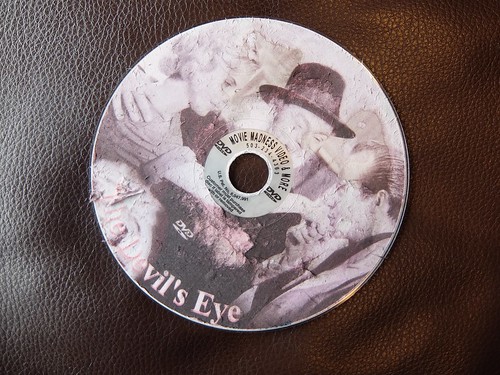
The Devil's Eye (movie review)

DSCF2954

We seem to have embarked on an Ingmar Bergman retrospective, with the Seventh Seal and now another religious parable, playing up similar memes.

We don't get Death this time, as a character, but the Devil himself.  Given the title, we might think his eye problem is less prosaic than a mere sty, which he seems unsure about and needs a mirror to half-discern.  The Devil, being vain, strives to see himself in his own wretched glory, and thereby hangs a tail, er tale.

The Devil is consumed with desire for the wholesome soul of a young maiden, still alive, on Earth, and thinks he has just the man to get it for him:  the corrupting Don Juan, accompanied by his likewise wily vassal.  Both are already denizens of Hell, so this offer of a foray back to Earth comes as a welcome invitation and both prove eager to rise to the challenge, plus a demon is sent after them, just to supervise.  The demon hangs out as a black cat, when not in male form.

The film portrays itself as a Divine Comedy, not unlike a midsummer night's dream, a parable with stock characters in which we may see ourselves reflected.  A naive dad, the vicar, a Ned Flanders type, does not see his daughter as a grownup, nor life in general from that standpoint.  He comes across as the clown, gent of somewhat stunted development, yet unwittingly a prime mover of events.

The vicar's wife, weary of living with such a child-like husband, is open to someone new.  The vassal senses this opportunity and his scenario plays out in parallel to Don Juan's,.  The demon goes after the vicar, trying to shake his faith in human nature.  The vicar proves to be quite a challenge, with an agenda of his own.

The happily engaged couple, the vicar's daughter and her boyfriend, between whom Don Juan's inserting himself would be disruptive, likewise have an unwitting air about them.  Everything seems so planned, so by the book, with the stock players unused to reflecting deeply, going through the motions, eager to do what's expected of them.

With Don Juan on the scene, Hell bent on hot pursuit, our female protagonist is plunged into self examination of her own values, and her cogent self assessment seems exacting enough to take some wind from Don Juan's sails.  She's inwardly loyal, or says she is.

Given Don Juan seems unable to penetrate her emotional armor, a merely physical "love scene" would seem extraneous and perfunctory, beneath his pride.  He would prefer to discover true love in his own assessment of what that looks like, a move perhaps uncharacteristic for him, but a breakthrough in spiritual maturity.  Don Juan finally up to the level of pining for someone other than himself.

The Devil is predictably upset by this outcome.  Don Juan has grown in stature and comes closer to matching the Devil himself in his capacity for despair.

Don Juan has attained a kind of proud boredom and disinterest in his own eternal abuse, which involves endlessly striving to seduce, yet always waking up at the brink of victory, in some perpetual Ground Hog Day of devilish design.  He addresses the Devil almost as an equal, as a consequence of his own most refined sense of "designer sin" and its high price tag.

Thursday, February 04, 2016

Resurgence

I think a lot of us are putting down our soup spoons to listen to NPR hype the future of women in combat roles, a new freedom and liberty they've long been begging to have.

Now that women have equal rights, is the premise, it's time for them to start paying the ultimate price more often.

The Selective Service must be feeling the pinch of only half the should-be-eligible population getting registered and this media campaign was long in the making.

Patriotism, common code words (they kept saying "existential"), and stellar examples of that  unquestioning attitude that makes a good soldier, get strutted out on what sometimes gets called "liberal radio", and we pause to listen, noticing this new voice of a next Pepsi generation (perhaps coached by some oldsters).

Of course the US is composed of diverse ethnic groups, not all of whom celebrate combat roles as the higher service.  Diplomacy takes a lot more skill and isn't for everyone either.

When it comes to "special operations" the military has no monopoly and what's more, never will, as thinking and acting in that unquestioning way exacts a price.  But we have real talent at the top, that's true too, so best of both worlds then?  Too pollyanna?

Anyway, those women who've been chomping at the bit to prove themselves in this all American way (since before the Revolution at least) now have reason to celebrate.  I advocated years ago we give them their own submarine (fleet?).

Whether some possible future world will have the smarts to not always be holding a gun to its own head ("weapons of mass suicide") is debatable, but we may still hope.  Submarines without WMDs are not unthinkable.  Women might prove braver in that sense, less self-destructively trigger-happy?

The spin is this is a victory for feminism.  The real question is are we seeing equal pay for equal work in a statistically meaningful way?

If women are still getting the short end of the stick in civilian society, yet are being rushed to the front lines, that bespeaks of human rights violations.  I look forward to the analysis.  Women and minorities have a long history of abuse in America.  I recommend Kindred by Octavia Butler on that score.

Sunday, January 24, 2016

The Seventh Seal (movie review)


This much-written-about classic by Ingmar Bergman is embedded within every film school curriculum and overview documentary I would suppose.  The Story of Film:  An Odyssey, certainly cites it.  For all that hype, had I ever see this movie start to finish?  Not for credit certainly.

The plot is set in medieval Sweden and appropriately follows a formula, popular at the time (and later), of a small troupe on a pilgrimage, eventually braving dangers together, and in this case, witnessing a witch burning in progress.

The fragility and ineptness of the entire belief system of the day is exposed, almost to the point of comically, in a somewhat Monty Pythonic (satirical) manner ("bring out your dead!").

Ironically, they are being punished by God, for being so forgivably clueless.  Fools are not exempt from the laws of nature however, and Death reaps souls aplenty.

The pilgrimage begins with the Knight and Squire, just back from the crusades, soon joined by Death, who stalks the Knight throughout the film, playing him at chess.  The Squire turns out to be the most learned and free thinking of the bunch and challenges the Knight's belief system in a teasing manner.

The Squire is chivalrous in rescuing a Damsel in distress, from a wicked thief who used to be something of a church authority, the one who encouraged the Knight and Squire to venture abroad on their crusade in the first place.  The Damsel joins the party, as does a troupe of three actors:  the Clown, his beautiful young Wife, their Director, and the baby Michael.

The Clown is perhaps closest to God in having visions all the time, which make him seem the most foolish, though his Wife listens and loves him.  The Clown is in good physical shape given he practices his moves all day, though his juggling is pathetic, what we see of it anyway.  He hopes Michael, their son, will grow up to become a juggler too.

The Wife is not so sure that's a good career choice for their boy.  Maybe he could be a Knight?  The Knight warns that's not much fun either.

The Knight is beset with existential concerns.  He wants answers.  What was the point of his pointless crusade, at the end of the day?  Helping the church burn women at the stake?  The Squire is especially repulsed by the whole business.

The Knight is initially open to the idea the "witch" might have some answers, given her supposedly close relationship with the Devil.  Then he sees she's just delusional, shaking her own faith as well.

In challenging Death to a game of chess, he delays his own demise long enough to win a reprieve for the small family he comes to care about.  The Clown, his Wife and Baby, escape Death for now, thanks to a combination of the Knight's nobility and the Clown's psychic powers.

The world (Sweden) is not a nice place, beset with the Black Plague.  Many are sure these are the End Times.  When Death arrives at the Knight's castle, where our party (minus the Clown family) has gathered, the Damsel seems most drawn to her next world, meeting Death with a look of anticipation.

The Knight rejoins a loyal spouse, who tended the castle all these years, awaiting his return, and yet he is far from overjoyed.  He's too tired to be capable of much emotion.  After his epiphany over cream and strawberries with baby Michael's family earlier, he has become exhausted.  He knows this small party is doomed (the chess game did not go well) and so remains emotionally distant.

There's a subplot with the Director, seduced by the Iron Smith's spouse.  These two, the Iron Smith and his unfaithful Wife, also join the party, rounding out the characters and providing contrasts.  Compare married life for these two versus that of the Clown and his significant other.

The different personality types, at different places along life's journey, all travel together, with Death on the heals of each one.  Like a medieval audience, we learn from these characters, confronted with challenges and adventures.  We feel called to contemplate our own life's journey.

Closing on the theme of Life as Chess (a strategy for winning over death for an interval), let us hear from Benjamin Franklin circa 1750 on the value of learning it:
“The Game of Chess is not merely an idle amusement; several very valuable qualities of the mind, useful in the course of human life, are to be acquired and strengthened by it, so as to become habits ready on all occasions; for life is a kind of Chess, in which we have often points to gain, and competitors or adversaries to contend with, and in which there is a vast variety of good and ill events, that are, in some degree, the effect of prudence, or the want of it. By playing at Chess then, we may learn”  [ source ]

Wednesday, January 20, 2016

Cultural Illiteracy

Special Type

When businesses moved from file cabinets stuffed with mostly typed and hand-written documents, to digital media, most adults got left behind.  Basic reading and writing was relegated to SQL and/or noSQL, which in turn lives behind web forms.  Spreadsheets are "what if" or "read only", like most web pages, making cube farmers the new peasants, illiterate and outside the bastion, not part of the 0.01%.  If a spreadsheet is also writable, then it's too mutable to matter (unless "what if").

In other words, if you're ignorant of SQL, you're incapable of even the most basic clerical functions associated with our current global / local civilization.  You're a peasant (cube farmer?) in the older sense, not like in Cuba where an agrarian engineer might use NumPy on Linux to map out the plantings and compute the return.  Not all peasants are digitally challenged.  But in the USA, where public schools usually share nothing of SQL, the depth of ignorance is deep.

Case in point:  I've always used CenturyLink for Internet access, including as an ISP back to US West days, then through the Qwest period.  I recently upgraded from DSL to optical fiber, but guess what?  I'm treated as a consumer of Prism TV services and no static IP is available in my network.  They don't expect me to host a computer or serve web pages from my house?  Why?  Because I'm just another dumb American who knows neither how to read nor write (in the business sense).

If you're just another dummy, then what you want piped to your house is News Weather and Sports so you can lie there like a couch potato, get fat, and die.  Woo hoo, what a great life that was, right?

Back in the day, the ancient Egyptians had a pyramid society (pun intended) with peasants at the base, then craftsmen, then military, then finally scribes and inner circle courtiers surrounding the Pharaoh.  Switching to China, we imagine the Emperor, surrounded by eunuchs.  The scribes were the ones who knew the SQL of their day.  To peasants, record-keeping was what it seemed like to us, a lot of cryptic hieroglyphics.  But the eunuchs knew the power of clerical work (clerking) when it comes to effective admin.  Fast forward:  So why do you think they call it "Unix"?  That's a joke for insiders.

We've returned to such a society.  The cube farmers who just use Microsoft Excel all day are piss ignorant with no scribe-level business skills.  They're mostly kept alive in meaningless jobs (feeding pens) so they'll consume and pay bills in a service economy.  The economy depends on pointless shopping and meaningless services.  If your life develops enough meaning to where you can't be trusted to mindlessly consume then you're a threat and a good-for-nothing.  Preventing the spread of static IP is a first line of defense against literacy making a come back.

Friday, January 15, 2016

Techno-Morality: A Linus Pauling Memorial Lecture

DSCF2589

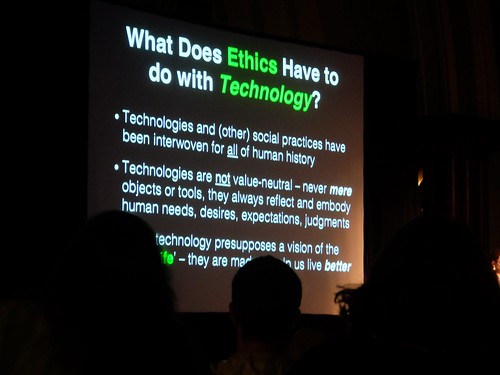
How is techno-morality different from morality more generally?  The virtues Dr. Vallor ticked off sounded familiar:  courage, humility, wisdom, magnanimity... I'd add fortitude, the ability to persevere in the face of adversity.

For example, when I tried to upgrade my copy of PyDev recently, the Python developers' plug-in for Eclipse, the screen dump showing error messages might have demoralized a lesser version of me.  But with the right mental attitude, I was able to focus on the documentation and "just do it" as they say around NikeTown.

Being a geek requires cultivating a kind of athleticism, along with a kind of self-congratulatory mechanism that are together conducive to making repeated attempts.  If at first you don't succeed, try, try and try (and try) again.

But who said being a geek was what Shannon was interested in?

I'd say she is one though, interested or not, that much was clear.  She mentioned liking to study the The Walking Dead for its philosophical insights, and I can see why.  That show pushes us to vicariously experience "life at the limits" as Walter Kaufmann would say.

Underground comics have been for ages a place to study the philosophical implications of a society gone off the rails or pushed to extremes in one dimension or more (Batman's Gotham is another paradigm use case).

Lets put it this way:  when the Internet first hatched from its dinosaur ARPA egg and started to reach the teaming masses, a need for "netiquette" or "Internet etiquette" was born.  But etiquette is so much lesser a word than "virtue" or "code of ethics" or even "code of conduct".  Netiquette includes such style guidelines as staying away from ranting in all uppercase letters in one's communications, a practice derogatorily referred to as "shouting".

Etiquette connotes manners, civility, not making a fool of oneself, whereas Ethics goes deeper and reflects character in a more telling way.  We all see a need for Netiquette, i.e. rules of the road, noticed if broken, so how much more so, then, should we accept a need for techno-ethics more generally.

To answer my opening question, then, what Dr. Vallor was acknowledging and addressing is the exploding set of possibilities, hitherto science fiction, technology might realize or has realized already.

Our decisions, vis-a-vis our technologies, are having more complicated ripple effects such that our powers of judgement are called upon as never before.  An ethical sense is what stands between a life worth living, and everything turning so ugly (as in The Walking Dead) that going on has become of questionable worth.

Fermi's Paradox is that we just aren't seeing many signs of intelligent life out there, and this becomes hard to explain given how hard we're looking.   "Where are all the people (intelligent life forms of any kind)?"

One possible explanation is developing high technology is almost always a prelude to a kind of crisis or singularity that removes said civilization as a source of positive radio noise.  Are we seeing evidence (in the silence of space) that species of our abilities are fated to be short-lived?

Shannon is ultimately in the business of risk assessment or even triage.  Looking ahead, at possible threats, such as a cosmic body smashing into the planet, what does it make sense to fear most, fear a lot, fear less?

Having a "fear profile" that maximizes one's chances takes discernment and homework.  For example she didn't think AI robots were about to stage a coup as the more intelligent / entitled half.  Much more likely, our cavalier reliance on silly algorithms would take us out.

We're more likely to perish thanks to machine stupidity than smarts, in other words.  We'll shoot ourselves in the head, figuratively speaking, i.e. start a nuclear war, simply out of carelessness.

The future is seemingly more opaque given complexity which is where the humility comes in.  Even as Vallor was outlining some of her own chief fears, she was quick to back off claiming that her perspective was the last word.  She made no claims to omniscience (refreshing, in a philosopher).

The audience was very engaged as questions of ethics with regard to technology are prevalent and galvanizing.  She had been to a middle school earlier that afternoon and the kids were eager to articulate about the issues.

We can all point to use cases, such as a doll that records what children are saying to it so that adults might listen in later.  Is that an invasion of privacy?  What is "right sharing" as Quakers might say?

What is characteristic of philosophy when it comes to ethics is there seems a less well-developed set of pathologies where an absence of ethics is concerned, in comparison to what the medical profession has crafted.  When it comes to the anti-virtues, what has philosophy to compare with DSM V?

What shocks many a virtuous adult about the Internet is its lewdness and carnival atmosphere, its peep show / freak show aspects.

Such noir aspects of cyber-life are as likely to attract the attention of psychiatrists as philosophers.  But then spin doctors of all stripes are attracted by extreme phenomena.  For every virtue, a host of sins beg for our concerted attention.

DSCF2586

Sunday, January 10, 2016

Critical Path

evening_gig

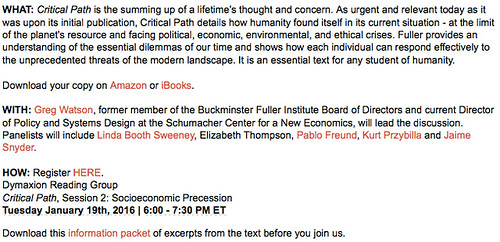
I'd join this reading program, hosted by the BFI, led by one of its board members, however I'm booked for a gig of my own that same evening.  Malesh.  Another time maybe.

Critical Path comes between Synergetics and Grunch of Giants, and follows the Hegelian pattern of some Pure Logic giving rise to History (a narrative telling, with a point of view, or many, polarized, and partially overlapping), which latter telling seems pretty twisted, leaving us worried Synergetics might not be the last word in the logic department ("ongoing corkscrewing" more likely -- it's not defining itself as a terminus).

Or is complaining about "weird and twisted" a deliberate miss-framing of a poetically licensed work?

Like what's this about humans specializing towards Idiocracy, passing monkeys going the other way, towards Planet of the Apes?  How did we get beamed here as information again?

Fuller's stars don't just shine at night, they program, for lack of a better word.  Lets at least agree their information is structured, if only spread out over signature frequencies.

The elements "talk" (broadcast) and why shouldn't they?  Spectrometers pick up information on what stars are made of.  Clearly the stars do inform the planets, in ways more than just by helping to drive photosynthesis.

In later chapters, Fuller definitely plays the Cold Warrior, moving his chess pieces around his global World Game board.

But then isn't "cold war" just more "cryogenics" in a synergetical sense, something meticulous and computational, like game theory?

How much of this is more smoke and mirrors?  How much enciphered?  Is "explorations in the geometry of thinking" a little bit like living through Lost?

They're always taking us down blind alleys, these tale-twisting bardic old people (Tribal Elders).  Some level of suspicion is not out of place, if only as a defense of a personal namespace.  We each give voice to a Universe, Carl Sagan a case in point.

Bucky shares lots of good inventions.  Like that's a really cool idea for a Geoscope in view of the UN building in NYC.

His plan for the US Expo Pavilion in Montreal was similar but ended up featuring the pure geometry of the dome (a slice of a geodesic sphere actually) instead.

The District of Columbia (WDC) crowd grew leery of Expos after that, given their fall from sophistication in some new cycle of American thought.

The USG peeled off from the Worlds Fair organization, following a different drummer, following Orlando perhaps i.e. Disney's EPCOT would be the permanent tribute to America's exceptionalism.  Or did America vanish into the singularity of Tomorrowland even before the USSR did?  Let historians debate such questions.

The Geoscope / Mapparium now have their software incarnations ala Google Earth and Terraserver, with ESRI providing a Dymaxion-skinned view, not a requirement, where global data is concerned, but certainly a nice-to-have.

Some schools of hermeneutics consider it impossible to have "literal truths" about the uber-murky past or future, not because we don't know the literal truth so much as our language is not designed to express it.

The box we think in is pretty strict and quickly stops makings sense when outside of.  These schools see myth not as a substitute for truth, but as an encoding for which no key is yet available, but yet may prove decipherable to some degree, to professional oracles and others similarly predisposed.

The stuff about humans and dolphins inter-twined is meant more as a friendly arm around a fellow mammal, a set of species the seagoing have long spun yarns about.   

Critical Path has its whales, required in any oceanic myth aiming to spring up from first principles, embracing at least some of what we know.

Wednesday, January 06, 2016

Home Economics

A pattern for me, when thinking about concurrency, is to gravitate to cooking in a large well-equipped kitchen with multiple chefs.  I should thank Dave DiNucci for connecting these dots for us at a Wanderers presentation.

I folded laundry while watching the "wicked smart" CBS Evening News (alluding to the last story about seeking the authentic Boston accent).  Meanwhile, I shouted to my dog downstairs that I'd be back down shortly (she gets lonely, and can't walk, let alone climb stairs).  All multi-tasking.  Reality runs in parallel even if we imagine "now" time slices in sequence, integrating the differences.

The Gathering of Western Young Friends was also influential, in developing my appreciation for an institutional kitchen.  This group of Quaker-Pagans sought out remote retreat center camping facilities that would allow the customers to take over logistics in a big way.

We brought in our own supplies and orchestrated the meals.  It helped that a few of us (not me so much) were serious foodies, the kind with their own knife rolls.  Some had cooked professionally.

Fast forward to Food Not Bombs.  When one joins a food prep team as an anonymous stranger, with others on the team also unknown to one another, with the ingredients for that day also somewhat luck of the draw, then collaboration powers inevitably get developed (unless there's a breakdown).  People have an ability to self-organize, given optimum conditions (e.g. the prospect of a healthy meal as a reward for task completion).

I was able to book our Quaker meetinghouse on Stark Street for a year of such experiments.  We pulled it off every Thursday.  My house was a hub for bicycle trailers coming and going.  We had some room for inventory, both at my house and in the meetinghouse basement (just a single box in the latter location).  My blogs chronicle this chapter and suggests one's habits have a way of perpetuating themselves, have a kind of inertia of their own.  Isn't that why we call them habits?

The most powerful habits are habits of mind, which may encounter the least resistance.  Physical habits maybe change, but in thought we have freedom, including the freedom to get stuck in a rut.  Learning to get free of thoughts that comprise a mental prison more than a path to liberation is a life-long challenge.

We need fast reflexes to get by.  Habits of thought are not in and of themselves "bad" so much as "potentially worth countering" -- usually with other habits.  We learn to consciously cultivate new habits as a way of dampening obsolete ones.

In team sports, coaches strive to impart the habits associated with team work.  In my essay on Home Economics for MathFuture, I stress the similarities between athleticism and multi-tasking with others in a well-equipped kitchen.  Sailing a boat likewise requires working as a crew.

Every successful enterprise needs team players with an ability to work together, developed over time through practice.  Home Economics, as much as any team sport, might become a basis for infusing these skills more widely through what we call school.

Jay Rinsing Burley

Friday, January 01, 2016

Think Outside the Box

Those of us working in the neighborhood of Common Core and STEAM (STEM + Anthro, or Art in most accounts), might appreciate "outside the box" as a fine meme to build on.

How?

What do you picture when you picture a box?

No doubt a rectilinear affair no?  Not a tetrahedron certainly.  But why not?

The tetrahedron is the paradigm container, with minimal edges and faces.

Forget practicality, think about conceptuality.

We'll get back to practicality, with the same Cube in a spanking new context.

We might spin it as "break free from the box" in the sense of the box's shape

We're free of our stereotype of "a box".  The blinders have come off.

What difference does it make, to be free of the "box shape"?  Think about it.

Thursday, December 31, 2015

The Human Experiment (movie review)


This documentary looks at the issue of toxins in our tissues owing to higher concentrations of various substances in our ecosystem (economy):  Bisphenol-A, PVC, asbestos... lead.

Flame retardants are a good thing in general, but the devil is in the details.  Efforts to change the mix in California have only incensed the flame retardant industry.

Other cases of this kind show the uphill battle being waged to get some kind of handle on poisons and/or poisonous practices.  Reducing the power of tobacco advertising, a form of drug pushing, was just the beginning of a long slog.

The fact that the USG, presumably a "superpower" is rather unfairly helpless against Big Tobacco, Big Asbestos, Big Killing You Softly in general (Obnoxico) comes through loud and clear.  Uncle Sam tends to go toothless where Cowardly Capitalism is concerned.

Lets face it, democracy is a fairly new invention, and as an average human one is a disposable item, to be milked for money in the interim, and maybe thereafter, in the form of ongoing payments from the estate.

Using the courts against Obnoxico is next to impossible as the legislation (rule making) may be so obstructive as to make court battles irrelevant.  Corporate personhood means giants among us set the rules, with ordinary humans relegated to steerage as 2nd or 3rd class.  Our monsters have us on the defensive already, yet most scientists still project our battle with AI robots in futuristic terms.

Our own conditioned reflexes have proved robotic enough, to threaten our continued survival as humane / sapient human beings.  The post-sapiens will still be good at shopping however.

Consumers still have the power to vote with whatever remaining purchasing power, though institutional buyers may be beholden to specific arrangements, through board members perhaps.

Sometimes "specific arrangements" are a good deal for all concerned, so I'm not casting aspersions on optimization as a concept.  Indeed, free market capitalism has this last resort optimizing capability:  the freedom of consumers, even without top-down organizations, to set up what amounts to a boycott.

Some ingredients get on the black list, as do some companies.  Legislation may bring up the rear in that case -- or not.  Public taste and opinion may lead legislation by a decade or more, as we've seen with Prohibition.

Lets remember the power of women, whom the USG is these days thinking to draft and send into combat, without first passing any ERA (Equal Rights Amendment).  Women look forward to having children with every advantage, and become health nuts during pregnancy, a lot of the time.

Their concerns about radio-toxins in the ecosystem thanks to reckless testing by Iron Mountain's minions, motivated Uncle Sam to clamp down on atmospheric testing, by negotiating with others to do the same.  Mothers everywhere were up in arms, more conscious than most of front lines biology.

When breast milk starts ticking, there's the thought to be more careful with our one shared planet.  Dr. Evil types need to be countered.  Have we no heroes anymore?

I think environmental engineering or engineering with ethics, informed about agriculture, conscious of human and non-human needs, is going to recruit a lot of top talent.  Movies such as this one, rather weak on science specifics, set a bench mark to move beyond.

Contrary to one mother's lament, that one shouldn't need a PhD in biochemistry to have a child, that's something we're all going to need, at least informally.  Taking care of life requires a lot more understanding of biochemistry than simply wreaking havoc, which requires few skills.

The growing crop of weapons inspectors will be a subcategory of environmental engineer.  There's nothing healthy about those stockpiles of WMDs, neither physically nor psychologically.  Humans are reduced to idiocrat post-sapiens when over-exposed to radio-toxins.  Protective measures, beyond just the haz-mat suits, are a job requirement.

Tuesday, December 29, 2015

Deep Cleaning

I've been in overdrive deep cleaning the kitchen, still have a ways to go.  I have original 1950s style pastel yellow, pink and light blue vinyl wall paneling + a stainless steel counter + painted metal cabinetry + an avocado green Magic Chef stove.

All this 1950s stuff is quite vintage at this point, and it shows.  The cabinets are tinged with rust and corrosion, indicating "well used".  Properly scrubbed, they're still shiny though, even if not "like new".

Our family moved in twenty years ago, taking over from the Kinglers, whom we suppose installed the wood stove in the middle of the living room (we gave that to Dawn's brother).

I popped in a VHS tape showing us enjoying life in 1997, about two years after we moved in.  Sorting through VHS tapes was another holiday project.

Blast from the past:  cleaning in a consumerist culture often means discovering interesting appliances that have fallen by the wayside, such as a WelBilt Bread Oven Model ABM600.  I don't find anything wrong with it (so far).  I got some yeast and dry nonfat milk, bread flour, to test it with.

Tara cleaned her room when she got here, to make it more suitable.  She's been resting between social engagements by taking in old episodes of Star Trek Voyager.

Lindsey has likewise been deep cleaning in preparation for the big move to Corvallis.  She officially moved out some months ago, but went to Nepal.  The next move entails actually evacuating the basement, where the bulk of her music equipment has been stowed.

I use a stiff brush with 409 on the vinyl and metal, after clearing off all items held with magnets.  Two 24" florescent tubes had gone out, which I replaced.

I'm wondering if the personal frozen dessert maker, a hand-cranked one-portion cooling device, could be re-purposed into a Martini cooler.  I forgot to buy olives for the test.  Next time.

I'm not a big Martini guy, have probably had fewer than twenty of those in my fifty seven years of life.  However, I'm open learning new things.

Tuesday, December 22, 2015

Listserv Posting

From: kirby urner
Date: Thu, Dec 17, 2015 at 1:16 PM
Subject: Re: Presenting misconceptions detrimental to learning ...
To: The Physics Learning Research List

On Thu, Dec 17, 2015 at 12:43 PM, [ JD ] wrote:
In particular, many of the most important concepts (in physics  and elsewhere) are so fundamental that they simply cannot be defined in terms of anything more fundamental.  One place where you see this with particular clarity is in Euclidean geometry, where the fundamental objects -- points, lines, and planes -- are emphatically and explicitly *not* defined.  The words acquire meaning from how they are used, and not otherwise. 
 
I'd like to riff off this paragraph a little in order to draw a distinction between "misconceptions" and "alternative conceptions".

My approach to the latter w/r to non-Euclidean alternatives is to start with Karl Menger's 'Modern Geometry and the Theory of Relativity' [1] wherein he suggests a "geometry of lumps" in which points, lines and planes are distinguished not by "dimension" (Karl was a dimension theorist) but by shape (topological characteristics).

I combine this with an alternative model of multiplying two numbers, where the two lengths A, B are posited at 60 degrees in alignment with unit-area triangles, such that A x B is the area closed off by the origin O, and segment AB. [2]

This model leads to an analogous treatment of 3rd powering (or multiplying any 3 numbers) that goes to a tetrahedron, not a cube.  "Three to the third power" is not a cube but a tetrahedron.  This is well known from the 1970s writings of geodesic dome architect Buckminster Fuller. [3]

Given the pronounced 4ness of the tetrahedron (4 windows, 4 points), and no distinction in dimension twixt points, lines and planes ("infinitely thin or small" e.g. "depth without height or width" are handled by a concept of "subfrequency" instead), we get a "pre-frequency" Platonic world that is considered "4D" (tetrahedron = concept of "container" i.e. that with inside/outside concave/convex aspects), with Time / Energy added as additional dimensions. [4]

That's all an opening into a philosophical investigation of what's permissible, in terms of having different namespaces.  Are these moves "allowed"?  It's a different way of talking.  I cast it as "Martian Math" to acknowledge it's alien, but not necessarily "wrong".

Challenging the efficacy and utility of Euclidean geometry is not the point.  Pointing to another way of connecting the dots that likewise holds water is the point.  One needs a limber mind to tackle slippery concepts (like "dimension") and getting too stuck in a rut is not a good way to stay limber.

Kirby

[1] in Albert Einstein: Philosopher-Scientist , The Library of Living Philosophers VII, edited by P. A. Schilpp, Evanston, Illinois, pp. 459-474
[2]  https://youtu.be/2B1XXV2Eoh8
[3]  http://www.rwgrayprojects.com/synergetics/s09/figs/f9001.html
[4]  https://en.wikipedia.org/wiki/Quadray_coordinates (a "4D" coordinate system)

Thursday, December 17, 2015

Rich Data Structures

rich_data
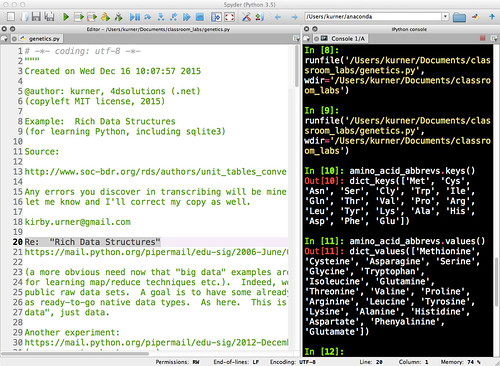
:: Python dicts mapping 64 DNA / RNA base pair triplets to 20 amino acids ::

The videos I'm watching on Safari On-line, about Hadoop, feature WordCount, a jarred job, working against a cluster containing all Shakespeare's writings in HDFS.

To unpack that a little, making a cluster of computers act in concert as a very large hard-drive, with RAID-like redundancy, is what cloud computing is all about.

You can build a cloud in your basement if you want to invest in the hardware.  You'll want two robust carrier grade master servers: one for NameNode and JobTracker, the other for Secondary NameNode (the change-log compactor, not meant to be considered a failover).

The six to one hundred slaves (for starters) may use commodity hardware.  One DataNode per slave machine keeps things easy, with paired TaskTracker too, each of these five types of daemon a long-running process on its own JVM.

This entire ensemble acts to emulate a giant disk, and actually the texts attributed to Shakespeare don't even begin to take up that kind of room.  The redundancy factor provides a high degree of security, provided the cluster is actively monitored and maintained, failed hardware replaced.

And by "a jarred job" I meant "stored in a jar file" (like a zip file or tarball), as we talk to this cluster in terms of these Java language jobs.   An ecosystem of software products, including open source, defines the Hadoop namespace more or less.  Sqoop, Hive, Pig... a bunch of funny names.

A map routine, farmed out to work against data blocks simultaneously, harvests the data for the reducers, which apply whatever amalgamating logic, summing columns, counting rows, number crunching against whatever the mappers have found.

That's all technology for dealing with Big Data.

At the other end of the spectrum, we have tiny data sets that are nevertheless more substantive than random semi-spurious examples.  In the age of print, squandering pages on "real data" (such as a complete Periodic Table of the Elements) would not be undertaken lightly.  The Periodic Table is concise for a reason.

How many "parts in inventory" does one need to get the idea? Of parts, not that many, but "many" is a concept to get one's head around also.  An appreciation for the sheer volume of the data being managed may be illuminating as well (in the sense of instructive). 

Once in a real knowledge domain, the data often starts getting bigger, even if the business logic remains more or less constant over time.  The same rules come to apply to more and more special cases -- not that rules never change.

Fortunately, and just in time when we needed it most, we often now get to learn new skills by downloading substantive example files, as it's not a matter of "wasting paper" like in the old days.  The move towards Open Data is a way to balance higher rates of collection.  Enriching the commons with more shared data provides more reality checks which presumably better guides public policy.

Having substantive files, such as William Shakespeare's works, or even just tiny maps of the genetic code, also helps us keep the bandwidth high.  You're not just learning some computer language, you're being reminded of what you learned about genetics.

Sharing bread and butter data from different disciplines, not phony nonsense examples, helps keep a subject matter grounded, and gives people more windows into one another's spheres of concern.

Yes, I understand the utility of "meaningless story problems" designed to call attention to what's most generalizable, the core concepts and techniques. By the same token, peppering one's teaching with real-world-flavored examples has valid uses as well.  It's not either / or.

Tuesday, December 15, 2015

Guns or Butter


This rather hawkish Frontline documentary seems inconsistent, in building support for more US troops on the ground, while never addressing the issue of US weapons falling into the hands of armed gangs.  How did "troops on the ground" really solve things in round one?

That the only response to a dark ages Catholic-vs-Protestant (Sunni-vs-Shia or the reverse) style war -- with modern weapons -- is "should we bomb or send troops?" is critiqued more directly in the Russia Today interview of a retired Marine, Jason Stapleton, below.  These two (Frontline and RT) come up back to back in my Youtube viewing queue.

The private sector floods the area with arms, in exchange for black market oil, without consulting either NATO or DC (or the Kremlin or...).  The Arms Bazaar is open to all comers, as a player in its own right.  It's not like guns are hard to find.

Pouring high-powered weapons into a war zone is not a clear recipe for restoring peace.  Just about anyone suggesting a "solution" seems to think it's a matter of which trigger-happy faction to support with more weaponry.  Certainly the weapons makers have it made.

Evacuating civilians is also a political maneuver.  Propaganda and ideology is not all about who has the most guns (or oil).  Win the allegiance of civilians by helping them escape a war zone why not?  Do more to shore up living standards in the refugee camps at least.  Take a high profile lead in lighting a way forward that's not just more darkness.  Be a beacon for hope, not a source of "shock and awe" for a change?

The suddenly low world price for oil makes sense, in light of the fact of the collective hunger for weapons.  The Arms Bazaar is feeding off this hunger, driving the price of oil down, given "black market" circuits (scare quotes because we're talking about a lawless state of war) are pumping like crazy, trading butter (crude, aka Peak Oil) for guns.

The private sector does not actually need US tax dollars to make its fortune, except on the very biggest ticket items (atomic weapons procurement funds many a fancy restaurant visit, good for the wine barons at least, until the grapes start ticking).

The US does not need to pump any more small or even medium sized arms into the region, for there to be plenty of such weapons (it's not like they're used up after two or three rounds -- expect at least a decade of trusty service on some makes and models).

Already, a large percentage of what's circulating is "US Army surplus" (captured from Mosul or wherever), valued in the hundreds of millions of petro-dollars.

Keeping the campaign aerial (the NATO-Russia solution) is a way to avoid direct weapons transfers, but ultimately dropping bombs is about continuing to destroy infrastructure that leaves nothing left by way of employment other than picking up a gun and joining the mayhem.

If the only job open is suicide bomber, but with several months of free room and board (called "training"), that might mean a longer life for some jihadists?  With nothing more to lose, why not go out in a blaze of glory right?  Goodbye cruel world with a vengeance, right?

Living standards plummet the minute those craters start happening in your city, thanks to bombs, whether delivered by car or by jet (or by cruise missile or by....).  Destruction is quick.  The consequences take longer to manifest, the healing even longer.

Invading Iraq in the first place is what helped end Iraq.  These nations were tenuous to begin with and couldn't take that much stress without shattering.

The purpose of the nation-state system was to find a way to live in peace.  That didn't work out did it?  We'll continue with the theater of it all, not having any better ideas apparently, but with less faith and belief in some of those recent ideologies, best left behind in the 1900s or whatever.  Good riddance.  On to something more sustainable, we pray.

Economics and GST both agree:  it's about guns versus butter (killingry versus weaponry) and also about non-linear spiraling, positively or negatively trending.  Without hope and longing for a brighter tomorrow (utopia), there's still room for fear and the hunger for outward weapons (oblivion).

Rather than cratering freeways, the basis of civilian trucking could be improved and extended from Kabul to Istanbul, a paying gig, perhaps for academic credit.  I know that sounds far fetched, but not for any lack of trucks or fuel oil, and the freeways were being used.

Taking that same oil money to rebuild hospitals and factories would be an option.  Other sectors besides the Arms Bazaar have goods and services of value.

What do people shop for, especially if their self-proclaimed business is to "glorify God"?  Some shop for and deploy tanks.  Others procure Boeing 737s.  Either way, it's a business (a bazaar).  The least responsible buyers are expecting the end of the world, but who can blame them?

Speaking of oil, I need to turn down the heat.  I was testing the furnace this morning.  It works.  No need to waste.  I'm mostly just using space heaters these days.  A rain forest ecology gets lots of rain, but isn't usually down to freezing except in the mountains, where skiing remains a popular sport.

Tuesday, December 08, 2015

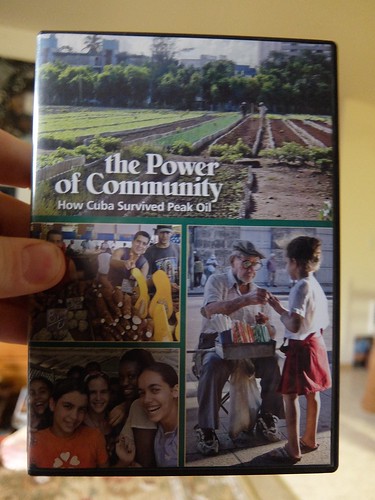
The Power of Community (movie review)

DSCF2143

This documentary is uplifting, as it tells a story we all want to hear, of humans surviving an energy crunch by cooperating, rather than turning on one another, every man for himself. The backdrop is local politics, less than peak oil.

Peak Oil is real, and should be welcomed as our saving grace vs. global warming, as the fossil fuels are simply running out, at least half empty already mas o meno. I always thought the Peak Oil talkers were more into taking the bull by the horns than the Oceans and Temperature Rising talkers, not that these are mutually exclusive talks.

Cuba was caught in the middle of Cold War politics and could not afford the lifestyle to which it had become accustomed, not in the wake of perestroika (перестро́йка).

Cubans were actually using more pesticide and fertilizer per hectare than many, and were exporting cash crops in exchange for basic foodstuffs, just like every other tropical paradise.  But for the US embargo, they had a mirror image thing going in the Second World, which was a lot like the First.

But then the Soviet Union morphed into something else and left Cuba to face everything short of invasion, in terms of economic sanctions.  Any ship putting in to a Cuban port was blacklisted in the US for at least six months, a heavy penalty.  Cuba went from being Second World to Third World overnight almost.

With the sudden shut off of former sources of income, Cubans had to completely reorganize their agricultural and transportation systems.  In so doing, they made some important discoveries, such that the way soil is compacted by heavy equipment requires heavy equipment to undo, and the pesticides and fertilizers were killing the natural topsoil, necessitating more artificial ingredients.  The spiral was unsustainable.

They went back to organic farming, and to oxen, with diverse crops, less mono-culture. This was done not out of idealism but out of necessity.  Cuba suddenly needed to be more food independent.  This takes big changes at the grass roots, but then in the face of severe shortages, the status quo was not acceptable either.  The changes were highly motivated.

Tractors were still important of course, but someone taking a plow to his or her field, behind two oxen, was once against lionized as an agrarian superstar.  The "peasant" (aka organic farmer) had status again.  Agricultural engineering is about as basic as it gets, just ask the Australians (they help out with their permaculture knowledge).  Once the concept of "working with Nature" is ingrained, a lot of the work just happens.

The upshot of all this morphing is Cuba is now enjoying higher living standards, in terms of people having amicable relationships (i.e. social skills).  They're not mowing each other down as much as in some countries, nor living the life of sputtering gas-aholics or shop-aholics.

Better food, more savvy, a closer connection with the Earth.  Our back to the Earthers here in the US already believe in this lifestyle, and some even practice it.  Portland, Oregon is much infused with the same values.  We admire our agricultural sector quite a bit (a source for hops, grapes and wine, cannabis products, pears and apples, berries and Christmas trees, also cheeses), not just our nanotechnology (not that these are entirely separate).

What's interesting is to mix the older more established methods of agriculture with new discoveries and inventions.  Going back to oxen and horses does not mean giving up Google Earth or smartphone apps, which draw little wattage on the demand side.  No one says you can't use Linux to help manage the farm, whether locally or in some cloud is up to the local proprietor.

This version of "the agrarian lifestyle" is not about self deprivation so much as learning how to master a definite puzzle, and learning to live lightly upon the Earth.

Living longer and prospering does not have to mean replicating a suburban American lifestyle, high on synthetic foods, low on developing the skills our pioneer progenitors took for granted.

Coming to grips with Peak Oil is what Cubans have done in miniature.  They're proud of what they've done and know the world needs hopeful examples.

Bucky Fuller always called it "starter fluid" those oil reserves.  We have this convenient store of carbon energy to boost us into a next age, with different lifestyle solutions.  We took off like a rocket and cratered our own nest.

In this next chapter, one of weaning, if we just squander the asset away without planning, instead choosing to fight for the right to stay stuck in the mud, then we'll get to look back and wonder: just what was so important about all those "jobs" we were doing? 

I mean, how can we even call it "work" if its primary goal is to distract us from what really needs doing?  What if, unlike Cuba, the rest of us just decide to goof off?  We sure burn a lot of oil just dinking around with our war toys.  You'd think as a species we might get more serious.

Monday, December 07, 2015

Timelines Welcome

DSCF9128

At Thirsters, a room on East Broadway where cognoscenti gather, we're blessed with some interesting room decor, including a framed timeline of world history, based on a Biblical version of events.  I'm guessing it was published in the early 1900s, maybe late 1800s?

I've been talking to Glenn about his Global Matrix system and the timelines it purveys, unfortunately not in such a concrete form as a website, yet.  Maybe 11K BC is when we find some evidence of humanity emerging from the prior ice age.

The Missoula floods (about thirty of them) have to do with great glaciers melting.  Lakes would pool in the ice way back when, then one warm day, break through some rim and drench the land to the sea.

The Black Sea got filled in around the same time right?  Noah wasn't lying about what was to come.

That wasn't the only flood though.  Plus there've been other ice ages.

The coasts keep changing.  Looking at the globe today does not tell us the scene even a few thousand years ago.  Dilmun is mostly under water.

Deep time timelines must be out there, I'm just in the mood to find them.  That's my attitude.  They must be out there.

Yes, it's true, scholars do not all agree about deep history or what happened when.  Timelines are based on specific schools of thought.  Lets just get them on the table at least.

The precession of the planet on its axis is important to relate to climate phenomena.  Our north axis points at Polaris these days, but that was not always the case.

Before we got into this age of Ursa, the north axis was pointed more at a star in Draco.  Old myths talk about the bear triumphing over the dragon.

It takes about 26K years to do a precessional cycle.  "In approximately 3200 years, the star Gamma Cephei in the Cepheus constellation will succeed Polaris for this position." [Wikipedia]

"Precession N" by Tauʻolunga - self, 4 bit GIF.
Licensed under CC BY-SA 2.5 via Commons.

The Social Network (movie review)

Let me say right off the bat that I'm highly skeptical of docu-drama as a genre, but then what else is there?  Every war movie ever made is a docu-drama, almost, unless you count the few documentaries, spliced together from footage from the actual battlefield.  Usually those get caught up in somebody's "history" and from there acquire spin.  Fictional bits creep in.

However, having attended Princeton, I can attest to some realism in the importance of rowing as a lifestyle, to those lucky enough to grow up around rivers or otherwise break in.  However I think Zuckerberg's character is less interested in banking on Harvard's name than on achieving redemption through smarts.  The movie is about meritocracy versus patriarchy in many dimensions, with software engineering giving rise to that nouveau riche we call Silicon Valley, self-booting.

Deeper than that though, the opening scene sets off a battle of the sexes, with the Zuckerberg character honestly insecure about what he brings to the table and trying to negotiate from perceived weakness.  He's not one of those "crew cut" Harvard guys but he figures he still has the appeal of knowing some inner circle and so addresses his love interest in terms of a rags to riches story, as in "I can help make you known to the people who matter".  Isn't that a core game at Harvard?

His girlfriend breaks up with him over that as she's interested in a relationship more based in equality and neither having the leverage of social advantage.  Had Zuckerberg not felt he was coming from weakness, he might have avoided a lot of soul searching but then we might not have Facebook or this movie, so lets give him the space do the math in his own time.

His exoneration comes late in the film when a lawyer of that same ineffable species, who has heard the whole story, tells him to his face he's not what the other girl said he was.  That's worth a lot, coming from her, as she's in a position to have insight.  From that standpoint alone I could see why this movie would not prove too damaging to any of those involved.  Each walks away with something, just like in real life.

Tuesday, December 01, 2015

Mathy Memes

[ a first draft published to MathFuture, a Google Group ]

My talks at PyCons (Python conventions) and OSCONs (Open Source conventions) going back show me mounting the stage to decry "calculus mountain", by which I meant the obstacle course and sometimes source of disappointment occasioned by the "forced march" through "delta calculus" if wanting to get into a four year college, and by extension into a STEM field (or "work for NASA" as some put it).

My contention, in those years, was those like me who'd made it over calculus mountain -- I got into honors calc at Princeton, skipping the regular, had Thurston the topologist for a prof; we used Spivak's, Calculus on Manifolds -- found on the other side some "cool pools" i.e. an oasis of other mathy topics that could have been just as well taught in high school, providing alternatives to those not turned on by calculus.

An example of such a "cool pool", no delta calc required, is Group Theory.  Permutations at play.  More generally, what we today call "discrete mathematics" was screamingly relevant, in terms of the doors it opens, compared with "integration by parts", or so I believed.  I found other voices sang with mine.  I was part of a choir.  I also joined forces with those wanting to teach "how to code" (computer program) for core credit.

Fast forward and I'm in Oregon, joining a small lobby group to say to the legislature:  "You know those three years of math you require for a high school diploma?  We want to bring in discrete math topics and open up more space in STEM than just pre-calculus / calculus, whaddya say?"  As far as I can tell, pretty much all the states said "OK" in unison i.e. they had no concrete objections to math-credit computer science.  So ruled without objection, right?

When it comes to marketing the possibility in practice however, that's another matter and big publishing gets involved.  I like to float mnemonics, easy to use -- but we hope not misleading -- memes.  Calling the conventional pre-calc / calc track "delta calculus", as I do above, is not how most people write.  The letter "delta", though used in differential / integral calculus, has not been made to "brand" it in that way.  High school calculus, as typically taught, does not go by any Greek letter.

My innovation, then, was to cast "delta calc" versus "lambda calc" as two flavors of "calc" (computation), like chocolate and vanilla.  No one said a given student can't do "swirl" (both flavors mixed together).

Lets be clear:  lambda calc already exists, one might point to the Princeton Institute for Advanced Study, a couple generations back:  Alonso Church and company.  So where do we want to take it next?

Lets remember that so-called "delta calculus" was at one time esoteric and not introduced pre-college.  In formalizing the work of Newton and Leibniz, as filtered through generations of refinement, thank the French, we got it into the form of pre-college deliverables, a spiral, a ladder, featuring Riemann sums and Leibniz notation for derivatives, first, second, third and so on.  Different school systems have different histories.  Many narratives criss-cross (inter-weave).

In canning calculus ("canning" as in "canning tuna" not as in "firing from a job") for the pre-college crowd, we sliced out most of the history.  We take for granted that mathematics, being a "universal language" is somehow too eternal to be subjected to a merely tempo-real -- as in historical -- treatment.  That's considered aftermarket trade book reading.  Textbooks must peek at history only in sidebar, or in footnotes maybe. 

Whatever the rationale for so sanitizing the subject, we neglect a most important bridge to the humanities i.e. here is where C.P. Snow's chasm, betwixt the humanities and sciences begins to yawn.  History provides at least a rope bridge across, whereas many find themselves trapped, on one side or the other (reading maths or reading history, but never the twain together thanks to illiteracy barriers).

Were we to restore more of the history, we would discover more of the all too human drama of contention.  But is debate a bad thing?  Isn't moving forward a matter of dialog, or "dialectic" as the educated say? 

Mathematics has not evolved quietly, without argument.  Newton and Leibniz argued with each other (a priority dispute) while Bishop Berkeley attacked the whole idea of infinitesimal quantities and proofs based on them (a conceptual integrity dispute).  Cantor and Kronecker took different sides in some arguments.  There's ferment, disagreement, or at least alternative ways to go.

But that's precisely what gets white washed in going over this material:  schools find it expedient to agree there's at least one subject on which everyone agrees.  Or, if they don't, at least none of the boiling-over arguments should touch the kids.  That math is contentious gets "dirty secret" or "in the closet" treatment.  But Thomas Kuhn in his talk of "paradigms" at least made it OK / safe to question the caricature of a "steady advance" did he not?  So why be so timid?  Why all the shielding?

Anyway, in rolling up "lambda calculus" into a more popular form, like was done already with the Newton - Leibniz stuff, I've focused on "composition of functions" as the primitive notion, with the multiplication operator very soon introduced as a "composer operator", so that we further develop that sense of polymorphism around operators, the ground of Abstract Algebra.

A permutation, a mapping of objects to themselves in another or same order, is a primitive function, a set of ordered pairs.  It's one-to-one, bijective.  And permutations may be "chained" (composed).  As a topic, they thicken the soup of whatever computer language, giving a gym to work out in.

"Why use the multiplication operator at all?"  That's where the "cool pool" of Group Theory comes in.  This is material we currently try to get into around Algebra 1 and 2, just a little, but we're in a hurry to dive into delta calc.

We have no time for passing functions as arguments to other functions, as we do in Python and other languages (that's a good introduction to delta calc too, through the gate of functions with function-arguments).

But now we do have that time, because we have a fork in the road and the freedom to follow the lambda calc road instead, or in addition, to the delta calc road.  The lambda calc road is certified legal and open to traffic, we just need more teachers to help out as guides.

I'm under no illusions that with the snap of some fingers, even more than just mine, these "reforms" might be injected in short order.  Rather I'm providing a road map for like-minded to reference, when explaining to the general public or intelligent layman what the strategy is.  "All the computer stuff we don't currently manage to squeeze in? -- we've got a way now, and I can explain it in terms of two Greek letters, lambda and delta".

I've "rehabilitated" obscure disciplines before, too early to assess with what success.  General Systems Theory (GST) is all over the place (somewhat like Tensegrity), as a management philosophy, as a kind of ecology, who knows?  It has a high caliber pedigree but where does it go from here? 

I noticed how Economists and Economics tend to have monopoly status when it comes to advising the financial markets regarding guns vs. butter, and suggested GST muscle in under the banner that "monopoly breeds inefficiency" owing to lack of serious competition.  GST was about giving Economics a run for its money.  Still is.  That's easy to understand, no?

Courses in GST could just as well provide rungs of that "climbing some business world ladder" as more science-oriented than Econ in some dimensions, including around issues of climate change we might hope.

Finally, another axis or spectrum I've contemplated, as have many, is what oft goes by "left brain" versus "right brain" as a dichotomy.  My track record is riddled with slides talking about "lexical versus graphical" by which I somewhat mean the same thing as the brain hemisphere people do.  We're talking about bridges again.

In STEM a goal is to have noodling-with-symbols (call it "algebra" or "being lexical") match up with visualizations and other experiential presentations or summaries.  We want to understand what we're looking at when interpreting all that data.

Control panels, dashboards, instruments, sensors...  we have a kind of model, view, controller architecture to consider, where what we reason about and codify using semi-numerical algorithms is the model, the business logic, and what we view and measure is feedback regarding our direction, as a company or enterprise or whatever.

We hope for some kind of decision-making or steering capacity, where choosing a more promising direction, over a less promising one, remains a possibility.  We're hoping to be more like pilots, not just witnesses to the inevitable, spectator-fatalists with no active role.  "Activism" is not a negative, but informed and effective activism is better yet.  "Passivism" is not an English word, but needs to be, as many are militantly passivist in their anti-activism.  I think "reactionary" is getting tired and needs a rest.

One of the best left-right i.e. lexical-graphical connectors I've found is using string substitution in lexical computer code to build a script that, when rendered, provides a ray tracing and / or perhaps a 3D printable object.  VRML and POV-Ray scene description language were often my two top choices, with similar choices in Elastic Interval Geometry land (a branch I was following). 

The 2D fractal, the Mandelbrot Set in particular, coupled with some historical timeline information, is a perfect topic, a sweet spot.  A strong lambda calculus course could set its sights in that direction:   doing the vector math lexically, with overloaded operators (like + and *), yet driving graphics on the screen.  Gerald de Jong's "creatures" provide a great example, of "math puppets" turning logic into animations.

Another approach to bridging model-lexical with viewable-graphical is to simply build up the skills to create a dynamic web page, where things happening graphically are driven by things happening lexically in the code.  In my Digital Mathematics outline, I cover that in "Supermarket Math" which would cover "e-commerce" (but regular commerce as well, as brick and mortar stores use SQL just as much).  Mine is but one more sandcastle on this pretty big beach -- just take a few ideas, flatter me by copying.

The goal is to forge these left-right connections, even as we bridge the C.P. Snow chasm by remembering to share more history.