Friday, May 12, 2006

Personal Workspace

PWS: Turning the Wheel

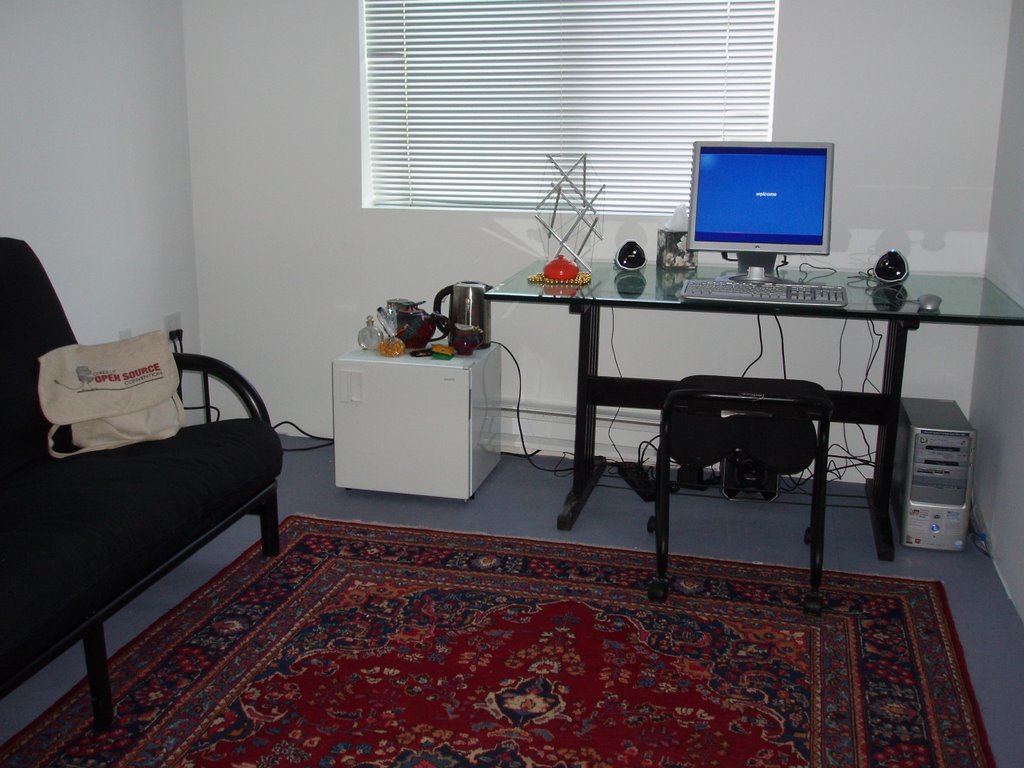
Dawn's new workspace is coming along nicely. We went from an empty room with a utility sink to a functional office in just three or four days.

She's recycling old props: the desk from an area center garage; the rug (on loan); the small refrigerator; the kneeling chair. The metal frame futon and computer are new: I assembled both, while Derek helped with the heavy glass and frame.

The computer, TurningWheel, is a Hewlett-Packard Pentium 4, has a gig of DDR and a 19" flat screen monitor. I drove out to Fry's for it, having seen the Mother's Day ad in the paper.

The building has wireless, other amenities. Lots of artists and small businesses have set up shop here.

Thursday, May 11, 2006

Memo To Math Teachers

I wrote this memo to math teaching community this morning.

Based on prior experience, I expect little reaction from the USA-based teachers who currently frequent this list. Developing a more sophisticated approach to math teaching, using recent computer technology, is pretty much the furthest thing from their minds.

After all, math through programming is not what the textbooks are about, and textbooks define reality to most teachers. Anything outside of a textbook is seen as just pie in the sky dreamweaving, no matter how much free and open source material is made available via the Internet.

Anyway, I'm not reporting any news here, just more of the same old same old. We've had to learn ways of working around the established math teacher networks and organizations. They're entrenched in their ways and not really relevant to our work.

Tuesday, May 09, 2006

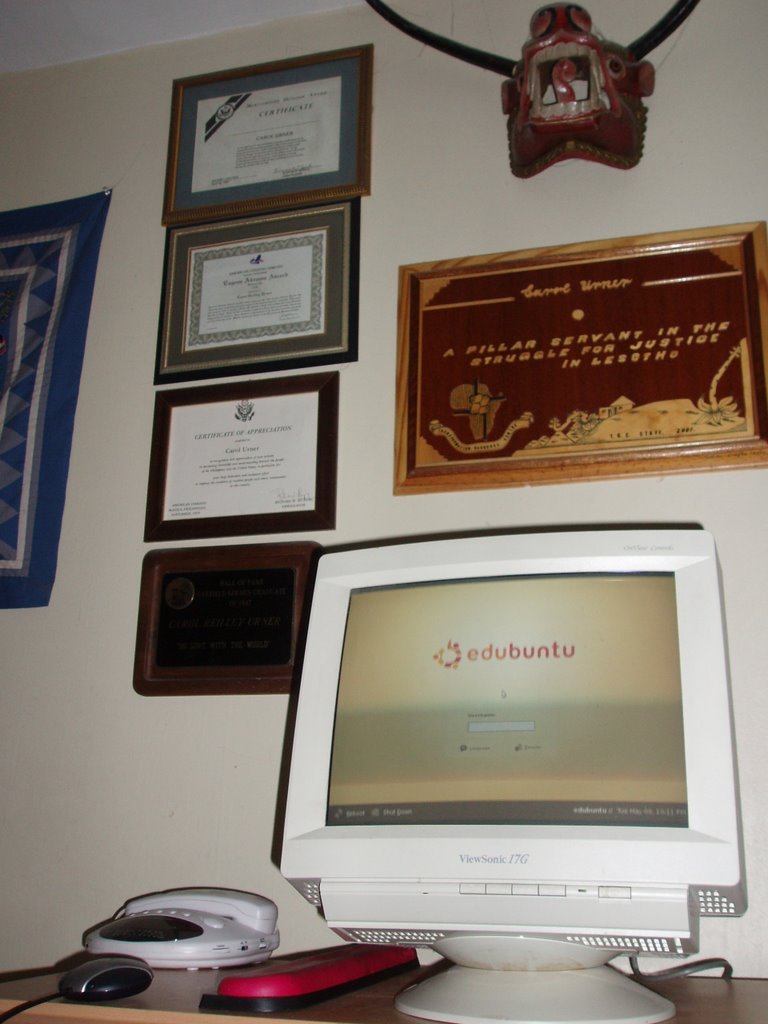
Edubuntu

(click photo for larger view)
Derek lent me an old Compaq Deskpro he bought recently, one of five workstations. He put Suse 10 on one of them, Edubuntu on another, the one I'm borrowing. I've got it set up in Carol's office, which feels appropriate, given all the memorabilia she has from that part of the world, and from Lesotho especially.

Maybe I'll be able to get Panda3D running on this thing. I saw two Ubuntu download options at the web site. Which one should I choose? Answer: breezy.

Screen shot of Panda3d on Edubuntu
Carol Urner's Office
(by K. Urner, Olympus Stylus 500)

Sunday, May 07, 2006

Making Coffee

I got this new Starbucks coffee-making appliance for Xmas, from me to myself (with a loving endorsement from family), which I've just stoked with Celebes, a favorite bean.

Earlier I met Mark, Don's friend and former student based in Guatemala. We three plus Micheal Sunanda watched An American Haunting this afternoon, which I'll likely review one day soon. I'm biased though, having always been a big Sissy Spacek fan (good seeing Sutherland again too, liked him in JFK among others).

Yes, I saw that front page article about the beautiful mind guy in Rm. 114, busting his brain to become famous. Checked into his stuff. Didn't see many hexagons (Glenn Stockton, on the other hand...). Maybe he'd like to present to Wanderers some time. Information gets lost going through newpapers and web sites, useful though these often are at providing valuable perspectives.

[ pause to pour coffee, chat with Dawn ]

I was telling Mark I think a problem with USA culture is we don't accept aid workers from overseas, think our job is to only export basic expertise.

Think of this SNL skit: zoom in on some cute uniformed Chinese girl, propping up an SWI (slumped while intoxicated) in some Gotham, USA. "What are you doing?" the curious camera man asks. "I'm assisting a victim of western capitalism" she replies calmly, and flashes her badge: Communist Chinese Peace Corps. Scream!

Anyway, you get my point. People are way paranoid here, don't want to get any help, just give it, even where it ain't really needed (at least, not in the form offered).

Related reading:
A Discussion of Human Capital Flows Through Semi-Permeable Membranes (paraphrase) by some Yes Men at The Onion (May 3, 2006 | Issue 42•18)

Friday, May 05, 2006

Lucky Lab

So I just rushed back from this brew pub, a meeting of POSSE, where the governor of Oregon made a brief appearance (David Pool, whom I know from our CollabTech days at FreeGeek, pointed him out to me), and Erik Sten, a local city council member now running for re-election.

Erik shared for a good half hour actually, taking a question from me about industrial sector zoning of the east side hugging the freeway. Would a "think tank economy" featuring such as the London Knowledge Lab, but Portland's, be apropos?

Erik thought that'd be a swell idea, matched his own vision quite a bit. And no, I'm not forgetting his "render farm" idea either.

A TV camera with a separate boom microphone showed up later, during the presentation on open source business models. People got more intelligently talkative. I thought we cut a great tape.

I'm burning Sunanda CDs from a master at the moment. As yet I have no clue what he shared on KBOO last night. Funny hippie psychobabble is how he characterized it, in the minds of his listeners at least.

Later:

I purchased Chinese food from Fujin, rented Sister Act and Sister Act 2 from the nearby Hollywood Video for Dawn and Tara, and picked up medicines at the Fred Meyer pharmacy. My hope is to visit with Jon Bunce (a Wanderer and musician) later this evening.

Dawn spent much of the day working on her new studio space, which is rather near to the east side Lucky Lab.

Wednesday, May 03, 2006

General Systems Theory

Certainly economists compete with one another to become stars in their own field, but the discipline as a whole still suffers from a monopolistic mindset. When it comes to fixing spending priorities, economists still seem to think there's only one game in town, namely Economics.

General Systems Theory aims to compete with Economics, by covering some of the same territory with a newer map, sort of the way astronomy gradually took over from astrology, when it came to such challenges as putting humans on the Moon. We needed to be more scientific, more deeply appreciative of nature's role. GST owes more to ecology than economics.

Contributors to our field include Kenneth Boulding, Ludwig von Bertelanffy, James Schlesinger, Barbara Marx Hubbard, R. Buckminster Fuller, Jack Urner and myself (plus many more).

For further reading:

General Systems Theory: Brainstorming New Scenarios for our Global University (Oct. 1996)

New Circuit Designs for Motherboard Earth (CyRev Journal, Issue 3, 1995 etc.).

Sunday, April 30, 2006

The Kennedy School


Thursday, April 20, 2006

Back at the Zoo

I descended a flight of stairs to discover an austere table, board member names in plastic shields, LCDs on tripods on either side, heralding the event: a Saturday Academy fundraiser, a time to be generous towards tomorrow's Oregon's daughters and sons. I sat at a round table (21), flanked by staff, with the Alien Landscapes instructor, and an OPBer. A mother and baby were also present.

Joyce Creswell set the tone, by invoking SA's 23 year long history -- coming upon a quarter century here. In these parts, 23 still counts as old, because our Silicon Forest is young, even though some of our oral traditions trace back to eye-witnesses to Mt. Mazama's decapitation (now she's named Crater Lake, and she's a deep one). My wife was here when Mt. St. Helens blew.

Illustrious captains of industry followed. Our area is endowed with talent, let's pass that on.

This is the same room I'd come to for a few CRIME meetings hosted by George Heuston of HPD, back closer to the time I was teaching at West Precinct with Jerritt (Mr. Linuxfund.org back then). We'd only need the rearmost partition, and mostly did projector presentations about patterns of IP use (many applications register, bittorrent especially), or abstruse lectures about cryptography.

Sam is chauffeuring for his sis (my wife), is also a pro poet.

We celebrated mom's 77th at Sweet Tomato last night, one of Tara's favorites. For her birthday, mom let me buy her any Laughing Horse book of her choice, and she chose Hitler Youth from Scholastic, about what it was like growing up in the shadow of Nazism. The resulting picture is comically surreal.

I also procured (and installed) those prayer flags (Guru Rinpoche was one of those incredibles I learned about on visits to Bhutan), plus watched that Squeakers DVD (thanks Kim), my two blog-announced goals for that day; plus I got a lot of other work done as well.

Friday, April 14, 2006

Shuttleworth Summit (day two)

Checking edu-sig this morning, from the hotel lobby (Guido is in the chair next to me); André is proposing rur-ple as an alternative to Logo while Ian blogged about his PyLogo.

We had a fantastic dinner at E&O last night. Gunner turns out to be a bigger country music fan than I'd realized.

Today's planning looked at timeline, tools, and content.

A first pass: develop in a fish bowl, in showcase settings, with others invited to adopt and adapt (within three years?). Second pass: package the "final product" for wider dissemination (within five?).

On the tools front, a key question is whether we're tying this project to any major specific software development effort.

Loosely coupled tools, with a bottom-up, open source curriculum writing process, will leave the question of tools somewhat open-ended. The lesson plans will specify the software needed, with multiple paths possible.

Will we eventually have some sort of Python-based hypercard-like browser plug-in, facilitating easy publishing by students and incorporating what's already worked well in Squeak? If yes, then so much the better. Peers i.e. teachers (including the more advanced students) will write lessons around it.

The content will translate a mind map of the whole ten year topics network to a repository of lesson plans, with lessons sortable by how technology intensive they need to be. The content will mostly assume some minimal level of infrastructure: a computer lab with or without the Internet for example. At the topical level, this curriculum should tie to the national standards, to facilitate widespread adoption.

We blitzed through a few five minute lightning talks, featuring South Africa's performance stats in TIMMS, primitive Logo in Javascript, Squeak, a book on Squeak, the Scheme approach to designing programs, a 2D dynamic geometry project not unlike PyGeo in 3D, and me on Python, doing a very abbreviated version of what I showed the London Knowledge Lab on Wednesday.

Robyn encourged me to look at what a contemporary Logo looks like. The slickest stuff is neither free nor cross-platform, even if it runs in a web browser.

Momentum seems to be building for a stronger graphics engine, either 2D or 3D, with Python bindings, that'll run interactively from within a browser. The Squeak folks may be willing to contribute to this effort. Guido feels we'll need to recruit new talent for this, as the Python community is currently pretty maxed out on projects. Should such an engine be developed, turtle stuff would be incorporated therein.

Thursday, April 13, 2006

Shuttleworth Summit (day one)

Our plan is to write the next generation curriculum for the Shuttleworth Foundation's vision, and a process for doing so. Nineteen of us are sitting around the table, one is taking the official notes (mine are not official). The essentials have been provided: coffee and tea, wireless.

Mark
: How do students develop communications and analytical skills and how might technology catalyze the aquisition of these skills?

Problem: mathematics is increasingly failing to hook kids' attention, with new math teachers ever harder to recruit. Yet technology is invading the education sector, plus students are spontaneously attracted to technology. How can we capitalize on both trends? How might we continue to deliver analytical capacity in this climate of declining interest in traditional mathematics learning and teaching?

There's no time to retrain the teachers, so the model should implement a peer-based system, wherein students are expected to mentor other students.

Mark's current vision is to start kids with Logo, then maybe move on to Squeak, then Python. That's a rough first take. We have the Scheme community represented at the table as well.

My comment: if there's a lot of broadband in this picture, access to technologically literate teachers shouldn't be the bottleneck. We can project video clips at will, including of talking heads, and about any topic. So it's not like there won't be a variety of adult role models presented. Even live interviews are possible. Guido: assuming the presence of broadband or a projector may not be realistic. Mark: pervasively only in the long term. May we at least assume an ability to play DVDs, and to burn them? Yes.

Other comments: we're talking about acquiring identity, not just skills, which relates to language and a cultural context. What is my role in the community, what are my community's values? The concept of "literacy" covers this, in that becoming literate involves creating one's life story. And this doesn't just happen in schools, especially given the Internet.

Let's focus on the analytical component, the mathematics. Computers enable kinds of mathematics that's difficult to do in other ways. And let's enlarge the analytic to embrace the sciences, which adds the modeling dimension, makes the math stories be about reality. Purely analytical capability may be perverse and/or shallow if not grounded.

Alan Kay pointed out that a curriculum needs to include powerful ideas, not just turn students loose, expecting them to reinvent the calculus. Developing problem solving skills must include exposure to powerful cultural inventions. Cultural memory is important.

Alan sure talks about the 1960s a lot. Guido expressed some frustration with that.

My suggestion: set up test beds, modeling existing and expected conditions, and develop curriculum segments in the field (the test driven development model). Implement a prototype branded curriculum in a pure form and let others copy what works. I'm hoping to avoid this pitfall: something imposed top-down on unwilling participants results in backlash and sabotage, or simply a diluted or distorted version, giving ammo to the curriculum's enemies and making outcomes hard to measure.

Alan thinks being able to script without having to type is super important, plus he wants a media rich experience, not just a turtle. He also advocates the one wireless laptop per child model, meaning you get to take them home. His emphasis is consistently constructing a "world" for children, some customized multimedia GUI ala Squeak, although he thinks this could just as well be done in Python. Alan is a big hypercard fan and is aware of the PythonCard project.

I'm especially skeptical on this last point. Let's focus on a distro perhaps (like edubuntu) but not over-integrate the environment to make something more seamless then necessary. Leave the environment heterogenous, more like the real world. I'm also finding that IM (instant messaging) motivates somewhat older kids to improve their typing skills.

I sense a tension between inspiring teachers versus bypassing them. Probably what we're doing is pioneering an open source culture devoted to curriculum development (not just software development) which includes and inspires some teachers, but leaves others feeling bypassed -- a typical outcome, not really a problem.

What Alan and I most agree on is the need for Wikipedia type content to mix with an interactive component. He showed me his recent Javascript implementation of Logo. I'm reminded of our ability to create interactive "labs" in the J language. Python needs a more developed interactive teaching module: show some stuff, give students a command line, show more stuff, and so on.

Lunch activity: demo of LAMS by its author, James Dalziel. Good use of chat rooms to facilitate peer to peer communications.

The breakout sessions were on the following topics: landscape 2010 (what will the ecology be like?); implementation of innovation (how will these new memes spread?); the role of the teacher in this new technology-based curriculum.

The landscape group expects at least a computer lab in most schools. We can't assume students will have access to a computer at home.

The implementation group is faced with a somewhat monolithic set of scored national tests, and debated what balance of collaborative vs. subversive tactics would work best. Recruiting teachers would involve empowering them as peer contributors to a lessons repository.

The teacher's role group assumed universities would help with teacher trainings and managing the courseware repositories. Shall we hold on to the notion that teachers must "know more" than their students, in order to be effective?

Coffee break. Warding off jet lag.

A branded distro, like edubuntu, with built-in links to further resources (LAMS workflows, moodles...), would give users access to a shared open source culture of curriculum development, not just software development. As a peer, I'd be patched into an ecology, a network, as I am now, but with more people self-consciously contributing. The ecology will feature many competing brands, not one monolithic sequence. Some curricula will be more tailored to specific national, regional and/or company standards.
Friday, April 07, 2006

V for Vendetta (movie review)

This film draws inspiration from Orwell, plus from all too familiar fascist "reality TV" fashions. Oppressive government is a nightmare and leads to dark paranoias, often leading to mass uprisings. This sequence gets played out over and over again, never exactly repeating. Like 1984, Vendetta goes ahead and simply maps to some future distopia, vaguely (or not so vaguely) extrapolating troubling trends in our own time.

It's also Beauty and the Beast, a genre I've not specialized in, although King Kong was an eye-opener. V is certainly a monster, and for 20 years has occupied himself plotting a delicious revenge against his torturers. Then he meets the girl, and the whole grotesque fantasy becomes surprisingly back burner.

But he goes through with it anyway; it's all he knows, what he's scripted to do. Then he hands the baton off to a next generation (to which this girl belongs). There's love between this girl and another girl too, under the masked one's auspices -- very complicated, yet touching and real (I couldn't believe those idiot parents disowning this most beautiful daughter, plus passing on getting another one).

Dawn and I saw it together. She said "a little more gratuitous violence than I like" and I got it. I took the whole thing as a sick and twisted fantasy piece, a simulator (OK, a wardrobe). And the product of a feverishly fertile UKer imagination -- they really know how to make 'em, those IngSoc types. Actually, we're talking Wachowski brothers, of The Matrix fame. Definitely a bold contribution to the literature.

Wednesday, April 05, 2006

Today's Networking

Today I'm busy working with Erica at Associated Oregon Industries (AOI) on improving their database program (inherited Visual FoxPro code which I've mostly rewritten by now).

I phoned Multnomah County to reschedule jury duty once again, this time for mid January 2007.

Dawn is having many high level discussions with her care team. She's the kind of patient many doctors like having: she takes it straight, unvarnished, yet with sensitivity and grace. Her professional care givers, in both eastern and western traditions, are among her biggest fans.

I'm planning to take Tara to AAA after school; we need to get her passport reactivated per family overseas travel plans. I really want to show them Italy, Rome especially (many favorite boyhood haunts). We've ordered a copy of her birth certificate on-line, after not finding our earlier copy. I'll also pick up a map of London, and maybe of the southwestern USA (Dawn's hoping for a bizmo trip).

I swung by the Linus Pauling House on Terry's invitation to meet with our ISEPP guest, Dr. Ulanowicz, and maybe listen in on some fun conversation. Apparently Wanderers had invited him to lunch some place (I found evidence of a meeting in progress). Given time constraints, I elected to scrawl a "Kirby was here" on the board; I'll hope to catch his lecture tomorrow evening.

Dawn ordered, and I picked up from the vet, a new bag of Moon Kitty's special cat food.

Arthur Seigel and I have another interesting thread going on edu-sig, which again explores the nature of my commitments and investments as a Fuller Schooler.

Hugh Watkins, the Copenhagen-based fellow student of Wittgenstein's philo, excerpted some recent Kirbiania about Wittgenstein in his blog (link).

Nick Consoletti is staying in my basement again. He wants me to write a recommendation for the Design Science Lab, which I currently know only a little about and am not involved with. I have no problem recommending Nick though.

Sunday, April 02, 2006

Wittgenstein Again

I wrote a more comic book version of this, but let's try to be more serious. The work for which Ludwig Wittgenstein (LW) first became well known, as the miracle-spawn of Bertrand Russell, was the pretentiously titled Tractatus Logico Philosophicus (TLP). Except this wasn't so silly-sounding for that day, as Latin still connoted authority, as did the flat hats and gowns, all the gothic surroundings of a dark ages cathedral. So the TLP fit right in, as more organ music.

Over time, however, LW became disillusioned with his tone in the TLP. Yes, it was a lot of clever, glorified nonsense, which hooked the reader mainly on its aesthetic merits, but it was also too grandiose in retrospect, too full of the author's own vanity, perhaps for having mastered the logical crypticisms indulged in by the school masters of his day, and since superseded by electronified gate logic.

So the next generation philo (published posthumously as the PI) would be pretty much devoid of these crypticisms, even if the transition to patent nonsense was still a goal (same joke, just better told).

In calling both works "a joke" I'm not attempting to deride or dismiss them in any way, which is why I think the link to Japanese style Buddhism tends to work, in that the Zen koan is likewise a relic or spin-off from trying to say the unsayable i.e. trying to point to the inside of Plato's Cave (as if it were just another concept, with convex and concave features).

In Fuller's philo, we're connected by this Void to his ongoing definings within an eternally aconceptual nonsimultaneous and only partially-overlapping scenarios Universe (or call it a centers network, with local spacetime coordinates in the eye of the beholder).

You don't get to take the world's snap shot and have it remain faithful to the original for long, not even with a beautiful logic. We have to keep working at it, ever refining and polishing our communications to better fit them within the backdrop of our present day (or private sky).

Thursday, March 30, 2006

From a Cube in Nashville

I'm sitting in a large cube in Nashville, Tennessee, waiting for rush hour to finish. Earlier today, I committed some autobio to the Math Forum, talking about my post Princeton years (early 1980s).

We visited the Nashville Zoo this afternoon. Lots of families had the same idea (great weather, no school). Many of the exhibited species had "vanishing animal" icons on their plaques. We'd like to turn that around of course, hence my placement of the elephant clipart on my GST poster (in case you were wondering).

Saturday, March 25, 2006

Gnu Math

This is a pun on "new math" (aka SMSG), developed within the cold war context to prod more Americans into a space age frame of mind. The Russians had launched Sputnik and paranoia was running high.

GNU = GNU's Not Unix, Richard Stallman's coin for a Unix-like command line environment, coded from scratch. Gnu Math integrates mathematics with a command line aesthetic, providing future Morlocks with tools of the trade.

For example, Pythonic Mathematics integrates algebra with OOP (the object oriented paradigm), a basis for many of our world game's models and simulations. The USG first got behind Python with its DARPA funding of Guido's CP4E initiative.

The civilian public education system was slow to catch on however, given the ideological priorities of a parasitical political machinery, which used the spectre of terrorism to keep Americans in a state of fear.

The Internet, also originally military, helped Americans develop antibodies to this parasitical ideology.

Thanks to the Internet, Gnu Math continued to make inroads, assisting the engineering community in its efforts to debug and restore integrity to a corrupted USA system.

Tuesday, March 21, 2006

Identity 2.0

My topic this morning relates to a talk I heard at OSCON 2005, from the main stage, by Dick Hardt. His brief: we need identity servers that authenticate to the various services behind the scenes, so we don't have to always re-enter the same stuff. Identity management would become the identity owner's responsibility. Having it all gathered in one place would actually make its theft much harder, as you couldn't get by with only fragmentary data, e.g. just an SSN or credit card number. Banks would "go to the source" and any hack of an Identity Server would be national news, not just run of the mill fraud, a cost of doing business.

Speaking of identity, I've been trying on "Silicon Forest exec" for size. I think that pretty well sums it up. I wrote to Allegra yesterday that I didn't want to be on BFI's Shelter Committee just now, not because I'm anti-shelter (duh) but because I'm trying to clarify my role in the World Game theater. I'm like this computer geek with aspirations to invest more in multimedia (4D Studios), out of my desire to craft some dynamite curriculum for future Silicon Foresters (no, not exclusively).

In order to pass along this culture, a thriving one, we need to leap frog various bastions of Ludditism, including, I'm sad to say, within the education sector itself. Too many teachers feel trapped in dead end jobs, and take it out on their wards.

In particular, I'd like to see a stronger curriculum served through the Pentagon Channel, as I think military investments will make a huge positive difference, if there's real intelligence behind them. The paramilitary gray zone between hot and cold war, is also the zone of disaster relief and emergency management. We're looking to economize through dual-use technologies. The same Fly's Eye Dome skeleton could contain a variety of hardware and software.

A military that knows how to perform civilian duties provides a stronger career path for would-be recruits, as they won't be irrelevant deadweight in peacetime. And for conscientious objector types, a purely civilian trajectory might be plotted, such that if war breaks out, they'll be tasked with the sometimes extreme services our nation has historically required of its peace-loving leaders.

Thursday, March 16, 2006

Taking Stock

I taught Python @ WHVN again today, focusing on nested data structures e.g. how to index into a dictionary of some USA and Canadian cities, each with lat/long coordinates expressed as a list of two 3-tuples. Here's the worksheet we used (PDF).

Kessler
has his Common Sense II pilot in Google Video, per my suggestion, bringing the count of Buckminster Fuller clips to five. For a bigger stash, check the EIK site [defunct -- Feb 9, 09].

Search results on Polyhedron/Polyhedra within Google Video still returns zero, nada. Of course I could change that, but I want to measure the Ivory Tower's level of commitment to supplying relevant open source geometry clips, sans my input (drumming fingers, twiddling thumbs). Princeton? Anyone?

Our USA military families are expected to fight and possibly die for their country, with kids expected to part with their parents, perhaps permanently, and yet what support do they receive in return, in the form of relevant education and training? Precious little. Their own American history and heritage is being denied them.

So how is this not tyranny then?

[Addendum, February 9, 2009: up to about 372 Google Videos with "Polyhedra" in the title, 291 on YouTube]

Monday, March 13, 2006

Back @ Wired

So I'm back to my usual haunts in Portland, having returned from haunts near Remote, Oregon.

I liked what Bob Scheiffer said last Thursday (?), about working to earn our trust, not taking it for granted. This Mens Retreat was like that for me -- I had to work building relationships (work I enjoy doing). We had a lot of new faces, plus many more familiar ones (e.g. mine in the mirror), and a lot to communicate, from each to many.

I did a good job anchoring my network I thought, but it's a somewhat nebulous network and I felt it taking me out of the room on occasion. I have so many to check in with. And I know I'm not the only one with big responsibilities (duh).

Fortunately, good Friends like Tom Head are out there doing a lot of checking. He got to the Dan Rather gig in Portland, reported back, and to China for a high level meeting on military matters, goes to London, Philadelphia...

He's an economist, Tom is, based at the nearby George Fox University. Tom couldn't make it to the retreat this year, as I couldn't last year, because he was off traveling some place per usual.

Anyway, I'm glad Larry was around. We talked iTunes and iPods (he had a new nano) -- plus I showed him an excerpt from Yes Men (the "leisure suit" segment), a DVD I purchased and sometimes screen on my laptop or otherwise project e.g. when I'm wanting to share about my GST brand of economics.

This money talk reminds me: I need to be on my way, delivering some pay checks to a client for TBC. Derek is supposed to meet me here; the barista was busy when I arrived, so I don't even have a coffee. Maybe when I get back, it'll be time for a Guinness.

Over an hour later:

OK, so I met up with Ron Braithwaite, tooling around town in his new biodiesel VW. He wondered about lunch and here we were, in front of Than Thao near the Pauling House, so we ordered V8 and V9 respectively.

Derek looked after my Toshiba back at Wired (his is a Compaq), drinking coffee, waiting for Joan.

Ron is steeped in Apple tech these days. If he succeeds in today's mission, Tillamook Creamery should be a beneficiary (Helvetica fonts lady). I was glad to meet up with Ron, who also missed our Men's Retreat this year.

I just got a call from Bernita about a death in the family (from natural causes). My heart goes out to the grieving.

Friday, March 10, 2006

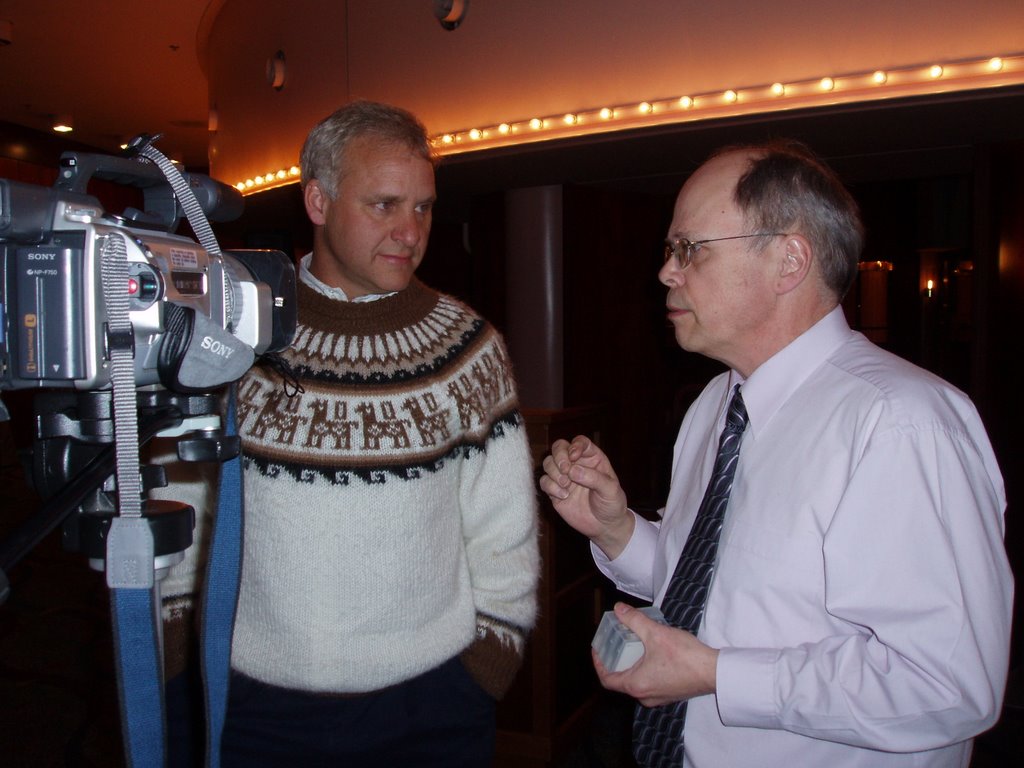
Candid Camera

Art Kohn and Terry Bristol
ISEPP dinner for Roger Penrose
(photo by K. Urner)

Thursday, March 09, 2006

More from Quaker-P (revised)

So if the prez wants to advertise why a line item veto might be useful, now would be a good time. You've got a Congress happy to cave to mob anti-Arab psychology, and tacking its deal-killing legislation to a continued funding bill for the war in Iraq (oldest trick in the book -- bind what a president hates to what a president most wants).

The prez could say "OK, I promised a veto, now here it is" and then "I guess that means no more war in Iraq huh?" Troops start coming home, the UAE closes harbors to military shipping unless it's to take hardware out of the region (with other harbors to follow), and we celebrate the re-emergence of civilian control over the Pentagon.

The Pentagon would be only too happy to leave anyway, as what Iraq needs is better civilian infrastructure and more police of the non-death-squad variety. American boys are starting to get cynical about any bright future in the armed services and that's bad for recruiting (helping tsunami victims, on the other hand, made our boys into heroes being all they could be -- girls too).

If you can't back up that noble-sounding rhetoric about defending the Constitution, freedom, democracy, with logically consistent on-the-ground activities, well, that hurts both prospecting and recruiting -- even given the devastation in New Orleans and a compliant not-lifting-a-finger FEMA (yes, if civilian life is made miserable enough, the recruits will keep coming, having nowhere else to turn).

Back to Coalition TV: we've got John Bolton at the UN feeling "a sense of urgency" around Iran's low-level defiance of the IAEA. Iran is at least dimly aware that a nuclear superpower has invaded and occupied the country right next to it, on false pretenses no less (forged documents from Niger, accompanying hype from Cheney). Americans, on the other hand, are busy watching Survivor (so-called "reality" TV) and resent the distraction.

We already know that the UN hasn't the backbone to stand up to the USA's neocons (a principle established in round one) so I can see where Iran's defiance might enter the equations.

Anyway, since when did the Pentagon have any say in this war? The whole show has been out-sourced to beltway bandits like Raytheon, home of the cruise missile (ka-ching) and "no connection to Cheney" Halliburton.

Some days I wonder why we even send journalists to that 5-gon any more. Who even buys the myth of "an American people in control"? Nakedly imperialist aggression is the "way of life" we must defend nowadays. Like, what's the fun in being the only superpower if they won't let you flaunt it?

====

OK, time to go teach Python to 8th graders. You might think I take a dim view of Americans, given my rhetoric. But of course I'm eagerly investing in a bright future for our kids, which means I'm busy giving them basic survival skills, like computer programming (very needed in our urban jungle these days). See my Bizmo Diaries for more info.

And so what are
you doing to help America today, if I may ask.