Wednesday, November 12, 2014

CitizenFour (movie review)


Big slow-moving bureaucracies that can't do their own thinking are easy targets for the faster thinkers, human individuals, brains with integrity, geeks or what have you.

The NSA is easy to crack and spy on, its mostly military-minded leaders none too bright and none too keen on protecting the Constitution, which they most likely know little to nothing about.

Google is easy to spy on as well, as is Verizon.  These companies have little to no ability to protect against serious investigative reporters, let alone geeks.

The table-turning of Wikileaks etc. is obvious:  the real intelligence community owns the unimaginative bureaucrats, the laughing stock victims of professional spying.

No, I'm not saying Snowden was a criminal, guilty of espionage.  Like Manning, he's a bright kid who wants to uphold and defend democracy.  He thinks for himself.  Unlike most generals.

So what do we learn from "spying" on the NSA: that most of its people are average Americans e.g. they get along to go along and aren't particularly principled.  So what else is new?   The technology is new.

I remember researching "PGP guy" (Zimmermann) versus Bobby Inman (then head of NSA).  Should ordinary citizens have a military-grade skill set?  The opportunity, the freedom to have that, is what counts.

Organized government, like organized religion, says no.  Who asked them though, right?

Anyway, PGP plays a role in this movie, as does encryption as a general theme.

This film could be shown in high schools to:

(a) inspire patriotism and respect for geeks and
(b) motivate more learning of maths, crypto in particular.

I saw it with Carol and Melody at Living Room Theater #6 in downtown Portland, a couple blocks from the main Powell's.

Saturday, November 08, 2014

Martian Math


1 x 1 = 1

2 x 2 = 4


3 x 3 = 9


3 x 2 = 6

Tuesday, November 04, 2014

Wanderers 2014.11.4


David Chandler was our speaker tonight.  He's made a name for himself in 911 circles by proving, fairly persuasively, that WTC-7 fell "at the speed of gravity" meaning "controlled" demolitions were happening, in addition to crashing airplanes (no airplane hit "WTF-7").

NIST in its final report agrees WTC-7 was in free fall for over two seconds.  The North and South Towers had their own pathologies.

The Twin Towers were certainly alluring as a symbol of cogitation, including to me, in nearby Jersey City for some years, a high school math teacher.  I was taken up with the plight of Tibet and seeing office towers as a place for "virtual nations", like corporations, to base themselves.

My fantasies tended toward offices of the Dalai and Panchen Lamas in respective towers, maybe goofy but I thought poetic, given the imposing nature of the towers.  This was before the family relocated its HQS to Bhutan.

Were one to dig up my crudely hand-drawn comic books of the day, the Twin Towers in silhouette would show up on various pages, and one might imagine I had nefarious designs.  The designs were benign however.

I'd ride the PATH train from Jersey City to WTC quite often, Manhattan's Penn Station even more often.  I had other designs as well, our family (dad in particular) having "planning" on its resume:  for a high definition Dymaxion Map billboard on the back of Loew's Theater (near my house); a rail spur to Newark Airport (like Portland's MAX to PDX); an IMAX in The Stanley.

JCNJ_planning

:: big dreams for JCNJ ::

When 911 actually happened, Dawn and I, in Portland, Oregon, were expecting a wedding anniversary, which it was, but not one of the normal kind obviously.

As a matter of logic, one cannot conclude from evidence of an intentional demolition that hitting the button on the buildings was long planned for that day, even if there was such a button.  How many more would be saved versus burned alive?  So many were leaping to their deaths, would that be going on for several days then?

Would helicopters and long ladders have made it all better?  Viewers would have felt moody and blue watching all that dying day after day, not that they weren't moody and blue already.

The "mercy killing" theory is the antithesis of the "part of the same assault" theory.

In between is the "needed to do it there and then for insurance reasons" theory.  Only the "coordinated assault" scenario really requires pre-planning.  Other scenarios require quick judgement calls one may question in hindsight... and a button.

Depending on the theory, different groups get to push the button.  Bin Laden pushed it?  Yeah right. Not enough is made of Bin Laden being the construction company.

The idea a building of that size would need to come down someday, so would be pre-wired for self destruction -- seems like a good idea at least.  Nothing lasts forever.  I'm not sure you'd need to sneak around adding explosives later.  Paul Laffoley's story suggests otherwise.

Sunday, November 02, 2014

New World Order

Whereas the financial press may date the end of the US as we know it to the 1980s, when terminal bankruptcy was trumpeted as a sign of bogus immortality, the layperson on the ground is more likely to date the desovereignization process to the breakdown of borders in the Middle East.

As of 2014, no one really knows where the borders are among the former nations of Syria, Jordan, Israel, Palestine, Iraq and so on.  Political maps survive, showing snap shots of various people's belief systems, however the credibility of such was draining away from the 1940s onward.

Ironically, a chief catalyst in the breakdown of the nation-state system was the Pentagon's "strategy" of bombing whomsoever it pleased in the No Man's Land around Afghanistan-Pakistan.  The cruise missile and later drone attacks were corrosive of the whole sovereignty concept and softened up that framework for eventual garbage collection.

Of course Romans did not really know Rome as an Empire had "fallen" on any given day.  Those narratives get invented later and only hold water through repetition and agreement, as stories are much more than necklaces of facts strung together.  The infrastructure of passports, customs, import / export taxes and so on remains, especially in areas where borders are enforced.

The end of the nation-state system happened first on paper in the back office, where those in the know were holding high cards or at least knew what a "high card" was.  Then "border rot" propagated by Pentagon policies, helped the world's "average joes" come to terms with the fragility of the entire nation-state framework.  Life would go on amidst the rubble of once proudly recognizable jurisdictions.

Thursday, October 30, 2014

Gothic (movie review)

In this obscure Ken Russell film, a bunch of over-privileged white people with servants to wait on them and nothing important to do, drive each other crazy in various ways, only to return to "normal" when the sun reappears.  Lord Byron and company, but no Ada.  I'm hoping for more movies about Ada.

Tuesday, October 28, 2014

Hash Tag M3

Probably #M3 won't catch on, certainly not right away.

Even our Clerk of Communications is not into Twitter and he's at least a standard deviation ahead of his peers when it comes to navigating around in Cyberia.

I expect #MMM will be far more popular, once more of us start using Twitter.

As NPYM Technology Clerk, I should role model how we do things in Twitter-ville.

:: in my twitter profile ::


:: going out to subscribers ::

Monday, October 27, 2014

Fall Fashion

I've been working on this look for awhile.  This is a different hat, a present from Glenn.  My Paul Kaufman original has gone missing again, maybe will show up on eBay someday.


Wednesday, October 22, 2014

Libby, Montana (movie review)

This almost-two-hour documentary does a marvelous job showing the story from Libby's angle, where the workers gradually put two and two together and realize this deadly asbestos they've been hearing about is actually the stuff they've been mining but branding as vermiculite or something else cute.  The stuff is everywhere because for awhile no one thought lung science could possibly matter in the rock business.  Kind of like H-bombs can't be bad for ya.  Or smoking.  Live and learn.

Anyway, what's missing are the board room meetings at W.R. Grace where the limited liability nature of the corporation kicks in.  That's what keeps little old ladies from losing their life's savings because some venture goes bad and all the sailors lose their lives at sea.  You may not get that box of chocolates, $100 wasted, but if you do, each bonbon will be individually worth $100, the proceeds all yours to keep or divvy among friends per your temperament.

That was the promise to English nobility:  risk ten sheep, reap a fortune, or at worst, lose the ten sheep.  No one comes banging on your door for twenty sheep.  There's a cap on your liability equal to the amount ventured.  That's what Inc. means.

W. R. Grace needed to reallocate resources to selectively bankrupt the Libby subsidiary, then block EPA from locking up lucrative contracts, in case a clean up ever was approved.  Meanwhile people were dying but there's no real cure for asbestosis anyway so that was already a write-off.

These were more good soldiers of capitalism, risking their lives for their labor in their capitalist sea, and reaping the rewards:  early death from complications associated with one's job.  Grace management died on the line as well, this wasn't just union men.  Whole families got it.  Asbestos is no joke.

Tuesday, October 21, 2014

Trains We Might Like to See


Sunday, October 19, 2014

Mycology Festival


I'm super-uninformed about the fungal inhabitants of Planet Earth, in terms of their names and ecosystem niches.  That doesn't mean I don't find them fascinating.  Given Christine is a professional photographer of same, i.e. makes a part of her living selling beautiful pictures of these guys, I was happy to use that as an excuse to pay a visit to Miller Hall, a part of the World Forestry complex near to the Oregon Zoo (shares a parking lot).

Indeed, parking can be a problem in that lot, so if you're a tourist or smart Portlander, consider parking below in Goose Hollow or nearby and visit Goose Hollow Inn for some fine local fare (I had Country Boy IPA).  Then hop the Max for one stop and study the quirky yet excellent timeline made from a core sample drilled as a prelude to carving this deep tunnel Max station into hard rock.  The elevators will take you hundreds of feet, to the surface.

Patrick, a co-worker, was on an independent health hike from Asylum District to the zoo.  I used my Max ticket to revisit Goose Hollow Inn to meet him for some Sunday Headless Chickens (Bloody Marys).  We rejoined the Mycology Festival and I sampled yet more of the exquisite shroom-based miso the Culinary Institute was serving.

The Pacific Northwest is haven to a large number of fungal species, so no wonder you have a legion of shroom-heads out here.  The festival was well attended.  Hugely knowledgeable experts were on hand, to identify specimens and give advice to hunters and collectors.  Again, I'm quite on the fringe of this subculture, but I appreciate the well-organized event.  The white square worked fine when swiping my card.  Encouraging.


Wednesday, October 15, 2014

Reminiscing About Conferencing / Software

GOSCON 2010
:: Steve Holden, GOSCON 10 ::

Speaking of Quakers, a long term low priority topic (in the sense of non-urgent), is do we want to open source any of our PHP + MySQL LAMP stack stuff through NPYM (where these are most used).  I'm suggesting moving slowly, in light of how specialized and esoteric our needs in the first place.  An adequate needs assessment has not been done.  Open sourcing is not the first step but a much later step in a longer process, as I have been underlining in committee / subcommittee threads.

I was NPYM Registrar at least one year, passing the baton to Dave Fabik as I recall.  That was in my FoxPro chapter, a language since discontinued, though still popular in Prague they tell me.  Actually the USA is full of FoxPro adherents and I don't mock it in any way.  Serious applications that do heavy lifting were my bread and butter, from camp registration to food banking to hospital data collection work (in tandem with other products -- the camp stuff was in dBase not VFP (they're all called xBase in the lingo)).

Anyway, that was before watching over Steve's shoulder in the Open Bastion chapter, which saw several conferences produced, only some of which I got to be at and observe first hand.  GOSCON was maybe my favorite because so esoteric.  I don't think I'll ever see one quite like that again.  That's where I first ran into Rami Kassab.  Then the DjangoCons were good, ApacheCon... nothing less than top notch, though I'm not a judge of speaker quality, not being a web framework geek (FoxPro was thick client LAN-based, pre-TCP/IP even).

I'm a somewhat peripheral player given IT Committee has a rather narrow mandate at the moment and grand schemes to use Github for anything are far from front burner.  That's fine with me.  I'm more here to grease the wheels for conversation among the principal players than to press for any new agenda.  The wheels were already turning when I got here.  I'm just adding some lubricant and telling campfire stories from my software developer past (now I teach a language, a little different, yet related).

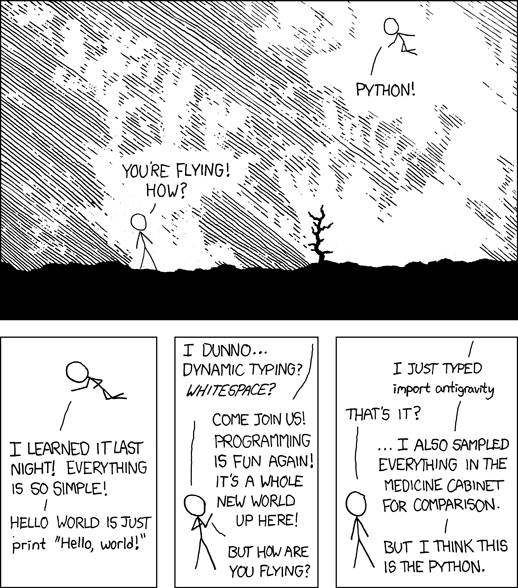
:: from xkcd ::

Sunday, October 12, 2014

Threshing Session

DSCF2653
:: meeting room, Stark Street facility ::

Yes, I'm blogging from the meeting room right now, but like a TV reporter in front of the camera before the event begins.  The Quakers are mostly down at Social Hour, schmoozing, which is what I'd usually be doing, but the hubbub was distracting.

I'm also listening to SomaFM (Drone Zone), probably sucking off Meeting Wifi.  Lew et al have done a good job reconfiguring the building to take advantage of what bandwidth we have.  The laptop is likewise "live", which is why at least the first couple paragraphs were real time.

I'll probably want to put this away soon, when more people show up (only three in here besides me, listening to Lucinda).  In geek world, like at Google, it's OK to keep using a laptop when a speaker is speaking, as remarked upon soon into it by Andrew Bacevich, a progressive Catholic (or so he seems to me).

Now there's no one here but me, when I snapped the above picture.

Quakers are not like Mormons or Masons in having "members only" rooms or rituals.  We have rooms and rituals, inner sanctums, retreats, but non-members are allowed to infiltrate by design, as a way of keeping a check on member honesty.  Quakers noticed from studying history (lived experience writ large) that a "members only" club design leads to abusive relationships, institutionally speaking.  Chuck Fager goes into this at some depth in an adjacent blog posted video.

What are we threshing about?  Depends whom you ask but the Bulletin distilled it down to a little box, so I should grab a screen shot of that:

announcement_threshing

The prospect of losing the PSC committee is exercising (worrisome, anxiety-producing) for many Friends as it looks like a disembowelment, a suicidal act.  The right to have such a Committee was won through bitter struggle so to just give away the store looks a tad cuckoo to put it nicely.

But that's just one angle, probably more prevalent among oldsters like me.  The younger hipsters see a way forward where we all turn to one guy or gal for guidance, or treat as a catalyst or whatever.  I'm hoping to pick up on what the new lingo might be, in the aftermath of such a radical surgery.

My guess is Friends will back away from the precipice and signal a willingness to resume their duties as Quakers (a self identified Friend has one choice: to walk the talk or appear hypocritical).

However, that we've even been to this brink says a lot about us and the State of our Society.

Our upcoming State of Society Report will need to draw from whatever Megge and Rick put together (they're to write some report).  I'll be sending some analysis to Philadelphia, plus blogging here obviously.

I think I'll move to the library now, and take some more pictures.

Marty has a laptop open, so I feel OK for me to do that also.  Good to see Carl, sitting in front of me.  He's clerk of Nominating, which is sourcing this proposal to shelve Peace and Social Concerns.

"Friends do not avoid issues which are difficult and controversial, or complex, or require learning information of an esoteric nature, and threshing sessions help the community get up to speed in advance of going back to executive mode."  That's a paraphrase.  Hmm... I don't see Josh.  I thought he might have a view on all this.

Megge is opening the discussion on whether we agree that the topic is "how best might Multnomah Meeting address Peace and Concerns issues?"

We're back to the water / welling / bubbling metaphor which has been popular in meeting lately, one of our thematic memes.  Catholics go through these.  Seems the topic wording is more vague than what was put in the newsletter.

Some Friends are too upset by the prospect of killing off Peace and Social Concerns (OK, icing it for a couple years); they want to thresh about their shock and worry about losing it, and maybe to share about their PTSD from being on the committee in the past.  We have some PSC veterans here.

Veterans:  Joanne Luchini, Carol Urner, Jim Metcalf, Desiree Hellegers, Debbie Averill... so far everyone is speaking passionately about how a Peace and Social Concerns Committee is vital to Quakerism.  Jan Kjerne remembers a time thirty years ago when the committee members all wanted to act solo and never attend meetings.  That's probably the time this meeting seriously faltered before, in the 1980s.

Jim emphasized that such a committee is not about solving all the world's problems, but about supporting people doing serious work in the world as peace workers.  The committee provides advice and coaching and is a repository for the meeting's organizational memory.

Still an hour to go.

Carl, clerk of Nominating, finally addressed the question as to why we're even having this discussion, as so far no one has backed Nominating's proposal.  Mostly, it seemed to Nominating that Friends were not interested in serving on a reputedly "falling apart" committee.

The idea that people might come to Peace and Social Concerns meetings without going through an appointment process sounded like a good way to address this apparent reticence on the part of potential committee members to come forward with concerns and leadings.

"There's still a Peace and Social Concerns Committee" Carl claims.  That sounds a tad euphemistic to my ears.  He used the word "goofy".  Mom said "I don't think you're goofy Carl".  Carl:  "well, it may be that the proposal was."

Eddy is reviewing her career with the meeting, as several Friends have.  We have only about nine minutes left.  Glee is confused about how to separate her concerns into Oversight and/or Peace and Social Concerns.  She's relatively new to Friends.

I don't sense any interest in shelving the committee so far.  My guess is the Meeting will move to resume operations as usual, with this vital organ intact.  That doesn't settle the issue of AFSC Liaison though, as I will likely discuss in a future blog post.  For today, that's a tiny footnote.

Peace and Social Concerns

Saturday, October 11, 2014

The Zero Theorem (movie review)

Glenn and I agreed afterwards, at the nearby English-style pub, lights out shades pulled (a holdover from bombers over Britain days, unfriendly).  This Monty Python esque movie is a frolic in the collective consciousness of our day, with perfectly played stereotypes or masks (archetypes if you're Jungian).

The "ga-ga girl" from Management, top of her class, kept being a spelling teacher in my fantasies, and I knew why.  The son of Management was convincing, with the onset of hormones, already a smart cookie.  The supervisor of our anti-hero (or hero) is brilliant as well.  And so on.  Management does a great job.  Having so much set in a church, which burned down when none of the faithful monks (vow of silence) would yell "fire!" made this a comic Brazil like relief.

The job life there is so utterly crazy yet a lot like mine "crunching entities" (I crunch with "objects"), and instead of pneumatic tubes ala Brazil we have glowing test tubes of fluid as the storage medium du jour, with human hands still in the picture.  Storing data in fluids as gene sequences (packets) to be assembled later (they're numbered) isn't such a bad idea, and glowing is like labeling, so Gilliam's team may have nailed it.  Pizza will of course still be popular.  The realism level here is quite high, right down to the almost-contemporary advertising and product placement gags.

I won't go into the plot or share more of the jokes.  Check the official trailer for more details of that sort.

Glenn knows about the authentic English-style pub tables one may procure in Dundee, a nearby town in wine country, Willamette Valley.  I used to live about three blocks from here in Hollywood, for which the theater is named or vice versa, used to serve on the Neighborhood Committee in fact, with neighbors and realtors bellyaching about the supermarket moving out, and someone with a pet cougar.  I rented a basement space from a dear Quaker family with kids, watched 'em both grow to adulthood before I passed on (met my death on) _______ [intentionally left blank].

Tuesday, October 07, 2014

A Quaker Arc

Fighting Quakers


Speaking of Carl Jung's Red Book, I will be suggesting in my Quakernomics talk tonight that branches of Gnosticism may have re-awakened within specific branches of Quakerism, but then I'm using a larger backdrop wherein Quakers, whatever their diverse makeup, had almost peaked around the time Philadelphia was Quakerdom's new capital (well before 1776 in other words).

So it's a bell-shaped curve rising up towards the "total capitalism" phase, when Quakers gave birth to the industrial revolution, and by extension the UK itself, with Friends then starting to experience diminishing power "until 1756, when they refused to vote a tax for war against the Shawnee and Delaware Indians".

Their refusal to fight the "Indians" was somewhat the final straw.  Then their refusal to support slavery was just beyond the pale.

Many a Quaker family fled westward in the build-up to the Civil War, finding themselves unwelcome guests, viewed as outright terrorists, or as disruptive at best, in the pro-slavery South.

However, in the UK, slavery was a less "in your face" phenomenon, and Quakers continued to climb the social ladder with their crowning achievement being this Iron Bridge which opened in 1781.

So let's use 1781 to mark the apogee of Quaker power in Universe so far, with a long sunset phase carrying us through the North American dark ages and near extinction within the derivative Pastoral forms.

I wrote a little program to draw timelines in ASCII, with a few examples:
 
timelines = {
"Oliver Cromwell":(1599,1658),
"George Fox":(1624,1691),
"Henry VIII":(1491,1547),
"Rene Descartes":(1596,1650),
"Margaret Fell":(1614,1702),
"Mary Dyer":(1611,1660),
"Queen Elizabeth":(1533,1603),
"Ben Franklin":(1706,1790)}

def make_line(person, start = 1490, end = 1800):
    line = (end - start) * ["."]
    born = person[1][0] - start
    died = person[1][1] - start
    line[born:died]= ["@"] * (died - born)
    return "{:>40} {}".format(person, "".join(line))

for person in timelines.items():
    print(make_line(person))


The British Empire peaks when Quakers have already started to wane, not surprisingly as imperialism is incompatible with egalitarianism.

The US empire -- more a flash in the pan by comparison -- takes place against the backdrop of the New World Order or whatever we wish to call the Future Unknown.

Historians and some economists may seize on Quakernomics as a useful meme. We shall see.

As I posted on Facebook recently:
Our Multnomah Meeting spawned a Quaker Economics Group under Joe Havens for awhile, huge interest and attendance, but no one thought to coin "Quakernomics" as anything special at least that I can recall. So hats off to these PR gurus and their new branch of economics. May they live long and prosper (Spock sign).

Sunday, October 05, 2014

Friday, September 26, 2014

Vectors...


I spent some of this morning reopening NARMIC files one might say, not that I actually made it to Swarthmore or anything. This is Opt Out season in Portland and plus AFSC is always studying militarism in one form or another.

"Ain't gonna study war no more" is maybe a fond hope on the part of that folk singer, but I don't see a way to follow suit at the moment, as steeped in war as the planetary humans still be (it's more about upgrading the quality i.e. making it more virtual, that AVP is about: Alternatives to Violence, lots of blog posts already...).

So in that mode, it's unsurprising I found myself watching this Google Talk by Andrew Bacevich regarding hyper-militarism in the USA.  Shades of Walter Kaufmann I'd say, in issuing these warnings, and of course Chalmers Johnson would be in this choir.  Hey, I'm obviously appreciative.

Then an unplanned nap hit me and the day went by.  That kind of time shifting happens when you're a world traveler and need to accommodate time zones, which sometimes one accommodates by ignoring, as in some cities the infrastructure is permanently active and in fairly high gear.  So just keep going in whatever time zone you're in and ignore the relative positions of planet and star.

Portland is getting to be a lot more that way.

But then of course the Internet is always that way too, as it's always "rush hour" in some subnet or other.  Topology replaces geography at some level.

OK, back to the lambda calculus (i.e. day job).

Wednesday, September 24, 2014

PPUG 2014.9.24 / Ongoing Threads

We're learning about how to use Django + Postgres to handle unstructured / schemaless data.  Clearly Postgres is an SQL engine, so this talk was about a kind of hybrid.  The searchable JSON field type is key, with binary JSON coming in version 9.4.  JSON is the de facto standard for web APIs.

I was in a somewhat grumpy mood on the bus, as I knew we'd be having pizza, courtesy of Energy Builders, our job-seeking sponsor of the evening, along with Urban Airship.  The Division bus 4 was running a bit behind schedule, not unusual during rush hour.  Contributing to my grumpiness was my ongoing thread with GS Chandy on math-teach.  The discussion is moderated and sometimes I'll spend a lot of time on a post only to see it vanish into oblivion, or at least not make it to the official archives.

With django-pgjson added, you can query JSON fields, impose orders and filters and so forth.  Basically you're doing the kind of thing SQL does but within JSON fields inside Postgres.  Don't imagine Postgres is necessarily slower than Mongo.  This seems like a cutting edge talk.

From my posting to GSC:
National governments generally use schools to instill nationalism, a form of patriotism.  This may mean familiarizing students with the roles and institutions available to them in civic government, or perhaps it means exerting peer pressure to enlist in a military service, provided that's a voluntary choice to begin with.  

In this model, schools are seen as extensions of recruiting offices by the military services.  That's another reason a Quaker family might homeschool in a given zip code:  the programming at the local public school comes across as too militaristic (e.g. mandatory ROTC for boys).

Lets start with a list of roles and then start looking at workflows.  

Roles + Workflows is how to analyze a Quaker meeting as well (where "Role" might be "on a committee" i.e. other objects need to be defined to give roles their sense -- but lets keep thinking in terms of theater and scripts).

"Role playing games" tend to be popular among young people yet how much time do we spend on the mathematics of "game theory" (closely related or perhaps a part of GST, as you know).
Also:
As you may know, in our geographic region, school has been used as a tool of cultural genocide in that native populations were forced to surrender their young to boarding schools / indoctrination centers the purpose of which was to expunge the region of local cultures and replace them with a uniform Anglo-Euro veneer. These boarding schools no longer exist as such, but their after-effects are still part of everyday experience in our region.

One purpose of these indoctrination camps or prisons was to make the "nuclear family" the only acceptable norm and to recast family relationships according to the "white man" model. The imposition of alien marriage customs was part and parcel of this genocidal program, as memorialized at the cultural museum on the Warm Springs reservation.

 A nation such as India will go into a region such as Ladakh and apply western concepts of "living standards" e.g. cash income per annum, to determine the indigenous lifestyle "poor" as in "under-developed". We're talking about a lifestyle that has evolved over millennia that includes a lot of hard manual labor, but then many adults with privileges and freedoms actively choose manual labor as a voluntary activity, so that in itself is not a sign of "poverty".

What are the criteria of "poverty" anyway? I'd say malnourishment is a sign of poverty and by that criterion the US population, in suffering from increasing obesity rates, is becoming increasingly impoverished over time. It's not really about money as in some economies that commodity is not so much needed. And yet the "dollars per annum per household" measure is still often quite mindlessly applied, as if money were the measure of all things.

 Some in my circle have been to Ladakh and we have actively discussed and been to events about whether "schooling" and "westernization" in general is helping improve living standards there, or whether it is actually having an overall negative impact in disrupting a 1000s-of-years old lifestyle by penning children into the "Free and Compulsory" new schools that India sees fit to provide.

Here's a blog post with Youtube on the topic.
I managed to get plenty of pizza and am glad to have salvaged at least some of my prose. We talked some about the ShellShock exploit / vulnerability.  This was during our "ask the audience" session wherein people poll the audience.  Who's using Python 3.x?  Who's using Flask?

Tuesday, September 23, 2014

Bombs Away

DSCF2095

WDC is doing what it does best again:  bombing.  There's always a cloak of "coalition members" (e.g. CNN) to keep our socio-paths in DC from seeming too Unabomberish, but I think that's a transparent rain coat at this point (apologies to Mark Allyn).  We know the Pentagon to be a bastion of mental illness and there's not much anyone can do about it, other than "sit back and eat pizza" (as I used to put it, back when bombing Belgrade was the cruise missile fiesta du jour, under Clinton).

However we should also move further west in our analysis, closer to The Heartland as it's called e.g. Ohio and Michigan, where you have many immigrants from the Middle East with strong views and extended families.  Atrocities by self-proclaimed ISIS members (or branded as such by media) trigger demonstrations in Detroit, which in turn make "bombs away" an acceptable policy, a cathartic revenge killing, characteristic of Christians who haven't turned the other cheek since the crucifixion.  Why should they?  No one else does, except maybe Buddhists sometimes.

The phenomenon of immigrants with an ax to grind is a standard pattern.  Organized crime was about to capitalize in Havana when Castro spearheaded a revolution, and Florida has ever since supported ostracizing Cuba, a policy the rest of the world pretty much ignores.  Many Syrians in the US have their own axes to grind e.g. with the Assad regime.  Their lobbyists become a source of white papers, just as refugees from Saddam's government were milked for justifications for invading Iraq.  The war profiteers are eager to test the F-whatevers of course (F-22s in this case).

Around AFSC there's this fixed view that the military is for those too mentally incapacitated to survive in a civilian ecosystem.  The gangland-mercenary lifestyle becomes an end in itself and killing sprees get you merit badges on your resume and/or colorful threads on your uniform / costume.  There's an esprit de corps, a camaraderie, that develops around bombing, both suicidally and otherwise.  Terrorism begets fraternalism, with token women as brothers.  ISIS and the Pentagon have much in common in that way:  both provide career opportunities for fratricidal morons.

Of course not everyone in the military is a rank idiot.  Starting wars is easy whereas getting them to wind down takes expertise and diplomacy.  The idiots all say war becomes necessary when diplomacy fails, but then outward war is by definition a failure, so it's eventually back to diplomacy again, this time perhaps more in earnest by people ready to try living as a civilians again, perhaps desperate to do so having tasted the no-win dead end that is war.  So we'll recruit a military person from time to time, as a war-stopper.  Quakers attract a cohort of ex-military in every generation who believe as Smedley Butler did:  that war is a racket.

DSCF2167

Sunday, September 21, 2014

Quick Insert


Before racing down to People's Climate March, I was thinking to review El Topo (Jodorowsky directing, and acting), however I'm under some time pressure.  September 21 is one of those circle your calendar type days.

I'm also cramming on Category Theory for notation buffs, though I might stay on the humanities side and say "analogy" or "metaphor" in place of "functor" given similarities in meaning.

Talked to Chandler at meeting, wanna figure out which "island in the Willamette" he was yakking about.

Mt. Tabor is looking good.

For further viewing:
Type Theory Foundations
Category Theory by Tom LaGatta

Thursday, September 11, 2014

Anthology Books

DSCN8685
:: Third Eye from porch of Anthology Books ::

Glenn and I enjoyed Stan'wiches today.  From our point of view it's El Dobre, the Polish place, but that name might have confused the public.  Either way, the food has been excellent and we loved the meatloaf pizza this afternoon.

We were watching them repaint Headlandia, which I gather Nomad Crossing owns, along with Vapelandia down the street.  Third Eye is adjacent and is somewhat the grandaddy on the block.  Linus Pauling House:  directly across.

I imagined the Pauling House fascia boards in a Bhutanese style.  The Newar temple, where Lindsey trained, is around the corner.

The economy is shifting gears here given hemp is making a comeback, industrially, for fabric, as well as the medicinal brands.

Adjacent to Linus Pauling House:  Anthology Books.  Quite a collection.  I bought a first person narrative about adventures in the Himalayas, for $6.

Glenn and I went in and talked with Gary.  We're all looking forward to the Equinox coming up, which we'll celebrate on Friday the 19th, a little early.

DSCN8687

DSCF1889

Thursday, September 04, 2014

DjangoCon Talk


I'm in a talk being presented by a team from National Geographic.  Justin Quick, Ben Fonarov and Farhan Syed are the speakers.

Django is a part of their website ecosystem.  Their talk is based on their Django module activitysteams on Github, the open source repository.

An Activity Stream is like a series of comments, likes, or game actions on a target.

A semantics like "You favorited a photo" pertains, with an "actor / verb / target" grammar.

What's exciting to me is the Neo4j graph database being used by the Horizon service.

Horizon is their Node.js web socket service that takes snippets (like "likes") and stores them using Neo4j.

I've been thinking of a Quaker meeting management API based on activity streams, not realizing what wheels might not need reinventing.

"Make [actor] [position] vis-a-vis [committee] for [term]" would be the kind of semantics we need.  Example:  "Make Joe Shmoe clerk of Oversight for three years starting June, 2015."

Also:  "Show [actor] and [actor] are married under the care of [meeting] as of [date]." As I've pointed out on math-teach, said marriage might or might not be recognized by the state in which the meeting is situated (Quakers define marriage their own way, independently of their surroundings sometimes).

The team made the good point that browsers prefer interactivity to read-only web pages.  Given how I generally have comments turned off in these blogs, I'm going against the grain on that score.  These are on-line journals more than conventional blogs.

However, it's fairly easy to post a link to a blog post and frame it for comments elsewhere, such as on Facebook.

Wednesday, August 27, 2014

Carol on the Columbia

DSCF1381


DSCF1371


DSCF1374


DSCF1376


Thursday, August 21, 2014

Quaker Village in a Box

Just add water... (smiley).

I'm mixing DemocracyLab memes with The Village (movie review) and coming up with this high tech "reality show" (reality, but shared in media) that comes with a software ecosystem and operating manuals, plus lots of DIY instructions for setting things up.

The community may not be autonomous or self sustaining in the larger sense, as we're all "solar surfers", but might still be somewhat remote and a place to restart in some ways, for some folks.

Yes, there's a bit of WestWorld in this vision (with Yul Brynner).

Monday, August 18, 2014

Edge of Tomorrow (movie review)

The plot here leverages the experience of every player of first person shooters:  you get so far into it, and then you die.  Reset, and again.  You play until you make it through, or give up (similar to our pedagogy at OST, in lieu of "grades").

Given there's no alternative "outside world" beyond the game (The Matrix is complete, a reality prison), Tom (named "Cage" with good reason) has his Ground Hog Day cut out for him.

Seeing Cruise and Murray and their co-stars (Emily Blunt as Rita, and Andie MacDowall also as Rita) as a double feature would be fun, as one gets two different worlds reflective of the kinds of acting each guy does.

Murry is quirky and whimsical whereas Cruise is darkly War of the Worlds and action oriented, highly kinetic.

Yet the similarities stand out too:  how to authenticate as a time traveler.  Blunt's Rita has "been there" and so has an added advantage vis-a-vis her looper partner.

Having Cruise go from shy and retreating to full on aggressive, with that same sense of partnership displayed by Peter Quill towards Gamora (Guardians of the Galaxy), was a fun twist.

A needed ingredient is that sense of destiny aka fate that goes with heroism, a strong sense of making a big difference.  Once Cage develops confidence and survivability, along with his sense of destiny, he develops his heroic qualities within the loop, an eternal return.

The "mimics" which Cage and Rita get to fight have plenty of demonic power.  As a first person shooter, this game is definitely challenging.  Live, Die, Repeat is the other name they came up with for it.

Thursday, August 14, 2014

Finding Vivian Maier (movie review)

One might imagine I felt drawn to Vivian as I share her obsession with "street photography" as they call it, though I more call it "National Geographic photography" when thinking about it to myself.

The controversy about her accent seems easily resolved:  you could call it "affected" as she went to France only later to discover her ancestral roots.  Adopting those roots and owning them was wise on many levels, including in the practical sense that upper middle class people still sucker to this day for that "European nanny" jazz (though these days the Philippines is the new Europe).  It pays to have a French accent when you're in the nanny business, and she had to learn hers late in life.

She had that kind of spy-like fly-on-the-wall existence that life behind a camera somewhat foments.  You get that distance, that "observer" mentality (to quote the est Training).  One is recording for posterity, spying as if for ETs, but really for the future, and it was just hugely fortuitous that John Maloof would acquire her property at auction to start, and do the requisite archeology.  He reminds people how fun it is to discover others, and that's just as viable a creative outlet as making a big show of oneself.  Reminds me of Trevor.

Indeed, he's being somewhat Vivianesque in playing the self effacing documentary maker.  People treat him with the respect of someone who's done some homework.  Vivian too, did a lot of homework, and came across as respect-worthy.  Her employers would have sensed that in wanting her to have parenting responsibilities vis-a-vis their own children.

Yes, developing film was messy, chemical, and a pain.  If you're a deeply private individual, as Vivian was, then piling up your negatives in good condition and putting them all in a time capsule, with some strategic letters, is not a bad strategy.   High risk, but at least doable.

Remember Bucky Fuller and his "chronofile":  to self document in that way added a dimension to his experiment "Guinea Pig B".

Vivian achieved her own kind of nirvana in morphing herself into one of the greatest street photographers in the age before we could just upload into the cloud.  Now I think she so resonates with people like me, the common garden variety camera buff, because we share the same fascination with street photography, and the technology to make it relatively painless.

Of course it helps that the pictures she took were really excellent.

As Linus Pauling said (paraphrase):  the secret to taking some really good pictures is to take a lot of them (as he said of "ideas").

This is a well-made documentary about an intriguing subject:  Mary Poppins meets Bridges of Madison County (OK, that's a stretch -- she doesn't meet anyone, but she does remind of Clint Eastwood).

Someone told me ahead of time she was "plain" and/or "homely" and if maybe that was why she had such a lonely life, the poor dear.  On the contrary, Vivian was photogenic and displayed a level of toughness that goes with the territory, if "street photography" is your game.

As for her supposed mental illness (yes, lots of paranoia, imagine today with Cyberia) and draconian child rearing techniques, lets remember this was spoiled upper middle class America and she was hired as a French nanny.

The role of the nanny was to be "bad cop" sometimes, giving parents a more "good cop" role, sparing them the need to use the rod (nanny was rod queen).

So sure, the little darlings had some PTSD under Mary Poppins, but who wouldn't under such a Scary Mary?  I'm sure Vivian could be intimidating when she needed to be but she didn't water board, lets be clear.  Hers was the wing of the OSS (or whatever spy service) that didn't torture, but maybe did stay out in the cold quite a bit.

Sunday, August 10, 2014

Graph Databases

Ever since Pernilla Lind's talk at OSCON, the idea of graph databases has been rolling around in my brain.  A kind of NoSQL.  That's the place to fit in.

I don't mind accepting the pejorative connotations of "spaghetti monster" (play up the Italian food angle) or the links to the spoof deity that said monster comes with, in the Atheists' religion (some denominations).

That's all a plus in my box.

Neurons, like the Wild World Web (WWW), get messy, like Ms. Frizzle taught.  That's STEM.  So yeah, a graph database might be a terrible tangle, a Gordian Knot.

The beauty of it though, may be seen in its application to Quakerism and its processes.  Nominating puts forward names in a slate, which gets approved by Business Meeting, thereby filling all these positions.

Who served as what when, create a time slice, produce a resume:  these things a graph database will do, and reliably, if you feed it true information.

GIGO, right?

Just keep track of who on what clearness committee recommended X for membership to Oversight, and you'll have your reports at the end of the day.  Bring a smile to your clerking team's helpers, especially if your meeting has grown complicated and involuted over the years.

Minutes are just log files detailing the transactions that have gone on.

But of course the applications of such graphing engines are far broader than Quaker committee work or household diagramming, business analysis and so on.  The list goes on and on.

Friday, August 08, 2014

Dymaxion House

Dymaxion House

My plan is to visit some coffee shop with Wifi and my copy of Cosmic Fishing, to re-read whatever Ed Applewhite recounts about the Witchita, Kansas operation.

Then I'll flip through Bucky Works by J. Baldwin, which Ed liked a lot.

Trevor of Synchronofile has the most comprehensive Fuller archive within a thousand mile radius, so I'll likely be consulting him too, just to remind myself about some of the subplots.

Speaking of Applewhite, I think he would have been gratified to see this depiction of Fuller's E-module, with follow-up mention of David Koski's Youtubes on Facebook:

From Nature Magazine
:: source ::

Thursday, August 07, 2014

More Counting Down

Disarm Day 2014

As in "countdown to zero" that is, a meme brought to you by the abolitionists, versus nuclear weapons that is (the anti-slavery battle is ongoing as well and they're related).

This year we again enjoyed fine weather, perfect shade, and a relaxed summer park atmosphere, with members of the public towards the back performing acrobatics quietly, in much the same way Joe Snyder does with kids' program during talent night at Annual Session (which I mostly missed this year, OSCON a priority -- still got some IT committee prep work done though).

A fun wrinkle was this mom & pop "radio station" showing up with what appeared to be equipment for making interviews.  I didn't see them make any, but one of their colleagues posed during Congressman Blumenaur's speech, with a black on yellow sign calling for Barack Obama's impeachment.  Carol later remembered Bonnie Tinker's fascination with the prospect of impeachment vis-a-vis George Bush.  My take both times is the same:  USAers are still PTSD from the Nixon Era and now see impeachment (a kind of scapegoating) as a solution for everything.

The highlight of course were the en Taiko Drummers, teens and tweens, led by taller girls but all obviously enjoying themselves and the audience feedback.  Mom took the opportunity to leaflet the front row during their 2nd performance, a stunt reminding these theater mode duffsters that it was theirs to stay active, get involved, not just to expect entertainment.  Or at least that's my spin.  She really didn't block anyone's view and she had relevant information.

Veterans for Peace is always high profile at this event.  The Native Americans were less foreground this year.  These things come and go.  I was wandering off site to savor local context and widen my perspective, and stumbled into a photo exhibit regarding some event called Vortex in 1970, which according to the proprietor was like a state sponsored Woodstock aimed at keeping a surly hippie generation out of trouble for the summer, by organizing some "lets get naked and pretend we're Indians" event.  That puzzle piece fit with my recent airplane reading.

Carol reminisced in the car about some of the early versions of this annual event, now pushing fifty years.  Fellowship of Reconciliation used to be involved but FOR must see Portland as "over it" by now, pretty much reconciled by now.  Mercy Corps is just across the street but not an active sponsor.  I was off in a Chinese second floor restaurant having a Tsingtao and watching Chinese TV for a part of it.  Like I said, I was taking in surrounding Portland (Old Town), adding nuance and new angles to an event I've attended for almost fifty years (but with a huge gap from like from age six to fifty).

Carol was given full credit for helping start this ceremony / memorial by Polo, a community / city leader, some years back.  She knows a lot of these people and had a walker full of stuff to compare notes about.  She's looking forward to another workshop today in fact, on the military's misappropriation of drone technology.

OK, time to stop blogging and head out to an AFSC-related meetup (AFSC is an old time co-sponsor of this event, right from its inception). The Portland office has relinquished its hold on its historic digs on E Burnside, though the outdoor sign is still there.

Where to go next, that's fully ADA compliant?  Old houses like that one usually don't even begin to qualify.  E Burnside has a ramp, with some turning radius in the restroom but I don't have the exact figures.  I'm suggesting we camp out, at least on billboards:  picture an AFSC tent overlooking a grand canyon (doesn't have to be the famous one):  "Really Out There, and Lovin' It!" could be the slogan (would McDonalds sue?).

The idea is like we're into scouting and stuff.  Like the old days in some ways, when AFSC ran work camps for COs.  The idea of a recruiting tent right in R2DToo itself has some appeal.  AFSC has a long history of working with stateless / houseless / refugee populations.

:: source ::

Saturday, August 02, 2014

Pilgrimmage


Islamic cultures have appreciated the geodesic sphere and dome from the start.

The shape is geometric and the mathematics pristine.  No wonder that the Globe restaurant in Riyahd, atop Al Faisaliah Tower, is considered one of the architectural marvels of the Middle East.  Sir Norman Foster, who also developed a fourth Dymaxion Car, was the designer behind it.

Here in North America, the domed mosque in Perrysburg, Ohio, near Toledo, has long been on my list of "see in person if you can" places, and yesterday I found myself only eighteen minutes away (per Google Maps) having pulled off I-75 for some excellent sushi with a co-worker.

Tara and I took the country back roads in the rental Mazda 2, guided by GPS.  Although the building was locked, a kind gentleman allowed me inside for a brief self-guided tour.

This dome was designed by Temcor, Don Richter's company, Don having been a student a Buckminster Fuller's at Black Mountain College, a contemporary of Kenneth Snelson.

Sunday, July 27, 2014

Replacing a Broken Camera


I'm thinking of the hardships endured by the Five Broken Cameras documentary filmmaker and his friends, compared with my relatively easy life.  So I had a scratch on my Nikon Coolpix.  That's hardly a super serious problem is it?

Yes, it was messing with every picture and for a guy like me, who uploads by the thousand, that seemed like a big deal.

But that's the kind of problem people shouldn't have to complain about.  Right?  Lets get real here and make fun of ourselves and our "first world problems" (his last problem looked legit), if we happen to be lucky enough to be in danger of spoiling.

The new camera is another small digital point and shoot, a FujiFilm XQ1 with lots of cool features, though less of a zoom than the Nikon Coolpix S9300.

Built into this little jobber, not an accessory, is an ability to share pictures with my Android smartphone, meaning it's even easier to upload from the field, without a computer as an intermediary and over the Verizon network.

Another first world problem is I'd left my brief case with another Wifi device at the boat moorage yesterday and had to go by the marina enroute from the airport (where I dropped off an OSCON attendee) to Forest Grove, where I was to (and did) retrieve Carol (my mom) from Pacific University.  I shared an outdoor lunch with the annual gathering of North Pacific Yearly Meeting.

Old Germantown Road made for a good Meeting for Worship for Driving (MfWfD).  I'll be doing quite a bit of driving over the next few days, if call goes according to plan.

Good seeing Tom Whittaker, Tom Head, Nancy Irving, Sarah Michener, Clint Weimeister and Gayle Matson.

Oh right, and I also replaced my Skullcandy headphones with more of the same brand, purchased at Fred Meyer for about $10 on sale (no microphone on this model).  Maybe the old ones had been through the wash or something, but one ear had gone flaky.  Nothing lasts forever.

Thursday, July 24, 2014

OSCON XVI: Wrap Up

If you've not been to an OSCON, you might find it surprising how many talks are of a "psychological" nature, meaning about inter-personal skills, not in the sense of compensating for not having them, but in the sense of being a community manager or developer evangelist for a global company that depends on Agile / OSS for strategic advantage.  Neo4j is such a company, and their developer evangelist did a dynamite job outlining exactly what the job is, using graph theory.

Older companies may not appreciate what a "community manager" even is, as that sounds like some touchy-feely PR job, some icing on the cake associated with lobbying and schmoozing with members of congress.  There's some of that "special interest" or "lobbyist" flavor, for sure, but you're more serving a team of expensive race horses, your developers, your sled dogs, who are pulling this chariot towards fame and glory, or just plain old towards helping people, making life less of a drag.  Graph databases are doing that for people and Neo4j is a serious player.

Another talk was on Dealing with Disrespect, by a seasoned community manager with Ubuntu on his resume, one of the premier users of, and of course developers of, free and open source software.  He sketched a sorting system of three buckets:  agreeable, disagreeable and unacceptable communications, and techniques for dealing with the disagreeable most especially, as that's where attention to context matters.  Get beyond just content and tone.  The basic posture is empathy.  As an empathetic attender to communications, you're less likely to just go off in the face of provocation.

What I found refreshing and agreed with in this talk is we're not attempting to criminalize offending content, such as satire ala South Park or whatever.  Offensive content, like toxic acids, has its place on the chemistry shelf, as an ingredient.  The public spaces are free to protect themselves from too much "push content" but if you wanna watch HBO, that's your business.  Content providers are not always trying to reach that "agreeable to everyone" market, or only are some of the time.  That's all my spin on the presenter's remarks, what I took away as validation, given my content is sometimes offensive.  It's not like I didn't put that skull and crossed bones on the bottle (smile).

I stayed at my workstation Thursday morning (atypically a last day, as the usual format is Monday-Friday, not Sunday-Thursday -- next year back to normal), getting back in the groove.  This was not vacation time for me.  On the contrary, it was double duty.  True for all in the mentor pool who manned the booth (Kelly, Patrick...).  Our main booth guy is not a coder by training but is fairly able to converse in Portuguese, Russian and maybe some other stuff.  Given i18n was a theme for us, he was just what we needed from central casting.  I sat around looking silvery gray and professorial, in my blue blazer (no elbow patches).  I brought Naga (@psf_snake) in her special carry-on and draped her over the OST counter on Wednesday.  I'm talking about the Python mascot in past OSCONs (she'd flirt with the Perl camel), this year mute on Twitter as I'm no longer her puppet master behind the scenes.

Tuesday, July 22, 2014

OSCON XVI

I've got a different angle on OSCON this year, from behind a booth counter some of the time, also in front of a TV camera in booth 818.  OST is booth 717.  We're well integrated into the O'Reilly ecosystem, with the mother ship booth to our west at the Expo Hall Center.

Our program opened with a series of videos encouraging OSCON attendees to strive towards being "full stack engineers".  What that means is awareness of one's place in an ecosystem.  Know about how you and your skills fit in to an environment.  Basic sense making, but in geek parlance.

Bluehost and HP are especially visible as one comes in the door.  Both gave keynotes this morning, Bluehost in tandem with Raymond Henderson of Grassroots.org, a latter-day CUE (where I used to work; Center for Urban Education) in the sense that it helps non-profits leverage free and open technologies (CUE was at its peak prior to Open Source going gangbusters, around the time of the IBM PC).  IBM was here in force this year as well, with Softlayer.

Grassroots.org will get you some reliable hosting for your footprint in Cyberia, as long as you meet specific criteria.  Your ability to do quality bookkeeping is relevant.

The keynotes were somewhat psychological with the theme being inclusivity, the flip side (as in, same thing as) diversity.  What about children?  What about introverts?  Say what?  The talk on "coming out as an introvert" by Wendy Chisholm was quite ingenious in taking the term "coming out" -- usually associated with gender -- in a different yet related direction.

Wendy, an Accessibility expert, had found a way to pace herself that didn't go against the grain so much, in terms of her need to be alone with her thoughts and process in tranquility.  Someone with a daily meditation practice would sorely miss it for the same reason.  In allowing for her own needs, her stamina had greatly improved.  She encouraged conference attenders to attend to their own inner rhythms and maybe cutting back on stimulation as a way of engaging more fully.

We also heard from the younger generation, from a precocious programmer with parents up to providing guidance, and a community smart enough to appreciate his talents.  These factors:  access to the tools, guidance and encouragement, had led Shadaj Laddad to achieve maturity as a coder, with adult-level skills.  That he had done so much work in Scala was something the audience could appreciate.  Did I see Python code with a decorator aimed at adding trail call recursion of some kind?  That turns out to be a deep topic in the literature I was unaware of.

I took the nap lady's words to heart.  Not right away, as I had booth responsibilities and time on camera with Patrick and Steve, but later.

Will Marshall of Planet Labs rounded out the inwardly focused talks, plus HP on OpenStack, by sharing about his plans to open global data to user via some API. He already has a lot of satellites out there.

Carol Smith from Google, another Diamond sponsor, along with Citrix and HP, recapped ten years of Summer of Code.  Much has been accomplished.  The "design science revolution" (Fuller's coin) lives on.

Sunday, July 20, 2014

Scala Tutorial at OSCON

My notes from Get Started Developing with Scala by Jason Swartz and Kelsey Gilmore-Innis.

This is my day for JVM languages i.e. languages that compile to the Java Virtual Machine.  Clojure and Scala both fit that bill and have other features in common as well:  immutable data, functional programming, first class functions.

I opted for this tutorial based on a lunch conversation at one of the i18n tables and showed up with nothing working or even installed.  One of the minders got me up and running, getting stuff off a memory stick.

Turns out my version of Java was too old on the OST Mac Air.  I'm grabbing jdk-7u65-macosx-x64.dmg.  That worked.

Now I have a little web servlet going, controlled by the tutorial code.

Starting SBT for OSCON Scala tutorial
mackurner:scala-tutorial kurner$ ./sbt.sh 
Starting SBT for OSCON Scala tutorial
[info] Loading project definition from /Users/kurner/Documents/scala-tutorial/project
[info] Set current project to Scala Tutorial (in build file:/Users/kurner/Documents/scala-tutorial/)
> console
[info] Generating /Users/kurner/Documents/scala-tutorial/target/scala-2.10/resource_managed/main/rebel.xml.
[info] Starting scala interpreter...
[info] 
Welcome to Scala version 2.10.4 (Java HotSpot(TM) 64-Bit Server VM, Java 1.7.0_65).
Type in expressions to have them evaluated.
Type :help for more information.

scala> "Hello, Scala"
res0: String = Hello, Scala 
scala> var started_programming: Map[String,Int] = Map("Kirby" -> 24, "Odd" -> 25)
started_programming: Map[String,Int] = Map(Kirby -> 24, Odd -> 25)

The language is not entirely unlike Java, statically typed, object oriented, but is more spare, more "expression-oriented" according to our presenter.  Someone who knows Java might move to Scala next.

Like Python and Clojure, Scala has a REPL (shown above).

I'm sitting next to a man named Odd Are. I like that.

For those who know Python:

>>> list(filter(lambda i: i < 3, [1, 2, 3]))

is the same as

scala> List(1, 2, 3).filter(i => i < 3)

or even

scala> List(1,2,3).filter(_ < 3).

Both Python and Scala feature top-level functions, meaning you're free and encouraged to pass them as arguments on occasion.  The methods map, reduce and filter give you a basis for functional programming.

Our presenters recommend easing into Scala by using it to write tests for Java code.

Recommended followup tutorial:  The Neophytes Guide to Scala.


OSCON 2014 Tutorials (Day 1)


My notes from: The Simplicity of Clojure presented by Clinton Dreisbach and Bridget Hillyer.

Collections in Clojure:  Vectors, Lists, Maps, Sets.

Vectors are heterogeneous, as are all the collections, so like Python's lists. Also 0-based.

(nth [3 6 9] 1) ;=> 6.

A List is a unit of execution in that the first element is the function. Above: [3 6 9] is the Vector whereas (nth ...) is a List.

Collections are also immutable, like Python's tuples, so (conj (list 1 2) 3) ;=> (3 1 2).

Maps are similar to Python dicts.  Why are they associative again?  Sets (#) are like Python sets: no duplicates

:keywords have a magical property of serving as functions. (:a {:a 1}) ;=> 1.

A :keyword is a symbol that evaluates to itself.

Function names (symbols) are common to all the collections wherever that makes sense.  This has to do with their all being Sequences (not just Collections).  The laziness of the Sequence should evoke Pythonic ideas of lazy iteration, as well as the general notion of sequence.

Strings are not sequences but get coerced into same in using sequence functions:

(first "this is it") ;=> \t

...where \t is the character type.

Python's special names enforce a kind of uniformity across types.  We get to the syntax level with __getitem__ and __getattr__ i.e. obj[x] and obj.x are things we define within the obj type.

First exercise (I'm in a tutorial):

(list "Professor Plum" "Mrs. Peacock" "Mr. Green" "Mrs. White" "Colonel Mustered" "Miss scarlet")

(nth (list "Professor Plum" "Mrs. Peacock" "Mr. Green" "Mrs. White" "Colonel Mustered" "Miss scarlet") 3) ;=> "Mrs. White"

They had us download LightTable to follow along.  Here are the slides.  LightTable works with Python as well!

I met up with Tatia and Ed Leafe at the break.  Ed shares my FoxPro lineage.  Tatia is fresh off the plane from Brazil.  She's a Pythonista, like Ed and myself, fluent in both English and Portuguese.  We compared notes on Ruby (another OO language like Python) and clojure (functional, more LISP-like).

In a local scope, function let takes a Vector to give its bindings.  defn contracts def and fn.

Thanks to prefix notation, the hyphen is fine in variable names (symbols), no confusion with the minus symbol.

Polymorphism:  how?  If you don't have objects.  multi-methods maybe.  Helps to know some Java maybe as defrecord relates to Java's classes and interfaces.  "Make a Piece protocol" to model chess pieces, say with possible-moves and can-move? as methods.  OO thinking involves dispatching.

Functional reactive programming:  Javelin treats your data like a spreadsheet.  Check core.matrix for an example of professional clojure code.  What's ClojureScript?  Read more at Hoplon.io.

For further reading:  Clojure for the Brave and True.

Friday, July 18, 2014

Wanderers 2014-7-9

This blog post is somewhat out of chronological order in that I've already blogged about a subsequent Wanderers meetup I attended (my practice is to cover only what I witness myself), but then some presentations may take longer to think on.

Anyway, Milt Markewitz treated us to some Kabbalistic esoterica last Wednesday, which he has done before, providing a neuro-scientific context:  ancient languages, in providing alternative mnemonic networks (semantic networks) may pop us out of our reveries and provide a fresh view.  When scanning invisible landscapes for better ways forward, seeing with new eyes as it were (per the concept of "aspect shift" in Wittgenstein) may sometimes prove our salvation.

Milt's chosen specimen ancient language was Hebrew.  Around the Blue House the I Ching tends to perform a similar service in providing doors to a collective unconscious in the Jungian and/or Nietzschean sense.

For some reason I associate Jewish mysticism with my Quaker animism, meaning the non-human aspect.  Treating non-humans with respect, as Wanderers among us, worthy of their own records and chronologies, cemeteries, is one of my themes.

We lost two of our non-human community shortly after this talk, a beloved dog named Blueberry and a cat of unknown name (but appreciated) -- which may be why this theme is so close to the surface.

Saturday, July 12, 2014

Dawn of the Planet of the Apes (movie review)

I've been an avid Apes (Planet of the) since the first one, with Charlton Heston and Roddy McDowall. I've even been known to read the books.

This newest addition to the franchise is excellent in that it continues to give the apes real personalities, no less than it gives them to humans.  The camera / observer is perhaps an angel from another planet in the sense of its sympathies going both ways.

The movie might be construed as pacifist in its message, even while the inevitability of war is its subject.  Fear and jealousy drive both sides and the lesser characters, the non-heroic, are the first to succumb.  They spread the seeds of war to others, including through treachery.  An old pattern.  The analogy of the physical virus with the mental one is crystal clear.

The facial expressions of anger, giving vent to the inner demon, stir in both human and ape alike, a first symptom of the infection.  I'm thinking of Tich Nhat Hanh and his challenge to followers to foreswear anger.  One might imagine this movie on his syllabus.

The choreography and computer graphics (visual effects) are spectacular.

Flavors of 12 Monkeys, Jurassic Park, Cabin in the Woods and several others, which isn't to say anything pejorative, on the contrary.

That the movie was brave enough to use subtitles is a big point in its favor.  The movie takes itself seriously enough to make real soul searching possible.  There's not much gratuitous levity.  The situation is dire.

Sunday, July 06, 2014

Exploring Cultural Heritage

:: all you need is cash ::

As a teacher of the Python computer language, I consider it my professional responsibility to fill in a lot of the gaps in my knowledge regarding Monty Python, for whom the language was named.  I found out watching the five hour bio of George Harrison, Life in the Material World, that he'd been instrumental in getting Life of Brian out there, after movie executives flinched at the South Parky content.

Speaking of South Park, that's another edgy cartoon I've been remiss in watching enough.  I watched the two part episode where Tom Cruise and other celebrities, tired of being made fun of, attempt to capture whatever mojo they can from a certain religious leader whose picture must not be shown in cartoon form.  For a brief shining moment, the scheme appears to work, and Tom is happily immune from spoofing.

Anyway, I hadn't seen the full mockumentary, All You Need is Cash, until last night.  I completed viewing it, with another Rutles fan, after taking the bus home from the Blues Festival and Don's boat (in the water again, after months of dry dock repairs).  George Harrison himself plays a role in this movie (can you find him?).

Tuesday, July 01, 2014

More Andragogy

I've been "watching" the World Cup, sometimes actually watching, on HDTV at a sports bar, e.g. Jolly Roger, while waiting to help on a move of some archive, but other times only hearing, being at the wrong angle to view, but hearing the cheering, the sounds of an engaged audience.  Such was the case at Horse Brass, where we sat around the corner from the TV (HD).

I've been advising my students to kick back and watch it though.  You'd think I'm self serving, just trying to have less work, but my view is programming requires some neural rewiring, or whatever model you like of "mental work", and that happens during sleep and off moments, not just when you're focused and concentrating.  Those two moments go together, a dialectic:  fierce concentration, followed by relaxed inattention, while you let the rest of your brain catch up, so to speak.

Bucky Fuller used Doppler Effect to mean something different:  the fact that we're not all on the same page all of the time, nor need we be nor should we be.  We roam around (wander) and find others on the same page, but not everyone, and sometimes only our own selves.  It's that "non-simultaneous only partially overlapping" stuff he talked about incessantly.  We get it in different orders, "it" being the thing we assemble from the puzzle pieces, per the constructivist view.

I'm calling this More Andragogy because it's pedagogy, familiar, but recapped for adults.  You might be a child reading this, but your peer readers are likely older, given the demographic for writings of this type.  I'm not thinking to be exclusionary and welcome child readers.  Fairy tales are for adults as well, as the muppet-masters manifest.  Inter-generational banter, message traffic, is the stuff of civilization, torch-passing and all that.

Today was a jumble.  We'd had a rule change at work awhile back, a consequence of growing towards new archetypes, as an academy, such that students were frantic to have finished X by today, a deadline.  Carol, mom, needed some professional attention and with help from Carl's Jr. and nearby Oregon Clinic (closed), I was able to snarf the WiFi I needed to keep up with said frantic students, enjoying a milkshake at the same time.  Carol's X-rays revealed nothing serious and we have follow-up care planned and covered.  The system worked for us today.  And yet: today was a jumble.

I hear the back gate swinging open as my door to the back deck (upstairs) is open, Sarah-the-dog taking in the night air, meaning Lindsey must be returning, our extended house guest from Savannah, GA.  She was introduced to me by Patrick, fellow mentor, with whom I just had a beer (not the first time).  We're a neighborly bunch, in our partially overlapping scenarios, experiencing the Doppler Effect by weaving through one another's lives in Scenario Universe as Bucky called it ("it").