Saturday, July 30, 2016

The Brainiac


Where is the brain?  In the head of course.

However, the meaning of a word is not a "thing in a place"; the meaning of "brain" is far from fixed or constant.

The myths that swirl together with science (gnosis) move "brain" (its meaning) along a trajectory, creating an arc in semantic space.  In this mix:  computers, the cloud, a "singularity" (in some myths).  Meme soup.  Alphabet soup.  Google.

I'm listening to Ray Kurzweil chatting with Neil deGrasse Tyson. I'm glad Ray is more in the utopian than distopian lineage, more like Bucky in that regard.

The reality of the cloud is helping people appreciate what used to be known as the noosphere, zeitgeist or world spirit, ala Schopenhauer, Teilhard de Chardin, other transcendentalist writers.

Poetry anticipates the future because language is a computation with weighted variables (the weights shift).  Music anticipates how the melody might go.  Thomas Paine.  Prophecy.

Ray portrays humanoids as trapped in their own skulls for the last two million years.  I'd suggest that reading and mass publishing created a proto-cloud well before "outward electronics" sped it up.  Scholarship has benefited from these exponential curves.  MEMEX.

I say "outward electronics" to distinguish our hand-held devices and supercomputers from "inward electronics": not designed by humanoids, but helping to comprise them.  Part of the mix.

The inward electronics joins together through "language" (another word of shifting meaning) to create the "meme soup" of culture.

Then outward electronics, following Moore's Law, came along to speed up the thinking, to harness more brain power in collective endeavors.

Our power to self organize is what's increasing.  We know we have the technical wherewithal to improve living standards (end world hunger), however we lack the Will (the ability to mobilize collectively).  Humanity is semi-paralyzed, retarded.

What about the collective unconscious of the Jungians and such?  A lot of that is accessible to awareness once the swirl is seen for what it is:  a collective computation.  We might as well just talk about "the computer" as in Synergetics.  A solo cogito, chugging along, does not a railway system make.

The mix of cellular and silicon circuits makes for a living pattern, call it a "spiritual machine" if you wish (you may not wish), living in the sense of changing and adapting, or "computing" in other words.  We're there now, however our language may not be.  Software is thinking, laying new track, switching.

Ray thinks the software is converging to a better tomorrow.  With acceleration comes less tolerance for puzzle pieces not fitting, or, alternatively, a shorter lag time before fitting them in.  AI is proving helpful, because of RI (real intelligence) making use of it.
DSCF7159

Thursday, July 28, 2016

Grizzly Man (movie review)


I borrowed this DVD from Glenn several days ago.  As it wasn't a rental, it went to the back of the queue.  I'd not realized Werner Herzog was the director, a pleasant surprise.  He's a masterful filmmaker, and narrator (storyteller).

The film doesn't beat around the bush about what happened to Timothy and his friend Anne, more mysterious, as to why she stayed.  She wasn't as suicidal around bears as Timothy, who tempted fate for a living.

The angle Herzog picks up on is not Timothy's controversial lifestyle (waltzing with bears), but his talents and technique as a filmmaker.  Herzog treats him respectfully as a peer.

In showing the many takes of the same scene, one might mock or denigrate a brave soul.  As a fellow director and filmmaker, Werner leads a lay audience to water, and some really beautiful music (the DVD comes with a full length feature on scoring the audio track, thumbs up).

Given almost eight billion people, and bears a true rarity, in relative terms, having at least one man daffy and lonely enough to go trans in this way, is a statistical possibility (as we see).

The locals, who've been keeping track for thousands of years, understand that taboos are for a reason.  Tempting a fate is a great way to someday meet said fate.  Treadwell is saying "bring it on" to this Bear World.

His life turns into a grim tale and sends a warning to children, but without a retraction of the loving attitude.  We're free to love foxes and guard their habitat.  Whether that means chasing them or sleeping with them is another matter.

Domestication has worked with some species.  Humans have found some understanding with other wild creatures.  These relationships are not static.  We could do more to cultivate our relationships with fellow travelers.  Religions have their work cut out, not just the sciences.

Werner is contrasting a hippie clown aspect with a more serious cowboy, in sampling the many talking heads from Timothy's scenario.  Treadwell was part of an ecosystem in the human world just as surely, with children a big part of it.

In watching Herzog's sampling of Treadwell's unedited hundred or more hours, I was grateful for the deep dive into a loner's life, and struck by the young age of the intended audience.  Timothy was creating raw material for documentaries he'd share with children.

In meeting his fate so fatefully, he upped the rating, from G to something closer to R.  Herzog wisely keeps us from having to relive the full ordeal, but does manage to communicate horror.  The grizzly story turns grisly.  And children still love the foxes and bears -- except the mean ones.

Mom & dad and my sis went to a private farm north of Lesotho where the caretaker developer allowed lion cubs to roam freely, including among the guests.  He'd cage them or move them out when old enough to do serious damage.

Mom doesn't know how that scenario turned out.  Carol, Julie and Jack only briefly overlapped it.  A lion cub jumped up on their table, in their presence, knocking it over, and ate their tuna fish sandwiches.  That's what tourists were paying for I guess.

Monday, July 25, 2016

EPCOT West

From an Art Colony

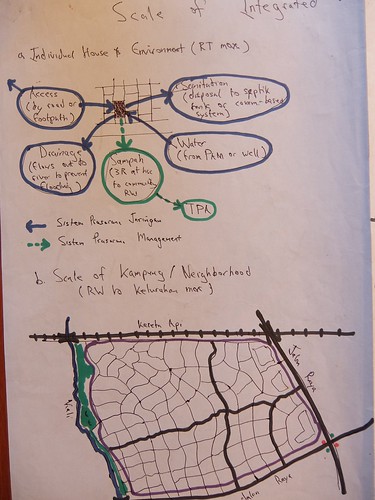
I used the term "EPCOT West" in a somewhat tongue-in-cheek manner, some years ago, to refer to Portland's Dignity Village, a collection of ad hoc shelters near the airport, adjacent to a prison.  Experimental Prototype of Tomorrow was the original meaning of EPCOT, if anyone remembers, before lawyers changed it to the more meaningless Epcot, which means nothing at all.

Those of us who've flown around the world some number of times are likely used to flying over vast "shanty towns", often referred to as "informal neighborhoods" by city planners.  US Americans define themselves in terms of not seeing these in North America, the US being "the wealthiest nation on Earth".

Actually "planning" informal neighborhoods seems oxymoronic to practitioners in the field, as they're by definition "unplanned".  The typical urban response is to criminalize "tent cities" in terms of what ordinances they violate.  However the numbers keep growing and the jails are full.

However, criminalization and warehousing people for profit does attract a form of capitalism.  Warehoused people with no human rights may be used as forced labor.  The institution of slavery is thereby restored, but in not calling it that, those implementing the system get their euphemisms and their cheap goods.

When actually feeding and providing a modicum of health care to the warehoused collateral becomes cost prohibitive, a typical final solution is to have the work camp become a death camp of sorts.  Crematoria are established.  Those removed from tent cities in urban areas are bused or trucked, or made to walk, to these out-of-sight out-of-mind prison camps in desolate areas.

Planning for tent cities, providing infrastructure for watching films, learning languages, engaging in work / study programs, is more the Global U approach, where all housing is student / faculty housing, regardless of grade.

This more humanitarian approach is deemed "liberal" in that it relies much less on the mass criminalization of poverty and death camps.  Whether one may afford to be "liberal" depends a lot on one's theory of economics.  The more Malthusian one's outlook, the less liberalism looks affordable.

The DC think tanks and Beltway consultancies are not especially liberal in outlook.  Their recipe for dealing with collateral is to assume miserable conditions in the tent cities will fuel resentment and a wish to fight back with physical violence.

Given the Beltway controls all the best weapons, this solution works well.  The public sides with "law and order" against "insurgents" and, if it shares the Malthusian view, cheers from the sidelines as the Apache helicopters, remotely controlled drones or whatever, strafe and bomb the shanty town denizens.  We've seen these policies carried out both in Panama and in Gaza.

The DC consultancies see "overpopulation" not "militarism" as the biggest issue to deal with.  In fact "militarism" and "overpopulation" fit hand in glove.

The Global U curriculum, relatively liberal, sees higher living standards as the primary and most effective form of birth control and family planning.

DC sees "higher living standards" as unaffordable and prefers to stockpile weapons for its preferred method of "adult abortion" (aka "homicide") i.e. the willful termination of human scenarios well after birth.

Here in Cascadia, relatively less militarized, the liberals have yet to completely embrace the death camps solution.  A lingering Global U curriculum, less Malthusian in outlook, still struggles to assert itself, gaining the ire of the Beltway, which resents the delays.

The Occupy Movement, e.g. OPDX in Portland, was all about setting up intentional tent cities wherein self-governance could be tried.  People spontaneously assumed their roles, choosing arm bands to signify in what capacity they might be consulted.  I worked in Food Services as one of several engaged in Logistics.

The liberals think if they gain experience mixing high technology (e.g. cellphone apps) with a more minimalist lifestyle — which still includes watching movies — then the Global U might continue to counter DC's militarism and implement its work / study.

DSCF7103
:: informal neighborhood in Indonesia, by John Taylor ::

Sunday, July 24, 2016

Rotten Apples


Saturday, July 23, 2016

Chicken Littles

One might think those into exploring the logical foundations of mathematics would have their interest piqued by the suggestion of a different way to model multiplication of two or three numbers.

We learn from childhood that a "square" number is like 2 x 2 whereas 2 x 2 x 2 is a "cubic" number.  But who dictated the two rods of length two needed to be at 90 degrees?

Suppose we placed them at 60 degrees, might that be an area of 4 as well?  Could 2 x 2 x 2 = 8 be shown with three rods emanating as if from the corner of a regular tetrahedron instead?  These are not hard questions to think about actually.

by Hollister (Hop) David
(with attribution to me)

R. Buckminster Fuller, with something like 45 honorary doctorates (meaning these institutions gave him a free degree to help prove its worth to others, as a standard-setter), considered the efficacy of measuring in tetravolumes one of the most important mathematical discoveries of his career.

He built up a whole philosophy, as mature as any one person might fashion in a lifetime, around the tetrahedron, at the center of his metaphysics but also of his numeric and geometric computations.  The domes came out of that work.

Did any philosophers pick up on these cues?  Or did they cop out by saying Fuller was an architect and it's the geodesic dome he'll be remembered for, not the mathematics?  Then maybe the next step is to attack his originality in that area, and use the word "charlatan" a lot.


I picked up on the core philosophy, as did a very few others.  We've made some further discoveries since.  That's exciting for us.  But is "a very few" enough?

Given how much of the American Dream for a better tomorrow was wound up in Fuller's brand of global utopianism (cite Disney World's EPCOT's Spaceship Earth), doesn't it appear these deliberately short attention spans, and a willingness to parrot "the authorities" might have other, deeper motives?

Lowering expectations for the future seems more in line with what the Great Tragedy Directors have in store for Spaceship Earth.  They've already scripted out their version of an End Times, and anything even remotely hopeful and utopian represents a disruption of their timeline.

How long do we keep postponing Armageddon?  There's some impatience to get on with it.

Philosophers with a longer view of tomorrow get shoved to the sidelines by the distopian schools.

To check whether your own school is distopian, more a part of the problem than a part of the solution, find out if any of Fuller's Synergetics is ever excerpted and discussed.  Is it on any syllabus whatsoever?

Consider jumping to a different school, with a stronger philosophy department, if not.

Friday, July 22, 2016

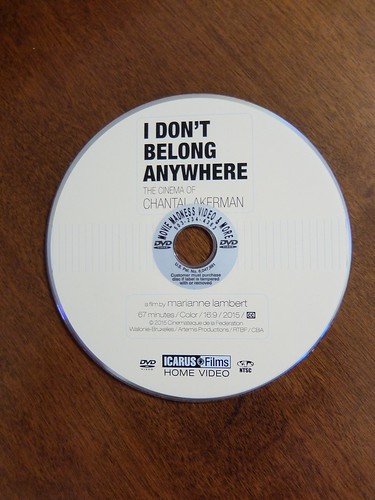
I Don't Belong Anywhere (movie review)

About Chantel Ackerman

I'd not heard of Chantel until about a week ago, when I watched one of her documentaries.

Not all her films are documentaries.  She'll weave stories from thin air as well, with made-up characters played by actors.

The really long camera takes, which give one time to reflect and listen to one's own mental chatter, define another end of the spectrum from the fast-cut, more heavy-handed storytelling of most filmmaking.

The camera just watches and listens, while the viewer has to look and hear, more like in real life. However that doesn't mean the frames are haphazard.  She's extremely meticulous.

Her style reminds me of both Iron Ministry and Songs from the North.

I arrived late to Wanderers as a consequence of finishing this week's viewing homework.

The conversation was truly wandering, with lots of chatter about crypto-currencies.

However the main theme was again gemstones, thanks to Steve Mastin (who brought some), with Glenn Stockton chiming in.

Gem Stones

Monday, July 18, 2016

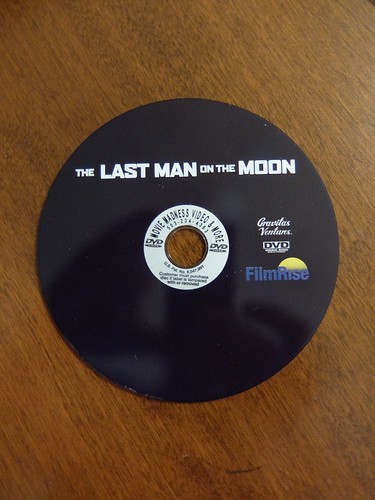
The Last Man on the Moon (movie review)

DSCF7034

Friend Denny phoned from PDX, just back from Shanghai, with the Republican Convention high on his list of events to follow.  That helped tip my scales away from heading down to the code school for Flying Circus this evening, my usual Monday evening activity.

I did work on #CodeCastle though, most significantly jumping onto a Pyret listserv to provide some overview, CC UMC (United Methodists).


Why not work on my class for tomorrow (teaching code) and study the newly rented documentaries, plus tune in the unfolding political show via various media (radio, TV and Twitter for starters).

People of my generation, who lived through the Apollo moon landings (I was in Rome for Apollo 11), will see the long road behind us in the high tech ruins of Cape Canaveral.

The Saturn V launch pad is now a relic. The mixture of futurism with decaying past, makes for a surreal combination.

People of my ethnicity, strongly discouraged from weapons training, were pretty much barred from gaining experience with the kinds of aircraft considered a precursor to NASA training.

I knew from an early age I'd never be accepted in that inner circle, but I was an avid tracker and backer of the space program nonetheless, and am still to this day.  Besides, I wore glasses.  Test pilots have perfect vision.

Eugene Cernan was maybe not as good on the bombing range as some of his friends, but at least he got to experience the G forces and show onlookers he had the right stuff.  He went in and out of San Diego on aircraft carriers.  I wasn't clear where all these bombs got dropped.  Hawaii maybe.

I hope someday those willing to train to work aboard spacecraft will find a civilian pathway open to them.  Actually we've reached that point already.  I often catch myself wishing for what has already come true.

The fact that humans were able to reach the Moon and return safely bolstered confidence in the species and ushered in new flavors of futurism, including the positive-accentuating utopianism of Bucky Fuller, which I glommed onto.

Critical Path is a lot about Apollo, including in the mythological sense of escaping superstition and nightmares.  So many disciplines, working together!  Apollo also seemed an exercise in socialism, in the sense of people co-owning public assets to accomplish something together, not that capitalism didn't play a role.

Friday, July 15, 2016

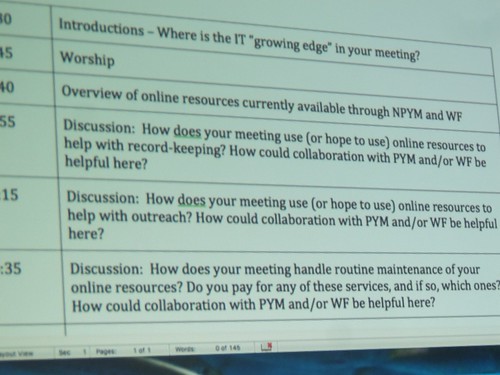
NPYM Interest Group

DSCF6986

Fortunately, Mary Klein, the Western Friend editor, was well prepared to lead this group, which I helped brainstorm along with Friends in other Yearly Meetings.

She even brought a projector (not that Whitworth University doesn't have those — this is a well-endowed campus).

Meetings that own their own buildings, and have Wifi, have discovered that renters, people using the building as an event center, appreciate the facility.

NPYM meetings tend to have websites.  Do they have current slates on-line?  Western Friend encourages a public, open policy.  Each Yearly and Monthly Meeting sets its own policies.  I've been encouraging NPYM to always share an-up-to date slate.

Quakerism is a form of role-playing.  How can we role play if we don't know who's doing what?  The whole process breaks down.

Also, given my background of working with nonprofits, I'm thinking at least the meeting's "officers" (i.e. clerks) should be publicly available.

Olympia may have the most open listserv, in terms of freely sharing unfiltered content.  My question is why don't most if not all committees have listservs?

Wouldn't Peace and Social Concerns benefit from more communications, not less?  What are the concerns?  Listservs are self-archiving, helping build organizational memory.

Western Friend has one of the most sophisticated websites and staffs on the Quaker cloud, archiving back issues of what used to be called Friends Bulletin.

FGC also has its trademarked Quaker Cloud, which a lot of meetings use.

I've found QuakerQuaker to be an interesting and usable website.  People create their own accounts and publish interleaving content, enabling discussion.

Dorene: accessibility, in terms of readability of websites, is an important feature.  The NPYM Drupal site is somewhat responsive, could be worse.  Try it.  It's sure hard to search though.

Friends worry about confidentiality (rightly so) and get paranoid (many meanings attached), like a lot of people.  Many are reluctant to share contact information publicly, with spam being maybe the least of their worries?

The Monthly Meeting developed in horse and buggy days, when most pedestrians could make it to meeting one day a week at most.  We had other business to attend to on other days.  Given electronic communications, the ability to get work done telepathically (OK "remotely") suggests "clerking" gravitate to include "moderating the listserv" for whatever committee.

At issue is the practice of Quakerism itself.  What is it?   Continuing revelation...

DSCF6988

Sunday, July 10, 2016

The Last Colony (movie review)

itscomplicated

My thanks to the filmmaker for so many excellent interviews and really helping me come up to speed on the pending issue of the hour.  Thumbs up on the music video as well.

In my book, Puerto Rico is the perfect issue to be discussing in 2016.  The narrative needs another swift kick in the rear, as the fourth plebiscite of 2012 was highly inconclusive and another was promised for this year (that's where the movie leaves us).

The needed "consensus" for statehood was not reached in 2012 and the Obama administration committed funds to a fifth run at the same question.
To resolve the dispute, President Obama proposed Federal support for a plebiscite under Federal auspices. The law requires that the options be able to resolve the status question, and the U.S. Justice Department must confirm that the options presented are possible under the Constitution, laws, and policies of the United States. The Governor of Puerto Rico has committed to hold the referendum by 2016.  [ source ][ emphasis added]
So when is the next plebiscite scheduled?  I'm having trouble Googling up a specific date.  November 8?  November 6?  What will the ballot look like?

The 2012 ballot was some kind of flow chart, with the majority saying "no we don't like the way it is" but then a great many stopped there, failing to choose from the set of next steps offered.  Of those choosing, 61% chose statehood.  Counting the "protest vote" of not choosing, the percentage of the total shrinks to about 45%.

As the movie makes clear, Puerto Ricans don't like how they're treated by the colonialists in DC (also not a state) and the unincorporated territory has recently (in the last couple weeks) made history by defaulting on paying a full amount owed to bond holders.  No US state or territory has done that since Arkansas did the 1930s.

Bond insurance kicked in this time, helping creditors, and proving buying such insurance is meaningful.  The myopic financial markets are maybe only too happy to turn a blind eye of malign neglect at this point, but candidates for public office need to speak to the big issues of our day.  Plus we want proof that they do their homework and are willing to show leadership by educating their fellow Americans along the way.

How would Donald Trump suggest the island reorganize?  What better time to get advice from the Bankruptcy King?  If only Trump University were still around, right?  There's no question of "a wall" here right, in terms of barriers to statehood?

And Hillary is a policy wonk, by her own admission, so does she have any advice for these 3.x million US citizens?  The standard thing is to encourage finding a resolution to the issue.  That's been going on for over a century.

Bernie:  Puerto Rico pays more in income taxes than your state of Vermont they tell me, yet have effectively no voice in the US Congress, how can this be?  Is this about imperial laziness?  Is Puerto Rico too big to fail?  What would failure look like?

The problems are thorny, twisted, legalistic, exactly the kind of issue more people should chew on.

If we can't manage to think through what to do in Puerto Rico, what makes us think we should be "pivoting" to "deal with" China, or "spreading democracy" in... actually I don't know if that's on anyone's agenda anymore, least of all in the "USSA" itself, what with all the secret supranational trade agreements under negotiation and so on.  Is the process of desovereignization about 99% complete?

Puerto Rico has all the hallmarks of a great puzzle in need of many eyeballs.  It's an open source project par excellence.  If politicians have any ability to improve lives and make things better, here's a golden opportunity to show leadership and provide a road map.  Or should we turn the matter over to engineers?

Probably "statehood, yes or no" would be the most straightforward.  Figuring out how to get smartphones enabled with a voting app, one token per Facebook or Google authentication, might make sense.  Is anyone working on it?

You could still vote in a polling place of course, but not both, not multiple times on multiple phones.  Might we use a blockchain somehow?  When we say people "vote with their wallet" maybe that would be literally true, as ballots show up like bitcoin, in your ballot wallet.

Mainlanders need to psychologically prepare themselves for a 51st state of the Union.  Lets at least get a preview of the new US flag.  Even if statehood doesn't happen (is becoming incorporated versus unincorporated the next step?), at least we'll be thinking about it as a real possibility, which is more than we can say of the average mainlander today.

Puerto Rico holds up a mirror and offers many lessons of history.  Given how little the average voter knows of history today, I think the issue of Puerto Rico's future is just the right issue to catalyze informed and informing debate.  Enough stalling already.  Lets get this show on the road.


Saturday, July 09, 2016

Back in Lobbyland

codecastle

I consider myself a lobbyist in the conventional sense of advocating for specific (special) interests, or "evangelizing" as some say.

My target audience:  politically aware individuals, some with more voting power than others, meaning some are legislators representing entire congressional districts, or whatever.

I'm not actually driving to Salem everyday and buttonholing representatives.

I've had Salem jobs, including right across from the state legislature, as a paid consultant, but that was then and this is now.

Mostly I just use social media to communicate my not-secret agenda.

PD = Professional Development.  PERS = employees on the public system payroll.


These days I'm hoping if Measure 97 passes (was IP28 -- a petition that makes it to the ballot becomes a measure) those paying more will have correspondingly greater input in how the funds get allocated.  Continuing with teaching to the usual tests may not be such a priority in the next chapter.

The needs of Silicon Forest companies for qualified role players in the future, is part of what's behind this agenda, akin to what Chambers of Commerce have concerned themselves with (curricula geared to the needs of industry and commerce).

And what if Measure 97 doesn't pass?  I've hinted about a Plan B in my twitter feed.  We'll still have the same needs for professional development and innovation.

Thursday, July 07, 2016

CodeCastle: Escaping the Base 10 Ghetto


I was born in the 1950s, around the time Russians first launched a satellite.  The US military had yet to do so and a crushing sense of maybe falling behind set in, one response to which was to shake up the mathematics curriculum with New Math as it was called.

Some brains in the University of Chicago came up with their SMSG curriculum, which phased in many novel concepts, including that numbering, or counting, takes place in a "base".

Engineers and rocket scientists had long before embraced this notion, but K-12 still reflected more agrarian origins, with lots of different units, many of them non-metric and non-decimalized (tea and table spoons, pints and cups), but with little formal reasoning about "bases".

As they say about fish not knowing about water (because they swim in it 24/7), so might we not see our arithmetic as "base 10" in particular.  What would it mean to count in another base?

This topic was taken up as early as 2nd grade, the grade I was in when I first learned about "place value" and "number bases".

Tom Lehrer (a mathematician as well as songwriter) came out with his New Math song around then (above).  I wasn't sure why it was so funny to the grownups, as it was mathematically correct.

The lessons learned from the New Math experience inform my designs for #CodeCastle, some "Pi in the Sky" institution (pun intended) that isn't as top-down as SMSG was.  How might we help K-12ers escape their time warp and join us in the 21st Century?

By the time I returned to the US from overseas in the 1970s, New Math was in a shambles.  NASA had mounted its Apollo program and put astronauts on the moon, in fulfillment of president Kennedy's promised stimulus package.  Mission accomplished.

No longer suffering from a sense of falling behind, though willing to truck out a "missile gap" to scare up funding, the New Math was largely shelved by school administrators.  Remnants permeate the curriculum to this day, but the backlash against it had been intense.

Teachers did not feel prepared to embrace all these innovations.  The learning curve was too steep.  Something more retro was adopted, then made more fuzzy.  The so-called New New Math was made center stage by the 1980s, with its own set of critics.

In moving towards a Common Core, for the convenience of big publishing especially, assurances were given that we'd not be returning to the "bad old days" of New Math, where "bases matter".

Everything will be comfortably in our familiar Base 10.  Leave it to college courses, or accelerated electives, to go beyond. Don't require it.

Given industry is by now mostly powered by binary numbers, expressed in terms of hex numbers, this decision to "ghettoize" K-12 as a Base 10 backwater, was controversial.  Weren't they off on the wrong track?  Decimals run on binary rails in digital computing.

Fortunately, two additional facts worked in favor of high tech industries:

(1) the Common Core sets a floor, not a ceiling and the teaching of hexadecimals is easily added

(2) school systems are appreciating the need for computer science friendly STEM courses and adapting to include them.

In Oregon, my #CodeCastle initiative ties to #IP28, a ballot measure aimed at increasing taxation levels on specific categories of business, according to a formula based on sales.

It's not a consumer sales tax, although special interests fighting the measure suggest that it is, knowing Oregonians have a record of defeating anything they consider a "sales tax".

Promoters of IP28 say it's about improving schools.  If that's so, then the businesses asked to up their ante might do well to make sure those improvements are real.

Earmarking legislation is in order.  Teacher training is in need of funding.

A role model teacher spends as much time learning and researching, studying, as teaching.

If the pie chart of a teacher's day is all teaching and grading, doing admin and lunch hall duty, then at least a third of the ideal day is missing.

I also think we need to role model adults getting along, collaborating.

At least two adult teachers per high school classroom would make a lot of sense in many cases, sometimes both in the room, other times spelling each other.

Neither teacher need be junior to the other, in terms of rank or experience.

Of course the latter reform suggests a much bigger budget than even IP28 would allow.  We would need a stronger education culture in Oregon, with the means to sustain a quality school system. Lets work together on finding ways to achieve this ideal.

In 2015, we saw that NASA astronauts still considered hexadecimals important in that Matt Damon used them to save his own life as the left behind astronaut in The Martian.

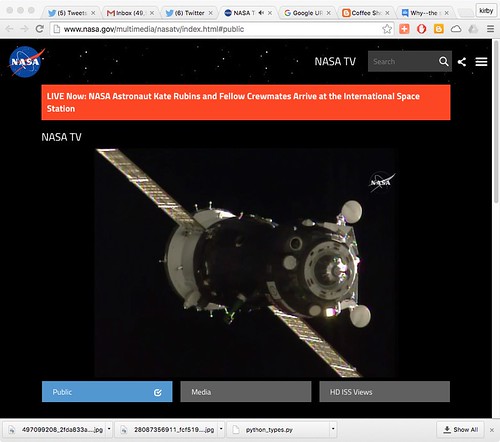
Is_docking
Soyuz docking with International Space Station in July 8, 2016

Monday, July 04, 2016

The Price of Peace (movie review)

DSCF6798

Portlanders packed into the Clinton Street Theater for this July 3 premier of a new documentary (110 minutes) about the life of S. Brian Willson, against the backdrop of Endless Wars.

Ever since the discovery of the principles of nuclear physics, which humans weaponized to use against themselves, those who've believed themselves to be "in power" have wanted to achieve some sort of Final Solution to something, using these nukes as leverage.

The US population was galvanized to fight military fascism and Hitler, only to inherit the mantle of "superpower", which to many generalists and generalissimos meant "we" (their side) had a window in which to purge the world of any nasty ideologies that might threaten their superpower's newly achieved King of the Hill status.

"Communism" was identified as the number one threat to continued world domination by many self-proclaimed authorities.  However, the consensus that made World War Two possible and turned the US economy into a war-fighting economy, started to break down after Eisenhower.  The rise of the Imperial Presidency was a big turn-off for many.

Manifest Destiny and the Indian Wars had played a strong role thus far, in the creation of a Lower 48 plus Alaska and Hawaii, with some territories, such as Puerto Rico.  The US was now ready to take to the world stage in a new way, as a colonial power, at least until Communism could be wiped out.

After that, maybe more nations could be trusted with self determination (e.g. the Philippines), which would naturally be friendly to US business interests.

S. Brian Willson grew up Catholic and Catholicism shared the US business community's fear and hatred of a new form of "rationality" that had grown up in the West through writers such as Hume and Diderot, culminating in the French Enlightenment.

Those branding around "God" and "Jesus Christ" in particular, had suffered a loss of power as the 1800s saw the rise of "unbelievers" only a minority of which considered themselves to be Communist.

Even deists such as Thomas Jefferson were not buying that church authorities should impose their values through laws, a power earlier taken for granted.  The public space was coming under the management of secularists.

In the absence of any consensus on God's Plan, and with the emergence of industrialization, two main schools of thought developed in the West:

(A) The Marxists encouraged workers of the world to unite and share in common the means of production (to which a Capitalist class believed itself entitled) whereas

(B) the Social Darwinists saw the relatively greater fortunes of some Capitalists as proof of their better breeding and consequent right to run things.

Those still believing in God could see Him operating in mysterious ways in either camp, depending on their political leanings.

Many within the Church were moved by Liberation Theology and the struggle for the rights of the most exploited.  Liberation Theologists became a new A-team and had much in common with the US abolitionists of the US Civil War.

The family in which Willson grew up was Catholic Social Darwinist whereas those seeking their independence in Vietnam were led by Ho Chi Min, not necessarily a Communist but demonized as such.

Asia was cast by the B-team as the place where the "dominoes" were about to fall.  Indonesia was another "trouble spot" with colonial heritage.

When Willson got to Vietnam as an officer in charge of some forty men, it was his duty was to assess the "success" of various bombing runs.  These low altitude aerial fire bombings of fishing villages, followed up with napalm, were indeed very effective (just about everyone was maimed or dead), which was no doubt highly gratifying to the engineers behind these patented inventions.

However, Willson, as a soldier on the ground, was not seeing the US winning hearts and minds with these tactics.  How would Social Darwinists win by continuing with human subject experiments, ala the Marshall Islands?  He didn't buy this could be a winning grand strategy and felt his motivating ideology crumble.

Upon returning to the US, he found crumbling ideologies everywhere he looked.  A lot of people were feeling like losers, having gambled on beliefs that had stopped making sense.

The Social Darwinists, for their part, were also Malthusians and saw the world as infested with millions, probably billions, of excess people.  War had become an acceptable means of "population control" in the minds of those believing themselves to be running things.

Using humans to test new kinds of weapons meant more resources, more spoils of war, especially for those inventing and manufacturing the munitions.

Given DC and the Pentagon had fallen to the B-team's forces, many US flag flyers with higher ideals (many of them decorated as war heroes) found themselves on the outside, fighting against other US flag flyers. A new kind of civil war began to simmer, even as Marxism began to fade.

New ideologies (memeplexes) were circulating through the population.  New so-called "Aquarian conspiracies" were popping up, much to the consternation of the FBI.

The movie takes us next to Central America in the Reagan Era.  By this time the CIA was taking over more command and control responsibilities, a trend that continued into the Drone Wars era.

War funding had been driven underground as more of an organized crime and drug running business (fighters need their meds, always have).  The budget had become "black" and privately owned mercenary businesses such as Blackwater had taken over the show.

Willson and many Veterans for Peace were now full fledged hearts and minds warriors, rejecting the Social Darwinism of many in the business community.  They were in competition with the CIA when it came to the Contras, which later were being overtly and covertly funded in these newer "black" ways.

Willson turns 75 today on July 4th.  His principled ideological positions have won him a huge following.  Portland's peace activist community has long celebrated his heroism.  He lost both legs to a munitions train taking weapons to Central America, and ordered to not stop.

The movie was co-sponsored by KBOO FM, which is also rebroadcasting the Blues Festival.

The bravery and courage of Vietnam Era fighters against Social Darwinism has won many hearts and minds in the Pentagon and FBI as well, which institutions have suffered from crumbling ideologies in tandem with their demographic cohorts (people from the same zip codes).

A new McCarthy style purge of "A-team Aquarians" or whatever we call them, would be difficult and would lead to backlash (blowback). US presidents have tried to pander to both sides -- and felt rejected by both sides.  The simmering civil war continues.

The old Business Plotters, many of them by now of nursing home age, have been scrambling to find new arenas for human subject experiments, settling on that Cradle of Civilization known as Baghdad.  Their goal is a New American Century dictated by themselves and their mostly dead cronies.

The "world domination" meme, on the other hand, was inherited by a new breed of engineer into "free and open source" (the polar opposite of "classified and secret").

Munitions are not as sexy as they once were (drones are for civilians) and "military porn" is seen more as an addiction and pathological perversion, ala Gitmo and Abu Ghraib.

Outward war, a kind of theater, is geared for perverted perps with runaway mental illness, those without self control.  The new post-Marxist A-team has higher tech and greater self-discipline than the more conventional B-team, still motivated by Social Darwinism and various phobias.

Starting a religious war against Islam is what the B-team is toying with, but given Muhammad Ali and what he stands for in peoples minds, that's unlikely to pan out.  Islam, like Christianity, is too factional to paint as a single mindset.  The great religions keep morphing.  The world does not stay still.

Saturday, July 02, 2016

Camp Life

Camp Life
student housing, Global U

I used to think of "eight million" as the size of a really big city, like Tokyo. 

Assuming a global population of eight billion, that's a thousand Tokyos worth of people. 

About eight Tokyos, or sixty-four million, live in refugee camps. These numbers are not precise, nor are the definitions (what's a city if not a more permanent kind of camp?).
After an increase of five million last year, the number of people displaced by conflict – refugees, asylum seekers or those displaced internally – was at an estimated 65.3 million by the end of 2015. 
It is the equivalent of one in every 113 people on the planet, according to the UN Refugee Agency, and if considered a nation would make up the 21st largest in the world. [ source ]
As a contributor to General Systems Theory (GST) for some decades, I've built up a model of the "Global U" (Spaceship Earth) in which each one of us is doing work / study, which nets us a livelihood in some way.  We survive, one day to the next, in "work / study scenarios".

Two "credit wheels" come into play, the input wheel (like a pie chart) and the output wheel (ditto).  A pie chart is apropos as not only does it let us partition income, the radius of the circle itself is a variable.

What I call a "personal workspace" (PWS) is between inflow and outflow and represents "value added" or "difference made".  Given these sources of input, including nutrients, all sustenance, information, props, opportunities, what outputs did I create?   What difference did I make?

Clearly these are very generic concepts, intentionally.  In application, we might focus on a Global U student in a tent, call him Jack, call her Jill (is she a girl scout?).  Jack is learning about germs i.e. bacteria and viruses, while Jill is learning about environmental contaminants.  They're siblings and definitely compare notes on what they're learning as these topics overlap.

These are also topics of vital everyday interest as the camp struggles to improve.  Jack and Jill both want to make a difference in terms of contributing to higher living standards for the camp.  One way to do that is to stay healthy.  Another way is to help others stay healthy.  A series of bike lanes has been set up and Jack spends some of the day delivering specific meds to specific tents.

Jack and Jill were issued tablets (in the sense of wifi devices with touch activated screens) by the camp school and in moving through levels in their reading programs, they get credits sent to their electronic wallets.

These wallets are somewhat like credit cards in that they may be deactivated if lost or separated from their owners.  The crypto-currencies they contain are more programmed than cash.  Some may have no meaning outside the camp context.

Every camp has cell towers and the students use those to upgrade apps and get new ones.  They use the devices to talk to one another.  Those devices with access to the global Internet will have access to this very blog post.

Monday, June 27, 2016

What Our Father's Did: A Nazi Legacy (movie review)

This documentary consists of an extended conversation between three principals:  two sons of high ranking Nazi officials, and a lawyer, Philippe Sands, who's family was wiped out in the holocaust about seventy years prior to when the film was made.

The lawyer is professionally prosecutorial towards Horst, who believes his father did what little he could to resist the Final Solution, but "high ranking" doesn't mean "standing up to" (quite the opposite).  People in a military machine are "just following orders" (a standard defense).

Is responsibility the same as guilt?  What is responsibility?  In the est Training (no longer offered), each individual had an opportunity to accept responsibility for the Holocaust, but that includes people like me, not born yet, and the namespace was philosophical more than juridical.

Horst is not even close to a Holocaust denier.  He accepts what happened during World War Two.  However he had a good experience of his father and sees him as a decent man caught up in events beyond his control, and who did his best for the Ukrainians at least, but could really do nothing for the Jews, given wheels already set in motion by Hitler's killing machine.

The other son, Niklas Frank , thinks his dad Hanz Frank, the "butcher of Poland" got what he deserved, and despises the way Horst, who's father worked for the butcher, continues to defend his father's record as a Nazi functionary.

The film contains footage never before made public.  The girl in the red dress, in the Warsaw ghetto, or was that Krakow, connects us cinematically to Spielberg's Schindler's List.

Horst's dad, Otto von Wächter, died under the protection of the Vatican and was never tried in Nuremburg, allowing Horst to take refuge in his longer view of history.

Horst is something close to Jewish himself given his own brand of scholarship.  He became an assistant to the famous Jewish artist, Hundertwasser, and captained that artist's ship Regentag to New Zealand.  Horst's own home was the secret meeting site of a former art colony focused on the teachings of Hermes Trismegistus as passed down through a Hebrew line.

"We tend to see people as victim or perpetrator" says the Philippe, but then the justice system is all about discovering who or what to blame.  "Command responsibility" has specific meaning in an international court of law.  The lawyer is sure Otto would have also been sentenced to death for his war crimes.  I have no reason to doubt his conclusion.

I learned a lot from this film and would recommend it to anyone studying World War Two or the Holocaust.  Also Shoah.  There's quality content here for art historians and architects as well.

I realize I take after grandma Esther, my dad's mom, in being eclectic in my reading and viewing habits.  She would likely have loved Movie Madness and its wide selection, of documentaries especially.

DSCF6687

Wednesday, June 22, 2016

Learn Hex!


Yes, another media campaign.  Long time followers of my blogs know I'm likely to jump on and off various fast-moving media campaigns, some of which I help source, spin doctor that I be (highly paid?  Sliding scale).

Remember the Kite campaign?  How about the Mite campaign?

The former linked to "kites" by Alexander Graham Bell, but also to Penrose "kites and darts" (aperiodic tilers).  The Mite is a space-filling not-regular tetrahedron, so:  "Aristotle was right!  Remember the MITE!" (that was Bucky Fuller's name for a "MInimum TEtrahedron" consisting of A and B modules).

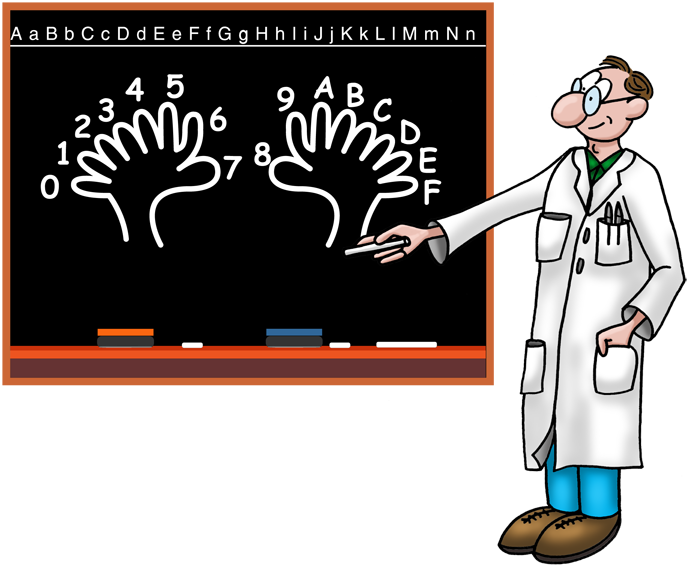
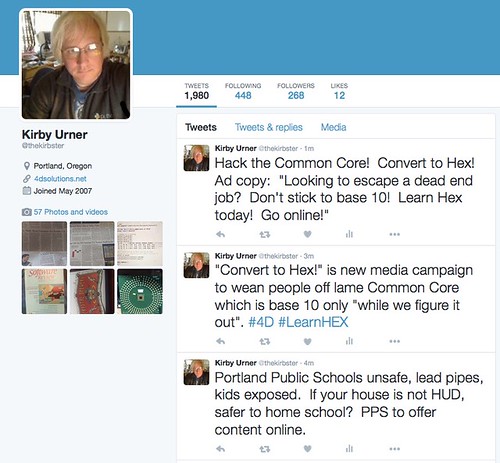
The new campaign is about countering the Common Core's mind-wasting "base 10 only" approach.  The curriculum outline suggests only base 10 is important and only base 10 algorithms will be tested, no conversion into and out of hex.  "Convert to Hex!" is a way to counter.

In Portland, our public schools serve mentally retarding lead in the water, like the HUD houses.  PPS has plans to offer more content online starting this September, for the average home schooler still interested in getting a public education.  Taxpayers have every right to this service, just write to the Governor if you don't believe me.

The impetus to stay home will increase with the knowledge that "base 10 only", just like "English only" (with punishment if you speak anything "more N8V or i18n"), are both linked to the "while we figure it out" mentality i.e. adults with a demonstrated inability to cope.  These are not your role model teachers, by any stretch of the imagination.  Your role model teachers are on your side, not theirs.

Fortunately, Oregon is being proactive and offering professional development courses to its rank and file teachers, especially its math teachers.  I don't think with Silicon Forest and ONAMI in the picture, we're a state that can afford any "base 10 only" brain-killer curriculum.  Common Core is a fine place to start, on paper, but if not transcended immediately, you're stuck in a mental slums.  Escape!  Seek freedom!  Learn Hex!

lean_hex

Tuesday, June 21, 2016

War Planning

Watching documentaries about Egypt and Turkey, and the fate of Islam therein, has reminded me how much Islam suffers from oppression at the hands of so-called "secularists" who think their job is to oppose all religion, except maybe some state religion that cozies up to them.

Religions harbor pacifists and idealists, which need not be terrorists, but what's terrifying to militarists is a shortage of recruits.  How does one carry out Endless Wars in the face of a burgeoning civilian economy with attractive lifestyle opportunities for women as well as men?

Making civilian lifestyles untenable (unsustainable) is step one, and this is relatively easy when the atmosphere permits raining down bombs on civilians.  This has been the status quo since at least the Franco-Hitler alliance against Spain, in which many courageous Englishmen lost their lives, fighting for Spain.

FDR was warned, by Ernest Hemingway in particular, about the advance of military fascism.  The world was sick of Endless War by then.  Bertrand Russell, a pacifist, only reluctantly came out as pro fighting against Hitler.  The US was having none of it.  Until Pearl Harbor that is.

But the wave of military fascism was not stopped by WW2 and US Americans saw their civil liberties curtailed like no time since the Civil War, given the new fight against "Communism" in Korea and Vietnam.  "Fascism" was no longer the enemy it once was.  Joe McCarthy, Richard Nixon his protege, had other enemies to prosecute.

Muhammad Ali defied the fascists and stood up for his rights as a civilian, converting to Islam in the process.  Islam was a source of pacifism during this period, providing meaning and hope to millions in America's racially divided cities.  The fascists would incite them to violence though, as radicals make easier targets in terms of PR.

We see the same phenomenon in Turkey and Egypt:  make Islam seem radical, a major threat.  The pacifists won't seem that way, but others will be lured into the limelight to make the case.  Focus on the radical elements within any group, in order to marginalize the ones making the most sense.

Indeed, some zealots will be already radicalized and won't need much encouragement to throw stones, at which point they may be shot, unless on the "right" side, in which case they're Freedom Fighters.

Endless Wars requires these "right" and "wrong" sides, endlessly, with little chance to debate as resorting to violence is the whole point, though often with prior lip-service to "diplomacy" which the endless warriors pray will fail.

Looking ahead to its superpower responsibilities with only a volunteer army, still largely based on the pressure of untenable civilian lifestyles, the Grunch war planners realized they'd need to tap women in much greater numbers.  Appealing to their sense of patriotism might work, despite the transparency of the thin disguise.

The "equal opportunity" to get drafted and sent to a base anywhere around the globe, perhaps to die doing onerous duty, is what feminism then became, in media campaigns designed by the military and shared on public radio.  Not only men should welcome this opportunity to serve their masters.

However the degradation of the biosphere, brought on in part by Endless Wars and wasteful ways, was making it obvious that the larger ecosystem (economy) was in jeopardy and principled pacifists, wanting instead to help heal the Earth, formed into vast networks of conscientious objectors.  Sufis and Quakers got together on this.

Faced with the prospect of growing pacifism, the military fascists needed ways to suspend the Bill of Rights and further erode the tenability of civilian lifestyles.  The prospect of firing up a full scale planetary war between the religions was starting to look unlikely, thanks to anticipatory networking.

Much time has been lost in the meantime, as cleanup and environmental projects get postponed.  The attack on civilians in Syria was maybe a tipping point, proving that those puppetting the nation-states were more into sponsoring Endless Wars than into caring about innocent civilians, seen as "collateral".

The tech sector, in the meantime, is into sharing banking services and the benefits of cryptography with an ever larger percentage of humanity, along with the ability to fact check misinformation and recognize media campaigns for what they are.  Misinformation, as a tool, is becoming harder to use, as it's getting easier to find inconsistencies in stories that don't hold water.

As women pour into tech and realize the elements of tenable (sustainable) civilian lifestyles are all present, their eagerness to capitulate to military fascists and their Endless Wars continues to wane.  The pacifist networks have already set these wheels turning in a big way.

So what will the fascists try next?  Demonizing Islam, as all about violently oppressing women, has worked well in the past, but is these days looking too predictable and socially engineered.  Fewer diplomats are falling for it.  However, the campaign seems to still work with a new group, the New Republicans (not quite the same as Neocons, though maybe not all that different?).

However, the pacifist networks are global in scope and get through on many channels with their message of hope and better prospects.  This religious message, of Peace on Earth, even has some Christians behind it.

The fascists face a globally active form of religious pacifism and their efforts to demonize Islam may not be enough to keep the Endless Wars going.  Is there a way to demonize pacifism itself?  Stay tuned.

Values

Monday, June 20, 2016

Golden Rule (Part 2)

DSCF6509

Part One of this story took place in the Quaker meetinghouse on Stark Street, however the seaworthy boat in question was around longer, per plan, and various scenarios intersected, as mentioned in my Facebook profile.  Lew Scholl got a ride thanks to conversations at the Solstice Party (Wanderers) that I missed.  Meliptus got involved.

Part Two was in Vancouver, Washington and featured several guest speakers, including my mom, for whom I served as chauffeur.  I hadn't realized the famous Leonard Peltier had a son named Chauncey, an Oregonian.  The Veterans for Peace organized and promoted this public-welcome event, in a room designed precisely for such public occasions in a Clark County public utility building.

I could give a lot more detail, however I took this opportunity to dive into Twitter more concertedly, part of my boot camp training, so I'll recommend poking around in @thekirbster at some point, scrolling back to this timeframe, if wanting to get more of a blow-by-blow as it were (more of the "as it happened" action).

Helen was a main presenter and mom gave us three reasons for hope:  the Ban Treaty (percolating); the city mayors of the world (good at saying no to would-be nukers); Marshall Islands taking a stand (as a victim of nuking wanting to see conditions of the NPT enforced).

Mom also links that wistfully-toned folk song, Last Night I Had the Strangest Dream to the Kellog-Briand Pact in a funny way, reminding us truth is stranger than fiction (it wasn't a dream at all).

Sunday, June 19, 2016

Songs from the North (movie review)


I learned quite a bit from this documentary by a South Korean, doing a kind of anthropology that doesn't apply overbearing spin at every turn.  She takes very long camera shots, to the point where her subjects get uncomfortable, as may the viewer (the equivalent of staring, however she's getting permission, usually).  The opening shot, of some kind of circus act, prepares us for her style, which I'm not objecting to, only describing.

She's not without opinions or views, though when it comes to politics she turns it over to her dad to talk about his friends who went north out of idealism.  In her dad's view, whatever Communism means, mainly a society among equals, is not what's practiced by "the Kims" and the cult of personality developed around them by orphaned and existentially traumatized children, now adults with children of their own.

The filmmaker suggests North Korea's freakishness is due to a freakishness of another kind:  we all know what Americans are like.  We hear an American talking about wartime supply lines, and a goofball general wondering, like MacArthur, why his troops were held back in any way.  "We had the atomic weapons and could have done whatever we wanted to up there" he says, leaving us to wonder what "we" wanted to do, and about what exactly. General Westmoreland's Vietnam was still ahead, as was the hit movie and then TV show, MASH.

The Japanese oppressed the Koreans terribly, and then the Americans came in and sliced the country into two, along a parallel that North Korea's Kim Il Sung never accepted.  His efforts at reunification brought nothing but more retaliation from the Americans who had meanwhile become friendly with both Japan and Germany (vanquished foes make good friends).  Following world affairs has never been easy.

The North Koreans eye East Germany as prototypical.  How East Germany got incorporated into the EU might serve as a model for their own reunification as a peninsula.  Yoo's dad encourages the North to build up its economy, which, as Communist, should be its first priority, but he sees them mostly doing political calculations instead.  The North Korean geeks are worried, that if a merger backfires, they'll be blamed and treated as internal threats, simply for being most like their counterparts (geek culture is cross-cultural because the Internet is uber-permeable).

We're left with Yoo's strongest impression:  this is the loneliest country on earth, in a twilight zone of only a short history shrouded in myth.  Neither the underground test nor the satellite launch looked all that believable but I'll leave it to the experts on Wikipedia to argue whether these have anything to do with real phenomena.  Why should the rest of the world tease and taunt a lonely child?  Why be so childish?  Yoo's eye is compassionate, neither apologetic nor angry. She didn't start the fire.

:: flash forward to 2018 ::

Friday, June 17, 2016

Slowing Down?

I heard speculation today that the looming uncertainty around the Brexit vote helped stay the Fed's hand regarding hiking interest rates.  If that filtered through to me, I figure many are saying it.

I'd add there's an element of projection here though, in terms of the US pot calling the UK kettle black, in that there's looming uncertainty around the US presidential elections as well.

If one is running a business, making plans for the future, these known unknowns add up, on top of unknown unknowns that will always be there.

I hadn't realized to what extent Gibraltar was involved in the calculations, in terms of its staying in or leaving the EU as well.  I'd been focused on Scotland and sentiments there.

Effects of the Intel layoffs are noticeable locally.  I just heard about WalMart.  Unemployment figures may also have played a role in giving the Feds more reason for hesitation.

Merchants in wholesale and retail have to be looking ahead to the Christmas season around now, anticipating how things might go until then.  Pundits were saying the presumptive Republicans had a greater chance of winning the presidency if the nation were gripped by fear of terrorism.

That was before Orlando, which many presumptive Republicans blame on a foreign state that mostly lives in people's minds at the moment (no borders, no passports, no currency, no embassies...).  If there's a line between a mental state and a political state, I'm not seeing it at the moment.

Although the media are looking at gun control, which is no back burner issue, the matter of actually barring Muslims from entering the country will require suspending the Bill of Rights will it not?

Congress shall make no law respecting an establishment of religion, or prohibiting the free exercise thereof.  If practicing the Islamic religion is grounds for deportation, wouldn't that be a law prohibiting the free exercise thereof?

I'm not the only one who remembers General Hayden's remarks on Bill Maher, the big headline on February 26 of this year.  He suggested the military would need to disobey any orders that directly conflicted with their Constitutional responsibilities.

What will be the demand for teddy bears and security blankets, come Christmas, if we're looking at martial law and/or troops urged to protect the existing US Constitution?  The question has to be in the back of some minds, even high up at WalMart.

People in the US are not used to a situation like in Egypt, where the Constitution was in abeyance for many years.  The new Egyptian Constitution is only about two years old, not over two hundred.

Actually, Constitution Daily says only that the question of constitutionality is open to debate.  A political movement tried to ban anyone of Chinese heritage from entering, not a ban based on religious beliefs.  That gets cited as a precedent.
Despite the recital by both sides of competing court precedents, the Supreme Court has never decided specifically whether a religious preference could be a valid basis for exclusion of all of those who follow a given faith.
The Bill of Rights is not specifically mentioned.

Hysteria about martial law is coming from other corners.  Youtube has many shrill clips predicting a power grab to give president Obama a third term.  FEMA camps feature in many of these.  Combine the US election with Brexit, and there's a lot of fear in the air.  Many businesses slow down in such a climate.

Tuesday, June 14, 2016

Wanderers 2016.6.14

DSCF6396

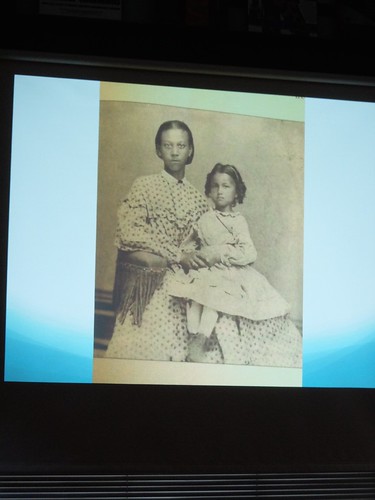
Peter Miller told the story of the Fisk Jubilee Singers, founded by his great-grandfather, circa 1871 to 1878.  Fisk University in Nashville was a post US Civil War institution that helped popularize a new sound, pre recording industry.

Peter has some memorabilia from the period, family heirlooms.

I watched the first half of CBS Evening News tonight, which was about the interweaving of the Orlando massacre with charged political talk.  There's no coherence only sorrow in this picture, circuitry gone haywire.

I've been active on Twitter of late, more than usual.  My "geek ethnicity" takes me into social media, such that when Microsoft bought LinkedIn recently, I got lots of tweets about it, from the geeks that I follow.

I tweeted about my taking public transport, to and from Flying Circus yesterday.

Somewhat as a joke: I invented (in my own mind at least) the recursive term "phobophobia", the fear of having phobias, or perhaps catching the more contagious ones.

"I'm phobophobic" I could say at a party.  Sounds funny.  But "parties" and "funny" are not a chief order of business around now, given the terror.  Sorrow songs, not Jubilee songs, fill the airwaves.

Watching Mason's Lost Girls last night, a re-enactment (not a documentary) adds to my sense of "crazy world" (Spaceship Earth = Hospital Ship).  Koyannisqatsi.

George White, Peter's great grandad, was born in Franklin, New York, 1838, the son of a blacksmith. He left home at sixteen and eventually found work as a teacher and choral director.

When the Civil War broke out he rushed to Cincinnati's defense. He then signed up with the Union Army and was in many battles, dwindling to only a hundred and forty pounds at six foot five.

He ended up in the orbit of Fisk University, an enterprise he could support and that eventually led to the Jubilee Singers.

Ella Shepherd became the heart of this enterprise, of Cherokee as well as Afro-slave heritage (her mother was sold away as a slave a couple times, though they were eventually reunited).

The choir went on many grueling road trips, and became a real money-maker for Fisk, as well as other institutions.

I'm tracking the Brexit referendum through Twitter too, and like many in my network, wonder if Scotland feels chained to a jumper.  What if Scottish folks prefer to stay in the EU, but maybe opt out of NATO?

Scots don't get much benefit from obeying the Trident submarine conqueror-invaders, as some see them.  The Nukehead Nations are on the wrong side of history these days.  Nations remaining innocent of nukes get more respect.  Those who cling to them seem stupid.

Of course suggesting "Scotland", an inanimate object, has "feelings" is venturing into the realm of corporate personhood.  What used to be a mere metaphor might today have legal implications.

Most people still understand nation-state talk as a shorthand, not a metaphysics, nor a theory about the sentience of AI monster-creatures.

We had a number of musicians in the audience tonight, who asked intelligent questions.  Jubilee Singers past and present, may be found on Youtube.

Here's Peter's preamble, circulated ahead of the presentation:
JUBILEE! In 1871 a bedraggled group of ten black students from Nashville'sFisk University, among the first black colleges founded after the Civil war,set out for Ohio to try to save Fisk from bankruptcy by giving concerts.when these Jubilee Singers disbanded, they were professional, world-travelled adults, having brought the Negro spiritual to the knowledge of the wider world, singing before American presidents and European monarchs. They had raised $150,000 to save Fisk and other black colleges from disbanding, and to build the Fisk campus. Illuminated by careful records and by letters and diaries of the singers, it is an improbable story of success over adversity and an illuminating saga of race in America. My great-grandfather, George White, was the Jubilees' founder and leader, and their story was an important part of my family heritage growing up in the Jim Crow south.