Wednesday, December 07, 2016

Okinawa: The Afterburn (movie review)

From Movie Madness

Males especially, as future breadwinners, need training in being fathers and fixers, flyers and foes (for self defense). The military is their school or institution for providing these things, free of charge but at a price similar to the one exacted by prison: a loss of freedom, and possible death by legal means (the state has pre-authorized you to die defending said state, just as prison guards may use lethal force).

Okinawa was such a training ground.  Lots of Japanese proto-wives to have and to hold, lots of children to share candy with, lots of B-52s to fly around and maintain.  They'd go home to Ohio and Alabama all the more ready to care for their families and communities in a civilian setting, having served, and therefore skilled and deserving of honor and respect, as veterans.

The reason one needs bases far away is to absorb the dominance culture and feel the might of one's homeland.  Soldiers impress other soldiers, by ordering locals, making them accept base after base, servant ranked jobs, and all the sex trafficking that entails.

Also, no one wants to be seen by one's friends and relatives, stumbling around in a drunken state, experimenting with sex and so on.  Best to go off and do that alone, with strangers, in a forgiving environment, then maybe straighten up and fly straight once home, grateful to not be dead yet.

The Okinawans did not take on this role without resistance.  Whole cave-fulls committed suicide or mercy-killed one another, having been trained since birth to equate hostile takeover with a death sentence, an instruction to self destruct.  That programming worked in many cases.  Parents euthanized their own children.

Others stumbled around in the Battle of Okinawa getting shot at, losing their people.  Many of them get interviewed for this movie.

After World War 2, Okinawa became a US military base, the Japanese military having been pushed out.  The Americanization process had started with Commander Perry, who sailed his fleet into harbor in the late 1800s and started bossing people around right away.

Japan to the north understood Americans were planning on having bases (not so much schools or resort hotels) all over and pushed back, as we know, with bases and prison camps, and comfort stations, of their own.  Korea, China and the Philippines bore the brunt of their counter-empire.

The option to have bases more like schools and resorts is always just beneath the surface.

The same Iron Mountain command structure that enslaved Okinawa has enslaved North America for many years, is striving to hold the world hostage more generally, with its nuke weapons and all that.  We're to obey, not question.  However some questioning still goes on, some reminding of the locals of our democratic values (similar to Okinawan values).

A lot of Okinawans misunderstood the Nixon Era and thought "reversion" i.e. "returning Okinawa to Japan" (like what the Brits did with Hong Kong) would mean an end to the US military bases.  They'd come to think that was what "reversion" meant.

So when Okinawa reverted, yet the bases stayed, even grew, some belief systems imploded.  Okinawans came to see themselves more as an ethnic minority people take advantage of and feel superior to.  The push back there has been more identity politics and island nationalism, not unlike in Puerto Rico.

Given all the inertia and the needs of males for dominance in situations, as expressed in their pressing need for these military bases, I'm not seeing any office in the USA that's powerful enough to command otherwise.

Figurehead presidents won't phase them out, whereas the Pentagon's fantasies of the future all depend on this network of bases, all interconnected in their own underworld.  Civilians have been stripped of any real power to stop the global dictatorship of a controlling military.  They just don't have the weapons. The whole planet seems like Okinawa in a nutshell, the prisoner of an evil genius, the Y chromosome.


Monday, December 05, 2016

Pizzagate Debate

Mississippi Pizza Club

I've been suggesting on Facebook that high school forensic (debate) teams pick up on Pizzagate as a topic to analyze for lessons in how to structure, or not structure, a case (argument).

For those unfamiliar, a conspiracy theory developed in social media, suggesting various politicos used a code language around setting up pizza parties to "secretly" plan for the molestation of the under-aged.

This code language had a double burden, as the double meanings apparently had to carry the full weight of both types of logistics, as actual pizza parties (of the innocent sort) did occur, wherein participants did eat pasta, in addition to pizza, and play dominoes while digesting lots of cheese.

So when were the orgies and other decadent practices planned?  Did the same emails serve to organize two vastly different types of event in parallel?  Exactly how did these parallel worlds arise from the same coded messages and wasn't there ever confusion about which type of "party" was meant?

Investigators into this conspiracy and/or those performing postmortem analysis have a splendid opportunity to dive into the underworld of pedophilia, sex trafficking, the sex industry, pornography and so on, with a noble purpose.  Lets sort out what our values are, our ethics.  That's not a waste of time.

For many new to the politics of Humans in Universe, this underworld is eye-opening, revelatory.  If you wish to fight some aspects of what you find, it pays to know the enemy's territory.  That's what any serious education must include, right — at least the opportunities?

Going back to Roman times (cite Cicero), schooling has focused on Rhetoric and the notion of a logical argument.  Many Buddhist cultures have evolved in similar fashion (cite Nagarjuna et al).

In the Wild West, when one runs out of arguments, one simply reaches for one's gun (e.g. the American War in Indochina): debate is over now, we win because of our weapons.  That's called winning the battle, but losing the war for hearts and minds.

Romans were just as prone as their Anglo-Euro offspring, to use their battle-hardiness as an excuse to rape and plunder.  If one is strong, why not take advantage and seize the work of others?  Some find such logic hard to resist (they're strong in body, but short on brains maybe).

How else was an able-bodied man to earn a good enough salary, if not by serving a command structure that would absolve him from guilt while indulging in what civilians call "crimes"?

For purposes of building a sustainable empire however, Rome needed more reason, less brawn.  This is where Christianity came in, bringing with it a lot of the more mature Greek civilization.  Rape and pillage could now be justified as "converting the heathen" — that breathed new life into New World conquest (the Roman emperor had become Pope by then).

We don't let minors vote in 2016 in the USA.  They're expected to slave away, unpaid, on whatever XYZ homework (IVM math is firmly censored). Abuse by adults is rampant.  Not a pretty picture.

So even if the Pizzagate conspiracy is a lot of thin ice, tough to defend in the full light of day, it's a hot topic of conversation among the abused and semi-defenseless.

So why squelch it?  Why bully the kids into silence about topics that obviously concern them (e.g. pizza)? Vector the energy in a positive direction why not?

pizzagate

Friday, December 02, 2016

Funny Joke

I got this from Brenda.  A New Yorker cartoon?  She might've made it up (she's one smart cookie), and in any case tells it better than I do.


German Philosophy

Spheres III

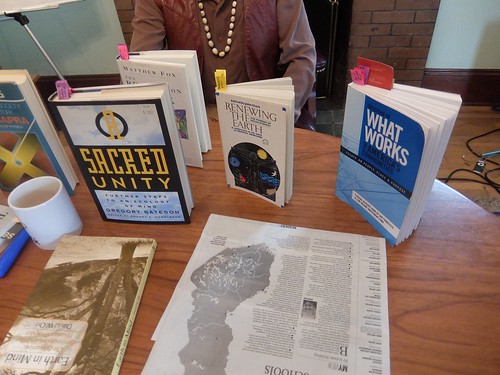
I've started with the third book in the trilogy, Foams, which author Peter Sloterdijk says in the introduction is OK.

I'm fortunate to live near a true scholar, Glenn Stockton.  He now owns all three in their English translations: Bubbles, Globes and Foams.

I've been blessed with friends who were also serious scholars in my life, Alex another (we had Szechuan food the other day, at John's Landing), and of course Lindsey, and my mom.  At Princeton, my contemporary Brian Karafin opened many doors for me.

Whereas Sloterjijk is generously inclusive of Bucky Fuller in his index, I'm not yet sure how much he makes of Synergetics as providing a toolbox of spherical metaphors, right down to the dyadic relationship of self-other and the kinds of twoness one finds in generalized concepts.

The arc of Peter's work starts with the household and village as the archetypal human collective and therefore psychological seed bed for much of our thinking.  Here is the micro-sphere or "bubble" of micro-economics, the "hearth".

Surrounding the village was its cosmos, the biggest containing sphere or context, a "globe" with mediation between micro and macro spheres perhaps through a castle (a residence for temporal powers) or a church and its priests (eternity based).

The cosmos was ontologically spherical and provided a celestial cast, of angels, demons, beings beyond human.  The microcosm was contained within the macrocosm.  Both architecture and alchemy sought to harmonize these relationships.

Any sense of shared consensus sustaining the aforementioned Old World Order, which Peter anchors in European history, has since broken down.  The old cosmologies have burst asunder and we experience ourselves in diaspora, more like a foam, with no parent globe to console or contextualize.

However, in his recent writings about orbiting space stations as likewise consciousness-altering, not just for their denizens, the metaphor of Spaceship Earth seems not far beneath the surface.  That's a globe, a promised land, we might still agree on.  He cites McLuhan a lot, tracing the latter's possible indebtedness to Toynbee for some of his ideas.  But does he fully appreciate Fuller?

The "kinds of twoness" to which I referred, as "in pure concepts", would be:
  • the inside-outside dichotomy, the state of being contained, which more negatively is one of being imprisoned, encaged, fenced in (the "buckyball" of 60 carbon atoms is likewise a "carbon cage" analogous to the "carbon- or nano-tubes" of the same graphene substrate).
  • the twoness of polarity and axial rotation: the globe spins, the record plays, great circles and hemispheres are formed.
With the sphere comes notions of convex/concave and of spin/polarity. Given the generic growth formula 2 * P*N*N + 2, where P are the shape-modulating primes, N a sequence of consecutive integers (linear growth vector), we associate the first term with radial exponential growth, and the +2 with the constant presence of any axial pair.

In Foams, Sloterdijk devotes a lot of attention to gas warfare, and also psychological warfare (atmospherics) and manipulation through propaganda.  Warfare turned from attacking combatants to undermining their environments.  The modern awareness of "climate change" owes a lot to the science of killing and/or "neutralizing" ourselves in large numbers.

DSCF1704

Thursday, December 01, 2016

American Transcendentalism 101


Some literati and cogniscenti want a simple linear tale, nothing too parallel, with forking.

As a Quaker though, with "Beanite" a parent class, I'm used to forking and have no problem with Pragmatism and Transcendentalism running parallel, even unto this day and age.

Wednesday, November 30, 2016

Fighting the Nukehead Nations


Friday, November 25, 2016

Web Components


Monica is way beyond me in her depth of knowledge regarding how we're now able to define custom HTML tags, meaning components, with their own encapsulated behaviors, state and styling.

I've done lots of GUI programming in my day and so "widgets" are not new to me, but how they're embedded in HTML + JavaScript desktop and mobile apps, using the Polymer library, is something I'm interested in learning more about.

In the new HTML, which structures the document per the Document Object Model (DOM), we have what's called a "Shadow-DOM" tightly coupled to specific HTML tags.  Defining web components involves stuffing little shadow DOM pockets with hidden functionality, though with the right developer tools you're free to crack in and read it.

If a website comes from a server it more than likely is talking to a server, that goes for phone apps as well. There's nothing open source about most websites other than the fact the tools to build them are open. Developers have made it easy to develop black boxes.  That was never going to go away.

However by training on a lot of the same tools, we learn to hop around among the boxes, contributing within each, bringing the lessons from one to another.

Monica is a fantastic teacher and speaker.

Wednesday, November 23, 2016

Wanderers 2016.11.23

On R-Pi 3 over VPN
:: working through JavaScript challenges 
using a Nodeschool Workshopper script ::


Naming this group Wanderers owes much to a saying of Mandelbrot's, the fractal guy (I met him, gave an opening talk before an elite audience at PSU, before he came on as the main event).

Here's that quote we use for a tagline:
"Science would be ruined if it were to withdraw entirely into narrowly
defined specialties. The rare scholars who are Wanderers-by-choice are
essential to the intellectual welfare of the settled disciplines."

(Benoit Mandelbrot)
I'd say we're also name that because our conversation follows a pattern I first noticed from the backseat for a car of the floor of a living room:  none to speak of.  Or rather, themes may develop and cycled round to, but a lot of what goes on around a dinner table, say, is "rambling".

I rambled in late, having overslept.  Several topics had already been broached, obviously.  While I was there the conversation turned to airport security dogs, species of rat used to sniff out land mines, bomb and drug sniffing.

What occurred to me later is how we'd ventured into a mainline theme around Thanksgiving in the US, a national holiday associated with traveling.  Chinese have those too.  The trains, not just the planes or the buses, feel the added weight and responsibility, given so many travelers.

I'm fine with the hypothesis that group dynamics exhibit replicable phenomena. Nick Consoletti did his doctoral dissertation on "Bohmian dialog" and had hoped to attend a class led by Dr. Bohm himself at Schumacher College in England.  Nick did his thesis work in Eugene, starting a Bohmian dialog group himself and making recordings (with permission of the participants).

Bohm's theory was conversational fields could be established that wandered within constraints and actually produced useful results when no individual nor even faction could for long control the flow.  Think of a focus group without a focus.  That's what Wanderers sometimes achieves.

What I also hadn't realized, at least consciously, as Barbara had brought the dog she cares for sometimes, to the Linus Pauling House (our venue).  Our conversation centered on responsibly employed non-humans who serve us loyally, without our non-human guest saying a word.

Much of the rest of the day was code school business, talking with one about an offer, advising another taking a JavaScript-only (mostly) tack.  One needs to say "mostly" as all these languages negotiate within an ecosystem of other languages.

Thanks to Nathaniel Bobbitt I was able to learn about Nodeschools and their Workshopper technology.  I'm plowing through some of those.  Note how they've been done in many human languages.  i18n is one of my themes.

CBS News tonight was very much about the nation's transportation arteries, especially around WDC, site of many a monument, including the one to Lincoln, the last story's focus.  I'm likely to join the throng, hoping for a lull on Black Friday, when a family branch has strategically staged their Thanksgiving dinner meetup.  I've already made some pies, and dented one of them.

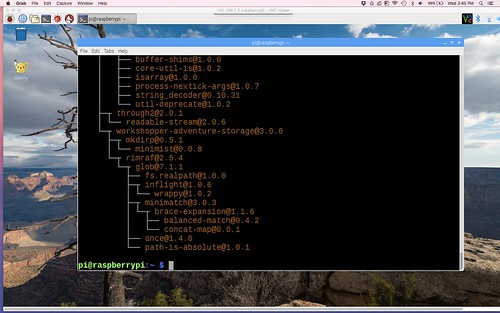
I'm running the Node modules, downloading through NPM, on my Raspberry Pi 3 in the basement.  I used to visit the basement to use the R-Pi 3, but now I just VPN into it, and use the UI in a window from anywhere in the school (a home school hybrid, as allowed by law).

Installing javascripting: a Workshopper module
:: R-Pi from Mac Air over school LAN ::

Saturday, November 19, 2016

ISEPP Lectures Kickoff (2016-2017)

ISEPP: Moral Arc
The formal name for this lecture series is the Linus Pauling Memorial Lectures, organized by Terry Bristol's ISEPP (I used to serve on his board, and before that my partner Dawn was his bookkeeper). Tonight was the first lecture this season.  He's had an historic lineup of MVP (most valuable player) speakers, tonight's speaker being no exception.

Michael Shermer has made a name for himself around Skeptic.com and as a columnist for Scientific American. Other Wanderers besides me have had him on radar more than I, especially Glenn and Christine (and of course Terry).  Dr. DiNucci was there as well, and the BuxtonsJoe Arnold.  I learned a great deal about the "Eclipse Economy" that's sweeping a sometimes reluctant-to-care central Oregon.  August 21.

The lecture was perfect for the occasion, relaunching the lecture series, and right after a contentious US presidential election.  His message is similar to Steven Pinker's:  objectively, many global trends are positive, in terms of less slavery, torture, outright war, more animal rights, more rational problem solving.  The lecture hall was comfortably full, with many in the balcony pews.

Saying yesteryear's kings and queens had low living standards compared to those of us with air conditioning, central heating, refrigerators, was like a direct quote from Bucky (music to my ears in other words).  "Accentuating the positive" remains a high calling, whereas evolution seems to predispose us to focus on the negative.

Given my recent immersion in Jungianism as filtered through Russian mysticism, in the form of the four volumes I purchased by Maurice Nicoll, I was quite open to hearing about how negative emotions tend to drive the action.  We're at the mercy of "monkey mind".  That's how science and rational design patterns help us grow and mature as a species: we overcome mere reflex-conditioning.

He's not worried about overpopulation.  The only terrorists he's really worried about are the ones who want to be dead, and think taking us all to kingdom come would be a best course of action.  He sees more hope for those wanting to make course corrections as democracies are on the rise and he has charts and statistics to argue that's a good thing.

Shermer was brave and bold with his content, mocking the ethics of ages past.  "What were they thinking?" is his implied caption to many a grim scene, from Medieval torture chambers to more recent lynchings.  Mom reminded me later, when I briefed her on the lecture, that Eleanor Roosevelt was dead set against lynchings but FDR was mindful of wanting to keep the southern Democrats in his camp, a balancing act.

Michael is not shy about reminding us that when it comes to committing atrocities, no one holds a candle to certain Christians. Lets remember the Hitler Holocaust for what it was, a culmination of long-running trends.  But then he shows that acts of genocide in general are going down.  Lets not pretend ISIS invented beheading.

Speaking of beheading, in keeping with his French Enlightenment spin, he advertised the guillotine as maybe the most humane of the capital punishment devices. At least it's fast and efficient. Certainly "old sparky" is not withstanding the test of time.  He thinks our ugliest practices are on the wane.  That's what his new book is about, The Moral Arc.

At the dinner afterward, to which I was cordially invited, Glenn and I had a whole table to ourselves.  I wandered around snapping pictures, discarding most of them (not the best light), and enjoying the catered repast, certainly world class.   The downstairs area of the First Congregationalist Church is perfect, as is the upstairs meeting space.

"How is this not a religion?" would have been the pithier version of my question, but meant inclusively, as Shermer was certainly seeing the great religions as masterful in their ability to adapt.  He expects most of them will survive the Darwinian process, and as I often put it, the best religions are yet to come. Dr. DiNucci had just attended a church that meets weekly for singing and sermons, but with no talk of the supernatural encouraged.

During dinner, a butter aficionado visited our table wondering if he could take some of the butter balls.  He returned for the rest of them later, saying his objective blood test data showed he could neutralize bad effects of carbs with plenty of butter.  He enjoyed fatty breakfasts based on similar reasoning.  We agreed this might be a personal quirk of his own biology.  We're not all created equal when it comes to the details of our metabolism.

Wednesday, November 16, 2016

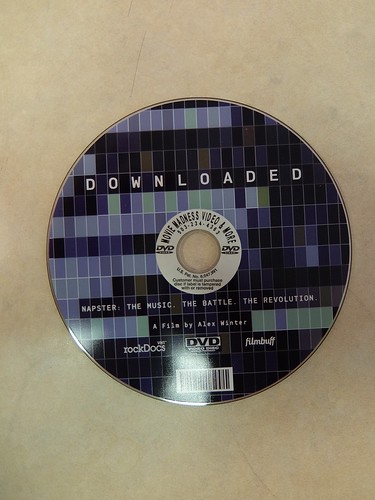
Downloaded (movie review)

DSCF1323

Historians will appreciate this quality anthropology.  Two cultures clash:  hackers with Hollywood, with the Feds hauled in to mediate through their Congressional and Court system.  The executive branch was also involved, leading to FBI warnings next to all these copyrights.

As Bucky Fuller points out, making money means keeping supplies of something scarce. Sometimes the floodgates burst, as happened in the case of Napster.  The paywall broke down.

The hackers were young and assumed adults in charge would have an optimized response to their disruptive technology.  A positive synergy would be discovered in short order.  On the contrary, the generation aging out was defenseless and had no choice but to go on the offensive, to save its way of life.

Fast forward to 2016 and the infinite copiability of digital assets is akin to the power of DNA to reproduce.  Any reproductively active adults are capable or creating new billion dollar humans (applying a government published statistic).  Imagine having to buy your factory-made children and all the hoops they'd want to put you through.

Some musicians were overjoyed to see that, along with pornography, the new telecommunications technology was quickly harnessed to channel them.  People wanted their music, more than anything.  Facebook would come later.  Other musicians understood their incomes were in the hands of an unprepared music industry and joined in the battle to shut Napster down.

I'd just hosted an after-Wanderers party, pumpkin pie served, and had at least one after-party viewer crashing on the couch.  I may have misunderstood that I was seeing a lot of the same people over time, mistaking the older versions of X and Y, for new talking heads.

However, that mistake is in keeping with the moral of the tale, which is never mind how fast the technology is changing, humans are able to reprogram themselves at a relatively finite rate.  More than one generation is needed to implement the adaptations.  The pioneers get to hit the proverbial "brick wall" or whatever it is that cannot abide change.

The whole topic of file sharing is too big to handle except in the abstract, in principle, whereas in reality we have special cases, such as hackers versus Hollywood.  The makers of this documentary understand they're exploring some deeper issues with even wider ramifications than an overhaul of the Hollywood music industry.

I go back to Hillsboro Police Department, here in the Silicon Forest (this Hillsboro is a township west of Beaverton).  Chamber of Commerce types were prodding public schools into yoking police into coming into classrooms and scaring the kids about the anti-capitalist practice of "pirating" (you could go to jail, and bring disgrace to your family).

The police were not dummies though and understood a new Free and Open Source culture was inspiring hopeful hackers to share their talents freely, using GNU / GPL and other innovative legal licenses.  Instead of just scaring the kids and criminalizing their natural tendencies, why not show them a better way?  HPD actually started its own Linux Lab as an after school opportunity, myself one of the instructors.

Rage Against the Machine

Monday, November 14, 2016

More Lessons from the Cold War

seymour hersh: "vietnam junkie" and journalist-historian

US presidents tend to gauge their own power in terms of their ability to force "regime change" in other parts of the world.

The overthrow of Mosaddegh in the Eisenhower years and the re-installation of the puppet Shah of Iran gave Allen Dulles and cronies a sense of what's possible. Guatemala then too, with Chile to come later, under Nixon.

Cuba was a more intractable "problem" as we see in hindsight, and now also Syria.

The White House has already been used as a platform to insist "Assad must go" with little thought about the day after.

President Obama admits his most serious mistake might have been not thinking about "the day after" in Libya, where a similar "must go" posture was struck.

A major symptom of a government imagining itself to be a "superpower" (i.e. having superpowers) is this insistence on having both the right and the wherewithal to overturn ("topple") other governments.

Keeping the people in line and in favor of "regime change" likewise requires endless bombardment with propaganda.  Minions need to be perpetually persuaded they're following the right leaders.

"Assad uses barrel bombs"; so did the Pentagon, in great quantities, during Vietnam, they're less expensive.

"Assad gassed his own people"; the evidence suggests that famous sarin attack in Ghouta was engineered by Assad's enemies.

Yes the "civil war" in Syria is ugly.  So was the civil war in the US.  Adding cruise missiles and stealth bombers to the equation has so far not helped any.

Any except the weapons testers that is, who are having a field day with their criminal undeclared war on civilian guinea pigs, the pattern since WW1, and outlawed by the Kellogg-Briand Pact.

"Saddam Hussein has a nuclear weapons program"; the allegations are designed to create fear in the general population and therefore support for more military action.

Or is popular support even a requirement anymore?

Opposition to the war against Iraq was huge, yet the WDC government went ahead anyway, bringing narratives about "democracy" to the brink of bankruptcy.  Are we back to monarchy then, or is it oligarchy?  Welcome to the Banana Republic of North America (BRNA).

Does there ever come a point when a population develops antibodies to all this fear and manipulation by those suffering from a "superpower" military-industrial complex?

Do we have any kind of antidote for this Fourth Reich mental illness?

Stay tuned.

As a footnote to the above interview:  my understanding is General Krulack's office in the Pentagon had arranged for Diem's transport to Europe but Diem was not yet ready to admit defeat and balked (sources: L. Fletcher Prouty, admittedly controversial; corroborating sources: intended arrest; CIA memo). The Kennedy brothers hoped he'd get out alive, understanding their position was high risk.

Saturday, November 12, 2016

Cold War Stories

Talks about the "U2 Incident"

Long time readers of my blogs will maybe have seen how I bring up the "U2 incident" from time to time. This is another one of those times.

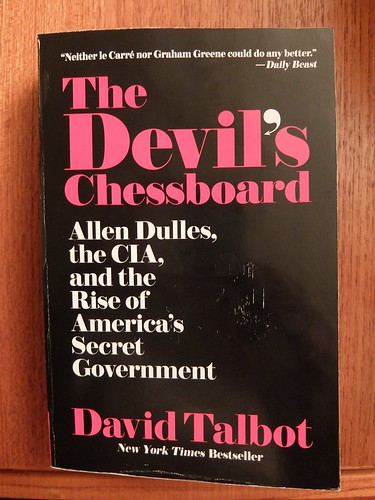
David Talbot cites L. Fletcher Prouty, or "Man X" — played by Donald Sutherland in Oliver Stone's JFK — as especially knowledgeable about the U2 incident.

However David sticks with the conventional narrative, that missiles hit this supersonic spy plane at high altitude, whereas Prouty himself calls that story line into question.

Prouty sounds a lot like a prototypical "9-11 truther" in calling the basic physics into question, wondering aloud in several passages, how Gary Powers could have survived.  Did he eject before the missiles hit?  Why did he have all that incriminating ID on him?  Might he have simply landed the plane instead?

The operation certainly cost Allen Dulles some respect and judging from Prouty, that may have been a principal aim. Not everyone was suffering from blind hatred for Communist Russia, certainly not Lee Harvey Oswald, who'd also worked in the U2 program in Japan. A smart Marine, he was curious about what life might be like in the USSR.

Allen had only partial or limited control over operations but had promised the moon, having seen regime change in Iran as proof of his superpowers.

The former OSS was never altogether sold on the idea of dominoes in Vietnam either, witness Daniel Ellsberg of RAND, a strong patriot who simply didn't buy the old guard's fading worldview.  Ditto Ralph McGeehee.

Trying to bully or intimidate these people, already skilled, doesn't always produce the intended results.

Eisenhower was under a lot of pressure after WWII to use the "nuclear advantage" for something meaningful.  The Devil's Chessboard chronicles how irresponsibly John Foster Dulles, as Secretary of State, blundered about on the world stage, confusing Tunisia with Indonesia while threatening everyone with nukes.

Friday, November 11, 2016

Armistice Day 2016


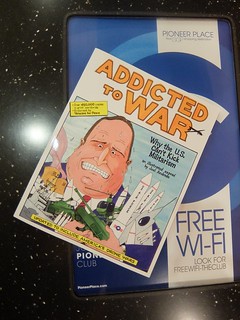
The theory or model put forward by the Armistice Day speakers today is pretty well spelled out in Addicted to War, a tome mom likes to distribute, used in some schools.

Outward war is obsolete given our present day technology, however many industrialists depend on heavy war spending to stay in business and adjudge the victims of war expendable collateral.

Madeline Albright is one of the champions of the "expendable collateral" view, having famously expressed her opinion that the mounting death toll in Mesopotamia had been "worth it" in terms of her own bottom line.  Whether infant mortality rates were really as high as she was told is a separate question.

Weapons systems need to be tested, and sometimes there's just no good substitute for real human subjects. Panama provided tests for the Apache helicopter.  Iraq, Syria, Yemen and Afghanistan have become a playground for those who murder by bomb, drone and cruise missile.

One of our speakers invoked Einstein, known for his anti-nationalism.  Albert was asked to be Israel's first president however he wisely saw this as a trap in terms of his own personal integrity, even if his vanity was given a boost by the invite.  Besides, what would a theoretical physicist know about governing a country?

At the end of WWI, people were sick of war and agreed to end them. The Kellog-Briand Pact, ratified by the US, became the law of the land, as well as a basis for the Nuremberg Trials and the UN itself.  Quoting from Wikipedia:
As a practical matter, the Kellogg–Briand Pact did not live up to its aim of ending war, and in this sense it made no immediate contribution to international peace and proved to be ineffective in the years to come. Moreover, the pact erased the legal distinction between war and peace because the signatories, having renounced the use of war, began to wage wars without declaring them...
True enough, but why blame the treaty?

The signatories, in refusing to declare wars while continuing to engage in them, merely exhibited their lack of moral fiber.  It's not the fault of the treaty that its signatories are so inept and lacking in integrity.

The Power of Nightmares was a fine documentary in charting how wars could be kindled based on tensions between cultures. Politicians, as well as journalists, have learned that getting wars going may be a part of their job description, if they want continuing support from the munitions makers.

Whether a war is illegal or not is secondary to its ability to serve certain economic interests.

Smedley Butler, a decorated US soldier who defended FDR against the Business Plot, expressed his disgust with what I call Cowardly Capitalism in his short essay War is a Racket, oft quoted by the denizens of OPDX.

DSCF1261

Wednesday, November 09, 2016

Wanderers 2016.11.9

DSCF1029

We're convened at the Linus Pauling house. I came in late and found the discussion was about municipal restrooms, public infrastructure, its state in our city.  That was something we looked at during OPDX as well, an ongoing issue.

Glenn bravely agreed to do a presentation, the morning after election night.  I expect we would have rehashed the electoral results had we not preprogrammed the discussion.  Glenn had a bag of books he's been reading and did a "reading rainbow" kind of thing.  The focus was public policy.

We're also talking about drugs and drug pushing.  The legals don't call their hype or advertising "pushing," a term used to differentiate themselves from the black or grey market competition, which they marginalize through criminalization.

Speaking of which, Proposition 64 passed in California.  Law enforcement doesn't see criminalization i.e. locking people up, as having anything to do with public health, because of course punishment for crimes is unrelated to providing remedies for social ills.

The military is a big user of drugs as well, with government approval and encouragement, also as a source of funds for "black ops" (unaccounted for, off the books). Warlords & Ganglands is a hot seller game in supermarkets this Christmas.  No wait, I made that up.

Glenn's commentary is somewhat along the lines of Michael Moore's Where To Invade Next? in that he's circling relatively more enlightened approaches in other countries that it might pay to adopt, Finland's in particular.

Direct A-to-B action, which always looks so rational and right, turns to unobtainium rather often, doesn't it? "Precession" is not big in most vocabularies (not even in my spellchecker -- now it is), along with "deliberately non-straight lines" -- two Buckyisms we pick up reading Synergetics (not a popularization of anything, so not really that popular).

The psychological commentaries by Maurice Nicoll seem pretty clear on a "second force" which is not equal and opposite (as then nothing would happen) but almost, with a resultant payoff or outcome. The payoff may not be what one expected though -- alluding to last night's election.  Nature tends to be surprising, the future unpredictable.

Nicoll's system is psychological though, not counter-posed to Newton's laws.  Synergetics actually paints action - reaction - resultant vectors into its low level event physics, somewhat a break with the past, and therefore more of an uphill project.  Anyway, something to think about.

I was thinking of heading to Th'underground today.  Measure 97 went down to defeat, despite our best efforts, but I haven't given up on #CodeCastle, a project relating to teacher training.  However Wednesdays feature a special schedule with shortened hours as I recall, given the space doubles as a food distribution site. Th'underground is a coffee shop in the #CodeCastle basement.

kirby_comics
:: political cartoon ::

Tuesday, November 08, 2016

A Next Project

Background Context

A next medium project I need to take up, but I'm not sure in what medium (so many media to choose from) will be directed towards Philosophy Space (also known as "Philosophy World").

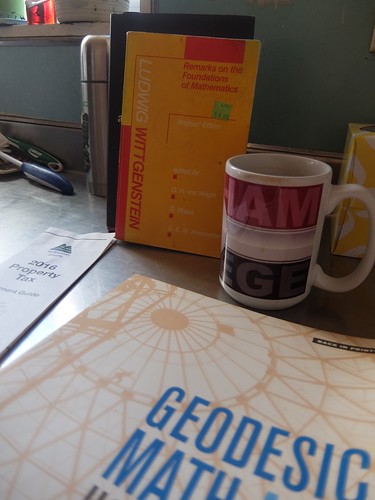
Ludwig Wittgenstein's Remarks on the Foundations of Mathematics (RFM) are annoying to many practicing mathematicians, because the tenor of his remarks do not reflect how they tend look at "foundations". Ludwig seems to turn them to slurry in some cases, undermining their eternal validity.

Similar annoyance is expressed towards another rank outsider businessman industrialist of the 20th Century, the guy who helped bring us the DEW line (see Cold War relics).  He purported to have a novel way of modeling multiplication in higher dimensions (like > 0).  What does that even mean?

Those who've familiarized themselves with LW's writings (sorry, I'm fine with initials, no hagiography need apply), come to see he's got some good points, worth sharing.  These days I'm coming to learn how much he mined the William James corpus for good examples of a philosopher really doing some thinking.

Likewise, the "Bucky stuff" is not just fluff, as the tetrahedron is indeed a topological simplex, so trying it on for size as a volume unit is hardly a radical idea in the rear view mirror.  What's radical is a vista wherein so few have thought to try said experiment, but then who's had the time or the inclination?  Now we've got it, and can kick it around.

Piling on these two annoyances, Wittgenstein's remarks and Fuller's fork in geometry, come the makers of "caltrop math" (non-violent despite associations twixt caltrops and acts of war).  The XYZ coordinate system has a new buddy, not saying I know the gender (of either really).  The IVM made by Bucky easily accommodates said "quadray coordinates" (pioneered after Synergetics was published).

Stay tuned as to medium.  In just getting this outline out there, I'm hoping to spark some more interest in the background materials.  Check Wikipedia and like that.

Think of it this way:  what would it be like to inject Quadray coordinates into Wittgenstein's remarks? The Bucky stuff is certainly like a Renaissance Neoplatonism.  These are science fiction moves, contrary to historical fact, designed to kindle new fires in some imaginations.  Not everyone is into philosophy obviously.  A positive outcome I would expect is a growing familiarity with some innovative ideas with practical applications.

Transcendentalist Readings

Saturday, November 05, 2016

Bagdad Meetup

I enjoyed a productive meetup with Nathaniel Bobbit at The Bagdad last night.  He's widely read, and in more than one language, having studied Heidegger in Spanish, Husserl too maybe.  He'd been married to a Spanish non-English speaker at one point.  He's looking at tackling Russian these days, an admirable challenge for a man in his early sixties (we're close to the same age, as I'm in my late fifties).

We talked about whether Bucky Fuller could be categorized as a "transcendentalist" or not.  The common wisdom is that school of thought was tied off a long time ago, to be succeeded by "pragmatism".  He clued me about The Metaphysical Club, a Pulitzer Prize winning book on the latter, by Louis Menand which I can get for my Kindle for under $10.

Actually, it's hard to get Fuller squeezed into any camp of philosopher, despite his mind-brain distinction and frequent used of "metaphysical" within his corpus, I think largely because he patented and built artifacts. Philosophers don't putter about with cars or domes, right?

Nat hadn't known about Fuller's meetup with Ezra Pound towards the end of the latter's long life, when he'd mostly given up making public appearances and was living in Italy.  Ezra first met Fuller in Spoleto and then attended his talks near Venice.  Some of these details appear in The Pound Era by Hugh Kenner, and in Humans in Universe by Anwar Dil.

Mr. Bobbit also clued me about the work of Patrick Hanks in corpus pattern analysis, wherein one uses computers to tease out how words are actually being used (usage patterns).  I recall a talk on Python's being used for that.  The "semantic web" was a different, though I'd argue related project.

I hadn't known of Edgar Allan Poe's invective against the transcendentalists of his day and understand how that'd lead to raised eyebrows around his Eureka: A Prose Poem — was he being satirical?  I'm guessing it was more a case of feeling he could do a better job.

E.J. Applewhite saw it as in the same ballpark as Fuller's Synergetics in two volumes (Macmillan) which had also threatened to become a prose poem if not properly shepherded.  Applewhite also compiled the four volume Synergetics Dictionary, a kind of corpus pattern analysis vis-à-vis the Fuller namespace.

Speaking of Python, I met someone at the Quaker meetinghouse who uses the teaching of science to teach English as a Second Language (ESL), and I asked her if computer programming were ever used in that way.  Object oriented thinking requires a kind of generic precision, a kind of grammar, based around the new punctuation of "dot notation".  We have these noun.verb() and noun.adjective forms, where nouns will have types, even ancestries.

ESL students tend to like the level playing field aspect, of all learning something new together.  The namespace keeps the English from wandering off into a tangle.  We have our attributes, properties, behavior, inner state.  We even have a 'self' in Python.  Of course other languages besides English could piggy-back on computer science, as a way to introduce themselves coherently.

I clued Nat about the Bubbles, Globes and Foam volumes, relatively new in English (translated from German).  Fuller is in the proper names index.

Tuesday, November 01, 2016

Identity Politics


How one deploys an identity makes a difference.  In identifying as Quaker, I go back to when Philadelphian Friends were somewhat upbeat about a utopia to come.

In the heady 1790s, some of the avatars of industrialization actually thought they could see light at the end of the tunnel, a way out of some Dickensian hell based in class warfare or whatever.

A company town really could be idyllic, not some battle ground twixt management and emergent unions.  Or maybe it's not a "company town" just a town where companies and its universities share a lot of values and resources.  They wouldn't be munitions makers.

Fast forward, and the Quakers' AFSC, like President Hoover (a Quaker), was resisting the allied blockade against Germany, pursued by Britain in 1915-1919.

Likewise, the Quakers resisted the economic sanctions against Iraq imposed by US State Department secretaries Madeline Albright and Condoleezza Rice.

The Nixon-Kissinger policies versus the Vietnamese were likewise cast as morally bankrupt and illegitimate.  Those of us in the liberal wing at least, welcomed Jane Fonda's visit to Hanoi.

But then US intelligencia has long decried Manifest Destiny syndrome and its craven craving for imperial powers.  Such craving is both the weak spot and the blind spot in the American psyche, as many historians will aver.

Any modeling of the USG on ancient Rome's imperial chapters, has never sat well with many who'd supported the American Revolution in principle, George Washington included.

A core goal of the latter was to get free of monarchs and their imperial designs.

Of course calling US policies "imperialist" always sounded kinda corny, the way those Commies talked.  That's until we got to reading the more serious histories and journalism and understood better how the shoe fit.

Anyway, I don't find it surprising that I think a lot like Mark Twain and William James when it comes to the Philippine-American war.  I lived in the Philippines long enough myself to do some thinking on this relationship.

These days I look at Puerto Rico, the lawsuit by the Marshall Islands against the nuclear powers (which the World Court decided not to hear), and the Ban Treaty, working its way through the UN General Assembly, and think this sort of non-violent defiance against nuke heads is very sane.


Saturday, October 29, 2016

Surveying Pedagogy


Long time readers of my writings, such as any remain (of my writings, as well as of long time readers), may have come across my use of "andragogy" a lot, in contrast to "pedagogy".

In 2016, "andragogy" is a recognized word, in Wikipedia and so on, however spellcheckers generally won't have it, out of the box.

Andragogy means "the teaching of adults" whereas "pedagogy" is about teaching children.

Yes, "child" and "adult" ("peda" and "andra") are cultural categories and vary depending on how much childhood is even recognized, or how.

As Eugene Khutoryansky points out in one of his rants (Why Children Should Rebel):
Our current concept of childhood is a relatively recent invention. Throughout most cultures throughout most of human history, individuals today referred to as "children" had the right to marry, serve in the army, and even act as the head of state.
I bring up Eugene on purpose as really his work is what I'm surveying today, having just come across it this morning.  He has produced and published some interesting physics and mathematics teaching movies.  Check them out!

As I wrote to PhysLrnr-L, which I joined on invitation of Dr. Bob Fuller, whom I collaborated with on a First Person Physics project:
Is the surreality of Eugene's world extraneous?  A cat watches the action in the Quantum Mechanics video, while the Maxwell's Equations one is inhabited by two angels in a somewhat Gothic setting.

Given "Maxwell's Demon" is already in the literature, and that we've all heard of Schrodinger's Cat, I didn't see the imagery as entirely extraneous.  He's alluding to known memes.
In the mnemonic arts since Cicero and earlier, the idea of using exaggerated-because-more- memorable imagery has been encouraged.
I've got a slide show and maybe a recorded talk called Pythonic Andragogy out there somewhere (once as a Lightning Talk in Santa Clara, at a Pycon).

I taught Python, the computer language, to adults a lot.  But then weren't Saturday Academy students pretty adult-like in some cases?

Again, culture and ethnicity mean many parameters stay in play, as we investigate whether andragogy deserves a long term future.

Thursday, October 27, 2016

Bed Time Stories

The scruffy hacker story, wherein Fancy Bear sparks indignation across the board, owing to connected Wikileaks revelations, meets expectations.

Bernie is close to Commie himself right?  So sure it makes sense these idealistic "open sourcerers" would be seeking revenge over how he was treated by Hilarious Hillary.

Lots of geriatrics have fallen for that phishing trick and easily empathize with poor AOL users and so on.  The white hat script kiddies are happy to explain how it all works, to their puzzled parents.

The other story is about the Internet of Things and how a bunch of wayward appliances all rose up in unison to attack Twitter, Netflix and Spotify.

This wasn't phishing, but something new.  Actually denial of service using bots and zombie computers is not new at all, but we're to understand the scale and focus of the attack was record-setting.

The scruffy hackers, connected to the Russians by as much slathered innuendo as possible (no wait, one of the long gone founders of the KGB had his name mistakenly not removed!) have the tamer old fart tech.
Fancy Bear is Russia, or at least a branch of the Russian government, taking the gloves off,” said one official in the Department of Defense. “It’s unlike anything else we’ve seen, and so we are struggling with writing a new playbook to respond.” The official would speak only on condition of anonymity, as his office had been barred from discussing with the press the US response to Fancy Bear’s attacks. “If Fancy Bear were a kid in the playground, it would be the kid stealing all the juice out of your lunch box and then drinking it in front of you, daring you to let him get away with it.  [ Buzzfeed ]
In contrast, the masterminds behind the toys, the attacking "things," seem to be getting away with their nefarious antics scot-free, with almost no questions asked.  "Few leads" says The Guardian.

The Russians seem to be manageable Bernie supporters, geeks in their basements with too much time on their hands.  Their motives seem understandable.

The dot com attackers, on the other hand, seem to still have their off switch and an army not easily stopped.  The corporate muggles are admitting their laziness.  Yes, their "things" may be gamed.  Don't forget to change your toaster's password.
"Nothing survives floods of this nature, existing or theoretical, centralized or decentralized,” Kaminsky said. “It all falls over. The hard questions here are about preventing this sort of exposure in the first place, and about improving our ability to respond and remediate when we do get it wrong.” Prevention and remediation are the only options in the kind of attack that paralyzed Dyn, Kaminsky said. [The Guardian]
This second, apparently not-Russian cabal, flipped their switch on and off a couple times, while engineers scrambled to "mitigate" the effects, however there's little evidence of real defenses or any actual mitigation.  The attacks simply ceased, ready to begin again another day.

Supposedly Homeland Security was looking into it.  How about the FBI?  In terms of how big a vulnerability was exposed, the scruffy Wikileaks phishing scandal doesn't hold a candle.

Duping individuals is little league compared to bringing down a core name server.

The upshot is someone with an off switch for the Internet is newly enthroned as Voldemort, while the Russians get to play second fiddle as scruffy hacker idealists, more Snowden types, in league with Anonymous no doubt.

The implication in the case of Fancy Bear is youthful rebellion on display, whereas the other attack is both more ominous and more unconscious, more sleep-inducing, more forgettable.  The corporate persons seem more eager to play dead, or at least roll over.  The Russians seem less scary, less a giant to obey.

We're not really planning a lot of "who did it" stories in the latter case are we?  It's more a tale of grin and bear it. You're at the mercy of Voldemort, and don't forget it — now forget it, until we remind you.

Of course there's been some attempt to connect these two stories, I'm aware of that.  Wikileaks is getting its revenge for some stale state trying too hard to be a hero.  That connection is not widely alleged however, only whispered into the rumor mill (or maybe bull horned if from Alex Jones).

Another bed time story is "911 was an inside job" but there I'd have to say why tell it that way?  A cabal of desperate outsiders, feeling powerless, thought this might be a way to seize control, and nothing panned out how it was supposed to.  Whatever the point of the plot, it got lost.  So much for "insiders" right?

Wednesday, October 26, 2016

Wanderers 2016.10.26

Prepared to Vote

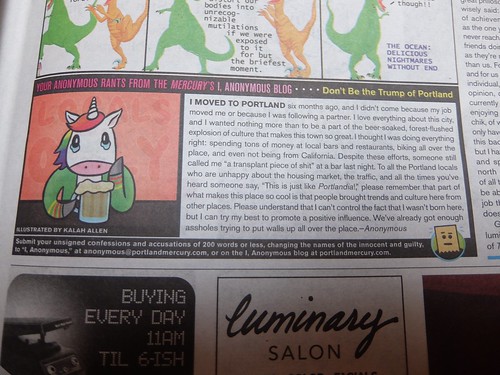
I brought my ballot along, and the Portland Mercury for some guidance on the more esoteric measures.  I was gonna vote in front of everyone, as a fun input to the conversation.  However I don't have the right blue or black ink pen.  By the end of today for sure.

We agree about Measure 97 (the paper editors and I), whereas Willamette Week came out against it.  Probably not enough information about where the money would go has come forward.

I understand suspicion about abuse.  I've urged these big companies that'd pay more in taxes, to get involved in public policy more explicitly, like Mentor Graphics does.  That doesn't necessarily mean creating more charter schools.  How does one create new public schools that are not charter schools, by the way?

When we started at Sunnyside Elementary, a bevy of parents had built a school within the school, and even had some hire-fire responsibilities vis-a-vis the teachers. This was a public school.  In Portland, anything is possible, might be a useful motto, even if the "laws of physics" still pertain.

For one thing, big companies (if I may address you as personhoods for a moment), tell us more about how we're to integrate math teaching with coding skills.  Just telling the high schools they need to hire an army of computer science teachers, leaving math immutable, is not gonna fly. Suggestions?

I'm not being sarcastic; I have my own very good ideas.  So if someone like me, a steep property tax payer, is able to offer strong answers, maybe a fancy pants CEO might do the same?  Not that I have anything against fancy pants.

Speaking of immutability, the MVC pattern (Model View Controller) has taken a turn, with React coders understanding the data flow as more unidirectional and circular.

The Components, represented in JavaScript, pass down info about state changes to their children on a need to know basis, whereas changes to state through the UI get tossed on the heap without trying to talk directly to other components.  They'll be updated soon enough.  Treat state as a giant global.

Conway's Law says all this micro-stuff (how we code) has maxi-consequences in the form of organizational structures.  We self-organize as we conceptualize, is another way of saying it.

Think of sitting in your cubicle and getting the usual memo traffic.  Suddenly, you have a great insight or idea.  Rather than passing it "up the chain" from manager to manager, just stick it in your Github account and let sifters and peer reviewers note the state changes.

React was tossed on the heap as open source by Facebook, in danger of dying from the complexity of its own code until this new paradigm got some legs.  React is typically used with JSX, a way of avoiding a templating language like Jinja2 and just sticking with mostly HTML inside of JavaScript functions.

WJ Bio

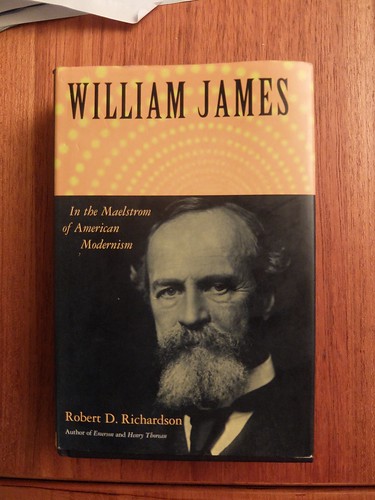
Last night I breezed through a bio of William James on my shelves (so many borrowed books I've not read!), learning of his huge disappointment over living in an imperialist bubble.  He was distraught over the US-Philippines war.

Politicians today register faux shocked surprise that the RP might be registering independence and siding with China more. The Philippines is not wanting to be proxy-maneuvered by Uncle Sam into some faux fight over fish, duh.

Quakers were semi-disgusted from the beginning, with the pell-mell eagerness of the human creature to make war, not love.  "Lets fight them Injuns" was the morons' battle cry.  And so it was. Quakers resisted stooping to that low an EQ (same as IQ in the Garden) and lost much of their clout.

Making war is far easier than building an initially fragile set of trusted relationships, later codified, then institutionalized, to make torch-passing easier.  The costs get postponed to a time when paying those costs get disconnected from root causes, and people therefore stay confused enough to be bullied into wanting yet more war.

James also found USers too high strung, too on edge.  This was well before Frenetic TV (a subtype of Hectic, a cousin of Hysterical).  What would he say today?  That USers are crazy?  Where's the news there?  USers hyperventilate excessively, reports the New York Times (can you see the headline?) — pretty much on cue.

I remember celebrating the 1999-2000 odometer flip-over in Lesotho and watching each culture celebrate as the world turned, on the BBC.  People were upbeat about it all, enjoying themselves, until we came to the US time zones, where people were crazed about Y2K.  "Are the fighters still flying?" "Check"  "Are the war ships still sailing?" "Check". William James had a point I think.

DSCF0396

Saturday, October 22, 2016

Where to Invade Next (movie review)

Rated R for Sex & Drugs

Michael Moore films follow the same pattern, well known in journalism, wherein we get to know the journalist as one of the players, an actor in front of the camera.

"Omniscient narrator" documentaries, if political in content, tend to sound phony, though many oldsters will still hear a Wild Kingdom interpretation of animal behavior without hearing a mockumentary.

There's much to say about how the ear is tuned.

So here's this bumbling guy, playing the "dumb American," stumbling around Europe and North Africa, getting a positive echo from the difference the USA makes, or made.  All those reforms Americans fought for paid off, in other countries.

Better benefits in Italy, school food in France, no drug wars or death penalty in Portugal, better prisons in Norway, better schools in Finland, more women's rights in Iceland and Tunisia, more affordable higher education in Slovenia.  The list goes on.

Everyone gets more paid vacation than average USers.  Moore doesn't even mention working for tips.

Now these relatively happy and enlightened people are hoping what they see on TV about Michael Moore's home country is not their worst nightmare coming true.

Michael Moore appears to come from some hell people wish to avoid, at this point.

How might we explain this grave turnaround in reputation, and will the USA recover?

The explanation offered has to do with a "race to the top" being harder to win than a "race to the bottom".

The recipe then, was to criminalize all drug pushing outside legal advertising, as a way to keep people down and out and/or hard at work within "chain gang" prison colonies, thereby providing prison labor to Victoria's Secret and many others. 

Operate some kind of Gulag in other words. Perpetuate slavery. Practice eugenics (war against the weak).

Whether Michael's country will bounce back or not is one of the major soap opera concerns of our time, and if Wagner were alive he'd likely have given us some great Hollywood soundtracks about it.

I'll settle for Weird Al. Like John Oliver, he's wondering if this really could be hell that we've entered, have actually been in for quite awhile maybe.

Carol has been especially eager to see this latest major box office Michael Moore flick.  She watched it from the big chair, wrapped in a quilt, eating popcorn.

Thursday, October 20, 2016

Emerging Cyberia

On kind invitation from Patrick, I walked over to his household, by way of New Seasons where I stoked up on prepared foods: chicken, brussels sprouts, macaroni and rice.  Patrick picked the beer.

I enjoyed watching the debate, the 3rd twixt the two ruling parties, with an affectionate corgi (brand of dog) jumping all over me.  Spencer joined us, while Katie flittered in and out.  That was the purpose of my visit, to take in this program.

Another "first world concern" adding actionable items to my "to do" list today is the HTC phone from Verizon, which as of two days ago is actually losing charge while plugged into a charger.  Turning it off while charging just barely holds the line.

Scouring the Internet leaves the door wide open as to whether it's a software or hardware glitch (I suspect the battery is shot, not the charging port).  In any case, it's soon to be a brick, and I'm still paying for it, so time to pay a visit to my local Verizon storefront.

I suppose the biggest takeaway, for me, was not "nasty woman" (Trump's remark) but the role of "Russians" in the national dialog.  In other times, Georgia (the Black Sea bordering region) and Crimea were maybe more front and center, or Ukraine, but now it's all cyber and Wikileaks flavored, even while Aleppo is deemed to have "fallen" to its own Assad government.

Whereas Gary Johnson (the Libertarian candidate) may not have known Aleppo was a city in Mesopotamia, I'm guessing very few political insiders could name all seventeen USG intelligence agencies that Hillary could cite as sharing her concerns about spies helping the Kremlin.

More Americans probably know that Archer worked for ISIS and that the Kremlin rebranded the KGB as something else, just like the CIA underwent a facelift to become just one of seventeen services — can you name them?

Trump is all about "dealing with ISIS" first, a goal he believes he shares with Vlad Putin, but then not the way they're doing it now, by staging a big battle for Mosul, a city to be "taken back" by Iraq. Donald ridiculed the Democrats for letting go of Mosul in the first place.

He takes a position somewhat consistent with Make America Great Again in casting Democrats on the losing side of history. ISIS won't be there given all the advanced notice to move elsewhere.

That's where the Russians come in, as outplaying the Obama administration.  In a way, that's a constructive role, as it's somewhat like poker or chess, and we see the Dems are incompetent so why not give a smart business man a chance?

I'm not saying I'm personally buying this rhetoric or narrative, only that I believe I'm fairly characterizing the Republican candidate's position.  He likes it when we're fair.

I live in Portland, Oregon which I'd say was most definitely a Bernie town (as in Bernie Sanders). The sense among Cascadians is DC is well past its prime in its ability to cough up credible theater.

The screen writing has gotten even worse than mediocre, and really has more to do with misguided ventures already in the rear view mirror.  Republican president Eisenhower was right to warn us of big business inertia and its need for war as a business expense — could be a "cold" one.

Speaking of cyber-war, I don't think the Russians' role vis-a-vis the US, here in October in 2016, is all that destructive. We're getting more immediate and relevant insight into how the game of politics is played, e.g. the shoving aside of Bernie.

Plus companies and committees (e.g. the DNC) are learning that keeping secrets is a real challenge when they're also hot properties, and this has been true since the village over the hill discovered the secrets of the catapult.

Spies might be sent over to catch up on the latest tech, or defectors encouraged to come over and spill the beans. How do these human behavior patterns work themselves out in tcp/ip world and beyond?

Sophistication around encryption is definitely a big part of it.

Businesses engaged in cyber-security for a living are being galvanized by the "Russian threat" and that could be good for the bottom line, in a purely capitalist sense.  As many security experts have been warning us, the tools of war are becoming ever more invisible.

The front line is not in Aleppo or Mosul so much, nor in outer space, but in cyber-space or "Cyberia" as some have called it, and as the debate proves.

Followup:  'twaz indeed the battery, new HTC One device on the way.

Sunday, October 16, 2016

Wittgenstein Again

Welcome to Uru

[ from emails to Nathaniel Bobbitt ]

I haven't read Peter Hacker's book yet, but having studied Wittgenstein, I somewhat get where he's coming from.

In Wittgenstein's philo we're trained to see words gaining meaning through use, not through pointing to phenomena.  "Words do not point" might be the slogan. 

Ergo "understanding" "thinking" and "pain" connect to introspected "mental events" in only tenuous / tangential ways.

Not much temptation on my end to imagine "understanding" as a "brain process" in any direct one-to-one literal sense.

Saying "bacteria respond intelligently to stresses in the environment" is not metaphoric nor anthropomorphic usage, merely an extension of common everyday usage. 

Ergo an "intelligent response" requires no brains at all (bacteria don't have them).

The supposition that "desire" "empathy" "false belief" are "mental states" in the sense of signature brain configurations, is extremely alien to my way of thinking but doesn't mean it won't be useful in motivating pattern matching and ToM reasoning skills.

Thursday, October 13, 2016

High School Math Notebooks


Sunday, October 09, 2016

Fuller's Legacy

"Bucky stuff" on CBS Morning Show (2009)

This well-produced 2009 segment reminds us of the "Bucky stuff" focuses on the practical applications of Fuller's ideas, which is not a mistake in any way.

However, my "stridency" (one might call it) in my Tweets (can anything called a "tweet" be "strident"?) stems from the a priori coherence of the unit volume tetrahedron idea.

Even with no practical applications (which it has), there'd be (is) a mathematics here, an approach to spatial geometry, worth passing on.

The different models of 2nd and 3rd powering, how to map 2x2 and 2x2x2 to respective areas and volumes, are where to start.  My Youtube below sets the stage.  I continue with the story under the heading of so-called Martian Math — one of many ways to go.

At this point, I'd say some understanding of Synergetics (the name of Fuller's two-volume magnum opus) and its subsequent influence, as well as its influences (what fed into it), are required simply to understand recent intellectual history.  Is that kind of history important?  To many readers, it still is.


Thursday, October 06, 2016

More STEM Tweets


Tuesday, October 04, 2016

STEM for All Seasons


One might think Barbara Oakley, author of the linked article [1], would've hit on the strategy of reading in STEM subjects in Russian, unifying and consolidated her skills in that manner.  I used Russian pamphlets on the Calculus, in translation, when a calculus teacher at St. Dominic Academy.  I was a pretty good calculus teacher.

Her critique echoes Scott Gray's of Making Math, co-founder of Useractive which later morphed into O'Reilly School (of Technology).  One needs to learn by doing, meaning practice makes perfect, whereas just watching videos (Youtubes) leads to a more vicarious understanding.

"Conceptual understanding" may prove paper thin, too fragile, when stressed by the "real world".  At the school, we emphasized "hands on" intensely, to the exclusion of any video from the curriculum proper, though as mentors we were free to cite useful Youtubes for background viewing.

I'm glad to see the infamous Forum 206 at the Math Forum has come back to life.  That listserv is really a vehicle for the NCTM (a US-based entity) so I'm refraining from jumping back in — unless and until I have some official role with said entity.

The UK has something similar, founded by Caleb Gattegno.

[1] How I Rewired My Brain to Become Fluent in Math (Nautilus Quarterly / Culture Psychology, September 15, 2016)