Wednesday, November 01, 2006
Saturday, October 28, 2006
The U.S. Versus John Lennon (movie review)
I saw this with Matt, appropriately, as John was a star in his sky, and his murder left a palpable emptiness. But this movie isn't about the senseless act of violence that ended his life. Rather, it's a shared trip down memory lane with some of our favorite talking heads. A lot of this story was new to me (I followed The Beatles from a much greater distance, mostly from my perch in Rome).
Yes, Lennon had a privileged life by working stiff standards, and probings by the FBI don't begin to approach the terrors of Vietnam, but that doesn't make him an enemy. His was a family values lifestyle, if that means loving your wife and kids and wanting what's best for them.
But when your wife is an already accomplished conceptual artist, quite able to expertly morph into some ninja princess master of psycho-guerilla warfare (as Bucky sometimes called it), and when you're one of these new breed of idols called "rock stars" whatever that means, and pretty clever besides, it's really unlikely your adventure will remain within "normal" parameters. Theirs certainly didn't.
Many of these fans (plus a few loyal opponents) were new to me, as on camera personalities, although G. Gordon Liddy I've seen and always get a big kick out of.
Richard Nixon has become archetypal in some way, surreal and Shakespearean. He's the star of his own universe most definitely, but one that's hard to break into, if you're not him. I experience compassion.
This fight between angry killer bee isms (communism... anti-communism), always so ready to devolve into stupid shootouts, as if that solves anything; Lennon was trying to show a better way to fight these battles, making them more like chess. He definitely engaged Nixon's attention, made more of a game out of it. Clowning is a serious business my friend, any real circus manager knows that.
And remember to set your clocks back tonight folks; the summer of '06 is long over, never to return. On a happier note, we get that extra hour in bed, perhaps reminding us of John. Peace.
Yes, Lennon had a privileged life by working stiff standards, and probings by the FBI don't begin to approach the terrors of Vietnam, but that doesn't make him an enemy. His was a family values lifestyle, if that means loving your wife and kids and wanting what's best for them.
But when your wife is an already accomplished conceptual artist, quite able to expertly morph into some ninja princess master of psycho-guerilla warfare (as Bucky sometimes called it), and when you're one of these new breed of idols called "rock stars" whatever that means, and pretty clever besides, it's really unlikely your adventure will remain within "normal" parameters. Theirs certainly didn't.
Many of these fans (plus a few loyal opponents) were new to me, as on camera personalities, although G. Gordon Liddy I've seen and always get a big kick out of.
Richard Nixon has become archetypal in some way, surreal and Shakespearean. He's the star of his own universe most definitely, but one that's hard to break into, if you're not him. I experience compassion.
This fight between angry killer bee isms (communism... anti-communism), always so ready to devolve into stupid shootouts, as if that solves anything; Lennon was trying to show a better way to fight these battles, making them more like chess. He definitely engaged Nixon's attention, made more of a game out of it. Clowning is a serious business my friend, any real circus manager knows that.
And remember to set your clocks back tonight folks; the summer of '06 is long over, never to return. On a happier note, we get that extra hour in bed, perhaps reminding us of John. Peace.
Monday, October 23, 2006
Friday, October 20, 2006
VIP Visits PKL
I retreived David from his uncle's in Dunthorpe this morning. If neighbors Koski and Torvalds ever meet at parties, it's about Finland that they share, not boring operating systems.
Later we paid a visit to Meliptus, though the tide was too low to permit its emergence from the boathouse.
I took along my newly acquired Bobliographon, the SubGenius Psychlopaedia of Slack.
David invested a lot of his youthful days in sunny California exploring Synergetics-related geometry, especially phi-scaled tetrahedral blocks. Today, he's a union HVAC engineer in Minneapolis, still interested in geometry.
While I was returning David to his uncle's, and again stopping by Trader Joe's, Dawn and Tara went to Freddie's for the Sim Pets add-on to Sims 2. Tara is quite blissful, now that her cute electronic dolls have these cute pets to go with.
Last night I took her to see the kick-off ISEPP lecture, by Dr. William Saturno on Mayan archeology. Saturno is an excellent storyteller.
Mayan cities really chewed through those trees, sometimes resulting in their outright abandonment (and later reoccupation). The forests atop these ruins (many from hundreds of years before Jesus) remain discolored even to this day, thanks to all that limestone plaster, and hence their tell-tale visibility to satellites, helping archeologist geocachers get there first, to protect the public record from more selfish and greedy looters and their black market accomplices.
We've got trips locked in to both New Mexico and Orlando, though I'm on a tight leash these days, owing to my ongoing fun gig with Saturday Academy.
Related reading:
The Archeology of Mathematics Teaching @ Math Forum
Later we paid a visit to Meliptus, though the tide was too low to permit its emergence from the boathouse.
I took along my newly acquired Bobliographon, the SubGenius Psychlopaedia of Slack.
David invested a lot of his youthful days in sunny California exploring Synergetics-related geometry, especially phi-scaled tetrahedral blocks. Today, he's a union HVAC engineer in Minneapolis, still interested in geometry.
While I was returning David to his uncle's, and again stopping by Trader Joe's, Dawn and Tara went to Freddie's for the Sim Pets add-on to Sims 2. Tara is quite blissful, now that her cute electronic dolls have these cute pets to go with.
Last night I took her to see the kick-off ISEPP lecture, by Dr. William Saturno on Mayan archeology. Saturno is an excellent storyteller.
Mayan cities really chewed through those trees, sometimes resulting in their outright abandonment (and later reoccupation). The forests atop these ruins (many from hundreds of years before Jesus) remain discolored even to this day, thanks to all that limestone plaster, and hence their tell-tale visibility to satellites, helping archeologist geocachers get there first, to protect the public record from more selfish and greedy looters and their black market accomplices.
We've got trips locked in to both New Mexico and Orlando, though I'm on a tight leash these days, owing to my ongoing fun gig with Saturday Academy.
Related reading:
The Archeology of Mathematics Teaching @ Math Forum
Sunday, October 15, 2006
American Pop (movie review)
Probably because we were just recently in Washington Square, NYC, this oldie but goodie seemed to jump off the shelf at Hollywood Video (along with the final episodes of Lost season 2).
The arch and famous fountain appear a few times in this animated feature, plus I dimly recall coming over from JSQ to attend a talk by Ralph Bakshi himself, closer to the time of this film's release (1981), at some NYU lecture hall also next to the park.
American Pop begins in Czarist Russia, where a mother and son escape a pogrom -- the rabbi dad falls to the sword, insisting on finishing his prayer.
After the mom dies in a garment factory fire, the son gets absorbed into Vaudeville, gets wounded in WWI (losing any chance for a good singing voice), marries a stripper, and eventually becomes a petty crime boss in Gangsterland USA (in part thanks to his own son's arranged marriage).
This next son, an accomplished pianist, enlists in WWII and is shot while playing, leaving his eldest to haunt Greenwich Village (enter the arch) and soak up its beat culture.
He makes his way, by stolen car and hobo train, to the drug, rock and anti-war scene in California -- by way of Kansas where a fling in the corn field begets a fourth generation (this we find out only later).
The last son ends up taking care of his washed up druggie dad (they move back to New York) who eventually abandons him (after first pawning the boy's guitar), and becomes the street smart punkish cocaine dealer with lots of music in his blood.
This last son becomes the superstar for the climax of this story, and although he's blue eyed and blond, all that American Heritage, Jewish included, is carried forward in the music, perhaps completing the great grandfather's prayer in some dimension.
The film uses interesting techniques, painting over live actors while sometimes splicing in raw documentary footage to add realism. Whereas the characters are fictional, the music is the real deal, popular American hits from throughout much of the last century.
For 12-year-old Tara (and for me), I thought this was a good history lesson, especially in complement with the EMP exhibits in Seattle and Nashville's Hall of Fame and Museum of Country Music. Follow the memes, study the genesis of your culture.
The arch and famous fountain appear a few times in this animated feature, plus I dimly recall coming over from JSQ to attend a talk by Ralph Bakshi himself, closer to the time of this film's release (1981), at some NYU lecture hall also next to the park.
American Pop begins in Czarist Russia, where a mother and son escape a pogrom -- the rabbi dad falls to the sword, insisting on finishing his prayer.
After the mom dies in a garment factory fire, the son gets absorbed into Vaudeville, gets wounded in WWI (losing any chance for a good singing voice), marries a stripper, and eventually becomes a petty crime boss in Gangsterland USA (in part thanks to his own son's arranged marriage).
This next son, an accomplished pianist, enlists in WWII and is shot while playing, leaving his eldest to haunt Greenwich Village (enter the arch) and soak up its beat culture.
He makes his way, by stolen car and hobo train, to the drug, rock and anti-war scene in California -- by way of Kansas where a fling in the corn field begets a fourth generation (this we find out only later).
The last son ends up taking care of his washed up druggie dad (they move back to New York) who eventually abandons him (after first pawning the boy's guitar), and becomes the street smart punkish cocaine dealer with lots of music in his blood.
This last son becomes the superstar for the climax of this story, and although he's blue eyed and blond, all that American Heritage, Jewish included, is carried forward in the music, perhaps completing the great grandfather's prayer in some dimension.
The film uses interesting techniques, painting over live actors while sometimes splicing in raw documentary footage to add realism. Whereas the characters are fictional, the music is the real deal, popular American hits from throughout much of the last century.
For 12-year-old Tara (and for me), I thought this was a good history lesson, especially in complement with the EMP exhibits in Seattle and Nashville's Hall of Fame and Museum of Country Music. Follow the memes, study the genesis of your culture.
Thursday, October 12, 2006
New Wings
This evening, I joined other Saturday Academy supporters, including Terry Bristol, to celebrate 23 years of operations plus the launch of a new public sector craft 'n groovy crew.
SA is finally going it alone, instead of under the auspices of this or that higher education institution (incubators OGI and PSU still plan to work in tandem).
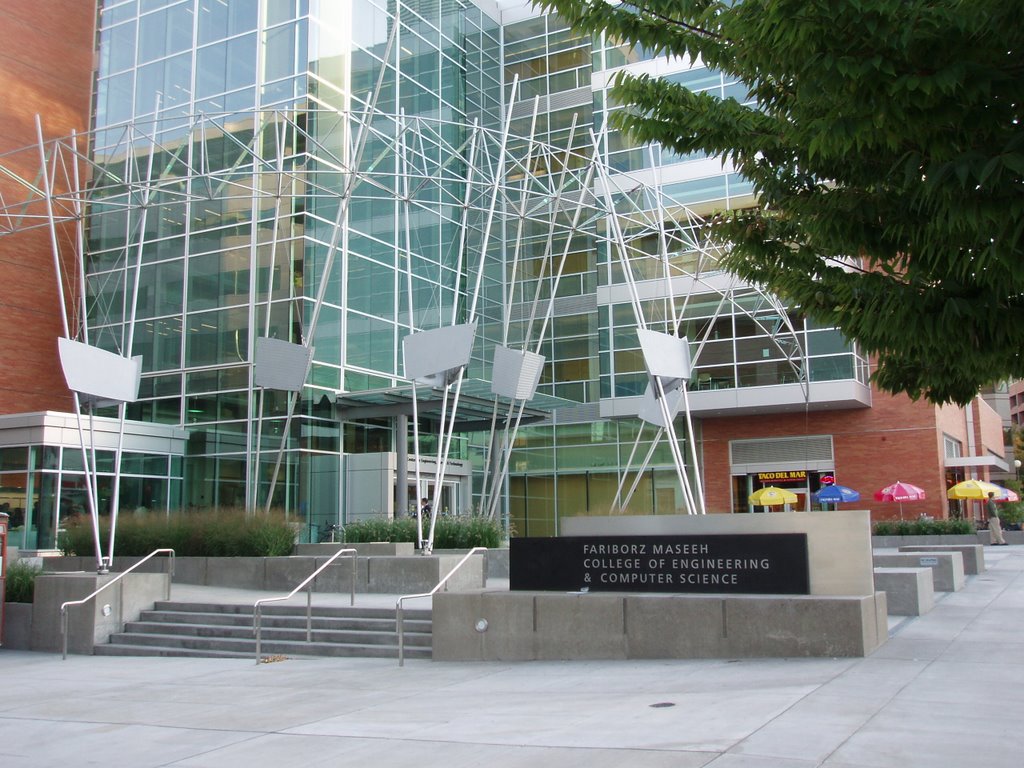
We enjoyed finger food and alcoholic beverages in PSU's new computer science and engineering building, applauding speeches and interviewing star students, veterans of SA's courses and internship programs.

One student had helped program the latest Lego robot using prosthetics you can't buy on the open market, such as magnetic field and pH sensors. Another had helped with a laboratory process that more effectively colorizes viral gene splicers. A third had spent a summer diving into the nanotubes literature and eventually working on their synthesis. All of these kids were still high school aged.
You'll find more on Saturday Academy elsewhere in this blog. I've been an instructor at both the OGI and PSU sites, teaching Pythonic Mathematics, a way of learning mathematical concepts while developing fluency with a state of the art object oriented computer language.

I spent some of the evening chatting with a man with a son named Kirben -- such an unusual name. The dad is one of four random CalTech students on former defense secretary Harold Brown's Xmas card for the year 1970.
SA is finally going it alone, instead of under the auspices of this or that higher education institution (incubators OGI and PSU still plan to work in tandem).
We enjoyed finger food and alcoholic beverages in PSU's new computer science and engineering building, applauding speeches and interviewing star students, veterans of SA's courses and internship programs.

One student had helped program the latest Lego robot using prosthetics you can't buy on the open market, such as magnetic field and pH sensors. Another had helped with a laboratory process that more effectively colorizes viral gene splicers. A third had spent a summer diving into the nanotubes literature and eventually working on their synthesis. All of these kids were still high school aged.
You'll find more on Saturday Academy elsewhere in this blog. I've been an instructor at both the OGI and PSU sites, teaching Pythonic Mathematics, a way of learning mathematical concepts while developing fluency with a state of the art object oriented computer language.

I spent some of the evening chatting with a man with a son named Kirben -- such an unusual name. The dad is one of four random CalTech students on former defense secretary Harold Brown's Xmas card for the year 1970.
Tuesday, October 10, 2006
Friday, October 06, 2006
Princeton Dinner
I joined fellow alums (hi Connie), a couple prospectives, parents of a current undergrad, and the staff of Pyramid Brewery (NW warehouse district), for a Princeton Club of Oregon celebration of our somewhat cerebral heritage last night. All told, about fifty of us showed.
Dr. Joshua Katz was there, hot off a jet, to stand and -- after either chicken, salmon, pork or pasta; wine, water or beer -- deliver Etymology: The Glamour of Grammar.
Among the words Dr. Katz was excited about last night and/or is known for in the etymological community, are: etymology (the word itself), you (the pronoun, Old English), eel & snake (Hittite through Latinate transformations), vespers (evening prayers) and badger (the mammal).
Princetonians lapped it up, then asked traditionally brilliant questions.
For example, I wanted to know if there was any precedent for this explosion of made up commercial words, like Tylenol and Toyota Camry. He joked about Häagen-Dazs (very made up) and all the obvious psychology that had gone into that. And no, probably no precedent.
He called on me as "Mr. Angil" because I'd earlier distinguished myself by fishing up the Latin root for eel (he'd polled his audience, just like he polls his students). I'd flashed on Angillara on Lake Bracciano in Rome's outskirts.
The Korean couple next to me featured a charming more loquacious mom (of a Princeton student, also of an NYU student), and a quiet dad who chuckled knowingly but never said anything. That reminded me of the cute Korean couple in Lost, which Tara and I were just watching, and I even caught myself blathering about that for a few seconds. A Being There moment.
To my right, the Latin teacher from Cottage Grove, with her two high school aged wards. They lapped it all up with the rest of us. My response to tough-to-get-in good schools is we just need a lot more of them. Princeton is great and we joke about God going there, but really its our wholesome Global University that's great, meaning this planet for starters, where God does indeed teach, with a special spin just for each of us.
Also yesterday, Uncle Bill came by, yet better versed in self-publishing, and we updated his website, plus I briefed him on iPods and Internet lore.
Dr. Joshua Katz was there, hot off a jet, to stand and -- after either chicken, salmon, pork or pasta; wine, water or beer -- deliver Etymology: The Glamour of Grammar.
Among the words Dr. Katz was excited about last night and/or is known for in the etymological community, are: etymology (the word itself), you (the pronoun, Old English), eel & snake (Hittite through Latinate transformations), vespers (evening prayers) and badger (the mammal).
Princetonians lapped it up, then asked traditionally brilliant questions.For example, I wanted to know if there was any precedent for this explosion of made up commercial words, like Tylenol and Toyota Camry. He joked about Häagen-Dazs (very made up) and all the obvious psychology that had gone into that. And no, probably no precedent.
He called on me as "Mr. Angil" because I'd earlier distinguished myself by fishing up the Latin root for eel (he'd polled his audience, just like he polls his students). I'd flashed on Angillara on Lake Bracciano in Rome's outskirts.
The Korean couple next to me featured a charming more loquacious mom (of a Princeton student, also of an NYU student), and a quiet dad who chuckled knowingly but never said anything. That reminded me of the cute Korean couple in Lost, which Tara and I were just watching, and I even caught myself blathering about that for a few seconds. A Being There moment.
To my right, the Latin teacher from Cottage Grove, with her two high school aged wards. They lapped it all up with the rest of us. My response to tough-to-get-in good schools is we just need a lot more of them. Princeton is great and we joke about God going there, but really its our wholesome Global University that's great, meaning this planet for starters, where God does indeed teach, with a special spin just for each of us.
Also yesterday, Uncle Bill came by, yet better versed in self-publishing, and we updated his website, plus I briefed him on iPods and Internet lore.
Tuesday, October 03, 2006
Postpone the Elections?
So this Princeton computer scientist shows on TV how mindlessly easy it is to subvert the Diebold voting machine, and Diebold's lame retort is "you didn't have the latest version of our software."
That's supposed to inspire confidance?
We have the talent in this country to develop a transparent open source voting system with tons of built in protections. Banks know this stuff cold. When big money is at stake, they're among the first to demand auditing.
But when it comes to voting, where's the integrity? Who really defends democracy anymore? Anyone?
Dissecting critical, core civilian infrastructure, describing how it works, is an essential function of public education in the USA. If we expect to recruit new voters into the system, we at least owe them an explanation of how it all works.
If a teacher can't describe how a vote at the polling booth makes it to some HQS for tallying, with checks against abuse, then that teacher's students have been denied access to their most fundamental rights as USA citizens.
Congress needed to play a leading role in restoring trust in voting, electronic or otherwise.
Not having a secure system in place is terrifying, destabilizing, and to even implicitly endorse this status quo is to be a kind of terrorist for sure.
I'll be scanning my sources for any sign that the American people are being given a clear story about their newfangled voting system. Unless these stories appear, I don't think USAers should be coerced into voting by any "powers that be," nor should the results be given any legitimacy.
The election should perhaps be officially postponed, and no I'm not talking about martial law.
On the contrary, we should go into a holding pattern, with politicians forced to fix what's broken, every move scrutinized, run through a gauntlet of experts, the security-minded, those with real world auditing experience.
This would be interesting reality television, instead of just the namby pamby stuff like on Survivor (talk about lame).
Until then, whatever these politicians talk about on television is really of no weight or significance to us. We might as well tune out and just listen to Muzak™.
If the real USA isn't what's on TV, why should we even care? Let's just admit that our USA has been subverted and destroyed from within, and move on, maybe start over on an island someplace.
Antarctica anyone?
That's supposed to inspire confidance?
We have the talent in this country to develop a transparent open source voting system with tons of built in protections. Banks know this stuff cold. When big money is at stake, they're among the first to demand auditing.
But when it comes to voting, where's the integrity? Who really defends democracy anymore? Anyone?
Dissecting critical, core civilian infrastructure, describing how it works, is an essential function of public education in the USA. If we expect to recruit new voters into the system, we at least owe them an explanation of how it all works.
If a teacher can't describe how a vote at the polling booth makes it to some HQS for tallying, with checks against abuse, then that teacher's students have been denied access to their most fundamental rights as USA citizens.
Congress needed to play a leading role in restoring trust in voting, electronic or otherwise.
Not having a secure system in place is terrifying, destabilizing, and to even implicitly endorse this status quo is to be a kind of terrorist for sure.
I'll be scanning my sources for any sign that the American people are being given a clear story about their newfangled voting system. Unless these stories appear, I don't think USAers should be coerced into voting by any "powers that be," nor should the results be given any legitimacy.
The election should perhaps be officially postponed, and no I'm not talking about martial law.
On the contrary, we should go into a holding pattern, with politicians forced to fix what's broken, every move scrutinized, run through a gauntlet of experts, the security-minded, those with real world auditing experience.
This would be interesting reality television, instead of just the namby pamby stuff like on Survivor (talk about lame).
Until then, whatever these politicians talk about on television is really of no weight or significance to us. We might as well tune out and just listen to Muzak™.
If the real USA isn't what's on TV, why should we even care? Let's just admit that our USA has been subverted and destroyed from within, and move on, maybe start over on an island someplace.
Antarctica anyone?
Monday, October 02, 2006
A Security Mom Speaks Out

Bagdad interior
Cindy Sheehan took the stage at the Bagdad tonight. She spoke from the heart, to an enthusiastic audience, handling the obligatory heckler with ease.I'd never been in the same room with her before (I was way up in the balcony). She thanked Portland for its strong support, and the Bagdad, and Thom Hartmann (who was not present).
Speaking of security moms, mine's flying back from Minneapolis tonight, where she was at some WILPF event (I'm hazy on the details). I'll be heading out to PDX to meet her plane.
Tomorrow, the painters arrive early and start doing some sanding.
Saturday, September 30, 2006
Thursday, September 28, 2006
This Land is Your Land (movie review)
Mom and I joined other Portland politicos in packing The Bagdad for this radio-advertised screencast about Corporate Personhood and related notions. Most seats were taken, right down to the front row. Radio talk show personality Thom Hartmann, and Lori Cheatle, the film's coproducer were present to host the event.
You could tell people felt they were onto something, yet the issues dealt with are anything but simple, meaning it's a film that makes you think (all the more reason to show it somewhere kwel like The Bagdad -- I got my Hammerhead ™ during the Q&A).
Yes, Nike discovered something about power signs, their catalyzing role in rolling out lifestyles. But it's not like others hadn't already put a spin on Nike. Grabbing that ball from the sky: a bold move.
And certainly Starbucks is going to get creamed in any fight over the right to blend Christmas, if playing the pro Russian Orthodox. Father Tryphon barely had to add sugar.
And yes, big empty factories are an eyesore, and Harlem looks kinda stupid with too much plastic eye candy. She's sensitive to her own looks, and with that, I empathize.
Kulture is too important to just waste, and yes, brand loyalty goes way deeper than skin sometimes.
Nature's own balance works through this picture, and she's pretty unforgiving at times -- we want to be right by her, really, and she really hates to hurt humans, is my feeling about her. But couldn't they share more responsibly and not overmine that myth of "rich people" running everything?
Humans like mini-me here just aren't totally in control OK? and no I'm not talking about "my bosses the ETs" (sheesh). I'm talking about Cybernetics 101. There's the Sun and the Moon and all that other stuff OK? So let's back off about "the rich people" 24 / 7 / 365, and give some just and due credit where credit is due: to Nature, who needs us to stay smart.
Like, let's not go blaming Donald "you're fired" Trump for everything, nor any other poor slob, just because life sucks and the times are real bad. Even so, it's still a costume party, and behind the masks... are more masks (the running joke of such a festival).
The V for Vendetta guy rips off his mask: "yes, 'twas I the Nasonex Bee™."
In a lot of ways, the fast cut editing and interleaving with American icons, like Jim Hightower and Granny D, was a way of comforting us, as the vista is always changing, sometimes at a fast clip, and that's sometimes unsettling, yes.
The rest of the world is feeling it too. Don't think any tucked away urbia is somehow immune from the butterfly effects of globalization. That's just your ecosystem at work. So remember to pace yourself.
Our local Powell's Books has a Dalai Lama paper doll book (plus remember Think Different). Real American Eagles do soar in the Grand Canyon. We're all involved in branding these days.
And there's a lot at stake, yes, however I don't think that UCLA brain professor has read enough Wittgenstein. The power of Pepsi is not just that it registers higher in the right brain, but that it links to dear Michael Jackson in Thriller, a wonderfully bold production.
Great art is not always for the feeble minded or weak at heart, might be the moral of this film. And Uncle Sam is a player, most definitely. That whole tea party thing? A branding issue.
So don't count on Uncle Sam to make life easy for "idle rich" on the block, yet many rich are hard working, at least somewhat smart with their power -- including many of the liberals in this film, most of 'em quite rich by today's standards.
You could tell people felt they were onto something, yet the issues dealt with are anything but simple, meaning it's a film that makes you think (all the more reason to show it somewhere kwel like The Bagdad -- I got my Hammerhead ™ during the Q&A).
Yes, Nike discovered something about power signs, their catalyzing role in rolling out lifestyles. But it's not like others hadn't already put a spin on Nike. Grabbing that ball from the sky: a bold move.
And certainly Starbucks is going to get creamed in any fight over the right to blend Christmas, if playing the pro Russian Orthodox. Father Tryphon barely had to add sugar.
And yes, big empty factories are an eyesore, and Harlem looks kinda stupid with too much plastic eye candy. She's sensitive to her own looks, and with that, I empathize.
Kulture is too important to just waste, and yes, brand loyalty goes way deeper than skin sometimes.
Nature's own balance works through this picture, and she's pretty unforgiving at times -- we want to be right by her, really, and she really hates to hurt humans, is my feeling about her. But couldn't they share more responsibly and not overmine that myth of "rich people" running everything?
Humans like mini-me here just aren't totally in control OK? and no I'm not talking about "my bosses the ETs" (sheesh). I'm talking about Cybernetics 101. There's the Sun and the Moon and all that other stuff OK? So let's back off about "the rich people" 24 / 7 / 365, and give some just and due credit where credit is due: to Nature, who needs us to stay smart.
Like, let's not go blaming Donald "you're fired" Trump for everything, nor any other poor slob, just because life sucks and the times are real bad. Even so, it's still a costume party, and behind the masks... are more masks (the running joke of such a festival).
The V for Vendetta guy rips off his mask: "yes, 'twas I the Nasonex Bee™."
In a lot of ways, the fast cut editing and interleaving with American icons, like Jim Hightower and Granny D, was a way of comforting us, as the vista is always changing, sometimes at a fast clip, and that's sometimes unsettling, yes.
The rest of the world is feeling it too. Don't think any tucked away urbia is somehow immune from the butterfly effects of globalization. That's just your ecosystem at work. So remember to pace yourself.
Our local Powell's Books has a Dalai Lama paper doll book (plus remember Think Different). Real American Eagles do soar in the Grand Canyon. We're all involved in branding these days.
And there's a lot at stake, yes, however I don't think that UCLA brain professor has read enough Wittgenstein. The power of Pepsi is not just that it registers higher in the right brain, but that it links to dear Michael Jackson in Thriller, a wonderfully bold production.
Great art is not always for the feeble minded or weak at heart, might be the moral of this film. And Uncle Sam is a player, most definitely. That whole tea party thing? A branding issue.
So don't count on Uncle Sam to make life easy for "idle rich" on the block, yet many rich are hard working, at least somewhat smart with their power -- including many of the liberals in this film, most of 'em quite rich by today's standards.
Saturday, September 23, 2006
Fall Retreat
Cheryl Pauling, Linus's granddaughter, came by the Pauling House today. Don (Terry's Igor) showed her around (I don't think she'd been here before -- I'm pretty sure Linus started getting into chemistry in the basement).
We're in the middle of the 2006 Fall Wanderers Retreat. Terry is holding forth per usual, defending Intelligent Design as he means it (a namespace): Engineering is a bullheaded god, Science overhyped and namby pamby. I keep firing my disruptor (not an outward weapon), only because I've heard it all so many times, so please beam me up Scotty (an engineer).
Didn't happen. Jon on guitar is a real pleasure. Don has a good singing voice to go along. OK, so good thing Scotty didn't hear me.
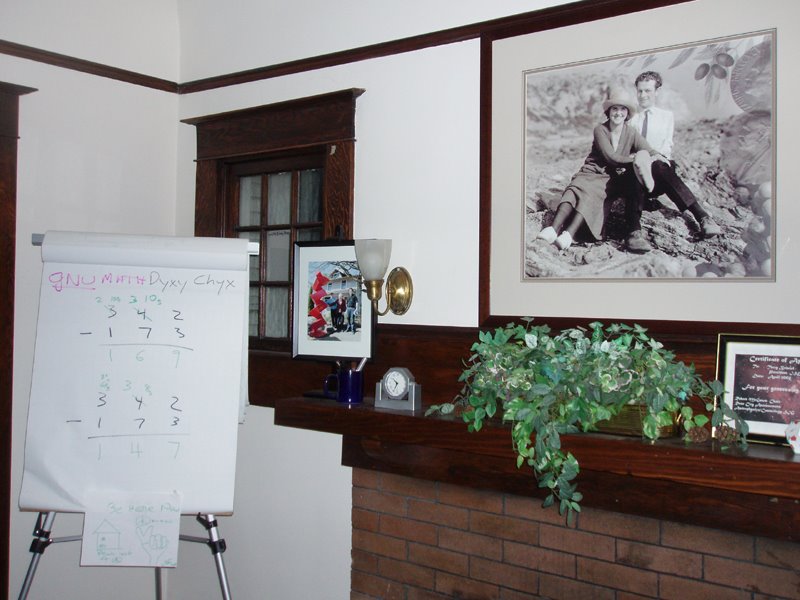
This morning, before all these people showed up (we're packed), I was rehearsing wordlessly pointing to butcher paper (like a flight attendant) while Tom Lehrer sang New Math on my iPod, amplified through my Altec Lansing inMotion portable speakers.
Tom sings through 342 - 173 (a subtraction problem) twice , in bases 10 and 8. His 1960s audience is cracking up, but he knows it their way too. As an MIT math prof, he's lived through more than a few changes in fashion.
Then I joined Dawn and Tara for an adventure: Portland's first Pirate Festival, a big success by the look and feel of it (lots of harmless gunpowder games, good music & food).
I'm using Don's Safari on an iSomething to post this, meaning I'm missing my customary wysiwyg text editing controls. I'll add some links, other formatting, when I'm back at my workstation.
From my workstation: I did get to play the Lehrer tune (plus Allan Sherman's You Went the Wrong Way, Old King Louie for an encore). I explained after the Lehrer piece that our emergent Gnu Math training is likewise evolutionary, though with different emphases.
Regretfully, we didn't manage to bring Sarah-the-dog down to the Lucky Lab for Dogtoberfest. There's only so much one can get done in one day.
We're in the middle of the 2006 Fall Wanderers Retreat. Terry is holding forth per usual, defending Intelligent Design as he means it (a namespace): Engineering is a bullheaded god, Science overhyped and namby pamby. I keep firing my disruptor (not an outward weapon), only because I've heard it all so many times, so please beam me up Scotty (an engineer).
Didn't happen. Jon on guitar is a real pleasure. Don has a good singing voice to go along. OK, so good thing Scotty didn't hear me.
This morning, before all these people showed up (we're packed), I was rehearsing wordlessly pointing to butcher paper (like a flight attendant) while Tom Lehrer sang New Math on my iPod, amplified through my Altec Lansing inMotion portable speakers.
Tom sings through 342 - 173 (a subtraction problem) twice , in bases 10 and 8. His 1960s audience is cracking up, but he knows it their way too. As an MIT math prof, he's lived through more than a few changes in fashion.
Then I joined Dawn and Tara for an adventure: Portland's first Pirate Festival, a big success by the look and feel of it (lots of harmless gunpowder games, good music & food).
I'm using Don's Safari on an iSomething to post this, meaning I'm missing my customary wysiwyg text editing controls. I'll add some links, other formatting, when I'm back at my workstation.
From my workstation: I did get to play the Lehrer tune (plus Allan Sherman's You Went the Wrong Way, Old King Louie for an encore). I explained after the Lehrer piece that our emergent Gnu Math training is likewise evolutionary, though with different emphases.
Regretfully, we didn't manage to bring Sarah-the-dog down to the Lucky Lab for Dogtoberfest. There's only so much one can get done in one day.
Thursday, September 21, 2006
Tuesday, September 19, 2006
Re: Nomenclature Threads on Synergeo
Usually my policy is to ignore 'em, as I regard Synergetics as a pretty complete phrase book, and don't require further definitions, especially those slanted for economic purposes. So I reserve the right to skip any "priority" discussions e.g. I care not who "invented the randome" as all of the really good ones are naturally occuring.
A huge problem with journalism these days is it fails to think in terms of geodesic spheres, instead of domes, ala the Cloud Nines or maybe space-based, ball-shaped Hyatt Regencies. So they miss all the good math, since a "chopped ball" lacks certain systemics, is anchored basically by dirt, in the sense that the flooring is part of its structural integrity (or lack thereof).
Many models of Fly's Eye go ahead and complete the full structure, and poke the legs through. There's some logic in doing it that way, in terms of added structural stability.
This lack within lexical journalism could be addressed at any moment by some relevant television, but people'd be creeped out being force fed synergetics on the evening news, however healthy such a diet might be on HDTV (and I'm not pushing for that outcome).
The PBS formats, for educational broadcasting, will help us reach all those journalist adult teletubbies, half of 'em flat on their backs in the dark, swilling pale fluids, and repeating to themselves slowly: "there... is... no... Matrix." Yeah, right.
A huge problem with journalism these days is it fails to think in terms of geodesic spheres, instead of domes, ala the Cloud Nines or maybe space-based, ball-shaped Hyatt Regencies. So they miss all the good math, since a "chopped ball" lacks certain systemics, is anchored basically by dirt, in the sense that the flooring is part of its structural integrity (or lack thereof).
Many models of Fly's Eye go ahead and complete the full structure, and poke the legs through. There's some logic in doing it that way, in terms of added structural stability.
This lack within lexical journalism could be addressed at any moment by some relevant television, but people'd be creeped out being force fed synergetics on the evening news, however healthy such a diet might be on HDTV (and I'm not pushing for that outcome).
The PBS formats, for educational broadcasting, will help us reach all those journalist adult teletubbies, half of 'em flat on their backs in the dark, swilling pale fluids, and repeating to themselves slowly: "there... is... no... Matrix." Yeah, right.
Sunday, September 17, 2006
A Little Zen Poem
The dog barked at the squirrel,
chasing it up a backyard fence.
A man came out red faced, glaring and angry,
that Nature had dared to play with itself.
I'm glad he wasn't me.
chasing it up a backyard fence.
A man came out red faced, glaring and angry,
that Nature had dared to play with itself.
I'm glad he wasn't me.
(edited in both Firefox and IE)
Thursday, September 14, 2006
CrossCultural Workouts
It'd make more sense to park a generator next to a gym, wire HVAC, and do multiuser video games on flatscreens with Iraqi troops, USAers together, mixing it up on screen.
But only after a lot of basic reflex learning curves.
It's no fun to frag people with only teenager level skills. You want adult level gaming sometimes, especially when training future officers.
Once we have a level playing field, in terms of basic skills, we'll recruit lots of hybrid teams: Americans and Iraqis against other Americans and Iraqis. Hey, it's already like this.
That whole Sunni-Shi'ite thing: I think Americans should back away from that slowly. You don't want to get into this episode of Alien World where the alien needs surgery and you're just a human doctor -- or vice versa.
There is no "military solution" in that namespace, so let's not even pretend that we're looking for one. That's up to the Imams to spin and control. Pumping in outward weapons just amplifies and feeds the craziness level, makes their jobs harder yet.
One thing I'm not doubting: all these people have courage. The Iraqis and Americans are sincere about wanting things to work out, Iranians, Syrians, Jordanians, Israelis... you've got real commitment and dedication, a willingness to serve the greater good.
Where I would focus is on artifacts, which is what Saddam's Castles were and are (a branded franchise).
Mosques will always exist, not just in Baghdad, but in Arizona. So will Synagogues. No great world religion is going away any time soon.
There's also no "setting everything back" to this point where other traditions were just in oblivion, off the radar someplace, never in our own backyard.
We're all in each others' backyards by now. That's just where our clever inventiveness as humans has gotten us. We should be celebrating. Yay, we're a planet. Yay, we could still make this work.
But only after a lot of basic reflex learning curves.
It's no fun to frag people with only teenager level skills. You want adult level gaming sometimes, especially when training future officers.
Once we have a level playing field, in terms of basic skills, we'll recruit lots of hybrid teams: Americans and Iraqis against other Americans and Iraqis. Hey, it's already like this.
That whole Sunni-Shi'ite thing: I think Americans should back away from that slowly. You don't want to get into this episode of Alien World where the alien needs surgery and you're just a human doctor -- or vice versa.
There is no "military solution" in that namespace, so let's not even pretend that we're looking for one. That's up to the Imams to spin and control. Pumping in outward weapons just amplifies and feeds the craziness level, makes their jobs harder yet.
One thing I'm not doubting: all these people have courage. The Iraqis and Americans are sincere about wanting things to work out, Iranians, Syrians, Jordanians, Israelis... you've got real commitment and dedication, a willingness to serve the greater good.
Where I would focus is on artifacts, which is what Saddam's Castles were and are (a branded franchise).
Mosques will always exist, not just in Baghdad, but in Arizona. So will Synagogues. No great world religion is going away any time soon.
There's also no "setting everything back" to this point where other traditions were just in oblivion, off the radar someplace, never in our own backyard.
We're all in each others' backyards by now. That's just where our clever inventiveness as humans has gotten us. We should be celebrating. Yay, we're a planet. Yay, we could still make this work.
Sunday, September 10, 2006
Lunch on Hawthorne
I met Glenn at Portland Ale House this afternoon, for a pint or two and, for me, the blue plate special, which included an interesting carrot & coconut soup (I'd get it again).
I spoke a lot about Kiyoshi, Fuller's adjuvant on some difficult books, but also a gourmet who helped Philly upgrade its self image, as a place to write home about when it comes to food. He and I ate at The Fork that time.
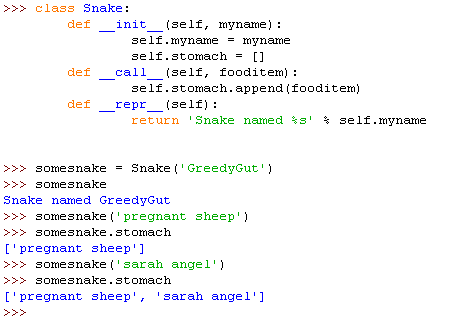
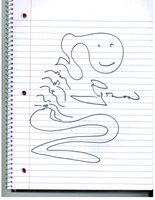
I showed Glenn a couple notebook sketches of Snakes with __rib__ syntax, a way of helping students remember how we override special methods in Python. D'ya want the plus sign (+) to do something custom? Just write code for __add__ (pronounced "under under add"), likewise for __mul__ if you want to script the multiplication operator (*).
And how 'bout when you make an object "eat" something through its "mouth" i.e. the object is already initialized ("born"), and now you're feeding arguments to a pair of curved parentheses (like lips) and you want some customized behavior: well, that'd be your __call__ special method.
They look kinda like __ribs__ no? -- especially when stacked up and indented, as one must in Python, where indentation is significant -- no "curly braces" for scope, like in Perl, Java, or C#.
Here, I'll upload a scan from said notebook:
Plus I've written about this before.
Glenn knows contracting pretty well, as both acting janitor for the Pauling Complex and senior fellow for ISEPP (he's built an entire home from scratch). Glenn went to Antioch, before becoming a cryptanalyst with the NSA among other things.
Over on edu-sig, I've been horrifying some posters with my radical notion that we oughtn't "script" our first programs, so much as code up some namespaces "like boxes of chocolates" and then just reach in and use the contents at runtime, with no main method in control.
You be the glue: treat the namespace as a library, a utility belt, that neither actively cues nor prompts you, but does spell out its own contents in some detail (well designed .py files should be pretty much self-documenting).
Meanwhile, over on math-teach, I've been diving head first into Supermarket Mathematics with the gnu math teachers (a cyberspace krew), using a new "musings" format, more soft focus than "memos."
I blend a kind of database management perspective (drawing from personal experience), with a more general discussion of the difference between Cardinality and Ordinality. I got some ideas about this from Midhat Gazale's book Number, and here I'm expounding on it more, contrasting the job of these UPC codes (just tell stuff apart) versus the role of Money, which has this strong Ordinality bias (positive money is better).
And finally, on Synergeo, I've been doing my best to explain my "4D/4D++" meme to Planet Tverse (John Brawley), while meanwhile squabbling with Rybo the Robot (my nickname for a guy who calls John "Zachary Smith" -- an allusion to Lost in Space, a 1960s TV show -- and calls me "King Kirb"). Yes, it's an odd namespace we've got going.
Synergeo is a good venue in which to test the relevance of YouTube and/or Google Video content, interspersing my Synergetics teachings with relevant audio-video objects, playable via URL.
Some fun anthropology:
In further researching this Synergeo namespace of twilight zone quasi-irrelevance, I watched this long excerpt of a Lost in Space episode culminating in Will's confronting this Yeti or King Kong or whatever (a Cyclops actually, if you want to get Hellenistic about it), after his male tribal elders had already provoked it unnecessarily (they threw some fire at it, pretty stupid).
So then headstrong Will drops the Monster with a ray gun. That was considered a good way to handle things back in the day, before Star Trek came along with the Prime Directive, which said Away Teams really oughtn't go around shooting the locals that way. We're here to boldly go, not stupidly attack.
The security moms back in the cave are remarkably blasé about the whole incident, are tied to their laundry baskets, see the World of Men through a telescope only, meaning Will must reach escape velocity to join his peers, and prove himself manly against the Giant.

I spoke a lot about Kiyoshi, Fuller's adjuvant on some difficult books, but also a gourmet who helped Philly upgrade its self image, as a place to write home about when it comes to food. He and I ate at The Fork that time.
I showed Glenn a couple notebook sketches of Snakes with __rib__ syntax, a way of helping students remember how we override special methods in Python. D'ya want the plus sign (+) to do something custom? Just write code for __add__ (pronounced "under under add"), likewise for __mul__ if you want to script the multiplication operator (*).
And how 'bout when you make an object "eat" something through its "mouth" i.e. the object is already initialized ("born"), and now you're feeding arguments to a pair of curved parentheses (like lips) and you want some customized behavior: well, that'd be your __call__ special method.
They look kinda like __ribs__ no? -- especially when stacked up and indented, as one must in Python, where indentation is significant -- no "curly braces" for scope, like in Perl, Java, or C#.
Here, I'll upload a scan from said notebook:
Plus I've written about this before.
Glenn knows contracting pretty well, as both acting janitor for the Pauling Complex and senior fellow for ISEPP (he's built an entire home from scratch). Glenn went to Antioch, before becoming a cryptanalyst with the NSA among other things.
Over on edu-sig, I've been horrifying some posters with my radical notion that we oughtn't "script" our first programs, so much as code up some namespaces "like boxes of chocolates" and then just reach in and use the contents at runtime, with no main method in control.
You be the glue: treat the namespace as a library, a utility belt, that neither actively cues nor prompts you, but does spell out its own contents in some detail (well designed .py files should be pretty much self-documenting).
Meanwhile, over on math-teach, I've been diving head first into Supermarket Mathematics with the gnu math teachers (a cyberspace krew), using a new "musings" format, more soft focus than "memos."
I blend a kind of database management perspective (drawing from personal experience), with a more general discussion of the difference between Cardinality and Ordinality. I got some ideas about this from Midhat Gazale's book Number, and here I'm expounding on it more, contrasting the job of these UPC codes (just tell stuff apart) versus the role of Money, which has this strong Ordinality bias (positive money is better).
And finally, on Synergeo, I've been doing my best to explain my "4D/4D++" meme to Planet Tverse (John Brawley), while meanwhile squabbling with Rybo the Robot (my nickname for a guy who calls John "Zachary Smith" -- an allusion to Lost in Space, a 1960s TV show -- and calls me "King Kirb"). Yes, it's an odd namespace we've got going.
Synergeo is a good venue in which to test the relevance of YouTube and/or Google Video content, interspersing my Synergetics teachings with relevant audio-video objects, playable via URL.
Some fun anthropology:
In further researching this Synergeo namespace of twilight zone quasi-irrelevance, I watched this long excerpt of a Lost in Space episode culminating in Will's confronting this Yeti or King Kong or whatever (a Cyclops actually, if you want to get Hellenistic about it), after his male tribal elders had already provoked it unnecessarily (they threw some fire at it, pretty stupid).
So then headstrong Will drops the Monster with a ray gun. That was considered a good way to handle things back in the day, before Star Trek came along with the Prime Directive, which said Away Teams really oughtn't go around shooting the locals that way. We're here to boldly go, not stupidly attack.
The security moms back in the cave are remarkably blasé about the whole incident, are tied to their laundry baskets, see the World of Men through a telescope only, meaning Will must reach escape velocity to join his peers, and prove himself manly against the Giant.
Saturday, September 09, 2006
Thursday, September 07, 2006
ToonTalk
So you'll find me apologizing to my gnu math teachers over on Math Forum for our slowness in getting them a usable stash of mathcasts suitable for gnu math teaching. Like, the following query still only pulls up my briefing to Wanderers re the high tech housing we're trying to recast in higher rez these days: video.google.com/videosearch?q=polyhedra (7050 results Jan 2012). [Update: Google Video was discontinued].
Not much selection in other words. Not my doing (I'm not trying to be the one and only producing in this genre -- I seek no monopolists' powers, more relish the prospect of competing).
You'd think polyhedra'd be a hot topic for would-be TV producers, if gearing up to showcase their Renaissance savvy. But then, B2B is still pretty weak; CEOs sometimes got behind the big desk without knowing about our Platonic Five, the Archimedeans, A&B mods, other purged and indexed topics, held back by the controlling Inquisition (aka math content police).
Now, when it counts, their handicap is more evident, right when a better quality education could have helped with the bottom line. Lots of opportunities for explosive growth as a mathcaster these days, lots of room for green field development. That scares some away, I realize.
As John Saxon discovered, upon retiring from a distinguished military career, special interests in this country associate anything "pentagonal" (as in hexapents) with Elvyn Lore, other Lord of the Rings anti-Christian storytelling. Not that ol' JRR ever imagined himself the AntiChrist, but for some people, that's just what one is, if making money off bestsellers that aren't about what's literally in the Bible. C.S. Lewis: same problem (lots of obvious, out-of-the-closet pagans are goodies in Narnia -- how could Aslan allow it?).
In Saxon's case, t'were his story problems that left parents disgruntled. They didn't want Little Johnny absorbing all these fairy stories involving species unknown in the Middle East, and which lead to uncomfortable questionings of authority. Disney: another threat (just look at Fantasia -- too scantily clad, plus a nasty promo from some diabolical corporate sponsor towards the end).
So it's not just lack of CEO sophistication that's road-blocking our advance. It's fear of capitalizing on Arlington's most famous architecture, making an asset out of something so blantantly phi-based. The left fears sacred geometry (too over-the-hill hippie, too unsophisticated), and the right fears some sort of feminazi Blair Witch conspiracy (anything with pentacles and tentacles is a candidate under-the-bed boogeyperson for them).
A solution? We need to bypass "white man superstition" and capitalize in less backward nations, at least to start. In Canada for example, or maybe Alaska.
Let the Christian Taliban have their "Afghanistan" in whatever necks of the woods. This isn't about wresting totalitarian control from the mom and pop church-loving. It's about going only where we're welcome.
When it comes to cyberspace, that's somewhat harder to police from our end, but we trust parental control blocker software to keep the more sensitive households secure against our semi-subversive (yet all American) style of thinking.
Not much selection in other words. Not my doing (I'm not trying to be the one and only producing in this genre -- I seek no monopolists' powers, more relish the prospect of competing).
You'd think polyhedra'd be a hot topic for would-be TV producers, if gearing up to showcase their Renaissance savvy. But then, B2B is still pretty weak; CEOs sometimes got behind the big desk without knowing about our Platonic Five, the Archimedeans, A&B mods, other purged and indexed topics, held back by the controlling Inquisition (aka math content police).
Now, when it counts, their handicap is more evident, right when a better quality education could have helped with the bottom line. Lots of opportunities for explosive growth as a mathcaster these days, lots of room for green field development. That scares some away, I realize.
As John Saxon discovered, upon retiring from a distinguished military career, special interests in this country associate anything "pentagonal" (as in hexapents) with Elvyn Lore, other Lord of the Rings anti-Christian storytelling. Not that ol' JRR ever imagined himself the AntiChrist, but for some people, that's just what one is, if making money off bestsellers that aren't about what's literally in the Bible. C.S. Lewis: same problem (lots of obvious, out-of-the-closet pagans are goodies in Narnia -- how could Aslan allow it?).
In Saxon's case, t'were his story problems that left parents disgruntled. They didn't want Little Johnny absorbing all these fairy stories involving species unknown in the Middle East, and which lead to uncomfortable questionings of authority. Disney: another threat (just look at Fantasia -- too scantily clad, plus a nasty promo from some diabolical corporate sponsor towards the end).
So it's not just lack of CEO sophistication that's road-blocking our advance. It's fear of capitalizing on Arlington's most famous architecture, making an asset out of something so blantantly phi-based. The left fears sacred geometry (too over-the-hill hippie, too unsophisticated), and the right fears some sort of feminazi Blair Witch conspiracy (anything with pentacles and tentacles is a candidate under-the-bed boogeyperson for them).
A solution? We need to bypass "white man superstition" and capitalize in less backward nations, at least to start. In Canada for example, or maybe Alaska.
Let the Christian Taliban have their "Afghanistan" in whatever necks of the woods. This isn't about wresting totalitarian control from the mom and pop church-loving. It's about going only where we're welcome.
When it comes to cyberspace, that's somewhat harder to police from our end, but we trust parental control blocker software to keep the more sensitive households secure against our semi-subversive (yet all American) style of thinking.
Saturday, September 02, 2006
Another Kinetic Saturday
Lots of crazy pool happening today: Portland Knowledge Lab is slated for an upgrade, so Tara gets the hand-me-down, which is already way better than any of our desktops @ home (some HP multimedia jobber, gets it done); jet traveling family members; likely BBQ; coffee with Derek; laundry to do, other chores (some of them manly).
Summer is turning to Fall and these last high-80s sunny days should be appreciated. I'm not really looking forward to firing up the basement furnace and burning a ton of fuel oil to keep this place warm (a large tank sits under the driveway, semi-full of the Montag brand). Maybe we'll come up with an escape route (what airlines allow O2 I wonder?).
Last night: the initial Invasion DVD, plus I taped and watched Danny (as we tend to call him in this household). Quite the pile of televisions, not to mention a stellar career. Bob too was fantastic in that role, with that style.
I'm drawn to the Jack Daniels tasters for an analogy (they've had about the same number so far). It must be really tough to just "sip" and not drown, given all those stories coming at ya, 24/7 365/365. CBS has quite the control room, as well it should, being one of the oldest in the business.
I'll add as a footnote that our reception ain't the best on local affiliate KOIN 6, because we get a ghostly broadcast signal (I think through the sensitive tuner) just a few seconds ahead of the Comcast cable feed, meaning we're always looking at "the near future" as a faint overlay.
I know that sounds as metaphorical as all get out (clairvoyance?), but I'm speaking quite phenomenologically here, have it on tape. However this glitch in no way interferes with my ability to appreciate the content, in my judgment. Just don't consider me an archivist of record for this stuff, given its not-industrial-grade quality.
Yep, lots of anchor action at CBS these days. When they do the look back for Couric, they shouldn't bleep over her stint as a fish (also played by Nicole Balick in the VG version).
I'm glad to see FEMA is taking itself more seriously these days, post Katrina -- and it's not just hurricanes we try to plan around, out here in the Pacific Northwest (not just forest fires either).
Summer is turning to Fall and these last high-80s sunny days should be appreciated. I'm not really looking forward to firing up the basement furnace and burning a ton of fuel oil to keep this place warm (a large tank sits under the driveway, semi-full of the Montag brand). Maybe we'll come up with an escape route (what airlines allow O2 I wonder?).
Last night: the initial Invasion DVD, plus I taped and watched Danny (as we tend to call him in this household). Quite the pile of televisions, not to mention a stellar career. Bob too was fantastic in that role, with that style.
I'm drawn to the Jack Daniels tasters for an analogy (they've had about the same number so far). It must be really tough to just "sip" and not drown, given all those stories coming at ya, 24/7 365/365. CBS has quite the control room, as well it should, being one of the oldest in the business.
I'll add as a footnote that our reception ain't the best on local affiliate KOIN 6, because we get a ghostly broadcast signal (I think through the sensitive tuner) just a few seconds ahead of the Comcast cable feed, meaning we're always looking at "the near future" as a faint overlay.
I know that sounds as metaphorical as all get out (clairvoyance?), but I'm speaking quite phenomenologically here, have it on tape. However this glitch in no way interferes with my ability to appreciate the content, in my judgment. Just don't consider me an archivist of record for this stuff, given its not-industrial-grade quality.
Yep, lots of anchor action at CBS these days. When they do the look back for Couric, they shouldn't bleep over her stint as a fish (also played by Nicole Balick in the VG version).
I'm glad to see FEMA is taking itself more seriously these days, post Katrina -- and it's not just hurricanes we try to plan around, out here in the Pacific Northwest (not just forest fires either).
Wednesday, August 30, 2006
Wanderers 2006.8.30
We had a lot of heated discussion at the Pauling House this morning, arising from the Sustainability Archetypes book and workshop experience that Milt Markewitz, our presenter, is in the process of writing and designing.
One diagram he uses is an XY grid with Mechanical vs. Organic along X, Malthusian vs. Cornucopian (different from Copernican) along Y. That generates the four quadrants around the origin (++, +-, --, -+ going clockwise, although Milt doesn't use such grade schooler signage, a potential source of unnecessary bias).
I predictably suggested a tetrahedron instead, with all six edge relationships given equal weight. Then I spent some energy oscillating between Power (-+) and Planet (+-), speaking in passionate defense of NavAms (a People ++), which Terry was ragging on as incapable of turning a Profit i.e. creating surplus (the fourth P --), nevermind the casinos (or the airline?).
I say "predictably" because, per this recent post to Synergeo (re hurricane Katrina), we buckaneers are always getting up off the XY plane whenever "four corners" are involved. That's just basic to General Systems Theory (GST).
Milt also shared about the book Finite & Infinite Games by James Carse. In the former (finite games), the purpose is to win, thereby ending the game, whereas in the latter (infinite) it's more about just keeping the game going (which sometimes means changing the rules). The latter encompasses the former, but not vice versa.
Milt told the story of two Cold War powers escalating through the Cuban Missile Crisis, up through the Reagan years, and culminating in Bush Sr.'s visit to Japan for a summit, after the fall of the Berlin Wall (the summit Bush barfed at). How far we'd come, I think was his point.
I followed up with an account of an earlier event, when Eisenhower was all set to talk turkey, after Russia'd been devastated by WWII, and DC held the nuclear card (another "I'm the only superpower" moment i.e. not a level playing field). That time, Russia's "shooting down" of the U2 spy plane derailed the president's bold plans for a lasting world peace (cite Prouty).
David Tver talked about issues confronting Nigeria, and personal choices he's had to make.
Later, I spoke passionately about this "4P" Tetrahedron, saying it's all good (it got us this far didn't it?), and how the naturally evolved integrity of humanity would keep us centered. As individuals, we wander in its phase space, changing character in complement with the environment (including other workshop participants).
Like, if we don't include the Dark Side (Power) consciously, then we'll just end up projecting it unconsciously, like all those Over the Hedge security moms behind keeping the troops in Iraq (a species of "power nester"). Christine found my point "archetypal."
Brian Sharp also joined us this morning, which I was pleased about (he asked about Dawn). We seemed to see eye to eye on a lot of issues this time, including on the vital importance of trusting our intuitions and senses (the wisdom of the body), including our undervalued sense of smell (likewise Nietzsche's focus).
Relevant web sites:
Appreciative Inquiry
Chaordic Commons
Grunch.net
Spirit Mountain Community Fund
One diagram he uses is an XY grid with Mechanical vs. Organic along X, Malthusian vs. Cornucopian (different from Copernican) along Y. That generates the four quadrants around the origin (++, +-, --, -+ going clockwise, although Milt doesn't use such grade schooler signage, a potential source of unnecessary bias).
I predictably suggested a tetrahedron instead, with all six edge relationships given equal weight. Then I spent some energy oscillating between Power (-+) and Planet (+-), speaking in passionate defense of NavAms (a People ++), which Terry was ragging on as incapable of turning a Profit i.e. creating surplus (the fourth P --), nevermind the casinos (or the airline?).
I say "predictably" because, per this recent post to Synergeo (re hurricane Katrina), we buckaneers are always getting up off the XY plane whenever "four corners" are involved. That's just basic to General Systems Theory (GST).
Milt also shared about the book Finite & Infinite Games by James Carse. In the former (finite games), the purpose is to win, thereby ending the game, whereas in the latter (infinite) it's more about just keeping the game going (which sometimes means changing the rules). The latter encompasses the former, but not vice versa.
Milt told the story of two Cold War powers escalating through the Cuban Missile Crisis, up through the Reagan years, and culminating in Bush Sr.'s visit to Japan for a summit, after the fall of the Berlin Wall (the summit Bush barfed at). How far we'd come, I think was his point.
I followed up with an account of an earlier event, when Eisenhower was all set to talk turkey, after Russia'd been devastated by WWII, and DC held the nuclear card (another "I'm the only superpower" moment i.e. not a level playing field). That time, Russia's "shooting down" of the U2 spy plane derailed the president's bold plans for a lasting world peace (cite Prouty).
David Tver talked about issues confronting Nigeria, and personal choices he's had to make.
Later, I spoke passionately about this "4P" Tetrahedron, saying it's all good (it got us this far didn't it?), and how the naturally evolved integrity of humanity would keep us centered. As individuals, we wander in its phase space, changing character in complement with the environment (including other workshop participants).
Like, if we don't include the Dark Side (Power) consciously, then we'll just end up projecting it unconsciously, like all those Over the Hedge security moms behind keeping the troops in Iraq (a species of "power nester"). Christine found my point "archetypal."
Brian Sharp also joined us this morning, which I was pleased about (he asked about Dawn). We seemed to see eye to eye on a lot of issues this time, including on the vital importance of trusting our intuitions and senses (the wisdom of the body), including our undervalued sense of smell (likewise Nietzsche's focus).
Relevant web sites:
Appreciative Inquiry
Chaordic Commons
Grunch.net
Spirit Mountain Community Fund
Thursday, August 24, 2006
More Dimension Talk
Sometimes, in my battles with HyperCross Dogmatists, I get sloppy and say Coxeter draws a sharp distinction between his (Coxeter's) meaning of 'four dimensional' and Relativity's, in his "introduction" to Regular Polytopes.
Actually, he makes this point on page 119:
What I've tried to make clear over the years is that R. Buckminster Fuller was not on the HyperCross bandwagon, and although he used the 4D meme, he had his own meaning and namespace for it.
Given a next generation of philosophy student tackling Synergetics as a primary work (one among many), I feel it's important to point out these potentially tricky and confusing name collisions. Partly why I've been developing the notion of "namespace" with some rigor (with inspiration from Python especially) is to help keep our B2B and B2C channels clear.
Like, you maybe wouldn't want to do business with me if you thought I was just another garden variety hypercrosser (they don't make many like H.S.M. Coxeter these days, the Geometer to whom Synergetics is dedicated).
Related readings by me:
The Matrix
4D++
Another Wittgenstein Essay
HyperCross Dogmatics
Actually, he makes this point on page 119:
Little, if anything, is gained by representing the fourth Euclidean dimension as time. In fact, this idea, so attractively developed by H.G. Wells in The Time Machine, has led such authors as J. W. Dunne (An Experiment with Time) into a serious misconception of the theory of Relativity. Minkowski's geometry of space-time is not Euclidean, and consequently has no connection with the present investigation.
H.S.M. Coxeter. Regular Polytopes. Dover Publications, 1973. pg. 119Although Coxeter warns against attaching any mystical significance to the fourth dimension, in retrospect we see how talk of mortal limitations vs. transcendent superpowers would inspire a religious sense in many physicists and mathematicians:
Only one or two people have ever attained the ability to visualize hyper-solids as simply and naturally as we ordinary mortals visualize solids; but a certain facility in that direction may be acquired by contemplating the analogy between one and two dimensions, then two and three, and so (by a kind of extrapolation) three to four. (Ibid, pg. 119).He footnotes Abbott's Flatland at this point, helping to feed a meme complex which persists to this day, e.g. in this film What the Bleep: Down the Rabbit Hole. In a rush to "be the next Einstein" (not a bad role model mind you) generations of science fiction reader have strived to join the shamanic inner circle of those chosen few able to view the HyperCross directly.
What I've tried to make clear over the years is that R. Buckminster Fuller was not on the HyperCross bandwagon, and although he used the 4D meme, he had his own meaning and namespace for it.
Given a next generation of philosophy student tackling Synergetics as a primary work (one among many), I feel it's important to point out these potentially tricky and confusing name collisions. Partly why I've been developing the notion of "namespace" with some rigor (with inspiration from Python especially) is to help keep our B2B and B2C channels clear.
Like, you maybe wouldn't want to do business with me if you thought I was just another garden variety hypercrosser (they don't make many like H.S.M. Coxeter these days, the Geometer to whom Synergetics is dedicated).
Related readings by me:
The Matrix
4D++
Another Wittgenstein Essay
HyperCross Dogmatics
"Namespaces are one honking great idea -- let's do more of those!"
-- from import this in Python.
Tuesday, August 22, 2006
Monday, August 21, 2006
Hexapent Family Tree
Background reading:
Geometry and GIS (thread @ Math Forum)
Correcting a mistake (thread @ Math Forum)
Packinon (geodesics & classes)
Darwin @ Home (elastic interval geometry)
Other hexapent links: [1][2][3][4]
Friday, August 18, 2006
More Cast
Another strong writer I've collaborated with over the years is Gene Fowler, of which you'll find several, but this Gene wrote Waking the Poet, and corresponded with Bucky over the years, and with his myriad progeny.
Gene thinks in terms of Amerish, a science fiction name for a language we're going into, as speakers of American English. Co-modeling and sys-talk figure in to his version, which I've scanned at some length.
Plus he taught himself Delphi (Borland's OOized Pascal) and XML, all so he could express his vision in eWriter. Not bad for a self taught old guy who'd done some hard time on the inside (not the only Fuller Schooler to have done so).
Gene's vision with eWriter is that we should keep XML in the conscious forefront, the way we do punctuation. Sure, we stop thinking about punctuation as much, after we learn it, but it's still the writer's responsibility to manage it.
Gene wants to enlarge our notion of Amerish grammar, by adding XML into its native machinery, one might say.
But as I understand it, this would not necessarily mean our eyeballing XHTML all day long. We already know that if the markup is for style, then its point is to remain hidden in the final viewing.
The writer/author knows that it's there, as do the viewers, but as when watching a stage play, your mind shouldn't be with the props and lighting the whole time (not if you're there to be enthralled).
I think this Google Blogspot interface is actually a good example of what Gene was talking about: as a blogger, I'm mostly using a WYSIWYG (wizzy-wig) browser-embedded text editing tool, but if I click on Edit Html, I'm able to mess with the markup (reminds me of WordPerfect's "reveal codes").
As an Amerish speaker, I'm not dismayed that my responsibilities have increased. It's a small price to pay to engage in a shared space of world-readable files, all interconnecting everywhichway in a great global matrix, and in so many intelligent languages!
Related reading: in a gnu math thread @ Math Forum (Aug 20, 2006)
Gene thinks in terms of Amerish, a science fiction name for a language we're going into, as speakers of American English. Co-modeling and sys-talk figure in to his version, which I've scanned at some length.
Plus he taught himself Delphi (Borland's OOized Pascal) and XML, all so he could express his vision in eWriter. Not bad for a self taught old guy who'd done some hard time on the inside (not the only Fuller Schooler to have done so).
Gene's vision with eWriter is that we should keep XML in the conscious forefront, the way we do punctuation. Sure, we stop thinking about punctuation as much, after we learn it, but it's still the writer's responsibility to manage it.
Gene wants to enlarge our notion of Amerish grammar, by adding XML into its native machinery, one might say.
But as I understand it, this would not necessarily mean our eyeballing XHTML all day long. We already know that if the markup is for style, then its point is to remain hidden in the final viewing.
The writer/author knows that it's there, as do the viewers, but as when watching a stage play, your mind shouldn't be with the props and lighting the whole time (not if you're there to be enthralled).
I think this Google Blogspot interface is actually a good example of what Gene was talking about: as a blogger, I'm mostly using a WYSIWYG (wizzy-wig) browser-embedded text editing tool, but if I click on Edit Html, I'm able to mess with the markup (reminds me of WordPerfect's "reveal codes").
As an Amerish speaker, I'm not dismayed that my responsibilities have increased. It's a small price to pay to engage in a shared space of world-readable files, all interconnecting everywhichway in a great global matrix, and in so many intelligent languages!
Related reading: in a gnu math thread @ Math Forum (Aug 20, 2006)
Sunday, August 13, 2006
Project Earthala
Aimeé Ford Conner gave me the Earthala meme. Project Earthala is one of those high tech ecovillage communities we wonder if we'll ever live to see, even if only on reality TV.
I'd make mine a by-invitation sanctuary for weary travelers I've met along the way (Aimeé and Peter included). It's not like you have to live there permanently -- but some would want to.
We'd have TV-out, i.e. you could subscribe to our shows, already edited for content. Journalists might be invited to give alternative inside scoops, or sneak in or whatever.
Anyway, you know if there's a "mine" there'll be a lot of "not mines" -- so you needn't worry if my Project Earthala isn't on your itinerary. You'll have other stops in other villages, just as fun and good.
I'd make mine a by-invitation sanctuary for weary travelers I've met along the way (Aimeé and Peter included). It's not like you have to live there permanently -- but some would want to.
We'd have TV-out, i.e. you could subscribe to our shows, already edited for content. Journalists might be invited to give alternative inside scoops, or sneak in or whatever.
Anyway, you know if there's a "mine" there'll be a lot of "not mines" -- so you needn't worry if my Project Earthala isn't on your itinerary. You'll have other stops in other villages, just as fun and good.
Friday, August 11, 2006
Bee Season (movie review)
A talented family with all its physical needs met, freely explores metaphysical issues.
These don't seem the happiest people in the world, but hey, karma is like that (lots to work through, and moving too quickly may be dangerous).
Each cast member takes a few steps along an inward/outward journey.
I wish more families were free to work out at this level, instead of spending so much time scrabbling for food, water and shelter. Moving too slowly may likewise be dangerous.
These don't seem the happiest people in the world, but hey, karma is like that (lots to work through, and moving too quickly may be dangerous).
Each cast member takes a few steps along an inward/outward journey.
I wish more families were free to work out at this level, instead of spending so much time scrabbling for food, water and shelter. Moving too slowly may likewise be dangerous.
Thursday, August 10, 2006
Wednesday, August 09, 2006
HexaPent Housing

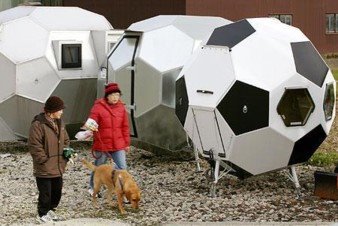
Trevor forwarded this link to my del.icio.us inbox.
People with claustrophobia wouldn't want time in these, even with flatscreens showing World Cup action.
But as working prototypes, they fit well in a Bucky Works context.
We need more low impact dwelling machines or "pods" with "feet" -- some models helicopter deliverable, and some to work around oil fields in the Alaskan tundra.
Tuesday, August 08, 2006
Eternal War of Incommensurability
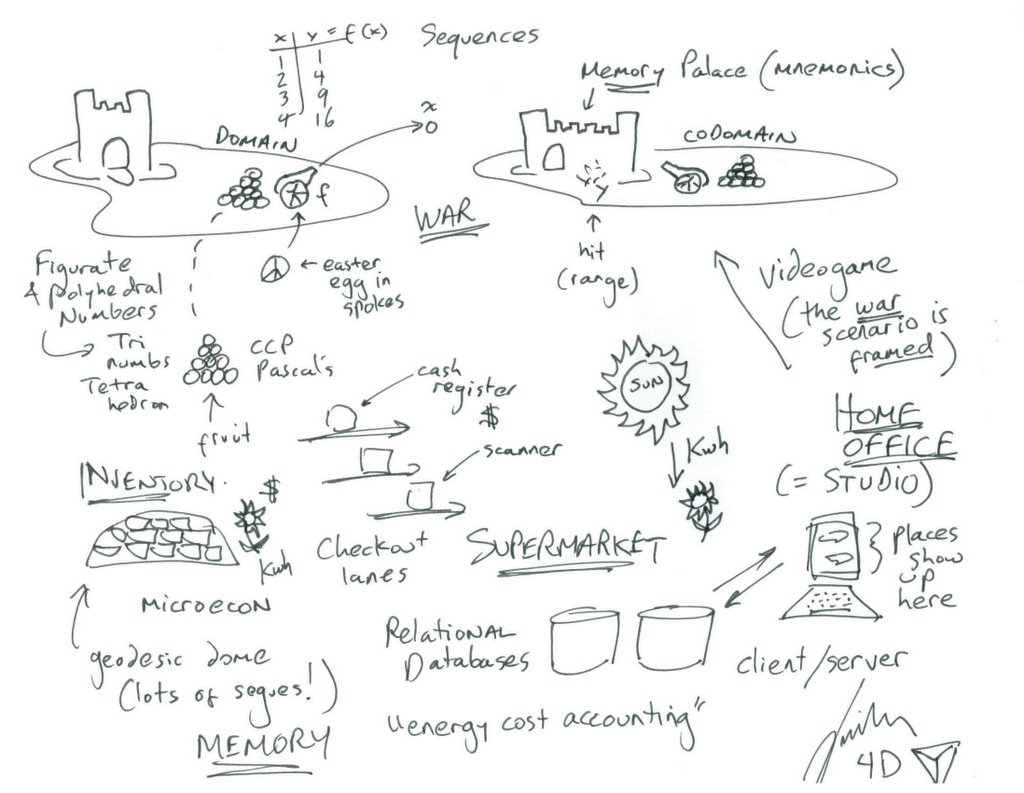
Although I maybe wasn't thinking this when I drew the above, the two Kingdoms depicted could as well be the two Kingdoms described below. See: Synergetics 987.044 & neighborhood, plus Incommensurable Icosahedra from my ISSN: 1059-1486.
Original context of the drawing: Boosting Bandwidth.
Memo to Wanderers
Posted to the wwwanderers.org Yahoo eGroup (added some HTML):
Received: by 10.78.165.13 with SMTP id n13mr1980834hue;
Sat, 05 Aug 2006 13:58:53 -0700 (PDT)
Date: Sat, 5 Aug 2006 13:58:53 -0700
To: wwwanderers@yahoogroups.com
Content-Type: text/plain; charset=ISO-8859-1; format=flowed
From: "kirby urner"
RE:
Dieter Kotschick
The Topology and Combinatorics of Soccer Balls (American Scientist, Volume 94, pg. 350 -- July-August of this year).
Glenn Stockton's name appears in Math Forum in connection with his gifting me a photocopy of the cited article @ Pauling House (Wanderers' Meeting), followed by a quick recap of its contents FYI:
http://mathforum.org/kb/message.jspa?messageID=4988588&tstart=0
Having finally seen Da Vinci Code for the first time last night (read book a long time ago) I was surprised at how little it did to exploit a rich set of geometric relationships. Fibonaccis were not tied to Phi very clearly, despite Pentacle.
Of course for a non-specialist audience, there's only so much you want to get into.
A mental schema I use:
Kingdom A:
Periodic Crystal Lattices:
Sphere packing schemes: SCP, BCC, CCP
Rhombic Dodecahedron, octet truss (A.G. Bell's "kites")
http://worldgame.blogspot.com/2006/07/math-they-wont-teach-you.html
Kingdom B:
Aperiodic Lattices & Five-Fold Symmetry:
Icosahedron, Pentagonal Dodecahedron, Hexapents
Penrose tiles
http://www.4dsolutions.net/ocn/hexapent.html
In Fuller's scheme, these two neighboring Kingdoms are bridged by the so-called Jitterbug Transformation, which transformation I would expect to incorporate into some of our archived mathcasts (re: Math Casting see: http://mathforum.org/kb/thread.jspa?threadID=1425804&tstart=0 and of course my ToonTown proposal for PDX, a potential source for such vidclips).
Kirby
Received: by 10.78.165.13 with SMTP id n13mr1980834hue;
Sat, 05 Aug 2006 13:58:53 -0700 (PDT)
Date: Sat, 5 Aug 2006 13:58:53 -0700
To: wwwanderers@yahoogroups.com
Content-Type: text/plain; charset=ISO-8859-1; format=flowed
From: "kirby urner"
RE:
Dieter Kotschick
The Topology and Combinatorics of Soccer Balls (American Scientist, Volume 94, pg. 350 -- July-August of this year).
Glenn Stockton's name appears in Math Forum in connection with his gifting me a photocopy of the cited article @ Pauling House (Wanderers' Meeting), followed by a quick recap of its contents FYI:
Having finally seen Da Vinci Code for the first time last night (read book a long time ago) I was surprised at how little it did to exploit a rich set of geometric relationships. Fibonaccis were not tied to Phi very clearly, despite Pentacle.
Of course for a non-specialist audience, there's only so much you want to get into.
A mental schema I use:
Kingdom A:
Periodic Crystal Lattices:
Sphere packing schemes: SCP, BCC, CCP
Rhombic Dodecahedron, octet truss (A.G. Bell's "kites")
http://worldgame.blogspot.com/2006/07/math-they-wont-teach-you.html
Kingdom B:
Aperiodic Lattices & Five-Fold Symmetry:
Icosahedron, Pentagonal Dodecahedron, Hexapents
Penrose tiles
http://www.4dsolutions.net/ocn/hexapent.html
In Fuller's scheme, these two neighboring Kingdoms are bridged by the so-called Jitterbug Transformation, which transformation I would expect to incorporate into some of our archived mathcasts (re: Math Casting see: http://mathforum.org/kb/thread.jspa?threadID=1425804&tstart=0 and of course my ToonTown proposal for PDX, a potential source for such vidclips).
Kirby
Saturday, August 05, 2006
Wednesday, August 02, 2006
Tuesday, August 01, 2006
Advice to Synergetics Teachers
I find one of the first things I need to get into, when lecturing on the Concentric Hierarchy (a semi-regular gig), is the Synergetics Constant thread.
Amateur mathematicians are disbelieving that a cube of edges sqrt(2) could possibly have a volume 3, as their mental model of powering is entirely cube-based. The pro mathemeticians understand the possibility of an alternative model, but Fuller's is alien and they have better things to study.
So Fuller has readers go through this whole exercise of looking at growing/shrinking tetrahedra, then triangles, to see how the 3rd and 2nd powering relationship (vis-a-vis a changing scale factor, applied to edges) doesn't change. Double the edges, eight-fold the volume, just like before.
Likewise, the Pythagorean Theorem admits to more than the standard square + square = square interpretation. That could be any shape (say a silhouette of Pythagoras [1]), as long as the proportions are properly metered (the shapes are all similar, such that shape + shape = shape).
Once we've been through this, and people realize the cube thing is cultural, it becomes a lot easier to dissect said volume-3 cube into a tetrahedron (either one) and its four 1/8th octas. Said tet = 1, so the remaining 2 (1+2=3), distribute among four 1/2 volumes, 8 of which give the volume- 4 octahedron and so on.
Then its long and short diagonals on the volume 6 dodeca and we're almost done. 12-around-1 for the volume 20 cubocta, embraced by the 2-frequency cube (x8 the original 3 volume = 24), and the jitterbug, to capture the five-folders (pentagonal dodeca, icosa, and rhombic triaconta mainly).
With that out of the way (the concentric hierarchy, which bow-ties in two Universes (positive and negative)), we get to the next standard objection: "but so many polyhedra are left out of account! What about all the Archimedeans, the zonohedra, the this that and the other?"
I have two answers for that:
(1) no one is stopping anyone from expressing Archimedeans in terms of A & B modules, E modules or whatever, or inventing modules of their own. Yasushi Kajikawa did some of the most important and pioneering work in this domain (published in the Japanese edition of Scientific American), before moving on to disaster relief shelter solutions (his focus at the SNEC summit @ Russell's in DC). Plus David Koski pioneered recursive self-construction of the T-mod (Ed forwarded his stuff to Stanford).[2]
(2) Second answer: Bucky's Synergetics is not intended as some comprehensive survey of all matters geometric. He salutes Coxeter, yes, as the paradigm geometer of our age, then dives head first into philosophical system-building, more in the tradition of Hegel and Kant (plus I apply my signature post-linguistic-turn Wittgensteinian spin). Don't think of Synergetics as a math book at all, and you'll be miles ahead of your peers, still struggling with a lot of misleading imagery.
So, to recap: explain how "the cube is cultural" to keep your momentum through the concentric hierarchy, which is conceptually satisfying once gotten (keeps your audience with you, even if skeptical), then handle the objection that Synergetics is neither comprehensive of geometry as a whole, nor finished in terms of what we might do with it (duh).
To help free their heads from musty and mystifying math associations, remind them it's really literature in some philosophical domain (note the citation to Plato) -- or do what I do and classify it as American Transcendentalism, a product of the 1970s Renaissance, a lot fed by the Apollo Project. Comparison to Poe's Eureka are more than apt, as E.J. Applewhite signified in his last public address (2004 Bucky Symposium @ GWU).[3]
Also, try to remain cool-headed and don't launch into any diatribes about how anyone calling themselves a "math teacher" should already know all this by now, as Fuller's early synergetics constant stuff was published circa 1950. Statistically speaking, it's less and less likely that your audience will have overlapped Bucky in any lifetime scenario sense, many of them having been born since the 1980s. Go with the Universe you're given, not the one you wish we'd had. Accept reality (even if it is only special case).
Notes:
[1] I saw this bust-of-Pythagoras demo @ OMSI one time (our local science museum, back when it was still adjacent the Zoo), plus similar teachings on the walls of Winterhaven (not my doing), a local public school and technology magnet (somewhat different spin than Benson's, also for techies).

[2] "Playing with Blocks"
[3] Ed @ GWU
More on the synergetics constant (3rd powering thereof)
Amateur mathematicians are disbelieving that a cube of edges sqrt(2) could possibly have a volume 3, as their mental model of powering is entirely cube-based. The pro mathemeticians understand the possibility of an alternative model, but Fuller's is alien and they have better things to study.
So Fuller has readers go through this whole exercise of looking at growing/shrinking tetrahedra, then triangles, to see how the 3rd and 2nd powering relationship (vis-a-vis a changing scale factor, applied to edges) doesn't change. Double the edges, eight-fold the volume, just like before.
Likewise, the Pythagorean Theorem admits to more than the standard square + square = square interpretation. That could be any shape (say a silhouette of Pythagoras [1]), as long as the proportions are properly metered (the shapes are all similar, such that shape + shape = shape).
Once we've been through this, and people realize the cube thing is cultural, it becomes a lot easier to dissect said volume-3 cube into a tetrahedron (either one) and its four 1/8th octas. Said tet = 1, so the remaining 2 (1+2=3), distribute among four 1/2 volumes, 8 of which give the volume- 4 octahedron and so on.
Then its long and short diagonals on the volume 6 dodeca and we're almost done. 12-around-1 for the volume 20 cubocta, embraced by the 2-frequency cube (x8 the original 3 volume = 24), and the jitterbug, to capture the five-folders (pentagonal dodeca, icosa, and rhombic triaconta mainly).
With that out of the way (the concentric hierarchy, which bow-ties in two Universes (positive and negative)), we get to the next standard objection: "but so many polyhedra are left out of account! What about all the Archimedeans, the zonohedra, the this that and the other?"
I have two answers for that:
(1) no one is stopping anyone from expressing Archimedeans in terms of A & B modules, E modules or whatever, or inventing modules of their own. Yasushi Kajikawa did some of the most important and pioneering work in this domain (published in the Japanese edition of Scientific American), before moving on to disaster relief shelter solutions (his focus at the SNEC summit @ Russell's in DC). Plus David Koski pioneered recursive self-construction of the T-mod (Ed forwarded his stuff to Stanford).[2]
(2) Second answer: Bucky's Synergetics is not intended as some comprehensive survey of all matters geometric. He salutes Coxeter, yes, as the paradigm geometer of our age, then dives head first into philosophical system-building, more in the tradition of Hegel and Kant (plus I apply my signature post-linguistic-turn Wittgensteinian spin). Don't think of Synergetics as a math book at all, and you'll be miles ahead of your peers, still struggling with a lot of misleading imagery.
So, to recap: explain how "the cube is cultural" to keep your momentum through the concentric hierarchy, which is conceptually satisfying once gotten (keeps your audience with you, even if skeptical), then handle the objection that Synergetics is neither comprehensive of geometry as a whole, nor finished in terms of what we might do with it (duh).
To help free their heads from musty and mystifying math associations, remind them it's really literature in some philosophical domain (note the citation to Plato) -- or do what I do and classify it as American Transcendentalism, a product of the 1970s Renaissance, a lot fed by the Apollo Project. Comparison to Poe's Eureka are more than apt, as E.J. Applewhite signified in his last public address (2004 Bucky Symposium @ GWU).[3]
Also, try to remain cool-headed and don't launch into any diatribes about how anyone calling themselves a "math teacher" should already know all this by now, as Fuller's early synergetics constant stuff was published circa 1950. Statistically speaking, it's less and less likely that your audience will have overlapped Bucky in any lifetime scenario sense, many of them having been born since the 1980s. Go with the Universe you're given, not the one you wish we'd had. Accept reality (even if it is only special case).
Notes:
[1] I saw this bust-of-Pythagoras demo @ OMSI one time (our local science museum, back when it was still adjacent the Zoo), plus similar teachings on the walls of Winterhaven (not my doing), a local public school and technology magnet (somewhat different spin than Benson's, also for techies).
[2] "Playing with Blocks"
[3] Ed @ GWU
More on the synergetics constant (3rd powering thereof)
Subscribe to:
Posts (Atom)