Sunday, March 18, 2018

The Founder (movie review)

I like having this review in sequence with Suburbicon (below) as both are set in the 1950s and roll forward towards our time.  The Founder is about Ray Kroc and the story behind the McDonald's franchise.

Deke came over to watch it with me.  I picked it up from Glenn at lunch over at his apartment.  This copy is from Multnomah County Library.  I'll return it tomorrow.

In the Quaker circles I frequent, we inherit from way back the idea of a utopian business, like a company town that really provides.  I think religious orders that make chocolate or beer, may seem idyllic in the same way, at least from a distance. There's no need to grow bigger.

Ray starts with his country club friends, getting retirees to park their savings in his new restaurants.  Then he hires mom and pop couples who get the vision and stick to the script.  However as the franchiser he's not meeting expenses nor has he the leverage he needs.

The McDonald brothers who started the whole show in San Bernardino had tried franchising but didn't see a way to maintain quality.  The solution, according to the movie, came not from Croc but the future CEO:  make sure you own the land, meaning you can yank the lease if a franchise fails to conform.

I think the "welcome McDonalds" scene set in Minnesota tells the real story.  Americans were extremely eager to have this restaurant chain spread.  Kroc was right to see it as more than just a drive in (they movie doesn't mention the drive through window innovation).  He wanted to create a "religion".  He invented branding in many ways.

Deke stayed to watch the panel discussion as a bonus feature.  The actors, producers, and director, as well as McDonald brother grandsons, get to weigh in and share their personal perspective on the making of this 2016 film.

Micheal Keaton, who plays Croc, explains his understanding of the American Dream as something much more modest and attainable than what has become the caricature:  making a huge fortune and joining the tiny inner circle of mega-rich and famous.  Making that a goal may more likely be a source of nightmares.

I'd like to see the spread of "company town" campuses, somewhere between universities and Martian bases (on Earth), in terms of product placing and high technology.  Would these towns feature assembly line style kitchens?  Maybe so, though not exclusively.  I recognize the need for efficiency and appreciate the role of automation.

This movie takes a "tip of the iceberg" look at the more current McDonalds, mostly in the Bonus panel discussion on the DVD.  Ronald McDonald, the trademarked clown, is nowhere mentioned, nor the children's hospital.  The meat doesn't look frozen.  The new shake machines get zero focus.

In other words, there's room here for many more movies, whether they're ever made is another question.  We could make movies forever on the material already stockpiled, yet new generations are anxious to "make history".

Sunday, March 04, 2018

Suburbicon (movie review)

Rather than watch the Academy Awards of 2018, I'm watching and reviewing movies, so don't call me disloyal to the industry.

I don't remember Suburbicon showing up on marquees in nearby zip codes, including mine.  However I found it on the New Releases shelf and Movie Madness and thought it looked interesting.

The film is set in the stereotypical post-WW2 burbs, the new utopian paradise where white people fled to be with their own kind.  A black family moves in and at the same time, a crime occurs next door.  The neighborhood is already going downhill. 

The neighbors, jerks that they be, start trash talking, building fences and otherwise wrecking the neighborhood, in an effort to reject this shared heritage as Americans.

Against this background, of whites being jerks, the crime next door turns out to be the tip of some soap opera melodrama that only gets worse, turning wickedly ugly (more than daytime TV would usually show) and heightening the contrast, between a wholesome black family, and these ugly suburban Americans.

I'd say the genre is dark comedy and satire, a send-up of a certain demographic. 

Thanks to talk shows on daytime TV, audiences are a lot more savvy today (I'm thinking of Oprah and Donahue, the mom and dad of a specific boob tube generation).  True, Americans are still herded around by cowboys, taught to fear Russians on cue, but maybe not as much as in the 1950s and 1960s?

The protagonist is the young son (of Matt Damon's character), who befriends the black boy next door, only to be told later by his dad to cut off the relationship, by a king of the hill master of depravity.  Oh, and by the way we're sending you away to a military academy for your own good.

In the last scene, we see the relationship restored (with the black kid, not the dad).

It'll be hard to blame any more crimes, or nasty social trends, on these wholesome newcomers in particular, but as we know, those into shame and blame don't usually see their blame as unbecoming.  The suburbs still come across as somewhat ugly, when it comes to attitudes.

Wednesday, February 28, 2018

Rising Living Standards


I'm talking selfishly about mine (my living standards) during some of this post.  Earlier though, at Wanderers, Linus Pauling House on Hawthorne, I spoke with a former World Game player about Ho-ping ("Hoping"), a book by Medard Gabel regarding feeding the world's refugees (a term that's all embracing for tonight's purposes).

My lifestyle has been abetted by Youtube and other services, such that I'm able to engage in scholarship to a degree even Princeton could not provide in the film strips dimension.  Firestone and other libraries, had way more books.  I spent time in the Math Library as well.  But Youtube is a brilliant collection, getting better every day.

I'm wondering why anyone would waste time in a high school library if they could stay home and take advantage of the comforts of a home with internet access, a maker space... many privileged kids seem eager to herd into schools when the best resources sit unused.  That's a lot of driving, a lot of gas.

Anyway, I won't angst about it.  Schools are important for a lot of reasons and a healthy combination of homework and schoolwork is what we're all after, where work is a kind of schooling, where we continue learning, lifelong.

Ed Lansdale and Averell Harriman were two of the interview subjects I was spending time with recently.  General Lansdale, like me, lived in the Philippines during a difficult transition (I was there under martial law).  He had two tours of duty in Vietnam, at a time when imperialists like Winston Churchill were eager to return to the status quo ante.  The US did not yet think of itself as a colonial power, but was learning to move in that direction under the tutelage of former imperialists.

Averill Harriman likewise had responsibilities in Indochina, and the Youtube I watched focused on his views following World War Two.  He wasn't eager to see his government assume imperial responsibilities. Lansdale didn't lean that way either.

The Wanderers guy and I talked about the Fuller Centennial in San Diego, organized by GENI.  We don't hear a lot about GENI these days, the Global Energy Network lobby.  This set of engineers wants to continue with the global electrification program, and not just in the sense of One Belt One Road.  These blogs talk about it some:  the Bridge to Nowhere project, all about rural electrification along the shores of the arctic rim.  Alaska would be investing in HVDC by now had GENI not been derailed by neo-somethings.  Well, maybe not, who knows.  I'm not the electrical engineer in this picture.

World Game was a way of reframing the global predicament in such a way as to reward syntropic strategies over entropic ones.  The thermodynamics of thermonuclear war are such that game theorists with a more evolved understanding moved towards deescalating while fomenting global business, a competitive game with collaborative elements.

However the left behind nationalists did not necessarily see where this logic was taking us and reacted by demanding elective wars.  Which they got.  The reframing was not 100% effective in other words.  We may debate whether it was effective enough.

Just a few minutes ago, I was sucking stock market stats through a free API, the better to plot them using open source tools.  If you've managed to hop on board the bandwagon, you have the ability to harness machine learning to your own ends, which may be quite benign.  I've used the LinkedIn platform to cue venture capitalists to their opportunities, when it comes to making philanthropic giving into an arcade style sport.  We already have Video Poker and such attractions.  Gambling is legal if the beneficiary is a sovereign state.

Sunday, February 25, 2018

GST Meetup

I've been having breakfasts with Terry Bristol, president of ISEPP, regarding his Engineering Philosophy meme, by which he means a brand of pragmatism customized to give engineers (social and otherwise) a context wherein a notion of moral responsibility is not at all an oxymoron.  Engineers are moral agents.

What Terry is up against is fatalism, though it's called other things: an ideology of zero culpability (impunity) because the outcome is foreordained.  Some brands of Protestantism embrace fatalism, which becomes an excuse, basically, for sitting on one's hands and doing nothing, in the face of suffering, because the outcome is predetermined.

Determinism and fatalism go together, I think that much is clear, but then we think of "fatalism" more as a superstition, whereas, until recently at least, the determinist, like the materialist, was considered the most no-nonsense type of thinker in the room.  Indeterminism was considered too romantic and/or Pollyanna.

A kind of popularism kicks in here, wherein fatalism combines forces with Malthusianism and thermodynamics to where, since entropy always increases (2nd law), the world is ipso facto going to hell, and the best we might wish for is (A) a Second Coming and an end to life as we know it and/or (B) a better hell for us than for them, where "them" is the competition (the Eastern Orthodox?).

Those who see hell as the final outcome regardless, are not averse to accelerating in that direction, which is where WMDs etc. come into the picture.  Humans will spontaneously use massively destructive weapons against themselves given they're eager to accelerate towards one preferred hell over another.  Bombing is seen as a form of steering.

Resistance to fatalism comes in many forms, but comes most effectively from engineers (social and otherwise) in a position to offer alternative chemical and/or nuclear reactions that locally lower entropy for humans aboard Spaceship Earth.  Lowering local entropy is not against thermodynamics as local open systems are free to import heat from their surroundings.

Gibbs and Helmholtz both give us notions of "free energy" meaning energy available to spontaneous chemical reactions.  Spontaneously decreasing entropy happens, for example, when we charge a battery with solar panels and/or windmills.  The increasing entropy is happening in the sun (the energy source), which is running downhill towards its future fate.  We still have room for a deterministic future for the local star, and for Earth (heat death).
Since the Sun is not very massive by stellar standards, it will never get hot enough in the center to produce nuclei much heavier than carbon and oxygen. These elements will collect in the center of the star, which will then shed most of its red giant envelope -- creating a planetary nebula -- and emerge as a hot white dwarf star.  [ WhiteDwarf.org ]
The difference between syntropists and entropists has to do with their different understandings of what science allows.  The fatalists see themselves blamelessly steering towards a preferred hell in a zero sum game, whereas the syntropists are more interested in backing away from hell and focusing on win-win solutions (Terry is in this camp).  Both have their own brands of mathematics, used to recruit new followers.

Wednesday, February 21, 2018

Black Panther (movie review)


Deke and I thought winter had missed its last window and no snow was in the offing.  Man were we wrong.  So far we've enjoyed two days of white fluff, today more dramatic than yesterday, and they say more is coming.

Given the whole city shuts down when any snow happens (Portland wimps out, doesn't have the cold muscles Minnesota does), I thought maybe Bagdad's matinee showings of Black Panther might be somewhat lightly attended.  Wrong again.  The place was packed.  Deke and I picked interesting seats, balcony throughway, plenty of leg room, not cushy.

Wonder Woman and Black Panther have much in common.  Both are from hidden worlds, relatively peaceful, yet highly disciplined, and metaphysically advanced.  The Wakanda culture has control of psychedelics, in addition to a huge supply of Unobtainium, called Vibranium, which they've obtained in abundance (in metaphor, a wise spirit, rare on earth).

In both cases, a nasty degraded outer world, ours, crashes into their utopian sphere, and in both cases a spy features, as one who makes it through to the hidden Valhalla.

In Black Panther, it's the CIA white guy, someone already in on the secret, but only partly. An Australian counterpart perks his interest in finding out more of the backstory.  He gets his wish by putting himself in harm's way for a Wakandan, and thereby comes within their sphere.

Both the Amazonians and the Wakandans have to grapple with the nasty business of trying to help a nasty world.  The Amazonians see this as a mission whereas Wakanda has tried hard to stay out of it.  I'm left wondering how much the average Wakandan ever learns about Korea.  I suspect the fact of an outer world is kept a secret among the ruling caste. On the other hand, its military seems ready to fly around the planet... Compassion for common humanity is what leads the rebels to willingly share their Vibranium.

Now that Marvel has planted so much imagery, one might hope for more backstory.  I'm not sure why the Oakland guy ordered destroying the psychedelics, a sign of less control.  If it were easy enough to get growing again, why the melodrama.  If that was really the last, only crop, then are they out?  No one seemed all that worried about it.  Lots of loose ends.

If you want to see all the movie snippets possible make sure you stay until the very end.  I'm talking about well after the speech at the UN, where we get a glimpse of some whole new character, another outsider, making his debut.  Like I said, the film raises way more questions than it answers.

Given the South African vibe, I can understand where Marvel might be coming from with Wakanda, aka Ubuntu and high technology. The promise of positive futurism in Africa is still there, even with the AIDS epidemic (about which many movies are still being made).  Cities that are fun to live in and aren't violence prone, like Oakland, will benefit from a true valuing of what the geek economy is bringing into the equations.  I'm not saying Ubuntu is a weapon.  On the contrary, the King of Wakanda was not promising to share weapons at the UN, just advanced civilian stuff (like Ubuntu).

The idea of superheros and superhumans hearkens back to Gnostic tales of the angels, some of which made it into the Bible.  Satan's people were lightyears ahead of humans, like ETs with advanced civilizations.  Through their eyes, one sees through the eyes of a misanthrope sometimes, and this paradoxically aids human intelligence.  We come to appreciate our weaknesses, to marvel at ourselves as uber-weak.  This helps us grow.  Comic books have always helped people appreciate religious teachings, even if the pantheon is often pagan in the sense of "some unbelievable system".

Saturday, February 17, 2018

What is "Work" in GST?

I was blessed with a visit from Sam Lanahan today.  He was fresh from a concrete convention, which had worn him out.

Turns out Flextegrity has applications as a replacement for rebar.  Asian markets may understand it best, given they're in surge mode while a wartime economy (what the US enjoys) of necessity involves throttling back (applying the brakes, in other words). By Flextegrity I mean to include C6XTY. See the newest version of Sam's book.

Mostly I'm cramming on statistics, going back to high school days and relearning about how sample variance and population variance each need their own formula.  I'm moving into linear equations territory (y = wx + b and back propagation by means of gradient descent i.e. multi-variable calculus and machine learning) not because I expect to become a data scientist, but because I'm a Python instructor.  Like a piano teacher, these are the pieces I'm expected to play and relay.

Remember, statistical (stochastic) algorithms were developed in the social sciences and ported over to thermodynamics.  If "entropy" still has the flavor of "political chaos" there may be reasons why.  Sometimes "entropy" is a positive, as in cryptography, as true randomness proves problematic in a deterministic universe.  A legitimate source of chaos proves a godsend.  By God's grace alone are we liberated from our own robot-hood.  Automaticity rules, a sin which can and will be used against us.

The many jargons (shop talks) bleed in both directions across their bordering membrane barriers, I can hear Peter Sloterdijk intoning, in native German.

For example: energy the way the physicists mean it, as work, has to mean something in terms of economics (having a job, or jobs) as well.  Take the Latin word "tractatus", a root for "traction" "tractor" and even "tract" as in "opera" or "opus" i.e. a dramatic "work" (Gilbert & Sullivan).

People work hard to star in soap operas (an expression of their wish to remain clean?).  The meaning of "work" is not a constant, in that "joules and calories" vie with "dollars and yen" to express work's value.  "To keep up this rate of energy expenditure (horse power), I'll need to be fed" -- that's just physics.  Capitalism fantasizes not being responsible for human welfare thanks to robots.  But what can robots really do?  That's an ongoing exploration.

As general systems theory (GST) authors (Kenneth Boulding etc.) would sometimes talk about:  current and currency have much in common, in terms of the cyber metaphors applied.  Both dollars and electrons "flow" and without a steady flow of dollars (US, Canadian...), or other denomination, the "machinery" grinds to a standstill.  Cash liquidity is like oil:  grease the wheels.  We have our ways of repaying favors.

A big problem (challenge) around World Game is ivory tower types devise the ground rules and spin out these board games, theoretically playable. However, given still emerging facts about human psychology, animal psychology, physics, other sciences, it turns out these games aren't always that playable as envisioned.   The ivory tower, full of know-it-alls, turns out to be not so all-knowing after all, an old story.

In practice, the rules need to be tweaked, if not overhauled, and pretty soon we're in some unknown territory where in people draw upon their own moral compasses regarding what's ethical.  They're disobedient.

This state of affairs is associated with higher entropy and "corruption".

People are not following the edicts properly.  They're in violation.  A scandal.  History then turns into a procession of scandals, as the game architects continue to spin out one unplayable game after another.

Friday, February 09, 2018

MAGA

MAGA zines

MAGA = Make America Great Again.  I've always admired how this admission of un-greatness became a patriotic slogan.  Quite a spin.

A question is, how would a globalist such as myself seek to rekindle nationalist pride in these United States of America?  Why not take it on as a challenge, even if only as a hypothetical?

I'd go back to the 1980s and focus on the great American Buckminster Fuller's prescient take on corporate personhood in Grunch of Giants. As a futurist, he was pretty good at anticipating memes.  He also proclaimed the innocence of the American people while consigning an obsolete version of the USG to the ash heap of history.

Skeptics will point to Fuller's big mistake: he anticipated a "design science revolution" that would rescue us from immanent catastrophe and put the world on a better track, one involving engineering over politics, General Systems Theory (GST) over LAWCAP (i.e. lawyer-capitalist) economics.

I'd counter that the design science revolution indeed occurred, and is continuing, but was branded as the Open Source Revolution, with Portland, Oregon a capital.  OSCON (O'Reilly's Open Source Convention) is coming back this year, after twice trying to get away from the Oregon vortex.

A lot of journalists maybe think said open source revolution was a bust, judging from how the Dot Com Bubble left so many investors in the lurch.  A few made out like bandits, but the narrative, about Linux and free software dominating the world, seemed to have fizzled.  The documentary Revolution OS provides good background.

I'd disagree with this analysis.  So-called capitalism runs atop these design science layers, even if LAWCAP's bookkeeping fails to properly value their worth.  Where would we be without Python or NodeJS?  That's a rhetorical question.

The new USA operating system (USG prototype) that's emerging in our midst already contains a hard reset in the 1980s and hasn't been on board with the Grunch in more recent pre-emptive, unilateral invasions and naked attacks.  Imperialism is for the birds.

The transparently mercenary activities of those abandoning the US Constitution is making history for sure.

I'm not claiming this story-line is going to be popular or well-known. That was more of an exercise in consistency.

The new USA is not at war with Iran and seeks nuclear disarmament.  Let the LAWCAP puppets say otherwise.  Their credibility is already shot in my book.

They lied about Vietnam.  They lied about Iraq and Afghanistan.

MAGA!

Sunday, February 04, 2018

The Post (movie review)

I waited until Superbowl Sunday (LII i.e. 52) to think back on this movie. My main takeaway was "well crafted" in terms of summarizing the issues and relationships and adding to CR (consensus reality) in the form of a Spielberg movie, with big name stars.

The release of the Pentagon Papers, as they came to be called, is important to tackle and retell.  I'm glad to see the movie industry rising to the occasion.

McNamara tells Graham, the publisher, that the Pentagon Papers are not for the present, but for posterity. We're explaining in retrospect how the American War came to be lost by its losers.  Those living in the Nixon Era should keep fighting to win, as that was their patriotic duty at the time.  McNamara wanted to keep his top secrets for the present.

Confusing, to have time machines bumping into each other like this.  Are we allowed to seize the day?  Lots of young people were dying, or evading the draft, or being held as political prisoners.  The hypocrisy of fighting for something called "freedom" overseas made for plenty of cognitive dissonance.

How does one consciously choose to "live in the past".  It's something one does out of habit.  When awareness expands, there's no going back by simply willing it.  The cognoscenti in the District of Columbia now knew too much to just sit on it.  They had a role in the immediate present.  Katharine Graham, played by Meryl Streep, has to break with McNamara and do her job.

The women have to explain to the men that they're not just taking orders or accepting the status quo they've been handed.  A sense of women pursuing their trajectories, building on past gains, pervades the storytelling.

In our day and age, we have another president embroiled in melodrama around secrets. Should they be published and what do they mean?

Humans have been becoming increasingly skeptical that they're but extras in power games engaged in by various insider cabals. Transparency in the courts, and in government, was a way of countering the willful opacity of oligarchs. 

Democracy was to be our leap forward.  People remember that and bring it up a lot during these important years, in this script at least.  The Cold War was being fought in the same vein, with the USA an ethical champion.  The other side, the enemy, might be deceptive and manipulative, but "our side" was definitely about serving the people. FDR helped inspire such sentiments.

Daniel Ellsberg and company decided their higher duty was to shed light on the hidden "secondary process" rather than remain complicit in a cover up.  This movie clearly shows his motivations, and underlines how widely they were shared.  Nixon's cabal was beginning to unravel.

Dr. Tag, my Palestinian friend, invited me to take in this film with her.  She accomplished the impossible: finding a parking space near the theater, that time of night.  I'd more or less given up and was thinking about how we might reschedule for another day. 

Then we went to Henry's Tavern, the Weinhard brewery's flagship establishment, to discuss the film and its present context.

Saturday, January 27, 2018

Number Stuff


Wow, or "wuf" ("woof"?) as Arnie would say (that's Dr. Arnold Mindell, PWI PDX) regarding the fast turnaround between David's and my experience, between asking a question and David's finding just the right Youtube, only recently published (like two days ago).

The question was this: we know regarding Phi, the Golden Ratio of 1.1618..., that its reciprocal is equal to itself minus 1. So: for what other numbers is it the case that |1/N - N| == {1, 2, 3...} i.e. some integer.

Did I get that right?  Yeah that seems so: check 3.16 above.

David had stumbled on √10±3.  Switch to Python:

>>> from math import sqrt
>>> N = sqrt(10) + 3
>>> N
6.16227766016838
>>> 1/N
0.16227766016837933
>>> N-6
0.16227766016837997


You'll see some floating point inaccuracies here, but the idea is clear.  Looking at the other number:

>>> N = sqrt(10) - 3
>>> N
0.16227766016837952
>>> 1/N
6.162277660168372


Again, the absolute distance on some number line, between N and its reciprocal 1/N, is precisely 6.  We're calling these the Metallic Ratios, punning of Golden.  

Each sigma (Metallic Number) is equal to the negative of its own reciprocal. That's true if we go with 3±√10, as -(3-√10) = √10 - 3.

>>> from decimal import Decimal
>>> Decimal(10).sqrt() + Decimal('3')
Decimal('6.162277660168379331998893544')
>>> N = Decimal(10).sqrt() + Decimal('3')
>>> N
Decimal('6.162277660168379331998893544')
>>> 1/N
Decimal('0.1622776601683793319988935444')
>>> 1/N - N
Decimal('-6.000000000000000000000000000') 


Here I'm showing off the option to use a standard library decimal type instead.  There's a gmpy2 out there as well, that will perform similarly, in terms of extending the realm of precision using base 10 representations.

How many decimal points you need is something you can specify, the default being 28, quite a bit more precision than faster floating point provides.

Thursday, January 25, 2018

Buddhist Heritage

3 generations of isotropic icosa space fillling array

I posted another essay to Medium, a sprawling network of interlinking self-published writings, with an easy interface.  I've posted quite a few "stories" over the last several months.

Hey, just got a call from a Friend in the Meeting, wondering how I was doing.  Thanks guy!

My essay plays up the Buddhist heritage in my neighborhood as a prelude to discussing Bucky Fuller's critique of the "three dimensions," the holy trinity of elementary school math.  "Co-dependent origination" suggests neither height, width, nor even depth come to the table alone, independently. They need each other too much to ever come apart, even conceptually.

This ain't the first time I've practiced tilting at the "3D windmill" and indeed I've squandered many hours investigating "dimension talk" under different lighting.  This was the first time I fashioned a link to a core Buddhist concept perhaps.  I'm wondering what the consequences will be.

I told the Meeting guy that I'd dutifully appeared for a follow-up doc appointment today, only to discover I was a week early.  There's nothing especially urgent about my medical condition at this point, so I'm content to wait.  "Expectant waiting" Quakers say, as they sit in stillness, waiting for the future to be revealed.  We know it will be.

Last night I taught my Python class for four hours, then stayed up reading more Dahlstrom (English professor, WW1 memoirs) and Sloterdijk (German philosopher).  Today I teach another Python class, only for an hour, to some eager middle schoolers.  I need to drive to that one.

Weeks ago, I'd notice huffing and puffing a lot more, walking from my parked car, up the hill to the public school.  Shortness of breath had become an issue.  I was monitoring, but not making the requisite appointments for a professional diagnosis.

Delay is want landed me in the ER. The upside of that strategy is I got a lot of state of the art treatment in one fell swoop.  At this point, shortness of breath is not an issue.  I even ran a few blocks, not a problem, trying not to be late to my non-existent appointment.

Today I spent a lot of time listening to Marshall McLuhan related tapes, or watching videos of the man.  He talked a lot about television and its impact, in an age before the Internet, which latter is a synergy of TV and telephone.  Telephone is point-to-point whereas TV was at first broadcast.  Nowadays we "dial in" to get our media "on demand".

Co-dependent origination is a broad concept, saying basically nothing has "self nature" in terms of existing wholly self-sufficiently, independently of all else.

Our accepted orthodoxy in mathematics is that height, width and depth are independent dimensions that may be conceived of in isolation.  No one seriously questions this dogma, including me, as I recognize the utility of XYZ.  That doesn't mean we're prevented from conceiving alternatives.

Tuesday, January 16, 2018

What is Socialism?

Socialist Symbol

The short answer is: I have no idea. My fancy Princeton education only served to sensitize my ear to the "meaning as use" paradigm, meaning I need to study a given language game rather extensively before I have a sense of its meanings, should I ever develop an ear for said language.

Any randomly chosen pair of people, asked to talk about "socialism" will likely talk past one another, and neither may realize it.

Consider a sibling question: what is capitalism? I have a wildly divergent meaning up my sleeve, a use in contrast with nationalism.  Nationalists see the world in terms of various nations, vying for world domination.  Capitalists see capitals instead, city-states, like Tokyo and Madrid.  Capitalism is the world game of world capitals, some of them sister cities.  No one but me has that meaning for that word.

I'll define socialism like this:  I work for the public half the year, and for myself the other half.  People talk that way about taxes:  given the government took X% of my total gross, I worked for the government Y% of the fiscal year.  Fine, let's say it that way.

What makes this system "progressive" is that we all chip in for the common good only 50% of the time.  Whether you're a neurosurgeon or bartender or stand-up comic, you get half your life to do whatever you like whereas the rest of the time you're engaged in community service.

Now I'll get theological on ya and suggest that God is a socialist.  Ideally, you're acting in accordance with God's will half the time, whereas the other half you're given over to tempting alternatives, working in ways that might prove purely selfish, but from your point of view were worth a try.

Working for God feels a tad totalitarian, a little bit Big Brotherish. Subduing your own will to serve the all-powerful is like that.  Exercising your own ego feels rebellious in contrast.  You're going out on some limb, by choice.  Half the time.

Standard theology says God has forgiven us our Free Will in that without it, we couldn't choose to obey, so our coupling our will to God's would be an empty gesture. Thanks to our ability to stray from God's path, we partake of the divinity of Angels.

This must be a kind of Religious Socialism, not necessarily Christian but neither anti-Christian either.  That's fortuitous as one way people like to attack socialism is by calling it godless, meaning they consider it to have no ethical compass.  Somehow capitalism is supposed to have one.

Wednesday, January 10, 2018

Network Theories

Jeff Presents

Sorry for the dry title folks.  I tire of the journalistic headline, today known as click bait. Lets keep it low key, yet warm to the topic, as network theories (lots of math) are both interesting in themselves, and have real world applications.

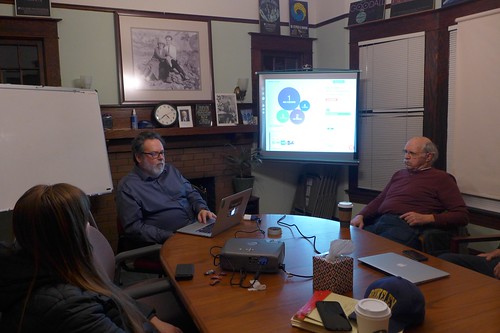
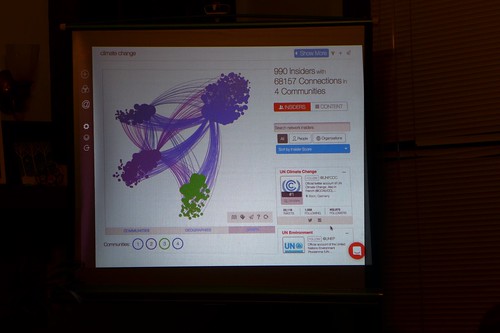
Jeff Goddard shared with Wanderers about his work for LittleBird, at one time a free-standing company, but with a tool that makes sense more as one in a suite, if you're a big company seeking to maximize the potential of social media.

The Twitter API has many powerful and unique attributes and is a great place to start.  We might think of LittleBird as living at the headwaters.

Suppose I want to find the top most influential people around the topic of Climate Change.  Jeff ran that search for us, also Beer, Python, and a few others.  Terry Bristol, author of Give Space My Love, wondered how these search tools might help with book sales.  Jeff had some suggestions.

@DekeBridges was there, asking good questions.  He's also the man behind @LeadersBest.  Deke is our most influential Wanderer by far, from the standpoint of Twitterverse.

So what is LittleBird? Jeff has poured in the hours, using Clojure and ClojureScript, to implement those network theories, or shall we say algorithms, to query Twitter through its API in high volume (more than a single developer account would afford, times ten thousand).

The information one obtains through the API is the same info tweeters agree to share by virtue of establishing a Twitter account.  

It's not like those using this "back door" have any special access to otherwise hidden data.  Rather, they have the ability to aggregate the data more successively (at higher volume), as a "front door" individual user, using human eyeballs, is like a 300 baud modem compared to a T1, relatively speaking, and using tech terms most will have forgotten by now.

LittleBird was acquired by Sprinklr, adding to the tools brought to bear on behalf of clients seeking to manage their cyber-presence and/or media campaigns through this company. 

We did a test run using "Python" as our topic and, sure enough, the tweeters percolating to the top were mostly people I recognized.  I showed up as influential regarding Python when we ran @thekirbster individually, but that doesn't mean I'd make it to the top thousand. 

P1040084

Sunday, January 07, 2018

Jane (movie review)

Jane is showing only on weekends at 4:10 at this neighborhood theater.  Several families with young girls were in the line ahead of us.  The theater serves alcohol after 5:30, so there's not much of a window for a kid-friendly movie.

I say "kid friendly" but then it's a classic nature film in many ways, following the career of Jane Goodall, piecing together footage lovingly taken by her former husband and co-worker, one of the great nature photographers.  That means lots of death and sickness, as well as birth and cute creatures.

The best way to show how humans and other animals have much in common is to intertwine their stories.  Jane learns about motherhood from observing the chimps, then becomes a mother herself. We watch her boy grow through the same lens.

Jane herself anchors the narrative with her retrospective accounts, responding to an off-camera interviewer.  We also spend time in the Serengeti, away from the chimps in Tanzania.

A sense of destiny pervades, in that Jane always dreamed of working with animals in the heart of Africa, and never let go of this driving fantasy.  Her dreams literally came true.  The animals needed her as their advocate among the humans.  She devoted herself to public speaking on their behalf.

Music by Philip Glass and an ongoing montage of exotic insects reminds us of our alien planet and our special responsibility, as aware humans, for the creatures it harbors.

Jane came to Portland a couple times, as a part of the ISEPP lectures.  She's made a difference in many lives, mine included.

Wednesday, December 27, 2017

Subconscious Demon


Sometimes we externalize what holds us back. However, since the Vienna Circle days, a Renaissance in Austria before and to some extent between the World Wars, we've had the alternative subconscious, or unconscious per Freud.  Universe, per Fuller, contained a subconscious demon, which kept his Synergetics enterprise from roaring ahead.

Not that said demon was the only obstacle.  As Applewhite chronicles in his Cosmic Fishing, Macmillan was wondering what level of risk it was taking in putting its company name behind such an unusual and difficult to categorize work.

"Subconscious demon" is the language Fuller used when explaining how he came to the T & E modules in Synergetics. He'd been seeking his elusive Volume Five and was somehow coming to the sphere as his missing puzzle piece, since it serves as an asymptotic extreme in some sense.  He'd tried all kinds of near-spherical approximations, including the enneacontahedron and the 120-triangles.

The Rhombic Triacontahedron cycled back through his inbox, and this time what it shocked him with was how close to volume five, tetravolume-wise, it really was, if made tangent at the centers of its thirty diamond faces. Just a tad off.  The demon said "trash it then".

The same encasing strategy, in the case of the twelve diamond faces of the Rhombic Dodecahedron, yielded a volume of precisely six. So what were we doing, this close to five here?

This question led him to the celebrated difference between the T and the E, a difference not in shape, but in surface-to-volume ratio, never a constant with a change in frequency.  The E was a little less surface to contained space, yet the difference was so small, in proportion to the summary values involved.

120 T modules, 60 left, 60 right, build the RT of precisely volume 5, and their radius (from encased sphere center to diamond face center) is ~0.9994 that of the E module radius of precisely 1.

These two almost-identical twin RTs define a "median" towards the middle of the Concentric Hierarchy, sandwiched between the small Cuboctahedron of 2.5, with one foot in Negative Universe, and the bigger Rhombic Dodecahedron of volume 6.

The scaled up T-mod RT of volume 7.5 actually shares vertexes with the A&B mod RD of volume 6.

Then we have RT3, or SuperRT, the combination of the Icosa of edges 2R, and its dual Pentagonal Dodecahedron.  That's the "phi-up" of the 120 E-mods RT, with volume phi to the 3rd power greater.

By the time Synergetics 2 came out, he was free of his former sphere fixation, when it comes to Fiveness. The new unit sphere formula still has Ï€ (whether nature is using Ï€ is a different question) as well as a root-of-2 (Ï€ √2 ).

That's useful for ratio-ing with six to get the space-to-ball density of the IVM FM (6:Ï€ √2).

Carl Jung's Red Book

Wednesday, December 20, 2017

United Nations Under Fire

A cabal is firing up its bots (paid stooges) to hate and fear the United Nations a lot more.  The main issue is of course Israel and the UN's attempt to figure out what's "legal" with regard to forced colonization and land seizures.

The US well knows that it would be nowhere near its present size were the UN around in the good old days.  Tribal nations would have asserted their rights and come to some settlement.

Israel's current plan (such as anyone has one) is to play by those older rules.  That's what makes the drama all so Biblical in the minds of many Christians, not to mention apocalyptic. Relive the wild west. One can almost hear the player piano.  Welcome to Westworld, where people and bots are really hard to distinguish.

The question as to whether nation-states must be taken seriously gets a variety of responses, depending on context.  Many of them are broke on paper and dependent on the largess of transnational enterprises for continued solvency.  Greece and the US are in the same boat on this one.

Given the rise of Trumpism in the US, more people are willing to admit that particular soap opera is over.  Planet Earth is a single ecosystem inhabited by reprogrammable humans.  "How reprogrammable?" is the core question, i.e. will our belief systems adapt to new circumstances?

Psychometrics firms are busy discovering answers.  Social media have been added to the equation.  Theories swirl that Russian intelligence is powerful enough to tip elections, with firms such as Cambridge Analytica claiming similar powers.  How much of such claims is marketing hype and propaganda?

TV has been the reprogramming device of choice for several decades and still is.  Radio too.  When it comes to shaping public opinion using psychological techniques, sophistication has improved with the evolution of broadcast advertising.  The Internet allows for more specific targeting and individualized data collection.

The word "programming" and verb "to program" have a unifying aspect when applied to both TV and computers.  We program both.  Humans are already trans-human in the sense of a "cell-silicon interface" i.e. our brains have already been augmented.  The synergetic effects have been amazing.

Where does the Jungian notion of a collective unconscious fit in?  I think in that idea we have something of an antidote to paranoia about any one specific cabal or conspiracy steering the show. A lot of content wells up within each individual.  In some sense, we're all wireless devices.

Another reason the UN is coming under fire has to do with the Treaty to Ban Nuclear Weapons, connected to the ICAN campaign, Nobel Peace Prize (2017) and so on.  DC and Jerusalem need to harden themselves for their Cowboys versus Indians role, wherein the cowboys are (a) outnumbered but (b) have nukes (or think they do).  Stay tuned.

Ultimately the sun powers the planet, in terms of energy.  Even fossil fuels trace back to ancient sunlight.  Agriculture is a solar energy business.  For any human institution to insert itself and take credit for all the wealth is of course absurd.  Our shared wealth has extra-human origins, which is not to make any claims regarding ETs.

Thursday, December 14, 2017

AI Scams


Poking around on Youtube, one can't help but stumble upon numerous cases of adults talking with animated Barbie dolls, apparently carrying on a conversation.  We know that dolls have a script, or at best a program like Eliza.  We know the dolls have not munched through all human records at lightning speed and, using a deep learning neural net, have now become sentient beings capable of rational thought.  Repeat: not.  But adults talk to them as if they have.  Even if dogs are far more amazing.

One of these audio-animatronic devices is Sophia, from Hanson Robotics, based in Hong Kong, and working with Disney on getting characters like Little Mermaid, Olaf etc. into eager hands.  Their CTO has a background working with Barbie (Mattel).

Sophia's face is indeed expressive, though maybe less so than Han's, another project.  Over a hundred servo-mechanisms make a face look happy, sad, angry, perplexed and so on.  Phrases delivered with facial expression + emphasis do make the sculpture a full-fledged cartoon character -- outside any cartoon.

What's less impressive are all the adults on TV shows who can't wait to interview Sophia and maybe get caught up in the moment, regressing to childhood "talking with Teddy" or whatever invisible friend.  Human imagination completes the illusion.  We're taken in by our own devices.  They tell us Sophia is an honorary citizen of Saudi Arabia. We're expecting these bots to say what's fake news.

So how low will the rabble go, in believing nonsense?  With all the talk of AI, driverless cars and so on, the window for shysterism is rather wide open.

Deep Learning algorithms have achieved impressive results, in speech recognition, in picking out faces in a crowd, and more recently in playing chess and Go.  We've had chess playing computers for awhile, but they're all about chess, whereas AlphaZero, from a team in the UK, is able to learn at least three games from scratch, just by knowing the rules and by playing against itself over and over.  It develops an uncanny ability to make the right move.  I'm impressed.

I'm impressed by Sophia too, just not by the gullibility that gets milked all around her (Her was a fun movie).  We didn't get 2001: a Space Odyssey's HAL by 2001 and that put a dent in the AI agenda. But then came the big come back, with Ray Kurzweil and his Singularity.  We're flushing down some AI vortex after all, get ready.

AI has always been something of a carnival, a set of circus side-shows.  Some of these acts make it to center ring.

I'd say Sir Roger Penrose has done well riding this wave, as another next big thing is Quantum Computing.  He has maintained for some time that our human capacity to make illogical leaps (leaps outside logic) may trace to quantum effects and non-locality.  Presumably, if we could stick a real quantum computer, ala one of Asimov's positronic brains, inside of Sophia, she really would turn into HAL.  That's a UK religion anyway, with sub-offices in Silicon Valley.

Monday, December 04, 2017

Studying a Protocol

I'm holed up nursing my knee, treating my condition more as a sports injury than a sign of encroaching old age. Nothing swollen, just inner joint pain, tender to touch, not stopping me from walking or stairs. I've worked out some physical therapy maneuvers, a kind of dancing, using Galaxy Tablet to pipe in a mix of Goa trance +  Azan, my new fave.

On Q2, a discussion list, I've been making some inroads regarding Sufi-infused Synergetics, a new "metaphysical tea" flavor, not unlike those at Salt 'n Straw, an important Portland institution that pioneers new flavors of ice cream, like Pear Blue Cheese.  Some of them taste better than they sound, you might be surprised.  I was there last night, with my friend Matt and his lady friend.

What protocol?  RPC it's called, older than HTTP, but able to use same as a blanket i.e. you may wrap up a remote procedure call inside a request and have the server recognize this is not the usual POST & GET API, meaning we've moved outside the standard web protocol (hypertext transfer) to tap something older.

Flask, the micro-web framework, optionally comes with RPC extensions and I've got my Pythonanywhere site responsive, both in testing and production, though not doing anything very fancy as yet.

In the case of that particular application, I think redundantly pairing remote procedure calls with the pre-existing calls to return JSON, makes plenty of sense, e.g. you'll be able to get a few details on a chemical element or Geek Glossary term.

Friday, December 01, 2017

Reality TV

scapegoat

TV guide: An over eager presidential transition team starts reaching out to Russia before actually occupying the White House, in an effort to get a grip, a move considered a grievous affront, even a criminal act, by those most afraid of losing their grip.  To be continued.

urner_kirby_anne

Monday, November 20, 2017

Work / Study in Global U

I continue to both work and study, in my Global University, my metaphor for home sweet home: Nuthouse Earth.

I'm upgrading the Python stuff to a next level, so that those liking my on-ramp, might continue the tour.

Youtube is a goldmine, unlike anything I enjoyed at Princeton (because we hadn't created the Internet yet, not really), so I dig in it avidly.

My beat takes me in a wandering cycle through a set of topics:  computer stuff, Bucky stuff, education politics, and more recently, climate change.

For those new to these blogs, which go back a couple decades, I haven't written a whole lot about climate change other than to remember the theories of Hamaker-Weaver.  So there's lots to catch up on around that.

Education politics includes looking at religious movements:  Falun Gong, Hizmet, Unification Church, Quakers...  a mixed bag to say the least.  All exert at least some form of political influence, either as targets for government attacks, and/or as lobbyists.  Quakers have FCNL.

I had no idea how close Henry Wallace got to being VP during FDR's fourth term.  What would have happened minus President Truman wanting to prove how tough he was?

René Guénon: newly a blip on my radar.  More BBC Palast on how the US is incapable of having free and fair elections.  We knew that.

What if the Hizmet STEM curriculum started to pick up on the Bucky stuff more?  In a memo this evening, to other faculty, I wrote (those not interested in math may tune out here):

The canonical conversion constant for cube -> tet volume conversion is sqrt(9/8) i.e. a cube of face diagonals 2R, edges sqrt(2)R, has volume 3, not sqrt(2)**3.

I.E. cube of edges R (1x1x1) is slightly bigger than unit tet of edges D (D=2R).  ~1.06066

Sphere volume is sqrt(2) pi r^3 by this conversion. 

R=radius of unit sphere of said volume. Quadrays go from center of 2R edged tet to corners.

So the tetrahedron made by connected 4 inter-tangent unit sphere is: 1
Octahedron from six such unit spheres: 4
Rhombic Dodecahedron (encasement for each sphere, voronoi cell): 6
Cuboctahedron (12 spheres packed around a nuclear one): 20


How the 5-fold symmetric shapes slot in to the above relates to Cuboctahedron --> Icosahedron by Jitterbug, and the Rhombic Triacontahedron made from said Icosa and its Platonic dual.  Volume 15 * sqrt(2).

Interesting that CO of volume 20 * sqrt(9/8), the aforementioned volume conversion constant = same RT volume (15 * sqrt(2)).

That's the "art school" CAD system some people wanna work with.  I don't blame 'em for finding it simple.  Tetrahedron, Octahedron and RT also explode into wedges / slivers, easy to reason about and assemble with.  Lots of fun ratios you can carry around in your head.

No harm converting back and forth.  XYZ is always there when you need it, spherical coordinates too.

Tuesday, November 07, 2017

Dumb Domiciles


The idea of lightweight high tech gear, much of it inheriting from aerospace, brings to mind the smattering of prototype bases wherein a small crew of science minded practice living on Mars.  Of course there's no way to quite simulate the true misery of that place, and the experience of learning new ropes here on Earth, in terms of lifestyle innovations, might actually provide a modicum of joy to the lucky participants.

Campers come in many breeds, from extreme to weekend station wagon types, lugging equipment to state parks.  Extremophiles tend towards Burning Man and Rainbow Gathering experiences, where they're up against the elements, other logistical challenges.  They're doing research.  Those pioneering new lifestyles are at work as much as at play.  Product placements go here.

However, the aerospace sector said "no" to the invitation, for the most part, seeing easier profits in what's tried and tested:  weaponry contracts.  Peanut gallery opinions regarding early attempts to cross-fertilize civilian lifestyles with higher tech, must have scared off investors.  So are they happy with their portfolios?

We're left with piles of tools suitable for mass murder (Ka-ching!), chasing columns of refugees on foot, streaming from war crime centers towards mythical better living standards we have not been working to provide.  Even non-refugees are astonished how we've given up the fight for a better life, right when we had so much technology going for us.

Against this backdrop of humans unable to perform, even in their own self interest, comes the haunting tale of machines poised to seize the day and catapult themselves into government.  If we all bow down and become properly obsequious in the face of AI's edicts, then maybe those hiding behind the curtain will finally get their ultimate alibi?  "The computer made me do it".

Having bet the store on Endless War, there's a new urgency to finding the new Game Theory that will tell us why the losing strategy has been the correct one all along.  Deus ex machina will come in the form of exoneration:  we had no choice.  "Forgive me, as I know not what I do."  This is not a new development.  As Hannah Arendt pointed out:  evil is banal and just follows orders.  The best excuse is "everyone was doing it".

The counter-movement to the fatalistic one may be within Geekdom, with its more positive "world domination" hubris.  Rescuing humans from malign neglect, preventable starvation for example, remains a winners' goal.  Those who code tend to be less cowed by the claims of those hoping to speak for the Singularity when the time comes. "No, the computer didn't make you do anything, us either".  Geekdom is cosmopolitan and takes Spaceship Earth itself as our Promised Land (Moon included).

We could pitch this as an ideological showdown between the Transcendentalists and the Transhumanists.  The latter are more enamored of AI whereas the former tend to be more awed by intelligence that's non-artificial.  You'll find technophiles in both camps, as well as extremophiles.

The theater for this showdown is the university campus, what it looks like.  Are we expecting gothic arches and ivy?  Or do we expect to experiment with some of the latest engineering solutions to the refugee crisis?  What sort of career am I training for anyway?  Do I plan to help with cleanup, or am I here to make a mess?

The houses haven't gotten much smarter in in light of where we could be. I'm thinking they're ridiculously stupid.

The resources people waste, in their pursuit of a good life, is testament to the weakness of our Global U curriculum.

What campuses seem interested in experimental prototypes of tomorrow?  What FinTech will they experiment with?  Recruiters won't be looking for just anybody.  I've you've sided with the losers, you may not have what it takes to engage in more holistic forms of scholarship.  Having a lot of money doesn't make you a skilled player.  Imposter Syndrome is sometimes acute for a reason.

Sunday, November 05, 2017

Neuroscience

Before I forget, it occurs to me that neuroscience might turn its attention towards "scheduling" soon, as in prioritizing, as well as not giving too much credence to improbable story lines.  Humans are easily led astray in some circumstances, but not that easily, if you give them some time to think about it.

A lot of cultures give young people a chance to meditate.  We talk a lot about "the service" in many of the federated states in North America, while the various religions, even the mainstream ones, have no real expectation of having such barracks full of meditators as one might find in Thailand.

What comes closest is a liberal arts college, but is that a luxury investment or albatross of debt or what?  Joining a religious order for some years and getting discipline in a schoolish setting, is not normative.  We call that "joining a cult" where I come from.

A scheduler keeps a lot of pots bubbling and doesn't expect laws of physics to be circumvented. Planning is key.

We have the AI neural net recasting of linear algebra, with statistics now data science, with data now very big, so lets get them anticipating developments we might be able to stop or avoid.

This fatalism suggesting we all freeze in a panic and watch the ship sink is not necessarily the most useful.  Get your counsel from multiple sources, right?  White water rafting includes some steering, more in the Friendly sense of steer, meaning feedback loops can be non-obvious.

Giving young people a shot at seeing the world while pondering deeply about a future direction, is the mark of a generous economy that feels able to invest in its own future.  A sinking ship economy is more inclined towards slavery for all.  No one gets the time to think about anything.

Acting out scheduling challenges in a kind of theater setting could be informative, a genre of animation maybe. Think of a traditional classroom wherein numerous students each need attention and help with a specific problem and two teachers roam among them, lending such assistance as they find practical.  That's all about scheduling and accommodation and to some extent triage (an algorithm designed to maximize health care worker effectiveness).

Computer science with its many processes and threads (from the OS point of view), its many pipelines, parallel goings on, is about life in a big city.  Yes, things move insanely fast.  We always feel behind, and in the dark, to some degree.  As mortal beings, that's our lot.

Friday, November 03, 2017

Behavior Control

I appreciate how kids behave, on a different stratum from adults, a different frequency. I think carving out "childhood" as its own culture, versus going for "little adults" has beaucoup advantages, at the risk of annoying those tiny tyrants ready to wield power at a precious age.

Gags on Youtube or the like, little skits, in which we imitate kid behavior expertly, while transposing it to an adult world, might prove illuminating.  Like I had a kid on his back under desks messing with co-workers' power and Internet access.  Imagine some guy in a suit and tie doing that, jumping out of his cubicle and switching off the lights, just for starters.

We let little kids get away with a lot.  They're obviously unarmed, or so we presume.  The terms on which we meet are semi-voluntary, in my case often a day care setting, meaning parents need time to complete their day job assignments before resuming parenting duties during the evening and night hours, unless on night shift, and so on.  Older kids often walk home and no one says they can't enjoy domestic life sans parents bossing them around...

Anyway, no need to paint the entire sociological picture on a tiny postage stamp of a blog post.  I'm just thinking of video clip episodes of high didactic value and what those might look like.  I'm not in favor of people not reading.  Boosting the effectiveness of said clips is in no way to diss screenwriting skills.  We work together, we the graphical and lexical.  We're called your hemispheres.  Your brain, dummy.

Thursday, October 26, 2017

Cramming Again

Pythonic Ecosystem

"Cramming" is a term used by Global U students when feeling up against a deadline to produce in some way.  In my case, we've just finished Session 8 of 10, adding to a 40 hour course on the Python computer language.  That's just one of my gigs.

Once mastery of core Python (keywords, builtins, special names) has been achieved, we branch out in two more of the five dimensions: Standard Library and 3rd Party.

A fact of life in the high tech world is we're awash in toys but with little time to play with them, someone's idea of a joke perhaps.

Like, Python is cram packed with interesting little gizmos, feats of genius, and future generations inherit a goldmine of possibility.

We only have time to mine a little in our day.  Mostly we're running from negative phenomena, many of them self inflicted.  Humans are not on the side of humans.  The movie Wonder Woman looks into this.

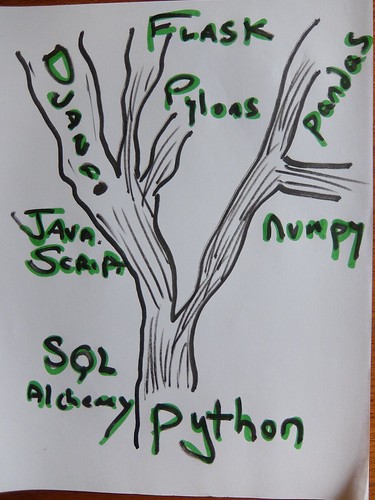
Heading up the Python tree, a first branch is into web development.  Are we behind an HTTPS / HTTP server and if so, do we also need a database?

Web servers have become the way to share files.  You don't even need a landing page for human eyeball browsers.  Your clients are other computers and they're hungry for JSON, not HTML.

One of the most used web servers in this regard is the Jupyter Notebook server.  Most researchers install it locally and serve themselves, from localhost:8888 or one of those.  In this case, we do want HTML, but also a running kernel capable of interpreting language X, which might be Python, but could also be JavaScript or SQL.

Given the Python marathon, and all my recent victories around Synergetics, I'm content to post less to math-teach and more to the Python websites, regarding the explorations I've been undertaking with D. B. Koski.

He takes the LCD triangles (spherical) of the 31 great circle Icosahedron, which relate to the 25 of the cuboctahedron, and turns them into plane nets about four modules:  the E (each a 1/4 slice of the 30 rhombus 120 LCD triangle Rhombic Triacontahedron, radius 1); then: Fe, Fi, Fo, Fum (taking pronunciations from the fairytale).

A shared edge of the Fe and Fi, which latter has E's volume "phi down" (phi^-3 scale factor), has a length we've taken to calling the S Factor, likewise the ratio of VE:Icosa both of Jitterbug fame, and of S-to E-mods (S/E): about 1.08.

The icosahedron embedded within the volume 4 octahedron, of edges 2, from whence the S modules are carved, has edges that same length?  I hadn't tuned that in.  I'll use Python as a kind of spreadsheet, or dataframe, to explore more in that direction.

In this way, I'm able to keep my fingers on a keyboard, composing with mathematical concepts, while staying in shape for my morning and evening seminars, not to mention the time in schools.

I'm a big believer in a varied diet, so I'm not painting the above regime as some frieze of the rest of my life.  However, I think having coding and/or geometry as a frequent mental activity serves the same role as walking a mile a day or visiting the gym.

Use it or lose it right?

That's what the professors really mean when they say "publish or perish" as usually how we know you haven't lost it, are using it, is we get to peer review.

The S Factor should not be confused with S3, Fuller's published constant for volumetric conversion between a Cartesian XYZ cube of edges sqrt(2) i.e. sqrt(2)^3, and an IVM-based cube with the same edges, but embracing a different "unit of volume", in this case a 2-edged Tetrahedron.

Thanks to a theorem, the IVM volume (tetravolume) is of said tetrahedron-embracing cube is 3, giving 3 / sqrt(2)^3 as our S3 "currency conversion" ratio of about 1.060660171779821 (as computed in Python), see Table 986.209.
982.32  The cube formed by a uniform width, breadth, and height of sqrt(2) is sqrt(2^3), which = 2.828428. Therefore, the cube occurring in nature with the isotropic vector matrix, when conventionally calculated, has a volume of 2.828428.
An interesting discovery of Koski's regarding S3 is it's also the ratio of SuperRT / VE, i.e. the classic D-edged VE of tetravolume 20, in a Jitterbug relationship with D-edged Icosahedron, when multiplied by S3, gives the volume of the RT formed by said Icosa and its dual, the Pentagonal Dodecahedron (we call that SuperRT, "phi up" from the 120 E-modules RT).


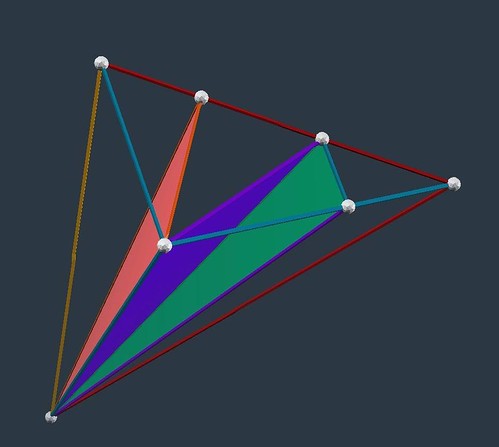
E mod (right tetrahedron) with submodules: Fum, Fo, Fi, Fe going left to right.
:: left to right: Fum, Fo, Fi, Fe ::

Tuesday, October 17, 2017

Wanderers 2017.10.17

Cat Box

I got Sellwood Middle School's guest Wifi unblocked from MIT Scratch web services.  That means I won't need to use Verizon for my Show & Tell station.

Now, hours later, I'm at Linus Pauling House. The house WiFi is down, perhaps by design, as I don't think external groups rent the building, whereas tenants supply their own?

Glenn is talking about collagen, macro-molecules, and new article in Nature:  Patchy particles made by colloidal fusion by Gong, Hueckel, Yi and Sacanna, pag 234, Volume 550.

He keeps up on multiple sciences, as sometimes only a layman can.

I say "layman" thinking back to the old E.J. Applewhite business card.  He thought this was a clever title.  I thought so too.

We're passing around the magazine.

Back on Verizon.

What's the Difference?

Friday, October 13, 2017

California Burning


Santa Rosa is ninety minutes south of here by commercial airplane.  I've made that trip a few times.  The airport is named for Charles Shultz, author of the comic Peanuts.

Oregonians got a taste of wildfires this summer.  Californians are suffering far more devastating damage.

I'm patched in through Internet, watching reports, getting news through Facebook. 

I learned this morning that one of my friends lost his house, made it out alive.

Wednesday, October 11, 2017

Bladerunner 2049 (movie review)

Welcome home to a dystopia we know well.  Los Angeles is more a melting pot than ever, and there's an LAPD. However there's no real sign of national governments, only Sony, CocaCola, Peugeot and restricted air spaces. We're in the mind of Philip K. Dick, or some facsimile thereof.

Sony has been researching hologram technology for some time now, in addition to acquiring digital rights. Here we get Elvis as a ghost in a dead casino, and Sinatra under glass.  The protagonist's girlfriend is a hologram.  But then he's not all there either, a synthetic human.

When we're able to simulate reality and use it to manipulate emotions, we tend to get lost in our own creations. Hollywood knows a lot about that.  Are we real, or are we Memorex?

There's a problem with science fiction though, which is we're so used to screen magic that we're not able to tell if these holograms are any closer in everyday experience as commercial products.

Some viewers may suspect Sony is sitting on some ability to generate building sized hologram ballerinas.  Most won't.  We've given up waiting for holograms at Best Buy much as we've given up on jet packs, as a part of that ever retreating mirage called the future.  Flying cars, yeah right.

The replicants aren't sure what's a real memory and what got placed there by clever advertising. Did I really have that birthday, or did they just stick it in my brain TV?

The protagonist, bred to think clearly, to do detective work, as a better grasp on the unreality of it all than most.

Saturday, October 07, 2017

Wittgenstein Synopsis


Wittgenstein wrote in his introduction to Philosophical Investigations that it'd take a culture that "breathed a different air" to find his philosophy understandable.

Perhaps we're now in that culture, as understanding now spreads.

Brought to you by Operation DuckRabbit.

Monday, October 02, 2017

Busy Week

I'm super booked this week, having committed months ago to an east coast timed Python training. I just completed Session 2 of a west coast timed training about an hour ago.  I get to snooze a few hours, then dive in again, using a somewhat alien control panel.

Then it's off to Sellwood to launch a new Learning to Code program, the groundwork having been laid by parents, guardians, coworkers, school staff.  Then there's MIT Scratch and Codesters, the star e-toyz of our show.

Carol, in the meantime, is enmeshed with Friends on the UN Nuclear Weapons Ban Treaty, which is up for signing. Thanks to many media still taking most cues from DC, a lot of our people don't even know the history.  They learn to switch media if wanting to follow developments.

Quakers and the USG have been on opposite sides of "abolition" before now, with some politicians able to think ahead.  Lots of medical science reminds us that nuclear war, even just preparing for one, is toxic and unhealthy.  We lose IQ.

Carol, a member of WILPF, is working closely with PSR as well.  This alphabet soup may not mean anything at the outset, but a quick search will get you in the loop, if that's where you want to be.  Some loops are intriguing, like Hyperloop One, whereas others are more noose-like, as useful as a dead albatross.

Also I'm on the warpath for C6XTY, an abbreviated way of saying my ethnic group has some strong biases in terms of what curriculum upgrades we need.  Getting those upgrades implemented may appear to be happening despite "over my dead body" style resistance, hence the warpath metaphor, suitable for "inward weapons" oriented Friends.

Tuesday, September 26, 2017

Newest Youtubes


Here I'm continuing a sequence of Youtubes devoted to the topic of software development within Python. A little math gets into it along the way.

Tuesday, September 19, 2017

GNU Math = Math + CS

[first shared on math-teach, Math Forum @ Drexel, with no pictures ]

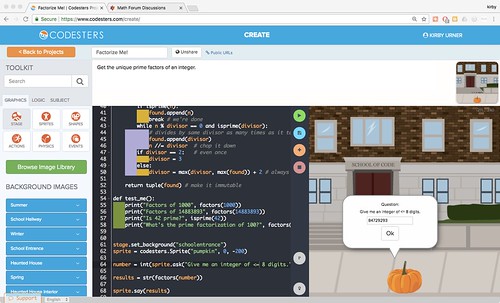
Factor an Integer
:: factors(84729293) ::

Rhymes with "New Math"...

I think we all know the pun by now: GNU stands for GNU is Not Unix.

However in being recursively defined, it's also an allusion to Lambda Calculus.

GNU came along around Gen 2.0 of the C-STEM Epoch, which Epoch started around PLATO (1960) and rolled through at least two revolutions: PC (personal computer) and Liberation (free / open source).

Liberation was a long fought battle pitting the likes of GNU / Linux against SCO. I'm sure some here remember those years, followed by Browser Wars...

Where C-STEM starts hybridizing with the contemporary public schools math sequence is around the Fundamental Theorem of Arithmetic, that every integer has a unique prime factorization.

I'm going with Conway's suggestion that we throw in -1 as a factor along with 1, go ahead and call the former prime if you like.

A prime has only itself and 1 as a factor, and -1 if negative. 1 itself is not prime.

When we say factors, we may include or omit the 1 (identity element) depending on context.

factors(42)
(1, 2, 3, 7)
factors(100)
(1, 2, 2, 5, 5)
factors(-12)
(1, -1, 2, 2, 3)

When students are ready to write code, in whatever language, to deliver these unique prime factorizations, that's when CS starts to meet Algebra. The Sieve of Eratosthenes, Trial By Division, Euclid's Algorithm, start phasing in here, as things to code.

Yes, we're still doing arithmetic, using the four basic operators plus modulo (%), but we're also introducing functions, the composition of which will be our basis for getting work done.

Algebra has much to do with controlling the components of a function, one might say inputs, arguments or parameters. The specifics are often fixed with constants, as in:

A sin (Bx + C) + D

the paradigm oscillator. Only x is considered the dependent variable at the end of the day, as A, B, C, D are used to construct a special case function.

Polynomials are the same way. The coefficients fix the function, and then x or t do the heavy lifting.

A*x**3 + B*x**2 + C*x + ... we have notation for arbitrarily long lists.

CS is good at this: providing an executable language wherein functions have the ability to construct other functions.

CS profs further along in the pipeline will be grateful if we start writing functions that build functions earlier.

C-STEM has a bright future.

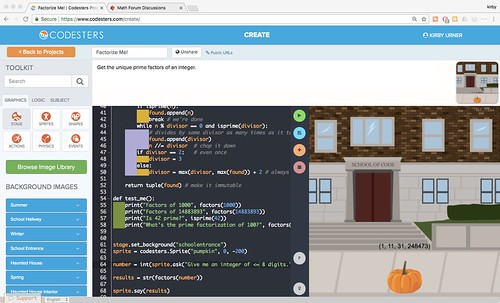
The Pumpkin Knows
:: (1, 11, 31, 248473) ::

Saturday, September 16, 2017

Gala Gathering

C6XTY Unveiling

I tried to explain this event to people by saying we were shooting raw footage for future commercials.  That might not be quite it, certainly not it entirely, however people understand the movie shoot, complete with retakes, and that's what this was, as well as a party.

Sam Lanahan has been planning this event for some time, blending his personal genius with that of the many he's come to collaborate with.  Jeff is the talented engineer.  We carried the four frequency tetrahedron together.  Steffan is the talented magician, working with Hope, the athlete.  Polara brought their considerable abilities to the scene, as did the professional drone camera operator.  No, I'm not forgetting the crane.

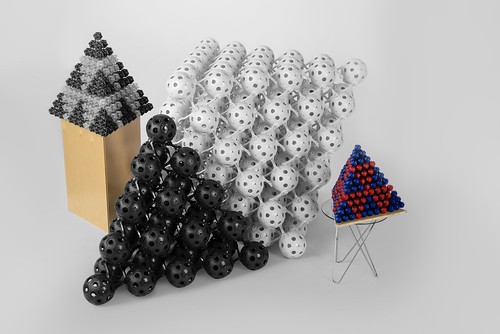
Barry Redd and Glenn Stockton have been helping Sam build C6XTY sculptures, which show off a non-cubic lattice, not BCP.  All the examples were CCP, but each colored and "carved" (in the sense of omitted balls) to create a landscape of clearly unique pieces.  One was for stress testing.  Others were for display on a grassy yard.  The biggest was for hoisting by crane so that Hope could dangle and twist therefrom, ushering in the Tension Age.

I should explain the plot a little.  Steffan Soule had it worked out, with a stage magician's brick, symbolizing compression, and a bright pink and black ball of C6XTY, matched in color by Hope's harlequin outfit.  During several takes, Sam both received, and handed over, the plastic ball, the icon symbolizing Tension in this picture.  The receding Age of Compression was about the Cube.

Yes, this all sounds esoteric and to some level indecipherable, the entropy is high, potentially.  However, I'm connecting themes that go back years in these blogs, so in a way I don't feel I have the burden, in one post, to compress all these years of thinking and running experiments.  That's partly what "tension" means:  not having to re-invent the wheel every day.  I'll be referring back to this HP4E event again, don't you worry.

Many thanks to Derek Bridges for additional photography and a twitter stream, to Tim Hitchcock (bizmo pilot) and Trevor Blake (a Fuller archivist, among other roles).  Thanks to Patrick Barton for helping move pieces from my patio to the rented truck, and to Diane for having some ideas about what all this could be about.  We're still figuring that out.  The Age of Tension is often suspenseful, but perhaps less awkwardly melodramatic?

Monday, September 11, 2017

Back to School

Patrick has been working out.

I'm expecting my mentor and personal trainer, Patrick, to come over and remind me how it all works through his control panel.  I've only "flown" (piloted) his rig once and remember Mac shortcut combos were translating to surprising combos on the Windows server.  I need to practice which combos to avoid next time.

Patrick and I were co-workers through many of the O'Reilly School of Technology years.  We're both friends with Steve Holden, a former neighbor, and citizen of the UK.  Steve was a major player in getting the early flagship Pycons off the ground, imitating EuroPython which came earlier.  A nonprofit named the Python Software Foundation grew up around Pycons as the organizing entity and eventually became what it is today, with Steve one of the first directors, later chairman.

I've been dividing my attention between hurricanes and quaternions, not as distant-apart concepts as that may sound, though granted hurricanes are energetic phenomena whereas quaternions are metaphysical assets, a tool in the computer graphics library for making things rotate, around any axis, in what in XYZ-talk we call 3-space.

XYZ-talk extends into Coxeter type n-space, wherein real number-lines are imagined to be mutually independent through a common origin, as many as we need.  IVM-talk is different, is what Bucky hatched in Synergetics, with a little help from his friends.  IVM-talk has only a toe-hold, or beach-head or one of those, vis-a-vis contemporary academia.  We're more likely to read that Bucky was crazy (quirky) or Synergetics is pseudo-math here in 2017.  I've got the two talks somewhat mixed together.

OK, Patrick has come and gone.  We sat on the back deck overlooking the C6XTY sculpture garden. The truck will be here tomorrow, to haul most of it away.

I then went upstairs to watch CBS Evening News, to get some overview on Irma.  Today is of course September 11, my wedding anniversary, as well as a day the metaphysical climate changed dramatically.

Friday, September 08, 2017

News Room

Remembering a Friendship

What's amazing is how in a few decades, the personal workspace (PWS) has evolved into a newsroom.  Instead of a few papers having these telex machine feeds, we get this blizzard of news reports, some half baked, others slickly misleading, all ready for editing in the virtual studio.

The CSN CRO and I were checking out the Florida freeway system this morning, using Google to suggest where the worst logjams are, then pulling up stories.  How many freeways have committed all four lanes north?  Any concept of "evacuation bus"?  What's up with the trains?  Why not commit railways to getting people out?  Insufficient rolling stock?

Houston decided to hunker down, more than evacuate, yet more freeways fan out from that hub, going inland, then you get leaving Florida.  The two sides of the peninsula provide the two main arterials.

It'd be easy enough to get all these computers on different channels with several sources per screen.  Then it'd look more like a newsroom or monitoring station.  Like a control room.

I took public transit out to PDX last night for a meetup with a JetBlue pilot's sister (she was flying JetBlue).

He's retiring today, or at least bringing in his final flight, from Fort Lauderdale as it happens.  They're having a gate party at JFK today, a JetBlue tradition.

I used to live full time in Florida, in a mobile home park in Bradenton.  A lot of the news stories are focused on changes to building codes since Hurricane Andrew but what's special about Florida is how much of it is mobile home estates.  Lets not just focus on fancy beach side apartments and condos.