Tuesday, March 28, 2017
Pacific Pivot
William Irwin Thompson, mentioned on the above (not glossy) magazine cover, has written extensively on the Pacific Shift.
In our Silicon Forest region, that means more connections within the Pacific Rim economy, which includes parts of Russia, as well as Japan, China and Southeast Asia. The increasing political closeness of Russia, much in the news, has its benefits.
I know some of the billionaire cabals are hoping to increase tensions between the two hemispheres, as that's where the money is from their angle (endless war).
Out here on the Pacific Rim, we have different billionaire cabals with their own agendas.
The "commemorative ruble" below is of course a joke (see latest issue of Mercury), and is a measure of how not concerned we are about the emerging pacifist economy.
Sunday, March 26, 2017
N8V American
The Indian Wars are cranking up again, with the Yanqui drive to nail down the borders once and for all. Reclassifying Latinos, from Hispanic to Native American, is not exactly what's going on, as many Pueblo are happy with "Pueblo" and don't need to care what's put on the check boxes.
The US president's visit to the tomb of Andrew Jackson was a signal to the General Custer types to become more militant about reporting when indigenous folk might be migrating in violation of Ranger rules. Incarceration is the big industry, next to human trafficking. Bounty hunters keep queuing at Information, asking when and where to saddle up.
I've been suggesting our Third Party (we could call it that) get advisers among the Born Free (or Free Born) of South Africa, those emerging from a post-Apartheid zone. A spirit of "not waiting for the government to do it" should warm the hearts of church-going citizens, eager to return social services to the pastor class. Does your Meeting get hip hop yet?
Quakers were never fans of the Indian Wars, preferring to do business among equals and profit all around. They were already heavy into negotiations with the locals when the Indian Wars were declared, and briefly pressed into service afterwards, as minions in charge of Boarding Schools. AFSC got an earful that year in Philadelphia, when I was a corporate delegate from NPYM.
I just got off the phone with Maureen Long. She's a part of the extended Methodist community around Portland and so of course knows Pat, who thought I'd be female when we met, based on my name Kirby (she's a she). I'll join one of their Wednesday feedings at Ghost Church (what I call it) in Sunnyside, when Maureen gets over her "case of the time zones" (she's recently back from west Thailand, visiting a son).
My Third Party, just revving its engines (no candidates yet, more like a record label) cares a lot about voting technology, wants a lot more openness, a lot like the California's Pirate Party, a natural ally.
We care all year around about polling and voting infrastructure and agitate to let US public schools feature said technology as a part of what students learn about and understand. Where are the museums about Vote Tech?
All the more reason to keep it open source.
Quakers tend to use consensus in Business Meeting however that only works when clerks have done sufficient homework ahead of time to smooth a path ahead for whatever minutes. The process is time-consuming and we call ourselves Friends for a reason. Come role play and discover your own talents.
That being said, among strangers or ships in the night, one expects a different system. Voting has its place, as does polling, and the infrastructure is progressing with leaps and bounds, given WiFi and encryption. Universities don't need to wait for governments to give their student bodies more practice.
Closed source elections with no audit trails have far less legitimacy, and contribute to the Banana Republic quotient, now skyrocketing in North America.
Our Third Party gains an edge simply by pointing to the sullied reputations of the colluding parties, which have aided and abetted, not to mention covered up, the dirty tricks in some cases. With nothing to lose, we have everything to gain.
Sure, universities here in North America might have some stake in more transparent elections, but don't they depend on the largess of Congress in many districts? How eager is Congress to invite more transparency in the electoral process I wonder? Do we see any signs of dawning awareness yet?
South Africa, home of Chappie and Die Antwoord is more liberal about sharing the bash shell with more ethnic groups, through Shuttleworth Foundation tuXLabs and so on. North Americans still suffer under the tyranny of TI.
I focus on these more liberal policies in my recent Is Code School the New High School?, which looks at all these connections in more detail.
On another topic, just to clarify: "Project Truckistan" is about more open borders for truck drivers, not just in terms of fewer mandatory check stops along the lanes, but in terms of getting to exchange truck routes more readily.
Get good in Ukraine and South Africa both. Give labor (work-study people) the freedom to move, not just their pseudo-human corporate employers. Cross-trained truckers might also serve as tour guides, two revolving door careers.
True, not everyone drives on the same side of the road, nor in all weather conditions. I was not suggesting dispatching drivers purely randomly was I? Transcripts matter.
The trucking issue comes up around truck routes in the Americas as well. How long must trucks sit in line waiting at borders or weigh stations? People tend to favor a policy of keeping the borders open between states in Lower48. Other regions of the world would like more of that freedom too.
We may need big data to help us on the metrics, and universities like MIT, or that one in Austin. I've not put any Jupyter Notebooks out on that myself, with or without Bokeh. Perhaps the Google Earth team will show some leadership in this area? We shall see.
Friday, March 24, 2017
No Immune System?
Excerpts from my postings to Facebook:
People expect so much from politicians. The institutions are what's broken though, starting with voting itself.
A federal contest to come up with the best open source not black box voting system with auditable / analyzable results, which the government would then adopt and own, not outsource, might help resurrect that "democracy" idea.
In the meantime, states need their own foreign policies and workarounds. DC is an obnoxious capital with no legitimacy at this point. Too many irregularities in the voting, per Palast etc.
Not talking about "fraudulent voters", talking about purging voter roles by the millions, Rove-style, thanks to deliberately sloppy matches.
Neither mainstream party wants to look at that (except Black Caucus) ergo USA is dead, long live USSA, the Imposter State.
I don't think it makes much sense to have a healthcare debate and exclude public health / CDC type epidemics such as Zika and Oxy.
Or the quality of food in government facilities, be those schools, prisons, hospitals or military.
Focusing purely on the nuclear family and how family physician type medicine will be provided is letting politicians off the hook in too many dimensions.
We need to see if there's any interest in public health.
My impression is the FDA is like in Idiocracy, helpless to protect Americans against the merchants of bad health.
Uncle Sam has no immune system?
Probably a 3rd party would do well if it focused very concertedly on the infrastructure of voting itself. Why don't public schools at least, have voting machines 24/7 that they get to work out with, come to understand?
Or is it that the public should not understand the vital infrastructure of democracy (exactly right, but our party could change that).
As campaign manager, I'd widely show the new Palast film, The Best Democracy Money Can Buy, about the Rove-style purge of some millions of voters in the build-up to the most recent presidential election, on the pretense that the algorithms were protecting against "double voting", somehow a common practice in a population hard pressed to vote once in most cases.
This magic trick, like the one in Florida in Bush vs Gore, likely swung the election, but no the Russians are to blame (we'd mock that "look the other way" campaign, to distinguish ourselves from Dems).
We'd probably also talk about Apartheid a lot and advertise our friendly ties with South Africa, home of Die Antwoord (a campaign needs music).
Saturday, March 18, 2017
Note to Translators
Translators might feel OK with simply adopting the simple Synergetics words for them, while supplying various synonyms and equivalents: the Mite, Rite, Bite and Lite. Also Kite, Syte (see below). Each is one syllable and therefore easily pronounced.
We're in the ballpark of space-filling and tiling, figurate numbers.
Earlier threads trace the convergence of Bridges type art-math content with the mosque patterns, already converged with geodesic architecture in the 1900s. We might say Humans in Universe by Anwar Dil was a precursor to the Iranian SpaceX, in hindsight.
The TetraBook "job" (Montessori meaning) pays the bills when it comes to adding insightful software to your PWS (a GST term). A page wags back and forth, its altitude the radius of some circle, symmetric "book covers" lying open on XY (Z is "up" except in POV-Ray in most Oregon Curriculum Network chapters, with quadrays more relative and zero-gravity).
The Mite, remember is Aristotle's space-filling tetrahedron. He didn't call it that, nor did Coxeter, which is why translators need to study the source documentation (Synergetics) more directly, if in doubt. The full text, with diagrams, has been online since W3 (WWW) got started, more or less, as many of you well know.
Two Mites face bond in various (not many) ways, one way yielding the Rite, another the Bite, using this namespace of Martian Math. The Rite explodes into four sections ala quadray quadrants, to give additional not-handed (outwardly identical) space-fillers, identified by Sommerville (1920s). Our K-16 has all that in the pipeline, where and when subject to local jiggering.
I've got the magnetic Mites in my Pergamon Press bag, the kit I carry to local schools sometimes, when yakking up 3D printers.
So far, that mostly happens through the Linus Pauling House, a birthplace of organic chemistry (alpha helix...) in that I meet with teachers and retired teachers at that venue, through weekly meetups going back some years.
During the latest election cycle, I was hoping to expand the number of teachers I get to work with, but the anticipated costs for professional development would have needed Measure 97 funding, so that plan got scrapped, and I went back to working more directly with the students, more like on the Saturday Academy model, some of whom are ESL (not native English speakers).
Given Synergetics and Python are not native English either, but different languages, we have more of that "even playing field" that keeps English from over-dominating.
I did over a year of Python work in California (over the wire, declared as income in Portland), and that included at least showing some of the Jupyter Notebooks at my repo in this area.
The Business Accelerator building has an IVM outside (an octet truss), inviting students to remember about A & B modules. The international school is blocks away.
Sytes (2 Mites): Rite*, Bite*, Lite
Kites (2 Sytes): Kate*, Kat*, Kit*
* space-filler (1/4 Rite also a space-filler, not-handed) -- note that only some of these are tetrahedrons (Rite, Bite and 1/4 Rite).
Kates, Kats and Kits build the Coupler of tetra-volume 1 (space-filler). Mite volume is 1/8, A & B both 1/24 (same as T). Typically we'll show ESL classes how Mites make not just Rites, but a Rhombic Dodecahedron (RD) of volume 6, a transition to the "NCLB Polyhedron" (RT) for those into parochial jargon. Montessori Schools are not guaranteed to have 3D printers. Look on-line for teaching supplies? Koski is supplying the name Kit, for the Syte made of two face-bonded Lites.
Friday, March 17, 2017
Pedagogical Artifacts
:: Mites make Rites, space-filling Sytes ::
Ethnographers use fancy words for "educational toys" sometimes, Lux Blox for example. Once a toy becomes a model of something serious, it's no longer a mere toy. Skeletons hanging in the medical school, even if made of plastic, are serious tools of science. I've used "toyz" to cross that line, as in "toyz for the adult-minded" (but then that has its own connotations).
The TetraBook is my standard example at this juncture. Consider the rhomb (diamond) as two triangular book covers laying flat. A diamond has long and short diagonals, corner to corner, and either could be the book's spine. Then we have a single page that flaps back and forth, a gizmo not unlike the unit circle in that the page tip traces out a circle, but of variable radius.
Getting to build these gizmos in a shop and/or 3D print them is a privilege many of us do not have. I checked out Hedron as a possible studio but 4D Solutions is mom & pop scale-wise, not really NASA or a government lab, in terms of budget. However one doesn't actually require anything that fancy to construct a Rite, a space-filling tetrahedron. You may follow the links through to Sommerville (a mathematician).
Another pedagogical artifact is the Adidas soccer ball, the pattern, which in chordal form is called a truncated icosahedron, well known to Leonardo da Vinci. We're at the heart of so-called Western culture here, the realm of the Platonics, all duals of one another. A rich genesis for geometry begins here, with or without Euclidean definitions. Menger's "geometry of lumps" has equal access, for something more like claymation (what distinguishes points, lines and planes is topological but not dimensional).
Dawn Wicca was the mom in this mom & pop operation and the family is missing her today (and always). We had a family business doing programming and bookkeeping: Dawn Wicca and Associates, with 4D Solutions a DBA (business alias). She kept herself alive through a vicious cancer, pulling her community together for a healing process, wise woman that she was.
Even back when we had DWA as a partnership, I was investing a lot of time/energy into my Oregon Curriculum Network website, as well as Synergetics on the Web. The Wikieducator stuff came later, along with Martian Math (one of four components of a Digital Mathematics curriculum, more developed in my various pilots).
David Koski is working on the TetraBook project. He envisions some of the shop course options, such as motor-controlled, with the cover tip to page tip strings stretched between counter-weights hanging beneath the book's plane.
I've kept it more screen-based, given my skill set, thinking of segments for hypertoons (a Portland Knowledge Lab project, back when Dawn had the annexed office at ActiveSpace). Making Portland a "toontown" and source of claymations, other technical animations, was and is my goal as a curriculum developer.
These days most "toyz" in the US are for authorized personnel in the military, where most have no clue about the heritage denied, unless a privileged officer from West Point perhaps. That's where people learn about radomes and the DEW line (Cold War history). I imagine few below the rank of general on active duty have had much time for Grunch of Giants (St. Martins Press). Don't ask an enlisted US army soldier about A or B modules, or whether MITEs make a RITE. Standards for K-16 vary. I don't know any public school math teachers who aren't free to teach this stuff.
Wednesday, March 15, 2017
Wanderers 2017.3.15
Wanderers was what I hoped it would be about: public schooling. Barbara, an experienced retired public school teacher, had already started the ball rolling. Dick Pugh was there as well, likewise a high school science teacher from way back, including at Cleveland PPS, where my younger daughter went. Alexia went to Grant PPS.
I didn't bring up anything about the Gulen Schools, not necessarily called that except informally, until towards the end of our meeting, as our discussion was not specifically focused on that particular controversy and I wasn't trying to commandeer the thread.
I'm on that physics listserv, provided a seat by Dr. Bob Fuller, I'm explaining how the 95% conventional XYZ approach, with the added spice of the "IVM", might be more effective at imparting core STEM concepts than convention alone. I call this "thinking outside the box" in my longer essay on Medium.
I've been suggesting that Quaker private schools might be the most influenced by American Transcendentalism ala Margaret Fuller and her grandnephew Bucky Fuller. However the Islamic tradition comes to tiling a plane and filling space as topics, and so could as easily start sharing about Mite, Rite and Kite as we Quakers could.
The best way to think of a Mite might be as a 1/8th Coupler, the latter a key shape in the game of filling space with Archimedean Honeycomb Duals. Guy Inchbald maps it out for us, minus any use of said nomenclature, which traces, as I've mentioned, to Transcendentalists in American literature (not just Quakers).
In today's political climate, the Gulen Schools are feeling stigmatized for their Turkish roots. In Turkey itself they're branded as part of a terrorist organization, much as people in Germany and the Netherlands are today considered Nazis by the Ergodan government.
Ergodon sounds a lot like Trump when sounding off about what are supposedly CIA plans to undermine their respective administrations (the failed coup of 2016 is laid at the door of Gulen and his Falun Gong like movement, as well as the CIA's, whom he casts as "working in cahoots with"). The lingua franca of paranoia is becoming more global, thanks to Alex Jones and friends; thanks to Youtube.
What may be paradoxical, too early to tell, is Uncle Sam's ongoing friendliness towards these newfangled public schools (so-called "charter schools") that supposedly introduce much-needed innovation without crossing various fine lines in the sand. Crossing those lines makes you private, no longer qualified for public funding.
The challenges to public schools are somewhat new now that TV has taken much of the burden of providing social cohesion.
I asked the group: could the USG set up thousands of boarding schools with admissions criteria, of course not at all based on race (a dubious concept to say the least)?
They might not take all comers, just as NASA doesn't admit just anyone into astronaut training. If there's political support for these academies, they could spring into operation overnight.
The military is already such a network, run on the public dime (and borrowed currencies).
Those who see schooling as a way to eradicate niche ethnicities and quake with missionary zeal about doing so, have become niche ethnicities themselves.
Most of us are content to offer choice and be generous with the freedom to create and operate public school facilities. Sure those might have an ethnic focus, by design. In Portland, we enjoy Japanese immersion as one of the magnet school options.
As I wrote on Facebook:
The country wants to have a debate about education, not just health care. We understand the military, with its six billion a year budget, is the Education King, dwarfing all others. The military has campuses around the world, many of them floating.
However one may serve in the military and still be a Sufi. Fuller himself was in the USN and distinguished himself as a Cold Warrior during what he called WW3.
I didn't bring up anything about the Gulen Schools, not necessarily called that except informally, until towards the end of our meeting, as our discussion was not specifically focused on that particular controversy and I wasn't trying to commandeer the thread.
I'm on that physics listserv, provided a seat by Dr. Bob Fuller, I'm explaining how the 95% conventional XYZ approach, with the added spice of the "IVM", might be more effective at imparting core STEM concepts than convention alone. I call this "thinking outside the box" in my longer essay on Medium.
I've been suggesting that Quaker private schools might be the most influenced by American Transcendentalism ala Margaret Fuller and her grandnephew Bucky Fuller. However the Islamic tradition comes to tiling a plane and filling space as topics, and so could as easily start sharing about Mite, Rite and Kite as we Quakers could.
The best way to think of a Mite might be as a 1/8th Coupler, the latter a key shape in the game of filling space with Archimedean Honeycomb Duals. Guy Inchbald maps it out for us, minus any use of said nomenclature, which traces, as I've mentioned, to Transcendentalists in American literature (not just Quakers).
In today's political climate, the Gulen Schools are feeling stigmatized for their Turkish roots. In Turkey itself they're branded as part of a terrorist organization, much as people in Germany and the Netherlands are today considered Nazis by the Ergodan government.
Ergodon sounds a lot like Trump when sounding off about what are supposedly CIA plans to undermine their respective administrations (the failed coup of 2016 is laid at the door of Gulen and his Falun Gong like movement, as well as the CIA's, whom he casts as "working in cahoots with"). The lingua franca of paranoia is becoming more global, thanks to Alex Jones and friends; thanks to Youtube.
What may be paradoxical, too early to tell, is Uncle Sam's ongoing friendliness towards these newfangled public schools (so-called "charter schools") that supposedly introduce much-needed innovation without crossing various fine lines in the sand. Crossing those lines makes you private, no longer qualified for public funding.
The challenges to public schools are somewhat new now that TV has taken much of the burden of providing social cohesion.
I asked the group: could the USG set up thousands of boarding schools with admissions criteria, of course not at all based on race (a dubious concept to say the least)?
They might not take all comers, just as NASA doesn't admit just anyone into astronaut training. If there's political support for these academies, they could spring into operation overnight.
The military is already such a network, run on the public dime (and borrowed currencies).
Those who see schooling as a way to eradicate niche ethnicities and quake with missionary zeal about doing so, have become niche ethnicities themselves.
Most of us are content to offer choice and be generous with the freedom to create and operate public school facilities. Sure those might have an ethnic focus, by design. In Portland, we enjoy Japanese immersion as one of the magnet school options.
As I wrote on Facebook:
So what you want is choice right? Including the right to home school. Or perhaps they get the Judaism at home but your family purposely chooses something more alien, like Japanese immersion, because of long range ideas about role / career opportunities that open to those with hybrid skills and capabilities.
My parents were quite willing to immerse me in an Italian school when we moved to Italy, to make me bilingual, but I rebelled against the smock and bow kids my age were expected to wear, so they immersed me in an English school instead, where I had to wear blazer and tie.
To be a fully public school, one needs to meet certain criteria, but what criteria? That's a discussion we never have in much depth owing to more superficial topics co-opting all channels.
How Jewish might a school / curriculum be and still count as public? The answer would interest the Catholics as well. Given religion is a huge aspect of the human experience, why not allow any student to go deeply into a religion of her or his choice from an academic perspective. Public schools should not shy away from allowing students to study anthropology (the A in STEAM, if you ask me and not an artist).
I'm fine with a public school offering safe gun use as an elective. No way should it be required. It's like taking a safe driving class. Owning a gun and a car are similar concepts as both are lethal in the hands of an unskilled operator.
I'd keep the guns, skis, snow shoes, snowmobiles, ham radio, tents, stoves, other equipment under lock and key, to be distributed during course work, which may include outdoor survival skills, scouting style.
More outdoor options is what the public boarding schools are about. Many thousand of those. Lets see if the local folks are smart enough to create those opportunities for themselves (lots of good jobs) and their children. Of course we're all skeptics as if they had the smarts they'd be enjoying these already.Again, I'm simply describing the military, our number one public education facility, by far.
The country wants to have a debate about education, not just health care. We understand the military, with its six billion a year budget, is the Education King, dwarfing all others. The military has campuses around the world, many of them floating.
However one may serve in the military and still be a Sufi. Fuller himself was in the USN and distinguished himself as a Cold Warrior during what he called WW3.
Tuesday, March 14, 2017
Back on the Grid
The above Youtube is sooo cute, these little orange guys with one eyeball.
I was just getting ready to post on Facebook | Quakers, that we should hire this crew of thespians to act out some anti-patterns we get in Quakers. Then I thought, why not blog that thought instead.
But lets not brand every pattern an anti-pattern. When oldster grandparents collude with the youngest to help them wrest power from their middle aged parents, what's that? One could say: evolution doing its job.
Notice the ruling cast has a big mouth but no eyes or ears, while the passivists are just one-eye with ears, have nothing to speak with.
Above the ruling cast (caste) are the controllers, the corporate personhoods, with eyes and multiple arms, very polytheistic. Talk about division of labor!
I bet H.G. Wells would applaud this cartoon, likewise Orwell. Anyway, I do.
Good work Amy Goodman, always love having your voice. She's another Sigourney Weaver type in how she stands up to those Aliens (corporate persons). She's not a cowardly capitalist always picking on the little guy, the defenseless, like True Korea.
I'm eating lots of potatoes today. I bought a whole bag of 'em then let 'em sit in the cupboard, getting all sprouty. I'm trained not to waste. Waste not, want not, right?
Fried potatoes for breakfast, mashed potatoes for lunch.
We're coming up on St. Patrick's Day and I'm pretending I'm Irish. Time for another Sierra Nevada Pale Ale (true, not Guinness, but then we're pretty mulatto about our beer).
Speaking of ethnic heritage, I've gone to battle for the Turks at some level, defending the right of trained Sufis to help Americans better like math and science. I consider that a wise investment in our collective future as a planet, don't you? Apparently some do not.
Turkish people seem rather polarized about these folks. I'm reminded of Chinese and their Falun Gong.
We have a suspicious public that doesn't understand why some Chinese Peace Corps would want to help raise living standards for the people of Flint, Michigan.
Their thinking is more like Lesley Stahl's in the linked 60 Minutes. Why would Americans be getting science from Sufis in this day and age? She found that counter-intuitive.
Wednesday, March 08, 2017
Work + Study Space
As we move around in the work place, we may get a private office, a cubicle, or some position on a Star Trek bridge with lots of people doing their jobs. More of a situation room.
Finding places to concentrate and study becomes a first order of business when landing in a new place. Where do I charge my devices? Do we have WiFi?
I understand the need to go off the grid, so to speak, and do that myself. I'm not always connected. However I do my best to take advantage of certain opportunities.
Twitter is more a message in a bottle in a lot of ways. Big data farms that sift for a living, might return a string of breadcrumbs. I seek such trails left by others.
We don't know, in putting ourselves out there, precisely what difference we'll be making. However it's less a matter of humility and more one of shirking responsibility to suggest we're making no difference. I make a difference. You do too.
If all you get is a locker and crowded classrooms, TVs blaring, then you're not getting much time to really think on your own. Some lifestyles afford precious little privacy, if any.
In designing an education system, ask yourself: if "learning to code" is what I say I encourage, how am I structuring the curriculum to permit plenty of alone time?
Yes, I know, coding is not always done solo. However one does need that sense of a workbench, of tools. You'll need your editor, your interpreters... you don't need me to tell you what you need, in most cases.
Does your school help you amass a wealth of tools you know how to use?
Tuesday, March 07, 2017
Psychotherapy
Today was day two of two in my annual pilgrimage to my auditor. Jody Francis used to be my ideal CFO, still is, though we were never in business together. She ran Fine Grind around the corner from me, and was a source of a religious experience that time at a Quaker retreat (just me, and AAA, left my lights on in a camp ground). She appeared to me as a bright star, probably Venus.
In this life, Dawn Wicca ran our partnership, from the ground up. We later married, keeping separate checking, which the business paid into, 50-50. She was a skilled and honest bookkeeper and I kept up my end of the bargain working for myriad non-profits, towards the end a large Catholic hospital system. After she died, I tried to keep the partnership going, an oxymoron I found out. The IRS saw double when I claimed personal income to the partnership as well. Nikki helped me sort it out.
Nikki is my H&R Block accountant. She works with many, which keeps her in shape. Every aspect of the tax code gets exercised. What an amazing pile of code that is, one could spend a lifetime, a career, looking into it. Nikki has done that. I have not. To file a Schedule C, take advantage of this or that, even get a refund by itemizing, is a daunting process. Even the 1040 EZ is quite a chore. So yes, I ate my costs as a very legitimate business expense, and will claim them next year, if I survive.
4D Solutions is what remains of Dawn Wicca and Associates. I resurrected it in the wake of losing my full time job as a code school mentor at OST. Since 1980, Dawn and I had been a partnership, then after she died of cancer, I went solo. I had my eye on a next partner but was too confused. Then Lindsey Walker moved in, a political refugee from Savannah, Georgia seeking asylum in Asylum District. I actually claimed her as a dependent one year, as more family member than renter (I was never interested in being a landlord per se). She traded digs for a car she no longer believed in driving, so that worked out. DMV has the records on "torture taxi" (the Nissan).
Even as O'Reilly was closing its code school (OST), I was picking up work with California. A forward-thinking professional development program found me through LinkedIn and picked me up as a Python mentor. I'm still doing that kind of thing in 2017. I also work with kids, having been certified to do so by the local archdiocese.
I claimed the Buddha Room and Snake Cave as office space, though I think of the Blue House as some moored ship of the line and all business in that sense, even the galley and heads. Those rooms account for about 20% of the floor space and barely paid the fee for the form, but at least I've carved out some self employment space. I did not claim Carol's WILPF office given it doubles as sleeping quarters at least some months of the year.
Perhaps 4D Solutions will be taken seriously, as the Oregon Curriculum Network fountainhead or whatever, you never know. The 4D story is mostly told in esoteric art history books. I've been proposing to offer more teacher training, other services. I'm more into a math + code hybrid, something of an exotic butterfly, even in the Silicon Forest context.
Speaking of esoterica, I don't try to reflect Food Not Bombs work on the books. Food slated for the dumpster is not usually accounted as "income". Americans are allowed to have guests, and entertain them, without registering as a BnB. I don't need to claim "movie nights" as a business expense either, as I'm not charging money.
:: Buddha Room ::
Thursday, March 02, 2017
Learning with Data
In printed textbooks, the need to save paper dictates that data sets remain small, lets say under 1K of data, just to fit. Analysis has a different flavor when you get to look at it and reason about it row by row, and we do that in Python using SQLite, part of the Standard Library.
However lets skip over what flavor of SQL or noSQL and refocus on data, and how it no longer needs to be small. Nor must it be enormous just for the hell of it. On edu-sig in Python.org, I've been yakking about "rich data structures" such as: the Periodic Table of the Elements; a Glossary of Terms; Assorted Polyhedra. Recently added: a database on roller coasters.
Let me boast the advantages: we're taking traditional classroom poster data, stuff already hanging on the walls, and distilling it to reinforcing content that we interact with through our computers, as well as through our own senses. We read them as files, starting from maybe JSON or XML (those are well known data exchange formats).
Tables are nothing new. Rows and columns, so-called arrays, became multi-dimensional in the guise of NumPy, or in the computer language J, which has them natively. The data languages all have them now, as a type. As many axes of address as you like. A lot like SQL or noSQL, a database in itself.
The complaint that switching to tables and SQL is some severe departure from reading and writing of old is stemming from nostalgia for when we could afford to wait in a long line for our money. ATMs to the rescue. For those, you need the tables to exist electronically, but otherwise it's just like the ledger books of our colorful past. Lots of people use paper today, nothing wrong with that, has its advantages. Not either / or.
The point being: now that literacy within industry does require doing homework, the need to pay ourselves to keep learning seems obvious, and as we practice, it helps to have rich data structures to hack on, and many of us have those and are currently hacking away. I'm not at all as fast as some when it comes to drilling down in some XML file using elementtree or whatever.
Indeed, I'm the king of non sequiturs some might say, however I grew up on film and know about jump cuts, flashbacks, not just plodding linear. Norman O. Brown and all that. Ad copy is likewise choppy.
J comes from a collaboration among Kenneth and Eric Iverson, and Roger Hui, not that I know the whole story. I immersed myself in J awhile back, having first cut some teeth on Kenneth's APL (A Programming Language), which I really grooved on. J did not disappoint, in terms of what it made possible. I grabbed some of its group theory too, when I pitched my tent in nearby Python Nation. Kenneth found a couple typos in my Jiving in J essay (I was honored, to have the attention of his genius).
Another double plus for using classroom poster data, as a topic in learning to code, is we're not intruding on anyone's privacy. Science has shared the Periodic Table with generations already. We don't need Hydrogen to sign a release. I'm not in denial about security and privacy, on the contrary I'm suggesting data that's the least sticky. That stuff at least, will be super easy to come by.
Monday, February 27, 2017
Circuit Rider
Patrick was kind enough to give me a heads up about the Ninkasi Festival at Belmont Station. I had the Greg Palast movie to return, so headed out on foot by Movie Madness. Although this tap room and retail establishment started out near to Horse Brass on Belmont (hence the name) as retail only, it moved to Stark Street, just a block down from the Quaker meetinghouse.
I've met with Friends at Belmont Station quite a few times, sometimes to go over math concepts, as I'm known to float around in math tutor space. However this time I was sharing perspectives with Patrick about some hefty RFPs he's been looking at (Requests for Proposals). I've been looking at them as well.
Before November of last year, I was hell bent on ramping up professional development classes for Portland teachers. I got the idea from doing PD for Californian IT workers, in a program geared for the already-employed.
My venue, I hoped, might be a neighborhood community center, a church with a lot of floor space. The idea still haunts me, however Measure 97 didn't pass, and even if it had, there's no consensus that teachers want or need PD from the likes of myself or Patrick. We bill ourselves as Python mentors, based on some years with the O'Reilly School of Technology, plus other gigs. Between us, Barton and I have quite a bit of experience.
Glenn and I work on the Global Matrix stuff, which overlaps in that we're looking to display global data using the age-old hexagonal grid motif, with twelve pentagons in the mix. These threads are not unrelated, in light of HP4E, one of my longest running media campaigns ("Hexapents for Everyone").
The Trimet Trip Planner said I could be at PDX Code Guild if I made it to Glisan, north of Stark, passed Burnside, by 6:24 or so, and I did, having only the one Ninkasi thanks to my host. The bus 19 took me within a couple blocks of 2626 SW Corbett, no transfer needed. Pretty nifty.
Sheri said she was baking cookies just for me (I think she'd seen on Twitter that I was making my way there). I caught up a little with Ben and collected the T-shirt I'd ordered from one of the other code schoolers some months back. The purpose of Flying Circus in part is for experts to huddle with novices and help them through hurdles. I got to do some of that, as an expert in both Python and JavaScript.
Wow, a modern browser sure does a lot, in terms of allowing for inspection, setting breakpoints and so on. Ben really helped a lot. Sheri knows her way around that Trimet Trip Planner developer API, or is getting there (I'd never seen it before, would like to use it more myself).
Since the voter suppression scheme revealed in the Palast movie had involved deliberately sloppy SQL, I was keen to share some of the details. Election technology, like FinTech, is a subset of IT. Code schools have a natural fascination with voting and voting technologies, especially in this age of blockchains.
I stayed late enough to need another e-Ticket to get back, not a problem. I walked down to Tillikum Crossing and hopped an Orange Line, transferring to the 4 at Clinton Street. I was back at Blue House in no time, ready for janitorial duties.
Thursday, February 23, 2017
Filling In
Speaking of "hollow schools" (below), Bridgeport Elementary is not one. The hollow schools of which I wrote are sometimes useful as gymnasium equipment, I don't deny it. Some even foster community.
Anyway, one of my team needed a sub and I'm on call to some level, we're not yet sure to what level. Usually I try to keep the day clear when I'm on in the evening, as I was tonight, closed circuit, with my adult peers.
However, I'm wanting to be a team player and what better way to get into shape than visit an elementary school in Tualitin and lead an after school hour in MIT Scratch, for Coding with Kids?
What tested my resolution to stay chill, beyond reports of impending ice rain, was the sudden power outage, a kind of flickering, and then a whole 90% gone, but the snake's aquarium heater still heating. What?
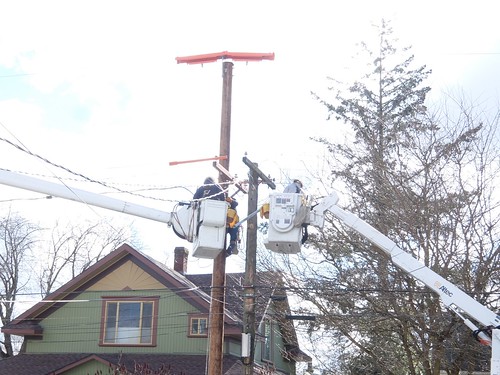
I dashed to the fuse box, forgetting the phone flashlight, but seeing clearly enough nothing seemed enough out of place to explain the phenomenon. Then it dawned on me: the three trucks outside my door working on the electrical pole across the street.
That's right: today of all days was the one a new taller pole was slated to replace the older one. Portland General Electric (PG&E) had a team of linesmen, plus traffic control people, on the job, fortunately making quick work of their part of it.
Some infrastructure is lower on the pole, probably Comcast and/or CenturyLink, with cable and/or fiber. That stuff stayed on the older pole, which they also sawed off, to maybe half of its former height.
Fortunately for my peace of mind, the power had come back on before I backed out of the driveway. Also fortunately, the expected icy rain was not the occasion for a jam-up on I-5. I got back from Tualitin in time for some last minute prep for class.
My students said kind things in the chat window, which I didn't save at the end of the day. Patrick joined us again, for more of a speaking role than last time. He gave a presentation on his snake trap, the one he's offering to folks in the Florida Everglades, for testing.
Like any inventor, Patrick needs feedback loops that amplify more than dampen, if his invention is to get off the ground. As Quakers put it, we learn to follow God's will "experimentally" i.e. by means of trial and error. Mistakes teach us a lot.
I've long been thinking "two teachers per classroom" changes the ratio, plus didn't philosophers of old often present subject material in the form of a dialog? Sportscasters have hit upon conversational banter as a way to impart fluency. Patrick and I have been eager to give co-teaching a whirl.
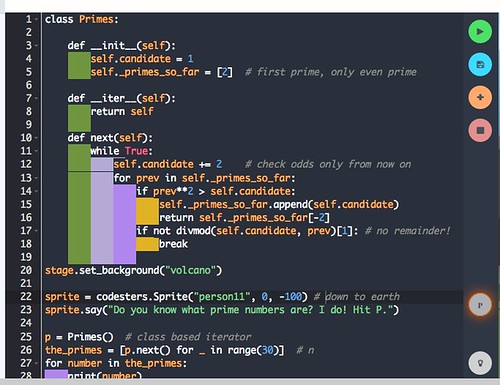
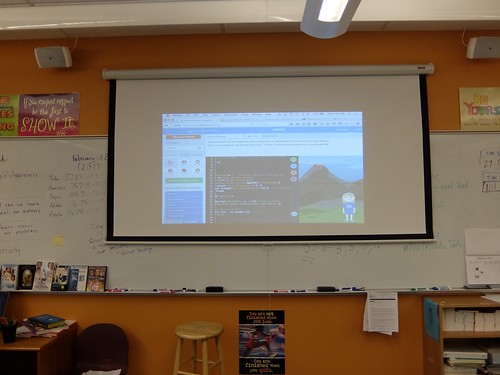
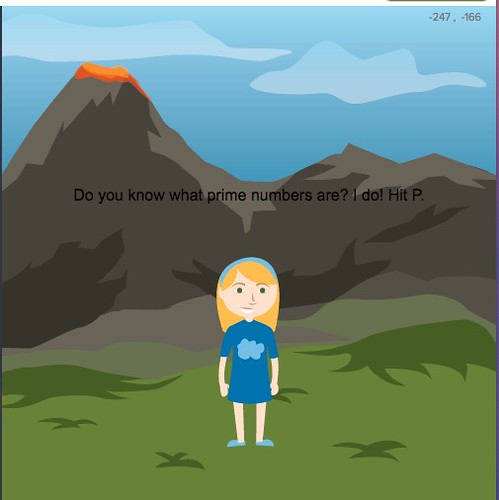
I've found it useful to cross-fertilize across my adult and kid gigs to some degree. I'll pare down an adult Python module, then enhance it in Codesters for the kids.
Then I'll run that same Codesters application for my adult audience, an exhibit in their world, regarding how kids these days learn to code (MIT Scratch, phasing in Codesters on the way to a cloud-based host, is one approach).
I had Steve Holden on my Python show a few weeks ago. He brought along some hardware devices from the UK, to control using MicroPython on a chip. Passing the screen around adroitly is an athletic ability in itself.
Sunday, February 19, 2017
Hollow Schools
The emerging trend in the high tech economy is to provide unemployed or
underemployed workers, college students, curious teens and others, with
many "hollow school" options, meaning the exercises are canned, and no
teachers are present.
Work through an automated textbook (web-based), and you'll pop out the other end of the pipeline with the needed skills.
That's a theory, quite unproved. It'll work for some people, as most fad diets do, and those are the people you want giving glowing testimonials. "I did the WorkForce Training [tm] and now I'm making one hundred K!"
Is academia the source of this dream? I'd say more it's from publishing. We need students / customers to "work through" our material. The teachers are no longer in real time, just look it up on Stack Overflow if there's a problem, or maybe we set up bandwidth for students to help each other, perhaps awarding them extra credit somehow for so-doing.
The messy business of keeping a faculty alive is what's left to the university in this picture. The publishers siphon off students and furnish some credential based on "working through" their offerings. States find it easier to work with publishers, which are businesses, than with universities, which are not as eager to get behind self-gutting platforms.
Where a more intelligent government + university system might step in, is with experiments to reverse the model, and pay students, instead of making students pay. If learning JavaScript + HTML + CSS is so vital to the economy, then lets bleed out a stipend, an allowance, could be to cyber-currency wallets on the cellphone (university provided?).
Pay teachers and students both, as they'll be exchanging roles all this time anyway. I may learn React and/or Angular from you (both JavaScript), but then I'm a Python teacher and will teach you Flask. Besides, it's work to study. Work-study is what we do for recreation, cradle to grave.
"Where does the money come from?" you ask. That's a question for general systems theory, the answer being "from the sun" (current = currency at the root of it all). Some economists may have competing answers but GST is more of a science than Econ is.
If you want to limit how these work-study program credits might be used, that's what FinTech is all about. Pay students to learn JavaScript in currency exchangeable for groceries but not booze. If you're studying biology, earned credits might be towards a catalog of microscopes and related equipment.
At the O'Reilly School of Technology (OST), our PR was contra-MOOC in the sense that we didn't think a 1:10000 teacher-student ratio was all that workable.
Not that there's anything wrong with watching Youtubes. One may learn plenty from passive viewing, as well as from reading. But when does another human evaluate the quality of your own work? Are you tested only by machines? What's the workflow? Is the school you're in hollow?
Do you think by watching doctor shows you become a doctor? Do we get computer programmers from robograders? What's the fail rate? What's the theory?
At OST we were more wanting to duplicate the Renaissance 1-on-1 apprentice model, where, in joining the JavaScript guild, one gets paired with a guru, a guide, someone who will work with you directly and think about your code with you. A co-programmer of sorts.
The whole thrust of Extreme Programming + Agile was "those who work alone don't develop as team players." Which is not to say working alone is unimportant. There's no either/or here.
The irony in this picture is hollowed out schools are scrambling to deal with the unemployment problem created by letting go of all the teachers by hollowing out all the schools.
We think faceless bureaucracies are now in position to roll over the apprentice model. Finally, we don't need to worry about teachers i.e. innovators and researchers, people who study for a living.
We can freeze our pot of gold curriculum into that end of the rainbow skills training we believe is out there, and all our unemployed will get their $90K full stack developer jobs. Solution provided!
Yeah right. Count me a skeptic.
Thursday, February 16, 2017
Wednesday, February 15, 2017
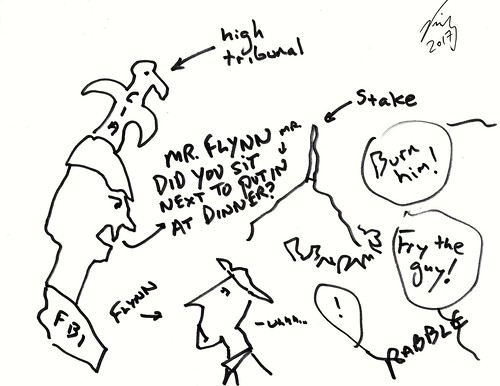
Rabble Babble
political cartoon, 2017
Kirby Urner on Facebook:
The USSA is now so fascist they'll put you in jail for calling a Russian diplomat, even if you're a private citizen about to be in government. Take the following action:1. Call all the Russians you know and leave a message: "help us, we're turning into mindless idiots in the USSA!"2. Call the Russian ambassador and apologize for the knee-jerk sanctions applied because RT happens to be better than CNN.3. Call your lawyer and tell her or him what you have done as an American Patriot. Sign the Patriots Roster for brave people only (you know who you are).4. Cut and Paste this to all your friends, especially in Russia, let them know we need their help ("was the USSR this bad?")
Wednesday, February 08, 2017
Code School Business
At a Wanderers I didn't chronicle, I met up with Nathan DiNiro again, someone I know from an O'Reilly Foo Camp as well. He's well connected in the open source medical records world, a thread in these blogs going back to my job at St. Vincent's hospital, as a consultant.
That's where I cut my teeth in the world of gathering biomedical data points for anonymized sharing, an important aspect of outcomes research.
I worked for the Center for Outcomes Research, and built both CLAIR and CORIS (the former for the cath lab, the latter for the cardiac operating room).
Both Nat and Glenn are familiar with a HyperLedger project. I read a recent article about that at Glenn's this morning in the MIT Technology Review, before backing up my teacher supplies to do a Codester session in Lake Oswego. Last night I was doing my night school gig.
The HyperLedger relates to blockchain, at the heart of bitcoin. The idea of keeping medical records safe in the sense of private, yet shared enough to hook people up with medical studies, is something of a holy grail, and some teams are going after it. Nathan's project is called Youbase, about which you'll find Youtubes.
My teacher supplies included a Vector Flexor, never opened. That was a trademark or hallmark of anyone sharing "the Bucky stuff" back when that happened. It's a rubber-joins and wooden dowels affair that shows the Jitterbug Transformation (JT).
Some of you following me in Facebook may have seen my floating the "JT on RT" meme, which I explain on Medium.
Over on QuakerQuaker, I've been talking about trucking again, and my project to make driving the Kabul to Istanbul freeways a for-credit academic program, for "Global U" students. What characterizes the US and EU are the open borders among states and the freedom to drive freight from A to B without queuing for customs again and again. Africa would like to see more of that too, as well as the Stans.
I use the term "Global U" (global university) somewhat how I use "Chinese Peace Corps": no specific institution or group is singled out, as these are more umbrella terms, metaphors, than particular entities. They work together sometimes.
Monday, February 06, 2017
Apollo Project
If rumors are true, that US president Trump has appointed a moon landing denier as a science advisor, then I say hallelujah. Whether the moon landings were a hoax or not is what the young people on Youtube want to talk about. Most of them were not alive at the time, and have grown up in a world of pretty realistic CGI. Add grainy television, covering over any gaffs, and wow, what a way to save money, when we finally "go to" Mars, right?
Me? I'm still a true believer, think we saw Apollo unfold pretty much as advertised. But that's not the point, what I think. Do I wade in with my hours of rebuttals? No. Am I glad to see the US government reflecting peoples doubts? Yes.
What may be closer to the truth is Apollo is the new stand-in for Nine Eleven, which is still fresh in our minds and the topic of so many Youtubes. Every theory is a conspiracy theory, no matter how you cut it. In an age of Photoshop and CGI, of course the public is eager to debate what might be agreed upon, that's their right. Having seen Hunger Games, "false flag" is on everybody's lips.
Yes, I'm aware that some people might be holding their breaths for full disclosure about UFOs. DT will demand a thorough tour of Area 51 and then tweet about the frozen aliens. As many adults have forgotten how many of their peers entertain such possibilities, as never knew in the first place. At least letting us know what's out there, in terms of belief systems, should be the State Department's job, not just National Geographic's, or the FBI's.
I'm reminded of a cocktail party conversation yesterday, with a student of cults, which doesn't mean she's not also a practitioner. She's not one of those who studies something with an eye to wiping it out. Most cults don't have that long a half life to begin with, as they revolve around specific personalities, which come and go. Once a cult lasts long enough, or gets big enough, it qualifies to be a religion. That's how we think in Asylum District.
Lets talk about the cults and acknowledge them, not sweep them under the rug. But then some holier than thou "at least I'm not in a cult" might be more of a namespace issue than anything. import this. Python joke.
My point being, cults are frequently characterized by how they grapple with the big conspiracy theories of our day, and do they sustain their own. What stories do these religions, or mini "designer religions" tell? How much scientific scrutiny and/or skepticism will they tolerate? The answers vary case by case.
If there's an inner circle knowingly keeping a detailed truth from becoming public, that the moon landings never happened, then that's a cult, and a powerful one, as I'd say most of us were successfully fooled (as I said, I'm still a true believer, partly because actually going to the moon might have been easier than pretending it were doable). Where and how? It's one thing to say "it's a trick" and quite another to know what the trick was.
What makes these debates so interesting are precisely Apollo's archetypal attributes as a chief of rationality. He marched into Delphi and took over the oracular franchise, banishing and in some accounts slaying the old Python that used to run the place. The rationalists had displaced Athena by some accounts, a direct offspring of Zeus. Or had they? These battles stay eternal in some dimension.
Were a major achievement of the rational mind, namely the moon landings, named for its icon, to morph in retrospect into something more occult, dead ending in the murky realm of PR and special effects, then Western Civilization, so called would be charting a new course with respect to the Greek pantheon. Youtubers sense the high stakes and resent how "mainstream media" doesn't let them participate except as viewers. Adding to the ranks of talented producers might be the way to hang on, if you're a more traditional broadcast network.
Put another way, I think the lameness of the NIST response to pressure in the case of Nine Eleven has greatly lowered peoples tolerance for suspended disbelief. They feel deceived, even without knowing what's true. That sensation rubs off on Apollo, casting shadowy graffitti across his pedestal. "If we can't believe you about Nine Eleven, how can we believe you about Apollo?" is the question that's being asked.
Tuesday, January 31, 2017
AFSC on the War in Syria
I was checking the AFSC website recently to see what the "Quaker KGB" was saying about the war in Syria. The advice is typically Quaker: agree to stop pouring in weapons, look for other ways to resolve differences. Weapons are profitable of course, but those taking advantage of tensions and helping them escalate may not look heroic or noble in the rear view mirror and some people still care about reputation (legacy).
People wishing to be respected as hard-nosed realists, with a strong grip on reality, will often resort to talking weapons, their procurement, shipment and operation. It's part of the currency of sovereignty, a way to signify independence as in "no one gets to push me around". Governments will amass weapons as a way of saying "you can't make me".
However, the "laws of physics" or "generalized principles" we might call them, don't coerce in the way people coerce each other. When people are trying to assure themselves they're not under attack by some enemy, either without, or within, they may question what's willful and what's fate.
In writing history, we're free to project almost superpowers on various players in our narratives, attributing to them powers of foresight and acumen they probably did not have. Quakers have the advantage of believing in "higher intelligence" meaning they're not always as paranoid about what may appear an organized set of developments. Patterns happen. No need to blame the ETs.
Everyone wants the war in Syria to end except maybe those who hate God and hate Islam. Some psychopaths have a strong urge to feed fires, exacerbate conflicts, see violence expressed, if not by themselves, then by proxies.
I'm a Quaker, but also one to delve into psychology as a STEM discipline. I've been studying up on the Borromean Rings in Lacan (French philosopher) for example, linking those rings to the three mutually intersecting Phi rectangles of the MAA icosahedron (to take one special case). Spatial geometry is what links me to so-called Western Civilization, and is likewise a road to Islamic architecture and designs (likewise Western by educated accounts).
I'm not with AFSC these days. In chapters passed, I attended Corporation meetings in Philadelphia as a representative of my Yearly Meeting (North Pacific). I also worked locally on the Latin American Asian Pacific program (LAAP), which was mostly about improving cultural relations among diverse ethnicities. I came to LAAP from having helped with Asian-Pacific Issues News, an obscure AFSC journal. Lets call it Asia Desk work, or more accurately Pacific Rim.
Sunday, January 29, 2017
Page Turner
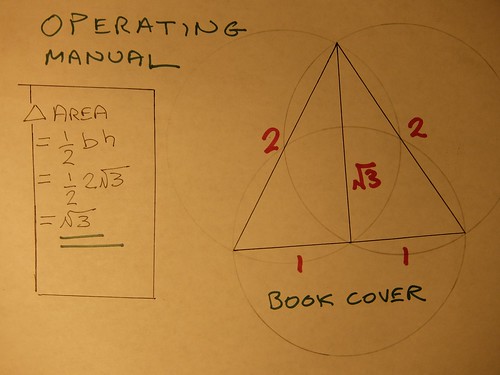
I was reminiscing with David Koski recently, about the "operating manual" he placed flat open on the table, triangular book covers, just the one page. The edges of the book covers, including hinge, are all two, the diameter of a unit sphere.
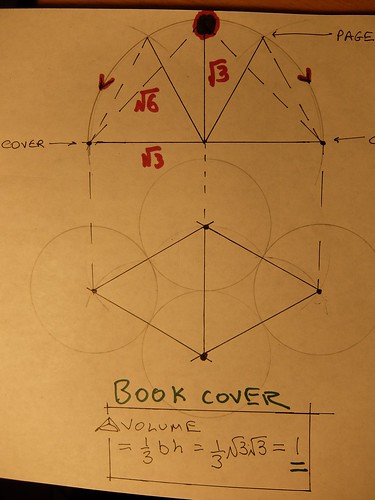
Imagine a page swinging back and forth, wagging, a triangle just as big as both book covers. It has an eye hook at the apex, something for taut string to pass through, should we want to emphasize this sixth edge of the two tetrahedrons. Yes the "page" can stay stiff. This is a moving sculpture I'm describing.
The two tetrahedrons have this page as their wall-in-common. As the page wags back and forth, two neighboring tetrahedrons co-vary and thanks to "base times height" have equal volume. One may be a regular tetrahedron, with the other more a wedge, yet they'll both have the same volume, whatever we set that to be.
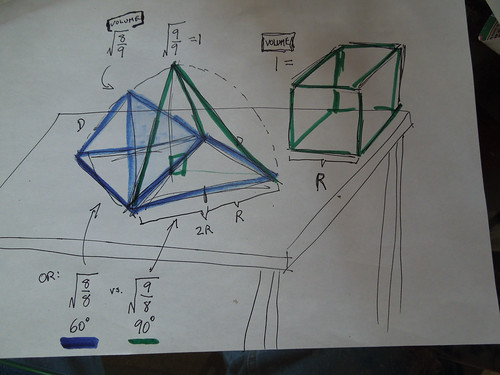
Imagine holding three ping pong balls in a triangle, a fourth one in the valley between. That's a starting place. Now take one of those balls (of radius R, diameter D) and pivot it around any two-ball valley to assume an angle of 90 degrees to the no-longer-touching furthest ball. That's √6, ball center to ball center (longer than 2 for sure).
The equilateral triangle of edges 2, both page and two book covers, has a vertical mid-edge to opposite vertex altitude of √3. The Pythagorean Theorem hasn't changed.
The right triangles defining each book cover have legs 1, √3, and hypotenuse 2. Area? Base times height over two = 2 * √3/2 = √3 per each book cover.
So what's the volume of each right tetrahedron defined by the single page pointing straight upward, at 90 degrees to the book covers open flat? The string from each book cover apex, to the eye hook in the page, is √6.
Even without that fact, however, we have the base, √3, and we have the height, also √3. Multiply those together and divide by three, per volume of tetrahedron formula, and we have 1. Exactly.
Having achieved a volume of one, lets switch to a corresponding cube of edges R, with R being the radius of diameter D spheres. Our original tetrahedron, recall, started with four of those. Then we spread a pair further apart. Anyway, our cube of edges R has a volume identical to each of the two right tetrahedrons just described.
What do we do with this fact? The starting tetrahedron of four closest packed ping pong balls was where we start when measuring volume in our Synergetics namespace, perhaps branded as Martian Math in your neighborhood.
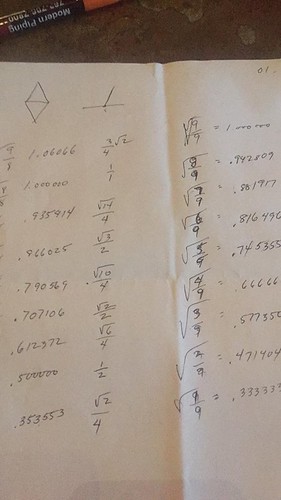
The right tetrahedrons associated with the vertical page each have a larger volume, by a factor of the √(9/8), about 1.06. We may want to use this constant when switching back and forth between two volumetric evaluations of the same vista, in doing unit conversion.
Wednesday, January 25, 2017
School Teaching
I've been deeply involved in work-study, about 50% work, 50% study, which was my goal. The work that I do is teaching. I'm an andragogue (teach adults) by night, and a pedagogue (teach kids) by day.
It's the latter work I'm just starting, meaning I've still got a ways to go when it comes to mastering MIT Scratch and Codesters, even though I'm pretty well versed in pure Python (above average anyway).
The studying part is more eclectic and harder to describe. I think of myself as an anthropologist quite a bit. I'm an avid consumer of culture. Remember Bucky Fuller (whom I write about often in these journals) and Marshall McLuhan were good buddies.
There's a Fuller title that's very like a McLuhan book, what is it again? I Seem to be a Verb.
Sunday, January 22, 2017
I, Robot
I reconnected with Russian mysticism, as some call it, thanks to a pile of books for sale at Multnomah Meeting. I've since traced prior ownership, of these four volumes, from a set of six, by Maurice Nicoll, to Friend Marson ("the Marsonite" I sometimes call him, a Peace Corps vet).
I'm referring to Psychological Commentaries by the Scottish Jungian, also a disciple of one "Dr. O" i.e. P. D. Ouspensky. Where did Dr. O enter our story before? In Linda Dalrymple Henderson's book, about non-Euclidean geometry and modern art. Ouspensky was branding around 4D, an icon which the young Bucky Fuller took on as well. Einstein was flying this banner. The 20th Century was looking propitious.
As I've been clear about in other blog posts, we have multiple meanings of '4D' in play here, but let me avoid that whole thread and get back to the Russian mystics.
Nicoll suggests we get back to developing our essence in later life, after maturing through the earlier stages. We have a fully formed personality by then. We've worked out with the reality principle. Put another way, our egos are fully developed and now we're ready to go the next step as it were, to reach for wisdom. How is that done?
The Russians want us to confront our robotic nature, our mechanical side. That's not always easy for US Americans because "robotic behavior" is usually demonized as somehow totalitarian (which it may be). Using "robotic" without a negative spin, with reference to human behavior, is akin to making "porn" somewhat meaningless, as when we talk of "train porn" (admiring trains, thinking of a Barcamp talk by the late Igal, PDX geek, worked with Patrick a little).
Let me take a well run (smoothly clerked) Quaker business meeting as my model. The people in attendance all have considerable experience, personalities fully formed. Kids would usually be off elsewhere, in a program of some kind. Business meeting is all adult stuff, pretty much, awfully dry for little kids especially. Nursing mothers are certainly welcome.
In saying the meeting went like clockwork, I'm not making a negative characterization. However if I say that Friends were robotic in their practice, that sounds insulting, like I'm saying "unimaginative" or "dull" (without the spark of life etc.). That's the cultural divide I'm facing, in translating these Psychological Commentaries into the language of my locale. "Robotic" is a term of admiration.
The resolution of my puzzle is perhaps through the example of Muhammad Ali, a man of schooled reflexes who could hold his own both inside and outside of the ring. He professed the discipline of Islam in later life, however he came to that religion already self-disciplined. In Afro-American subcultures, "machine dancing" is a recognized art form, influenced and enhanced by some of Michael Jackson's maneuvers.
Through "machine dancing" we move to the martial arts and all those routines people go through when working for that next colored belt, the next level.
True, Dr O. and Maurice want us to see, in our robotic nature, those features we may at first project on others, when we fail to "remember ourselves" as they say in their jargon. I'm not suggesting that Friends all convert to such thinking. However I do think it worthwhile to remember our deeper culture and apply that in our daily lives. Teachers like Maurice did not do all that writing out of sheer boredom. They were working towards a less violent world, less indulgent in negative states, from which great misery arises.
For those not familiar with Ouspensky, one of his famous maxims is "man cannot do" which is on the face of it meaningless. I'd say the program is meant to apply what Nicoll calls "the shock of consciousness" which is an experience of extreme determinism and epiphenomenalism wherein all humanity appears to be on autopilot. Walt Whitman's The Sleepers is a soliloquy of great compassion, by someone with a body electric, another robot in other words.
Friday, January 20, 2017
Amortizing
I was watching one of those reviews of Uber, where they try to talk a would-be driver out of the deal, based on various starting assumptions. One thing people forget to do is continue discounting the value of what to them is valuable equipment.
In my case, for example, I have this creaky-old 2011ish Mac Air that's been my workhorse through thick and thin. It has no health insurance. I could send it in for refurbishing at some expense, but in the accounting world I'd have been creating a savings account based on the obvious need for a next computer someday.
OK, so I'm thinking in that direction. All I need to do is slip in the ice one more time, as they say. I'll be starting another class soon though and as long as she's still running (the Mac Air), I'm going to keep her on my desk. She's wheezing though. Her fan is off kilter. The severity of the wheeze comes and goes. I know it could get so much worse.
Speaking of loss, did I mention the fish that are going or have gone? We decided the horse faced loach was a goner quite awhile ago, when he failed to appear even at the usual low frequency. More recently, my top-feeder has died. Lower temperatures may have been to some extent to blame. Fish don't last forever though. Turnover is built in to their design.
Alexia is studying bookkeeping at the college level, having gained some practical experience working with her mother, Dawn, my wife and business partner. She was good at accounting and really understood the clients she worked for. She had already taken on another partner and split off the bookkeeping in a way that could continue, after DWA was reduced to a checking account.
One of the DWA aliases, registered with the bank so people could write checks to it, still can, was 4D Solutions, which I map to 4dsolutions.net on the web. Behind my logo lives the Oregon Curriculum Network (OCN), which I consider my not-for-profit way of helping Oregon in particular. It's not that anyone in particular has adopted this material. I'm more just joining the throng of earnest scholars who took to the web, like fish to water.
Probably my most ambitious project, considered as a business plan, is Coffee Shops Network (CSN). Under that heading comes a "charitable gambling" operation that converts winnings at games into charitable donations to the coffee shop's list of charities it supports. A donut company might give you the token, with purchase, to try your skill in some way, and then back up your performance with charitable giving on your behalf. You've won the right to commit the donut company's dollar to the cause you've championed.
GST used to be about "fundraising thermometers" a lot, on the web. That certainly happened, in the form of Kickstarter, GoFundMe and all the rest. I've been pretty strong at predicting things, but that's what hindsight is good at seeing. We get to be right about stuff. We get to be wrong about stuff.
Talking with Alexia about bookkeeping a little has reminded me of amortization as a concept. Lots is coming back to me. I also used to write about Global Data the corporation a lot. Going back in time in my blogs gives some examples of that. The goal was and is to provide a lot of global data to the world, however in practice it's Google we usually think about.
My style of thinking is somewhat informed by those years looking at the Hunger Project and looking at some of the Fernando Flores stuff around that same time. His thinking was centrally featured at the 2016 Pycon here in Portland, when one of his students delivered a keynote. I'll insert my recent tweet about that.
Hey, right on cue, as I write about things breaking or falling apart, my kitchen sink just stopped draining. After wrenching apart some pipe, I've discovered wherever the blockage is, it's below the standard trap. Not good. Especially with guests coming.
In my case, for example, I have this creaky-old 2011ish Mac Air that's been my workhorse through thick and thin. It has no health insurance. I could send it in for refurbishing at some expense, but in the accounting world I'd have been creating a savings account based on the obvious need for a next computer someday.
OK, so I'm thinking in that direction. All I need to do is slip in the ice one more time, as they say. I'll be starting another class soon though and as long as she's still running (the Mac Air), I'm going to keep her on my desk. She's wheezing though. Her fan is off kilter. The severity of the wheeze comes and goes. I know it could get so much worse.
Speaking of loss, did I mention the fish that are going or have gone? We decided the horse faced loach was a goner quite awhile ago, when he failed to appear even at the usual low frequency. More recently, my top-feeder has died. Lower temperatures may have been to some extent to blame. Fish don't last forever though. Turnover is built in to their design.
Alexia is studying bookkeeping at the college level, having gained some practical experience working with her mother, Dawn, my wife and business partner. She was good at accounting and really understood the clients she worked for. She had already taken on another partner and split off the bookkeeping in a way that could continue, after DWA was reduced to a checking account.
One of the DWA aliases, registered with the bank so people could write checks to it, still can, was 4D Solutions, which I map to 4dsolutions.net on the web. Behind my logo lives the Oregon Curriculum Network (OCN), which I consider my not-for-profit way of helping Oregon in particular. It's not that anyone in particular has adopted this material. I'm more just joining the throng of earnest scholars who took to the web, like fish to water.
Probably my most ambitious project, considered as a business plan, is Coffee Shops Network (CSN). Under that heading comes a "charitable gambling" operation that converts winnings at games into charitable donations to the coffee shop's list of charities it supports. A donut company might give you the token, with purchase, to try your skill in some way, and then back up your performance with charitable giving on your behalf. You've won the right to commit the donut company's dollar to the cause you've championed.
GST used to be about "fundraising thermometers" a lot, on the web. That certainly happened, in the form of Kickstarter, GoFundMe and all the rest. I've been pretty strong at predicting things, but that's what hindsight is good at seeing. We get to be right about stuff. We get to be wrong about stuff.
Talking with Alexia about bookkeeping a little has reminded me of amortization as a concept. Lots is coming back to me. I also used to write about Global Data the corporation a lot. Going back in time in my blogs gives some examples of that. The goal was and is to provide a lot of global data to the world, however in practice it's Google we usually think about.
My style of thinking is somewhat informed by those years looking at the Hunger Project and looking at some of the Fernando Flores stuff around that same time. His thinking was centrally featured at the 2016 Pycon here in Portland, when one of his students delivered a keynote. I'll insert my recent tweet about that.
@LorenaABarba @deg511 your keynote at Pycon2016 was excellent and I think back to it often. https://t.co/d0AXtx4noA— Kirby Urner (@thekirbster) January 20, 2017
Hey, right on cue, as I write about things breaking or falling apart, my kitchen sink just stopped draining. After wrenching apart some pipe, I've discovered wherever the blockage is, it's below the standard trap. Not good. Especially with guests coming.
Wednesday, January 18, 2017
Blockchain Voting
I was bringing up blockchain voting in a Quaker forum, as an example of a promising technology. Farm house Friends still put more faith in old fashioned paper balloting with visible counting, and in a one room school house, this can work. Perhaps paper ballot counting scales much further, without limit, for the sake of discussion.
Blockchain has excited people for different reasons. What a financial playing field requires is a set of rules that are self-enforcing, in the sense that cheating should be next to impossible, even in theory. With strong encryption, such schemes became feasible. Gambling casinos are a first good example, as they depend on the mathematics of probability to stay profitable, not on sleight of hand, even if stage performing magicians are among the attractions.
The example most cited up to now is Bitcoin, which came with clever terminology and a self funding model of a self booting currency. "Bit miners" around the world would learn of the different transactions at different times, more how Facebook works. Not every Friend sees updates to your profile at the same time, but after awhile, everyone knows about them.
The question then becomes, which sequence of events, which chronology, is real? Instead of making the players prove their case, each one hiring an army of lawyers (good for middle men), a contest is held (about every ten minutes), of a brute force nature, meaning if your computer is capable of monster computations, you win the contest often enough to make transaction-tracking worth your while.
If your bitcoin miner computer wins the contest, it's paid some bitcoin, and its version of events (of transactions, their sequence) gets added to the globally shared blockchain, the one true narrative account. The point of doing it this way is precisely to rely on some shake of the dice that no one controls. Agreement gets created. Trust builds that the transactions are secure.
Micro-payments between individual parties becomes possible, without the usual and more expensive amount of overhead. Sending remittances home, from family members working abroad, is one of the most used applications of this technology. The currency converts into bitcoin at the source, and out into perhaps some other currency at the intended destination.
How does all this apply to voting though? That's an excellent question. Lots of talented social engineers have been exploring the ramifications of blockchain technology on electronic voting.
Before Measure 97 went down to defeat, on the State of Oregon ballot (November, 2016), I was having fantasies of showcase facilities where rotating groups of students, with faculty (more advanced students) could come to learn about the new tech.
However I hadn't thought through who goes where exactly. The mostly unused Sunnyside Methodist Church (or "ghost church") had given me some ideas. I was thinking in terms of teacher training, having watched over my dad's shoulder (he was an education system planner) and having some sense of the workflow.
In other words, say you're at Cleveland High School and learning about how polling and voting works, or doesn't. The school has some voting machines and equipment for counting ballots, with the school routinely bringing questions to a vote. "Who believes in UFOs?" Yes, that's a poorly designed question, however if the goal is to work out with equipment, the point of the question may not be the point of the exercise.
We go through a lot of effort to authenticate here and there. To our banks. To our medical service providers. One would think a citizen of a nation is by definition entitled to specific on-line services, including the right to vote in various elections by means of a smartphone application. The fact that the USG gives us no means to authenticate as citizens to perform our civic duties, is evidence that USA OS is still more on paper than a socially engineered reality. Lets hope better days are ahead.
Some readers may have been inwardly objecting, from the top, that Quaker practice is not about voting, so why would blockchain voting be pertinent in a Quaker forum in the first place. To clarify, I'm accepting that Quakerism does not define the public sphere and that my civic duties as a voter do not fall outside the scope of my duties in general.
Monday, January 16, 2017
War Studies
That famous folk song that goes "ain't gonna study war no more" seems clearly in the back of the mind of our writer, Friend Wolf Mendl, as he opens with a defense: "Why would a Quaker, a subclass of Pacifist, study and/or play war games?" Obviously, in order to end it (outward war), in favor of world game instead, he says in translation to 2017-speak.
Lets remember George Fox was looked up to as a leader of the type you'd want to follow in battle. England found it frustrating that some of its bravest had a strong penchant for non-violence, but as the pamphlet points out, that's more the Chinese way, of Sun Tzu. Overt force is just gross, compared to the subtle thrusts of his martial art.
Friend Mendl, then quotes Clausewitz (more often cited than read) in saying the political has to guide the military is a truism, as "the political" is simply what thoughts go through our minds as we set about with our planning. What's the ideological glue that coheres this massive attempt at cooperation? What follows is almost robotic, and gets faster and more precise with practice, which is what drilling is all about. Martial artists are always looping through their moves in various hypertoon scenarios.
We get to Kissinger and ample citations to a dogma that military might makes for influence on the world stage. That truism, combined with a lot of zero sum game misassumptions endemic to English speakers, but not only English speakers, has led us to the threshold of mutually assured destruction, a cliffhanger for sure.
Back to my point about George Fox as cut from cloth similar to that of a military leader, I think Quakers around Oliver Cromwell's time, on through William Penn, got some appreciation from the war rooms for at least having done some homework. They didn't walk in and immediately start kneeling or handing out pamphlets or other inappropriate behaviors (pouring lamb's blood on everything). They speak knowingly of the chessboard (if not a go board) and have constructive things to say.
This Pendle Hill Pamphlet (#247) contributes in that tradition. Having come out several decades ago, there's no hint of our curriculum changes in the lower grades around geometry, bringing the context of world game to American literature, as E. J. Applewhite predicted and helped make happen. I'm not saying every public or private school shares anything about all of the focal points my own students all know about. Not in early 2017. However the garden had been planted, the memes released, much earlier in the 1900s. Osmosis takes time. At least Quakers were doing their homework.
Wednesday, January 11, 2017
Wanderers 2017.1.10
Our honored guest at Wanderers last night is an extremely intelligent and diplomatically skilled dude. I've met a few of these Afghani-Americans with a foot firmly planted in both worlds, that of the US, and that of contemporary Afghanistan.
Dr. Monammad Khan Kharoti is a medical doctor, a surgeon, with a strong understanding of the cultures he's dealing with. His focus, since well before 9-11, has been providing schooling for Afghans, for girls as much as for boys. The Taliban have never objected to that agenda. The facilities are internally gender-segregated and religious texts are not eschewed, as has been the Western standard until quite recently.
Khoroti sees two scourges in Afghanistan: illiteracy (which leads to incapacitating ignorance) and the misfortune to have been associated with Osama bin Laden, which turned the US from friendly to definitely hostile.
Offering free tours of the US to small groups of Taliban, through the State Department, just to learn about the differences first hand, would go much further towards establishing a peace than misguided attempts at military takeover. Ideologies spread by osmosis, not bullets, which only harden the hearts of those shot at.
We reminisced about the good old days when the world was less in turmoil. I took a commercial bus for ordinary folks from Peshawar to Kabul that time, through the Khyber pass, with my mom and dad. We had no reason to be fearful in the 1970s. From Kabul we flew to Tashkent on Aeroflot, then on to Moscow and St. Petersberg, then Helsinki no problemo.
Those were the golden years maybe? Any way back to that? The trucking industry needs the routes from Istanbul to Kabul to work without obstruction. Kabul isn't far from Islamabad after that.
Kharoti is well respected by the Taliban. He's clearly acting in the best interests of the people he serves. His integrity goes unquestioned.
Monday, January 09, 2017
More About Martians
presentation at NIST
I've been on a CC or two with Istvan as I recall, as I was in communication with Ed Applewhite about the time he wrote The Naming of Buckminsterfullerene for Chemical Intelligencer, which Dr. Hargittai edited.
I'm still taking this one in, about the Martians of Science, Istvan's name for his fellow Hungarians advising the Manhattan Project.
Me on Facebook:
Speaking of NIST, I've enjoyed a recent exchange with Friend David Chandler on the awaited results of a next study (not by NIST, a peer review thing). NIST has findings of consequence for future building designers, given WTC7's structural failure from fires. I'm following from a distance.
I'm still taking this one in, about the Martians of Science, Istvan's name for his fellow Hungarians advising the Manhattan Project.
Me on Facebook:
I remember when Edward Teller spoke at Princeton. Students hissed a lot. They do that at Princeton, like a viper pit or something, could be unsettling. They did the same thing with James Schlesinger as I recall, another GST guy. No hissing at Isaac Asimov's packed talk as I recall, nor at Nader's (an alum).
Given my interest in Martian Math, with input from Applewhite, it makes sense that I'd be doing this homework.Certainly economists compete with one another to become stars in their own field, but the discipline as a whole still…
Speaking of NIST, I've enjoyed a recent exchange with Friend David Chandler on the awaited results of a next study (not by NIST, a peer review thing). NIST has findings of consequence for future building designers, given WTC7's structural failure from fires. I'm following from a distance.
Subscribe to:
Posts (Atom)