Sunday, July 12, 2015

Deficiencies in the English Language

The BBC interviewed some bloke last night who used to be a BBC journalist and so needed to be unbiased, but was now in a new position, as a pundit, and so could come right out and say that Iran is seeking nuke weapons.  He was open about shedding his former journalistic guise and becoming more openly biased.

The pundit was talking about ongoing negotiations in Vienna to establish a "breakout box" inside of which Iran would be boxed, not allowed to break out.  This is the Standard Model used within Washington DC circles (e.g. within the Beltway) as well.

What's missing from the analysis, as usual, is any calculation as to what's in it for Iran to paint the Rogue States (the nuclear WMD states) as minions of a Great Satan, the hubristic desire to hold a Sword of Damocles over the rest of humankind, to arrogate the role of a "Do as I Say or Else" supreme bully.

People with nukes tend to threaten, gloat, lord it over, strut, puff etc. (it's a syndrome) -- we've seen it in the White House, and lets talk about Tony Blair.  Saying nuke WMDs are "against Islam" is a setup to portray Christians, Jews and secularists as morally inferior i.e. susceptible to the military-industrial complex (a meme virus).

Eisenhower himself warned us of this susceptibility.  Iran, not just South Africa, stands for hope, sanity, and a better tomorrow in this picture.  Islam is about a better future, not Tyranny by the Rogue States, with the same criminal, murderous weapons that Iran should never have (Iran agrees).

Even if Iran is secretly building a bomb, or wanting to, it's poor journalism to not even sketch for the listeners how Iran might actually have a motive to lead the Ban Treaty movement, and to embrace not only non-proliferation, but criminalization of existing nuclear arsenals, an agreement most UN nations have already signed.

Wouldn't that be good PR, to help leverage a ban on nuke weapons worldwide?  Iran would be seen as a moral leader, victorious against the reprobates and backsliders, the less humane.

Politically speaking, it adds to Iran's gravitas as a principled nation and great civilization, to take a stand against nukes while allowing for atomic power.

Doing so from a position of strength makes it a conscious choice.

The US wants to paint itself as victorious in "forcing" Iran to submit to inspections.  But what about the US itself?  It has no intention of submitting to anything, and that's where its hypocrisy is both self evident and self undermining.

The US position well explains its continuing loss of credibility, day by day, which the BBC is striving valiantly to shore up, given that Special Relationship and perhaps loyalty to another English-speaking culture.  But hasn't all this shoring up become uncomfortably transparent?

In fact, imputing such a motive to Iran, to be a religious leader seizing the moral high ground, which might have an endgame wherein Iran-trained weapons inspectors gain access to syndicate facilities in Colorado someday, once the Ban is imposed, connects a lot of dots already out there, such as the Nuclear Free Zone we know Iran proposed, but which the WMD nations derailed for the region.

Great Satan wants His nuke weapons without restrictions of any kind.

Great Satan has actually used nukes against Japan and Micronesia.

Yet through misdirection we're made to think Iran is the hypocrite.  Very clever?  Maybe just dumb?   How long can it last?

The longer Iran's rhetoric and actions match up, the more Great Satan seems engaged in delay tactics around preventing any Countdown to Zero clock from ticking.  Tick, tick, tick...  Austria is already strongly in favor of a Ban Treaty.  Is that why they're meeting in Vienna then?

I'm not at all surprised that CNN hasn't the courage to explain the PR situation to the American viewers, easy to fool, none too bright, par for the course.

However, I'm a little surprised the BBC won't let its global listeners even sample this line of reasoning, which is well-known outside the Anglo-speaking sphere.

Maybe tonight?

Will they get anyone more conversant with the actual dynamics of the situation, for balance if nothing else?

One almost thinks the English language, or "forked tongue" as some call it, is incapable, almost as a software issue, of revealing its own inconsistencies and hypocrisies.  It'd be too undermining.

Perhaps the BBC is really just for superficially intelligent listeners.  Certainly real intelligence services would need to keep score at a deeper level, if planning to stay relevant on the world stage.

Friday, July 10, 2015

Term Limits

BBC had an engaging episode, in the form of a multi-voice, moderated conversation, last night on the topic of term limits.  On Newshour Extra.

The guy from Singapore posited an East-West dialog with the West trying to be more important than the East in suggesting term limits as a panacea.  An ascendant West was an aberration from this gentleman's point of view, though in some models of our spherical GU (global university) it's hard to find these political divides in the first place.

The US President got a lot of focus. 

Imagine a Constitution that allowed a president to run for a third term, but under different rules:  the electoral college would be bypassed and a simple majority vote would need to be obtained.  No fourth term would be possible without interruption i.e. after sitting it out for at least one term, OK to start over.  Might we vote for Obama for prez in 2020?  Not possible per Amendment XXII. 

Grover Cleveland was 22nd and 24th president when a 3rd term would have still been allowed.

Or suppose Supreme Court justices had a maximum of eight years? 

We make the Judicial Branch a "for life" appointment (yes, I know the theory, similar to that behind academic tenure -- freedom from influence, but if you're already partisan?) but subject the Executive Branch to stringent term limits.  Why not jigger this?

Obviously the inertia behind a system as vast as the United States is there's no turning on a dime.  We could have science fiction movies about this 3rd term alternative campaign. 

Imagine "3rd term" were institutionalized as "experimental" i.e. anytime we held a presidential election for a 3rd termer, we'd assume innovation.  Then, ideas that worked well, that seemed beneficial, could be worked into the first two terms as reforms.

Nice idea on paper maybe but there's no turning on a dime as I've said. 

But think of individual high schools full of teenagers eager to interact, to practice self-governance, along with faculty and admin.  Why not use our imaginations there?  Or in a college? 

The appeal, in the college catalog, to prospective students, is not just course offerings, but this intricate manner of self-governance that really gives a resume some cred.  "Their Student Senate has real power, wow, I should go there!" thinks the politically-minded prospective.

We think some 200 UN nations might sound like a lot.  But think how many corporations we have, some of them supra-national. 

Why not have "corporate governance" be more flexible? 

Who says it's not flexible even today? 

Quakers have corporations, with no voting, no Robert's Rules.  Doesn't that prove the corporate structure is already flexible? 

That's a query not a rhetorical question. 

To be continued.

Tuesday, July 07, 2015

Big Rock Candy Mountain

lets hang the jerk who invented work...

I was listening to KBOO the other day, regarding who owns the Arctic.  People living above the Arctic Circle, called "the north" in this namespace, such as in Greenland, have a dialog going with the rest of us in "the south" regarding the use of natural resources.

Sometimes there's a tidy sum to be made from extracting resource X, and it might actually be renewable (eco-tourism depends on an endless supply of tourists).  Some level of abstraction, of resources from the environment, if only oxygen and water, is required for biological continuance.

The bootstrapping equation is:  knowledge worker jobs such as one might have in some corporate office building, with bandwidth and plumbing, require fancy educations, but before we attain those high levels of education comes maybe decades of more menial work.  That's what the more plodding developers think.

"Says who?" and "Why not short circuit or leap frog, like skipping landlines for cells?"   Lets enroll thousands in general systems theory, prototype curricula, pilot testing.  Experiment with XRL (extreme remote livingry), emergency shelters.  Not because it's an emergency necessarily but because when it's not an emergency is a good time to prepare for one.

Conflate study into work / study (chores + scholarship + playful research projects) and actually pay Greenlanders to obtain that schooling starting now.  It's a loan against one's future income, if you want to see it that way.  When you're born, your elderly self is already sending you money from the future!  We can do that with bookkeeping, no time travel required.  Don't let intermediaries intercept your birthright!

Lets call this the Big Rock Candy Mountain scenario, in contrast with the Iron Mountain scenario, which latter feeds and shelters its Army Specialists on the understanding they'll do work / study under the Generalists ("the generals").  These are very similar Mountains, in terms of the patterns they employ.  Livingry and killingry both require innovation and human-powered networks.

Sunday, July 05, 2015

Out of Mind / Sight

The usual phrase is "out of sight out of mind" and has numerous applications.  In Madness & Civilization, Foucault traces what he considers to be a series of signal flips in Western Europe's perceptions of, and ways of coping with madness, which we may also call "extreme deviance" to the point of inconveniencing others and prompting them to seek a radical solution.

In the Middle Ages, a town might drive its indigent, especially its beggars, outside the city gates and impose on them fines for returning.  Towns alongside rivers or canals might have their madmen hauled away by boat, creating the image of the Mad World as a large place "out there" beyond the boundaries of the Polis (city-state, police).  Foucault makes much of this "ship of fools" image.

With the Renaissance came the view of Madness as a window into a cosmic Other, a demonic realm, making it sacred in some ways, more shamanistic or shamanic.  The deranged had their own wisdom which likewise glorified the Good Order, showing how derangement was integral within the wheel of life.  Reason and Unreason both derived from the same holy root.  This attitude sounds more Oriental to me.

By the Age of Reason, after the French Revolution, madness was more a pathology associated with "not working" (as in "not making sense") and the strategy became one of confinement.  The mad should be made to work, as under Protestantism, virtue was in one's discipline and obedience to God's ordained.  What drove the mad mad was not a demonic order but an untamed bestiality, an "animal nature" which normal humans had transcended (risen above) in a moral sense.

A giant hospital system, left over from when leprosy was more of a scourge, was re-purposed to warehouse the scandalous, with the truly insane on display as people to feel superior to.  For a fee, one could visit the Asylum and mock the crazies and the freaks, or exude pity according to one's temperament.

I'm reading all this against the backdrop of JFK and the Unspeakable by James Douglass (a well-read theologian) wherein some random guy, Ralph Leon Yates, picks up a hitchhiker in his pickup.  The passenger has a gun-shaped bundle he claims are "curtain rods" and he wants to keep them in the cab.

The driver saw later this man looked just like the Lee Harvey Oswald on TV and the curtain rods were likely the gun he'd smuggled into the Book Repository and killed John Kennedy with.  He'd left the Oswaldy guy close to there.

The problem with this story, according to Douglass, was the Warren Commission had already included the one and only "curtain rods" story it wanted, with this extra Oswald story a loose end. Having two variations of the curtain rod story pointed back to a cover-up, as did all the suspicious shenanigans in Mexico City, which had to be rejected also, for much the same reason.

An overzealous crew of Ollie North types, imagining themselves clever operatives, had seeded the field a little too zealously with incriminating memories, very likely using an Oswald look-alike -- including in the movie theater where he was later arrested (the "other Oswald" was in the balcony and arrested later per Douglass).

The fate of the driver?  He went to the FBI with his story, but since the Establishment understood its job was to support the Warren Commission, they had to commit him to a psychiatric hospital at the end of the day, and subject him to "drug therapy".  His crazy story was too much of an inconvenient truth.  He'd passed a polygraph test but that only proved he believed in his delusion, all the more evidence he was insane.

We shouldn't stop there in associating Yates's "treatment" with the rigid Rationalism of France.  Why not see Langley itself as a mother ship of "hospitals" dedicated to the treatment of the deranged?

Lets remember though, that deep within the Agency, subterranean, riddled with moles, many an operative was even then delighted to see the cover story was so transparently a cover-up.  It would unravel in time, it would have to.  Many would participate in the unraveling, even as others would insert new stories designed to misdirect.  Right from day one, LBJ refused to blame the Russians, knowing where that could lead, dashing hopes many held for a more serious confrontation.

That's what a "cover story" is, when of this magnitude:  it buys time, is but a time capsule.  One generation hands it off to a next, an obvious puzzle, a mess.  One might as well stamp "cover up" on the box.  It's radioactive, and has a half life.  But in slowly leaking its information, whispering its truths, it's less explosive, and that's the intent.

Were FDR-era Americans ready to accept a coup?  Had they heard of the Business Plot?  Coups were the stuff of Banana Republics.  The people of the USA needed a different narrative, the truth could wait.  They needed an official madness, a story that couldn't get them in trouble at work.  The job of the Warren Commission was to provide that.  People needed something to say that was not crazy, in a crazy world.  "A lone gunman, acting alone..." that story would become their security blanket.

Beyond the mother ship is a network of secret prisons, all interconnected by torture taxis.  We're familiar with this Gothic infrastructure, as a result of the latest wars.  Large chunks of major office buildings, airstrips and old bases, sympathetic contractors... Capitalism's Invisible Army.  Yet another Gulag.

The madhouses of Reason's Europe were simply re-purposed, yet again, to confine extremists, inconvenient parties.  Madmen were not usually suicide bombers in Medieval times.  Even lepers were not that suddenly contagious.  Advances in the design of explosives changed the profile of insanity towards that of a Unabomber.

In sketching an appealing profile in courage, of Jack and Robert Kennedy, Douglass somewhat skirts the issue of madness in the Oval Office itself and what that might mean.  Other books take up that issue, including in relation to the Kennedy profile e.g. Royal Babylon and Hersh's book The Dark Side of Camelot.

In going here, I find much that's fascinating yet think there's a danger in over-personalizing what were clearly crazy times.  The Oval Office, in its shape, is clearly a metaphor for the skull.  Craziness in the Oval Office just means in the Executive Branch, West Wing included.  So we've come full circle, wherein craziness fights craziness (so who wins? -- it's the dialectic that matters, so who cares?).

Prohibition (still lingering) had turned the majority of Americans into criminals (aka "sinners") by that time so I'm never impressed by "organized crime" as anything worse than "organized religion" -- both have done their dirty business.  To Douglass, I maybe sound like Quaker Mafia.

"Goodies and Baddies" are so much less nuanced than "Cowboys and Indians" (a clash of ethnicities) -- unless you've learned to like villains.

A lot of people felt excluded and shoved aside by that Imperial Presidency.

We have a lot more hindsight today, regarding what the Kennedy brothers were up to.  At the time, they were likewise considered inconvenient extremists by many factions, as Douglass well documents.  Participation in the cover-up was widespread, including by people with no clue about the truth -- they just saw it as their duty to support the official line, for sanity's sake.


:: another puzzle piece, take it or leave it ::

Saturday, July 04, 2015

Spy (movie review)

My angle into this movie was from too serious a springboard.  I've been reading the "new" JFK book (2008), by Douglass, who talks about Thomas Merton -- whom I also read as a younger man some, though had no idea about those Cold War letters.

I was in second grade or so, when the Cuban Missile Crisis happened.

That new JFK book, recommended to me by Friends, refers to so many other such readings and plunges me back into that whole morass, wherein the CIA swirls in a more down-the-toilet sense.  I've actually not finished reading it yet.

Those were not happy times, and they stayed unhappy.  I can relate to "long strange trip" ala the Grateful Dead reunification (upcoming in Chicago).

I'd say the gear shift to this comedy CIA, one the movie's writer-director unabashedly embraces for a ready meme set of spoof-able cliches, built up by Hollywood, in complicity with the CIA's own storytellers, over the decades, was somewhat jarring.

At first people seemed to be having some fun here, but no, it was still horrific, and still quite crazy, with rats and bats and stuff in the basement.  In making the control room batty, and outfitting it with a Brit, we bridge to British humor, maybe?  Did this movie play well in the UK?

I of course appreciate the retro references (e.g. the credits), the semi-knowing satire.  But I noticed the audience around me was laughing and I was more just sinking down in my chair, worried I wasn't getting it.

Accents certainly played a role.  Spy World has always been about i18n.

There's this sense of ordinary people bashing through that wall of illusion (movie screen) behind which the phony world of 007 (one of the previews was for Spectre), its Never Land, does not exist.

Said faux world is here reconstructed as more female-friendly in some way (think Carmen Sandiego), and a source of edginess and getting lost in fashion.  Vanity and jealousy are heavy duty in this space, so what else is new?

Never Land keeps a toe hold in reality e.g. appears to have money, a real building in Langley.

Buying into horror as part of the genre and making that an object of spoof just reminds me that Spy World is also Gothic in the Lovecraftian sense.  I keep forgetting that.

Kafkaesque too.  Lets not forget Byzantine... 

So yeah, maybe not quite in the mood.  Why blame others?

So then I ambled down to the Blues Festival, in progress.

I found a patch of grass in the semi-dark and started reading Madness and Civilization by Michael Foucault.  A lot of people have read that already, the Powell's paperbacks had been around the block a few times.  Maybe I'd browsed it before?  It seemed fresh to me anyway.

I wanted a copy for Kindle so I could read it on my devices while listening to blues in Portland.

One thing I've learned from the new JFK book (also on devices) is how directly the Kennedy brothers took on some of the special interests, steel in particular.  Steel speaks up in Grunch of Giants too.

I like the idea of a president as "one who presides", which is a long way from what the executive branch had become.  But then a lot of people want to participate in government.

As all presidents know, everyone, OK at least a few, want to be, or think they're a president too.

Monday, June 29, 2015

Car Stories


A well-known plus to renting a car now and then is one gets in a time machine and travels to the far future, the present, 2015 (as of this writing, duh).  Normally I drive a 1997 Nissan, a quality vehicle that I still appreciate.  But it needed a new mass airflow sensor and so I called up Enterprise and booked a car for a day.

The rental was a 2015 bright red Toyota Corolla with a lot of frills, including radio controls on the steering wheel, rear view camera, great mileage (to Salem and back on a quarter tank).

Carol and I both caught something probably contracted by Lindsey in her air capsule coming from China to Bay Area.  Or who knows anymore.  In addition, I'm susceptible to seasonal allergies in these hot summer days in the 90s (F-scale) so I'm likely to be a basket case anyway, given the right pollen mix.

I tried Sudafed and Claritin both, but stayed pretty miserable and tried not to get too close to people at the Salem Meetinghouse.  Carol was likewise in a state, and as a guest speaker, co-appearing with Dr. Linda Richards, she actually had a workout, whereas I was just an audience member.

We'd started the day with Paul Barker at the Stark Street meetinghouse, so two meetinghouses in one day.  I'd call us dedicated circuit riders.

However mom and Linda were not on strictly Quaker business, more were representing Women's International League for Peace and Freedom (WILPF) to Followship for Reconciliation (FOR).

Carol's specialty is demilitarization whereas Linda teaches history of science.  Both have given excellent Wanderers presentations at the Linus Pauling House in Portland (connected with ISEPP).

Wednesday, June 24, 2015

Math Avoidance?

The accusation of "math avoidance" comes from those claiming our K-12 maths curriculum (using the UK plural) is too watered down, too diluted with geegaws and gizmos.  It's just "toy math".

Whereas I'm sympathetic to the accusation, I do need to ask if it's "math avoidance" to simply bury all the late 20th Century innovations documented in architecture, regarding the relationship of geodesic spheres to the virus and buckyball both.

Is it wise to be so ignorant of this heritage?


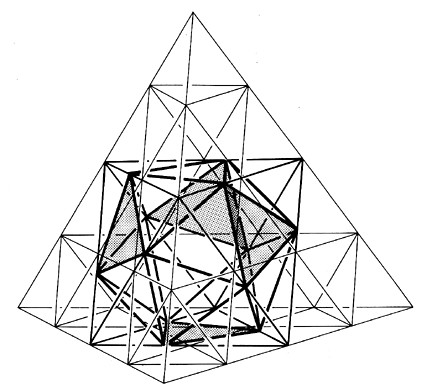
f8812

Fig. 988.12 Icosahedron Inscribed Within Octahedron: The four-frequency tetrahedron inscribes an internal octahedron within which may be inscribed a skew icosahedron. Of the icosahedron's 20 equiangular triangle faces, four are congruent with the plane of the tetra's faces (and with four external faces of the inscribed octahedron). Four of the icosahedron's other faces are congruent with the remaining four internal faces of the [ octahedron ]. Two-fifths of the icosa faces are congruent with the octa faces. It requires 24 S Quanta Modules to fill in the void between the octa and the icosa.

Readers of Synergetics already know of the volume 20 VE, which contracts to a volume 18.51 Icosa by Jitterbugging.  That's our s-Factor at work i.e. (Svol / Evol) to the -1 i.e. Evol / Svol.

20 * (1  / sFactor) = 18.51...

As seen from the excerpt below, from a Python program, these two volumes come with "S + s3" and "E + e3" expressions for volumetric decompositions.

In this case-sensitive notation, S:s3 == E:e3 == Phi ** 3 i.e. the linear dimensions of s3 are 1/phi those of the S-module, ditto e3 vis-a-vis the E-module.

The S-module has a tetra-volume of pow(phi, -5)/2.
print("VE:         ", 20,                 420 * Svol + 100 * s3)
print("Icosa:      ", 20 * sFactor ** 1,  420 * Evol + 100 * e3)

With output:
 
VE:          20 19.99999999999996
Icosa:       18.5122958682192 18.512295868219162

Another Icosa-to-Cubocta relationship involves not Jitterbugging, but keeping the faces flush, eight of them, though only partially overlapping, as shown in the figure below:

Fig. 988.00 Polyhedral Evolution: S Quanta Module:
Comparisons of skew polyhedra.

We could call this a "skew" relationship and applying 1/sFactor twice to the 18.51 icosahedron takes use to what Koski affectionately calls the "Small Guy" cubocta, of volume ~15.86065.

What is it's frequency, assuming Icosa edges = 2? Recalled 20 * F**3 is our formula:

print("Small Guy edge:", 2 * pow(sFactor ** -3, 1/3))

Output:

Small Guy edge: 1.8512295868219202

What's interesting about that number, a linear dimension, is that it's 1/10th the volume of the jitterbugged icosahedron's.  The differences in the ending digits above have merely to do with floating point error margins.

So what is the volume of the Icosa within the volume 4 Octa of Figure 988.12?

Clearly it's 4 - 24 * Svol or 4 - 24 * (pow(phi, -5)/2) = ~2.917961.
In Python again, and using David's decomposition formula:
 
>>> Svol = pow(phi, -5)/2
>>> s3 = Svol * pow(phi, -3)
>>> 60 * Svol + 20 * s3  # S + s3 form
2.9179606750063085

Applying the reciprocal of the sFactor twice more, to this tiny Octahedron-inscribed icosahedron, nets us the volume of its "skew mate": the volume 2.5 cuboctahedron, i.e. 1/8 the volume of the cuboctahedron of volume 20, faces flush with the same Octa of volume 4.

>>> baby
2.9179606750063085
>>> baby * (1/sfactor) * (1/sfactor)
2.5000000000000107

Monday, June 22, 2015

Inside Out (movie review)


Yes, I too admired this film for its cleverness and compassion.

As she gets older though, and even while young, I think those five archetypes don't quite cover it.  Maybe we would find some mutant sixth and seventh crew members in different people?

We take only a small sample, with N only > 10 towards the end, if it ever gets that high (cross species, nice touch).  I'm talking about how we look in on different control rooms.  Always the same five?

This Disney / Pixar movie is the paradigm "control room" movie, taking the meme right to its psychological roots, as a source of core memories feeding complexes ("military industrial" or whatever).

Shades of Woody Allen right?

Long term memories get visited later, by an estranged headquarters pair, seeking to get back to the helm.  Not giving too much away.

She's a ship in choppy waters, our girl, and through an extended and elaborate set of interlocking metaphors, we get an excursion through a detailed mind map.

Either that (more crew) or each of these five might need to stretch a bit more, to take in new territory?  The subconscious covers a lot of ground... I'm maybe just unclear about the plumbing. 

I admit the prospect of a sequel somewhat scares me.  What if the series catches up and passes me?  It gets scarier doesn't it?  San Francisco is just the beginning.  Maybe The Zero Theorem fits here?

OK, I'm angsting a bit, have some concerns of my own.  Maybe I'm a tad envious of little girls and the problems they get to have?  Sniff.  You've gotta admit she has it pretty good, just having so much joy for starters.  Her parents have benefited, a stress point right there.

Hey, I'm looking forward to Minions.

Twas fun to see this on a big screen with a friend in an audience.  I had my book on cryptography and Poe along, taking the bus, got a ride back in a new Mercedes.

We get more from a spontaneously shared event in a dark movie hall, than watching on a flat screen home alone.

Not that I don't welcome the more kicked-back option; I do that too.  I'm glad I have the option to choose.  Did I mention seeing Jurassic World with Alexia?

This is one I'd gladly add to my collection.


Tuesday, June 16, 2015

Villa Touma (movie review)

Thanks to a heads up from Dr. Tag, I was able to bus over to 16th & NW Glisan to McMenamins Mission Street Theater & Pub just in time for this fundraiser for Palestinian Childrens Relief Fund (PCRF).

This showing of Villa Touma, a film by and about Palestinians, was an event designed to launch a  new PCRF local chapter.

An orphan girl, of an eligible age (almost 19) is taken in by her aunts, who live in the past and want to marry her off to someone judged to be of high social class.

The Palestinians I was watching this with found lots to laugh about, but questioned the realism of the premise.  "No one is really like that, it's not true" one of the audience members commented.

But then the film is a spoof, gently mocking those who try to live in the past.

That these sisters take themselves so seriously only adds to the comic element.

We get a window into a dollhouse inhabited by these sad clown ladies, a dog, and a caretaker.  The atmosphere is purposely claustrophobic, redolent of the dead ends these lives have become.

Badia does bring some light and joy into this household, slowly lifting spirits, but her oppression is severe and she fails to meet the unrealistic expectations of her silly aunts.

From my angle, the film was a lot better than the nasty and shallow review by Jay Weissberg in Variety.

As a movie reviewer, Jay has perhaps proved his talent elsewhere, but his panning of this film is flat and unmodulated, deriving from a failure to recognize that he's dealing with a comedy of manners, not a compelling political analysis of anything.

Faulting a film because one guessed wrong about the genre is more a reflection of viewer immaturity than anything to do with the film itself.

Sunday, June 14, 2015

Gender Pride Day

:: gay pride 2014 (rerun) ::

I'll call it that, given today is Gay Pride Parade in Portland, and Prairie Home Companion, on the radio now, has been appropriately Seattle / Northwest based.  Is this a rerun then?  As of yesterday, sure.  Dang but Garrison is good.

He just advised a guy to go for same-sex marriage next time, funny marriage counselor skit.  All morning were poignant "dad" stories on NPR, well made.  I found myself admiring radio as a medium again.

That's right, unlike last year when I photographed Gay Pride on a somewhat rainy day, capturing Congressman Blumenauer and some others, this year I'm kicked back in an easy chair ("... of computer science") with my dog and the radio.  Having a case of Achilles tendinitis (self diagnosed) is a contributing factor to my relative inactivity.

Carol wanted to walk home from Stark Street Quakers (SSQs).  I drove her there at 9:40, bright sunny day, great for a parade.

"Gay" does not even begin to cover the full pantheon of "Queer" or as some say "Pan", the parent class, most inclusive, from which the subtypes derive.  Remember that genders turn off and on and that the asexual dimensions are often the most textured and nuanced.

"Turned on" states, even friendly-flirtatious, often feed the exaggerated caricatures more easily, so those working against stereotypes will often do so in a more business class persona, at least around Portland, which has an eclectic Central Business District (CBD) and everything.

Bend gender at work, where it matters, not at the bar, where no one cares (in a liberal town like Portland, it takes a lot more work to get stares, so your mileage may vary).  That would be my advice to gender activists.  However, work includes business lunches and being out in public, so I'm not drawing a hard line.

While kicked back, I'm conversing with other math-teachers, or debating in some cases, on the issue of multiculturalism (is that an issue?) and "technology in the classroom", both perennial themes.

Last night I was catching up on work-related studies around Cython, the basis of Sage, and I-Python Notebook in synergy therewith.  Cython is a hybrid Python + C that "compiles" to C code that in turn compiles using a C compiler.  Sage is developed in this language.

In this mode of work-study, I have Safari open on the Samsung tablet (Galaxy 3) and an I-Python Notebook on the laptop.  Same chair ("... of computer science").  I'll read for awhile, then tap tap on the computer, read some more and like that.

Nor do I have a working camera this year, as of yesterday.

The Fujifilm XQ-1, black, which I adore, suddenly no longer powered on, after a bright morning of fun shooting.  Taking pictures is such a big habit of mine that I was almost right away on the phone to Camera World, where I bought it under a year ago.  An hour later, I was downtown at the store, having it shipped for repairs under warranty.

Good timing for seeing Ex Machina, before driving home.

Thursday, June 11, 2015

Opt Out App

Patrick is excited to have access to some real electrical meter data from actual households, broken down by appliance (e.g. wine cooler) a level of detail he doesn't currently need.  His goal is to harness input patterns and feed them to a Numenta bot that may prove capable of anticipating what's next to some degree, better then current technology can.  Crystal balls are always in vogue, even if they see ahead only one or two minutes.

I just registered for OSCON again, so am looking forward to Patrick's talk.

Speaking of parents with families, an Opt Out app is about opting out of specific kinds of recruiting the Constitution doesn't say you need to accept.  Once opted out, you may also choose to report violations.  I've brought this app to the attention of the Portland Peace Program.

Civilian services, such as scouting in its various forms, which involves instruction, investing in infrastructure, winning merit badges, is likewise in need of more people willing to Opt In.  Scouting and coding have merged on many levels, as mathematics becomes more of an outdoor sport, thanks to geocaching etc.

Saturday, June 06, 2015

High School 2.1


I don't know how directly Nexus architects were influenced by Scott Gray, maybe not at all, directly, however the similarities are striking, between the Nexus and "user active" philosophies.

A percentage of the instruction these students receive could be from mentors such as myself, propagating Python skills over the wire, responding individually to students within my caseload.  Every mentor, from senior to rookie, is working a beat, which will be defined by track and language of instruction (English or...?).

If students need to take supervised tests i.e. we need to seriously authenticate they're who the say they are etc., the Node (say a Nexus) provides the venue.  If they're inspired and want to pursue their learning off site, e.g. from home, the same distance learning portals are there.

I'm upbeat about this new model for high schools and encourage more states besides Michigan to show off their imaginative next versions.

Sunday, May 31, 2015

Tomorrowland (movie review)

There's precedent in these blogs for me breaking a review into two or having another review come to me later, more analysis or whatever, and that's the approach I wanna take here.

Willamette Week, a witty paper, had me all prepared to not like this, for the right reasons, but I ended up admiring it a lot, for all the archetypes and love knots it takes on.

Remember I go by Chief Marketing Officer for some Coffee Shops Network that has Athena very much in its heraldry, and this film has an Athena.  The dad-daughter relationship there is encoded in Greek mythology as well:  she sprang from his head directly.  There's some Gnostic potential there.

So yeah, lots to think about and really well made.  Good work.  I will follow up at a later date with more thoughts.  Hey, I'm still thinking about Mad Max.  These movies are like time release pills.  They're not over when they're over, if you're like me.

Alexia, sorry if we'd planned to see this together, I was just pretty sure it was a dud going in and my evening was geared to Starlight Parade.  You and I would have others to choose from.  As it happens, not a dud in my case, and I missed the parade this year, hope to catch it next time.

Thursday, May 28, 2015

Body Art


 I have a lot on my plate to write about, including the closing ISEPP lecture for this season, Terry summing up engineering as a moral enterprise (up to some good, one always hopes).

Let me mention the Gift Shop idea and where that went:  Body Art.

That'd be quite consistent with Third Eye across the street and is completely compatible with the decal-based art already in the mix.

So that's a win.

Yes, I'm talking about Peace Sign (or even Peace Corps sign) tattoos, for many significant, including among the Laughing Horse reading and viewing circles.

With most taboos removed and stereotypes crumbling, there's a niche somewhere on Hawthorne no doubt.

Glenn is repainting.


More NPYM IT

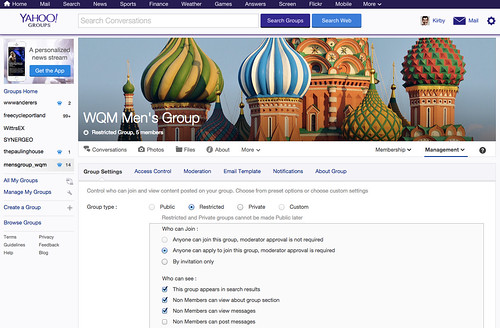
WQM Mens Group:  Group Settings
:: working with WQM Men's Group ::

Tuesday, May 26, 2015

Memorial Day

DSCF8754

People were out in droves in my neighborhood, enjoying those establishments choosing not to close for the holiday, but stay open.

I'm reminded of my quick visit to London Knowledge Lab on a bank holiday when no one sane would be at work.  But a kind Lab guy, knowing my itinerary (guest of Shuttleworth Foundation, hot off a jet from Pacific Northwest), realized it was now or never.  I gave a presentation.  The gig was recorded and for many years made the rounds, plus I got to brag to the Foundation folk I'd already briefed LKL, sounded important.

This year, 2015, I drove Deke, a fine fellow, on an errand to Dr. Bolton's hood, out Tryon way.  We stopped in to visit with Sir Charles, an emeritus sociology department chairman and contemporary of my dad's.  The Boltons started to tune in Urners at University of Chicago, but then went their separate ways.  Not until they got together again in Portland did the conviviality really develop, such that when we moved to Rome, we made the trip to Positano, to hang with the Boltons, on sabbatical.

The intersection top of Boones Ferry, where Stephenson T's in:  that's been a rough corner and a lot of redesign has gone into it recently, I think for the better.  This was my landing quad i.e. my starting sector in the World Game of Portland I started playing, off the plane from Bangladesh.  Mom & Dad were pulling up stakes there, I'd gone to help them pack up, take another look around Dhaka, and then I stayed with the Boltons rather than resume an East Coast existence.  Time to get back to my Portland roots.

The Nissan has a fuel system issue that I'll trace to poor maintenance on my part, casting no aspersions on Nissan for this one.  The Altima I drove to and from, on my recent mid-west tour (St. Louis MO etc.), was a world class motor vehicle.  I like how rental car scenarios let us try before we buy, or rent again, or whatever.   Anyway, the Maxima bucks like a bronco sometimes, even shutting off.  Good thing it's OK to restart in neutral.  But hey, Deke and I both remarked how overall smooth the whole trip was.

Funny part:  Charles was just showing us a postcard from Maureen, in dense handwriting, and saying he thought she might still be in Europe when, knock knock, there she was at the door, pretty funny.  I alerted them to Carol's immanent arrival and suggested we all get together again soon, Deke included (he liked our energy, think he might join).

Maureen was at the WILPF Centennial like mom was, with her son Erin in a supportive role.

Mom did a lot of her five weeks solo, also tackling NYC YMCA on her own (for visits with UN people) and DC.  She routed herself back to LAX via JFK and fortunately made standby on JetBlue, shortening her stay in JFK by a good six hours, way to go Carol!  She said she'd gladly take JetBlue again.

The day before, I got together with my friends the Gunnells, new in Portland.  I took pictures at the wedding, my former co-worker Eddy's daughter the bride.  Eddy and I were high school teachers at St. Dominic Academy, for girls (young women) in Jersey City, New Jersey.  That was back in the 1980s, great gig!

Friday, May 22, 2015

Bravo Michigan on Bold Experiments

I may have gotten the story a little wrong and will apply corrections in future blog posts, allowing misapprehensions to continue registering here, but my current understanding being that high schoolers in Michigan are guaranteed by law at least one distance education class as a part of their public schooling experience.

Public Act 205, passed in 2009, allowed the formation of full-time online schools for the first time in fall 2010. In 2006, the Michigan Legislature was the first in the nation to pass a requirement that students have an “online learning experience” before graduating. [ source

Is that opt in or opt out and what if one wishes more than one?

In any case, the Nexus Academy solution looks promising in that it solves the need to authenticate identity.  Those of us in distance learning know a weak spot is what if the student lets her dog do the homework instead.

Most realize they cannot fake it for long on the job, so why fake it now, but adults are more likely to realize this than children maybe?  Not that teenagers are children exactly.

In any case, certified testing centers are a need at all levels for all ages.  The science wants control and supervision, not some going overboard on some "honor system".  Authentication is required, perhaps with biometrics.

One might imagine a combination of experiences, inside one of these centers for some activities, outside for others.  You need not imagine yourself cooped up for days on end, as for academic credit you're required all over the map.

What is distance learning anyway?  Thirty feet away can be pretty far, in human terms, in a room of five hundred.

A lecture hall is distance learning?  Might as well be.

Actually no, there's an audience / speaker rapport that makes live talks a bonus, same with music.

Anyway, it would be up to Michigan whether an obstacle course in cyber-space such as mine, or some other DL activity, would count for credit per the State of Michigan.  That's not my decision, as an online teacher, and besides who want's to learn lambda calculus anyway?

But the very idea of a Nexus Academy wherein I might have students, even if I'm in faraway Oregon or St. Louis, does inspire me, whether it's really practical in the short haul or not.  Thank you USDLA for opening my eyes to the possibilities (that's a conference my school sent me to, and a membership organization).

Raining in Portland, did yard work today.

Decision-making is by many methods, and who has access to all that many boardrooms?  We have our finite experiences.  Democracy does not just mean once a year elections, or once every three or four.  People learn to vote when going out on a group date and picking a restaurant.

But then if you're Quaker and use consensus, maybe you never choose?  "Let someone else program it" might be how the unprogrammed would do it, but presumably "expectant waiting" is more intelligent than that.

Tuesday, May 19, 2015

Wanderers 2015.5.19

DSCF8673

Tonight was my turn to give a Wanderers presentation.  I decided to spice it up by saying I was acting a part, not really being my ordinary self.

I wore shiny shoes and my Quaker hat (a Stetson).  I was the "Quaker futurist", like a gig, or act.

Trevor (depicted below), being the Egoist presenter recently, was an inspiration.  "If someone says I'm egotistical, I correct them, saying it's really egoistical that I'm being" (bada boom -- one of my jokes).

Shades of Portland Center Stage...

Anyway, I was a bit gruff and abrupt, and people warmed to that as I'd warned 'em.  I practiced by telling Don to "shut up" a couple times, like I thought I was Bill O'Reilly.

The idea was my Martian-tinged cult had some future in the pipeline and here was a Saturday Academy class, already delivered, that had already passed the torch.  The future just passed you by, did you even notice?

1, 12, 42, 92... I kept harping on that, like a mantra.

I was touting the standard Garden of Eden in a Climatron stuff, a kind of utopianism associated with Whole Earth Catalog if anyone remembers those.  The Bucky stuff, I call it.

Stewart Brand had a hand in this stuff, and so did J. Baldwin.  Stewart pushed to get pictures of the whole Earth, as in "from-space photography" into the public domain.

Shots from space (ET PoVs) were entirely new in those early days of the first orbiting satellites, ala Sputnik et al.

I started my hour-long presentation with two misanthropic cartoons, pulled from my Facebook profile, then flipped through slides from the Martian Math class.

The Martian Math stuff was portrayed as 10-20 years ahead of the pack.  I was purposely somewhat Cabalistic or cliquish one might say, in implying Silicon Forest was moving ZomeTool, as implied by a picture from our field trip to ONAMI, as a part of some cultic process.  We talked about Grunch a lot (Fuller's coin), and Ed Applewhite's Cosmic Fishing.

But I digress.

People were quite engaged and full of insights and questions, as I'd hoped.  We talked about dedicated freeways with self-driving trucks -- but don't we have those already?  They're called trains and only one of the cars, called the engine, needs to drive (the trucks would need some kind of supervision too).

Although I was walking them through some slides, the idea was to inspire conversation.  We were there to think about Futurism as a discipline, and about how Science Fiction works, as distopian-to-utopian.  I mentioned the Paul Allen museum on the subject, in nearby Seattle.

The ratio of science to fiction matters.  That's on one of the slides.

And also:  is it about humans expanding elsewhere, or being expanded upon, as in invaded?  A little of both maybe?  I talked about "angels and devils" as the old days ETs.

Regrets poured in from some of the people Don had invited (that's his role) but who couldn't make it and maybe wanted to be polite and all, but as you can see from the picture (above), it's a small room.

Thanks for thinking of me, and lets get together soon!  Life is short.


DSCF8333
Trevor in character at Mother Foucault's

Wednesday, May 13, 2015

Voting Machines

Project Vote

Those of you US people without amnesia (Gore Vidal said this was the United States of Amnesia we live in, if you'll recall), may remember the voting machine fiasco.

We all lost confidence in the machines because they would not share the algorithms or submit to auditing by students of computer science, who might be high school aged.

One of the nonprofits I work with is experimenting with state of the art e-voting software that not even an election administrator can rig.

It's a vote-by-email type of system, with one ballot going out to each eligible person.  I'm not saying it's either fool proof or applicable in its present form to just any election for whatever office.

DemocrayLab is the NGO I've written about most in connection with providing "democracy in a box" ideas, i.e. turn-key software that's democracy-enabling.

However eVote and Helios are already open source, not saying you need to bother Mark just because you're interested in either of these two packages.

Every high school needs voting machines as a part of its civics curriculum, with votes counted often, on myriad topics, experimenting with different modes.

In some systems, even the voters are secret e.g. you don't know who in the audience is really the critic for the New York Times.

With Quakers, we tend to move by consensus but that only works in a non-trivial way when the players are communicative.

When people stay strangers, you lose a lot of the inertia that comes from shared access to organizational memes.

That's why companies do team building and such, even encounter groups in some walks of life, to break down the barriers to speedy / timely / efficient communications.

Monday, May 11, 2015

Conference Call

Foreground:  Linus Pauling House

In case my Gift Shop proposal flies, I've talked to Glenn about a tour.  Area Program Committee is considering a proposal to fill in for the missing Laughing Horse Book Store and Video Collective ("nothing lasts forever but the earth and sky" -- Kansas).

There's a hole in this town that Friends could help fill, both programmed and unprogrammed.

501(c)(3) nonprofit corporations are allowed to sell swag.

But this would be more than a swag shop.  We'd have vintage Peace buttons, educational materials. Proceeds fund our non-profit programs.

We get around needing to provide ADA compliance to this rickety old building (the one we're touring) by having the organizing meetups elsewhere.

We can do sales outside on summer days, so if you're on crutches you'll still get access.

The competition wants a strictly back office low profile in a little trafficked part of town (comparatively).

Their building is for sale and unstable in that sense but the back office people don't seem to worry as they have few responsibilities and no programs.

Our program people are in the field.

Why a small city like Portland should get Philadelphia-type jobs is a bit of a mystery.

"Back office" is what Friends Center is for, is what we thought, not West Region where we need to be public-facing and engaged.

DSCF8471

Saturday, May 09, 2015

PR for Earlham College


:: thanks! ::

Sunday, May 03, 2015

May Day 2015

May Day 2015

I haven't been to the postmortem / analysis meeting yet, and I missed the last several before the event itself, having participated in the fundraising phase more than the route planning phase.  I was in favor of a counter-clockwise route, but the fact that it ended up going clockwise was perhaps unintentional.  The newspapers are saying we were off the planned route.  That's credible.

However, walking against traffic in the bus mall, all professional drivers with union sympathies, right passed the Apple Store and other centers for the more privileged work-study players, highlighted the contrasts, as we made it to our R2DToo campus.  I took the pedestrian crossing to traverse the west-traveling lanes and revisited the Door Project, per storyboard.  Other than that, I was free to cross paths with the march haphazardly and took breaks at both Rogue Hall and Melting Pot.

Our plan was to keep moving and not assemble on the steps of the Justice Center in quite that way, but then all these plans were before Baltimore and continued escalation in tensions through the media.  Given all these storms, our relatively festive and orderly mobilization was not the unruly mob portrayed by the children writing for The Oregonian and such, i.e. journalists of low stature ready to react without much thought or reflection. 

The operation was both professional and to the point, criticisms to the contrary notwithstanding.

Wednesday, April 29, 2015

Closing Keynote: USDLA


The closing keynote by Burck Smith focused on mega-trends for the future.

Non-accredited institutions are muscling in to the same teaching space occupied by accredited institutions.

Accreditation has been a kind of monopoly allowing those on the inside to keep their tuitions high.

With the falling cost of course delivery thanks to distance education, profits have been fattening for the accredited, but at high cost to students.

In the next chapter, the competition from the players outside the accredited sphere are likely to make deeper inroads into diploma space, offering certificates instead.

Monday, April 27, 2015

USDLA Keynote


Hal Plotkin, with experience in the Obama administration, is now with Creative Commons.  His abbreviated history of the copyleft movement (skipping the GNU / GPL chapter) led to this punch line:  in some scenarios, dropping proprietary content in favor of equally high qualtiy open content saves enough money to assure students get a properly equipped personal workspace to get on-line.

That's a lesson learned in the software industry a generation ago.  Perhaps the Linux / GNU chapter got skipped given Microsoft's interests in this area?  Free software and free curriculum content (free in the sense of liberated) certainly have a lot in common.

A focus of Hal's keynote was CC-by within TAACCCT, a US Department of Labor program.  We got to watch a fun little video (above) and learn about some success stories.

Translating into computerese, he's into gamification of learning e.g flight simulators for everything (chemistry etc.).  "Nobody can cheat on a flight simulator".

The geek world memes of "Ignite" (as in Ignite Portland, or Ignite.gov) and "open licenses" appear to have permeated this education world.  Several of the talks have the word "ignite" in them.

I'm here with some of my co-workers from O'Reilly School of Technology, nothing to do with the auto parts company, everything to do with publishing e.g. Safari On-line.

We got some statistics that only 7% of the world's humans have post secondary school education, but that's measured in terms of having academic degrees.

If you're like my friend Lindsey in Nepal, deeply involved in the study of Newar Buddhism, you might not have a PhD in that, yet still be highly educated.

Education and academic schoolwork are overlapping non-synonymous concepts in my book.  That might be heresy in this group, not sure (I'm a newbie).  The pro open source ignite flavored memes we're getting here are quite familiar to me however.

OSCON will be in Austin TX next year.  Portland and Austin have a lot in common.  They're both into staying weird.

The first talk I attended after the keynote was about "the four stages of SAMR" meaning Substitution, Augmentation, Modification, Redefinition, an approach to giving new technology a foot in the door into course delivery.  Share PDFs with Dropbox, use a Learning Management System (e.g. Blackboard) for grading.  Basic stuff.

We're hearing a plug for Microsoft Office Mix + Powerpoint + Notepad, adding to my sense that F/OSS (free and open source software) is not a primary focus here.  "All students use Evernote or OneNote for all notes" (Powerpoint slide) -- that's Augmentation, after Substitution lets them use any app for notes.

OneNote is free as in beer at least, if not open source.  I'll first need to upgrade my OS to use it though.

Saturday, April 25, 2015

Back in St. Louis


I woke up to telecommunications in Campaign Illinois, after seeing Johnny Rawls Blues Band at Iron Post, in Urbana, to learn of the devastation in Nepal, a 7.8 earthquake.

Lindsey is in the middle of the chaos.  She had taken disaster training seriously in Portland, little knowing she would confront disaster in Kathmandu Valley, in the shadow of the Himalayas.

My Altima Nissan (actually Alamo's) served me well on this trip, a jump into the future from my 1997 maxi taxi, a Maxima.   Push button start, rear view camera, comfortable and strong.  Quite and expensive piece of equipment, and I was relieved to get it back in mint condition, though with 700 plus additional miles to its credit.

I've updated some of the people who know Lindsey, and of her whereabouts, that's she's still alive.  Many were not so lucky.

Tuesday, April 21, 2015

Spherical Trig

I've been brainstorming with my peers on math-teach about how to make spherical trig more accessible, starting with a set of tools and not staring at a lot of cryptic scripting language right off the bat.  On a sphere, the Pythagorean Theorem has a different form.

Imagine a curriculum that used a code such as:  sTem; STem; steM... to highlight which of the four domains (Science, Technology, Engineering, Mathematics) gets the most emphasis in a given Lesson Plan. Multiple letters might be highlighted.  Superimposed (stacked), the Lessons reinforce one another and build up a multi-layered surface (spherical) or system (global matrix).

The acronym STEM is perhaps peculiar to English and need not be taken too seriously.  The pun on STEAM, with A = Anthropology, seems to be one of STEM's chief values as a marketing device.  We get another bridge to the Humanities through Anthro / Animal, thereby unifying the Liberal Arts in true Trivium / Quadrivium fashion.

In Synergetics, the spherical triangle is emphatically a face of a tetrahedron with edges to the planetary center.  Saying "planet" for "system" has a somewhat Little Prince flavor.  But then we already use the word World for a namespace, as in Python World, or Python Planet (both references to the computer language, but of course Monty Python resonates as well).

My travels took me through Salt Lake City recently and I found myself reading about Pink Floyd, the pink flamingo that escaped from the zoo and lived in the wild with the other birds for a number of years.  Brine shrimp are plentiful in those lakes (a patchwork of shallow mini-lakes), though I'm not sure if that's what flamingos actually eat.  Tourists would spot Pink Floyd from time to time, but he or she drifted off and was last seen in Idaho.

Among the tools a student might use:  Google Maps and/or Google Earth for finding locations and getting their lat / long coordinates.  These might be fed to a Web resource (URL) that spits back XYZ coordinates, taking Planet Earth to be centered as some origin.  Straight line distances through the Earth's crust would correspond to chords, whereas on the surface we have geodesics or great circles.  Going from lat / long to XYZ to spherical coordinates helps us translate between data sets.

Friday, April 17, 2015

Generations

They say a generation is twenty years.  Twenty years ago I went to the Fuller Centennial in San Diego and wrote this three part series.  I'm tonight reading a partially overlapping account.

Ken Kesey and the Merry Pranksters were boomers, somewhat post beatnik which was Jack Kerouac's generation.  The two met in New York as a part of that bus trip, Leary's group the next stop.  Sometimes a Great Notion (Kesey's next novel after Cuckoo's Nest) was being released.

Pegging the time.  I was in elementary school, starting in Portland, winding up in Rome.

My generation was / is late boomer, pre Generation X.  When our group had families, those were called Yuppies (young professionals) a play on Hippies.  Various neighborhoods gentrified or whatever.  Jersey City sure took off, since my day in the early 1980s, as a high school teacher walking to work along Kennedy Boulevard.

I took my daughter to New York and Long Island City that time, to meet with Kenneth Snelson and to take in a ceremony honoring the friendship between Fuller and Isamu Noguchi, a sculptor.  Shoji Sadao was another in that crew, a workshop / studio, across from where the Noguchi Museum is today.

My mom is aiming to be in New York City by tomorrow, for only for a brief stay.  She'll be back through on her return.  I'm meanwhile soon to set out for the mid-west on company business.  My daughter is now twenty, a next generation.

The Princeton P-rade is worth catching, if you get a chance.  The classes parade in order, though with a 25th year group in front (I think is how it goes -- I was there for that one).  You see time go by really quickly, a review.  The alums get younger and younger, turning into underclassmen at the end.  I'm not sure what other universities do that.  Pretty interesting.

The "march through time" metaphor (is it a metaphor? -- seems pretty literal) is pretty cliche.  Or is it the march of time?  Whatever.  "Time is the only dimension" was one of the tropes I remember from Synergetics.  But then time and size go together.  One needs room to rattle around.

Given I was in Rome during the tumultuous 1960s, I had a somewhat different take on things than my three-years-older wife.  She had stayed in North America, mostly in the southeast, joining the Portland scene before I did.

My return to Portland, in 1985 (as I've pegged it, I hope correctly) was after my parents left Bangladesh but then moved to Bhutan, where dad continued his career as a planner / designer, now of education systems, later in Lesotho.  When my wife was hired as the bookkeeper for Center for Urban Education, I was away in Bhutan.  On a next trip, she and Alexia joined me.

Anyway, if you're curious about my autobio I've got more on file.  Check it out.

Thursday, April 16, 2015

Trite Math

Держись!

According to the Bridges trolls, i.e. the kick-and-punch reviewers who come out from under the bridge when someone proposes to cross it, the relationship VE:Icosa :: S:E is of no conceivable import, cultural, artistic or otherwise.  So be it.  Lets call it Trite Math (Koski's coin).

VE is a remote vocabulary word in the Synergetics namespace, pioneered by the ever-lonely Bucky Fuller.  VE stands for Vector Equilibrium.

Rational ancient Greek speakers know it as the "cuboctahedron" although that suggests a solid shape, not the skeletal version with doubled radials, eight hinge-bonded unit-volume tetrahedrons, per Concentric Hierarchy lore.

That's twenty-four radial versus twenty-four circumferential vectors in Bucky's accounting system and vocabulary, hence the name "vector equilibrium" (twenty-four of each).

The shape is barely stable however, only fleetingly itself.  It Jitterbugs into an Icosahedron of equal edge lengths, the Icosa in the ratio above.  In so doing, the volume decreases from 20 (the eight tetrahedrons are volume one, six half octahedrons volume two, so 8 + 6*2 = 20) to about 18.512... (more digits).

S & E are both slivers, splinters.

The topologically minimum container in ordinary space and ordinary language, is the tetrahedron.  You don't have a volumetric "cage" with less than six edges, if constrained to constructing with sticks.  Fuller accounts volume using aggregates of these slivers, which he names:  A, B, T, E and S.

You can look them up. They have plane nets and everything. A, B and T all have the same volume (1/24).  E outweighs T by a tad, has the same shape.  S is for Skew.

So VE:Icosa :: S:E is a volume thing.  David Koski has been playing with these blocks and making lots of discoveries.  Low hanging fruit (i.e. trite fruit) is plentiful in this 4D domain.

Lets do it in Python:


e3 is simply Evol shrunk by 1/phi i.e. all edges are .618... of what they were, with volume decreasing as 3rd power of that amount.  Edges:Area:Volume grow and shrink in a 1, 2, 3 powering relationship when a shape changes size (duh).

I agree this is all pretty easy and accessible, which in some circles is a mark of inferiority, of triteness.

[ The fact that floating point numbers have noise digits on the end owing to base conversions etc. may be off-putting to "real numbers" fans. ]

Cliché Math we could call it. Cut and Paste Math.

Speaking of which, the source code for studying the above modules is available here on edu-sig.

The source to render the above graphic is also available, but you'll need the free / open source POV-Ray ray tracing engine to get the final result.

Rejected, too-trite and/or incomprehensible papers:
Bridging XYZ and IVM Volumetric Accounting Systems with the Square Root of 9/8 by Kirby Urner
Revisiting R.B. Fuller's S & E Modules by David Koski

Sunday, April 12, 2015

POV: A Game of Fetch


POV = Point of View.  In this case, provided by a DJI Phantom Vision+ 2.

Starring Seuss the dog, Les piloting, Elise and Kirby as backup ball throwers.

:: the quad-copter ::

Tuesday, April 07, 2015

Wanderers 2015.4.7

:: paying myself $30 plus postage ::

Barry is talking about needed reforms in the capital games tax, talking about day trading, after the capital gains period, eating your losses etc. etc..  He's a retired banker, but those around the table aren't that as financially savvy necessarily.

I think a state should expect commitment of time and energy in lieu of taxes or as a type of taxes.  You get a job with the government where presumably there's value added as a result of your performance.

Barry doesn't like the corporate personhood movement, also known as Voodoo Economics whereby inanimate objects (corpses, corporations) gain personhood (souls).  It's a kind of legal fiction, or science fiction that's serious enough to govern role playing in some subcultures.

A government could run hotels, rental car depots, a bunch of tourist related stuff.  It does so now, in the guise of its military, but what about civilian bases, more like Disneyland than Mordor?  There's no shortage of stuff for people to do, as committing some percent of their aliveness to serving the greater good.

The so-called 1% would stereotypically want to exempt itself from government service as they're wanting to party in penthouses and not maintain mountain trails.  Not everyone is equally able.  One could have a monetary way of playing the taxes game, but also this other way, like joining the military but the civilian correlate.

At one point I was suggesting Girl Scouts as the model, with abandoned bases in the Philippines as my backdrop.  I'd been to Clark AB pre Pinatubo so knew how a base might double as a civilian campus, or be converted into one, more like a university, less like a prison.  War is unfreedom to the max.

Christine is asking questions, as Barry continues talking about stocks and IPOs.  Insiders can't sell their shares right away.

When people give to charity they get credit sometimes.  Their profile is updated.  However the government takes the glory for how taxes are spent.  Were individual role playing the currency, bleeping over the importance of individuals would be harder.  People complain USAers are "too individualistic".  Maybe that really is not the problem.

You want to be a star, a celebrity, and how do your taxes help you achieve that?  Does the government give you fifteen minutes of fame?  Are you able to make movies?  In some cases yes, taxes get used for that.  But how many filmmakers get to serve the greater good as their way of pulling their weight?  Don't we waste talent by not letting them?

Some from the art side struck up a side conversation on Zombie Jesus, another circulating comic meme.  Warning:  not everyone has a sense of humor where Jesus is concerned.  More of a Gnostic thing maybe?

Saturday, March 28, 2015

Interstellar (movie review)

I caught this at Laurelhurst, packed house, smaller screen, bright and sharp picture though, I don't require Real3D to stay happy (except outside when driving I find it convenient).

I'd been skeptical about this film given the hype and my low opinion of public opinion a lot of the time, call me a snob or elitist.  However I've come to respect the film for what it tackles:  the way in which love seems to transcend even death, or call it gravity.

The memes are straight from the dust bowl cornfields of America mixed with NASA space program ethos, a volatile combination with many stark contrasts.  Planet Earth is on the wane and there's a sense of needing to bootstrap somehow.  Why are humans always on the brink?  Or maybe that's what prehistory was about:  not being right up against it with End of the World just around the corner.

Science fiction is expected to have worm holes and higher dimensions.  That tradition was established at the end of the 1800s, when novelesque plots were developed to take advantage of 4D, the new kid on the block.  The tesseract or hypercube, made its brilliant debut, with no upper limit on dimension number.  Worm holes could be everywhere.  Our confinement to the solar system, a frustration for plot developers, was solved.

As I've harped on in these blogs, the tesseract is not a time machine except in scifi.  That these would be jumbled together on the chalkboard is part of the tradition, but formal math does not permit it.  The polytope mathematics of the nD crowd, led by Coxeter, is not the 4D mathematics of Einstein, nor the 4D philosophy of Fuller, to which this film comes very close (no obvious tetrahedrons though).

In classic humanities liberal arts, the dead speak to us in our libraries, through our books, across time, across space.  Yes, it's kinda spooky, and poltergeists (at least tales of) lurk in those pages.  Young girls are especially drawn to certain passages, specific phenomena.  Their dads use science to discourage this tendency but then end up on the other side of it, wanting to speak after deadline.  The hero's frustration is palpable.  He has machine Marines for cold comfort.

The relativity touch was really well acted I thought, complete with aging at different rates.  Maybe I'll see this movie again, in Real3D even.  A car pulled out in front of me on Stark on the way home and I was glad to have the right break-hitting reflexes and enough traction even in wet weather.  The film is long, starting with previews at 8:45 and not letting out until close to midnight.  Not complaining; it kept me in my seat.

Sunday, March 22, 2015

ReThink911 @ HGP

911 Talk @ HGP

I learned from Dr. DiNucci that David Fura would be presenting on 911 at Friendly House, addressing Greater Humanists of Portland.  Given local Quakers have been recently joined by David Chandler, scheduled to speak at the meetinghouse on April 12, as a part of our Peace and Social Concerns program, my scoping out this talk seemed apropos.  Fura cites Chandler in his slides and plays the video of David, identified as with AAPT, asking the NIST guy a question.

The National Geographic and Popular Mechanics efforts at debunking get tackled in Fura's talk.  If thermite is not useful in demolition, as NGS alleges in its own attempt at debunking the Truthers, then how does one explain the patents for using it that way?  I forget what the Popular Mechanics thing was about, however these debates are all on-line so feel free to tune in.  A lot of people are participating in these discussions, not just the Humanists and Quakers.

The ReThink911 agenda is all about casting doubt on the official NIST reports, especially around WTC7, the building that (even officially) went into free fall, officially because of fires weakening its structural members, but unofficially and off the record thanks to preset charges i.e. because of controlled demolition.

If NIST is right -- but it won't release its computer model -- then it has discovered a new way for skyscrapers to fail due to carbon-based fires never before contemplated and never before or since seen.  The Truthers remain highly skeptical of the NIST theory, wherein the numbers keep changing.  Both sides appear to use science to support their claims.

My question, as a matter of logic, is how one gets from the apparent fact of "controlled" demolition to the "uncontrolled" events of 911.  Buildings of that size and stature should be designed with demolition in mind right from the start, as Paul Laffoley asserts was the case with these 1970s monsters (which I admired), losing money and ready to be replaced by the 21st century.  With what we don't know.  Laffoley's own design, conceived after 911, was for a Gaudi-like building, part memorial, more conceptual art than a blueprint at that stage.

Could these buildings have been scheduled to come down anyway, just not as a result of terrorism?  Was someone "pushing the button" a part of the terrorist plot all along?

If demolition were integral to the design, then the question becomes at what point in the timeline were charges added.  Might there have been a schedule driven by financial concerns unrelated to troop movements in the Middle East?

As expected, once off the official narrative, it's somewhat of an inkblot test as to whom we think is really responsible.  People who don't read a lot often think of Neocons and the CIA as the same bunch, whereas from other angles one sees open hostility, or at best rivalry between these two camps.  Just saying "bad guys did it" doesn't really get us anywhere.  The devil is in the details.

That the CIA is trying to use the Truther Movement to make Bin Laden look like a patsy is consistent with past cover up failures.  Iraq would be more like Cuba by this analogy, Oswald being cast as pro Castro and by extension a Soviet spy.  Hadn't Saddam plotted against Bush Sr.?

However analogies with the JFK chapter only go so far as in this case there's really no doubt about the jet airplanes hitting the two buildings, WTC1 and WTC2 (not WTC7) -- except amongst odd-ball extremophiles.  In Oswald's case, it's rather doubtful he ever fired that rifle, or killed Officer Tippit or any of that.  He was just following instructions, up to where he tried to escape his fate as the fall guy, by explaining his innocence to the police.  Jack Ruby had to silence him.

What do the ReThink911 people imagine would have happened if only the jets had hit?  What would have been the scenario, absent any controlled demolition?

The jets hitting was enough to get people jumping off buildings.  Hundreds if not thousands had died already.  Clearly these were nightmare situations, with firefighters bravely walking into them.  If the goal were to provoke a war with Iraq, per the Neocon agenda, wouldn't this terrorist act have been sufficient?  Why would anything potentially even more risky be required?  At least one of the Humanists asked about this during the Q&A.

With no demolition system in place, would the towers still be standing today in 2015, or would they by now have been demolished, WTC7 included?  After that day, they were totaled, unsalvageable no?  So we'd have demolished them by now at least, maybe even without the planes hitting.  The Twin Towers were close to worthless by 2000, were white elephants, according to many accounts.  As soon as we had finished rescuing all the people, they would have needed to be destroyed, no question.  Repair would have been infeasible.

However Fura thinks the WTC towers may have been too full of asbestos to make their demolition practical at any point.  This would point to a major design flaw as how does one replace buildings of that size once they've outlasted their lifespan?  How would one remove towers of that stature except by controlled demolition?  Or is the theory that anything that big has to last forever?

Do we suppose architects are off the hook in needing to think about a building's full life cycle, including its eventual destruction?  I expect the buildings would have needed to come down later, actually quite soon, WTC7 included.  In fact, once the Twin Towers where down, why keep WTC7 around even a day longer?  Everyone was out by the time it imploded.  Why not?  It was worthless by then.  Just more rubble to clean up at that point.  Civilians had cleared the area.

What I don't know is how many additional lives might have been saved had the firefighters been given more time with their hook and ladder trucks etc.  People were already jumping to their deaths.  The additional numbers that might have been saved is a difficult calculation once you factor in the number of firefighters who might have died as a result of heroism, trying to rescue people from the two towering infernos.  Lots to think about there.

Saturday, March 21, 2015

Brunch on Hawthorne

DSCF6635

We promised William an authentic Hawthorne brunch this first spring day, and Cup & Saucer did not disappoint.  Glenn talked about his "global matrix", a thread in these blogs.  I called it a "non-glaze over" namespace, as for Glenn at least, his particular decryption or encryption (however you want to look at it) keeps him fluent in many cutting edge areas.  He has low bus numbers though.

William is studying computer science and works full time doing the kind of work he trained for at OST and elsewhere.  When we first met, he was one of my students, still in Afghanistan.