I was emphasizing in come recent AFSC communique, intra-committee, about the importance of public restrooms: "I think the City of Portland spends irresponsibly little on maintaining park bathrooms. This was my standard at Occupy also."
I was also reminiscing about Teresina Havens and her service in Tokyo or one of those as a latrine cleaner. She was in training as a high level Buddhist and later came to Portland with her partner Joe Havens to start a study group. My wife Dawn and I joined. Her husband later started a group as well, dubbed "Quaker Economics" though it may have had a more formal name.
When lots of people meet outdoors for a General Assembly that may take hours, there need to be facilities present. Sometimes that means Kybos, for those familiar with an obscure reference. Mobile units may be hauled away or deposited by truck. However other solutions exist. A museum exhibit specifically relating to municipal toilet facilities developed in the depression years, under FDR and Eleanor, would attract my attention, and I suggest the attention of many critics.
If your city has public parks with closed, run down, unmaintained public restroom facilities, then ask yourself where the money goes. Don't your property taxes buy you public parks with facilities we might have pride in? Perhaps an attendant or two needs to be present, rotating through other duties? Park regulations should be respected, with all night campers only in the zones designated, with lit pathways to toilets, with sometimes subtle low-glow lighting.
When I say rotating through other duties I'm talking maybe duty aboard a commercial jet liner, hosting hundreds in small quarters as honored guests of an airline. Park duty in rotation, at cities visited, would further establish the customer service reputation of these hospitable elites.
Join a Food Not Bombs crew and see the inside of a new temple, meet religious people. These friendships may endure. Or perhaps your crew is home-bound from disaster relief service in the Caribbean, a big storm having left a path of destruction. Some people specialize in being there when needed and we honor their service. At Rose Parade, and Gay Pride too.
I had dinner with a social worker this evening. A lot of scared youth come to Portland because they feel rejected in their own neighborhoods. The stigma of "being gay" or "trans" is enough to push people out of homes and into the streets, where social services have to pioneer a humane response.
My social worker friend is proudly and openly gay and suffers no loss of respect as a consequence. But that such role models exist, though encouraging, does not provide any immediate solution for those drowning in the overwhelmingness of it all. Some are pregnant. Some are just being released from institutionalized care, perhaps because the insurance has run out and it is no longer profitable to test tomorrow's banned drugs on them.
Not that all drugs should be banned. Military units dispense all manner of psycho-actives per this Time magazine cover story. In some lines of work, you're expected to be "on" something, usually coffee which is both legal and unregulated. Sometimes something stronger. Athena's oracles at Delphi had their python vapors. Some narratives say Apollo slew this "dragon" (a recurring meme), but I say the python escaped to Nashville (TN).
The relative sanity of coffee shop world gives me some hope. There's precedent for sharing controlled substances responsibly, taken to higher levels in some capitals.
True, hippies flocked to Kathmandu and maybe made a negative impression in some cases. Drug abuse did occur. They came from a culture of under-privileged, under-served by their cities (e.g. check the public restroom scene) and oppressed by their schools.
The social worker and I coincidentally wore matching jackets, somewhat business oriented but also causally "night out" in flavor (I wore a dark blue buttonless shirt with no tie or collar, subdued compared to her colorful and tasteful tattoos).
Our venue was upscale Ethiopian, yet homey, not overly institutional. Ethiopian restaurants tend to be like that, clearly family affairs, with you their guests. I liked the sort of Southwest Airlines swagger, a joking informality, within a framework that's all business, in the sense of keeping things running smoothly. I paid with Alaskan Airlines visa.
Speaking of keeping things running smoothly, I salute Saburo's Sushi House, where I went for the first time on a Father's Day, with Tara. We dutifully waited in line like they say you usually have to, and lucked out getting in on a first serving. We felt well served and privileged, plus the fare was fantastic, right down to the tea and miso.
Tuesday, June 18, 2013
Thursday, June 13, 2013
Two Meetings

I'll try to tie these two meetings together.
The first was a presentation by Allen Taylor at Linus Pauling House about some of the things going on in the private sector around space exploration.
Planetary Resources, a new company interested in mining asteroids is raising money, via Kickstart, for the million dollars needed to add another mini-telescope satellite, this one to offer its services to the public.
You'll be able to get your picture flashed through the on-board camera, with the Earth or Moon as a backdrop, given the external LCD to which the photos will be uploading. For $25 or so, you can get a wedding picture with a cosmic backdrop.
The second was a presentation by an Iranian-American from Tuscon, AZ who thinks relations between the respective people would improve were more people in the US aware of what a cool guy Mossadegh was. He has his Mossadegh Legacy Institute to help spread the word. He's on tour thanks to this vision.
The Veteran for Peace introducing Moji was the same guy who gave a speech at the Eagle Scout ceremony on Saturday. This was at Portland's Peace House.
The Huntworks live there, an older couple who raised their family in Iran and have Farsi-speaking children.
Many Iranians have a fascination with space exploration and appreciate that, with a more cosmic perspective, there's a withering of fascination with nation-states. Human beings and their planetary saga becomes the focus.
The break-down into "nation-hoods" with many humans falling through the cracks as "not documented", is breaking down. We have leaders in each nation working to be responsible for a global context, even if their particular position in that context is ethnic-flavored.
I agree with Moji's view that the Persian lineage has much to contribute to the ethics / aesthetics of "modernity" and ongoing "modernization". What has hurt Persian civilization, set it back was the absorption of modernization within the context of colonialism. China went through a similar chapter, as have others.
"Future shock" has been real enough (Toffler was right to predict it) but is not a one way street. As technology continues to morph our civilizations, unexpected synergetic effects of cultural inter-mixing will continue to make us all better off.
Some see such "multi-culturalism" as a threat, as if the mixing of cultures were something new in this world. That all depends. So far, Portland is integrating well with Persian culture.

Friday, June 07, 2013
Esoteric Languages
Before I forget this happened, no photos were taken (by me -- there was video happening), let me recall the meeting of the esoteric computer language society, with a name that I'll look up in a sec.
I ran into Dr. Dave DiNucci at Pepinos and he was preparing, getting things ready.
Dekum Building, downtown.
Great talk.
Bart from CompSci / PSU was the opener, with a talk on M4. He brilliantly made it look hard and easy at the same time.
Then Dave hit us with his Flash and interesting shop talk he invented, with diagrams, to help people manage parallel processes. He's worked on this a long time in professional settings.
The roles and resources feed into atomic actions which figure into plans and strategies -- all technically defined in a tight system.
He has a new book out on it.
We've discussed it at Wanderers.
Zissou.
I ran into Dr. Dave DiNucci at Pepinos and he was preparing, getting things ready.
Dekum Building, downtown.
Great talk.
Bart from CompSci / PSU was the opener, with a talk on M4. He brilliantly made it look hard and easy at the same time.
Then Dave hit us with his Flash and interesting shop talk he invented, with diagrams, to help people manage parallel processes. He's worked on this a long time in professional settings.
The roles and resources feed into atomic actions which figure into plans and strategies -- all technically defined in a tight system.
He has a new book out on it.
We've discussed it at Wanderers.
Zissou.
Sunday, June 02, 2013
Murder Mystery
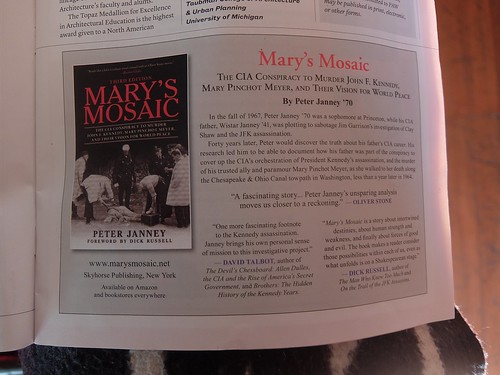
The Kennedy Era comes into different focus as the generations fly by. Peter Janney has done a lot of groundbreaking legwork for this book, including digging up and reacquainting people with a cast that has mostly exited by now. In some cases he's finishing work others started. As an investigator he tells his story with great proficiency as I am guessing Seymour Hersh would agree.
I see a few names I know in the book, going back to times in Washington / Georgetown and friendships stemming from my deep dive into Fuller School Lit. Plus I've done some reading in the Kennedy Conspiracy bookshelf, of course taking in the Oliver Stone film.
In particular I've studied the writings of Col. Fletcher Prouty and bought his CD. Prouty talks a lot about the U2 incident which Janney casts as the CIA engineering its own downfall for some reason. To derail a peace conference? That's the story.
Eisenhower was suddenly on the defensive, with Gary Powers on Russian TV. Allen Dulles didn't seem so in control of the situation either and really needed that "shot down" coverup lest he be seen as outmaneuvered. He needed to boss the Warren Commission as well, more the outsider than the insider on some days, but loyal to what was obviously the official line.
The whole business of violating the USSR's territorial integrity was creating blow back. The Cold War would continue, with no peace while one superpower acted like it owned the place and lorded over the other. People push back in the face of insecurity. Proxy wars would be waged while a "Third World" struggled to step away, not get sucked in on either side (more like Switzerland).
Prouty also focuses on the Kennedy assassination, but from the point of view of someone more connected to the mixing of American and Southeast Asian intelligence. He makes it clear that Hanoi Jane was not the first to find these people poetic. The OSS (called the OS by Janney) had some serious admirers of Ho, an ally against Japanese imperialism in those days.
The foreign policy whereby Vietnam would be handed back to the French and colonialism continued was not the way every school was thinking it should go, especially among America's elite Asia-philes. Enlisting Nazis to fight the Soviets was likewise not a universally popular move. Truman came to distrust the CIA as much as anyone, as Janney makes clear.
A key passage in Janney's book is where he portrays JFK as deeply upset upon learning of Ngo Dinh Diem being murdered, with Robert McNamara the source. This scene should be contrasted with A.J. Langguth's account in Our Vietnam: The War 1954-1975 wherein Gen. Lansdale, ever hopeful of returning to Vietnam, maybe serving as ambassador there, was brought before JFK earlier as perhaps a candidate to orchestrate Diem's demise. It's not like the Kennedys were any less capable of plotting murders (Lansdale either), or at least wishing for them to happen. Dragon tears for a fellow Catholic? Lansdale said no, Diem was his friend.
Prouty does not claim Diem's murder was according to plan -- on the contrary, he was supposed to fly to Belgrade that day and got as far as the airplane before turning back, perhaps realizing a coup was likely in his absence and not wanting to face that outcome? Gen. Krulak's Pentagon office, where Prouty worked, had everything to do with that planning. Prouty was sent to Antarctica as a military escort shortly thereafter, while JFK went to Dealey Plaza.
McNamara in this scene is livid with Lansdale afterwards when the latter declines such a mission and charge from his commander in chief. The Secretary of Defense (coming over from Ford) hisses that no one should deny and defy a president (top boss) like that, his survival instinct as middle management lashing out at a relatively quiet general who'd spent a lot of time in the Philippines already, where the US fancied itself the latest landlord in a series (Japanese earlier, with Americans before that -- this was Part 2 with MacArthur in a starring role -- Spaniards before that (though they ate Magellan (my joke from when we lived in Magallenes Village)).
Lansdale's purported idea to scare Castro with the prospect of a second coming (of Christ) also reads like a reminder of Catholic catechism (Colby was also Catholic). But according to Helms in Veil, Kennedy had other ideas, more prosaic, at least in the early days. Johnson saw it as "Murder, Inc." i.e. lots of people were getting snuffed or "disappeared". Yes, that's the way it still was in the 1960s and I'm not saying it all stopped in the meantime. The US had been a gang land all along, from the Streets of New York to Chicago to Vegas. Organized crime is a serious power, when you make some of the most wanted things in life also illegal (or too scandalous to talk about in adult fashion with your polity).
The idea that a strong woman was fighting for JFK's soul, trying to "hippify" him, is highly believable. CIA wives were trying to be a vector for a psychology sweeping the nation (universities especially), and that included using more psychedelics. The conservative old codgers whom Ed Applewhite assured me made up the bulk of the CIA (akin to Ralph McGeehee's "football players" (Ralph had been one)) would not be at all comfortable with JFK's hippification, and the military-industrial complex was indeed seeing dollar signs in endless proxy wars with a familiar ideological basis: the defense of "capitalism" against "commies" (this was before the "dot commies" and "software libre" etc., which capitalism has embraced).
They (the industrialists) got more of what they thought they wanted with their man Johnson, a chance to try out napalm and other weapons. As made clear in the book Human Smoke, the itch to try new weapons is almost irresistible. War is a spectacle, it's theater. Some people love it dearly, from the angle they get. A grand sport (Hunger Games -- like that blockade against Germany). A great game. If life is a battlefield, then what's the alternative to loving your fate as a warrior? These metaphors go back to the Crusades and are more than just metaphors -- people live by these credos, good Christians included.
Prouty is clear that an underlying pessimism and fatalism was acting as an invisible hand in this picture. He quotes Buckminster Fuller as someone saying astute things in that regard. Applewhite moved from Mockingbird to retirement to working on Synergetics, per Cosmic Fishing etc. Fuller would continue to write about the CIA (Capitalism's Invisible Army he calls it) right up through Grunch of Giants, mostly as a vector for post-WW2 business interests as inheriting from East India Tea (his own father was a "company man" in that sense, i.e. in the tea business) -- to be followed by the age of networks and networking (the one we're still in, lots of Web foo).
These were scary times and the Kennedy brothers were fighting Irish, not afraid to make some serious enemies. Having a president who seemed subject to blackmail depended on the sense of scandal that would erupt had the truth been known, about the trysts, the drug use. The movie industry had yet to do much to crack the surface of "aristocratic lifestyles". The public was believed to be too child-like, too puritan, too soft, to really face reality. This seemed a theme in Hyde Park on Hudson (movie) also.
I'm thinking that might be a fair assessment, but in retrospect we let ourselves see more and more, and it's actually a relief to get some of the misinformation out of the system. Fuller's Critical Path seems an unbelievable fairy tale in some dimensions, as many in the West have a self congratulatory story about their ultimate victory in the Cold War. Books like Janney's paint a somewhat different picture wherein Russian penetration was more complete. Telling Americans what they want to hear makes 'em shop more (is better for business); they buy more Coke and Pepsi. So why not pander to a thirst for more truth if they're ready -- and maybe put some coke back in Coke (just a little) while we're at it? Could be good television.
After some years of pretty edgy TV, I think the general polity is more conditioned to look reality in the face, as Chögyam Trungpa ardently advocated. Looking at the Kennedy Era with the eyes of hindsight, there's a willingness to see "that of God" as the Quakers put it, in this cast of players upon the stage, on a Titanic in some ways. This was a time of great turmoil and disappointments, with many killed in wars overseas, but also many in outright urban warfare in the USA's own meaner streets. "America eats its young" -- sometimes it's well to see it that way.
I'd like to dial back to the scene where Rufus Jones is saying something positive about Cord Meyer. What was it about World Federalism that failed to stand up under pressure? There are more routes and trail heads to explore here, thanks to this new groundbreaking.
Of course a lot has to do with archives that are independently managed, estate affairs. Historians don't get made privy to everything. People have secrets. However it may be a cowardly thing to keep too many and Janney is bold about lashing out, being harsh with the dead even. He sculpts himself as a character for future scholars, and enters the drama himself, not only an investigator, but an affected individual who also had sincere love for the murder victim (as Jack Kennedy did). He wants to be remembered in that light as well.
I see a few names I know in the book, going back to times in Washington / Georgetown and friendships stemming from my deep dive into Fuller School Lit. Plus I've done some reading in the Kennedy Conspiracy bookshelf, of course taking in the Oliver Stone film.
In particular I've studied the writings of Col. Fletcher Prouty and bought his CD. Prouty talks a lot about the U2 incident which Janney casts as the CIA engineering its own downfall for some reason. To derail a peace conference? That's the story.
Eisenhower was suddenly on the defensive, with Gary Powers on Russian TV. Allen Dulles didn't seem so in control of the situation either and really needed that "shot down" coverup lest he be seen as outmaneuvered. He needed to boss the Warren Commission as well, more the outsider than the insider on some days, but loyal to what was obviously the official line.
The whole business of violating the USSR's territorial integrity was creating blow back. The Cold War would continue, with no peace while one superpower acted like it owned the place and lorded over the other. People push back in the face of insecurity. Proxy wars would be waged while a "Third World" struggled to step away, not get sucked in on either side (more like Switzerland).
Prouty also focuses on the Kennedy assassination, but from the point of view of someone more connected to the mixing of American and Southeast Asian intelligence. He makes it clear that Hanoi Jane was not the first to find these people poetic. The OSS (called the OS by Janney) had some serious admirers of Ho, an ally against Japanese imperialism in those days.
The foreign policy whereby Vietnam would be handed back to the French and colonialism continued was not the way every school was thinking it should go, especially among America's elite Asia-philes. Enlisting Nazis to fight the Soviets was likewise not a universally popular move. Truman came to distrust the CIA as much as anyone, as Janney makes clear.
A key passage in Janney's book is where he portrays JFK as deeply upset upon learning of Ngo Dinh Diem being murdered, with Robert McNamara the source. This scene should be contrasted with A.J. Langguth's account in Our Vietnam: The War 1954-1975 wherein Gen. Lansdale, ever hopeful of returning to Vietnam, maybe serving as ambassador there, was brought before JFK earlier as perhaps a candidate to orchestrate Diem's demise. It's not like the Kennedys were any less capable of plotting murders (Lansdale either), or at least wishing for them to happen. Dragon tears for a fellow Catholic? Lansdale said no, Diem was his friend.
Prouty does not claim Diem's murder was according to plan -- on the contrary, he was supposed to fly to Belgrade that day and got as far as the airplane before turning back, perhaps realizing a coup was likely in his absence and not wanting to face that outcome? Gen. Krulak's Pentagon office, where Prouty worked, had everything to do with that planning. Prouty was sent to Antarctica as a military escort shortly thereafter, while JFK went to Dealey Plaza.
McNamara in this scene is livid with Lansdale afterwards when the latter declines such a mission and charge from his commander in chief. The Secretary of Defense (coming over from Ford) hisses that no one should deny and defy a president (top boss) like that, his survival instinct as middle management lashing out at a relatively quiet general who'd spent a lot of time in the Philippines already, where the US fancied itself the latest landlord in a series (Japanese earlier, with Americans before that -- this was Part 2 with MacArthur in a starring role -- Spaniards before that (though they ate Magellan (my joke from when we lived in Magallenes Village)).
Lansdale's purported idea to scare Castro with the prospect of a second coming (of Christ) also reads like a reminder of Catholic catechism (Colby was also Catholic). But according to Helms in Veil, Kennedy had other ideas, more prosaic, at least in the early days. Johnson saw it as "Murder, Inc." i.e. lots of people were getting snuffed or "disappeared". Yes, that's the way it still was in the 1960s and I'm not saying it all stopped in the meantime. The US had been a gang land all along, from the Streets of New York to Chicago to Vegas. Organized crime is a serious power, when you make some of the most wanted things in life also illegal (or too scandalous to talk about in adult fashion with your polity).
The idea that a strong woman was fighting for JFK's soul, trying to "hippify" him, is highly believable. CIA wives were trying to be a vector for a psychology sweeping the nation (universities especially), and that included using more psychedelics. The conservative old codgers whom Ed Applewhite assured me made up the bulk of the CIA (akin to Ralph McGeehee's "football players" (Ralph had been one)) would not be at all comfortable with JFK's hippification, and the military-industrial complex was indeed seeing dollar signs in endless proxy wars with a familiar ideological basis: the defense of "capitalism" against "commies" (this was before the "dot commies" and "software libre" etc., which capitalism has embraced).
They (the industrialists) got more of what they thought they wanted with their man Johnson, a chance to try out napalm and other weapons. As made clear in the book Human Smoke, the itch to try new weapons is almost irresistible. War is a spectacle, it's theater. Some people love it dearly, from the angle they get. A grand sport (Hunger Games -- like that blockade against Germany). A great game. If life is a battlefield, then what's the alternative to loving your fate as a warrior? These metaphors go back to the Crusades and are more than just metaphors -- people live by these credos, good Christians included.
Prouty is clear that an underlying pessimism and fatalism was acting as an invisible hand in this picture. He quotes Buckminster Fuller as someone saying astute things in that regard. Applewhite moved from Mockingbird to retirement to working on Synergetics, per Cosmic Fishing etc. Fuller would continue to write about the CIA (Capitalism's Invisible Army he calls it) right up through Grunch of Giants, mostly as a vector for post-WW2 business interests as inheriting from East India Tea (his own father was a "company man" in that sense, i.e. in the tea business) -- to be followed by the age of networks and networking (the one we're still in, lots of Web foo).
These were scary times and the Kennedy brothers were fighting Irish, not afraid to make some serious enemies. Having a president who seemed subject to blackmail depended on the sense of scandal that would erupt had the truth been known, about the trysts, the drug use. The movie industry had yet to do much to crack the surface of "aristocratic lifestyles". The public was believed to be too child-like, too puritan, too soft, to really face reality. This seemed a theme in Hyde Park on Hudson (movie) also.
I'm thinking that might be a fair assessment, but in retrospect we let ourselves see more and more, and it's actually a relief to get some of the misinformation out of the system. Fuller's Critical Path seems an unbelievable fairy tale in some dimensions, as many in the West have a self congratulatory story about their ultimate victory in the Cold War. Books like Janney's paint a somewhat different picture wherein Russian penetration was more complete. Telling Americans what they want to hear makes 'em shop more (is better for business); they buy more Coke and Pepsi. So why not pander to a thirst for more truth if they're ready -- and maybe put some coke back in Coke (just a little) while we're at it? Could be good television.
After some years of pretty edgy TV, I think the general polity is more conditioned to look reality in the face, as Chögyam Trungpa ardently advocated. Looking at the Kennedy Era with the eyes of hindsight, there's a willingness to see "that of God" as the Quakers put it, in this cast of players upon the stage, on a Titanic in some ways. This was a time of great turmoil and disappointments, with many killed in wars overseas, but also many in outright urban warfare in the USA's own meaner streets. "America eats its young" -- sometimes it's well to see it that way.
I'd like to dial back to the scene where Rufus Jones is saying something positive about Cord Meyer. What was it about World Federalism that failed to stand up under pressure? There are more routes and trail heads to explore here, thanks to this new groundbreaking.
Of course a lot has to do with archives that are independently managed, estate affairs. Historians don't get made privy to everything. People have secrets. However it may be a cowardly thing to keep too many and Janney is bold about lashing out, being harsh with the dead even. He sculpts himself as a character for future scholars, and enters the drama himself, not only an investigator, but an affected individual who also had sincere love for the murder victim (as Jack Kennedy did). He wants to be remembered in that light as well.
Thursday, May 30, 2013
Wanderers 2013.5.30
I showed up late for Wanderers this morning (yesterday morning by now -- it's late) and was surprised to find only Glenn. I was even more surprised to learn of Jay's passing, one of our group and one of Terry's oldest friends.
Dave DiNucci came by when we'd all left, then turned up in Pepino's when I did, having invited The Open Bastion. Steve is out of town but his small staff continues working in the new office. Dave is giving a talk tomorrow, to a meeting of an esoteric languages (computer) society. I will likely try to find it.
Tara had suggested a couple weeks ago that I might like The XX, a band she already liked a lot and followed, but had never seen perform live. Coexist is the album they were sharing.
Indeed, concerts, rock or otherwise, have not been big on her radar. We joined with Rose and Elliot beforehand looking for food, though on a Memorial Day our choices were more limited than on a typical Monday. Parking was free.
My impression of The XX and the opening band, Hundred Waters, was they were not in the "angry rebellion" school of rock. That's just one branch in any case. This group is more introspective. I enjoy mellifluous and electronic, am a regular on SOMA FM, so these musicians were in my ballpark.
They're on a grueling tour playing all over North America. The truck and bus were parked out back. This is serious showbiz with lots of lights and lasers, with voices and sounds strong enough to keep it entrancing and tight.
Speaking of show biz, my thanks again to Uncle Bill for inviting me to La cage aux folles at Lakewood Center for the Arts, in Lake Oswego. Residents of Willamette View Manor were there in force, packing the house and raising the average age. Bill chatted with a woman of 94 who may not have understood the play, which is about non-nuclear and classic nuclear families and their attempts at coexistence.
Lindsey Walker continues to record in her basement studio. Her anti-fossil-fuel-use philosophy means she has no big dreams of truck and bus tours. Even encouraging local teens to drive to a local venue is something she's given up. It's experimental music and out there for free. Free Box is the title.
My evaluations at work have been positive, even though I've been challenging my bosses regarding some of the workflow designs. We're all co-developing and many variables are in flux. Consistently good quality performance overall is what allows space for adjustments and "exaptations" (experiments) to happen. "Learning experimentally" is a Quaker theme and yet obviously not anti-science. The myth that science and religion have to be at odds is just that, a myth (and not one of the better ones either).
Dave DiNucci came by when we'd all left, then turned up in Pepino's when I did, having invited The Open Bastion. Steve is out of town but his small staff continues working in the new office. Dave is giving a talk tomorrow, to a meeting of an esoteric languages (computer) society. I will likely try to find it.
Tara had suggested a couple weeks ago that I might like The XX, a band she already liked a lot and followed, but had never seen perform live. Coexist is the album they were sharing.
Indeed, concerts, rock or otherwise, have not been big on her radar. We joined with Rose and Elliot beforehand looking for food, though on a Memorial Day our choices were more limited than on a typical Monday. Parking was free.
My impression of The XX and the opening band, Hundred Waters, was they were not in the "angry rebellion" school of rock. That's just one branch in any case. This group is more introspective. I enjoy mellifluous and electronic, am a regular on SOMA FM, so these musicians were in my ballpark.
They're on a grueling tour playing all over North America. The truck and bus were parked out back. This is serious showbiz with lots of lights and lasers, with voices and sounds strong enough to keep it entrancing and tight.
Speaking of show biz, my thanks again to Uncle Bill for inviting me to La cage aux folles at Lakewood Center for the Arts, in Lake Oswego. Residents of Willamette View Manor were there in force, packing the house and raising the average age. Bill chatted with a woman of 94 who may not have understood the play, which is about non-nuclear and classic nuclear families and their attempts at coexistence.
Lindsey Walker continues to record in her basement studio. Her anti-fossil-fuel-use philosophy means she has no big dreams of truck and bus tours. Even encouraging local teens to drive to a local venue is something she's given up. It's experimental music and out there for free. Free Box is the title.
My evaluations at work have been positive, even though I've been challenging my bosses regarding some of the workflow designs. We're all co-developing and many variables are in flux. Consistently good quality performance overall is what allows space for adjustments and "exaptations" (experiments) to happen. "Learning experimentally" is a Quaker theme and yet obviously not anti-science. The myth that science and religion have to be at odds is just that, a myth (and not one of the better ones either).
Saturday, May 25, 2013
American Psycho (movie review)
I came to this movie after already having seen three seasons of Dexter. That put me in a position to see the latter as inheriting from the former. Both have opening credits involving food, mixing the ideas of human flesh and meat. Likewise the Christian Bale character, Bateman, has an ongoing internal monolog (which we the audience hear), a prominent feature of the Dexter series.
I find it funny that Bateman differs from Batman by just one letter, Bale the player of both (how like Bateman is Bruce Wayne in enjoying urban luxuries and amenities).
This movie is about identity and how slim to none are the chances of having one in this world of suited clones. We could be in the tortured mind of any one of them, a Vice President, feeling a kind of predatory power over weaker and meeker types -- yet these were the strongest reminders of Bateman's own sense of powerlessness and so he hated them, sometimes hunted them.
Dominance over others seems the only way to compensate. Having the best restaurant reservations. Having the best suit. Business card. Accounts. The characters mistake each other for others and/or assume one another's identities, at least in Bateman's case, and how is his any different (he wallows in his supposed difference, the classic solipsist).
The tip off that we're living in someone's interior comes with the trapped feeling of closure, of not being able to come out with some "secret" as such, as it's a real secret only if it can be in principle confessed (told, shared). As the Bateman rampage goes more extreme, reality fails to respond properly. He gets to the point of lucid dreaming but not waking up.
He's getting away with too much right from the get go. We're in a dream from the start. He's an ego on steroids, the imaginary projection of some Wall Street dweeb, full of insecurities. The ATM tells him about the cat in his arms. Things have gotten ridiculous. He who spends hours on makeup and body beautiful rituals, is haunted by thought pictures (day book doodles), just like any other VP in the Big City.
The emptiness of a lying facade is transferred to the television at the end and the masquerade that is Washington DC. Reagan is on, the viewer veeps taunt, evince sincerity, dismiss, and otherwise go through the motions. Isn't Reagan some king of the actors, a past president of the Screen Actors Guild? Do we sense jealousy then?
He's apparently lying about some crazy stuff going on, wherein some secret war against people in Central America was being funded by sweet talk with Iranians holding hostages, and the White House just was not really tracking that well, improperly supervising the nuthouse. Not that it's gotten any easier.
But given what we've just seen from Wall Street, who's calling the kettle black in this picture? Talk about glass houses.
Willem Dafoe plays a great foil for Bateman's rising paranoia. As the detective investigating a disappearance, he seems to be circling in, forcing a tighter and tighter story amidst a panoply of lies and speculations. We had just seen him the night before in Lynch-directed Wild At Heart, another horrific movie.
I find it funny that Bateman differs from Batman by just one letter, Bale the player of both (how like Bateman is Bruce Wayne in enjoying urban luxuries and amenities).
This movie is about identity and how slim to none are the chances of having one in this world of suited clones. We could be in the tortured mind of any one of them, a Vice President, feeling a kind of predatory power over weaker and meeker types -- yet these were the strongest reminders of Bateman's own sense of powerlessness and so he hated them, sometimes hunted them.
Dominance over others seems the only way to compensate. Having the best restaurant reservations. Having the best suit. Business card. Accounts. The characters mistake each other for others and/or assume one another's identities, at least in Bateman's case, and how is his any different (he wallows in his supposed difference, the classic solipsist).
The tip off that we're living in someone's interior comes with the trapped feeling of closure, of not being able to come out with some "secret" as such, as it's a real secret only if it can be in principle confessed (told, shared). As the Bateman rampage goes more extreme, reality fails to respond properly. He gets to the point of lucid dreaming but not waking up.
He's getting away with too much right from the get go. We're in a dream from the start. He's an ego on steroids, the imaginary projection of some Wall Street dweeb, full of insecurities. The ATM tells him about the cat in his arms. Things have gotten ridiculous. He who spends hours on makeup and body beautiful rituals, is haunted by thought pictures (day book doodles), just like any other VP in the Big City.
The emptiness of a lying facade is transferred to the television at the end and the masquerade that is Washington DC. Reagan is on, the viewer veeps taunt, evince sincerity, dismiss, and otherwise go through the motions. Isn't Reagan some king of the actors, a past president of the Screen Actors Guild? Do we sense jealousy then?
He's apparently lying about some crazy stuff going on, wherein some secret war against people in Central America was being funded by sweet talk with Iranians holding hostages, and the White House just was not really tracking that well, improperly supervising the nuthouse. Not that it's gotten any easier.
But given what we've just seen from Wall Street, who's calling the kettle black in this picture? Talk about glass houses.
Willem Dafoe plays a great foil for Bateman's rising paranoia. As the detective investigating a disappearance, he seems to be circling in, forcing a tighter and tighter story amidst a panoply of lies and speculations. We had just seen him the night before in Lynch-directed Wild At Heart, another horrific movie.
Wednesday, May 22, 2013
Wanderers 2013.5.21
We packed two deep, including a bicycle (different meeting), one deep on the other, to attend to John A. Dougherty regarding the Matthew Effect, something newly named in sociology, but basically an ascending / descending spiral, the fact that change is often exponential and not linear, because self-reinforcing.
The questions had to do with living standards and whether the "tails" were spiraling out of control and maybe breaking up the middle. Or was "middle" something of an illusion to begin with and on what scales? Much of the discussion had to do with both the power and powerlessness of being "monied" i.e. wealthy in terms of that scoreboard. People attend to various scoreboards and ostentatious consumption is certainly not a prime criterion of taste, even among many reputedly wealthy.
I harped on what I call "institutional wealth" (someone else made the link to Star Trek) thinking of living on an aircraft carrier at sea. You don't go to a bank window to cash a check to live on board, but rather bunk and wifi come with the job, as does flying the plane, firing the torpedoes, landing the helicopter or whatever -- those playing with these toyz do not fork out for the privilege nor do they own the toyz. Uncle Sam owns the Tomahawks. Some call it socialism (see Critical Path). Uncle Sam is a lot like Bob Dobbs, Alfred E. Newman, or Betty Crocker, in terms of serving as an iconic person.
When priests wake up in the morning, it may be to a campus, a bevy of buildings, a set of walk ways and facilities. Their relationship to this shared wealth is again not one of having title (entitlement) or even a share (as in some entitlement to a divvy of the profits). The relationship is developed through church documents and literature. In some eras, church management services have permeated the countryside. Copernicus was one of these church fathers, tasked with everyday administrative tasks such as divvying land amongst family members in the wake of a death, like a lawyer would. Which is not to say these jobs had no income. They came with a stipend.
Anyway, I digress. The point is the wealth of new understanding brought on by the Copernican revolution is incalculable in monetary terms. The exponential vortexes people create may change the invisible landscape wherein investments happen.
I like how the narrator (see trailer below) disabuses us of the notion that "money powers film" in his opening to a fifteen hour documentary on film history. The powers we most value are not what money can buy. You have to put in the investment in other dimensions. The sewing and reaping is in banks we don't see, "in heaven" if you want to sound naive about it.
John is performing valuable service with the Thirsters these days, helping the group and set of conversations continue performing a switchboard function. Adding fluoride to the water went down to defeat again in Portland. One may sway votes and influence outcomes without actually casting a vote oneself, and not even be hypocritical in my view. Negligent? Maybe. It's also a statement of position, although in the case of Oregon, I think vote-by-mail is a proved technology that should spread to the less enlightened states. That being said, holding secure, highly reviewable (replayable) elections in Cyberia remains of core interest. I hope to make the next meeting of DemocracyLab in that regard, in the same venue as Thirsters most likely.
In the tradition of Thirsters, John's formal talk was only about 10 minutes, like a Lightning Talk in some ways, and designed to catalyze discussion. True to form, the ensuing chatter was indeed quite free ranging, with people piping up from many points of view. This is what Wanderers is good for, so I think we all got our money's worth (the coffee fund is all we keep, Jon Bunce in charge, and he made two pots last night, even though I represented we could stop at one -- glad he ignored me).
The questions had to do with living standards and whether the "tails" were spiraling out of control and maybe breaking up the middle. Or was "middle" something of an illusion to begin with and on what scales? Much of the discussion had to do with both the power and powerlessness of being "monied" i.e. wealthy in terms of that scoreboard. People attend to various scoreboards and ostentatious consumption is certainly not a prime criterion of taste, even among many reputedly wealthy.
I harped on what I call "institutional wealth" (someone else made the link to Star Trek) thinking of living on an aircraft carrier at sea. You don't go to a bank window to cash a check to live on board, but rather bunk and wifi come with the job, as does flying the plane, firing the torpedoes, landing the helicopter or whatever -- those playing with these toyz do not fork out for the privilege nor do they own the toyz. Uncle Sam owns the Tomahawks. Some call it socialism (see Critical Path). Uncle Sam is a lot like Bob Dobbs, Alfred E. Newman, or Betty Crocker, in terms of serving as an iconic person.
When priests wake up in the morning, it may be to a campus, a bevy of buildings, a set of walk ways and facilities. Their relationship to this shared wealth is again not one of having title (entitlement) or even a share (as in some entitlement to a divvy of the profits). The relationship is developed through church documents and literature. In some eras, church management services have permeated the countryside. Copernicus was one of these church fathers, tasked with everyday administrative tasks such as divvying land amongst family members in the wake of a death, like a lawyer would. Which is not to say these jobs had no income. They came with a stipend.
Anyway, I digress. The point is the wealth of new understanding brought on by the Copernican revolution is incalculable in monetary terms. The exponential vortexes people create may change the invisible landscape wherein investments happen.
I like how the narrator (see trailer below) disabuses us of the notion that "money powers film" in his opening to a fifteen hour documentary on film history. The powers we most value are not what money can buy. You have to put in the investment in other dimensions. The sewing and reaping is in banks we don't see, "in heaven" if you want to sound naive about it.
John is performing valuable service with the Thirsters these days, helping the group and set of conversations continue performing a switchboard function. Adding fluoride to the water went down to defeat again in Portland. One may sway votes and influence outcomes without actually casting a vote oneself, and not even be hypocritical in my view. Negligent? Maybe. It's also a statement of position, although in the case of Oregon, I think vote-by-mail is a proved technology that should spread to the less enlightened states. That being said, holding secure, highly reviewable (replayable) elections in Cyberia remains of core interest. I hope to make the next meeting of DemocracyLab in that regard, in the same venue as Thirsters most likely.
In the tradition of Thirsters, John's formal talk was only about 10 minutes, like a Lightning Talk in some ways, and designed to catalyze discussion. True to form, the ensuing chatter was indeed quite free ranging, with people piping up from many points of view. This is what Wanderers is good for, so I think we all got our money's worth (the coffee fund is all we keep, Jon Bunce in charge, and he made two pots last night, even though I represented we could stop at one -- glad he ignored me).
Sunday, May 19, 2013
Approved: Long Distance Membership
Multnomah Meeting took an important step today in accepting a request for membership from a person who lives in closer proximity to other Meetings than ours, in another country. This made the request somewhat different from that of a would be Isolated Friend, where local meetings do not exist, by definition.
What is established by this move is a precedent whereby Oversight is empowered to usher through membership requests, minus the criterion that everyday attenders and/or members of the Meeting need to be able to visit with and/or serve on committees with X before X's membership is considered and accepted (or denied). Perry recommended that our Faith and Practice be amended accordingly.
Rather then give average attenders equal opportunity to meet X, it is sufficient for a smaller group within the Meeting to proffer a recommendation of membership and to go through a seasoning process, whereas for many in the Meeting, the person is "sight unseen". This precedent could be useful if the prospective member is in prison for example (e.g. Chelsea Manning) and cannot be expected to travel to Portland, Oregon.
Another important precedent associated with this membership was our preparedness to accept X as a Quaker, a person within the Religious Society of Friends, with or without membership in a specific Monthly Meeting.
As someone privy to the Oversight meetings, I can attest that those who were most concerned that membership be primarily a geographically based institution were prepared to say denial of membership in Multnomah Meeting did not constitute a rejection of the claim that this person was already a Friend based on other criteria besides membership, and indeed the Oversight Committee was prepared to embrace X as such even if the business meeting had accepted its recommendation to stress geographic criteria and deny membership (for now, unless / until X relocated to Portland).
However, this last point is hardly a dramatic shift in policy as we have increasingly come to see the institution of membership as but one way among many to signify one's commitment to the Religious Society of Friends. To become a recorded member is to manifest a type of team spirit that not all Friends may choose, perhaps because not living close to an ideologically compatible Meeting (although if other meetings follow our lead, this may become less of a barrier).
As I wrote in my internal email to Oversight and shared later with Anne Hyde:
This freedom gives individuals more ways to customize their membership, by possibly choosing a "home base" that is not close to one geographically, but does seem closer psychologically.
In the age of cyberspace and Cyberia, it stands to reason that distance is less of a factor.
From Oversight minutes from our last OC meeting (before today's Meeting for Business):
What is established by this move is a precedent whereby Oversight is empowered to usher through membership requests, minus the criterion that everyday attenders and/or members of the Meeting need to be able to visit with and/or serve on committees with X before X's membership is considered and accepted (or denied). Perry recommended that our Faith and Practice be amended accordingly.
Rather then give average attenders equal opportunity to meet X, it is sufficient for a smaller group within the Meeting to proffer a recommendation of membership and to go through a seasoning process, whereas for many in the Meeting, the person is "sight unseen". This precedent could be useful if the prospective member is in prison for example (e.g. Chelsea Manning) and cannot be expected to travel to Portland, Oregon.
Another important precedent associated with this membership was our preparedness to accept X as a Quaker, a person within the Religious Society of Friends, with or without membership in a specific Monthly Meeting.
As someone privy to the Oversight meetings, I can attest that those who were most concerned that membership be primarily a geographically based institution were prepared to say denial of membership in Multnomah Meeting did not constitute a rejection of the claim that this person was already a Friend based on other criteria besides membership, and indeed the Oversight Committee was prepared to embrace X as such even if the business meeting had accepted its recommendation to stress geographic criteria and deny membership (for now, unless / until X relocated to Portland).
However, this last point is hardly a dramatic shift in policy as we have increasingly come to see the institution of membership as but one way among many to signify one's commitment to the Religious Society of Friends. To become a recorded member is to manifest a type of team spirit that not all Friends may choose, perhaps because not living close to an ideologically compatible Meeting (although if other meetings follow our lead, this may become less of a barrier).
As I wrote in my internal email to Oversight and shared later with Anne Hyde:
Members are telling the world that they will not hypocritically and unaccountably contradict themselves and say they're NOT a Quaker, e.g. if the going gets rough and Quakers seem more unpopular in some circles, for their unwillingness to countenance slavery, or dropping bombs, or whatever.Now that we have "membership at a distance", I think the doors are more open to geographically distant individuals to enjoy membership status, even where Quakers and Quaker meetings are close by, but are perhaps of a different lineage or tradition.
In becoming a member, one is publicly and in a communitarian spirit, saying "I am a Friend". In contrast, someone who does not choose the badge of membership is freer to do like Peter and deny his friendship with Christ. "Are you a Quaker?" "I attend, but am not a member" -- that's an "out" (a distancing) you don't have if you've publicly recorded yourself as a member (in a "world readable format" as we say in these days of the Internet).
A member is publicly demonstrating a level of commitment.
Non-members are free to demonstrate a high level of commitment in other ways of course i.e. membership is not our only measure / criterion whereby commitment is measured.
People often compare it to marriage, versus simply living together and keeping whatever vows / commitments private. Membership is more like a public vow of loyalty, though I won't say oath.
This freedom gives individuals more ways to customize their membership, by possibly choosing a "home base" that is not close to one geographically, but does seem closer psychologically.
In the age of cyberspace and Cyberia, it stands to reason that distance is less of a factor.
From Oversight minutes from our last OC meeting (before today's Meeting for Business):
Kirby emphasized the institution of membership could be designed differently to permit long distance affiliations, and that we were somewhat closing a door.That door is now open more widely than ever before.
Wednesday, May 15, 2013
Spring Breakers (movie review)
I've started on a plan to watch a lot of Harmony Korine films. The Bagdad kicked it off with Spring Breakers, but Christine (a film maker) showed me Gummo first.
The film somewhat mocks the Spring Breaker as a type, a species, that never wants to break character. Once in a swim suit, they stay in a swim suit, or partially out of them, as if clothes really had no protective value (and they don't, against bullets).
There's a Survival aspect in the way these girl survivors winnow down to the two we're warned are baddest at the beginning. They're bad all right (as in "bad ass" thinks the Breaker), hard core. One might segue to Thelma and Louise at the end, given no good may come of it. They think as one unit, as Borg, or two Debbies from The Oblongs.
One might think of this as the R-rated sequel to that It's Friday music video.
Now watch the first four minutes of this Occupy film.
You've just learned a lot about how hedonism and consumerism help contain the tribes. "What? Contain? They're out of control!".
The Breakers proselytize, but aren't missionaries, and they have no standing army or sprawling priesthood. They do not rape and pillage or set fire to small villages in Southeast Asia. Yes, the girls enjoy the fundraising aspect, which is both thrilling and extortionist. Girls with guns get awfully cocky.
With "gangsta girls" in charge, you go up a rung from imperialist Patriarchy. Many will frown at that contention and say good Christians are more benign than this orgiastic frenzied devil-worshiping mob. No, these were the good Christians, look how they call their mothers. It's the men who seem more corralled and inhibited (not subdued, not unduly oppressed), and I'm saying that's a step up.
Girls are better at "going wild" in some ways, less Fascist-Apollonian, more Athenian.
How much like Burning Man (Burners) or the Country Fair near Eugene (Cascadians), or Rainbow Gathering?
The desert is less forgiving than sunny Florida, and hippies mix in their studies more, versus swinging to both extremes. Protective clothing is likewise far more necessary in the forest.
Those hippies and punks tend to geek out more (Tarot anyone?), are more DIY, plus maybe use a different mix of controlled substances.
None of these "live forevers" (like in Groundhog Day) seemed interested in learning scuba or marine science. Their inability to get passed eternal frolicking marked them as still bambi-like in those bathing suits. They'd get older, if not badder.
No review of this movie would be complete without some mention of the soundtrack and the "loading gun" swipe sound. What could so easily be an amateur's touch proves an effective suspense builder. It also sounds something like a camera (lots of shutter action). The camera itself is a weapon and or precision tool, a scalpel perhaps, for this skillful postmortem.
The editing style is also worthy of notice, with short repeat loops, a kind of "going over a few times" (like "scratch" in DJ world), mixed with flash backs to longer ago. Events emerge in collages versus one strict chronology, a scrap book effect, jumbled-frenetic. Blended memories.
The film somewhat mocks the Spring Breaker as a type, a species, that never wants to break character. Once in a swim suit, they stay in a swim suit, or partially out of them, as if clothes really had no protective value (and they don't, against bullets).
There's a Survival aspect in the way these girl survivors winnow down to the two we're warned are baddest at the beginning. They're bad all right (as in "bad ass" thinks the Breaker), hard core. One might segue to Thelma and Louise at the end, given no good may come of it. They think as one unit, as Borg, or two Debbies from The Oblongs.
One might think of this as the R-rated sequel to that It's Friday music video.
Now watch the first four minutes of this Occupy film.
You've just learned a lot about how hedonism and consumerism help contain the tribes. "What? Contain? They're out of control!".
The Breakers proselytize, but aren't missionaries, and they have no standing army or sprawling priesthood. They do not rape and pillage or set fire to small villages in Southeast Asia. Yes, the girls enjoy the fundraising aspect, which is both thrilling and extortionist. Girls with guns get awfully cocky.
With "gangsta girls" in charge, you go up a rung from imperialist Patriarchy. Many will frown at that contention and say good Christians are more benign than this orgiastic frenzied devil-worshiping mob. No, these were the good Christians, look how they call their mothers. It's the men who seem more corralled and inhibited (not subdued, not unduly oppressed), and I'm saying that's a step up.
Girls are better at "going wild" in some ways, less Fascist-Apollonian, more Athenian.
How much like Burning Man (Burners) or the Country Fair near Eugene (Cascadians), or Rainbow Gathering?
The desert is less forgiving than sunny Florida, and hippies mix in their studies more, versus swinging to both extremes. Protective clothing is likewise far more necessary in the forest.
Those hippies and punks tend to geek out more (Tarot anyone?), are more DIY, plus maybe use a different mix of controlled substances.
None of these "live forevers" (like in Groundhog Day) seemed interested in learning scuba or marine science. Their inability to get passed eternal frolicking marked them as still bambi-like in those bathing suits. They'd get older, if not badder.
No review of this movie would be complete without some mention of the soundtrack and the "loading gun" swipe sound. What could so easily be an amateur's touch proves an effective suspense builder. It also sounds something like a camera (lots of shutter action). The camera itself is a weapon and or precision tool, a scalpel perhaps, for this skillful postmortem.
The editing style is also worthy of notice, with short repeat loops, a kind of "going over a few times" (like "scratch" in DJ world), mixed with flash backs to longer ago. Events emerge in collages versus one strict chronology, a scrap book effect, jumbled-frenetic. Blended memories.
Monday, May 06, 2013
Terry Talks

Some will think of TED talks, reading that title, and indeed ISEPP's Pauling House now has a videographer who produces for TED. However Terry's run longer and the live audience still gets the immersive experience. ISEPP's venues are less of a studio, though sound mixing and video recording are happening.
Terry's talk is of course cosmic in scope, but also perfect for Portland, a boom town these days. We're rational optimists out here in Oregon, still surrounded by an undefeated spirit that feels at home here.
If this were football I'd say Terry is making an end run around the defending Scientists by separating out the disgruntled engineers, less appreciated, and making them an opposition. There's deliberate tension in setting up the dialectic that way, with Fatalism fading to Defeatism owned by science, with Engineering still a throbbing heart of possibility.
As a consequence, religion is both shut out, and shut in. But you've got a discourse, with heroes, and philosophy. Terry flashed through a sequence of champions versus the dunce cap B Team. Paul Erlich is definitely B Team, along with all the other waiting-to-say-I-told-you-so pundits believing we'd be dead by now, instead of at 9 billion. Paul Romer, on the other hand, another big picture speculator, is A Team in Terry's playbook.
Terry scoffs at apocalyptic doomsayers more than most, and urges some of the loudest of such to retire from the podium, given their track record is so bad.
How he gets there, to his position of Engineer-Optimist, is more through Karl Popper and lets say Hegel. He's happy to admit he's not the first one to truck out a dynamic Noosphere (not a term he used, something I picked up through Princeton) that has direction, towards some "good" (how that's defined is maybe less important than agreeing there's direction, an alchemy of fear and longing, not just value-neutral "trying stuff at random").
He doesn't much lean on Bucky Fuller or even American Transcendentalism back to Whitman. He relies on Pragmatism instead, with lots of emphasis on John Dewey.
He'd just given this talk, or one like it, in China, and he freely admitted out at outset that his Engineer Ascendent memes maybe had a receptive audience there, not just because of recent great leaps forward, but because of a Marxian schooling in the background, wherein history plays out against a backdrop of a larger evolutionary tale, seamlessly the same thing, Nature a steering committee. We could say Marx absorbed some key memes from Hegel, much as did Schopenhauer, and these memes resonate in Chinese thinking as well.
To get to this pinnacle minus Bucky or Wittgenstein is all the better for me. I'm not going to be accused of just cribbing from Bristol, nor he from me. We're coming from different foothills. Yet we both understand synergy and more-with-lessness.
How many man-hours does it take to produce one lumen's worth of power? We effortlessly channel light, ergs, straining our spines relatively less per unit. More like the PR around magic in the old days: as though you could wave something called "a remote" and choose "a channel" (or frequency) -- we know how to do that today, even from a young age.
Thanks to my board member valency, I was able to replace a cancellation and bring Trisha in for both the talk and the Heathman Dinner (a yummy slice of salmon with accoutrements). She's a working mom, artist, hard worker, free spirit, just the right kind of Oregonian to appreciate Terry's upbeat hypertalk. Glenn, Don, Steve and I joined her, closer to MHCC, from which she hails, for a reunion of sorts (not the first time at Pub 181), and a visit to her newest digs.
Suburbia and the Global U. New circuit designs...
We stayed pretty late for old guys, but I had my morrow's trek to prepare for: a long drive to Florence, Oregon by way of Big Bear Camp, and thence to a Girl Scout camp for our WQM gathering.
During the Q&A, both in the church and at the hotel, Terry was on his best diplomatic behavior. He knows how much distrust there is for myopic, self-aggrandizing, environment-despoiling "engineers".
The proud / loud industrialist who leaves an eco-disaster behind, hiding behind a sham, self-justifying ideology, is a stereotype, and Terry is doing his best to dodge attempts to stick him with it.
He knows we've been awful. He's not denying that humans are mistake prone. Trial and error is not banished from his equations, just he thinks there's "cosmic genius" in the trying (noncomputable), or there's what the Quakers call "that of God" in each participant (some sense of the whole).
Tuesday, April 30, 2013
Portland AFSC Support Committee

Our conference call yesterday was a telephonic nightmare, though everyone was in a good humor about it, and we found workarounds on the fly. The non-office group that started the Star Cafe conference call, including our clerk, patching in from Greater LA, could hear one another, but we in the office could not be heard on speaker, and if anyone picked up the receiver, the phone's speaker would die.
The old phone system, potentially high end, fashionable at Victoria's Secret, had become unusable. Discontinuities in management left old passwords inaccessible. Factory resets? The work fell to Mireaya.
These glitches, and those with the leased photocopier, have nothing to do with landlord relations.
Sharing the building with the IWW is a plus for a number of reasons. On the whole, it's not a bad situation. There's wheel chair access and East Burnside is a happening place. The Catholic Archdiocese and AlbertinaKerr are both in the same neighborhood.
Our agenda was packed as usual. Pedro and I talked earlier, about some of my correspondence. I'd been endeavoring to connect Navajo and Wabanaki efforts, or at least raise awareness of parallel / convergent narratives.
Native peoples of North / Central / South America feel they have an automatic right to not have their movements (immigration status) controlled by immigrant populations from other continents. They're not the immigrants in this picture -- they've been here much longer. Some of this sentiment will be expressed in the upcoming May 1 festivities.
Links between Hanford and the bombing of Nagasaki in particular were discussed. Apparently there's some new research available, in the form of an award-winning student project.
These are not official minutes by the way, and I'm not the recording clerk. My role is to help mind the relationship between our Yearly Meeting (NPYM) and the AFSC. This is distinct from the MMM - AFSC liaison role, which is linked to Multnomah Meeting's Peace and Social Concerns Committee, currently experiencing turnover as its clerk prepares for a Friends Peace Teams adventure.
The community service interns were generous in letting me photograph some of the squares for the Drone Quilt that's being coordinated at a more national level. AFSC is just one of many participants in that project.
The Door Project is also benefiting from intern support. Some Portland Public Schools have a community service requirement, more like scouting (our newest committee member, welcomed last night, is an Eagle Scout).
Speaking of PPS, Cleveland High parents are up in arms over the budget cuts. As I put it in my written report to our committee:
Regarding the May Day theme of fighting back against oppressors who
are dismantling social services in order to feed their fevered dreams
of imperial domination, parents at Cleveland High School are up in
arms (see below)....
Those who preach austerity and cutting the budget while squandering on
military jobs (because it's easier and lazier to kill for what you
want than to negotiate a peace) have no business representing
themselves as "the USA", a nation that went bankrupt (morally as well
as financially) sometime in the mid-1980s according to Medal of
Freedom winner R. Buckminster Fuller. Of course some hope for a
reawakening of her democratic principles.

Saturday, April 20, 2013
Launch Sequence
...162, 92, 42, 12, 1. That's a lowering frequency in to a nuclear sphere of 1, where the grammer of Synergetics may locate a point of inside-outing and a corresponding 1, 12, 42, 92, 162 expansion. Bow tie Universe and all that.
The progression hooks to Coxeter in the recent biography, The King of Infinite Space. This was a mathematical discovery Coxeter approved of, found merit in, and your mathematics might be only high school grade, and yet still you might prove it.
As I posted to Math Forum, in my posited Lucky Devils Academy (LDA), you have a slow, leisurely, relaxed approach to sequence and series generation. You may introduce recursion in various ways.
Even fractals are color coded sequences, where those that converge are the black Mandelbrot points (example fractal), while those that diverge are colored according to their rate of divergence. At Saturday Academy we took advantage of the University of Portland's excellent projector system and watched some Mandelbulb movies (another brand of fractal).
Sooner or later we get to Python, where we explore and implement math objects, including sequence and successive sum generators. You're using Python for something it's good at. My recent examples to Math Forum included Bernoulli Numbers and Gregory Coefficients (I'm not claiming to be the first to express those algorithms as generators plus I'd done Bernoulli Numbers before, though less elegantly).
 1, 12, 42, 92, 162...
Of course I have an ulterior motive in sharing generators in that 1, 12, 42, 92, 162... describes a growing octet truss, a piece of scaffolding. The bars between the hubs describe tetrahedrons and octahedrons.
With a new model of 3rd powering, demonstrated with a tetrahedron, we get relative volumes of one and four. Other whole number and incommensurable volumes click into place forming what Bucky will call the "concentric hierarchy".

As a grand central of connected concepts, it's hard to beat the density of relationships within this graphical / lexical matrix of shapes and sequences. The Lucky Devils come away from this reading / viewing program more savvy about Python, the micro-architecture of the virus, and the geometric facts that will help with their STEM studies.
The progression hooks to Coxeter in the recent biography, The King of Infinite Space. This was a mathematical discovery Coxeter approved of, found merit in, and your mathematics might be only high school grade, and yet still you might prove it.
As I posted to Math Forum, in my posited Lucky Devils Academy (LDA), you have a slow, leisurely, relaxed approach to sequence and series generation. You may introduce recursion in various ways.
Even fractals are color coded sequences, where those that converge are the black Mandelbrot points (example fractal), while those that diverge are colored according to their rate of divergence. At Saturday Academy we took advantage of the University of Portland's excellent projector system and watched some Mandelbulb movies (another brand of fractal).
Sooner or later we get to Python, where we explore and implement math objects, including sequence and successive sum generators. You're using Python for something it's good at. My recent examples to Math Forum included Bernoulli Numbers and Gregory Coefficients (I'm not claiming to be the first to express those algorithms as generators plus I'd done Bernoulli Numbers before, though less elegantly).
 1, 12, 42, 92, 162...
Of course I have an ulterior motive in sharing generators in that 1, 12, 42, 92, 162... describes a growing octet truss, a piece of scaffolding. The bars between the hubs describe tetrahedrons and octahedrons.
With a new model of 3rd powering, demonstrated with a tetrahedron, we get relative volumes of one and four. Other whole number and incommensurable volumes click into place forming what Bucky will call the "concentric hierarchy".
As a grand central of connected concepts, it's hard to beat the density of relationships within this graphical / lexical matrix of shapes and sequences. The Lucky Devils come away from this reading / viewing program more savvy about Python, the micro-architecture of the virus, and the geometric facts that will help with their STEM studies.
Wednesday, April 17, 2013
Wanderers 2013.4.17
Today's discussion veered into Intellectual Property. I think Fuller's universal scholarship, paid for by the benefits accrued to us all by the leading innovators, has been sidelined by a gambling system that walls out most would-be participants. Safe to say, I'm not a big fan of the current IP regimen and don't really care what the Supreme Court has to say on the matter. Washington DC is a corrupt little town (OK, major city) that hasn't earned the right to dictate to anyone, about anything. Actually, it has subsystems with integrity and that complicates matters. I'm a fan of some offices. But IP law is BS. I have no problem with the fact that it's crumbling.
We also talked about the impending fluoridation of Portland's water supply. This is one of the few municipalities not to add fluoride yet. I'm against doing it, as the environmental impact of higher fluoride levels on salmon runs, such as this impact has been studied (not much), suggests that it's both significant and negative. I'm tired of humans whining about their teeth, claiming they're too lazy to brush with fluoride and need their dose to be administered through the public water supply. What lazy good-for-nothing jerks, to risk salmon runs out of inertia. That sounds exactly like humans though, oblivious to the welfare of any but themselves, ugly stupid ape-like numbskulls that they be.
I didn't have the luxury in wallowing in my misanthropy though. I was glued to my computer, actually plowing through my case load, or "slaying the queue" as I put it. Lorri calls me a slayer (blush), which makes me feel buff, whereas I'm anything but, and with two pizza slices for lunch (no breakfast) the situation is unlikely to improve -- and a beer, C-Note by Lompoq Brewery. We ate after Wanderers at Oasis, right across from the Bagdad, scene of many event in this blog, from OMSI science pubs to movies.
Then I went to Fresh Pot next to Powell's on Hawthorne and slew the queue for many more hours. By late afternoon, I was ready to take a crowbar to my ceiling again, in the Buddha Room, and pull down more dry wall. I'm trying to get that room back in shape as my office / studio. Then I went upstairs and slaved away in Tara's room, turned upside down (figuratively) by my other daughter's crashing there for several weeks, with two pets no less. That was a fairly smooth interlude actually. She got launched in a new job, serving in one of these far flung answering services that lets people work from home, kind of like CareWheels was going to be, had that been allowed to take off (Canada said no, I thought stupidly).
I've been reading Wittgenstein's Poker, which so far is good on chronicling the deterioration of the Ludwig-Bertrand friendship. Bertie did a lot to give Wittgenstein a leg up, but the latter grew disillusioned with "logic" as it was then conceived and pioneered in new directions. In retrospect, I'm glad the protege outgrew the master, yet I'm quick to acknowledge Bertie's positive impact on me as a boy. His books, in the parents' collection, helped galvanize my interest in that subject (philosophy).
We also talked about the impending fluoridation of Portland's water supply. This is one of the few municipalities not to add fluoride yet. I'm against doing it, as the environmental impact of higher fluoride levels on salmon runs, such as this impact has been studied (not much), suggests that it's both significant and negative. I'm tired of humans whining about their teeth, claiming they're too lazy to brush with fluoride and need their dose to be administered through the public water supply. What lazy good-for-nothing jerks, to risk salmon runs out of inertia. That sounds exactly like humans though, oblivious to the welfare of any but themselves, ugly stupid ape-like numbskulls that they be.
I didn't have the luxury in wallowing in my misanthropy though. I was glued to my computer, actually plowing through my case load, or "slaying the queue" as I put it. Lorri calls me a slayer (blush), which makes me feel buff, whereas I'm anything but, and with two pizza slices for lunch (no breakfast) the situation is unlikely to improve -- and a beer, C-Note by Lompoq Brewery. We ate after Wanderers at Oasis, right across from the Bagdad, scene of many event in this blog, from OMSI science pubs to movies.
Then I went to Fresh Pot next to Powell's on Hawthorne and slew the queue for many more hours. By late afternoon, I was ready to take a crowbar to my ceiling again, in the Buddha Room, and pull down more dry wall. I'm trying to get that room back in shape as my office / studio. Then I went upstairs and slaved away in Tara's room, turned upside down (figuratively) by my other daughter's crashing there for several weeks, with two pets no less. That was a fairly smooth interlude actually. She got launched in a new job, serving in one of these far flung answering services that lets people work from home, kind of like CareWheels was going to be, had that been allowed to take off (Canada said no, I thought stupidly).
I've been reading Wittgenstein's Poker, which so far is good on chronicling the deterioration of the Ludwig-Bertrand friendship. Bertie did a lot to give Wittgenstein a leg up, but the latter grew disillusioned with "logic" as it was then conceived and pioneered in new directions. In retrospect, I'm glad the protege outgrew the master, yet I'm quick to acknowledge Bertie's positive impact on me as a boy. His books, in the parents' collection, helped galvanize my interest in that subject (philosophy).
Saturday, April 13, 2013
Philosophy of Science

Yesterday was a philosophical day, in terms of ethics / aesthetics (some say "esthetics"). "How much shall I eat?" was one of the queries. Quakerism bases itself on "queries" and "knowing experimentally": probably a reason Quakers tend to not run away from STEM.
Two philosophy parties were in the Friday night picture. I went to both. I ate at both. Then I went back to the first one and had a (very thin) slice of cake. I should call them "dinner parties" to be more accurate. The second was in the Heathman and followed a philosophy of science lecture by John Dupre.
Now today, Saturday, I'm with Dupre again. We're in the Pauling House listening to Terry bounce around in his namespace, influenced by John Dewey. If we look at this as the philosophy that steers his choice of lecturers, then I'd consider it elucidating. We're hearing what makes Terry tick.
I brought two books in my briefcase I don't expect to get to share, except asynchronously, such as here. Both books were edited by Robert G. Fuller, the physics professor. He died not long ago. One book is about Robert Karplus, his mentor, the other about Aung San Suu Kyi, his student from that time he taught in Rangoon, at British Methodist Academy. He continued to track her trajectory ever since.
We learned more about that region of the world from Peter recently, the other Princeton grad at Elliot's talk (besides me) who therefore knew about Blair Hall and Blair Arch.
Terry casts two archetypes named the Scientist and Engineer, which he contrasts. In theater or psychology, we could set this up in two minutes as a premise for some melodrama, yet to be unveiled. That's the suspense: will there be a plot, after the preamble? Stay tuned. In Bucky's namespace the plot is eternal regenerativity, how to keep it all going.
Earlier today I showed Christine, a photographer, the Kenneth Snelson book. I was wanting to share the 360 degree photographs, but she went through all of it, including his Portrait of the Atom with its curious electrons, sometimes rendered with quirky effects.
Complementarity, experimentally demonstrable, is another of Terry's plot elements. He says local vs. nonlocal, particle vs. wave, are similar to left and right handed. We have a minimum of two paradigms, says Terry, and they're not reducible to one another.
At the first party, I received a gift from the scholar who's birthday we were celebrating: Wittgenstein's Poker. That's a book I've long been meaning to read. I will post about it more on Sean's list.
Terry's philo is a lot like Erhard's but presented differently. He gets to where there's no determining "the meaning" and that's freeing for him more than angst-producing. Meaninglessness is not heavy but an invitation to create meaningfulness.
Terry's attack on the Scientist archetype coming from the Engineer's angle is in danger of being a straw man argument. To have straw men, one may need straw worlds. It's the world of one static truth, a machine, that's made of straw here. Terry advocates pluralism. One still needs theories and models though. To say there's no ultimate final ideal car is not an argument against having cars or developing new ones.
Thursday, March 14, 2013
Pycon 2013

:: from Portland to Pycon ::
I dipped into basket case status getting here, having sent the Razr M through the wash (insured, a $99 deductible / slap). On top of that, I miscalculated the Max time and stood in the wrong line at Alaska.
If I'd gone to a kiosk (no line) and paid for one bag, then I could have jumped to the front in pre-paid bag. Not knowing that, or figuring it out, I queued behind the languid folks for Hawaii, getting my hit of adrenaline (clock ticking).
Do I live longer for these steroidal moments, brought on by attacks of stupidity? We shall see.
What to do with the extra time? Beaches. Happy Hour. Just snacks, beers.
The day before I ate a lot, both literally and metaphorically, in a busy engaging day. Sam is cutting ties with Flextegrity, setting it more adrift, so Trevor and I descended, like vultures. Sam was liberally sharing, letting go of a certain bicycle parked for three years.
We visited his storage unit.
The exercise felt Food Not Bombs like, rescuing soon-to-be compost. Apropos of that, Adam phoned mid-exercise, needing the meetinghouse key for FNB work.
Speaking of storage units, Trevor showed Sam and I to a secret location (cinematic) where he's stashed more tons of Fuller-related material, with many thanks to Joe Moore.
Some of Dawn's closest friends and I walked the labyrinth at Unity, joining in her memory. Alexia is house sitting in a neighboring state.
Then came a meetup and catching up with an FNB friend, followed by Wanderers.
The next day was my flight on Alaska. Getting some last minute Alpo for Sarah contributed to my lateness.
The consequences of missing my plane were not that great in this case. Having WiFi at PDX let me keep working pretty much the whole time.
Holden had flown down the day before. I found him with Brian Curtin, Jack Diederich, other luminaries, having beers in the lobby.
We hobnobbed for awhile. Brian has been working with our Code of Conduct, applicable at Pycons. Did the Ukraine PyCon of 2012 really attract 4K attenders? Some of us were skeptical.
The talk on abolishing the traditional 9-12 high school structure, didn't make the cut unfortunately. My lightning talk did make the cut: Python for Adults. Maria Litvin is here, has participated on one of the panels. This was our first Education Summit.
Lots of interesting people. I finally got to meet Michel Paul (picture below), with whom I've been conversing on edu-sig for quite awhile.
Our keynote speaker was Walter Bender, founder of SugarLabs, which produces free software for the One Laptop per Child program's flagship computer, the XO. Walter knows Ed Cherlin obviously.
Henrique was here with at least seven others from Brazil (Steve thinks more like fifteen, which he's happy about, his trip to Brazil a career capper as PSF chairman in some ways -- Van is doing that job now).
Python is gathering momentum in South America, as evidenced by the increasing number of Pycons. Argentina, Paraguay, Uruguay, Ecuador, Brazil and Venezuela all have active Python users.

Wednesday, March 06, 2013
Wanderers 2013.3.6
Don invited me to turn my AFSC adventure into a formal talk. I took awhile to respond, and Micheal Sunanda, not often around, had signaled his willingness as well, so we split the platform. He actually left the building during most of my talk, whereas I puttered in the kitchenette, making coffee, during a lot of his, also dove into emails.
What I emailed was my exultant sense for having Elizabeth Furse join us for the AFSC part of the meeting. She's worked with AFSC, which I hadn't known, out of Seattle, and for sure knows Arthur Dye, a former director there. Elizabeth had visited Wanderers recently, thanks also to Don, and impressed everyone with her command of US / NavAm relationships (I use "NavAm" as an abbreviation for Native American, with plenty of resonance left over to mean an airline ala PanAm, connecting airstrips within NavAm bases and/or connected sovereignties -- been doin' it for years).
Eddy and I had just been to the corporation meeting (annual), both in the same capacity: as NPYM representatives. Yes, we have a lot of acronyms going. I've blogged about some of these before: WQM, FUM, EFI, FGC, GWYF, QUNO... FCNL.
Ironically, what Elizabeth had to teach me today was that Quakers were perhaps at the forefront of that "kill the Indian to save the man" movement that was so counter to NavAm interests. A major portion of Friday night at Friends Center was about this genocidal campaign. We reviewed slides of the concentration camp boarding schools where the young natives were coralled brainwashed, forced into thinking like Anglo-Euros, much to their detriment in terms of continuing the family lineage and traditions. These cultures continue to feel decimated and healing is going to take awhile. Yet perhaps a corner has been turned, that's the good news.
So I see the need to dig more deeply, into Quaker works in this area. Having work camps together still is an important tool of diplomacy from a Quaker viewpoint. My parents were camp leaders as late as the 1970s, wherein Palestinians, Israelis, and a smattering of cosmopolitans from American University of Beirut, all hunkered down to build a swimming pool in solid rock. This was before the general erosion of an older intelligence that kept a relative peace in many areas where conditions have since deteriorated. This was in Ramallah, not far from Jerusalem.
These camps were entirely voluntary however. In the WWII chapter, they were less so, as conscientious objectors were assigned to them willy nilly. I know it sounds like I'm rambling but we're intersecting Doug Strain's scenario, and his associations with AFSC are quite significant, his associations with Linus Pauling at Cal Tech even more so.
What I emailed was my exultant sense for having Elizabeth Furse join us for the AFSC part of the meeting. She's worked with AFSC, which I hadn't known, out of Seattle, and for sure knows Arthur Dye, a former director there. Elizabeth had visited Wanderers recently, thanks also to Don, and impressed everyone with her command of US / NavAm relationships (I use "NavAm" as an abbreviation for Native American, with plenty of resonance left over to mean an airline ala PanAm, connecting airstrips within NavAm bases and/or connected sovereignties -- been doin' it for years).
Eddy and I had just been to the corporation meeting (annual), both in the same capacity: as NPYM representatives. Yes, we have a lot of acronyms going. I've blogged about some of these before: WQM, FUM, EFI, FGC, GWYF, QUNO... FCNL.
Ironically, what Elizabeth had to teach me today was that Quakers were perhaps at the forefront of that "kill the Indian to save the man" movement that was so counter to NavAm interests. A major portion of Friday night at Friends Center was about this genocidal campaign. We reviewed slides of the concentration camp boarding schools where the young natives were coralled brainwashed, forced into thinking like Anglo-Euros, much to their detriment in terms of continuing the family lineage and traditions. These cultures continue to feel decimated and healing is going to take awhile. Yet perhaps a corner has been turned, that's the good news.
So I see the need to dig more deeply, into Quaker works in this area. Having work camps together still is an important tool of diplomacy from a Quaker viewpoint. My parents were camp leaders as late as the 1970s, wherein Palestinians, Israelis, and a smattering of cosmopolitans from American University of Beirut, all hunkered down to build a swimming pool in solid rock. This was before the general erosion of an older intelligence that kept a relative peace in many areas where conditions have since deteriorated. This was in Ramallah, not far from Jerusalem.
These camps were entirely voluntary however. In the WWII chapter, they were less so, as conscientious objectors were assigned to them willy nilly. I know it sounds like I'm rambling but we're intersecting Doug Strain's scenario, and his associations with AFSC are quite significant, his associations with Linus Pauling at Cal Tech even more so.
Friday, March 01, 2013
Prison State
During the breakout session at the AFSC meeting, people dispersed to various rooms to learn about programs. I went to the presentation on some of the prison work that goes on.
The US has an immature understanding of humans and likes to make everything a morality play with goodies and baddies. A lot of this thinking was inherited from England, a likewise under-developed civilization of mediocre collective IQ. Organized religion has a lot to do with it.
The US incarcerates a huge number of people, a growing profit center for many public and private organizations.
Prisoners = free or almost free labor, and compared to the boredom of doing nothing much, many prisoners would prefer to be doing something skillful. Making furniture is a chief activity. The government itself thrives on slave labor in this way.
Calling it "slave labor" is of course loaded. The double standards involved warrant the term, some would say.
Identifying products suitable for boycott because made by prison labor was not a strategy suggested by staff. Prisoners often prefer work to idleness and would be disappointed to lose their manufacturing jobs. Not that they necessarily would, as the USG and state governments are a reliable customer.
Chinese consumers should educate themselves on what products for sale in China might be made by US prisoners. Whether to boycott or not is an individual choice.
I think school children, if sitting in desks made by prisoners, should be made aware of that fact. The study of prisons and prison systems is a great 8th grade topic. At Overseas School of Rome, we had Sociology as a subject in middle school. Fred Craden was my teacher. I don't think most US based schools offer sociology am I right?
Our staff presenters were from New York and Michigan respectively.
The US has an immature understanding of humans and likes to make everything a morality play with goodies and baddies. A lot of this thinking was inherited from England, a likewise under-developed civilization of mediocre collective IQ. Organized religion has a lot to do with it.
The US incarcerates a huge number of people, a growing profit center for many public and private organizations.
Prisoners = free or almost free labor, and compared to the boredom of doing nothing much, many prisoners would prefer to be doing something skillful. Making furniture is a chief activity. The government itself thrives on slave labor in this way.
Calling it "slave labor" is of course loaded. The double standards involved warrant the term, some would say.
Identifying products suitable for boycott because made by prison labor was not a strategy suggested by staff. Prisoners often prefer work to idleness and would be disappointed to lose their manufacturing jobs. Not that they necessarily would, as the USG and state governments are a reliable customer.
Chinese consumers should educate themselves on what products for sale in China might be made by US prisoners. Whether to boycott or not is an individual choice.
I think school children, if sitting in desks made by prisoners, should be made aware of that fact. The study of prisons and prison systems is a great 8th grade topic. At Overseas School of Rome, we had Sociology as a subject in middle school. Fred Craden was my teacher. I don't think most US based schools offer sociology am I right?
Our staff presenters were from New York and Michigan respectively.
Sunday, February 24, 2013
Zero Dark Thirty (movie review)
I thought I might miss this one but JS at the Meeting said it was good and not all that biased in his view. Not sure what to make of that, my curiosity piqued, I made time after a Hilton lunch at ApacheConNA, where Alexia and Christine and I joined up with director Holden. Christine had her own truck and took Alexia onward, while I ducked into the Regal in Fox Tower.
Katherine Bigelow has already made a name for herself in the war movies department, with Hurt Locker.
Everyone gets what they want to some level. Letting the solo agent make the positive identification of UBL was a good touch. Did she have much choice in that being who he was at this point? The big plane seems a little hollow at the end, when the whole point of her career until now has been to reach this point, so now what? Make a movie about it?
Pakistan is properly alert to having some airspace invaded. Choppers always have problems so don't call me a spoiler. It's not like the U2. Remember the President Carter thing with the helicopters? The movie makes some literate allusions into the lore, Charlie Wilson's War isn't far in the background.
Had UBL actually died years before, this would have been the better story then too, and there would not have been much to cross-check its authenticity. This movie is far from claiming to be an historical rendering of events.
That followup movie would talk more about who got what out of the deal. The CIA is portrayed as having been made to look bad after 911, when it falsely claimed WMDs were being stockpiled (remember that dog and pony show at the UN? They watch that in grad school now and learn that NATO intelligence was clearly inferior, jealous of UNSCOM and Scott Ritter).
So now it was all up to this Lindsey Moran type to not be so wrong this time. She needed her loyal fans. The (movie) director counts on at least some being won over. She's the UBL hunter, straight from high school. Not necessarily a gun nut either.
Speaking of the director, the actor, Gandolfini (Tony Soprano), looked not unlike Panetta as CIA director I thought, if maybe rounder. The NSA had a role too, as a skeptic and reality check. We were back to the embassies and Fortress America (I remember those under-car mirrors). Not too hard to understand. The US president was close at hand, was the feeling (as thoughtful, analytical). The narrative looks for its boosters within White House circles.
Maya is not totally unsympathetic (more would say the exact opposite) in that she does net better treatment for the first torture victim, who starts getting some decent treatment eventually, though not Hilton quality certainly. Being truly amicable goes a long way. Not that we see much of that in this film. USAers are an unfriendly bunch for the most part, as cast, eager to detain you or at least snatch your cell phone at gun point (not shown).
Although persistent, Maya is not expected to have paranormal abilities (Casey was known to look for ESP on one's resume), there's no remote viewing except what comes in from satellites, nor does she need to speak or read other languages. She has to go through translators and her collection of torture CDs would need to be dubbed. She's an attainable role model maybe. There's no assumption she's expected to bed-bounce her way to the top either. She's more like a good Muslim in that way.
The birthday cake plot element again seemed to echo back to Iran and Ollie North during Reagan's term. They (he and McFarlane) were hoping to butter up some arms trader in that storyline. Or was it Ayatollah Khomeini himself they were hoping to charm? I'm Googling old articles as I think back to those days. There's a sense of betrayal. Iran is a still a "bad guy" in Washington's simple "friend or foe" neural logic (simpler than Drosophila's probably).
I should see that other new spy movie about that op (rescuing hostages), which I remember learning about closer to the time in early public accounts.
Anyway, the movie hopes we're at least friendly enough to buy some of these images of who and what Americans are supposed to be. There's this hunt for UBL. Now it's over. They shoot a lot of parents coldly, telling the children it's OK. The Pakistanis aren't so sure this is acceptable. They're told to stay back.
US military helicopters have become a cliche and/or trope, thanks to Vietnam War movies. This film takes the challenge of the chopper sound to heart and explores "stealth chopper". Can a helicopter be made quieter than a dog barking? The soundtrack poses that as a kind of physics question, testing our willingness to suspend disbelief (another variable, a wild card).
I know many of the events mentioned were real enough. Nancy Irving herself told me what it was like at Friends House, after that bus explosion in London.
Tony Soprano is perceptive, noticing the ISI is close to UBL's secret hangout. There's a negotiated flavor to this settlement. Something for everyone. Washington DC continues to play some imperial headquarters full of bossy types. The film suggests spunky women (who know when to cuss correctly) have a bright future at Langley, token blacks too, and OK to be Muslim (Wolf a nice touch).
I returned to ApacheCon in time for the whiskey social. A lot of the guests are from other time zones and some are furiously working on their talks. I empathize. We later joined Ashley at Rock Bottom. Both her parents were or are in the military. Mom is a medic.
Katherine Bigelow has already made a name for herself in the war movies department, with Hurt Locker.
Everyone gets what they want to some level. Letting the solo agent make the positive identification of UBL was a good touch. Did she have much choice in that being who he was at this point? The big plane seems a little hollow at the end, when the whole point of her career until now has been to reach this point, so now what? Make a movie about it?
Pakistan is properly alert to having some airspace invaded. Choppers always have problems so don't call me a spoiler. It's not like the U2. Remember the President Carter thing with the helicopters? The movie makes some literate allusions into the lore, Charlie Wilson's War isn't far in the background.
Had UBL actually died years before, this would have been the better story then too, and there would not have been much to cross-check its authenticity. This movie is far from claiming to be an historical rendering of events.
That followup movie would talk more about who got what out of the deal. The CIA is portrayed as having been made to look bad after 911, when it falsely claimed WMDs were being stockpiled (remember that dog and pony show at the UN? They watch that in grad school now and learn that NATO intelligence was clearly inferior, jealous of UNSCOM and Scott Ritter).
So now it was all up to this Lindsey Moran type to not be so wrong this time. She needed her loyal fans. The (movie) director counts on at least some being won over. She's the UBL hunter, straight from high school. Not necessarily a gun nut either.
Speaking of the director, the actor, Gandolfini (Tony Soprano), looked not unlike Panetta as CIA director I thought, if maybe rounder. The NSA had a role too, as a skeptic and reality check. We were back to the embassies and Fortress America (I remember those under-car mirrors). Not too hard to understand. The US president was close at hand, was the feeling (as thoughtful, analytical). The narrative looks for its boosters within White House circles.
Maya is not totally unsympathetic (more would say the exact opposite) in that she does net better treatment for the first torture victim, who starts getting some decent treatment eventually, though not Hilton quality certainly. Being truly amicable goes a long way. Not that we see much of that in this film. USAers are an unfriendly bunch for the most part, as cast, eager to detain you or at least snatch your cell phone at gun point (not shown).
Although persistent, Maya is not expected to have paranormal abilities (Casey was known to look for ESP on one's resume), there's no remote viewing except what comes in from satellites, nor does she need to speak or read other languages. She has to go through translators and her collection of torture CDs would need to be dubbed. She's an attainable role model maybe. There's no assumption she's expected to bed-bounce her way to the top either. She's more like a good Muslim in that way.
The birthday cake plot element again seemed to echo back to Iran and Ollie North during Reagan's term. They (he and McFarlane) were hoping to butter up some arms trader in that storyline. Or was it Ayatollah Khomeini himself they were hoping to charm? I'm Googling old articles as I think back to those days. There's a sense of betrayal. Iran is a still a "bad guy" in Washington's simple "friend or foe" neural logic (simpler than Drosophila's probably).
I should see that other new spy movie about that op (rescuing hostages), which I remember learning about closer to the time in early public accounts.
Anyway, the movie hopes we're at least friendly enough to buy some of these images of who and what Americans are supposed to be. There's this hunt for UBL. Now it's over. They shoot a lot of parents coldly, telling the children it's OK. The Pakistanis aren't so sure this is acceptable. They're told to stay back.
US military helicopters have become a cliche and/or trope, thanks to Vietnam War movies. This film takes the challenge of the chopper sound to heart and explores "stealth chopper". Can a helicopter be made quieter than a dog barking? The soundtrack poses that as a kind of physics question, testing our willingness to suspend disbelief (another variable, a wild card).
I know many of the events mentioned were real enough. Nancy Irving herself told me what it was like at Friends House, after that bus explosion in London.
Tony Soprano is perceptive, noticing the ISI is close to UBL's secret hangout. There's a negotiated flavor to this settlement. Something for everyone. Washington DC continues to play some imperial headquarters full of bossy types. The film suggests spunky women (who know when to cuss correctly) have a bright future at Langley, token blacks too, and OK to be Muslim (Wolf a nice touch).
I returned to ApacheCon in time for the whiskey social. A lot of the guests are from other time zones and some are furiously working on their talks. I empathize. We later joined Ashley at Rock Bottom. Both her parents were or are in the military. Mom is a medic.
Saturday, February 16, 2013
Evolving Minerals

Dr. Robert Hazen is a huge mineral enthusiast, enjoying a Renaissance of interest in the discipline. What mineralogists have recently discovered is the panoply or canvas of minerals one finds goes through a progression, or "evolution" if you will, with the implied sub-meaning of "complexification" (greater variety, more permutations).
Early rock from the congealing of the solar system, such as that meteorite that recently blasted out windows in Russia (a big topic of our conversation), won't have many minerals in it and half of what it does have is only present in relatively nano amounts.
You need complex chemical reactions to catalyze a bigger vocabulary, processes like vulcanism and of course the appearance of water. Those things only happen later, on bigger planets (is the current thinking), if at all.
Planet Earth, at age 4.5 billion or so, may actually be peaking around now, in terms of its mineral variety, as the Sun continues to warm. The breathable future is measured in millions, not billions of years. That may be the standard life cycle then, for planets in our class.
Hazen was very sure that humans' contribution to CO2 is like nothing the world has ever seen and is orders of magnitude higher than any second greatest cause of net change. We're pushing fast and hard into unknown territory and he wonders if that's a good idea, though as a scientist he finds it fascinating.
Hazen wonders if "evolution" might gain more traction as an acceptable topic, in the anti-science USA, if transposed to this scale of minerals. There didn't used to be clays. Evidence is pretty strong that, without bacteria, you don't get specific crystals. Humans are not the first biological form to play a role in planetary alchemy. That used to be considered a newfangled idea.
He was also pretty definite about the story of the Moon. Though he had nothing affirming to say about Velikovsky (someone asked at the dinner) he does of course accept that worlds collide. Earth was not long congealed before this second mass collided with her at an angle and hit the reset button big time.
Venus may have undergone something similar as evidenced by her "reverse spin" (did she reel in a moon?) -- it's hard to know much about Venus. Earth's spin nudges our Moon away from us, day by day.
Anyway, besides deterministic processes, you have these stochastic random events, and these will make a huge difference in any given scenario.
In Hazen's mind, it's pretty clear that "life" (however defined) is happening in trillions of cases. His version of Universe is very richly permuted with life forms. Maybe that's why he seemed so enthusiastic about science. He also has a mineral named after him. He was up front about the political nature of nomenclature committees. Some of us were already used to that from tracking Pluto's demotion from planethood. As new information comes in, old mental categories need to be fine tuned.
"Were buckyballs part of the early crystalline makeup of the universe? Maybe not because buckyballs aren't crystals right?" That was my question, plus another about whether anthropogenic mineral is an oxymoron. Yes, a buckyball is not a mineral but a lattice of them would be. Early Universe had graphite. Astral buckyballs have already been seen and indeed their spectral signature is what led Kroto to approach Rice University in the first place (this is me thinking out loud now).
Regarding my other question, right, it's not a mineral if made in the lab, that's just part of the concept. That being said, humans have created conditions that have allowed new crystals to spontaneously form. Coal tailings, debris from mines, have been the only known locations for some types of crystal growth pattern.
We had many young students in the audience and the audience was very encouraging of their coming up with questions, which many did, coming to the microphone. The balcony was filled with sponsored tickets. The Mentor Graphics banner was prominent.
I did some outside work with other Wanderers. The Heathman dinner was spectacular. I asked about the Hamaker-Weaver thesis (glacial dust, re-mineralizing the Earth). Some elements of that were part of Hazen's model, as the carbon cycle is one of his research foci.
Carbon subduction is of major interest. As the Earth cools, it can afford to suck more of its own carbon to lower levels apparently. He and his wife had just visited Biosphere 2 in Arizona where he had been struck by the scale of some of the experiments, though he thought they might be leaving out some important variables. Live and learn. I bought his book, The Story of Earth.
Thursday, February 07, 2013
Report from Afghanistan

:: meeting room, Peace House ::
Some of the wiser elders of Portland (Oregon) gathered at Peace House tonight to go over their thinking about hearings in Washington DC regarding intelligence matters. Our speaker: a native born Afghan expat with over forty years experience in North American academia, going back and forth to Kabul. He has US citizenship yet speaks fluent Pashto and Dari, as well as English, reads and writes in 'em too.
The New York Times article of February 5, Drone Strikes' Risks to Get Rare Moment in the Public Eye, was passed around for those who'd not seen it. This was a well-read group, professional activists, well traveled, Portland cognoscenti. The NYT article focuses on Mr. Brennan's advocacy of weaponized drones, versus drones for surveillance only, such as the WWF uses against animal poachers in East Africa (and elsewhere).
Afghani police themselves wonder why they can't make the arrest on the ground, versus letting aliens shoot at fellow citizens from the sky by remote control. Drones seem pretty cool until they start shooting, at which point you have to wonder what happened to habeas corpus and innocent until proved guilty, the UN Declaration of Human Rights and so on. Why are the poor and under-priviledged always getting the ax? Aren't those pulling the trigger on their "flying shooters" (weaponized UAVs) equally chargeable as criminals?
Nah, war is always about double standards and total unfairness. War is about flipping off those who yearn for the rule of law. Mayhem rules. We had some Vietvets with us, reminding us how true that is. Given permission and encouragement, humans have what it takes to slice each other to bits and then some. Drugs help.
War is by definition a kind of gangland violence and a US president wanting war powers is someone working hard to suspend the Constitution. We all learned about Rome in school. The patricians (Republicans) were frustrated by the constraints placed on them by the Plebes (Democrats) and decided enough was enough. They went fascist, staged a coup and branded a new position of Emperor, commander in chief in a perpetual war of expansion. "Fasces" is Latin for "bundle of rods" and is what you see emblazoned in US House of Representatives iconography.
They tried the same thing against FDR, but Smedley "Fighting Quaker" Butler blew the whistle (see Business Plot in Wikipedia).
Rome is never far beneath the surface, and at times like these, one wonders why they don't just wear togas in Congress. I guess the suits make 'em look more Anglo and they're still aping the Brits after all this time.
I asked our speaker about how to tell the story as a Drug War. We'd heard about oil, copper, gold... Afghanis are rightly proud of their resources. They see the size of those bases, the US embassy, like Roman outposts, and don't believe for a minute that they're about to be vacated. This "pulling out" in 2014 sounds like another chapter in hoodwinking the American people, while continuing to run a giant jobs-welfare program on the backs of the occupied.
The military / mercenary business is a jobs program, we all know that. Dollars pump directly though these pipelines, as desirable as opium or cocaine, directly to warlords and government officials. It's called "corruption" but it's also called doing what one can while one can, for one's extended family.
The audience reminded me it was Ecuador that had taken recent steps to legalize its own pharmacological assets. Washington DC likes to outlaw crops in other countries, shows up with flame-throwers, assuming it has jurisdiction where it has none.
The idea that after all this time the US was still in some kind of "stalemate" in Afghanistan seemed somewhat laughable to those present at this meeting.
We were admittedly not yes-men or yes-women regarding the president's policies. This was not a room full of kiss-butts at the CIA, praise Allah, all bucking for job security and cushy retirement (the hearings are about making Brenner the new CIA chief, which Central Intelligence Agency is, since 911, only one of sixteen desktop icons in the lineup -- but still with higher public name recognition than most, with NSA a close second).
Like John le Carré, Dr. Wahab would have liked a police response to the crime of 911. This was not a job for the military and the militarization of intelligence has resulted in a rotting and crumbling of that intelligence.
The USA of forty years ago was not as idiotic, to put it bluntly, was just starting down that slippery slope. The leadership was perhaps better back then, for all the psychosis in high office (not a new phenomenon). Even if Obama is semi-sane, he's still surrounded by drone-infatuated crazies and Gitmo apologists. Back in the day, we had more people like Bob Textor and Roger Paget (and James Lambert while I'm naming names).
I think NATO was just jealous of all the respect the UN was getting, sending consultants around and trying to make the world (aka Planet Earth) a better place. The US was like the evil queen in Snow White, going "mirror mirror..." and hearing "UN, UN" (not US). This was hurtful, and the Jesse Helms crowd decided to pull the plug on the UN and go with NATO instead, which had a more liberal use-of-weapons policy (best to go with one's strengths, they were thinking).
NATO is now practicing "development at gun point", far less effective than the UN brand, and far more corrupt. The military-minded also prefer NATO because they like to strut and puff in uniform, while sending emails to their secret admirers.
Wednesday, February 06, 2013
Wanderers 2013.2.6

Steve Mastin delivered a detailed yet sweeping account of the history of diabetes, especially its diagnosis (e.g. Benedict Reagent, Clinistix, glycosylated hemoglobin HbA1c etc).
Type 1 diabetes is more of an autoimmune disease whereas Type 2 results from a combination of susceptibility (increasing in the population) and environmental factors, such as diet and obesity.
Steve has worked in the field, including with Japanese ministries post WW2, when the switch to new eating habits triggered a diabetes epidemic.
We went off on numerous tangents (per Wanderers) as Steve knew some of the players personally and wanted to give a sense of them, Richard T. Jones (OHSU) for example.
Attendance was high, including David Feinstein, Dick Pugh, Dave DiNucci, Michael Hagmeier and several others.

Saturday, February 02, 2013
Cosmic Consciousness

:: a mashup of meetups ::
Dick Pugh graced Wanderers with his standard spiel, the one he takes on the road, with help from NASA. He does a great job, as one of the world's leading experts on meteorites. In more ways than one, it's a discrete science, a perfect niche, as there aren't really that many big ones you might own. Only 6% are the iron type. Most are rocks or hybrids. Two days have gone by, and I didn't take notes.
The giant (or relatively large) hard thing breaks apart and leaves a field, usually. It hits at an angle, leaving an oval pattern of stuff. That's what the meteorite hunters look for, less for craters, which just don't happen that often.
The Earth's surface, being lush, or under water, masks some of its craterous features, plus its atmosphere really does burn up a lot of the smaller stuff. Really big things that hit at cosmic speed are in a category of their own, and are Earth changing. On the smaller side are the giant impact craters.
Our small group was very privileged to handle so many certified rocks of extraterrestrial origin, many of them as old as the solar system or older. Many have pedigrees and history. Most are discovered, a few have known impact times.
I encourage people to study meteorites and what they remind us about our solar system environment. Seeking the "shooting star" as they're called is also a reason for getting outside at night under clear skies. "No child left inside" is the Outdoor School slogan (something we have here in Portland). Get off yer duff and go watch some space debris burn up in the biosphere. Go alone or with dear ones.
Because a large mass will break apart, it can look just like a lot of windows of the same giant craft. I recall when freeway goers including myself were treated to this illusion just south of Seattle one night, as if a great UFO had been sighted. Cars pulled over, and a sight it was to behold. The Seattle Times said later it was space junk breaking up, something Russian maybe.
Subscribe to:
Posts (Atom)