In part, that's to answer the question "what does Python bring us?".
A little history is in order here: runtime memory has been expensive and scarce, and one of the worst crimes was to write resource hog programs that took more memory than necessary.
Now, some applications unavoidably require gobs of memory, but the least you can do, as a programmer, is explicitly deallocate what you've allocated. Free up the resources you're not using when you're done with them. Don't make other processes do all the work to clean up and reclaim.
Put simply: clean up your own messes.
What garbage collection supplies, is an automated bookkeeping service for determining what bits of memory are ready for recycling. The coder doesn't have to worry so much about being a memory hog, as the virtual machine on which the coder's code executes, is already quite resource aware. When it allocates from the heap, it does so with strings.
In Python, when a list, tuple or dictionary is no longer referenced, it simply goes away. The garbage collector comes along (exactly when usually isn't your concern) and cleans house.
Clever programmers will now insist that garbage collection is for sissies. If you want lean and mean code, do your own allocating and deallocating.
But the truth is, we don't always want our code lean and mean. Sometimes we like comfortably fat Python, well fed. Maybe it just ate a goat.
Anyway, it's easier for us to be lazy a lot of the time. Hackers, meet Slackers. Slackers, Hackers. Shaking hands all around.
Python fills a niche, is not all things to all people. Use it when it's smart to use it, but always be open to using something else if/when the situation demands it.
Monday, July 17, 2006
Saturday, July 15, 2006

Thursday, July 13, 2006
Robots @ OMSI
I reupped our family membership with OMSI on Monday, between visits to our Portland Knowledge Lab -- informally so-called -- and the Lucky Lab.
Tara went looking for Aibos, and found a case with them, none moving. The most animated robot, an arm, was assembling 2D puzzles from triangular tiles, in a race against half-heartedly playing-along humans.
The other main source of animation was an exhibit full of ants, asking us to think about how rules so simple an ant could follow them, might lead to emergently interesting properties, a so-called "hive mind".
I thought it was kind of cheating to use ants, since a hallmark of robots is that humans make 'em, at least indirectly. Yes, "by human design" may mean trading away some quality and sophistication, but in exchange we earn the right to have some pride in our work (unless, of course, we're simply slapping trademarks on naturally-occuring designs, adding little from our own humanity).
Bernie-the-geochemist has me persuaded that private industry long ago left most universities in the dust vis-a-vis critical path R&D. However in being more secretive and proprietary (vs. open source like academe) private companies ensure that realistic futurism stays locked away from prying eyes.
That's not necessarily a good thing, if those were positive toys. We could've inspired more hope in our young -- with working prototypes, not just artists' conceptions.
I bet Sony could have staged a dynamite exhibit about robots, or at least gotten more focus for its pioneering research. So many good toys stand waiting in the wings, while bus-loads of school children see only obsolete futures based on decades-old research.
Tara went looking for Aibos, and found a case with them, none moving. The most animated robot, an arm, was assembling 2D puzzles from triangular tiles, in a race against half-heartedly playing-along humans.
The other main source of animation was an exhibit full of ants, asking us to think about how rules so simple an ant could follow them, might lead to emergently interesting properties, a so-called "hive mind".
I thought it was kind of cheating to use ants, since a hallmark of robots is that humans make 'em, at least indirectly. Yes, "by human design" may mean trading away some quality and sophistication, but in exchange we earn the right to have some pride in our work (unless, of course, we're simply slapping trademarks on naturally-occuring designs, adding little from our own humanity).
Bernie-the-geochemist has me persuaded that private industry long ago left most universities in the dust vis-a-vis critical path R&D. However in being more secretive and proprietary (vs. open source like academe) private companies ensure that realistic futurism stays locked away from prying eyes.
That's not necessarily a good thing, if those were positive toys. We could've inspired more hope in our young -- with working prototypes, not just artists' conceptions.
I bet Sony could have staged a dynamite exhibit about robots, or at least gotten more focus for its pioneering research. So many good toys stand waiting in the wings, while bus-loads of school children see only obsolete futures based on decades-old research.

Saturday, July 08, 2006
Smart Cars 2
So Tara was asking if "smart car" means they talk to you, like some of these GPS units. I explained it was more in reference to the buyer being smart for choosing it, over some fuel-inefficient gas hog.
However, this did lead to speculations about what "autopiloting" cars might be like.
I suggested "robot freeways" and add-on dashboard controls, that'd let a car go into "zombie mode" such that freeway computers would steer.
You could dial in "Chicago" and doze off, confidant that your vehicle would be routed safely and smoothly through the robotic freeway system, all the way from LA.
However, most of the time, you'd pilot your vehicle yourself, just like old times (even use a stick shift if you prefer -- Razz has a stick).
The old I-net might be the backbone of our smart car system, but only in some lanes and on some routes.
Fun science fiction anyway, worth projecting on the big screen. Actually, a lot of prototyping has already occured. People have been fantasizing about "smart cars" for a long time by now.
Some of the first smart cars might actually be more like smart trucks, used mostly for inert and inanimate freight -- and the occasional test pilot, thrill seeker, or quality assurance engineer.
Like when testing roller coasters, we use crash dummies, other proxies, until we're satisfied with the safety of the equipment.
However, this did lead to speculations about what "autopiloting" cars might be like.
I suggested "robot freeways" and add-on dashboard controls, that'd let a car go into "zombie mode" such that freeway computers would steer.
You could dial in "Chicago" and doze off, confidant that your vehicle would be routed safely and smoothly through the robotic freeway system, all the way from LA.
However, most of the time, you'd pilot your vehicle yourself, just like old times (even use a stick shift if you prefer -- Razz has a stick).
The old I-net might be the backbone of our smart car system, but only in some lanes and on some routes.
Fun science fiction anyway, worth projecting on the big screen. Actually, a lot of prototyping has already occured. People have been fantasizing about "smart cars" for a long time by now.
Some of the first smart cars might actually be more like smart trucks, used mostly for inert and inanimate freight -- and the occasional test pilot, thrill seeker, or quality assurance engineer.
Like when testing roller coasters, we use crash dummies, other proxies, until we're satisfied with the safety of the equipment.
Wednesday, July 05, 2006
HexaPent

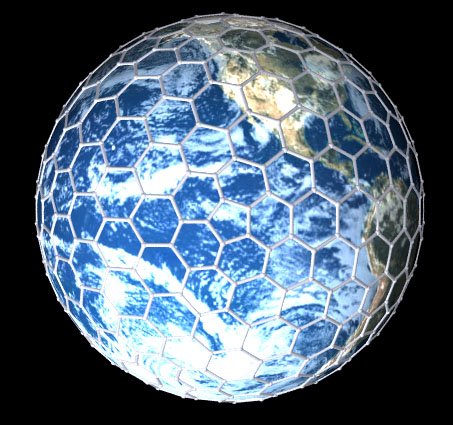
Four freedoms of the global grid: to vary frequency, orientation, altitude, to fold/unfold. The viewer has yet additional freedoms.
The latitude/longitude grid gives the illusion of regular quadrilaterals (squares) nearest the equator, and furthest from the two poles where longitudinal gore tips meet.
The global matrix, backward-compatible with lat/long, gives the illusion of regular hexagons in regions furthest from the 12 pentagons. Irregularities are more evenly distributed.
Both grids fold/unfold, using various algorithms e.g. Fuller's and Snyder's.
Related links:
Fuller's Geoscope Project (global data displays)
Glenn Stockton's Global Matrix Project (Math Forum citation)
Monday, July 03, 2006
Ghost Trains
One of the ways USAers like to advertise their dysfunctionality on the world stage is by making their passenger trains run late. Of course serious business commuters couldn't afford that, so the Northeast Corridor tries to keep up some semblance of a schedule.
But when the distances get long, and the ridership less skyscrapey (less penguin-suited), Amtrak takes a back seat, has no right of way on privately owned tracks. Some get elected to Congress purely on their promise to keep the passenger trains 2nd class, always begging just to stay on the tracks, let alone on time.
Canadians find this frustrating at times. The northbound Amtrak, from Portland to the border, was disgorging passengers without proper ticketing the other day, the computer system having died again. Clerks were hand-writing postits or something, expecting Canadian authorities to just swallow the costs of not dealing with a trully functional railway system.
Plus that Amtrak train is just skeletal anyway. One conductor has to run the whole show, including serving snacks behind the counter, with a line out the door and down to the next car. There's just no budget for staff anymore, even though talented young people would like nothing better than to punch tickets and tell stories, on some dream train through the North American outback.
The Coast Starlight is still good. Wine and cheese, parlor car. A tourist magnet. Always late though.
I don't blame Amtrak. It's more a national schizophrenia at work. Letting civilians have a decent rail system would be like "socialism" whereas the old agreement with Congress is to let wealthy industrialists set the living standards where they need 'em, low enough to keep workers scrambling, even for the most miserable jobs (use "citizenship" as leverage, by turning the legal against the illegal).
"A really healthy civilian vista would mean a disasterous drain on the Pentagon, in terms of manpower," or so the dying computer model seemed to imply, "so use Katrina as leverage, to drive more wage slaves into bondage."
In actual fact, the Pentagon would have no problem filling vacancies in a bona fide, lean and mean, "Be All You Can Be" army -- if the mission were something other than naked aggression on behalf of a few privileged private industrialists.
It's the dying computer model we don't need. Arlington's Pentagon still anchors a global matrix (as one of twelve, per hexapent shop talk). I think its original architects were probably forward thinking enough to have ensured our USA's survival, even if the erstwhile piggy-backing LAWCAP went down with all hands.
But when the distances get long, and the ridership less skyscrapey (less penguin-suited), Amtrak takes a back seat, has no right of way on privately owned tracks. Some get elected to Congress purely on their promise to keep the passenger trains 2nd class, always begging just to stay on the tracks, let alone on time.
Canadians find this frustrating at times. The northbound Amtrak, from Portland to the border, was disgorging passengers without proper ticketing the other day, the computer system having died again. Clerks were hand-writing postits or something, expecting Canadian authorities to just swallow the costs of not dealing with a trully functional railway system.
Plus that Amtrak train is just skeletal anyway. One conductor has to run the whole show, including serving snacks behind the counter, with a line out the door and down to the next car. There's just no budget for staff anymore, even though talented young people would like nothing better than to punch tickets and tell stories, on some dream train through the North American outback.
The Coast Starlight is still good. Wine and cheese, parlor car. A tourist magnet. Always late though.
I don't blame Amtrak. It's more a national schizophrenia at work. Letting civilians have a decent rail system would be like "socialism" whereas the old agreement with Congress is to let wealthy industrialists set the living standards where they need 'em, low enough to keep workers scrambling, even for the most miserable jobs (use "citizenship" as leverage, by turning the legal against the illegal).
"A really healthy civilian vista would mean a disasterous drain on the Pentagon, in terms of manpower," or so the dying computer model seemed to imply, "so use Katrina as leverage, to drive more wage slaves into bondage."
In actual fact, the Pentagon would have no problem filling vacancies in a bona fide, lean and mean, "Be All You Can Be" army -- if the mission were something other than naked aggression on behalf of a few privileged private industrialists.
It's the dying computer model we don't need. Arlington's Pentagon still anchors a global matrix (as one of twelve, per hexapent shop talk). I think its original architects were probably forward thinking enough to have ensured our USA's survival, even if the erstwhile piggy-backing LAWCAP went down with all hands.
Sunday, July 02, 2006
Thursday, June 29, 2006
Summer Camp
 from Mareva's and Brad's FED gallery @ BFI
Related reading:
[1] Recruiting
[2] Dignity Village
[3] Brainstorming on BuckyWorks
[4] Summer Camps
[5] Location Scouting
[6] 1995 Centennial in San Diego
[7] Fly's Eye Dome Raising
[8] Geodesic Treehouse Flash site
Wednesday, June 28, 2006
Spaceship Earth 911
Again, a control room needn't be a panic room, and although the medical situation for many is dire, we needn't wallow in hopelessness. Taking command and control remains a live option, even if it's too late to save everyone now entented or wandering roadside, stomach empty, support nonexistent -- around Darfur for example.
So the reality TV backdrop we've got already (so no need to mock it up): a scene of misery and devestation in many parts of the globe, with complementary skillsets and resource inventories likewise scattered about. The plot, in broad outline, is: improving our ability to coordinate as a species, to feed ourselves and develop a healthy body, the body of humanity.
If that sounds like a Christian mission, that's probably not accidental. We wish to heal from sin, where sin is our error-prone nature, our need for divine guidance per whatever governing gyroscopic theology, mythology or science fiction (we have many namespaces besides the Christian ones, also doing good work (we all learn from one another, i.e. our diversity works to our advantage over the long haul)).
In the old days, the Charity Channel was mostly on backwater cable, not considered ready for prime time, because the storyline was more about "fighting for a lost cause" than about "winning the war". Viewers got demoralized when all they saw were needy people to the horizon, with a couple overworked doctors in the foreground.
Where are the logo-identified medevac helicopters and the lunar base like desert domes, complete with Red Cross rehydration clinics and HVAC utility pods?
If we had some props of that caliber, we might start getting some real advertising revenue (a bootstrapping process -- self- amplifying), and a growing cast of star performers, sometimes those same overworked doctors (like that guy Jack in Lost), but now faced with a different set of challenges. Or like Lara Logan, chief foreign correspondent for CBS News, and a recent visitor to Darfur.
And like in Lost, we'd take time out to do flash backs, except now we're filling in with real bio, like we do with soldiers sometimes, if their story is known.
Our military got a foretaste of such action in the last South Asian tsunami, and found many ways to stay relevant, including with ships and helicopters. Effectively safeguarding our desert domes from wandering marauders may require some serious ATV training in Oregon. Other sites may require perimeter checking by biodiesel motorcycle or snowmobile.
So the reality TV backdrop we've got already (so no need to mock it up): a scene of misery and devestation in many parts of the globe, with complementary skillsets and resource inventories likewise scattered about. The plot, in broad outline, is: improving our ability to coordinate as a species, to feed ourselves and develop a healthy body, the body of humanity.
If that sounds like a Christian mission, that's probably not accidental. We wish to heal from sin, where sin is our error-prone nature, our need for divine guidance per whatever governing gyroscopic theology, mythology or science fiction (we have many namespaces besides the Christian ones, also doing good work (we all learn from one another, i.e. our diversity works to our advantage over the long haul)).
In the old days, the Charity Channel was mostly on backwater cable, not considered ready for prime time, because the storyline was more about "fighting for a lost cause" than about "winning the war". Viewers got demoralized when all they saw were needy people to the horizon, with a couple overworked doctors in the foreground.
Where are the logo-identified medevac helicopters and the lunar base like desert domes, complete with Red Cross rehydration clinics and HVAC utility pods?
If we had some props of that caliber, we might start getting some real advertising revenue (a bootstrapping process -- self- amplifying), and a growing cast of star performers, sometimes those same overworked doctors (like that guy Jack in Lost), but now faced with a different set of challenges. Or like Lara Logan, chief foreign correspondent for CBS News, and a recent visitor to Darfur.
And like in Lost, we'd take time out to do flash backs, except now we're filling in with real bio, like we do with soldiers sometimes, if their story is known.
Our military got a foretaste of such action in the last South Asian tsunami, and found many ways to stay relevant, including with ships and helicopters. Effectively safeguarding our desert domes from wandering marauders may require some serious ATV training in Oregon. Other sites may require perimeter checking by biodiesel motorcycle or snowmobile.
Tuesday, June 27, 2006
Gnu Math on Synergeo
So if you don't know about GNU: GNU is Not Unix was created by hackers who wanted free access to their tools, even as pesky administrators were moving in to own and control.
GNU went for The Hurd, using new theories about kernel design, but Linux, a classic monolithic, beat The Hurd to the punch, for a time almost eclipsing GNU in the free and open source namespace.
GNU is a source of basic programmer tools necessary for kernel and userland development: text editors, parsers, compilers -- a complete workbench. You've probably heard of emacs, extensible in LISP.
What GNU features, above all, is a command line, per Neal Stephenson's classic In the Beginning Was.... So Gnu Math means learning math at a command line, or in a shell (perhaps a more feminine way of saying it).
In the Python shell (Python, like Ruby, being a potential gnu math language), we explore ideas such as Rational Numbers, Numbers Modulo N, Polynomials, Vectors, Polygons, and Polyvertexia (polyhedra). It's a more discrete treatment, given the constraints of IEEE floating point and definitely sized registers. And that's just fine for doing synergetics, which uses discrete math anyway.
You'll have noticed "Polyvertexia" -- from Bucky in Cosmography -- and my Python module rbf.py (optionally quadray based) is indeed the classic concentric hierarchy ala the two Synergetics volumes, products of the 1970s Renaissance.
The war in Southeast Asia was over, people thought a positive future was just around the corner. Then came the backlash: generations of anti-hippie took over, or seemed ostensibly to be so, and it became verbotten to really think Positive Future anymore (utopia), vs. some unending War on Terror (oblivion), which brings us up to date.
Out of this 1970s scenario also came the object oriented paradigm (OOP), in the form of SmallTalk, which Ward Cunningham, inventor of the Wiki, helped promulgate. Ward later infiltrated the Python community (he was more than welcome), as he, like Alan Kay, understood SmallTalk to be a dead language (perhaps resurrected in Ruby, also the spawn of Perl).
Ward joined PORPIG in recent years (Portland's Python Interest Group), which is how I came to have beers with the guy (I've had some beers with Alan too).
OO usually means using dot notation, a syntax where the object comes first (the thing), followed by action verbs with arguments (what Python calls "callables"), or by the names of attributes.
In SmallTalk, these were both varieties of message, and actually all attributes were private, accessible to outer globals only through setters and getters (as the Java people say). Please correct me if I'm wrong about these details.
So in gnu math (math in the shell, and also a pun on "new math" or SMSG), we import from namespaces, such as RBF's synergetic one, and start playing with its objects, which, in the case of rbf.py, would be Tetrahedron, Octahedron, RhDodecahedron, Cuboctahedron, Icosahedron and RhTriacontahedron. What did I forget? Oh yeah, Cube. They're all inter-sized the proper way, and when you rescale any instance, their area and volume attributes change accordingly (as 2nd & 3rd powerings of the linear scale factor).
The class definitions themselves are prefrequency, in the sense of non-instanced. They're like blueprints for a house. Any real instance (real house) needs to be constructed, meaning the nitty gritty details relating to persistence in time-size need to be defined (work often neglected by those working only with abstractions).
Python uses __init__ for this work, and in rbf.py, the above objects by default appear according to our Fuller School tables, such that volumes = {"Tetrahedron":1, "Cube":3, "Octahedron":4} and so on (that's an expandable dictionary).
In order to read the source code for rbf.py, gnubees must already understand a little about vectors, which I've developed as coords.py -- but there's no reason to just use my particular modules for such things. I'm just showcasing the general idea of gnu math and CP4E (computer programming for everybody).
Your job would be to pick a preferred langauge and do your own explorations in this geometry of thinking. Here on Synergeo, and Synergetics-L before it, that's a longstanding tradition (to pick an executable language and go with it), and lots of collaborations have happened as a result notably around the Watermans (Steve Waterman) and Elastic Interval Geometry (Gerald de Jong, Karl Erickson, Alan Ferguson, Kenneth Snelson (off list) and Russell Chu).
"Understanding about vectors" in a gnu math context of course includes writing code for them, probably in an OO language like Python. Mathematics is advertised as "an extensible type system" meaning we use the tools we already have to make new, improved ones, using the principle of synergetic advantage.
On the ground, making inroads with these ideas has been an uphill battle. People tend to hold their hands to their ears and holler "I can't hear you!" if you start up with any brand of Positive Futurism. They're all vested and geared to fight some War on Terror forever, and didn't plan to retool any time soon. The design science revolution was never on their agenda, and their presumption was the hippies were losers.
But times change, and hippies become hackers, and gnu math now percolates out and around cyberspace, through the various philosophical coffee shops and student union screening rooms. More people come to learn about the options now facing humanity. "Utopia or oblivion?" Bucky asked.
The twilight zone world power authorities seem hellbent on oblivion a lot of the time, but I think our design science brands are going to rock some boats for the better for a change. More kids will be "getting it" about our ability to succeed within a longer time horizon than the apocalyptics dare dream about.
GNU went for The Hurd, using new theories about kernel design, but Linux, a classic monolithic, beat The Hurd to the punch, for a time almost eclipsing GNU in the free and open source namespace.
GNU is a source of basic programmer tools necessary for kernel and userland development: text editors, parsers, compilers -- a complete workbench. You've probably heard of emacs, extensible in LISP.
What GNU features, above all, is a command line, per Neal Stephenson's classic In the Beginning Was.... So Gnu Math means learning math at a command line, or in a shell (perhaps a more feminine way of saying it).
In the Python shell (Python, like Ruby, being a potential gnu math language), we explore ideas such as Rational Numbers, Numbers Modulo N, Polynomials, Vectors, Polygons, and Polyvertexia (polyhedra). It's a more discrete treatment, given the constraints of IEEE floating point and definitely sized registers. And that's just fine for doing synergetics, which uses discrete math anyway.
You'll have noticed "Polyvertexia" -- from Bucky in Cosmography -- and my Python module rbf.py (optionally quadray based) is indeed the classic concentric hierarchy ala the two Synergetics volumes, products of the 1970s Renaissance.
The war in Southeast Asia was over, people thought a positive future was just around the corner. Then came the backlash: generations of anti-hippie took over, or seemed ostensibly to be so, and it became verbotten to really think Positive Future anymore (utopia), vs. some unending War on Terror (oblivion), which brings us up to date.
Out of this 1970s scenario also came the object oriented paradigm (OOP), in the form of SmallTalk, which Ward Cunningham, inventor of the Wiki, helped promulgate. Ward later infiltrated the Python community (he was more than welcome), as he, like Alan Kay, understood SmallTalk to be a dead language (perhaps resurrected in Ruby, also the spawn of Perl).
Ward joined PORPIG in recent years (Portland's Python Interest Group), which is how I came to have beers with the guy (I've had some beers with Alan too).
OO usually means using dot notation, a syntax where the object comes first (the thing), followed by action verbs with arguments (what Python calls "callables"), or by the names of attributes.
In SmallTalk, these were both varieties of message, and actually all attributes were private, accessible to outer globals only through setters and getters (as the Java people say). Please correct me if I'm wrong about these details.
So in gnu math (math in the shell, and also a pun on "new math" or SMSG), we import from namespaces, such as RBF's synergetic one, and start playing with its objects, which, in the case of rbf.py, would be Tetrahedron, Octahedron, RhDodecahedron, Cuboctahedron, Icosahedron and RhTriacontahedron. What did I forget? Oh yeah, Cube. They're all inter-sized the proper way, and when you rescale any instance, their area and volume attributes change accordingly (as 2nd & 3rd powerings of the linear scale factor).
The class definitions themselves are prefrequency, in the sense of non-instanced. They're like blueprints for a house. Any real instance (real house) needs to be constructed, meaning the nitty gritty details relating to persistence in time-size need to be defined (work often neglected by those working only with abstractions).
Python uses __init__ for this work, and in rbf.py, the above objects by default appear according to our Fuller School tables, such that volumes = {"Tetrahedron":1, "Cube":3, "Octahedron":4} and so on (that's an expandable dictionary).
In order to read the source code for rbf.py, gnubees must already understand a little about vectors, which I've developed as coords.py -- but there's no reason to just use my particular modules for such things. I'm just showcasing the general idea of gnu math and CP4E (computer programming for everybody).
Your job would be to pick a preferred langauge and do your own explorations in this geometry of thinking. Here on Synergeo, and Synergetics-L before it, that's a longstanding tradition (to pick an executable language and go with it), and lots of collaborations have happened as a result notably around the Watermans (Steve Waterman) and Elastic Interval Geometry (Gerald de Jong, Karl Erickson, Alan Ferguson, Kenneth Snelson (off list) and Russell Chu).
"Understanding about vectors" in a gnu math context of course includes writing code for them, probably in an OO language like Python. Mathematics is advertised as "an extensible type system" meaning we use the tools we already have to make new, improved ones, using the principle of synergetic advantage.
On the ground, making inroads with these ideas has been an uphill battle. People tend to hold their hands to their ears and holler "I can't hear you!" if you start up with any brand of Positive Futurism. They're all vested and geared to fight some War on Terror forever, and didn't plan to retool any time soon. The design science revolution was never on their agenda, and their presumption was the hippies were losers.
But times change, and hippies become hackers, and gnu math now percolates out and around cyberspace, through the various philosophical coffee shops and student union screening rooms. More people come to learn about the options now facing humanity. "Utopia or oblivion?" Bucky asked.
The twilight zone world power authorities seem hellbent on oblivion a lot of the time, but I think our design science brands are going to rock some boats for the better for a change. More kids will be "getting it" about our ability to succeed within a longer time horizon than the apocalyptics dare dream about.
Saturday, June 24, 2006
Summer Retreat
We have a busy day lined up. McMenamins is celebrating a birthday (free cake), plus we have other cultural events in our queue. Uncle Lightfoot is swinging by in his Aztec. Plus Wanderers is happening (Rick Grote came by, and Dick Pugh).
Although stream beds are public land in Oregon, Dick has been shot at by nervous growers of curious crops, who think public lands belong to them exclusively. Dick had to shoot back. But mostly he relies on his METEOR license plate. "Not a vanity plate" he explains, "but a message to the public about why I might be in the neighborhood" (he is looking for cosmic debris, on which he is a recognized expert).
Over on Math Forum, I did more to sketch a model for how to treat public schooling. By definition, the USA's system trains its own i.e. invests in the training of future office holders, people wishing careers in public service, both civilian and military.
That doesn't mean we ignore the needs and desires of private industry. As a matter of fact, sustainable profit margins depend upon keeping our USA strong enough to foment prosperous civilian lifestyles, both at home and abroad. Weak governments sucker for tempting illusions, such as quick fixes through war.
A future president should have a route through the publicly supported infrastructure to her future desk in the Oval Office.
I also wrote about StrangeAttractors, by Design Science Toys. This was aimed at helping math educators conduct some informed debate about the tangible artifacts we might use to support children and young adults in their quest to attain mastery over the basics. In various mock battles, educators line up for and against these toys, but the toys themselves rarely get upgraded. Each new generation gets the same sorry-assed cubes and rectangular rods to play with. Whoopeedoo.
Although stream beds are public land in Oregon, Dick has been shot at by nervous growers of curious crops, who think public lands belong to them exclusively. Dick had to shoot back. But mostly he relies on his METEOR license plate. "Not a vanity plate" he explains, "but a message to the public about why I might be in the neighborhood" (he is looking for cosmic debris, on which he is a recognized expert).
Over on Math Forum, I did more to sketch a model for how to treat public schooling. By definition, the USA's system trains its own i.e. invests in the training of future office holders, people wishing careers in public service, both civilian and military.
That doesn't mean we ignore the needs and desires of private industry. As a matter of fact, sustainable profit margins depend upon keeping our USA strong enough to foment prosperous civilian lifestyles, both at home and abroad. Weak governments sucker for tempting illusions, such as quick fixes through war.
A future president should have a route through the publicly supported infrastructure to her future desk in the Oval Office.
I also wrote about StrangeAttractors, by Design Science Toys. This was aimed at helping math educators conduct some informed debate about the tangible artifacts we might use to support children and young adults in their quest to attain mastery over the basics. In various mock battles, educators line up for and against these toys, but the toys themselves rarely get upgraded. Each new generation gets the same sorry-assed cubes and rectangular rods to play with. Whoopeedoo.
Monday, June 19, 2006
TCP/IP for Gnubees
In /etc/services on your Ubuntu box, you'll find tcp and udp both paired with standard port-numbers for protocols your kernel understands.
tcp is checked-receipt, meaning the sender is notified of every received packet.
udp doesn't want acknowledgement and is favored by gamers competing on multiuser servers, as tcp is relatively slow.
A tcp sender will helpfully stamp packets with serial numbers, in case the received order is different (and depending on routing, it may well be), plus stamp them with a TTL (time to live) so those failing to make delivery won't then become waywardly redundant and clog our arteries with a lot of negatively synergetic pseudo- information.
tcp packets are return-addressed, and so arrive with all kinds of postmarks. Part of tcp's job is to acknowledge each received packet, via small ACK packets, some of which may likewise fail to return home (no, we don't ACK the ACK packets, although initial hand-shaking is sort of that way).
The packet itself contains payload. An originating service applies a return address then passes the packet on through a next gateway (possibly a NATing router) which applies more labeling information and further forwards the payload, and so on, until the intended addressee is reached (or not, as the case may be). At this point, if at last through the gauntlet, the packet yields its payload, its mission accomplished.
DNS lets us keep the addressing alpha-friendly. For example, by pinging www.python.org I learned that today a host publicly identified as 82.94.237.218 is answering the call, while http://82.94.237.218/ meanwhile returns the home page (I find that satisfyingly consistent).
Thanks to DNS, underlying IP numbers may change, even while domain names remain constant. Furthermore, IP numbers are not ultimately tied to specific hardware (identified by MAC address, with ARP providing the ethernet-to-IP coupling). When we retire a host, we needn't retire its IP number.
Some subnets are by definition local, meaning they have no unique meaning on the Internet. 192.168.x.x is one such intranet domain (.x.x marks the subnet). Per RCF 1918:
Some port number like 1776, for example, might actually refer to port 80 on some box in some local "just us chickens" 192.168 village neighborhood. Such a box might serve HTTP requests without itself having a presence as a numbered host on the Internet (which is good, because we don't need to know about every Tom, Dick or Harry serving web pages, at least not in any way DNS cares about).
Historically speaking, this ability to use port numbers as a part of a return address helped us grow the Internet to a size perhaps unanticipated by some of the original designers of IPv4. They imagined us running far lower on public IP numbers by this time, towards the start of the IPv6 phase-in.
Thanks to NATing routers, we've allowed large numbers of computers to remain blissfully anonymous, out of the global IP namespace, thereby freeing more of a limited resource to focus on what's trully "inter" network traffic, more so than the local "intra" stuff of small businesses and home networks.
Yes, some companies take disproportianately selfish advantage of this public resource, with their data-intensive private intranet VPNs, hogging bandwidth. The more responsible companies pay their own way, and then some, which helps our shared global infrastructure keep pace with increasing user demands.
Recommended reading:
Practical TCP/IP by Niall Mansfield, Addison-Wesley, 2003 ISBN 0-201-75078-3 (e.g. see section 23.4 regarding port translation and one-to-one NATing).
jennifer@edubuntu:~$ sed -n 27,35pThe more application-specific protocols, such as ftp (file transfer : 21), nntp (usenet : 119), smtp (email : 25) and www (web : 80), depend on these tcp and udp protocols to get the job done.
> < /etc/services
> | awk '{print $1 " : " $2}'
ftp-data : 20/tcp
ftp : 21/tcp
fsp : 21/udp
ssh : 22/tcp
ssh : 22/udp
telnet : 23/tcp
smtp : 25/tcp
time : 37/tcp
time : 37/udp
tcp is checked-receipt, meaning the sender is notified of every received packet.
udp doesn't want acknowledgement and is favored by gamers competing on multiuser servers, as tcp is relatively slow.
A tcp sender will helpfully stamp packets with serial numbers, in case the received order is different (and depending on routing, it may well be), plus stamp them with a TTL (time to live) so those failing to make delivery won't then become waywardly redundant and clog our arteries with a lot of negatively synergetic pseudo- information.
tcp packets are return-addressed, and so arrive with all kinds of postmarks. Part of tcp's job is to acknowledge each received packet, via small ACK packets, some of which may likewise fail to return home (no, we don't ACK the ACK packets, although initial hand-shaking is sort of that way).
The packet itself contains payload. An originating service applies a return address then passes the packet on through a next gateway (possibly a NATing router) which applies more labeling information and further forwards the payload, and so on, until the intended addressee is reached (or not, as the case may be). At this point, if at last through the gauntlet, the packet yields its payload, its mission accomplished.
DNS lets us keep the addressing alpha-friendly. For example, by pinging www.python.org I learned that today a host publicly identified as 82.94.237.218 is answering the call, while http://82.94.237.218/ meanwhile returns the home page (I find that satisfyingly consistent).
Thanks to DNS, underlying IP numbers may change, even while domain names remain constant. Furthermore, IP numbers are not ultimately tied to specific hardware (identified by MAC address, with ARP providing the ethernet-to-IP coupling). When we retire a host, we needn't retire its IP number.
Some subnets are by definition local, meaning they have no unique meaning on the Internet. 192.168.x.x is one such intranet domain (.x.x marks the subnet). Per RCF 1918:
The return address info, needed for acknowledging receipt, traces a sequence of public IP numbers down to some internal gateway, at which point port numbers may become more relevant, as a NATing router knows how to sort those ports to local IP number mail boxes.The Internet Assigned Numbers Authority (IANA) has
reserved the following three blocks of the IP address
space for private internets:
10.0.0.0 - 10.255.255.255 (10/8 prefix)
172.16.0.0 - 172.31.255.255 (172.16/12 prefix)
192.168.0.0 - 192.168.255.255 (192.168/16 prefix)
Some port number like 1776, for example, might actually refer to port 80 on some box in some local "just us chickens" 192.168 village neighborhood. Such a box might serve HTTP requests without itself having a presence as a numbered host on the Internet (which is good, because we don't need to know about every Tom, Dick or Harry serving web pages, at least not in any way DNS cares about).
Historically speaking, this ability to use port numbers as a part of a return address helped us grow the Internet to a size perhaps unanticipated by some of the original designers of IPv4. They imagined us running far lower on public IP numbers by this time, towards the start of the IPv6 phase-in.
Thanks to NATing routers, we've allowed large numbers of computers to remain blissfully anonymous, out of the global IP namespace, thereby freeing more of a limited resource to focus on what's trully "inter" network traffic, more so than the local "intra" stuff of small businesses and home networks.
Yes, some companies take disproportianately selfish advantage of this public resource, with their data-intensive private intranet VPNs, hogging bandwidth. The more responsible companies pay their own way, and then some, which helps our shared global infrastructure keep pace with increasing user demands.
Recommended reading:
Practical TCP/IP by Niall Mansfield, Addison-Wesley, 2003 ISBN 0-201-75078-3 (e.g. see section 23.4 regarding port translation and one-to-one NATing).
Sunday, June 18, 2006
Synergetics NC17
Synergetics does have a naked girl in it, although she goes by very briefly. That's a potential connect point for "gnuroticized mathematics" which might just mean beautiful people musing about polyhedra, beholding them or whatever -- use your imagination.
I bring this up partly because people enjoy groping around in Bucky's personal life, looking for evidence of scandal. According to Prohibition Era aesthetics, any woman having sex out of wed lock (why do you think they called it that?) is no doubt somehow benefitting financially, and so must be a prostitute by definition.
Plus people liked to be nosey (celebrities bought fame in a fish bowl), and often drew wrong conclusions based on the psychological need to project stuff (and anyway why should facts interfere with a rich fantasy life, hey?).
The free loving 60s were in rebellion against that: women should have all the freedoms men had, to avoid getting branded as whores or whatever, just because they had as much fun in bed. It seemed to work for awhile, but then attracted a lot of backlash from many corners. Karma isn't all about sex, anyway, Freudian dogmas notwithstanding.
Bucky lived through several changes in scenery in other words. Ethics around sex keep changing, plus as an early jet setter, he was coming up against alternative codes in other-worldly places. Spaceship Earth is somewhat kinky, I think you'd admit. A kind of love boat on steroids, some might call it.
The best strategy is to be a responsible adult, as wrong moves will likely come back to haunt you (or, if you're 007, get your girlfriend in trouble with bad guys). And on the other hand: your reputation is yours to risk. You, like Bucky, have that same twelve degrees of freedom.
I bring this up partly because people enjoy groping around in Bucky's personal life, looking for evidence of scandal. According to Prohibition Era aesthetics, any woman having sex out of wed lock (why do you think they called it that?) is no doubt somehow benefitting financially, and so must be a prostitute by definition.
Plus people liked to be nosey (celebrities bought fame in a fish bowl), and often drew wrong conclusions based on the psychological need to project stuff (and anyway why should facts interfere with a rich fantasy life, hey?).
The free loving 60s were in rebellion against that: women should have all the freedoms men had, to avoid getting branded as whores or whatever, just because they had as much fun in bed. It seemed to work for awhile, but then attracted a lot of backlash from many corners. Karma isn't all about sex, anyway, Freudian dogmas notwithstanding.
Bucky lived through several changes in scenery in other words. Ethics around sex keep changing, plus as an early jet setter, he was coming up against alternative codes in other-worldly places. Spaceship Earth is somewhat kinky, I think you'd admit. A kind of love boat on steroids, some might call it.
The best strategy is to be a responsible adult, as wrong moves will likely come back to haunt you (or, if you're 007, get your girlfriend in trouble with bad guys). And on the other hand: your reputation is yours to risk. You, like Bucky, have that same twelve degrees of freedom.
Thursday, June 15, 2006
Gobbledygook?
Very few readers would bother to wander at length through the pages of Synergetics, a hard book to read, unless paid to do so.
That's why I've always figured philosophy professors might be among those to pick up the ball and run with it, if anyone. Doctors of philosophy are paid to read the hard stuff (Hegel, Kaufmann, Rorty, Quine, Popper...) and then discuss it knowledgeably.
However, given how specialized academic philosophers have become, what're the chances they'd ever have the patience for such as the following? Slim to none?
The subtitle of the work is "explorations in the geometry of thinking" (so psychology then?), and section 251.50 provides some official hype: "[t]he integration of geometry and philosophy in a single conceptual system providing a common language and accounting for both the physical and metaphysical."
Sounds like a philosophy to me.
Those who'd worked closely with Bucky over the years knew that he'd been effective, in both hot and cold wars. The guy had a track record, which included working closely with the military. By the late 1970s, he was pointing to Synergetics as a place where he'd distilled a lot of his best thinking.
So a small clique within the intelligence community, anchored by E. J. Applewhite, continued exploring his writings for clues and views, as well as promising policy directions. Ed had been Fuller's chief collaborator on the two volumes, as chronicled in his whimsical Cosmic Fishing. He was an effective recruiter.
This Applewhite-managed "A team" operated outside the established academy for the most part, as a sort of elite counter-culture. Ed enjoyed dropping in on working scientists especially. He had business cards printed up giving "Layman" as his profession. He also helped with the relocation of the Fuller Archive from BFI to Stanford, and with the founding of SNEC, later renamed to The Synergetics Collaborative.
When I eventually joined this clique, having majored in philosophy at Princeton, I didn't cross paths with Applewhite right away, even though I was living in Georgetown in 1984, in a spare room provided by Brenda Brush (then an EEOC employee) and filled with spy novels. I even wondered at first if Ed really existed, until I ran across some article in The Futurist magazine, to which my dad had subscribed.
In one of our first meetings, Ed gifted me with his recently published Synergetics Dictionary, to help me interpret Fuller's unusual language (his vocabulary was deliberately remote -- gobbledygook some called it). That was the time my friend Matt and I were driving my sister's car from Montclair, New Jersey (she'd been in the Philosophy for Children program), to her new digs in Whittier, California. We drove the four volumes cross country.
Later, Ed and his wife June flew out to Portland to hang out for a couple of days (they stayed at the Arlington Club), which visit included a quick visit to Matt's office (he was still in the Portland Building back then). Ed was really into architecture and marveled at Portland's eclectic skyline.
Some years later, in a high-level multi-hour meeting with Jay Baldwin in San Jose at Rick Sonnenfeld's (my roommate in college, then with IBM @ Almaden), I talked about the chasm-spanning bridge I was building between Fuller's writings and Wittgenstein's later philosophy. I had a video camera that day, and got some clips of Jay talking about Tefzel, a barrel of which Rick just happened to have (good prop!).
Synergetics is a case study in how words derive their spin from usage patterns, language games, more or less deliberately engineered. As a self-discipline and as a grammar (i.e. as a wittgenstein.grammar), synergetics suggests a form of life, a lifestyle, a sense of ethics and aesthetics. There's a moral dimension to Fuller's writings, even if Critical Path claims to be beyond good and evil.
Outtake:
We think we know what "gravity" means, but meanings really depend on the namespace don't they? Using dot notation, we could say that synergetics.gravity is not the same as physics.gravity, even if they partially overlap through Newton.
A philosopher might counter: so why not use "shmavity" then, if your "gravity" isn't the same as mine? But conceding every good word to an alien system isn't necessarily the most promising strategy for making headway in philosophy. Bucky had a greater will to power than that (250.30), as do strong writers more generally.
That's why I've always figured philosophy professors might be among those to pick up the ball and run with it, if anyone. Doctors of philosophy are paid to read the hard stuff (Hegel, Kaufmann, Rorty, Quine, Popper...) and then discuss it knowledgeably.
However, given how specialized academic philosophers have become, what're the chances they'd ever have the patience for such as the following? Slim to none?
326.08 So long as humans progressively employ and develop their syntropic, energetic, metaphysical mind's capability to locally abet cosmic integrity, just so long will that metaphysical capability continue to operate in this particular local Universe's ecologically regenerative, planetary team aboard spaceship Earth. If, however, the entropic, energetically exploiting, antisynergetic, exclusively partisan profit motive -- political or financial -- continues to dominate and rule humans by force of arms, then the Earthian ecology team will become self-disqualifying for further continuance as a potentially effective local sustainer of cosmic-regeneration integrity. This is the net of what has now become metaphysically evidenced regarding the potential significance of humans aboard planet Earth. It is the nature of the contest between brain and mind. Brain is selfishly exclusive; mind is cosmically inclusive. Brain now commands the physical power to overwhelm humanity. But it is also the nature of mind’s design science capability to render all humanity physically successful, thus eliminating human preoccupation with the struggle and thereby freeing all humanity to become metaphysically preoccupied with fulfilling its cosmic-regeneration functioning.So is this really not philosophy then?
The subtitle of the work is "explorations in the geometry of thinking" (so psychology then?), and section 251.50 provides some official hype: "[t]he integration of geometry and philosophy in a single conceptual system providing a common language and accounting for both the physical and metaphysical."
Sounds like a philosophy to me.
Those who'd worked closely with Bucky over the years knew that he'd been effective, in both hot and cold wars. The guy had a track record, which included working closely with the military. By the late 1970s, he was pointing to Synergetics as a place where he'd distilled a lot of his best thinking.
So a small clique within the intelligence community, anchored by E. J. Applewhite, continued exploring his writings for clues and views, as well as promising policy directions. Ed had been Fuller's chief collaborator on the two volumes, as chronicled in his whimsical Cosmic Fishing. He was an effective recruiter.
This Applewhite-managed "A team" operated outside the established academy for the most part, as a sort of elite counter-culture. Ed enjoyed dropping in on working scientists especially. He had business cards printed up giving "Layman" as his profession. He also helped with the relocation of the Fuller Archive from BFI to Stanford, and with the founding of SNEC, later renamed to The Synergetics Collaborative.
When I eventually joined this clique, having majored in philosophy at Princeton, I didn't cross paths with Applewhite right away, even though I was living in Georgetown in 1984, in a spare room provided by Brenda Brush (then an EEOC employee) and filled with spy novels. I even wondered at first if Ed really existed, until I ran across some article in The Futurist magazine, to which my dad had subscribed.
In one of our first meetings, Ed gifted me with his recently published Synergetics Dictionary, to help me interpret Fuller's unusual language (his vocabulary was deliberately remote -- gobbledygook some called it). That was the time my friend Matt and I were driving my sister's car from Montclair, New Jersey (she'd been in the Philosophy for Children program), to her new digs in Whittier, California. We drove the four volumes cross country.
Later, Ed and his wife June flew out to Portland to hang out for a couple of days (they stayed at the Arlington Club), which visit included a quick visit to Matt's office (he was still in the Portland Building back then). Ed was really into architecture and marveled at Portland's eclectic skyline.
Some years later, in a high-level multi-hour meeting with Jay Baldwin in San Jose at Rick Sonnenfeld's (my roommate in college, then with IBM @ Almaden), I talked about the chasm-spanning bridge I was building between Fuller's writings and Wittgenstein's later philosophy. I had a video camera that day, and got some clips of Jay talking about Tefzel, a barrel of which Rick just happened to have (good prop!).
Synergetics is a case study in how words derive their spin from usage patterns, language games, more or less deliberately engineered. As a self-discipline and as a grammar (i.e. as a wittgenstein.grammar), synergetics suggests a form of life, a lifestyle, a sense of ethics and aesthetics. There's a moral dimension to Fuller's writings, even if Critical Path claims to be beyond good and evil.
Outtake:
We think we know what "gravity" means, but meanings really depend on the namespace don't they? Using dot notation, we could say that synergetics.gravity is not the same as physics.gravity, even if they partially overlap through Newton.
A philosopher might counter: so why not use "shmavity" then, if your "gravity" isn't the same as mine? But conceding every good word to an alien system isn't necessarily the most promising strategy for making headway in philosophy. Bucky had a greater will to power than that (250.30), as do strong writers more generally.
Wednesday, June 14, 2006
Bomb Guantanamo?

The Pentagon is always hatching potential military operations, like some egg farm in Aliens, and as a Quaker, I'm mostly repulsed by the ugly stupidity of it all.
However, given the president's fond hope that Guantanamo be shut down, and given the enormous resistence he's encountering in the form of foot dragging ("but... but..."), I think this plan to just level the place has some appeal.
We'd get the POWs out of course, and the personnel (if some captain wants to "go down with the ship" I suppose that could be arranged).
The POWs deserve some R & R, no matter how dangerous someone thinks they may be. Any humane code of ethics, even a penal one, would demand it.
Saudis own a lot of off shore islands in North Carolina or someplace. The Brits have property. Why not something cushy for a change, complete with flat screen TV?
They could watch our USAF coordinating with the Cuban Air Force, sending Guantanamo to a richly deserved oblivion.
The only real problem with this plan: Cuba may want to keep Gauntanamo intact for tourism.
It'll be like one of those concentration camp sites in Germany, but better preseved, perhaps with some Disneyesque audio- animatronics, showing how prisoners were abused for some number of years. Like, of course they're dangerous, even if they weren't to begin with.
USAers won't be forbidden to visit Cuba by then (having thrown off their would-be tyrant masters), so there'll be lots of traffic. And we'll finally have the freedom to tell it like it was. The POWs will get their say as well, for the archives and for the viewers in the Visitors Center.
I'm thinking as a compromise we should go ahead and give the green light to the Pentagon's hawks, and bomb at least a little. Then let's preserve the balance for history and forensics, until people get tired of remembering the hell on earth some tried to establish, and our victory over their kind.
Tuesday, June 13, 2006
Waiting Rooms
The waiting room is another common motif in our pattern language, ostensibly not as exciting as a control room, but potentially just as suspenseful.
Waiting for test results. Waiting to see the vet.
Sarah-the-dog and I did the vet thing yesterday, thanks to Tom Head. She needed three routine shots and a blood draw, to keep her legal and healthy.
The vet felt some bulldog amidst her lineages, along with the pit, plus Sarah's mostly a lucky lab, her full name being Sarah Angel (she has little wing-shaped patches of lighter hair on each shoulder).
Later, I waited with my wife in a cushy chair next to hers, gobbling tootsie rolls by the fist full, mentally pacing. The test results were encouraging this time.
Still later, before our meal at Chang's Mongolian Grill (near Halsey and 122nd), I waited in an immediate care facility with Tara to diagnose the hot tub rash she'd acquired at the beach (it'll go away soon).
She listened to her iPod while I read an old Forbes (oral history of Netscape) and a more current Utne Reader (some scientists thought Tenzin Gyatso shouldn't get the floor at their upcoming neuropsychology meeting).
Today, I'm hoping to stay away from waiting rooms, although "expectant waiting" is actually a built in feature of Quaker faith and practice. So waiting I will be, whether in a special room for it, or just stopped at a red light.
Waiting for test results. Waiting to see the vet.
Sarah-the-dog and I did the vet thing yesterday, thanks to Tom Head. She needed three routine shots and a blood draw, to keep her legal and healthy.
The vet felt some bulldog amidst her lineages, along with the pit, plus Sarah's mostly a lucky lab, her full name being Sarah Angel (she has little wing-shaped patches of lighter hair on each shoulder).
Later, I waited with my wife in a cushy chair next to hers, gobbling tootsie rolls by the fist full, mentally pacing. The test results were encouraging this time.
Still later, before our meal at Chang's Mongolian Grill (near Halsey and 122nd), I waited in an immediate care facility with Tara to diagnose the hot tub rash she'd acquired at the beach (it'll go away soon).
She listened to her iPod while I read an old Forbes (oral history of Netscape) and a more current Utne Reader (some scientists thought Tenzin Gyatso shouldn't get the floor at their upcoming neuropsychology meeting).
Today, I'm hoping to stay away from waiting rooms, although "expectant waiting" is actually a built in feature of Quaker faith and practice. So waiting I will be, whether in a special room for it, or just stopped at a red light.
Saturday, June 10, 2006
R & R
 photo by me
I'm "camping out" at the beach, complete with hot tub, large kitchen, and wireless (hardly "roughing it").
The Oregon Coast is one of the best in the business (if being a coastline may be considered a business -- it's a big one if so).
Although technically "on vacation" from my Gnu Math projects, I couldn't resist expounding upon the importance of error handling this afternoon. Earlier, it was more about funding.
Our party: Gayle (friend), Kirby (self), Dawn (wife), Carol (mom), Tara (daughter), Brenna (Tara's friend).
Gayle is a geneology buff and, given wireless, was able to research dendritic off-shoots into the past, of our respective ancestral trees.
She traced Dawn's paternal line back four generations to Ireland, through census documents mostly. These records contradicted her dad's claim to some elite Aryan heritage, but then her dad "was a pathological liar" (or perhaps he was referring to a different dendrite).
Mom's paternal line was harder to trace, but Gayle did manage to pull up Thomas Dewey Reilley's (mom's dad's) draft registration from a database in Montana. He was born in 1898 and grew up to become a linotype operator.
Mom was born in 1929 in Chico, California. Her mom's side goes back to Goldens in New Jersey, buried in proximity to Urners it turns out (my dad's paternal line, which traces to Switzerland).
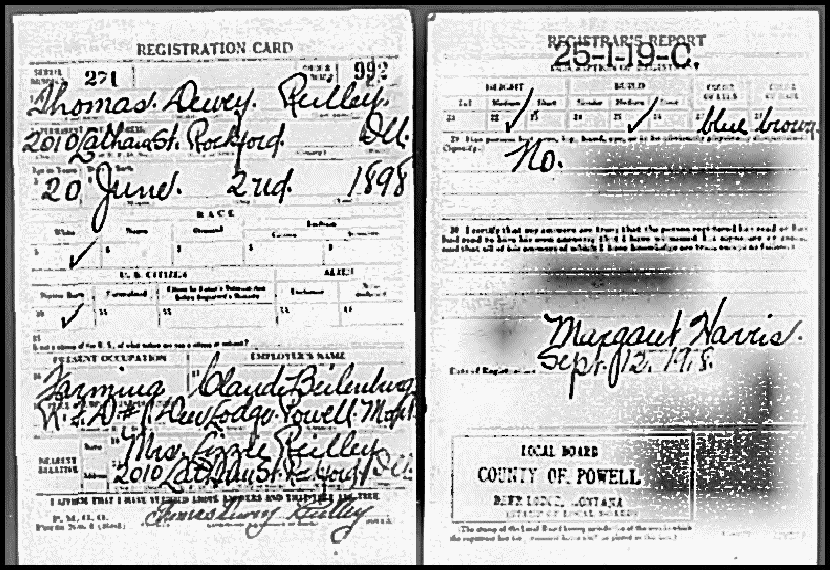 grampa Tom's draft registration, 1918
Monday, June 05, 2006
Coffee with Trevor
We haunted Division yesterday. I told the barista "fully leaded" iced coffee, while she kept asking if I wanted it decafe. I later made small talk about the surrounding artwork (very science fiction, with allusions to trigonometry).
Trevor pointed out later that this girl behind the counter was deaf. He signs for a living, currently for Portland Public. Another point of interest: "deaf" and "decaf" are alot alike and in local dialect (and perhaps elsewhere), the sign for deaf may mean "decafe please" in a coffee shop namespace, with the sign for "hearing" therefore meaning fully leaded (one can't deny the logic of it).
Trevor had a stash of new office supplies, including plastic protectors for his growing Fuller archive: reprints from big name magazines, starting with Fortune back in '46 or so, when his dreams for futuristic housing, post WWII, seemed quite believable to returning GIs. Then came WWIII (the Cold War) and more postponement of the Peace Dividend (WWIV was then enqueued).
I gushed over his collection, saying words like "syllabus" and "university" -- the usual rant. I'm like this guy in a comic book: always the same talk balloons.
Then we wandered over to Powell's on Hawthorne, where comic books were indeed my focus. My daughter has a birthday coming up. I'm so far behind in my reading. What would would Manga Synergetics look like?
Trevor pointed out later that this girl behind the counter was deaf. He signs for a living, currently for Portland Public. Another point of interest: "deaf" and "decaf" are alot alike and in local dialect (and perhaps elsewhere), the sign for deaf may mean "decafe please" in a coffee shop namespace, with the sign for "hearing" therefore meaning fully leaded (one can't deny the logic of it).
Trevor had a stash of new office supplies, including plastic protectors for his growing Fuller archive: reprints from big name magazines, starting with Fortune back in '46 or so, when his dreams for futuristic housing, post WWII, seemed quite believable to returning GIs. Then came WWIII (the Cold War) and more postponement of the Peace Dividend (WWIV was then enqueued).
I gushed over his collection, saying words like "syllabus" and "university" -- the usual rant. I'm like this guy in a comic book: always the same talk balloons.
Then we wandered over to Powell's on Hawthorne, where comic books were indeed my focus. My daughter has a birthday coming up. I'm so far behind in my reading. What would would Manga Synergetics look like?
Saturday, June 03, 2006
Control Rooms

We don't see many intelligent control rooms on TV. The NSA tends to always show the same one, usually with some distracting red light going, like some cop car was embedded in the ceiling.
The Pentagon shows boring maps on butcher paper (the Hollywood war room is passé). CBS shows Google Earth or such like.
But where's the data? Power lines, fuel lines? Like, have those Iranian nuke plants been turned on yet? We get to see lots of scaffolding, plus we have diplomats in a tiff over enrichment (yawn), but are regional hospitals getting a more constant flow of affordable electricity yet? What's the story? If the enrichment is for power plants, then let's see that power. God knows it's needed.
That CBS segment on the CIA's harvesting of open source television broadcasts for its growing DVD archive was fun, but TV is highly redundant with non-information. Telecasters simply repeat what they learn from one another, embellishing a little.
How many independently reliable sources really fed this story? Sometimes only the producer may know, and sometimes even she doesn't. "News from nowhere" they call it -- an occupational phenomenon.
The TV maps show political boundaries, some sense of big cities, other geographic features, and that's about it.
I'd hate to think of anyone really needing to make important decisions in such control rooms. The visuals are so poor. There's barely any read-only instrumentation, let alone flight controls. Talk about flying blind!
So I guess I should take this time out and thank the World Game and its Fuller Projection, for giving early inspiration to my Global Data's corporate mission: to make lots of relevant global data freely accessible. Advertising slogan: It's your Spaceship.
Thursday, June 01, 2006
Gnu Math
Of course "gnu math" is an allusion to the "new math" of the 1960s, more formally known as SMSG.
And it's an allusion to the GNU project (Stallman et al), which was about creating a Unix-like coding environment from scratch, such that geeks no longer in a privileged position within the university, could nevertheless retain access to the tools of their trade.
Engineers asserted their independence from the suits at that point: we don't need you to tell us how much we're worth, at the cost of dividing and conquering us and making us pay one another with you always in the middle. No, we'll be one big company or guild, and work for ourselves, coming up with whatever tools we need inhouse. Now go away.
Except the suits came back, having figured out how to sell open source itself as a product and business model (even the original "free" didn't always mean "inexpensive").
However, in the case of Gnu Math, we're mostly talking about how we use a shell or command line in place of a calculator to teach and learn mathematics (although we retain the calculator as a GUI motif in some contexts).
More specifically, we use cross-platform OO languages (& J?) and dot notation to tell the story of "maths as extensible type systems" (see my London Knowledge Lab talk).
Plus mathematics itself has a history of staying open source. Sure, some algorithms stay secret for awhile (RSA for example), but eventually become part of our shared heritage, once we figure out safe uses for them.
The command line provides a lot of power to its users and in the wrong hands may become a weapon in service of dubious if not outright nutty causes (the Nazis were prime consumers of IT for example).
However, in trade off, we have the potential to become vastly more competent and less tentatively bureaucratic in our self-management of human affairs. More die from malignant neglect than directly from weapons these days.
And yes, freedom is still costly sometimes.
Even as we up our skill level and invent new language games, we need to instill new forms of vigilance. Every bona fide practice comes with self-discipline and a peer group. Moral judgments become possible. Better versus worse exists.
Quality work is the surest path to lasting brand loyalty, but many times we take short cuts, because "lasting" isn't the same as "now".
Engineers improvise, don't always have the luxury of dealing in eternal truths, much as we may love our philosophy. It's an object world of trade-offs. We mutter quick prayers for guidance, then choose.
So yes, Gnu Math is also about a commitment to excellence, but with a sense of realism. Many open source projects fail, for one reason or another, and that's OK. We try stuff, abandon stuff, make false starts, and introduce new bugs amidst the old, sometimes begetting negative synergies.
Healing and repairing is as much what we're about as developing the "next big thing." A commitment to excellence involves a willingness to maintain what's old and tested, is not just about rushing ahead with what's new and untried, even if promising.
Relevant:
Posts to edu-sig: [1][2]
And it's an allusion to the GNU project (Stallman et al), which was about creating a Unix-like coding environment from scratch, such that geeks no longer in a privileged position within the university, could nevertheless retain access to the tools of their trade.
Engineers asserted their independence from the suits at that point: we don't need you to tell us how much we're worth, at the cost of dividing and conquering us and making us pay one another with you always in the middle. No, we'll be one big company or guild, and work for ourselves, coming up with whatever tools we need inhouse. Now go away.
Except the suits came back, having figured out how to sell open source itself as a product and business model (even the original "free" didn't always mean "inexpensive").
However, in the case of Gnu Math, we're mostly talking about how we use a shell or command line in place of a calculator to teach and learn mathematics (although we retain the calculator as a GUI motif in some contexts).
More specifically, we use cross-platform OO languages (& J?) and dot notation to tell the story of "maths as extensible type systems" (see my London Knowledge Lab talk).
Plus mathematics itself has a history of staying open source. Sure, some algorithms stay secret for awhile (RSA for example), but eventually become part of our shared heritage, once we figure out safe uses for them.
The command line provides a lot of power to its users and in the wrong hands may become a weapon in service of dubious if not outright nutty causes (the Nazis were prime consumers of IT for example).
However, in trade off, we have the potential to become vastly more competent and less tentatively bureaucratic in our self-management of human affairs. More die from malignant neglect than directly from weapons these days.
And yes, freedom is still costly sometimes.
Even as we up our skill level and invent new language games, we need to instill new forms of vigilance. Every bona fide practice comes with self-discipline and a peer group. Moral judgments become possible. Better versus worse exists.
Quality work is the surest path to lasting brand loyalty, but many times we take short cuts, because "lasting" isn't the same as "now".
Engineers improvise, don't always have the luxury of dealing in eternal truths, much as we may love our philosophy. It's an object world of trade-offs. We mutter quick prayers for guidance, then choose.
So yes, Gnu Math is also about a commitment to excellence, but with a sense of realism. Many open source projects fail, for one reason or another, and that's OK. We try stuff, abandon stuff, make false starts, and introduce new bugs amidst the old, sometimes begetting negative synergies.
Healing and repairing is as much what we're about as developing the "next big thing." A commitment to excellence involves a willingness to maintain what's old and tested, is not just about rushing ahead with what's new and untried, even if promising.
Relevant:
Posts to edu-sig: [1][2]
Saturday, May 27, 2006
Elastic Interval Geometry
If you've attended my Saturday Academy classes or OSCON presentations, you may have heard me speak about, and possibly demonstrate, Elastic Interval Geometry (EIG).
Unlike static geometry, EIG unfolds in time according to a precise and deterministic algorithm, but not in any way that's easy to predict short of running the EIG engine -- at least not if the structures are at all complicated.
Gerald de Jong was inspired to develop EIG by a Kenneth Snelson sculpture (this tower) near his home in Holland. Later (if I have the chronology right), he turned in to Bucky's Synergetics, through which he met me, among other afficionados.
I still have some Hi8 videotape from the time he flew out for a JavaOne event in the Bay Area, and afterwards stayed with me in Portland. We drove up to Seattle for a big synergetics pow wow at the viewcrest home of Russell Chu and Deb Kasman MD. John Braley and Karl Erickson were among those present -- old timers on my Synergetics-L which, along with Geodesic, was probably the first synergetics-focused list.
Anyway, what triggers this trip down memory lane is the fact that Gerald has recently launched this new Internet domain and blog, to serve as a platform for his ongoing explorations of Elastic Interval Geometry (EIG).
Unlike static geometry, EIG unfolds in time according to a precise and deterministic algorithm, but not in any way that's easy to predict short of running the EIG engine -- at least not if the structures are at all complicated.
Gerald de Jong was inspired to develop EIG by a Kenneth Snelson sculpture (this tower) near his home in Holland. Later (if I have the chronology right), he turned in to Bucky's Synergetics, through which he met me, among other afficionados.
I still have some Hi8 videotape from the time he flew out for a JavaOne event in the Bay Area, and afterwards stayed with me in Portland. We drove up to Seattle for a big synergetics pow wow at the viewcrest home of Russell Chu and Deb Kasman MD. John Braley and Karl Erickson were among those present -- old timers on my Synergetics-L which, along with Geodesic, was probably the first synergetics-focused list.
Anyway, what triggers this trip down memory lane is the fact that Gerald has recently launched this new Internet domain and blog, to serve as a platform for his ongoing explorations of Elastic Interval Geometry (EIG).
Wednesday, May 24, 2006
Business Strategies
So after a blue sky Wanderers' this morning, during which there was much talk of urban flora and fauna, possums, the ocassional wayward coyote and such, three of us adjourned to my garage for further brainstorming.
How could our east side produce row host veggie-loving think tankers in search of strong open source solutions, along with good beer (affordable, if not entirely free)?
Per the recent POSSE meeting, we'd need at least wireless. The consensus: it's not all about about Beaverton (or Nike either). We already have Free Geek in the right district. Nor are we closed to meat-lovers. Lucky Lab has a sandwich called Vegetarian's Nightmare.
What Free Geek got right was the big dance floor with a sound stage up front, plus ample projection facilities. When a media company shuts down for the day, some workers want to party, and that may include projecting choice pieces from the archives, be these from current projects or from days-gone-by. Smaller screening rooms are likewise used for this purpose.
Like many architects, geeks seek large warehouse type spaces, well suited to scenery changes, with ergonomic desks and ample access to kwhs. This is what Jerritt Collord tried to get going in Northeast. He was ahead of his time. Portland has been somewhat slow on the uptake I suppose -- a pitfall for towns that consider themselves more sophisticated than they are. Jerritt's talent was certainly recognized out in Hillsboro, West Precinct.
Glenn Stockton also discussed the cultural anthropology behind the pant crease, how it signified "store bought" and therefore had to be put back with a hot iron after washing, to continue sending the right message about the wearer's social class.
I'm sure there's a lot more to the story, including from a military angle (uniforms). Likely jeans will remain popular attire in the new PDX Tech District though.
The health care sector is a likely primary consumer of our open source bioinformatics. I used to don a blue uniform, with shoe covers and a hair net, when working after closing time in CVOR. This was back when I worked for David Lansky at CORE (Center for Outcomes Research), on such projects as CLAIR (Cath Lab Angiograms and Interventions Registry) and CORIS (Cardiac Outcomes Research Information System).
Suits connote "clueless" among many techies, though I've been wearing mine a lot lately, permanently creased with silicon. But the old IBM dress code never really caught on in our neck of the woods. Maybe we're just too much into henna tatoos and jewelry or whatever, not to mention spiky hair.
How could our east side produce row host veggie-loving think tankers in search of strong open source solutions, along with good beer (affordable, if not entirely free)?
Per the recent POSSE meeting, we'd need at least wireless. The consensus: it's not all about about Beaverton (or Nike either). We already have Free Geek in the right district. Nor are we closed to meat-lovers. Lucky Lab has a sandwich called Vegetarian's Nightmare.
What Free Geek got right was the big dance floor with a sound stage up front, plus ample projection facilities. When a media company shuts down for the day, some workers want to party, and that may include projecting choice pieces from the archives, be these from current projects or from days-gone-by. Smaller screening rooms are likewise used for this purpose.
Like many architects, geeks seek large warehouse type spaces, well suited to scenery changes, with ergonomic desks and ample access to kwhs. This is what Jerritt Collord tried to get going in Northeast. He was ahead of his time. Portland has been somewhat slow on the uptake I suppose -- a pitfall for towns that consider themselves more sophisticated than they are. Jerritt's talent was certainly recognized out in Hillsboro, West Precinct.
Glenn Stockton also discussed the cultural anthropology behind the pant crease, how it signified "store bought" and therefore had to be put back with a hot iron after washing, to continue sending the right message about the wearer's social class.
I'm sure there's a lot more to the story, including from a military angle (uniforms). Likely jeans will remain popular attire in the new PDX Tech District though.
The health care sector is a likely primary consumer of our open source bioinformatics. I used to don a blue uniform, with shoe covers and a hair net, when working after closing time in CVOR. This was back when I worked for David Lansky at CORE (Center for Outcomes Research), on such projects as CLAIR (Cath Lab Angiograms and Interventions Registry) and CORIS (Cardiac Outcomes Research Information System).
Suits connote "clueless" among many techies, though I've been wearing mine a lot lately, permanently creased with silicon. But the old IBM dress code never really caught on in our neck of the woods. Maybe we're just too much into henna tatoos and jewelry or whatever, not to mention spiky hair.
Sunday, May 21, 2006
RSA using Pythonic Notation
Euler's Theorem:
Using the Extended Euclidean Algorithm (EEA), we compute: d = inverse(e, totient(N)) such that (e*d) % totient(N) == 1.
So now d is the secret complement of public key N, presumably not derivable minus knowledge of factors p and q, and presumably N can't be factored in any reasonable amount of time (win big bucks if you're able to crack these large Ns).
Then RSA works essentially as follows:
if gcd(b, N) == 1: assert pow(b, totient(N), N) == 1Also, if public key N = p*q with p,q being big probable primes per Miller-Rabin, then the totient(N) is simply (p-1) * (q-1).
Using the Extended Euclidean Algorithm (EEA), we compute: d = inverse(e, totient(N)) such that (e*d) % totient(N) == 1.
So now d is the secret complement of public key N, presumably not derivable minus knowledge of factors p and q, and presumably N can't be factored in any reasonable amount of time (win big bucks if you're able to crack these large Ns).
Then RSA works essentially as follows:
ciphertext = pow( plaintext, e, N)I've got more discussion of all this at the Math Forum under the heading of Gnu Math.
plaintext = pow( ciphertext, d, N)
Friday, May 19, 2006
ISEPP Lecture (End of Season)
Dr. Louis Bucciarelli got his name in lights on the marquee of the Schnitzer last night. This low key MIT professor studies engineers almost through the eyes of an anthropologist, but I think he would argue, really more as a fellow engineer, self-aware on many levels.
His general message was positive: end users are getting more into the loop as influencing the design process. Today's "users" are less passive than yesterday's "consumers" -- and we may expect this positive trend to continue.
Engineers have the ability to implement many possible futures. There's no "technological determinism" at work, no predestination. So they need to be steered, even as they become more self- steering, as not all futures are equally possible nor equally desirable nor equally worthy of our allegiance and focus. Some futures, even if very possible, just aren't worth our time and energy.
So we need to prioritize and consult the oracles, figuratively speaking, to divine just what we really want to get out of our engineering. Our powers of invention have a way of giving us what we ask for over time, including nightmarish scenarios with technologies to match, if terror is what we're into. Bucky Fuller posited longing as equally motivational, and good at counter-balancing fear (Fuller credited Einstein for this "fear vs. longing" dichotomy, as well as for a non- anthropomorphic concept of God).
Speaking of Bucky, some young voice in the audience, belonging to no one I recognized, asked during the Q&A what would be the outcome of this whole Fuller thing (paraphrasing). Bucciarelli professed mostly ignorance of the Fuller corpus, though attempted an answer, hinting over-zealotry was more frequently a flaw in scientists than engineers.
You see, in Bucciarelli's object world (his terms), we may divide scientists from engineers in that the former claim to be discovering lasting truth (capital T sometimes) or generalized principles, whereas the latter just want to make something work in special case, a goal that may require frequent redesign and a rather short life cycle (or half life) for one's products. A different mindset.
If Bucciarelli himself is any indication, the engineer's mindset breeds a certain quiet reserve, which I was not alone in finding congenial. Indeed, another young voice during the Q&A spoke to the entrancing quality of his voice and asked if maybe he hadn't read books on tape or something in a previous job. "I was a rock star" he said, "next question?"
I went to the microphone to ask whether engineering firms might more formally identify key assistive disciplines and hire people into the firms under those job titles e.g. as bona fide anthropologists and psychologists. Bucciarelli said many firms already do that, at which point I inserted a special plug for philosophers.
Later, during the dinner at the Heathman, I asked if maybe the engineers and lawyers were on a collision course, given optimizing solutions to human problems would entail leveraging our newfound ability to faithfully copy digital assets ad infinitum, whereas many colonists want to fence off large regions of our shared intellect (an invisible landscape) much as they did on the physical plain, for their proprietary/branded cattle and/or horses (so-called "livestock" vs. the dead kind on Wall Street).
Having ideas stream freely, with no regard for fences or borders, makes a lot of private property minded lawyers feel antsy, to say the least. A freely copiable, high powered operating system like Linux seems like such a waste of a golden money-making opportunity to them.
Engineers, on the other hand, see all these new users being well served by these new circuits (e.g. the Internet), a marvel at how little the lawyers' concept of money enters into it (which isn't to ignore the fact that our Internet is hosted and protected by monied institutions, DARPA for example).
Bucciarelli's response mirrored my own thoughts on the matter: some lawyers will have a hard time keeping up with the changing times.
But it's not like we're planning to let go of the whole notion of lawful and ethical behavior (that's me thinking). On the contrary, engineers are taking an increasing interest in user values and ethics.
In the case of design science, for example, what counts as engineeringly sound may even synch with our ethical predilections i.e. keeping our designs free and open is what leads to fixes and improvements (smarter engineering), and is what keeps end users increasingly in the loop, increasingly educated about what really goes on behind the scenes, and therefore more able to really contribute and help steer (stronger ethics).
All in all, this has been a great ISEPP season. The small cross-section of Oregonians managing to attend these lectures must now be among some of the most educated and up to date on our planet. My enduring thanks to Terry Bristol and Mentor Graphics especially (both the company and the foundation) for making it happen. The Wanderers have also played a vital and catalyzing role.
His general message was positive: end users are getting more into the loop as influencing the design process. Today's "users" are less passive than yesterday's "consumers" -- and we may expect this positive trend to continue.
Engineers have the ability to implement many possible futures. There's no "technological determinism" at work, no predestination. So they need to be steered, even as they become more self- steering, as not all futures are equally possible nor equally desirable nor equally worthy of our allegiance and focus. Some futures, even if very possible, just aren't worth our time and energy.
So we need to prioritize and consult the oracles, figuratively speaking, to divine just what we really want to get out of our engineering. Our powers of invention have a way of giving us what we ask for over time, including nightmarish scenarios with technologies to match, if terror is what we're into. Bucky Fuller posited longing as equally motivational, and good at counter-balancing fear (Fuller credited Einstein for this "fear vs. longing" dichotomy, as well as for a non- anthropomorphic concept of God).
Speaking of Bucky, some young voice in the audience, belonging to no one I recognized, asked during the Q&A what would be the outcome of this whole Fuller thing (paraphrasing). Bucciarelli professed mostly ignorance of the Fuller corpus, though attempted an answer, hinting over-zealotry was more frequently a flaw in scientists than engineers.
You see, in Bucciarelli's object world (his terms), we may divide scientists from engineers in that the former claim to be discovering lasting truth (capital T sometimes) or generalized principles, whereas the latter just want to make something work in special case, a goal that may require frequent redesign and a rather short life cycle (or half life) for one's products. A different mindset.
If Bucciarelli himself is any indication, the engineer's mindset breeds a certain quiet reserve, which I was not alone in finding congenial. Indeed, another young voice during the Q&A spoke to the entrancing quality of his voice and asked if maybe he hadn't read books on tape or something in a previous job. "I was a rock star" he said, "next question?"
I went to the microphone to ask whether engineering firms might more formally identify key assistive disciplines and hire people into the firms under those job titles e.g. as bona fide anthropologists and psychologists. Bucciarelli said many firms already do that, at which point I inserted a special plug for philosophers.
Later, during the dinner at the Heathman, I asked if maybe the engineers and lawyers were on a collision course, given optimizing solutions to human problems would entail leveraging our newfound ability to faithfully copy digital assets ad infinitum, whereas many colonists want to fence off large regions of our shared intellect (an invisible landscape) much as they did on the physical plain, for their proprietary/branded cattle and/or horses (so-called "livestock" vs. the dead kind on Wall Street).
Having ideas stream freely, with no regard for fences or borders, makes a lot of private property minded lawyers feel antsy, to say the least. A freely copiable, high powered operating system like Linux seems like such a waste of a golden money-making opportunity to them.
Engineers, on the other hand, see all these new users being well served by these new circuits (e.g. the Internet), a marvel at how little the lawyers' concept of money enters into it (which isn't to ignore the fact that our Internet is hosted and protected by monied institutions, DARPA for example).
Bucciarelli's response mirrored my own thoughts on the matter: some lawyers will have a hard time keeping up with the changing times.
But it's not like we're planning to let go of the whole notion of lawful and ethical behavior (that's me thinking). On the contrary, engineers are taking an increasing interest in user values and ethics.
In the case of design science, for example, what counts as engineeringly sound may even synch with our ethical predilections i.e. keeping our designs free and open is what leads to fixes and improvements (smarter engineering), and is what keeps end users increasingly in the loop, increasingly educated about what really goes on behind the scenes, and therefore more able to really contribute and help steer (stronger ethics).
All in all, this has been a great ISEPP season. The small cross-section of Oregonians managing to attend these lectures must now be among some of the most educated and up to date on our planet. My enduring thanks to Terry Bristol and Mentor Graphics especially (both the company and the foundation) for making it happen. The Wanderers have also played a vital and catalyzing role.
Tuesday, May 16, 2006
Fast Food Nation
I was at the First Congregational Church for a presentation by Eric Schlosser last night. He's finishing up his tour promoting Chew on This, a book for children about the history and impact of "fast fooding" in America.
Calling it "fast fooding" is sort of an inside family joke: in Bhutan we'd sometimes see signs for "Fooding and Lodging" (a normal usage in India). However, the long term health effects of marketing junk food to children are no laughing matter. Childhood obesity and diabetes have reached epidemic proportions in the USA.
I bought a copy for Tara, which Eric kindly autographed. Tara is already into it, finding it cram packed with interesting facts. She plans to make it the basis for a speech she's to deliver on Friday at her school.
Should teachers and students be free to question media campaigns in class? I'd say that's the mark of a free society. If you've been intimidated into never questioning slick PR, you're not free.
Mad Magazine, produced on Madison Avenue in the heart of New York's advertising district, was an early pioneer in this regard. Vance Packard's The Hidden Persuaders was another. If a democracy is to withstand the test of time, it needs a strong counter-culture to keep questioning its integrity. Democracy's enemies traditionally use "national security concerns" as their chief means of suppressing internal dissent.
The USA's politicians tend to be quietly respectful of capitalism's invisible army of child and adult psychologists. Their media campaigns use the same clever tricks the artificial corporate personages use to inspire loyalty to their brands.
Calling it "fast fooding" is sort of an inside family joke: in Bhutan we'd sometimes see signs for "Fooding and Lodging" (a normal usage in India). However, the long term health effects of marketing junk food to children are no laughing matter. Childhood obesity and diabetes have reached epidemic proportions in the USA.
I bought a copy for Tara, which Eric kindly autographed. Tara is already into it, finding it cram packed with interesting facts. She plans to make it the basis for a speech she's to deliver on Friday at her school.
Should teachers and students be free to question media campaigns in class? I'd say that's the mark of a free society. If you've been intimidated into never questioning slick PR, you're not free.
Mad Magazine, produced on Madison Avenue in the heart of New York's advertising district, was an early pioneer in this regard. Vance Packard's The Hidden Persuaders was another. If a democracy is to withstand the test of time, it needs a strong counter-culture to keep questioning its integrity. Democracy's enemies traditionally use "national security concerns" as their chief means of suppressing internal dissent.
The USA's politicians tend to be quietly respectful of capitalism's invisible army of child and adult psychologists. Their media campaigns use the same clever tricks the artificial corporate personages use to inspire loyalty to their brands.
Friday, May 12, 2006
Personal Workspace
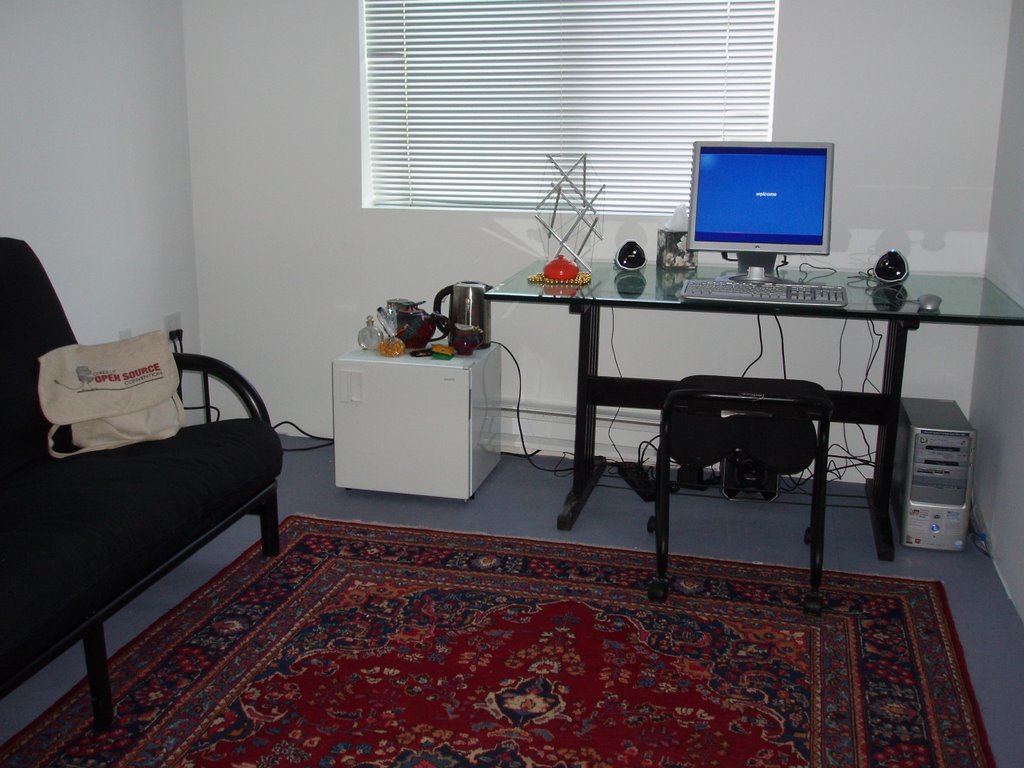 PWS: Turning the Wheel
Dawn's new workspace is coming along nicely. We went from an empty room with a utility sink to a functional office in just three or four days.
She's recycling old props: the desk from an area center garage; the rug (on loan); the small refrigerator; the kneeling chair. The metal frame futon and computer are new: I assembled both, while Derek helped with the heavy glass and frame.
The computer, TurningWheel, is a Hewlett-Packard Pentium 4, has a gig of DDR and a 19" flat screen monitor. I drove out to Fry's for it, having seen the Mother's Day ad in the paper.
The building has wireless, other amenities. Lots of artists and small businesses have set up shop here.
Thursday, May 11, 2006
Memo To Math Teachers
I wrote this memo to math teaching community this morning.
Based on prior experience, I expect little reaction from the USA-based teachers who currently frequent this list. Developing a more sophisticated approach to math teaching, using recent computer technology, is pretty much the furthest thing from their minds.
After all, math through programming is not what the textbooks are about, and textbooks define reality to most teachers. Anything outside of a textbook is seen as just pie in the sky dreamweaving, no matter how much free and open source material is made available via the Internet.
Anyway, I'm not reporting any news here, just more of the same old same old. We've had to learn ways of working around the established math teacher networks and organizations. They're entrenched in their ways and not really relevant to our work.
Based on prior experience, I expect little reaction from the USA-based teachers who currently frequent this list. Developing a more sophisticated approach to math teaching, using recent computer technology, is pretty much the furthest thing from their minds.
After all, math through programming is not what the textbooks are about, and textbooks define reality to most teachers. Anything outside of a textbook is seen as just pie in the sky dreamweaving, no matter how much free and open source material is made available via the Internet.
Anyway, I'm not reporting any news here, just more of the same old same old. We've had to learn ways of working around the established math teacher networks and organizations. They're entrenched in their ways and not really relevant to our work.
Tuesday, May 09, 2006
Edubuntu
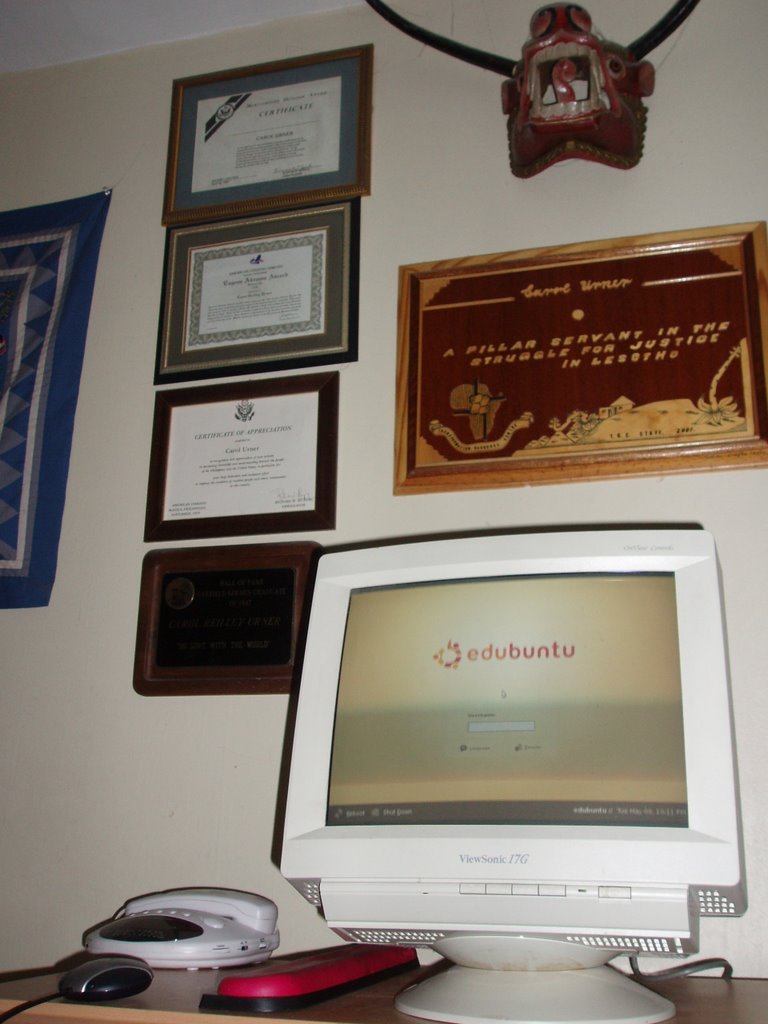 (click photo for larger view)
Maybe I'll be able to get Panda3D running on this thing. I saw two Ubuntu download options at the web site. Which one should I choose? Answer: breezy.
 Screen shot of Panda3d on Edubuntu
Carol Urner's Office
(by K. Urner, Olympus Stylus 500)
Sunday, May 07, 2006
Making Coffee
I got this new Starbucks coffee-making appliance for Xmas, from me to myself (with a loving endorsement from family), which I've just stoked with Celebes, a favorite bean.
Earlier I met Mark, Don's friend and former student based in Guatemala. We three plus Micheal Sunanda watched An American Haunting this afternoon, which I'll likely review one day soon. I'm biased though, having always been a big Sissy Spacek fan (good seeing Sutherland again too, liked him in JFK among others).
Yes, I saw that front page article about the beautiful mind guy in Rm. 114, busting his brain to become famous. Checked into his stuff. Didn't see many hexagons (Glenn Stockton, on the other hand...). Maybe he'd like to present to Wanderers some time. Information gets lost going through newpapers and web sites, useful though these often are at providing valuable perspectives.
[ pause to pour coffee, chat with Dawn ]
I was telling Mark I think a problem with USA culture is we don't accept aid workers from overseas, think our job is to only export basic expertise.
Think of this SNL skit: zoom in on some cute uniformed Chinese girl, propping up an SWI (slumped while intoxicated) in some Gotham, USA. "What are you doing?" the curious camera man asks. "I'm assisting a victim of western capitalism" she replies calmly, and flashes her badge: Communist Chinese Peace Corps. Scream!
Anyway, you get my point. People are way paranoid here, don't want to get any help, just give it, even where it ain't really needed (at least, not in the form offered).
Related reading:
A Discussion of Human Capital Flows Through Semi-Permeable Membranes (paraphrase) by some Yes Men at The Onion (May 3, 2006 | Issue 42•18)
Earlier I met Mark, Don's friend and former student based in Guatemala. We three plus Micheal Sunanda watched An American Haunting this afternoon, which I'll likely review one day soon. I'm biased though, having always been a big Sissy Spacek fan (good seeing Sutherland again too, liked him in JFK among others).
Yes, I saw that front page article about the beautiful mind guy in Rm. 114, busting his brain to become famous. Checked into his stuff. Didn't see many hexagons (Glenn Stockton, on the other hand...). Maybe he'd like to present to Wanderers some time. Information gets lost going through newpapers and web sites, useful though these often are at providing valuable perspectives.
[ pause to pour coffee, chat with Dawn ]
I was telling Mark I think a problem with USA culture is we don't accept aid workers from overseas, think our job is to only export basic expertise.
Think of this SNL skit: zoom in on some cute uniformed Chinese girl, propping up an SWI (slumped while intoxicated) in some Gotham, USA. "What are you doing?" the curious camera man asks. "I'm assisting a victim of western capitalism" she replies calmly, and flashes her badge: Communist Chinese Peace Corps. Scream!
Anyway, you get my point. People are way paranoid here, don't want to get any help, just give it, even where it ain't really needed (at least, not in the form offered).
Related reading:
A Discussion of Human Capital Flows Through Semi-Permeable Membranes (paraphrase) by some Yes Men at The Onion (May 3, 2006 | Issue 42•18)
Friday, May 05, 2006
Lucky Lab
So I just rushed back from this brew pub, a meeting of POSSE, where the governor of Oregon made a brief appearance (David Pool, whom I know from our CollabTech days at FreeGeek, pointed him out to me), and Erik Sten, a local city council member now running for re-election.
Erik shared for a good half hour actually, taking a question from me about industrial sector zoning of the east side hugging the freeway. Would a "think tank economy" featuring such as the London Knowledge Lab, but Portland's, be apropos?
Erik thought that'd be a swell idea, matched his own vision quite a bit. And no, I'm not forgetting his "render farm" idea either.
A TV camera with a separate boom microphone showed up later, during the presentation on open source business models. People got more intelligently talkative. I thought we cut a great tape.
I'm burning Sunanda CDs from a master at the moment. As yet I have no clue what he shared on KBOO last night. Funny hippie psychobabble is how he characterized it, in the minds of his listeners at least.
Later:
I purchased Chinese food from Fujin, rented Sister Act and Sister Act 2 from the nearby Hollywood Video for Dawn and Tara, and picked up medicines at the Fred Meyer pharmacy. My hope is to visit with Jon Bunce (a Wanderer and musician) later this evening.
Dawn spent much of the day working on her new studio space, which is rather near to the east side Lucky Lab.
Erik shared for a good half hour actually, taking a question from me about industrial sector zoning of the east side hugging the freeway. Would a "think tank economy" featuring such as the London Knowledge Lab, but Portland's, be apropos?
Erik thought that'd be a swell idea, matched his own vision quite a bit. And no, I'm not forgetting his "render farm" idea either.
A TV camera with a separate boom microphone showed up later, during the presentation on open source business models. People got more intelligently talkative. I thought we cut a great tape.
I'm burning Sunanda CDs from a master at the moment. As yet I have no clue what he shared on KBOO last night. Funny hippie psychobabble is how he characterized it, in the minds of his listeners at least.
Later:
I purchased Chinese food from Fujin, rented Sister Act and Sister Act 2 from the nearby Hollywood Video for Dawn and Tara, and picked up medicines at the Fred Meyer pharmacy. My hope is to visit with Jon Bunce (a Wanderer and musician) later this evening.
Dawn spent much of the day working on her new studio space, which is rather near to the east side Lucky Lab.
Wednesday, May 03, 2006
General Systems Theory
Certainly economists compete with one another to become stars in their own field, but the discipline as a whole still suffers from a monopolistic mindset. When it comes to fixing spending priorities, economists still seem to think there's only one game in town, namely Economics.
General Systems Theory aims to compete with Economics, by covering some of the same territory with a newer map, sort of the way astronomy gradually took over from astrology, when it came to such challenges as putting humans on the Moon. We needed to be more scientific, more deeply appreciative of nature's role. GST owes more to ecology than economics.
Contributors to our field include Kenneth Boulding, Ludwig von Bertelanffy, James Schlesinger, Barbara Marx Hubbard, R. Buckminster Fuller, Jack Urner and myself (plus many more).
For further reading:
General Systems Theory: Brainstorming New Scenarios for our Global University (Oct. 1996)
New Circuit Designs for Motherboard Earth (CyRev Journal, Issue 3, 1995 etc.).
General Systems Theory aims to compete with Economics, by covering some of the same territory with a newer map, sort of the way astronomy gradually took over from astrology, when it came to such challenges as putting humans on the Moon. We needed to be more scientific, more deeply appreciative of nature's role. GST owes more to ecology than economics.
Contributors to our field include Kenneth Boulding, Ludwig von Bertelanffy, James Schlesinger, Barbara Marx Hubbard, R. Buckminster Fuller, Jack Urner and myself (plus many more).
For further reading:
General Systems Theory: Brainstorming New Scenarios for our Global University (Oct. 1996)
New Circuit Designs for Motherboard Earth (CyRev Journal, Issue 3, 1995 etc.).
Sunday, April 30, 2006
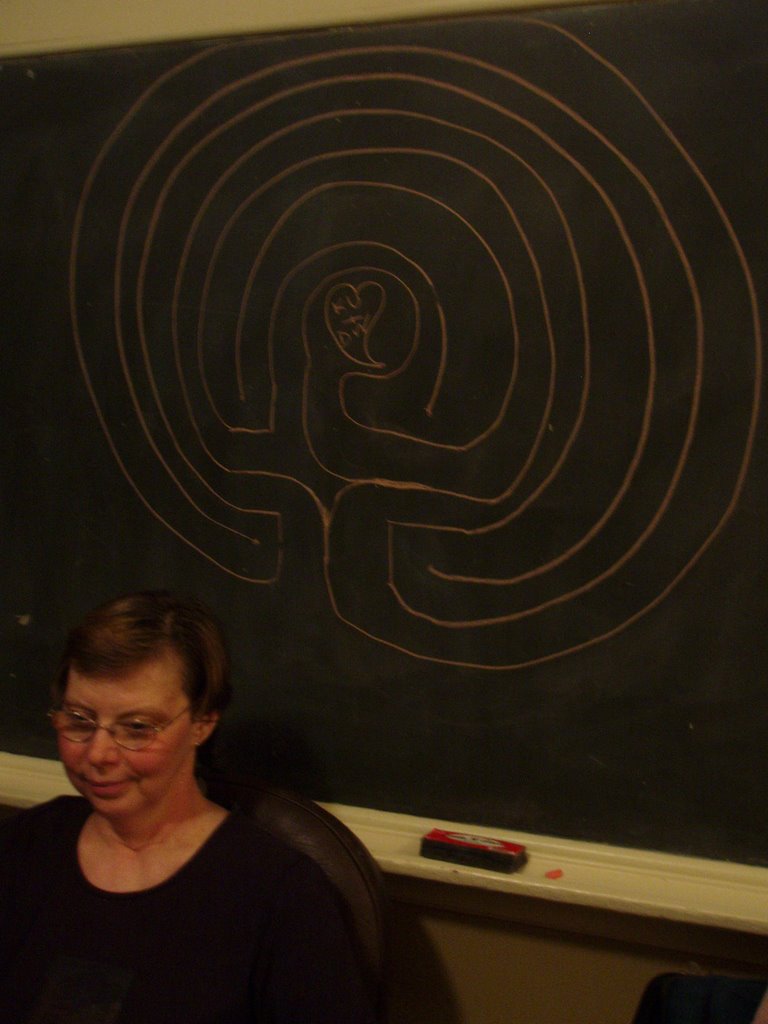
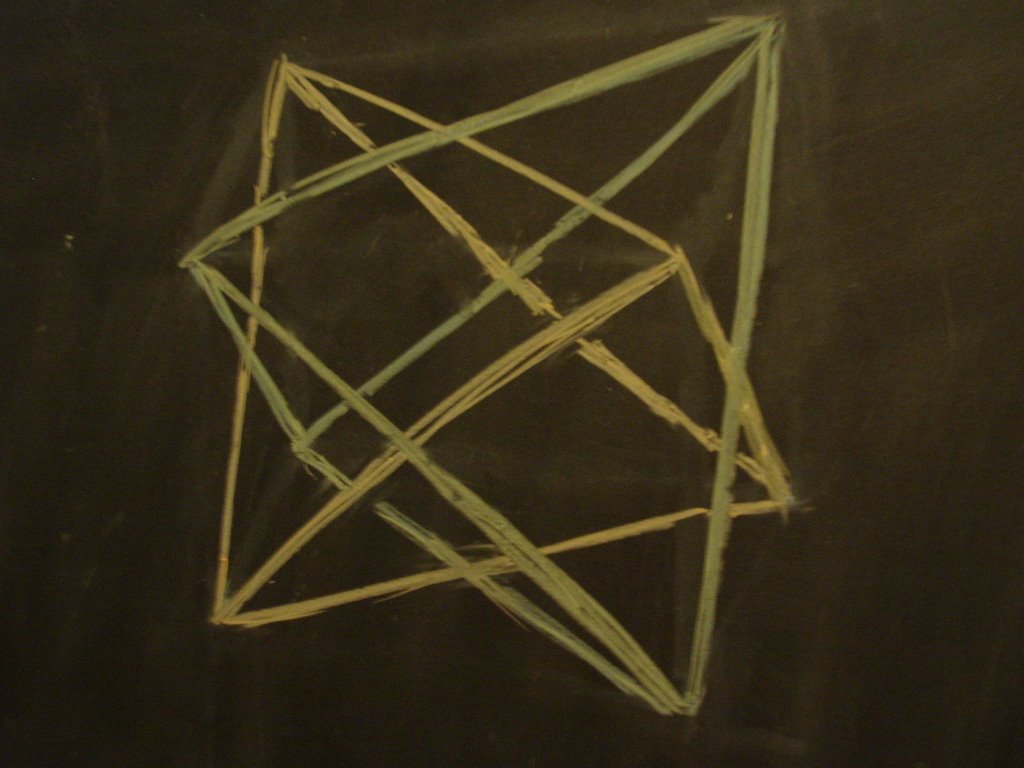
Thursday, April 20, 2006
Back at the Zoo
I descended a flight of stairs to discover an austere table, board member names in plastic shields, LCDs on tripods on either side, heralding the event: a Saturday Academy fundraiser, a time to be generous towards tomorrow's Oregon's daughters and sons. I sat at a round table (21), flanked by staff, with the Alien Landscapes instructor, and an OPBer. A mother and baby were also present.
Joyce Creswell set the tone, by invoking SA's 23 year long history -- coming upon a quarter century here. In these parts, 23 still counts as old, because our Silicon Forest is young, even though some of our oral traditions trace back to eye-witnesses to Mt. Mazama's decapitation (now she's named Crater Lake, and she's a deep one). My wife was here when Mt. St. Helens blew.
Illustrious captains of industry followed. Our area is endowed with talent, let's pass that on.
This is the same room I'd come to for a few CRIME meetings hosted by George Heuston of HPD, back closer to the time I was teaching at West Precinct with Jerritt (Mr. Linuxfund.org back then). We'd only need the rearmost partition, and mostly did projector presentations about patterns of IP use (many applications register, bittorrent especially), or abstruse lectures about cryptography.
Sam is chauffeuring for his sis (my wife), is also a pro poet.
We celebrated mom's 77th at Sweet Tomato last night, one of Tara's favorites. For her birthday, mom let me buy her any Laughing Horse book of her choice, and she chose Hitler Youth from Scholastic, about what it was like growing up in the shadow of Nazism. The resulting picture is comically surreal.
I also procured (and installed) those prayer flags (Guru Rinpoche was one of those incredibles I learned about on visits to Bhutan), plus watched that Squeakers DVD (thanks Kim), my two blog-announced goals for that day; plus I got a lot of other work done as well.
Joyce Creswell set the tone, by invoking SA's 23 year long history -- coming upon a quarter century here. In these parts, 23 still counts as old, because our Silicon Forest is young, even though some of our oral traditions trace back to eye-witnesses to Mt. Mazama's decapitation (now she's named Crater Lake, and she's a deep one). My wife was here when Mt. St. Helens blew.
Illustrious captains of industry followed. Our area is endowed with talent, let's pass that on.
This is the same room I'd come to for a few CRIME meetings hosted by George Heuston of HPD, back closer to the time I was teaching at West Precinct with Jerritt (Mr. Linuxfund.org back then). We'd only need the rearmost partition, and mostly did projector presentations about patterns of IP use (many applications register, bittorrent especially), or abstruse lectures about cryptography.
Sam is chauffeuring for his sis (my wife), is also a pro poet.
We celebrated mom's 77th at Sweet Tomato last night, one of Tara's favorites. For her birthday, mom let me buy her any Laughing Horse book of her choice, and she chose Hitler Youth from Scholastic, about what it was like growing up in the shadow of Nazism. The resulting picture is comically surreal.
I also procured (and installed) those prayer flags (Guru Rinpoche was one of those incredibles I learned about on visits to Bhutan), plus watched that Squeakers DVD (thanks Kim), my two blog-announced goals for that day; plus I got a lot of other work done as well.
Friday, April 14, 2006
Shuttleworth Summit (day two)
Checking edu-sig this morning, from the hotel lobby (Guido is in the chair next to me); André is proposing rur-ple as an alternative to Logo while Ian blogged about his PyLogo.
We had a fantastic dinner at E&O last night. Gunner turns out to be a bigger country music fan than I'd realized.
Today's planning looked at timeline, tools, and content.
A first pass: develop in a fish bowl, in showcase settings, with others invited to adopt and adapt (within three years?). Second pass: package the "final product" for wider dissemination (within five?).
On the tools front, a key question is whether we're tying this project to any major specific software development effort.
Loosely coupled tools, with a bottom-up, open source curriculum writing process, will leave the question of tools somewhat open-ended. The lesson plans will specify the software needed, with multiple paths possible.
Will we eventually have some sort of Python-based hypercard-like browser plug-in, facilitating easy publishing by students and incorporating what's already worked well in Squeak? If yes, then so much the better. Peers i.e. teachers (including the more advanced students) will write lessons around it.
The content will translate a mind map of the whole ten year topics network to a repository of lesson plans, with lessons sortable by how technology intensive they need to be. The content will mostly assume some minimal level of infrastructure: a computer lab with or without the Internet for example. At the topical level, this curriculum should tie to the national standards, to facilitate widespread adoption.
We blitzed through a few five minute lightning talks, featuring South Africa's performance stats in TIMMS, primitive Logo in Javascript, Squeak, a book on Squeak, the Scheme approach to designing programs, a 2D dynamic geometry project not unlike PyGeo in 3D, and me on Python, doing a very abbreviated version of what I showed the London Knowledge Lab on Wednesday.
Robyn encourged me to look at what a contemporary Logo looks like. The slickest stuff is neither free nor cross-platform, even if it runs in a web browser.
Momentum seems to be building for a stronger graphics engine, either 2D or 3D, with Python bindings, that'll run interactively from within a browser. The Squeak folks may be willing to contribute to this effort. Guido feels we'll need to recruit new talent for this, as the Python community is currently pretty maxed out on projects. Should such an engine be developed, turtle stuff would be incorporated therein.
We had a fantastic dinner at E&O last night. Gunner turns out to be a bigger country music fan than I'd realized.
Today's planning looked at timeline, tools, and content.
A first pass: develop in a fish bowl, in showcase settings, with others invited to adopt and adapt (within three years?). Second pass: package the "final product" for wider dissemination (within five?).
On the tools front, a key question is whether we're tying this project to any major specific software development effort.
Loosely coupled tools, with a bottom-up, open source curriculum writing process, will leave the question of tools somewhat open-ended. The lesson plans will specify the software needed, with multiple paths possible.
Will we eventually have some sort of Python-based hypercard-like browser plug-in, facilitating easy publishing by students and incorporating what's already worked well in Squeak? If yes, then so much the better. Peers i.e. teachers (including the more advanced students) will write lessons around it.
The content will translate a mind map of the whole ten year topics network to a repository of lesson plans, with lessons sortable by how technology intensive they need to be. The content will mostly assume some minimal level of infrastructure: a computer lab with or without the Internet for example. At the topical level, this curriculum should tie to the national standards, to facilitate widespread adoption.
We blitzed through a few five minute lightning talks, featuring South Africa's performance stats in TIMMS, primitive Logo in Javascript, Squeak, a book on Squeak, the Scheme approach to designing programs, a 2D dynamic geometry project not unlike PyGeo in 3D, and me on Python, doing a very abbreviated version of what I showed the London Knowledge Lab on Wednesday.
Robyn encourged me to look at what a contemporary Logo looks like. The slickest stuff is neither free nor cross-platform, even if it runs in a web browser.
Momentum seems to be building for a stronger graphics engine, either 2D or 3D, with Python bindings, that'll run interactively from within a browser. The Squeak folks may be willing to contribute to this effort. Guido feels we'll need to recruit new talent for this, as the Python community is currently pretty maxed out on projects. Should such an engine be developed, turtle stuff would be incorporated therein.
Thursday, April 13, 2006
Shuttleworth Summit (day one)
Our plan is to write the next generation curriculum for the Shuttleworth Foundation's vision, and a process for doing so. Nineteen of us are sitting around the table, one is taking the official notes (mine are not official). The essentials have been provided: coffee and tea, wireless.
Mark: How do students develop communications and analytical skills and how might technology catalyze the aquisition of these skills?
Problem: mathematics is increasingly failing to hook kids' attention, with new math teachers ever harder to recruit. Yet technology is invading the education sector, plus students are spontaneously attracted to technology. How can we capitalize on both trends? How might we continue to deliver analytical capacity in this climate of declining interest in traditional mathematics learning and teaching?
There's no time to retrain the teachers, so the model should implement a peer-based system, wherein students are expected to mentor other students.
Mark's current vision is to start kids with Logo, then maybe move on to Squeak, then Python. That's a rough first take. We have the Scheme community represented at the table as well.
My comment: if there's a lot of broadband in this picture, access to technologically literate teachers shouldn't be the bottleneck. We can project video clips at will, including of talking heads, and about any topic. So it's not like there won't be a variety of adult role models presented. Even live interviews are possible. Guido: assuming the presence of broadband or a projector may not be realistic. Mark: pervasively only in the long term. May we at least assume an ability to play DVDs, and to burn them? Yes.
Other comments: we're talking about acquiring identity, not just skills, which relates to language and a cultural context. What is my role in the community, what are my community's values? The concept of "literacy" covers this, in that becoming literate involves creating one's life story. And this doesn't just happen in schools, especially given the Internet.
Let's focus on the analytical component, the mathematics. Computers enable kinds of mathematics that's difficult to do in other ways. And let's enlarge the analytic to embrace the sciences, which adds the modeling dimension, makes the math stories be about reality. Purely analytical capability may be perverse and/or shallow if not grounded.
Alan Kay pointed out that a curriculum needs to include powerful ideas, not just turn students loose, expecting them to reinvent the calculus. Developing problem solving skills must include exposure to powerful cultural inventions. Cultural memory is important.
Alan sure talks about the 1960s a lot. Guido expressed some frustration with that.
My suggestion: set up test beds, modeling existing and expected conditions, and develop curriculum segments in the field (the test driven development model). Implement a prototype branded curriculum in a pure form and let others copy what works. I'm hoping to avoid this pitfall: something imposed top-down on unwilling participants results in backlash and sabotage, or simply a diluted or distorted version, giving ammo to the curriculum's enemies and making outcomes hard to measure.
Alan thinks being able to script without having to type is super important, plus he wants a media rich experience, not just a turtle. He also advocates the one wireless laptop per child model, meaning you get to take them home. His emphasis is consistently constructing a "world" for children, some customized multimedia GUI ala Squeak, although he thinks this could just as well be done in Python. Alan is a big hypercard fan and is aware of the PythonCard project.
I'm especially skeptical on this last point. Let's focus on a distro perhaps (like edubuntu) but not over-integrate the environment to make something more seamless then necessary. Leave the environment heterogenous, more like the real world. I'm also finding that IM (instant messaging) motivates somewhat older kids to improve their typing skills.
I sense a tension between inspiring teachers versus bypassing them. Probably what we're doing is pioneering an open source culture devoted to curriculum development (not just software development) which includes and inspires some teachers, but leaves others feeling bypassed -- a typical outcome, not really a problem.
What Alan and I most agree on is the need for Wikipedia type content to mix with an interactive component. He showed me his recent Javascript implementation of Logo. I'm reminded of our ability to create interactive "labs" in the J language. Python needs a more developed interactive teaching module: show some stuff, give students a command line, show more stuff, and so on.
Lunch activity: demo of LAMS by its author, James Dalziel. Good use of chat rooms to facilitate peer to peer communications.
The breakout sessions were on the following topics: landscape 2010 (what will the ecology be like?); implementation of innovation (how will these new memes spread?); the role of the teacher in this new technology-based curriculum.
The landscape group expects at least a computer lab in most schools. We can't assume students will have access to a computer at home.
The implementation group is faced with a somewhat monolithic set of scored national tests, and debated what balance of collaborative vs. subversive tactics would work best. Recruiting teachers would involve empowering them as peer contributors to a lessons repository.
The teacher's role group assumed universities would help with teacher trainings and managing the courseware repositories. Shall we hold on to the notion that teachers must "know more" than their students, in order to be effective?
Coffee break. Warding off jet lag.
A branded distro, like edubuntu, with built-in links to further resources (LAMS workflows, moodles...), would give users access to a shared open source culture of curriculum development, not just software development. As a peer, I'd be patched into an ecology, a network, as I am now, but with more people self-consciously contributing. The ecology will feature many competing brands, not one monolithic sequence. Some curricula will be more tailored to specific national, regional and/or company standards.
Mark: How do students develop communications and analytical skills and how might technology catalyze the aquisition of these skills?
Problem: mathematics is increasingly failing to hook kids' attention, with new math teachers ever harder to recruit. Yet technology is invading the education sector, plus students are spontaneously attracted to technology. How can we capitalize on both trends? How might we continue to deliver analytical capacity in this climate of declining interest in traditional mathematics learning and teaching?
There's no time to retrain the teachers, so the model should implement a peer-based system, wherein students are expected to mentor other students.
Mark's current vision is to start kids with Logo, then maybe move on to Squeak, then Python. That's a rough first take. We have the Scheme community represented at the table as well.
My comment: if there's a lot of broadband in this picture, access to technologically literate teachers shouldn't be the bottleneck. We can project video clips at will, including of talking heads, and about any topic. So it's not like there won't be a variety of adult role models presented. Even live interviews are possible. Guido: assuming the presence of broadband or a projector may not be realistic. Mark: pervasively only in the long term. May we at least assume an ability to play DVDs, and to burn them? Yes.
Other comments: we're talking about acquiring identity, not just skills, which relates to language and a cultural context. What is my role in the community, what are my community's values? The concept of "literacy" covers this, in that becoming literate involves creating one's life story. And this doesn't just happen in schools, especially given the Internet.
Let's focus on the analytical component, the mathematics. Computers enable kinds of mathematics that's difficult to do in other ways. And let's enlarge the analytic to embrace the sciences, which adds the modeling dimension, makes the math stories be about reality. Purely analytical capability may be perverse and/or shallow if not grounded.
Alan Kay pointed out that a curriculum needs to include powerful ideas, not just turn students loose, expecting them to reinvent the calculus. Developing problem solving skills must include exposure to powerful cultural inventions. Cultural memory is important.
Alan sure talks about the 1960s a lot. Guido expressed some frustration with that.
My suggestion: set up test beds, modeling existing and expected conditions, and develop curriculum segments in the field (the test driven development model). Implement a prototype branded curriculum in a pure form and let others copy what works. I'm hoping to avoid this pitfall: something imposed top-down on unwilling participants results in backlash and sabotage, or simply a diluted or distorted version, giving ammo to the curriculum's enemies and making outcomes hard to measure.
Alan thinks being able to script without having to type is super important, plus he wants a media rich experience, not just a turtle. He also advocates the one wireless laptop per child model, meaning you get to take them home. His emphasis is consistently constructing a "world" for children, some customized multimedia GUI ala Squeak, although he thinks this could just as well be done in Python. Alan is a big hypercard fan and is aware of the PythonCard project.
I'm especially skeptical on this last point. Let's focus on a distro perhaps (like edubuntu) but not over-integrate the environment to make something more seamless then necessary. Leave the environment heterogenous, more like the real world. I'm also finding that IM (instant messaging) motivates somewhat older kids to improve their typing skills.
I sense a tension between inspiring teachers versus bypassing them. Probably what we're doing is pioneering an open source culture devoted to curriculum development (not just software development) which includes and inspires some teachers, but leaves others feeling bypassed -- a typical outcome, not really a problem.
What Alan and I most agree on is the need for Wikipedia type content to mix with an interactive component. He showed me his recent Javascript implementation of Logo. I'm reminded of our ability to create interactive "labs" in the J language. Python needs a more developed interactive teaching module: show some stuff, give students a command line, show more stuff, and so on.
Lunch activity: demo of LAMS by its author, James Dalziel. Good use of chat rooms to facilitate peer to peer communications.
The breakout sessions were on the following topics: landscape 2010 (what will the ecology be like?); implementation of innovation (how will these new memes spread?); the role of the teacher in this new technology-based curriculum.
The landscape group expects at least a computer lab in most schools. We can't assume students will have access to a computer at home.
The implementation group is faced with a somewhat monolithic set of scored national tests, and debated what balance of collaborative vs. subversive tactics would work best. Recruiting teachers would involve empowering them as peer contributors to a lessons repository.
The teacher's role group assumed universities would help with teacher trainings and managing the courseware repositories. Shall we hold on to the notion that teachers must "know more" than their students, in order to be effective?
Coffee break. Warding off jet lag.
A branded distro, like edubuntu, with built-in links to further resources (LAMS workflows, moodles...), would give users access to a shared open source culture of curriculum development, not just software development. As a peer, I'd be patched into an ecology, a network, as I am now, but with more people self-consciously contributing. The ecology will feature many competing brands, not one monolithic sequence. Some curricula will be more tailored to specific national, regional and/or company standards.
Friday, April 07, 2006
V for Vendetta (movie review)
This film draws inspiration from Orwell, plus from all too familiar fascist "reality TV" fashions. Oppressive government is a nightmare and leads to dark paranoias, often leading to mass uprisings. This sequence gets played out over and over again, never exactly repeating. Like 1984, Vendetta goes ahead and simply maps to some future distopia, vaguely (or not so vaguely) extrapolating troubling trends in our own time.
It's also Beauty and the Beast, a genre I've not specialized in, although King Kong was an eye-opener. V is certainly a monster, and for 20 years has occupied himself plotting a delicious revenge against his torturers. Then he meets the girl, and the whole grotesque fantasy becomes surprisingly back burner.
But he goes through with it anyway; it's all he knows, what he's scripted to do. Then he hands the baton off to a next generation (to which this girl belongs). There's love between this girl and another girl too, under the masked one's auspices -- very complicated, yet touching and real (I couldn't believe those idiot parents disowning this most beautiful daughter, plus passing on getting another one).
Dawn and I saw it together. She said "a little more gratuitous violence than I like" and I got it. I took the whole thing as a sick and twisted fantasy piece, a simulator (OK, a wardrobe). And the product of a feverishly fertile UKer imagination -- they really know how to make 'em, those IngSoc types. Actually, we're talking Wachowski brothers, of The Matrix fame. Definitely a bold contribution to the literature.
It's also Beauty and the Beast, a genre I've not specialized in, although King Kong was an eye-opener. V is certainly a monster, and for 20 years has occupied himself plotting a delicious revenge against his torturers. Then he meets the girl, and the whole grotesque fantasy becomes surprisingly back burner.
But he goes through with it anyway; it's all he knows, what he's scripted to do. Then he hands the baton off to a next generation (to which this girl belongs). There's love between this girl and another girl too, under the masked one's auspices -- very complicated, yet touching and real (I couldn't believe those idiot parents disowning this most beautiful daughter, plus passing on getting another one).
Dawn and I saw it together. She said "a little more gratuitous violence than I like" and I got it. I took the whole thing as a sick and twisted fantasy piece, a simulator (OK, a wardrobe). And the product of a feverishly fertile UKer imagination -- they really know how to make 'em, those IngSoc types. Actually, we're talking Wachowski brothers, of The Matrix fame. Definitely a bold contribution to the literature.
Wednesday, April 05, 2006
Today's Networking
Today I'm busy working with Erica at Associated Oregon Industries (AOI) on improving their database program (inherited Visual FoxPro code which I've mostly rewritten by now).
I phoned Multnomah County to reschedule jury duty once again, this time for mid January 2007.
Dawn is having many high level discussions with her care team. She's the kind of patient many doctors like having: she takes it straight, unvarnished, yet with sensitivity and grace. Her professional care givers, in both eastern and western traditions, are among her biggest fans.
I'm planning to take Tara to AAA after school; we need to get her passport reactivated per family overseas travel plans. I really want to show them Italy, Rome especially (many favorite boyhood haunts). We've ordered a copy of her birth certificate on-line, after not finding our earlier copy. I'll also pick up a map of London, and maybe of the southwestern USA (Dawn's hoping for a bizmo trip).
I swung by the Linus Pauling House on Terry's invitation to meet with our ISEPP guest, Dr. Ulanowicz, and maybe listen in on some fun conversation. Apparently Wanderers had invited him to lunch some place (I found evidence of a meeting in progress). Given time constraints, I elected to scrawl a "Kirby was here" on the board; I'll hope to catch his lecture tomorrow evening.
Dawn ordered, and I picked up from the vet, a new bag of Moon Kitty's special cat food.
Arthur Seigel and I have another interesting thread going on edu-sig, which again explores the nature of my commitments and investments as a Fuller Schooler.
Hugh Watkins, the Copenhagen-based fellow student of Wittgenstein's philo, excerpted some recent Kirbiania about Wittgenstein in his blog (link).
Nick Consoletti is staying in my basement again. He wants me to write a recommendation for the Design Science Lab, which I currently know only a little about and am not involved with. I have no problem recommending Nick though.
I phoned Multnomah County to reschedule jury duty once again, this time for mid January 2007.
Dawn is having many high level discussions with her care team. She's the kind of patient many doctors like having: she takes it straight, unvarnished, yet with sensitivity and grace. Her professional care givers, in both eastern and western traditions, are among her biggest fans.
I'm planning to take Tara to AAA after school; we need to get her passport reactivated per family overseas travel plans. I really want to show them Italy, Rome especially (many favorite boyhood haunts). We've ordered a copy of her birth certificate on-line, after not finding our earlier copy. I'll also pick up a map of London, and maybe of the southwestern USA (Dawn's hoping for a bizmo trip).
I swung by the Linus Pauling House on Terry's invitation to meet with our ISEPP guest, Dr. Ulanowicz, and maybe listen in on some fun conversation. Apparently Wanderers had invited him to lunch some place (I found evidence of a meeting in progress). Given time constraints, I elected to scrawl a "Kirby was here" on the board; I'll hope to catch his lecture tomorrow evening.
Dawn ordered, and I picked up from the vet, a new bag of Moon Kitty's special cat food.
Arthur Seigel and I have another interesting thread going on edu-sig, which again explores the nature of my commitments and investments as a Fuller Schooler.
Hugh Watkins, the Copenhagen-based fellow student of Wittgenstein's philo, excerpted some recent Kirbiania about Wittgenstein in his blog (link).
Nick Consoletti is staying in my basement again. He wants me to write a recommendation for the Design Science Lab, which I currently know only a little about and am not involved with. I have no problem recommending Nick though.
Sunday, April 02, 2006
Wittgenstein Again
I wrote a more comic book version of this, but let's try to be more serious. The work for which Ludwig Wittgenstein (LW) first became well known, as the miracle-spawn of Bertrand Russell, was the pretentiously titled Tractatus Logico Philosophicus (TLP). Except this wasn't so silly-sounding for that day, as Latin still connoted authority, as did the flat hats and gowns, all the gothic surroundings of a dark ages cathedral. So the TLP fit right in, as more organ music.
Over time, however, LW became disillusioned with his tone in the TLP. Yes, it was a lot of clever, glorified nonsense, which hooked the reader mainly on its aesthetic merits, but it was also too grandiose in retrospect, too full of the author's own vanity, perhaps for having mastered the logical crypticisms indulged in by the school masters of his day, and since superseded by electronified gate logic.
So the next generation philo (published posthumously as the PI) would be pretty much devoid of these crypticisms, even if the transition to patent nonsense was still a goal (same joke, just better told).
In calling both works "a joke" I'm not attempting to deride or dismiss them in any way, which is why I think the link to Japanese style Buddhism tends to work, in that the Zen koan is likewise a relic or spin-off from trying to say the unsayable i.e. trying to point to the inside of Plato's Cave (as if it were just another concept, with convex and concave features).
In Fuller's philo, we're connected by this Void to his ongoing definings within an eternally aconceptual nonsimultaneous and only partially-overlapping scenarios Universe (or call it a centers network, with local spacetime coordinates in the eye of the beholder).
You don't get to take the world's snap shot and have it remain faithful to the original for long, not even with a beautiful logic. We have to keep working at it, ever refining and polishing our communications to better fit them within the backdrop of our present day (or private sky).
Over time, however, LW became disillusioned with his tone in the TLP. Yes, it was a lot of clever, glorified nonsense, which hooked the reader mainly on its aesthetic merits, but it was also too grandiose in retrospect, too full of the author's own vanity, perhaps for having mastered the logical crypticisms indulged in by the school masters of his day, and since superseded by electronified gate logic.
So the next generation philo (published posthumously as the PI) would be pretty much devoid of these crypticisms, even if the transition to patent nonsense was still a goal (same joke, just better told).
In calling both works "a joke" I'm not attempting to deride or dismiss them in any way, which is why I think the link to Japanese style Buddhism tends to work, in that the Zen koan is likewise a relic or spin-off from trying to say the unsayable i.e. trying to point to the inside of Plato's Cave (as if it were just another concept, with convex and concave features).
In Fuller's philo, we're connected by this Void to his ongoing definings within an eternally aconceptual nonsimultaneous and only partially-overlapping scenarios Universe (or call it a centers network, with local spacetime coordinates in the eye of the beholder).
You don't get to take the world's snap shot and have it remain faithful to the original for long, not even with a beautiful logic. We have to keep working at it, ever refining and polishing our communications to better fit them within the backdrop of our present day (or private sky).
Subscribe to:
Posts (Atom)
