Wednesday, October 28, 2015

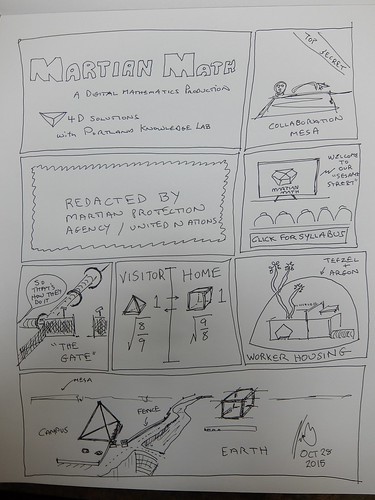
Martian Math Storyboards


Going viral...

Masthead

DSCF1690


For Further Reading:

Sunday, October 25, 2015

Computer Lore


Thursday, October 22, 2015

Black Panthers: Vanguard... (movie review)

I finally got to this, having naively shown up on opening night thinking I could just waltz in and buy a ticket.  That was a gala event, for which I had not planned in advance.  No matter, Hollywood Theater, a nonprofit with members, let this important new documentary run for quite a few days.

I found it helpful to tightly focus on the Panthers through this period, but was always aware, since I was alive through some of this, of how much else was going on in parallel.  How Black Panthers related to Black Muslims and Malcolm X is discussed even less than their relationship with Black Christians and Martin Luther King.  The Panthers were more secular, less likely to invoke God in their speeches.  They simply wanted higher living standards and freedom from oppression.

With mass movements like this, mob psychologies, the so-called leaders act as tone and trend setters, but then the real inertia comes from the rank and file, people looking to be a part of something bigger than themselves. Not much vetting goes on sometimes as players are thrown together by circumstance.

This out-of-control snowballing effect was evident in the case of the Panthers but also in the case of law enforcement.  J. Edgar Hoover helped set the tone with Cointelpro, but it was up to individual police departments to "get creative".  Effectively micromanaging from the top, with this much going on concurrently, is somewhat impossible.  Would be public figures ride the wave, and use the media to help them do so, as another category of celebrity.

The former Panthers, police, journalists and historians, interviewed for this film have the benefit of a lot of hindsight.  If people had only had the luxury of being this reflective at the time... if only. Quakers intersperse a lot of silence for a purpose.  People need that time to reflect and to hear one another's voices in a safe environment.  They also need ways to debate and challenge one another without resorting to physical violence.  William F. Buckley, to his credit, worked at providing such a forum, an alternative to violence.

Speaking of Buckley, the segment on the park in Chicago segues smoothly to the famous Buckley-Vidal altercation.  Eldridge Cleaver delivered the speech in that park, and had left the scene before violence erupted, however he was charged with inciting said violence.  He decided he'd be better off in Algeria, where he started an international chapter of the Black Panther movement.

The commitment to Free Huey (Newton) from prison was a big part of Panther psychology and when he was finally let free, he was an icon.  However all that prison time had shaped him in ways that distanced him from his fans.  The party tried to consolidate around Bobby Seale, who ran for mayor of Oakland, and when that didn't work, things fell apart.  Huey had become abusive and tyrannical.

One could say the Panthers lost in their bid for a revolution, however big wheels turn slowly.  Nixon, the law and order president, turned out to be a crook (in addition to the usual war criminal, what most warlords are) and to this day the right to openly carry guns on public property (not private necessarily) owes a lot to the Black Panthers.

Their work in Chicago to build bridges with poor whites, so-called hillbillies from Appalachia, has paid off in some dimensions.  And backwater Oregon, where being black is no longer illegal, now has peaceful ties with Hanoi.  Today we have the Internet, and infiltration was always a two way street.

Watching this documentary in tandem with a few others, such as Neverland, the one about Patty Hearst and the Symbionese Liberation Army, would help open more windows on a complex timeline.  Historians are still putting together these vistas.  The US Versus John Lennon would be another good one to watch in close proximity.  No one documentary gets the whole picture of course.  History is non-simultaneously conceptual, meaning there's no single snapshot synopsis (obviously).

Today was much higher in pain and stress than anyone had planned, mostly for Carol, my mom (age 86).  She managed to gouge her leg quite deeply getting out of the car, fortunately at a hospital.  What was supposed to be a routine thirty minute checkup turned into a visit to the ER for sutures and a tetanus shot (as well as for the blood test she'd originally come in for).  I'm required to report this event to my car insurance company or risk Medicare not covering any of the costs, according to the hospital.  Mom is OK.  We're still planning that trip to Corvallis tomorrow.  Followup from Corvallis:  Farmers says they'll cover it.

Monday, October 19, 2015

Religious Teachings


The talking animals in this namespace ("Noah's Park") seem remarkably incurious as to the origin of a buried treasure that comes to light.

The hypothesis it was placed there deliberately to inspire future experiments is one definitely worth exploring, but what else might it mean?  Is it a relic of a past civilization?

That the wings could have metaphorical significance is not proposed, nor does anyone care to speculate as to how this statue actually did come to be in the pond.  Is it some kind of trick, like a faux fossil in the mud?

Clearly none of the animals present have the skills to manufacture such trophies.  If this really is the complete namespace, then divine origins are as good an explanation as any.  We may accept "God-given" as axiomatic. Honk is right to seek its meaning.

At least the mysophobic camel takes this sign from God seriously, as some form of communication, and attempts to do God's will, by trial and error.  As the dutiful empiricist, seeking his true niche (a cleaner place) he does his homework, practices science.

Yes, Honk the camel is the most faithful, the most loyal to God in the face of skeptics who have never felt the tug of the divine.  Honk is perhaps the Moor, the Arab alchemist, the Kabbalah scholar who seeks to know God's secrets first hand.

The authority figure or imam, a frog-faced individual named Ponder, does not dispute the sign's divine origin, nor really offer much of an alternative interpretation.  Yet he tut tuts the camel's empiricism, smug in his all-knowing attitude.

The frog recommends the camel keep the statue once the wings have symbolically broken off (a reminder of the dead-end nature of ego pride), but then seems uncertain as to whether he, a mere frog, has comprehended God's will himself.  Any show of humility is more than welcome at this point.

Children exposed to this material will have an easier time ignoring loose ends, such as "what did the sign from God really signify?"  Did it foretell that birds, another species, would one day collaborate to form an airline, creating friendly skies for this camel?   This would seem far fetched but in retrospect apparently it did.

A hidden teaching was in due course revealed:  go ahead and give up on dreams of greater powers obtained through your own efforts and loyalty to God, and instead let your friends help you compensate for your obvious weaknesses.

Your approach to God will be indirect, mediated by others (the birds) whom God made to ply the sky.  Be satisfied with your base nature (as a camel).  Don't aspire to be in some way above your station or "beyond your light" (as Quakers might put it).

Depend on your community to prop you up, in exchange for learning your lesson and in future adopting their same incurious / unquestioning attitude, and lack of aspiration.  Learn to restate the obvious ("camels don't fly") over and over, as a kind of mantra, while avoiding all manner of speculative experimentation as empty vanity.  Be a dolt.

Saturday, October 17, 2015

Diplomatic Gaffs

There's some loudmouth general on the Official Washington press release circuit who is probably making life harder for diplomats, in saying he expects to have permanent bases in Afghanistan, just like in Okinawa, Korea and Germany.

Generals may be too busy administering bureaucratically intensive Iron Mountain activities to bone up on recent history.  The granting of bases to the US was always with a veneer of sovereignty to paper over any sense of perpetual empire and hegemony as officially the New World Order (as purveyed by one District of Columbia).

That face-saving rhetoric was thin, as in hollow, but now that it's nakedly controverted, there's no way to restore the mask.  The sugar coating has now dissolved away, leaving only the bitterness of strong medicine -- or was it really a toxic poison?

The nightmare has by now become official policy.  "We're not trying to solve these problems, we're making them pillars of our institutions, our way of life" is the new line.  The War on Terror, as many predicted, is to be hard-coded, with AQ, IS and the Taliban the now eternal justification for ongoing combat (with a fallback to China and North Korea).

The US military is now frankly admitting it has no plans to scale back, meaning what were once called "zones of insecurity" are actually its source of security, with many "fighting seasons" ahead (just like "football season"!).  That's a meal ticket right there.  War is indeed a racket, feeding on deliberately induced fears, inflamed to hatred by war-monger PR.

Keeping Okinawa a theme park and playground for US forces is tantamount to job security complete with R&R and that's what Iron Mountain is all about (i.e. military socialism).  The military is the US jobs corps, with the least bang for the buck (in terms of dollars per livable lifestyle -- especially when lives lost or taken is factored in).

We have an Islamic bank in Whittier, part of Greater LA.  If some people want a Sharia Court satellite channel where they voluntarily put their cases and relationships under the care of Judge Imam and his code, so what?  It's not like there's a shortage of bandwidth.  We have orthodox everything in New York City already.  Lawyers are trained to merge management systems, like what US Airways and American are doing.

Some women really would prefer not to go to school, given learning from home is a viable option.  More of the men might want to stay home as well.  Lifestyles abound and the freedom to choose one is the freedom to practice and believe.  Weren't those the rights the US military was pledged to protect in the first place?  How was denying Taliban their religious freedom in any way a Constitutional value?  What is the end goal with respect to that orthodoxy?

Culture wars should be fought (debated) through one's culture, whereas wanton dismemberment and execution ala Vietnam is the antithesis of really having one.  Arguments around the dinner table are what's civilized (All in the Family), and tensions between generations over how best to adapt.  Civilian life is hard work and trying to find short cuts through violence only postpones that work getting done.  We end up back where we started, just with more haunting memories and yet deeper regrets.

Official Washington cannot be trusted to not say stupid things, is the (new?) global perception, heightened by the risks taken by political campaigners, on the Republican ticket especially.  The Russians, in contrast, have their new network of intelligence centers, one in Algebra City, where supposedly they're sharing IT skills with their new-found friends.  Iraqis have found a new way to fight back maybe?

Once the superpower mentality was allowed to reveal its innate slowness and complacency so directly, it became a farcical embarrassment.  Public opinion has intuitively recoiled, at least in some hard currency markets.  Is it good PR to fund scary clowns?  Matters of taste are at stake as always, but then having standards for quality was never trivial.

In stating the Pentagon position is so weak in Afghanistan that it must be extended indefinitely, like in Korea, like in Germany, the general is projecting weakness on a global scale.  The US clings to its supremacy more out of self-deception than reality.  That's why it's called a complex.  That's why the air is leaving the balloon.  The executive branch especially, is way over-extended.

The US is less truly capitalist than a mixture of cowardly capitalist and military socialist.  The military provides the "safety net" (full of holes) and a measure of social mobility, while the cowardly capitalist fears any government competition in the civilian sector (NGOs especially, but really anything well-managed and more multi-dimensional in its wealth-creating than "money driven" is perceived as a potential threat, Open Source included).

Bernie Sanders could probably create more space for his brand of "socialism" were his public attuned to the fact that they already live in the midst of a socialized wealth distribution system, called the US military.  As long as one signs up to fight for cowardly capitalists, one has one's meal ticket punched indefinitely.

More Summer Reading

Wednesday, October 14, 2015

A STEM Exercise


Use biological organic chemistry language to translate the language of some ET asked to report on the chemical structure and function of:  a traffic intersection in a human city.
"The sapien exoskeleton conveyances alternate arterial traction (rubber-street friction) in response to controlling red and green frequencies emitted from the electro-signaling neurons."
In other words:  "Cars stop and go in response to traffic signals" (or "to robots" as we say in South Africa, where traffic lights are robots).  I may presume the ETs understand the sapiens have a molecular-mechanical interface ("steering wheel, gas pedal...") whereby said signalling gets implemented by motor action.

They'd have to catch examples, if only on slides, of "car crashes" resulting from some disconnect twixt the "red light" and the "brake" (an enzyme, embedded in the membrane twixt "passenger compartment" and "engine compartment").

Clearly quantum mechanical randomness was at work.

[ They (the ETs) would probably not have the science to figure out that the sapien going "against traffic" was talking on its "cell phone" (yet another neuronal network for meme delivery). ]

Now draw the diagram, then do the animation.  Of course the human translators are highly intuitive and their interpretations, though often quite similar, will have unique elements.

Our capacity to communicate with these ETs continues to improve.

Monday, October 12, 2015

Synergetic Shoptalk

Synergetics sometimes takes flak for Fuller's including a model of DNA as a triple helix, whereas of course it's only a double helix.

The triple helix does occur in nature, in collagen for example, used to weave fabric in the skin for example.

These are not replicatory fibers, lets be clear i.e. not every helical structure implies direct involvement in mitosis.  Collagens get manufactured within cells.

Given the importance of "colloids" in Korzybski's General Sementics, I think we could use the Synergetics triple helix as a bridge to / from that title / namespace.

Fuller's uses "tactile" in the sense of "feel" i.e. visceral "gut level" intuitions versus having "visions" or "seeing" a truth.

"Seeing" versus "Feeling" is contrasted within Synergetics shoptalk as Eulerian (topological) versus Gibbsian (tactile).   Synergetics remains psychological in its meanings, which is why it continued to hold Applewhite's interest.  "Explorations in the geometry of thinking" was the subtitle (emphasis added).

We both feel and see our networks (texts, tissues) and sense their level of "bondedness" as liquid, solid, gas -- with fluid the home base / happy medium for life.  One of the Synergetics animations symbolizes gas, fluid, solid using vertex, hinge and face bondings of the tetrahedron respectively.
1054.50  Polyhedral Bonding: Willard Gibbs' phase rule treats with the states of the environment you can sense with your eyes closed: crystallines, liquids, gases, and vapors. Euler's points, lines, and areas are visually described, but they too could be tactilely detected (with or without fingers).  
1054.51  The mathematicians get along synergetically using Euler's topology alone. It is the chemists and physicists who cannot predict synergetically without using Gibbs' phase rule.
Is this meaning merely mnemonic?

In a tactile sense, these different bonding modes emulate (simulate) the degrees of freedom characteristic of these three phases of matter, and even of thought.  We speak of logical foundations under-girding more fluid prose, which supports yet more gaseous / cloudy styles of thinking, more uninhibited and speed-of-light.

But then logic may be too brittle, as in less flexible, so "foundations" may not be quite the right metaphor when dealing with crystal cores.  Fuller was not a fundamentalist.  The fluid phase was the least eccentric in his book, the zero, with solid and gas a -1 and +1 degree of freedom respectively.

An Eulerian (topological) cartoon is applied to a Gibbsian (tactile) intuition, by Bucky.  I think he'd say the move is synergetic (yielding of new insights), and not just mnemonic (aiding memory).

Sunday, October 11, 2015

Saturday, October 10, 2015

Integrated Learning

Fluent Python

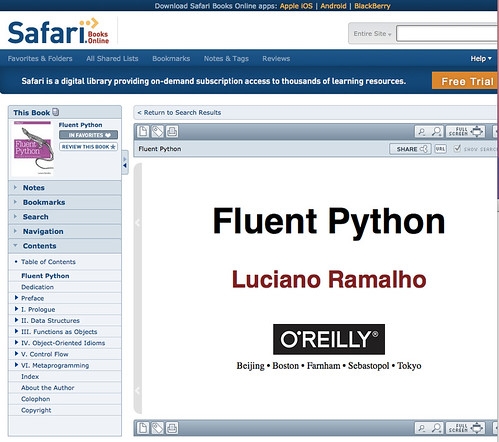
I've got my nose back in Luciano Ramalho's Fluent Python this morning, in Safari On-line.  I caught two of Luciano's talks at OSCON this year, and have downloaded their recorded versions.  The book itself has been a bestseller in its category on Amazon.

I've always want to see a concise Pythonic narrative that ties back to underlying C code and here I'm finding that.  For example Luciano does a great job describing the hash table algorithm behind dicts and sets, and then links directly to source code, where we find these comments:
The basic lookup function used by all operations.
This is based on Algorithm D from Knuth Vol. 3, Sec. 6.4.
Open addressing is preferred over chaining since the link overhead for
chaining would be substantial (100% with typical malloc overhead).

The initial probe index is computed as hash mod the table size. Subsequent
probe indices are computed as explained earlier.

All arithmetic on hash should ignore overflow.

The details in this version are due to Tim Peters, building on many past
contributions by Reimer Behrends, Jyrki Alakuijala, Vladimir Marangozov and
Christian Tismer. 
Having a link directly to Knuth's The Art of Computer Programming in the comments for the Python dict object grounds a specific source code implementation in the computer science behind it.  Great for digital mathematics teachers in need of heuristics.

I have that Knuth volume upstairs. What a great way to learn. Plus I have the Python REPL (pronounced "reh-pull") open in another window.

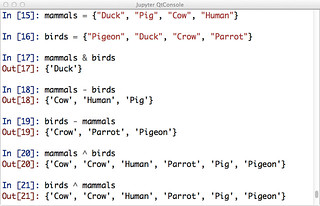
In going over the set data structure and its operations, I was thinking back to New Math and elementary school, when set notation was making its early entry into kid consciousness.  This was unfamiliar material to most teachers and much of it was junked in the ensuing backlash.  But we had no REPL back then (a few lucky college kids had ISETL maybe?), what if we'd had one?

set_ops
:: a duck is not a mammal! ::

But in 2015, why not boot a Python interpreter at some point when typing has been mastered?  Learn about union, complement, difference, intersection all over again.  It's just like New Math, but with more machinery to back it up.  I call it Gnu Math.

Speaking of typing, my friend Glenn reminded me why he can't type effectively, even after a lifetime as a typist:  most keyboards don't allow resting fingers on keys whereas in his time with NSA he had to pound through ten-ply fan-fold.   When he tries to type on a keyboard, he floods his own text with errors.  So frustrating!

Maybe there's some steampunk solution where an old mechanical Royal typewrite type keyboard is wired up as a USB peripheral?  My retired college professor friend Chuck Bolton never seemed to master the new keyboard either.  The Royal sits proudly in the living room.

In sharing Python with art history students or journalists, what's more important than exhaustive practice or keyboarding is an appreciation for the layers of culture, the ecosystem.  How does C source code relate to Python and what's a hash table?  That's enough of a story for one article.

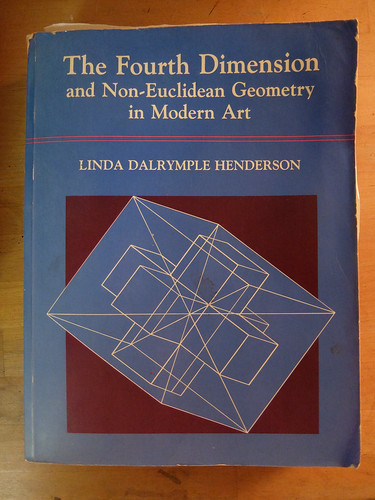
Why I'm addressing art historians these days has to do with the '4D meme' in the art world since the late 1800s, the core topic of another book I sometimes reread and review:  Linda Dalrymple Henderson's The Fourth Dimension and Non-Euclidean Geometry in Modern Art.

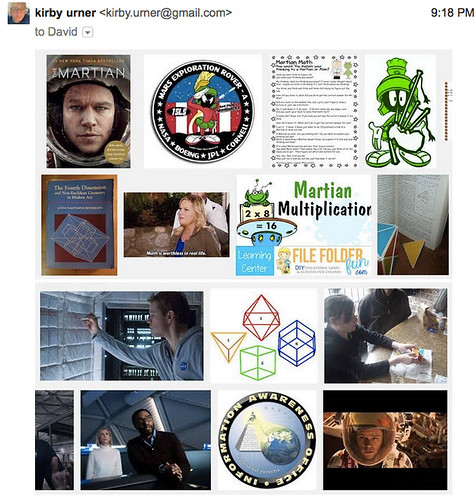
Through Python, I introduce art history students to the topic of Quadrays or Q-rays, needing no more than some high school XYZ mathematics, thereby helping to anchor the '4D' meme as Fuller used it. I also introduce Q-rays in Martian Math a curriculum field tested with high and middle school students at the Reed College and Portland University campuses.

DSCF0953

Wednesday, October 07, 2015

A Breakdown in Self Discipline

DSCF1054

Carol and I drove to Tom's this morning, which isn't far.  Walking is good for her, but today it was raining and this time three years ago she came down with pneumonia, after insisting on giving a speech on a bright October 2012 day in the park.  She had to be hospitalized and was on oxygen for months after that.  So we take care and not push it.  This year she went to Des Moines.

Anyway, at Tom's, an eatery, we had our breakfasts.  Per usual, I wolfed mine, being part wolf, at least in spirit (but also in eating behavior), so had time to spare.  Rather thank yak away, letting hers get cold, I went out for a Willamette Week, new on Wednesdays.

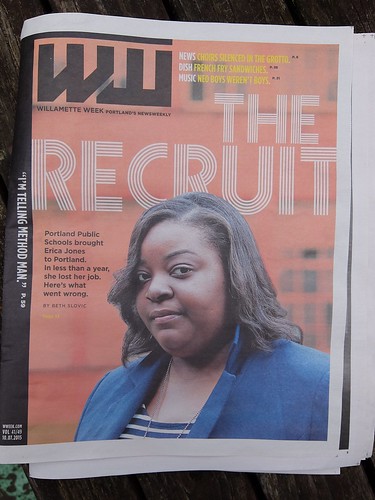
The cover article was really interesting.  Portland knows it's "too white" in some dimensions but is still trying to figure out in what way.  Lots of feedback circuits have been set up, and I think it's sinking in day by day, but to accelerate the process, PPS (Portland Public Schools) has put its shoulder to the wheel and tried to get some real Diversity going.  Some active recruiting has occurred.

The article is a first person account by one of the main guinea pigs in this experiment, Erica Jones, from Georgia.  Although the experiment may sound like a failure the way she tells it, I think it tells of a talented and brave person making a difference and filing her report.  Mission accomplished.  PPS and WW readers learn a lot, the whole point from the start (to learn).  The protagonist gets to retire to an easier lifestyle free from PPS pathologies (they'd made her sick), so a happy ending.

I recall on a jumbo jet, international in flavor, wherein we were all taking our seats, preparing for take-off.  Then some loud-mouth all-American white kid came on board, running his mouth incessantly in some fantasy world about terrorists and bombs, complete with sound effects -- unpleasant chatter to say the least.

What was most amazing though, was his parents seemed to see no reason to have erased this behavior before bringing him on an international flight, subjecting fellow travelers to nerve-grating spew.  It's not like this was an infant.  And that in a nutshell is what astounded this teacher:  the schools had no effective means of working with a lack of discipline and disrespect (there's a difference between "respect" and "obsequious" which any English teacher might go into).

But then to speak up on behalf of the kids, I'd say the school they're placed in really is more like a penitentiary in that the brainwashing forced through those text books is really quite obsolete and not matched to the needs of current generations.

The curriculum is way behind and kids have that intuitive resentment that stems from feeling warehoused, like refugees anxious to get somewhere better, to some Promised Land, and feeling delayed by fences and border guards.

The teachers take on the sheen of prison guards.  But that's hard to articulate when you're a kid and when kids before you all went to school and a lot of 'em thought the same thing.  Only juvenile delinquents hate school right?

However, we can give objective shape to their deprivation.

Do they teach you to cook (yes in some cases)?  Including for big numbers?  What history do you get and what civics?  How many voting machines does your school have and how often do they get used?  Do you ever get away from light pollution?

I'm not saying I know the outcome in all cases.  How about tetra-volumes, do your math books cover that?  They do?  Excellent.  I bet in some private Quaker schools they're already introducing at least a sidebar on Quadray Coordinates, designed to keep those philosophical debates alive (to be revisited in later years).

I've recently connected with another "hacktavist" youth group willing to take on more parallel / alternative schooling.  That's not a new pattern I realize.  Black Panthers did the same.

When some mainstream system or curriculum breaks down, others grow up around it, sometimes to become mainstream themselves.  This has happened often in history.  It's not necessarily a crisis, or calamity, not an apocalypse (except maybe in some technical religious sense with positive connotations -- check with your local religious authorities).

When change needs to happen, it tends to happen in some way, even if not the ways planned, and change often needs to happen.  Rule of thumb:  improving one's powers of anticipation and responsiveness is usually a likely possibility compared to the relative likelihood of stopping change cold in its tracks.

With all our new abilities to flip classrooms and provide professional development, more teachers could be like me, not responsible for a student's everyday behavior, which I don't monitor.  The teachers and students are not in the same room.

Studying for real also means time alone, as in a study carrel, not just in collaboration.  That's what you learn in college if not before.  Packed into rows and columns, in a classroom, with all present supposed to be connecting the same dots at the same time... why force that?  Why is such enforced regimentation even a selling point?

Having a safe personal workspace is what's paramount, if learning is really the priority.  If warehousing is the priority, why not just say so and drop the pretense?

Just having a locker is not sufficient.  When does this student just get to sit and read, undisturbed, or just meditate, free of distraction?  Do motion studies like in Elephant (cameras follow each student).  Develop stats.

Homework is great in theory, if you really have a home that fosters study.  Many homes do not.  Losing all interest in reading is a sign of serious brain rot.  Measure "time reading" as seriously as you measure "calories eaten" at least (over eating is more of a real danger, though over reading at the cost of degrading physical health is also a real condition).

The word "gymnasium" is right:  reading and reflecting are a form of working out.  Keeping fit is not just about swimming laps.  Watching TV is informative.  This is not an anti-TV rant.  However making TV (video / audio) is even more informative.  Does your school help you learn to do that?

As when writing or jamming, you may be lifting from other sources, making links.  Sharing camera shots, including segments, is not a crime when the licensing is deliberately liberal.  Citing sources is much appreciated and lends credibility but in some forms of journalism, sources get concealed, for their protection.

Does your school cover these basics then?

Tuesday, October 06, 2015

Men Without Honor

Official Washington got disgraced by its military again today, a bunch of unprofessional uber-cowards.  No one in the Pentagon resigned.  The Secretary of Defense still gets a paycheck.  Disgusting.

An inveterate glutton for war toys, way beyond reason, and with zero self control, Washington has made the mass killing of civilians a somewhat routine event.

This most recent massacre was much worse than in Roseburg obviously (do the numbers), but with the same cause:  mental illness, an inability to face reality, unrestricted access to weapons by those who shouldn't have them.

The perps in this case used a monster death machine against defenseless Doctors Without Borders and their hospital.  The logistics were so bad that phone calls from the hospital made no difference to "central command" (a headless chicken).

President Obama said nothing public about it.  He's going to Roseburg, Oregon, apparently because only American lives matter, whereas his own sickly mercenary forces murder children routinely.  The hypocrisy is palpable.

Some slob with stupid medals all over his chest tried to make it all better with his lame excuses, but of course WDC lost this stupid war long ago in the hearts and minds sense.  Who needs an enemy when you have goons like these running the show?

Lets see if anyone takes any responsibility whatsoever for this obvious war crime.  I'd reckon the loss to WDC in the billions over this, but that city has negative money anyway and will never repay, bankrupt as it is, morally as well as financially.

Flags at half mast?  Why have them on the pole at all?  Definitely the Pentagon should take theirs down, at least for a few symbolic minutes.  Show some public remorse maybe?  Just a tiny bit?

In any case, stop claiming to represent the American people already!  Your services are neither required nor admired.  Your cowardice will echo through the annals of history.  Citizen diplomats disavow this war and the perps behind it.

Just because one wears a military costume doesn't make one a respectable human being.  More is required.

I somewhat expect the story to morph such that the "Afghani forces" who supposedly requested the strike were actually Taliban infiltrators looking for ways to embarrass central command and make it appear like a headless chicken -- a way to deflect criticism and make the Taliban share the opprobrium.  The story has already morphed away from NATO itself making the request.

Everyone knows NATO can be tricked into doing just about anything, if one just acts and sounds like a warlord.  Finding a way to blame "the terrorists" would be the typical response here.  Lets see if that's how it plays out.

Why an organization so easily duped should be allowed access to war planes would be the next question but that's easy to explain:  no background checks required, just a credit card and the signatures of a few paid-for well-paid elected officials.  Talk about corruption!

Sunday, October 04, 2015

My Comment on QuakerQuaker

Yeah, it's hard to not get cynical about religion once one sees how it's harnessed by the temporal powers to their own ends.  Emperor Constantine learned his lesson:  if you can't beat 'em, join 'em, i.e make the Roman Empire officially Christian and you'll have the tools to keep growing. 

Mass produce Christian baubles for the gift shops, and the faithful will follow you blindly, as their "blind faith" (so very similar to blind loyalty to one's King) is built right in as a virtue, at least in the more decadent brands of pyramid scheme hierarchy. 

Obedience, not defiance, is what to cultivate in the masses.  Any religion able to do that is worth more than gold. 

Religion is used to create that state of reverence and solemnity, gravitas.  The Cross gets planted on some South American beachhead, and voila, miracle of miracles, this is now Papal Property.  Amazing.  It's downright Biblical!

Unfortunately for emperors and dictators, crime bosses of all kinds, Christianity is not quite tame enough to support a Borg Cube forever.  Whereas most humans seem eager to the point of desperate to surrender their free will to experts, professionals, pundits of all stripes, a tiny minority seems hell bent on doing its own thinking.  Irreverent Quakers pop up, questioning authority, refusing oaths of loyalty.  WTF!?  Where does the operator's manual say how to deal with Quakers?

As a result of such obstreperousness, micro-fractures emerge, and every so often, we get a meltdown, like the 100 years war twixt Catholics and Protestants [exemplary of a "meltdown" not saying Quaker caused -- KTU ].  Or the Civil War in the US.  Or maybe even something good happens.  A shakeup in world religions might be just what the doctor ordered.

For whatever reason our species refuses to settle into any one Kingdom or Reich.  I consider this hopeful and positive.  The Tower of Babel is maybe my favorite Bible story.  Silly humans, thinking they could create One System to Rule Them All.  Ain't gonna happen.

Thanks to some divine spark within common humanity, the peasants, handed a gun and a picture of their God, sometimes disobey their "superiors" and refuse to kill the enemy, seeing through the manipulation.  They see The Man behind the curtain, and, like Smedley "Fighting Quaker" Butler say out loud that War is a Racket.

However, to see religion as a tool of social control is not to see the falsity of all religion.  Cynicism of that variety is simply too easy.

Rather, the many religions and psychologies, not to mention philosophies, do indeed give us insights into something both collective and transcendent about the individual human mind. 

One could simply say "religion is the power of God's mind combined with the human being's endless ability to distort it".  The idea that humanity is simply a distorted image of what true angels must be like is an old one and I think I'll land it there for now -- a friendly / familiar airport.

[original context:  comment re So What's So Terrifying About Christianity? ]

Saturday, October 03, 2015

Art History

DSCF0953

Glenn Stockton has purchased the latest edition of Linda Dalrymple Henderson's book, The Fourth Dimension and Non-Euclidean Geometry in Modern Art.  I have an earlier edition (depicted above).

She's expanded her introduction considerably for the new edition, looking at published works at least up through 2009.

Linda is correct in lumping Bucky with those claiming to work in a fourth spatial dimension, versus time, and quotes him regarding the tetrahedron providing his own justification for such terminology.

In Synergetics, simply turning a right angle number of degrees (90), going around a street corner, is not escaping into "another dimension".  A turn of 89 or 91 degrees would be no less significant, were true dimensions at stake.

Rather, we start with Kant and an admission of volume or space as a priori, with the passage of time thrown in to give the grammar of change.  Things take up room and persist in doing so -- that's our experience in a nutshell.

How many spatial dimensions is volume?  The conventional answer is three, building up by right angles, through height, width and depth.

Fuller's answer is to throw a tetrahedron into the picture as a whole ab initio, and to argue its faces and vertexes bespeak a primitive fourness.  "A tetrahedron shouts four!"

That's about all he's saying -- almost too simple to make it into the history books.

If you want the 3ness of 3D, look at each of the two complementary zig-zags or "cobras" that make any Tetrahedron, a Z of three connected vectors.  But the four points so connected define the alternative "other" Z, so 3 + 3 = 6 is more like it, but sure, a Z might be used for addressing purposes, giving 3-tuples. Space is "Z-D" (but what number is that?).

The conventional description of volume as "3D" relies on a "jack" of X, Y and Z axes, each one a next dimension.  From this "jack" (vs. a "caltrop") we get 3-tuple addresses.

A fourth orthogonal is problematic (in the sense of oxymoronic), however 4-tuples are not, and these n-tuple data structures may be "projected" to something visual in ordinary space.  nD phase spaces have their Z-D analogs. 

A ball of n spokes from the center, whether orthogonal or not, may be declared "independent" with sliders set each to a specific level.  That's a "point" in an nD phase space.  Tighten the rules a bit, and you get a manifold or metric.

Fuller's math is not investing in having any "hypercross" of four orthogonals.  The tetrahedron pure and simple anchors our talk of 4D in this logical model, not in some sleight of hand or science fiction. One may use 4-tuple quadrays isomorphically with 3-tuple XYZ rays.  The caltrop spans Z-space (Z + N = Tetrahedron).

Developing an alternative 4D namespace is not to find fault with, nor invalidate, anything by Coxeter, the grand master of multi-dimensional polytopes to whom Synergetics is admiringly dedicated (with permission).

Frequency (time/size involvement), added to angle (pure shape), gets us to five dimensions if we wish to avail of such tools, i.e. a tetrahedron persisting in time-size, the stuff of scenarios in "Scenario Universe" -- make sense?

Energy added to pure Platonic form (4D) is more the Synergetics template.

When we have room for multiple namespaces, including exotic remote ones, such alternative beginnings get more room to breathe and show off their advantages, if any.

Synergetics itself, once booted, helps us keep our minds open, to multiple namespaces.  Systems, fully omni-triangulated, may be plentiful, like bubbles, produced quickly and in great numbers.  Stay tuned.

Thursday, October 01, 2015

Journalistic Shorthand

DSCF0838

In journalistic shorthand, adapted from diplomacy, they say "Assad must go" or "Saddam must go" (Saddam, Qaddafi and Assad were all on the short list they tell us), but of course in reality that's code for a whole administration, extended families, neighborhoods, sections of town.

Were we to decree that so-and-so could no longer be Mayor of Portland, Bud Clark for example, that might affect the people of Goose Hollow.

So when we hear talk about trying to remove "Assad", lets remember we're talking about institutions and organizations, a complicated motherboard, circuitry.  One doesn't swap out a leader like a light bulb or other simple component, it's not like that.

The diplomats all say the goal is to broker a deal with various parties at the table but it sounds like WDC doesn't want Assad at the table even to begin with.  Given that NATO / EU / US has already taken out Saddam and Qaddafi, the question is when will it stop?  What was the window?

Of course there's a ton of history to go over, if TV viewers ever have the patience for it.  There's no way to learn anatomy in thirty seconds.  Wasn't it Walter Cronkite who said his biggest fear was that so many people just got their news through him?

All we're in a position to do in Portland is welcome new refugees.  That's what Willamette Week is about this issue, introducing some new families.

No one asked Cascadia if / when to commence bombing; that decision was made by quite a few self-appointed authorities and a smattering of elected ones.  Their comic book language ("Assad must go") says nothing reassuring about their grasp of the situation.   Shorthand is too short sometimes.

Lets talk about what's going on in Iraq a lot more maybe?  What's the view from Baghdad?  I'll dig into that some, but for the most part I know they'd prefer we stay out of it and just deal with the collateral damage.

Saturday, September 26, 2015

WILPF Festivities

WILPF Turns One Hundred

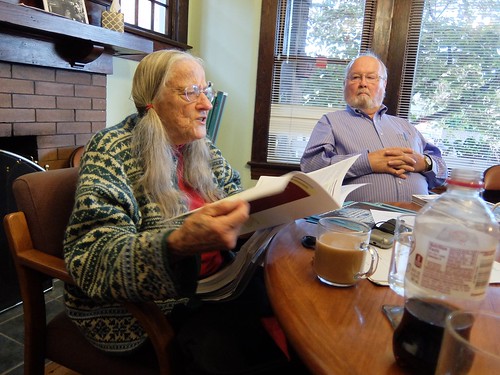
The gala events were in The Hague, NL, and Carol (my mom) got to go, as an official delegate this April, when the Women's International League for Peace and Freedom celebrated a hundred years of existence.

One hundred years ago, Grace De Graff -- who'd moved to Oregon from Illinois, to become a school teacher, administrator, and education planner -- was at the league's founding in The Hague, invited by Jane Addams herself.  Jane was on the lookout for strong manager women, still struggling to gain basic parity, in terms of rights, with men of privilege.

Today's events were the Portland, Oregon WILPF chapter's version of a Centennial, and I was invited to be one of the photographers (I believe technically I'm also a member of WILPF).

Carol Urner wrote a letter to the Oregon Reporter in the early 1960s, when I was pre-school aged, expressing fear and disappointment that this was all she had to look forward to:  a lifetime of fear under the threat of thermonuclear war.  That was no kind of world in which to bring up children, surely Russian moms agreed.  She'd wished so long for a family life, and having it end up a twisted science fiction nightmare in the wake of WWII was just heartbreaking and she wrote that to the newspaper.

Adult readers, other mothers especially, from all over town responded by telephone the next day, really wanting Carol to cheer up as "we can do something", and so a Portland women's movement was formed, to create some outcry about the standard assumption that we should all be buying and installing bomb shelters, with kids learning to duck and cover.

This movement later fed into WILPF, already active, and discovered by my mother and her friends as a perfect fit for their concerns.  Another famous WILPF member: Ava Helen Pauling, wife of the two time Nobel Prize winner, Linus Pauling.

Carol has been at it ever since, though in Rome and the Philippines, Cairo and Bhutan, she back-burnered her focus on abolishing nuclear weapons.  I'm glad she did, as that way she did get a family life mostly free of obsessing about The Bomb, and the end of civilization as a place of playgrounds and carefree kids.  She got to study history a lot more (one of her passions) and work with women's self help projects, handicraft-based, and teach grade school, and write text books.

One of the women who took the torch from De Graff, not directly but in a reconstitution of Portland's WILPF, was Eleanor Davis, age 92.  She grew into WILPF through her mother, whom she recalls being active in the 1950s.  Iona Tanner, whom I remember from childhood, has chronicled some of the history, as did Mary Bolton later, in the form of scrap books and clippings.  There's a lot of organizational memory here, worth curating I should think.

My job, as chauffeur plus photographer was to take Carol, Eleanor and their equipment and literature, to the staging site, named Walk of the Heroines on the Portland State campus. This monument was designed specifically to memorialize women, and a great many names appear thereon, sometimes grouped by organization.

The WILPF section is two or three stones of names towards one end.  I'm not sure how the monument is managed as to whether more names might be added.  Either way, I'm glad for this monument, though I'm biased given mom's name is inscribed thereon, next to that of Mary Bolton.

Sonya Pinney, not named (she's self effacing) was at the event, as observant as ever, seems to me.  She'd been digging through the recent issue of Western Friend and seeing letters replying to my article (two long ones).  That had led her back to the article itself in the previous issue, so we had quite a bit to talk about, comparing notes.

Then I had to attend to my car, moving it and the wheel chair to a next terminus, where the march would end.

Yes, the women marched with their WILPF banners quite a few blocks.

For some of that time, I was talking with Joel, a Food Not Bomber connected with Unitarians, and grabbing a quick salad at Safeway, catching up with the women at the Eliot Center.

For those into digging, the slides embedded in the show above are but a sampling, with more in the Photostream.

I won't try narrating the entire program in Eliot Center, save to say I took Eleanor home a little early, as she'd had all the fun she could bear, as my wife Dawn was wont to say.  Also, I caught up with Elizabeth, Ben Linder's mom, just a little.

Carol, who made at least three speeches over the span of the program, was pretty exuberant the whole time, on not much sleep, and crashed upon our arrival home.

Given all the logistics involved, and how much time had gone into the planning, I'd say stress levels were somewhat high, but that we all worked together on pulling it off.   Part of my job was staying peripheral, an unobtrusive observer, similar to my role at Disarm Day.  My camera and I wandered off into the surrounding context, capturing a slice of Portland in the Fall of 2015.

Making Sarah-the-dog hold it for so long was an oversight on my part and I phoned Deke rather late in the game to please check up on her if in the neighborhood.  I didn't have a clear grasp of the script we were following and imagined getting home earlier.

Congratulations to WILPF on a hundred years of focused work.  May the next hundred be likewise invested in having the world become a more humane place.  Lets hope we get to look back on continued progress, with thanks to our heroines for showing a way forward.
Monday, September 21, 2015

Triangulation Puzzles

ToonTown

I invited Alan Potkin to address Wanderers at Pauling House tomorrow, about his work in the field of environmental impact.  We've had lots of "eco talks".

As Alan points out:  so often the institution charged with undertaking an environmental impact study has a vested interest in the outcome in that it not mess with already drafted plans, many jobs on the line. 

The dam building company is supposed to do PR about what could be lost?  The builder is supposed to pay for an objective review?  They'd hire Alan and get what they'd paid for; and more than they wanted to know.

Why isn't this design in itself seen as a problem?  We let the accused plead the Fifth.  If someone is going to be working against you and your perceived interests, then really have that be someone else.  One can only be one's own sparring partner up to a point.

How do we solve conflicts of interest?  Triangulation puzzles.

Not solving them begets corruption, we know that much.

Alan may have left town however; no reply to my voicemail.  Maybe next time.

Other loose ends, for the Home Management committee:  the 1000 megabit service is to be throttled back to just 40, and they'll throw in TV.

I'm also getting the local digital broadcasts in the public frequencies.

The main thing is to stay on fiber with its faster up as well as down speeds, for an affordable monrhly fee.  CenturyLink would actually charge me more to not get TV, same bandwidth!

"No" said their office, I must pay the installation I thought was thrown in, but she agreed to shave off the bill for the few months.

Lumping Car and House karma into one:  K&M had it fixed by this afternoon; indeed a new starter was needed.  Thanks to AAA for prompt towing.

City life can be pretty smooth, if you're able to pay for it.  Aye, there's the rub.

A cornucopia of animations from ToonTown:  that's what Portland Knowledge Lab was forecasting, in an earlier chapter.

I'd rented an office near Lucky Lab, but moved out when Internet proved too slow.

I'd been expecting Synergetics-infused blends "any day now" but that assumes art schools were priming the pump with lectures of the type I've not been slated to give (yet), nor much of anyone apparently.

So that economy stalls.  Malesh.  Think where we could have been by now.

Other parts of our economy keep barreling ahead.  Even the bare ToonTown image seems to stick.  That's because Portland does have relevant heritage.  I was building on an existing image.

We could be making more manga, not to mention anime.

But I'm thinking most especially of cartoons of a techie type i.e. in this age of nano-tech / ONAMI it's the area of STEM visualization (or STEAM) were we need most focus.

Just talking heads are not enough.

The genre of biology videos, showing the happenings with DNA...  the problem being the bottleneck identified by Pfizer:  everyone is silo-ing IP (intellectual property) when it's the Open Way that's known to work (the liberal arts model, not penalizing sharing information but on the contrary making it easier).

Roadblocks aside, we could be practicing with curriculum treating of topics that already are Open Source, such as file systems and how they work.

Lets see what I can find...


Yeah, I do like those "sped up" drawing whiteboards, with fun drawings. I've watched lots of those.  Too many talking heads, teacher's back turned, writing... Not how we want it on TV.

I'd also like more density, with cutaways to talk about hardware, the history of storage (per Von Neumann)... a much wider selection of topics, inter-connected.

How 'bout it? Better STEM TV anyone?

Lets build up the library, the videogrammatron, of short clips anyone might use.  High production values are maybe self defeating if locked entirely behind some IMAX screen.  Lets share the IP.

Plus I'm talking about quirky art in addition, affordable and within range of solo artists.

The mix would be reminiscent of Sesame Street in some collections.

Thursday, September 17, 2015

Zardoz (movie review)

DSCF0266

This is an oldie but goldie I'd probably never have seen were it not for Alan Potkin of Brooklyn NY (by birth) becoming a lightning bolt in my reality, joining me at Horse Brass out of the blue (we set it up by cell) along my Belmont Street descent from Mt. Tabor (local hill), getting back in shape from a bout of ankle-itus.

Alan and I always have lots to talk about.  He's been in these blogs before.

Alan's wife, from France originally, is a distinguished scholar of that region of the world we think of as mostly Burma (Myanmar) these days, a region where ethnic strife continues, with world religions in the blender, mixing it up to make puree.

Alan shares her deep love for this region and goes there to pursue projects.  They married in our living room in Thimphu in the 1980s.

The fact that humans adapt to their world differently and then get flung together by fate, as is happening now in the EU, how the US was formed, has never been smooth, to say the least, though in isolated cases (e.g. specific marriages) it can work out well and serve as an inspiration to others.

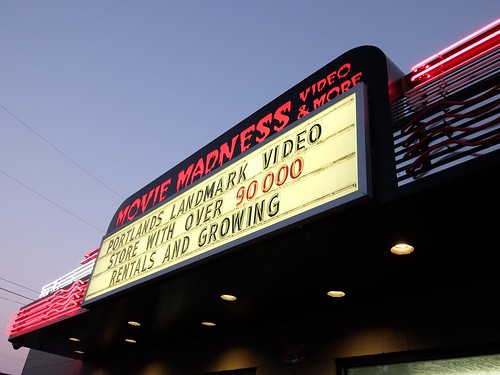
Somehow the conversation turned to Zardoz, a film, and since we were but a block away from Movie Madness, I was eager to prove its "we have everything" reputation, and indeed it did, filed by Hollywood Director, John Boorman, who wrote, produced and directed it.

Boorman is of British heritage Alan wanted me to know (i.e. he didn't only work through Hollywood's institutions), continuing our conversation later, with Carol, at Maru, the Japanese restaurant (Alan was ecstatic about the squid).  We'd watched the DVD, sans Carol, in my living room.

Lets see if I can get this right after only one viewing (I'm tempted to watch it again but hey, I'm not making a living as a movie critic and have to keep moving).

Zed (Sean Connery), a badass outlander, gets angry and disillusioned when his preferred lifestyle, with the Pentagon (by analogy, not mentioned), is disrupted by the stupid Sky Head, which now wants them to try agriculture.  The Sky Head used to barf guns, telling them to go crazy.

Instead of shooting the Brutals and raping their women (maybe the best part), Zed now has to teach them to farm, which is tedious and without shooting.  However by this time he's literate himself and knows the stupid Sky Head is really like some Wizard of Oz instrument of control, and the civilization behind it is just using him.  So he resolves to stowaway and get revenge against higher management.  This he does.

Higher management, in the meantime, has existential worries of its own, having tricked itself into immortality without sex.  They're bored, plagued with a serious death wish.  Apathy and senility are claiming their people, or they become renegades, which is also not fun.

Real death without coming back simply as another copy of the same worn-out persona, the same goon, would be a blessing and Zed, and those like him, may be the answer to their prayers.

The film ends on an up note, as needs dovetail and sex is back in the picture.  Everyone seems to get what they wanted.

Alan has been checking up on the hydrological projects, i.e. the hydroelectric dams, in South / Southeast Asia that have occupied his attention for the past few decades.

His technique is to boost the efficacy of environmental impact statements by pushing the PDF format to its limit, including movies of the waterfalls and waterwheels, the cultures, that might be lost if engineering fails to optimize for tourism and local welfare.

Fortunately, in many cases, by using pipe-fed turbines, as in Bhutan, engineers may take advantage of drops in the topography, i.e. of gravity, without a massive dam.  The pipe fills to capacity, but is not sucking down or backing up the whole river and thereby develops sufficient pressure for at least a micro-hydel-style turbine.

Of course this solution is not always relevant.   I'm just glad people have been thinking outside the box a little.

The Feng-shui of optimal power generating, that takes everything into account, is something we would hope the Chinese would be good at, but engineering needs to advance in its understanding of itself too?  We shall see.  From my viewpoint, Alan has been encouraging the engineering to improve.

Tuesday, September 15, 2015

Autobiographical Interlude

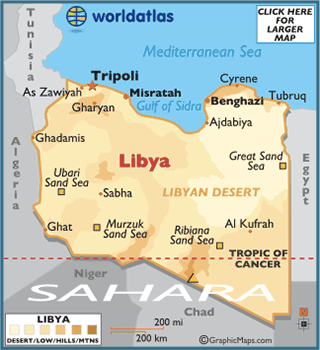
libya
:: worldatlas ::

How did I get to be "kicked back" in the Steve Holden Chair of Computer Science (large recliner), here in the Blue House, Asylum District -- and what does that mean for humanity?

That sounds like a good B-movie opening; that's right we're low budget.  I'm not going to tell a story of how I amassed a great pile of drachmas (pesos, lira).

Jack, my dad, wanted to practice his profession with a blanker slate than a busy metro area like Portland could offer -- which makes sense given his PhD work was in regional planning for less developed nations (we could say "Third World").  By the end of the 1960s, after some good years in Portland, we ended up in Rome as a family, so he could easily commute to the "project site" otherwise known as Libya.

From Rome we moved to Florida, with a few weeks in Ramallah, Palestine that summer, working with AFSC (a Quaker NGO, founded by a philosophy professor and Friends).

I'd attended both Junior English School of Rome, and American Overseas School of Rome, which we called OSR (ASOR today).

Then after Bradenton, we moved to the Philippines, arriving near the start of martial law under Marcos and cronies. I attend the International School (IS) in Makati.  Dad worked for the UN, USAID, University of the Philippines.

At that point, having finished high school, I branched off on my own trajectory, but continued visiting "home base" as it moved around, after that, to Egypt (Cairo), Bangladesh (Dhaka), Bhutan (Thimphu) and Lesotho (Maseru) in that order.  My younger sister pursued higher education in Ohio and New Jersey, ending up in Greater LA.

My dad was killed in a car crash in South Africa (RSA) in October 2000, and my mom, who sustained injuries, and was not expected to live, divides her year between myself and my sister.  She's in good health at 86 and continues her peace activism.

Carol his a history degree from Ateneo de Manila, a Jesuit college.  She knows a lot about St. Francis and also his friend Jacopa, an admirer from a powerful family in Rome at that time (a period she intensely studied).

Now I'm back in Portland, Oregon, have been since 1985, having left for Rome after 2nd grade.

I was joined by Dawn Wicca, as a business partner and later as my wife, from the 1990s to 2007, when she died of breast cancer.  Dawn was survived by two daughters, one from her previous marriage.  She was from Ohio, then Florida, an activist in the women's self help movement, and a bookkeeper, specializing in non-profit accounting.

From the Philippines I moved to Princeton for four years of university then kicked around the east coast, living in Jersey City, DC, Brooklyn, Queens, Apple Valley NC, before returning to Portland, by way of Bangladesh.

Dad's PhD work in planning had been at the University of Chicago.  He was completing that work when I was born, in 1958.  Both parents were Quakers by then, pacifists by leaning and training.  That accounts for the AFSC work, which I continued in my own way.

Carol (mom) was active in Women's Strike for Peace, and later WILPF (Women's International League for Peace and Freedom).

Post Princeton, I continued my interest in "futurism", encouraged by the example of my dad (his big picture plans for Libya and other countries were about anticipating needs for the next fifty years or so). By high school I'd become an avid reader of science fiction, and movie goer.  These traits are reflected in my blogs.

My foci at Princeton were myriad, though with philosophy paramount.  The combination of futurism, philosophy and international affairs (which I studied through Woodrow Wilson school courses) remains an evident source of thematic content in my writing and life's work.

My Quaker background led me to such writers as Kenneth Boulding, and later Dawn and I joined a group called Quaker Economics led by Joe Havens.  Joe's wife Teresina was an avid student of Buddhism and we were also members of her group.

Dawn and her first daughter joined me on a trip to Bhutan during which we visited the temple to Tara at Tongsa, for which figure our second daughter was named.  She is now college aged.

If I start talking about my career I'll start sounding like I'm giving my resume.  I might as well just link to it instead.

Saturday, September 12, 2015

Reality TV

Time to review some old themes and writings, with lotsa links to the "business mobile" (smartvan) concept.  The idea is we fan out in smartvans, not willy-nilly but as part of concerted World Game maneuvers and missions to assist refugees, other victims.  We're "dispatched" in other words, which implies a "control room" (any number) and "planning" in some scenes.  If you've watched a lot of movies, you have the innate ability to extrapolate and imagine a few episodes, at least in rough outline.

The TV angles are many, but lets talk about fundraising.  Our fans patch in to our web portal or we may even have a DVD show, like with seasons.  Broadcasters pick us up maybe.  We're like this weekly adventure series of brave / attractive people in a smartvan, part of a larger fleet, out there being helpful to our fellow humans in various dramatic ways that home viewers want a piece of.

Not only do the fans donate and get credit for so doing, they apply and train to jump in, to join us in the "MercyCorps style" swimming pool, this "model UN", this "scouting trip" or whatever.  A "terraforming corps"?  It's Planet Earth that I'm talking about.  We terraform more or less consciously, as a species, but either way, we make a big difference to the biosphere, that's obvious.

So yes, I'm turning Peace Corps / Americorps type work, jazzed up with smartvans and more high tech, into Reality TV that's self funding, with product placement another big part of it.  Who made the smartvans and just how smart are they?  I'm bringing it down to earth while projecting role models.

Crowning me a king of this genre (a producer) and paying me royally (not that much really -- I'm middle to business class) just adds momentum (inertia) to all this happening (helps make it real).

So what are the critics saying, and why haven't we done this already if it's such a good idea?  I've certainly been vocal enough about the possibilities.  Is it that "do gooder" programming is too "bleeding heart"?  Maybe only Catholics will watch our shows?  "If it bleeds it leads".  But then we're going to trouble spots and disasters in some shows, so if it's blood they're looking for...

I'd say we've been evolving the infrastructure.  The problem of dealing with micro-amount donations, nevertheless tracked (giving credit to donors who gave -- with anonymous mode options), is still not fully solved.  More banks may need to lend their expertise.

People aren't used to viewing a screen while contributing a few cents here, a few cents there (or call 'em bitcoins), optionally building their own record or profile, not to prove that they're rich so much as to show off their values and ability to "pick 'em" over time.  You're leaving a record of your intelligence, but in a way that's not yet habitual given insufficient infrastructure.

That's what a lot of philanthropy is a lot about (leaving a record of one's intelligence).  These Foundations have their own version of horse races.  But if you're a working stiff, you've not had time or leisure to invest in that "rich tycoon with zeal" mentality.  You don't get to look out over the world thinking "what shall I fund"?  Junk mail isn't working so well either, lets say.

That's where Coffee Shops Network comes in.  You buy your scone from Green Mountain and already get a sliver of GM's profit to toss in some bucket, like a chit or chad, say ten cents just to trivialize (in charitable casinos the amounts may be much higher).  Sipping your latte, you pop in your ten cents and flip up a game, say a Sudoku.

Given how fast and deft you are, you've won a whole dollar before it's over, and GM empowers you to be a "for the moment" shareholder / stakeholder (you bought their scone didn't you?) and to commit that dollar, your heroic skill having amplified value ten fold, to some worthy cause that these game machines know how to connect with.

Some favorite charity in Nepal just got another dollar.  Both you and GM have netted some good karma.  You feel accomplished.  You get a kick (energy boost) out of the experience.

That's a somewhat simplified and idealized rendering of the standard CSN transaction:  profit slice towards good will shared by company and procuring customer.

Accounting for "good will" on the books, as a way of building company reputation, is not at all a new idea.  What's new is the micro-management of donated amounts and the cutting in of customers as momentary shareholders, almost board members (in committing micro amounts of profit).

Some supermarkets do this at checkout, with coin jars for charities, but usually with no pledge to match, and with no way to give name credit to the donor.

But what if company X is ideologically opposed to funding Y or Z as "bad for the company's image"?  No problemo.  The range of options, the charities that might benefit, is known in advance and if the customer is truly hell bent on supporting Y or Z, just procure from a different outfit, free country.

Some of our shops host games that support some controversial causes, what can I say?  You may disapprove of your children's choices.  I'm not here to dictate who gets what.  I'm talking about wiring, an infrastructure, and a pleasant environment in which to help steer planetary affairs, with interesting reveries on the LCDs.

The CSN business model helps pave the way for doing the same things at home i.e in PWSs (personal workspaces), procuring investment credits, playing games, adding value.

People in their smartvans, getting support from others, in turn give support.  Channeling funds to the right places is a game we should all be in on, starting young.  We develop that ethic of paying attention to world problems.

Our cultivating a philanthropic mentality is not just for altruistic churchy "get me to heaven" reasons.  One simply acts more logically as a part of some solution when thinking globally.  We're less awkward, less wasteful, more attractive (including to ourselves) in proportion to our ability to solve problems as an intelligent life form, both individually and collectively (as team players).

"Doing good for real" makes for better television in other words, and better sex (I had to say that).   Hollywood stars learned these lessons long ago.

Tuesday, September 08, 2015

Wanderers 2015.9.8

Carol Addresses Wanderers

I got to the Pauling House early, given Carol (mom) is the presenter again.  I fumbled for keys, realizing I didn't have them, when Dick Pugh tried the door.  It was open.  Duh.  We made ourselves at home around the table.  Glenn, the official opener, arrived on time.

Dick was on the cell about the fire ball over Thailand last night.  Meteorite.  He's on it.  Don usually opens but he's got a meeting that will delay him until start time.  Hey, here he is!  I'm blogging in real time (I do that quite a bit, then polish up later).

Carol is talking about developments in the Countdown to Zero campaign, i.e. the abolitionist movement vis-a-vis WMSs (weapons of mass suicide).  She's been working in this area, mostly with Women's International League for Peace and Freedom, for quite a number of years, certainly since 2000, when she moved back to the US from Lesotho, after the accident.

She opened by talking about the Iran Deal, inviting discussion.  She passed around some PR, a poster, on Keeping Space for Peace.

This year the campaign is delving into Cyberspace more, which one might suggest is only metaphorically space, or virtual space, but that's taking too narrow a view.

Cyberspace is supported physically by satellites, which are used not just to carry communications, but to support GPS, which means ballistics / guidance.

Carol suggested that Geeks have the most insight into cyber warfare, which triggered a discussion of the difference between Geeks and Nerds.  I gave my standard "a nerd is the larval form of geek" spiel (short), while Glenn reminded us of the etymology of "geek" (carnival origins).  I think of nerds as socially awkward, more the ugly duckling phase of the more socially adept swan.

Jon sees the parallels to Lysistrata, what the women are doing, in trying to drag the guys away from wartime fixations.  WILPF does include men however.

Not one single nuclear weapon has been destroyed, according to Ban Ki-Moon, according to Carol.  They've been stowed, or are being cannibalized to make new / improved weapons.  Dave DiNucci came up with an actual quote.

Dick Pugh insists that many physical warheads have indeed been destroyed, but the active materials stay active.  Dick thinks a lot of warhead material has been diluted in some cases, to be useful for reactors only.

Our little group is not uber-informed about all this, it seems to me, but that just goes to show why we need a college major of Weapons Inspector or something similar.  Decommissioning is going to require a lot of watch dogs and engineeers.  Such dogs do not just appear without grooming.

Carol went over the Marshall Islands lawsuit, against all powers who are supposed to be working on disarmament, according to existing treaties.  The Okinawa Nuclear Free Zone.

"How much does Japan contribute to the Countdown to Zero campaign?" a Wanderer asked.

I said I was looking forward to a simple ethical code wherein anyone harboring or nurturing the creation of nuke weapons was obviously a Dr. Evil type psychopath Baddie worthy of some 007 or 003 type take down by a Goodie state and/or agency.  Persian Intelligence is already looking forward to fighting Dr. Evils on a world scale.