I am grateful for my friendships. I learn a lot from them.
Thanks to Ron, I'm now downloading Ubuntu 9.10 upgrade files on Sun's VirtualBox, newly installed as a guest operating system under Win7. The laptop is to my left, connected by ethernet on my home office subnet. I'm staring at Old Faded, my refurbished monitor (less frills than even at Free Geek around here some days (Ron and I used to work there together)).
This has been finals week for my daughter. She's off with her friends celebrating that it's over, in the neighborhood.
I thought Lionel's latest contributions with the Wikipedia page were substantive. Koski thinks we've done a professional job. Everything CJ Fearnley added is still in the mix, along with my earlier edits. I'm not thinking so much in terms of a "fork" as a "merge" at this point.
I'm scanning the horizons for breakthroughs, thought this virtual convergence of math teachers looked promising. Real work happens through cyberspace, even if we don't get to move in to our virtual classrooms. We still need to feed, shelter and clothe ourselves. Education Automation (an old title, not unlike Skinner's Walden 2 in some respects) requires logistics on the ground.
Friday, January 29, 2010
Thursday, January 28, 2010
Recapping Some Threads
I brewed up a tempest in a teapot last year, on both math-teach and math-thinking-l, focusing a lot of attention on what I was calling a "digital math" (DM).
Then I'd wonder somewhat wryly if we were really up to implementing such changes in "the lower 48", implying Alaska and Hawaii might be leading the pack in this regard.
I also campaigned for using more electronic media in place of wood pulp textbooks, as more environmentally friendly and easier to correct (update, fix, otherwise improve).
Well, I certainly got some feedback, and I've needed to revise my approach.
For one thing, "digital math" is just not conservative enough for most teachers. "Discrete math" sounds dry as bones maybe, but at least it's a recognized topic.
I filed an update to math-teach earlier today, with a note to PSF members just to let them know I'd mentioned Python Software Foundation in passing.
My little media campaigns aren't widely reported on or repeated in any case, so chances are none of this was on your radar (dear reader) unless you've been tracking these blogs for some reason, or dove in through Twitter or Facebook.
Getting more computer-savvy math courses, both inside and outside the 50 star states, remains on the agenda for lots of groups of course.
A goal is to reach out through teachers to a lot of underprivileged, not make this just be about elite schools pulling even further ahead.
Experimentation and innovation is the name of the game. Will we be able to engender the right spirit? What gets people in the mood to try new approaches?
What sponsors want to step up to the plate, put their brands on the line? Is this really about the government doing everything, while private industry kibitzes from the sidelines?
Anyone with semi-romantic ideas about capitalism should be arguing otherwise no? Industry leaders are wanted and needed on this one, both domestically and overseas.
Then I'd wonder somewhat wryly if we were really up to implementing such changes in "the lower 48", implying Alaska and Hawaii might be leading the pack in this regard.
I also campaigned for using more electronic media in place of wood pulp textbooks, as more environmentally friendly and easier to correct (update, fix, otherwise improve).
Well, I certainly got some feedback, and I've needed to revise my approach.
For one thing, "digital math" is just not conservative enough for most teachers. "Discrete math" sounds dry as bones maybe, but at least it's a recognized topic.
I filed an update to math-teach earlier today, with a note to PSF members just to let them know I'd mentioned Python Software Foundation in passing.
My little media campaigns aren't widely reported on or repeated in any case, so chances are none of this was on your radar (dear reader) unless you've been tracking these blogs for some reason, or dove in through Twitter or Facebook.
Getting more computer-savvy math courses, both inside and outside the 50 star states, remains on the agenda for lots of groups of course.
A goal is to reach out through teachers to a lot of underprivileged, not make this just be about elite schools pulling even further ahead.
Experimentation and innovation is the name of the game. Will we be able to engender the right spirit? What gets people in the mood to try new approaches?
What sponsors want to step up to the plate, put their brands on the line? Is this really about the government doing everything, while private industry kibitzes from the sidelines?
Anyone with semi-romantic ideas about capitalism should be arguing otherwise no? Industry leaders are wanted and needed on this one, both domestically and overseas.

Monday, January 25, 2010
Forging Ahead
 :: 61-axes by vorthmann & hart ::
The Wikipedia project has been going OK (SNEC helping). I did some editing from Laughing Horse Books last night, after accompanying the collective on a recon mission under some bridges: the camp near Mercy Corps had been swept recently -- means the police had cracked down. Dignity Village and most shelters are full (need some new ones?). Met up with a church team from Tanasbourne, compared notes.
More editing today from Urban Grind. Then back to the Flextegrity workstation, keeping on keeping on.
More editing today from Urban Grind. Then back to the Flextegrity workstation, keeping on keeping on.
Koski and I have both been focusing on great circle networks. He's got zonohedra and zero volume hexahedra to think about, some Pascal's Triangle rule.
I've been revisiting Fuller's trying to superimpose his A module's plane net onto his 120 LCD triangles, a result of spinning the icosahedron around its 31 axes.
"Fuller states two possible icosahedra from the VE so 2*31 axis = 62. The whole enantiomorphic thing. Then adds the 25 great circles getting 87, but it is noted that the 3 and 4 axis of the VE are redundant, the three is part of the 15 axis and the 4 is part of the 10 axis in the five fold. Since he had doubled the 31 great circles he reduces the 87 by 14 to get 73; (3+4)*2 =14."He's referring to this well-known figure (in geometer circles): Fig. 1132.01B.
Like how many young women are getting some digital math in their schools, thanks to any kind of stimulus, public or private? Give us a breakdown by zip code area, thanks in advance.
Tuesday, January 19, 2010
Wanderers 2010.1.9
We're going around the table introducing ourselves. Our guests are from Borneo. Adrian Lasimbang from near Kota Kinabalu and John Paisley. Here's John's thumbnail autobio:
I made a quick trip to Frys this morning. The Win7 laptop had a loud and vibrating CD/DVD drive, but seemed to work, until I pushed it to a limit, in trying to read an Ubuntu 9.10 iso. It burned OK, but would not read it, even though my desktops would. Frys graciously exchanged it. That's good, as this is a work machine. The 150 GB backup device came in handy.
Patrick and I were looking at Beautiful Soup at Angelo's this evening. This cool guy engaged us in talking about gauges versus metric. Turns out he's a glass blower and has this cool Youtube about trying to "blow lava" (as if it were glass, which it sort of is -- Pele's in this instance).
Small villages in Borneo, using micro-hydro for power, do manage to gain Internet access in some cases. Bringing in trainers helps minimize the negative effects of future shock. The communities retain control over their own adaptation process and that proves a more satisfying and sustainable process. Kids don't need to trek off to school, learn right there in the village -- a valuable development.
BSEE '87, came to Portland that year to work in test and measurement at Tektronix which lasted for 5 years when I discovered I'm terminally self-employed and went back into residential construction. Presently owner/president of John Paisley, Builder, Inc. I've worked with The Borneo Project since '95 protecting indigenous peoples' land rights from timber, mining, and other extractive interests, through projects such as community mapping, longhouse construction, village scale microhydro, solar-powered, satellite-linked internet at remote villages, and preschools for Penan (an exceptional group of hunter-gatherer nomads).We have a therapist and zoo guide visiting with us tonight. She knows about orangutans, which is what took her to Borneo last year. She and I have chatted before, during the Appreciative Inquiry seminar.
I made a quick trip to Frys this morning. The Win7 laptop had a loud and vibrating CD/DVD drive, but seemed to work, until I pushed it to a limit, in trying to read an Ubuntu 9.10 iso. It burned OK, but would not read it, even though my desktops would. Frys graciously exchanged it. That's good, as this is a work machine. The 150 GB backup device came in handy.
Patrick and I were looking at Beautiful Soup at Angelo's this evening. This cool guy engaged us in talking about gauges versus metric. Turns out he's a glass blower and has this cool Youtube about trying to "blow lava" (as if it were glass, which it sort of is -- Pele's in this instance).
Small villages in Borneo, using micro-hydro for power, do manage to gain Internet access in some cases. Bringing in trainers helps minimize the negative effects of future shock. The communities retain control over their own adaptation process and that proves a more satisfying and sustainable process. Kids don't need to trek off to school, learn right there in the village -- a valuable development.
Sunday, January 17, 2010
Coffee Shop Meetings
Regarding TT (teacher training), I diagrammed a workflow, pretty primitive, while waiting for Rami, an MVP Oregonian ramping up around Django.
This is all based on old news though (from last summer), mixed with a little recent email. Were I a journalist, I'd probably be called into the editor's office, to be asked if there's really a "there" there.
Django is a content management system (CMS) that allows developers to build more full featured web platforms, such as ThinkSpace.
Django is written in Python and provides a free and open source library of tools one needs for talking to databases and presenting well styled web pages to the user. You also get session management, user authentication, an admin back end.
These tools come as a tightly integrated Python package (in site-packages) and work right out of the box. The rest is your own secret sauce.
In a separate meeting at Starbucks, I learned about the Red Card, while explaining my philanthropic gaming idea, basically a "U drive" lottery system, with shop patrons taking credit for their donations to charities. You'd need the right banks to accept the incoming funds and convert them to EFTs as a service.
Speaking of coffee shops, I was in Lyrik again this morning, hobnobbing with Joe about Flextegrity again. We pulled up the folder and rolled through some slides. Last night was a grand opening for some new pieces, several of which sold.
If I stick with photography, then the story comes to you, perhaps in far away Japan. It's not either/or though. Local venues make sense. Lindsey is always strong-arming people towards Muddy's, which I appreciate. Aimee and I are thinking of going there next time.
I was glad to see Allison Randal is getting nominated to the PSF Board. +1.
This is all based on old news though (from last summer), mixed with a little recent email. Were I a journalist, I'd probably be called into the editor's office, to be asked if there's really a "there" there.
Django is a content management system (CMS) that allows developers to build more full featured web platforms, such as ThinkSpace.
Django is written in Python and provides a free and open source library of tools one needs for talking to databases and presenting well styled web pages to the user. You also get session management, user authentication, an admin back end.
These tools come as a tightly integrated Python package (in site-packages) and work right out of the box. The rest is your own secret sauce.
In a separate meeting at Starbucks, I learned about the Red Card, while explaining my philanthropic gaming idea, basically a "U drive" lottery system, with shop patrons taking credit for their donations to charities. You'd need the right banks to accept the incoming funds and convert them to EFTs as a service.
Speaking of coffee shops, I was in Lyrik again this morning, hobnobbing with Joe about Flextegrity again. We pulled up the folder and rolled through some slides. Last night was a grand opening for some new pieces, several of which sold.
If I stick with photography, then the story comes to you, perhaps in far away Japan. It's not either/or though. Local venues make sense. Lindsey is always strong-arming people towards Muddy's, which I appreciate. Aimee and I are thinking of going there next time.
I was glad to see Allison Randal is getting nominated to the PSF Board. +1.
Thursday, January 14, 2010
Message Traffic

The catastrophic events in Haiti have galvanized AFSC into action. I was encouraged by the quality of the email, complete with embedded article, pictures, and donate button, signed by the executive director. This went to various e-lists, was forwarded into the mix. Lots of scam artists have gotten into the act as well. Plus no amount of money is any substitute for real logistics on the ground.
Would these hexayurts help? We'd need a new kind of reality TV to find out maybe.
Yes, another Sleeping Bag Fundraiser is in the works through Laughing Horse Books. Musicians from Portland's legendary scene are focusing attention on human misery here in Portland. Lindsey Walker is planning an all acoustic event (not amplified) at our meetinghouse on March 3, in collaboration with Elizabeth Fischer, our Program Committee clerk. The money is handled transparently. Our musicians aren't getting paid, they're getting exposure as committed and caring for their community.
Good seeing Jeff at Alberta Street Pub, the night of that Spanish language class at Laughing Horse Books (moved over from Liberty Hall). He's a Wanderer with training in international business, including in China.
Other stories I've been tracking: the one about John McLaughlin doing stuff (op-ed) behind the scenes (I recall his making an appearance earlier in my blogs); the one in Scientific American about shutting down the supply chain for all weapons-grade nuclear materials, a blanket ban.
Regarding compassionate engineers just doing the right thing, I think a lot of that goes on. The unsung heroes outnumber the sung, at least in some especially treacherous areas. Waiting for politicians to agree may result in life-threatening delays, dangerous meltdowns, loss of vital services.
Geodesic Domes with a Made in China label? That could be a business. Of course we have room for more than one player.
On the more prosaic side, I've been rave reviewing the 2nd edition of Litvin & Litvin, aka Mathematics for the Digital Age. I showed it to Jeff. I also showed it to Patrick. Rami said he's taken a look at the web site. Robert Hansen is even thinking of marketing angles, a breakthrough as he and I have had some heated arguments on math-teach.
The Wittgenstein list is pretty hot these days. I'll anchor to one of Sean's. Explore in this neighborhood if wanting some juicy posts on the Tractatus. You'll find me quoting a passage from The King of Infinite Space regarding Donald Coxeter's relationship with Wittgenstein. I'm also back to appreciating Henry Le Roy Finch and his book Wittgenstein: The Later Philosophy (Humanities Press, 1977).
So Donald Coxeter's scenario partially overlaps these two others I've studied intensively: Bucky Fuller's and Ludwig Wittgenstein's -- an interesting triangle.
Monday, January 11, 2010
Reality Checks

:: math meetups ::
At the checkout lane in People's Food Coop this evening, I came across The Big Ideas of 2010, the latest issue of Adbusters. The centerfold or double page spread towards the center, was all about mechanized bombing with "game changing" drones, as controlled from Nevada or other cubicles. The verbiage about the weapons seemed mindless and laudatory, the familiar cruel hype. The message of the spread seemed to be that war by these means might be continued indefinitely, if for no other reason than doing something else might be considered defeatist.
I was disturbed by this nightmarish article, especially because of its context. Here we were in a mostly organic, progressive, worker owned food coop, the kind of institution Portland prides itself in supporting. Why would the magazine rack include such psychopathic propaganda? Was our world imploding this quickly?
Lindsey was stocking up on supplies (grains, beans, onions, carrots), some of which will stay at Harrison Street, some of which might go to Duke's, where she's planning to get her food handler's license and whip up a southern vegan meal during the next "private undercover party" (one of our Ignite-like events). She didn't see the article but thought it might be tongue-in-cheek, a spoof. I wasn't so sure, was feeling disoriented.
At about this time, the Clerk of Oversight phoned me, aware that I was slogging through hell in some way. I'd been at the two hour committee meeting that afternoon, left a little early when Tara texted, saying she might be coming down with something. I ferried her home from a friend's on SE Clatsop. She'd been using the bus both ways, as I'm working to conserve fuel, and promote teen independence (as a high schooler, her student ID also counts as a bus pass). She's seeming better this morning, off to school on the bus again.
I'm hoping to get together with Friends and give more of a sense of my picture over here. Just keeping these journals is not the complete practice. We have clearness committees and stuff like that.
I've been in touch with Gary Litvins about Mathematics for The Digital Age and have an OSCON proposal in draft form wherein that book gets mentioned towards the end of the abstract. Here's what I've written:
Oregon teachers have plans to start field testing a new kind of mathematics course in 2010 that would count towards fulfilling the legally mandated three year minimum mathematics requirement for a high school diploma. Learn how the Python community has been supporting these efforts and how the open source community more generally is becoming involved.From a math teaching perspective, I think the Litvins text is a breakthrough. Students use it at Phillips Academy in Andover, considered one of the nation's top schools. I've been going on Math Forum asking for advice from my peers: if we wanted to spread a course more like this around Oregon, how would we do it?
Other developments such as poster sessions at Pycons, an upgraded turtle graphics library, new on-line resources and published titles, suggest future trends in education.
The appearance of Mathematics for the Digital Age and Programming in Python, by Maria and Gary Litvin may signal a sea change in high school level mathematics teaching, or perhaps it simply represents a confluence and positive synergy of many long term trends, including the bias towards teaching more discrete math topics at the high school level.
The solution that seemed to be shaping up last August was to simply fire up the new course under the heading of discrete and/or digital math, per state standards. There's already a section in the standards for such material.
However the real question is where to find the teachers, when to equip them with the few additional skills needed to take some well-known and conservative content, and make it ready for the digital age. In the case of the Litvins text, that means learning some Python.
Would we field a small army of Python trainers then? That seems like a possible strategy, should funding become available. Or perhaps these teachers are simply learning Python on their own? Having been a high school teacher, I know there's a lot of pressure just to keep up with the existing schedule. Preparing to teach something new would mean time away from other duties and teachers on the front lines may not have that luxury, absent some institutional work flow.
I may be too out of the loop on this one. Should someone else give this talk then? Maybe this blog post will garner some feedback.
Exercise 8 in Chapter 10 (2nd edition) gets into V + F = E + 2, Euler's Law for Polyhedra. That's the kind of stuff I get into through my Oregon Curriculum Network web site, also very vested in Python. I've tended to use VPython, a 3rd party library, for my Saturday Academy classes, which makes it relatively easy to get colorful polyhedra on screen. I haven't done much with PyMol yet, another add-on our chemistry teachers might enjoy.
Having since checked that Adbusters web site, I think Lindsey is correct that I was reading a spoof. More like The Onion then? On the other hand, it just seemed too real. These drones are much worse than V-2s, plus are used against people with no air defenses to begin with (no RAF). Calling these remotely piloted know-nothing drones "weapons against blow back" is simply ridiculous, but then I could hear some faux counter-terrorism expert saying just such a thing, perhaps over a secure phone from some ski trip somewhere. Are these the same anonymous faux experts who disbelieve the NIE, think we should be bombing civilian power plants in Iran? Who put them in charge?
Once home, I focused on filling out an application form for a part time tutoring job. I wrote to Stu Quimby on Facebook, asking if I could use him as a reference. My work on a geometry toy is more relevant to math students than some of that database work for the outcomes research people at Providence Health System.
Getting a digital age math course option out to students will require innovation at the institutional level, the design of new roles, new work flows. As an army of one, all I might do is point in that positive direction and suggest this might be our ticket to a brighter tomorrow. I am quite aware that the Obama administration wants to get the focus back on education and jobs, not to mention health care. We might well have a bigger army here soon. On the other hand, innovation is a difficult process taking skilled managers. ONAMI was an inspiring, showed me that Oregonians still have that pioneering spirit.
Education in the digital age means using more viewers like Google Earth and Microsoft TerraServer. The news shows are already using those. TV has already improved in that sense.
My thanks to Carey Carlson for sending some philosophy PDFs, somewhat in the Russell-Whitehead lineage. Also thank you Tom Higgins for pointing me to Roger Ebert's blog. My prayers for John and Eve Talmadge, cousin Mary, Grace, cousing Pat and her mom.
Thursday, January 07, 2010
Some Adjustments

Trevor's latest music CD is a masterpiece. I made a special trip upstairs to warn my daughter to prepare herself if she was going to come downstairs.
These sounds are sometimes both inexplicably eerie and hauntingly beautiful in ways only music and life can be.
I needed to backpedal on some misapprehensions I had about Nietzsche, namely that he was Austrian. I made a post hoc change to Philosophy 101, tweaking the time stamp (a ritual gesture, means "shifted" or "adjusted").
Paul Laffoley's blog gives me a new angle on Pierre Teilhard de Chardin, whom I've been yakking about recently. I'm having some deja vu about all this, not sure why:
My only objections to Pierre Teilhard de Chardin (1881-1955) are first, he refused to believe in the existence of Extraterrestrials, meaning that the Earth was the only place in the Universe where intelligent life exists; and second, as a student he participated in “The Piltdown Man” hoax in 1918 in East Sussex England by burying a Neanderthal human skull without its mandible and then substituted a chimpanzee mandible. The attempt was to make the World believe in the existence of the fabled “Missing Link”.Trevor rightly points out that Grunch.net has this retro 1990s flavor, suggests I convert everything to WordPress, including these blogs. As it is, Synergetics on the Web is a hodgepodge of different styles and fonts, lots of hand-coded static HTML.
My thinking these days is "grunch" and "grunge" go together ("grunge of giants"?), meaning we start from the fact of a downscale planet, don't pretend we're richie rich. Yes, there's this "GRoss UNiversal Cash Heist" connotation (GRUNCH), but that simply means we have nowhere to go but the future, no choice but to invest, one way or another.
Anthony Mason had the right idea in that January 5 piece on CBS News, which Katie said was terrific. Will new shelter solutions be a part of the mix, or is the plan to just do more FEMA trailers from here on out?
A Math Talk
The reason I promote hexadecimals so much has less to do with understanding everything there is to know about bases, including negative and irrational number bases, and more to do with comprehending some details behind the ASCII-to-Unicode story.
Expanding the number of permutations of 1s and 0s, by adding slots, doubling their range with each added new one, means growing by powers of two. At four bits you have 16 permutations, mapping to the digits 0-F.
Since when was F a digit?
Since hexadecimals: 0 1 2 3 4 5 6 7 8 9 A B C D E F.
Two such digits represent eight bits and that's conveniently called a byte (I'm reminded of mites, sytes and kites for some reason). Four bytes look like this: 12 AB 5F EC.
8 bits gives 2**8 or 256 permutations, enough for much of Latin-1 (like Roman letters), but not enough for all the world's alphabets and ideograms, math symbols, cursive glyphs in joining groups (ways to connect to one another -- important in Arabic and Syriac scripts).
By widening the field from 8 to 32 bits, one boosts the range to 2 to the 32nd power or 2**32 or 4,294,967,296 (more than four billion slots). Only the first 21 bits are really needed at this time, leaving room for the shared symbol space to double many more times.
Think of at least three reasons we might need to add code points (hint: what if Teilhard was wrong?).
My thanks to Carl Trachte for this blog post.
Tuesday, January 05, 2010
Another Debate
This is actually Wanderers 2010.1.5, if you're flying that airline, however I'm more the Martian this evening, coming late, leaving early.
I've got the client laptop, so had to remember the pass code (WEP). Bill Sheppard gave me a clue. I asked in pen on a postit (sticky 3M) so as to not interrupt proceedings, which is all about systematic errors in GPS readings, Mt. Hood guy, lots of listeners.
You need a minimum of two systems if you're going to prove the errors are systematic in the first place.
This debating coaches web site is interesting to me; I forwarded it around. This might explain some election shenanigans? "Drill baby drill"? Was that Exxon or what?
Barry: an under-ocean DC line across the Bering Strait would never work. You'd need 10 feet of insulation plus there's nothing but wilderness on both ends. He also despises windmills as flaky and loud, ecologically destructive (too many roads). I also wanted to ask him for an opinion about thorium reactors -- some other time perhaps.
Trevor has some great new information, such as show times in WDC, for the D.W. Jacobs play about Bucky.
One of our Cascadia Wilders is relating her experiences with little handheld GPSs, what happens when a satellite goes goofy (because setting). The more satellites the better, but you'll get sucky readings if the alignment is bad. You need to know how to read that. Digital math, an outdoor sport (sometimes) is / was gonna do that for ya. In Alaska maybe?
The client laptop is Windows7 with the latest Office. Word is way different. I spent the evening adding drop shadows to those two of Koski's, showing vZome with twisted greens, courtesy of Dave Koski.
Aldona just walked in, armed with info on algae (a potential fuel source -- so much more space efficient). Good seeing her. Steve Mastin, Jon Bunce... some people I don't recognize. That guy looks like retired brass, an unusual species in Portland -- I could be wrong. Anyway, he looks familiar. I'll call him Bob.
The debaters seemed pretty certain that WDC was remiss in not accepting the offer of technical assistance.
Trevor cites Bucky in Playboy suggesting homosexuality might be one of those gentle taps on the brakes Malthus favored, a godsend. Apocalyptic types prefer oblivion to utopia so they can say "I told you so" though.
The new translation of Wittgenstein replaces Anscombe's "queer" with something different, even though that's what she heard, in English. Is this improving her translation or copy editing? Sean is right to ask the question, even if it's much ado about nothing.
I've got the client laptop, so had to remember the pass code (WEP). Bill Sheppard gave me a clue. I asked in pen on a postit (sticky 3M) so as to not interrupt proceedings, which is all about systematic errors in GPS readings, Mt. Hood guy, lots of listeners.
You need a minimum of two systems if you're going to prove the errors are systematic in the first place.
This debating coaches web site is interesting to me; I forwarded it around. This might explain some election shenanigans? "Drill baby drill"? Was that Exxon or what?
Barry: an under-ocean DC line across the Bering Strait would never work. You'd need 10 feet of insulation plus there's nothing but wilderness on both ends. He also despises windmills as flaky and loud, ecologically destructive (too many roads). I also wanted to ask him for an opinion about thorium reactors -- some other time perhaps.
Trevor has some great new information, such as show times in WDC, for the D.W. Jacobs play about Bucky.
☂ D. W. Jacob’s play R. BUCKMINSTER FULLER: THE HISTORY (and mystery) OF THE UNIVERSE will be performed May 28 - July 4, 2010 at the Arena Stage Crystal City in Washington, DC. Doug tells me: “Crystal City has put out an international call for artists to create outdoor works of art around Bucky themes and concepts, etc.” More information available from the Arena Stage.I'm to meet with Trevor tomorrow, have some ideas to run by. Our Private Undercover Party motif, developed through Duke's, might be just the ticket for a teaser / preview of Tetrascroll (a cosmic fairytale).
One of our Cascadia Wilders is relating her experiences with little handheld GPSs, what happens when a satellite goes goofy (because setting). The more satellites the better, but you'll get sucky readings if the alignment is bad. You need to know how to read that. Digital math, an outdoor sport (sometimes) is / was gonna do that for ya. In Alaska maybe?
The client laptop is Windows7 with the latest Office. Word is way different. I spent the evening adding drop shadows to those two of Koski's, showing vZome with twisted greens, courtesy of Dave Koski.
Aldona just walked in, armed with info on algae (a potential fuel source -- so much more space efficient). Good seeing her. Steve Mastin, Jon Bunce... some people I don't recognize. That guy looks like retired brass, an unusual species in Portland -- I could be wrong. Anyway, he looks familiar. I'll call him Bob.
The debaters seemed pretty certain that WDC was remiss in not accepting the offer of technical assistance.
Trevor cites Bucky in Playboy suggesting homosexuality might be one of those gentle taps on the brakes Malthus favored, a godsend. Apocalyptic types prefer oblivion to utopia so they can say "I told you so" though.
The new translation of Wittgenstein replaces Anscombe's "queer" with something different, even though that's what she heard, in English. Is this improving her translation or copy editing? Sean is right to ask the question, even if it's much ado about nothing.
Saturday, January 02, 2010
Omega Party

:: omega party ::
I'm no expert on the history of this place, having just set foot in the door a few minutes ago. Obviously this used to be a neighborhood church and was designed with that purpose in mind.
Buzz and I met at Laughing Horse this afternoon. He wanted to learn more about tensegrity, having come across it through my blogs. I showed up with Kenneth Snelson's newest book. We stood on a street corner with his daughter, about Tara's age, thumbing through it, while waiting for her ride to show up.
In his authoritative Tensegrity, R. Moto says he's not crowning Kenneth the Father of Tensegrity only because he's not a kingmaker, hasn't the power to bestow that title. This seems a diplomatic communication of his sentiments.
Speaking of Kenneth, I was pleased to read about his recent in-studio meetup with Gerald de Jong. Good news. Gerald has been a Snelson fan for many years.
Gerald was our house guest in the 1990s, during which time we drove to the Kasman-Chu residence in South Seattle for a geometry confab, followed by a rendezvoux at Karl Erickson's to learn more about elastic interval geometry and Gerald's emerging Java application (Karl was an early power user, as was Russell Chu).
Even back then Gerald was committed to using a cigar shape, like a shiny balloon, for his elastic intervals. Darwin at Home, his more recent EIG application, still reflects this aesthetic.
Gerald had come from the Netherlands to attend JavaOne in the Bay Area. We would meet again at a party in Santa Cruz, after another JavaOne, with Bonnie DeVarco, Joe Moore, other scholars and luminaries.
These in-person meetings were infrequent. However we'd been meeting in Cyberia as avatars, in Bonnie's virtual high school, or in that other "world" devoted to matters geometric. ActiveWorlds had come online long before Second Life and we were among the early adopters, investigating educational uses for this shared communications infrastructure.
Speaking of neighborhood churches (Kenneth pokes fun at me for any "church of Bucky" vibe), I've been preaching to the choir on Synergeo again. My welder friend darmraj is pointing out that practically no one on the planet devotes any attention whatsoever to our friggin' MITEs, their tripart dissection. We're just a bunch of crazy die-hards at this point, floundering amidst the flotsam and jetsam of unused nomenclature.
Quoting myself preaching:
This all seems kinda backwards doesn't it. A rag tag crew of buckaneers, scattered around the world, is stuck knowing more about primitive space-filling shapes and crystal lattices than most people ever wanted to know. That's a natural consequence of taking Fuller seriously and is proof that this curriculum works, in terms its of students developing higher reading comprehension, better powers of concentration. You'd think that'd attract some attention?Buzz and I then adjourned to the book store. The collective was holding a staff meeting, so we kept our voices muted, hung out in the foyer, running our laptops, connecting to Facebook. Buzz shared about an already up and running Pacific Rim manufacturing concern with an active R&D division. He was yakking about shelter solutions, polyurethane fabric. Like tents? We'll see where he goes with this.
Preaching to choir, talking to self.... blah blah.
Over on the Wanderers list, I came across this sad blog post from one of our global university students, shared by Gus Frederick of Silverton. Hossein is like the Dick Pugh of Iran, an award-winning science writer studying astrogeology on his own dime. The New Mexico Institute of Mining and Technology has offered him a scholarship, would be happy to get him, but he can't get a visa from the US authorities.
Bucky Fuller considered nation-states a cruel holdover from those divide-and-conquer great pirate days. They encouraged parochialism and self-destructive behaviors. A more supranational mindset was emerging, thanks to telecommunications and decreasing misinformation, so humanity was in a race against the clock in Grunch of Giants (1983). World Game, with its focus on the global electrical grid, would help reorient and anchor the new thinking in this brave novus ordo seclorum.
Lindsey has started her set. Burn Out seems appropriately apocalyptic under the circumstances. It's closing time at Liberty Hall, a final performance. "The curtain's coming down, and everything is gone. The banquet's left the hall, the débutantes are bald, there's nothing left to do..." The acoustics are excellent, her performance bold, to my ears flawless. Portland is blessed with a truly vibrant music scene.
Other bands have arrived and stacked their equipment along both sides of the room. Only another eight hours to go. I'll be exiting shortly, wandering off on foot to find Michael and Matt. We're celebrating Michael's birthday today.
Monday, December 28, 2009
Borrowed Books
I'm borrowing a couple technical tomes from the Flextegrity company archives. Extended Icosahedral Structures, edited by Marko V. Jaric and Denis Gratias (Academic Press, 1989), and Rene Motro's Tensegrity, Structural Systems for the Future (Kogan Page Science, 2003).
Last night we coasted along at the high school level, sharing elementary geometry. My write-up argues that our literature base provides a more secure grounding for tackling such science readings, however the proof is in the pudding. What do I myself, for example, comprehend from these readings? In a way I have an unfair advantage though, as I've chosen from a neighboring domain.
Linus Pauling's contribution in the first tome is on the skeptical side, advances the hypothesis, backed up with experimental evidence, that "icosahedral twinning of cubic crystals" explains a lot of what we were seeing in the raw intelligence.
Background: X-ray diffraction and electron micrographs are disclosing more information about crystalline structures and the readouts provide startling evidence of 5-fold symmetry (icosahedra, rhombic triacontahedra etc.) for some of the metallic alloys (aluminum with magnesium is especially implicated but we've seen it before elsewhere for sure). Given icosahedra don't pack to fill space, there'd never been a strong expectation that crystals, which do extend omni-directionally, would have such a symmetry. Scientific instruments were proving otherwise and the heat was on to come up with explanations. The papers were flying thick and fast (1980s).
Pauling takes the conservative line that individual components might (obviously do) have icosahedral symmetry, but if you zoom back far enough, you'll discover these mega-groupings that obey known rules of the non-5-fold kind. Buckminsterfullerenes packed in an fcc, or flextegrity itself would be good examples, but Pauling's groupings are more complex. Mg32(An, Al)49, for example, is analyzed in Figure 1 as being a bcc, but inside you have these nested 5-fold clusters (icosahedron, dodecahedron, truncated icosahedron). Figure 4 shows the icosahedron's relationship with a cube (like Sam's tensegrity). The 82o-atom primitive cubic crystal, consisting of clusters of 104 (Figure 3), provides a great climax for this paper. There's lots about "unit cubes" which a knee-jerk buckaneer might worry about. Think of a 2F cube and stop worrying. Then watch the chemistry channel around 30 angstroms (on your frequency spectrum dial).
This article is a great compendium of already-found structures, going back to the 1920s. It's heartening to see all this knowledge in one place, makes me wanna look at the VRML worlds and toons, cines, claymations (Portland Knowledge Lab stuff).
On the other hand, in a higher dimension you can have an icosahedron of 20 regular tetrahedra, other magic tricks impermissible in ordinary dimensions. Sadoc and Mosseri do a great job on this, starting on page 163. Check out Figure 1 from Pearce (I've just been citing him), and the impossibility of having 20 regular tetrahedra make a regular icosahedron on page 169 (Figure 2).
Go from R3 to S3 and problem solved (!), with the caveat (page 173) that "the template itself lives in an unphysical space (S3)." We see Coxeter's name a lot, plus this number sequence 1, 13, 45, 117, .... (not finding that in OEIS though).
Riffing off the above... Another explanation for the readouts has been the aperiodic one: whereas "a five-fold-symmetric lattice" is something of an oxymoron, aperiodicity is compatible with quasi-uniform density and plenty of structural conformity. "Distributed individuality", as manifest by the Penrose tiles, analogous spatial modules, results in multiple unique 3D tessellations of the same space. There's much more one could say (and Pauling does). The number of Barlow packings (CCP, HCP both subtypes) is likewise huge (if finite) and those all have density 0.74 -- so let that be a reminder of the geometry, if not the chemistry. There's an essay on glass I still need to look at (Figure 2 is revealing).
Regarding the second title, I'm another player with a personal angle on the Fuller-Snelson rift, which R. Motro spends some time on, the consummate diplomat. All I'm gonna add at the moment is I think the patent system is somewhat cruelly exclusive, although I can't blame those who rush into it, but there's a Zeitgeist phenomenon we should credit as well. These ideas are in the wind and not everyone is within shouting distance of a patent attorney, might be too busy starving in India someplace. For a few minutes, imagine a patent office with Holy Ghost on every single filing. No need for a patent office then. My point exactly. Back to reality: I celebrate human genius in all its forms and am happy to count my friends as true blessings.
OK, some source code from Patrick to look at (buzzbot). Gotta boogey.
Followup: Dave Koski, upon reading this blog post, sent me the following update: "Not sure if the Pauling institute has a gun to your head or if the flextegrity dynamic is getting to you. Pauling was long ago dismissed with his assertion that quasi-crystalline structures was a trompe l'oiel of being icosahedral in nature."
Last night we coasted along at the high school level, sharing elementary geometry. My write-up argues that our literature base provides a more secure grounding for tackling such science readings, however the proof is in the pudding. What do I myself, for example, comprehend from these readings? In a way I have an unfair advantage though, as I've chosen from a neighboring domain.
Linus Pauling's contribution in the first tome is on the skeptical side, advances the hypothesis, backed up with experimental evidence, that "icosahedral twinning of cubic crystals" explains a lot of what we were seeing in the raw intelligence.
Background: X-ray diffraction and electron micrographs are disclosing more information about crystalline structures and the readouts provide startling evidence of 5-fold symmetry (icosahedra, rhombic triacontahedra etc.) for some of the metallic alloys (aluminum with magnesium is especially implicated but we've seen it before elsewhere for sure). Given icosahedra don't pack to fill space, there'd never been a strong expectation that crystals, which do extend omni-directionally, would have such a symmetry. Scientific instruments were proving otherwise and the heat was on to come up with explanations. The papers were flying thick and fast (1980s).
Pauling takes the conservative line that individual components might (obviously do) have icosahedral symmetry, but if you zoom back far enough, you'll discover these mega-groupings that obey known rules of the non-5-fold kind. Buckminsterfullerenes packed in an fcc, or flextegrity itself would be good examples, but Pauling's groupings are more complex. Mg32(An, Al)49, for example, is analyzed in Figure 1 as being a bcc, but inside you have these nested 5-fold clusters (icosahedron, dodecahedron, truncated icosahedron). Figure 4 shows the icosahedron's relationship with a cube (like Sam's tensegrity). The 82o-atom primitive cubic crystal, consisting of clusters of 104 (Figure 3), provides a great climax for this paper. There's lots about "unit cubes" which a knee-jerk buckaneer might worry about. Think of a 2F cube and stop worrying. Then watch the chemistry channel around 30 angstroms (on your frequency spectrum dial).
This article is a great compendium of already-found structures, going back to the 1920s. It's heartening to see all this knowledge in one place, makes me wanna look at the VRML worlds and toons, cines, claymations (Portland Knowledge Lab stuff).
On the other hand, in a higher dimension you can have an icosahedron of 20 regular tetrahedra, other magic tricks impermissible in ordinary dimensions. Sadoc and Mosseri do a great job on this, starting on page 163. Check out Figure 1 from Pearce (I've just been citing him), and the impossibility of having 20 regular tetrahedra make a regular icosahedron on page 169 (Figure 2).
Go from R3 to S3 and problem solved (!), with the caveat (page 173) that "the template itself lives in an unphysical space (S3)." We see Coxeter's name a lot, plus this number sequence 1, 13, 45, 117, .... (not finding that in OEIS though).
Riffing off the above... Another explanation for the readouts has been the aperiodic one: whereas "a five-fold-symmetric lattice" is something of an oxymoron, aperiodicity is compatible with quasi-uniform density and plenty of structural conformity. "Distributed individuality", as manifest by the Penrose tiles, analogous spatial modules, results in multiple unique 3D tessellations of the same space. There's much more one could say (and Pauling does). The number of Barlow packings (CCP, HCP both subtypes) is likewise huge (if finite) and those all have density 0.74 -- so let that be a reminder of the geometry, if not the chemistry. There's an essay on glass I still need to look at (Figure 2 is revealing).
Regarding the second title, I'm another player with a personal angle on the Fuller-Snelson rift, which R. Motro spends some time on, the consummate diplomat. All I'm gonna add at the moment is I think the patent system is somewhat cruelly exclusive, although I can't blame those who rush into it, but there's a Zeitgeist phenomenon we should credit as well. These ideas are in the wind and not everyone is within shouting distance of a patent attorney, might be too busy starving in India someplace. For a few minutes, imagine a patent office with Holy Ghost on every single filing. No need for a patent office then. My point exactly. Back to reality: I celebrate human genius in all its forms and am happy to count my friends as true blessings.
OK, some source code from Patrick to look at (buzzbot). Gotta boogey.
Followup: Dave Koski, upon reading this blog post, sent me the following update: "Not sure if the Pauling institute has a gun to your head or if the flextegrity dynamic is getting to you. Pauling was long ago dismissed with his assertion that quasi-crystalline structures was a trompe l'oiel of being icosahedral in nature."
Saturday, December 26, 2009
Disaster Relief
The science here is that healing is critical to life, and the call to practice healing arts is one many seek to follow. Providing opportunities to serve, in roles for which one is trained, has competence, is one side of the equation. Other objectives: field testing of new practices & procedures, product placement, brand loyalty.
Cast in these terms, "answering the call" may sound idealistic and therefore perhaps too unrealistic. Some disaster relief goes on of course, but as Katrina-Rita well demonstrates, political systems may be reluctant to see disaster relief as as a primary leadership responsibility, even domestically (not that all agencies are equally dysfunctional).
The military on the other hand, does have call answering responsibilities, with war a kind of man-made disaster. The competencies may be different, in having a goal to inflict pain on some enemy. When it comes to providing opportunities for service in disastrous circumstances, we have that in this case. National guard recruiting commercials make that clear.
In our global university context (another metaphor for Spaceship Earth), the pain of war is self-inflicted. Reorienting to "save our ship" is equivalent to seeking a more sustainable security.
Military personnel are expected to test armaments, wave the flag, thereby providing ammo to arms bazaar merchants when hoping to impress the VCs (or procurement officers as the case may be). If you're marketing a new weapons system, you need to show off what it can do, persuade that it's deadly. It's called "the theater" for a reason. Witness Panama.
Back to the doctors and their mission, you also want opportunities to test new technologies and techniques, not because you seek to inflict pain, but because you wish to ameliorate it. You have your theater as well. You're a health care professional with duties and responsibilities, skills. Big pharma, other vendors, ply you with free samples, pump advertising to the LCDs, creating expectations and demand. These are similar to the pressures in the defense industry.
The hunger to serve is ingrained, as is the recognition that one needs to match jobs with skills. If a job becomes impossible for some reason, the institution itself needs to adapt, by inventing new roles. No one needs to wear the title of Superman (or Iron Man) in Afghanistan. Clark Kent gets the day job, not his alter ego.
In the aftermath of Katrina, we saw a lot of military logistics capability standing by on the sidelines, frustrated. North Americans don't trust an armed force of a federal nature in their states, except on bases (in forts), have their national guards at state level.
I recall Lara Logan from CBS interviewing some commander on the ground, in New Orleans after Katrina, asking what was taking so long in the face of all this suffering. Was this commander with the Army Corps of Engineers? I don't remember the details, except that he shared her frustration. Defending one's homeland needs to mean something real.
In the aftermath of the tsunami in South Asia (five years ago today), you had militarily trained personnel doing full time disaster relief, and loving it in many cases. Helicopters were relevant. Storytellers in the media communicated the higher troop satisfaction levels. The body politic back home was on board with this also. This is way better than hitting the kids with bombs, don't you think? We had some consensus.
What's sorely lacking from these disaster relief scenarios are quick deployment solutions, crack teams of disaster relief workers, backed by the full faith and credit of our housing and food service industries.
Geodesic domes would not be out of place here, or maybe we're just deploying shipping containers, especially designed for this work. Prototypes abound. Getting these things off the drawing board and into the field takes skills and hard work. Here's an expense we might justify.
These are life skills, our progeny learning them. Work/study is both training and serving. The tools at hand needn't be Neolithic, assuming we keep our skill sets intact. The opportunity to use higher tech is tremendous, but will require overt focus and design.
Compassionate engineering is not an oxymoron, nor is it anti-profitable (anti-wealth creation). On the contrary, if your company isn't helping with healing, then aren't you risking your brand? Ditto flag, religious icon. Being on the right side of history counts in the market place of ideas. Ben & Jerry's has done some good work... Newman's Own. Let's take stock.
I was just perusing Grunch of Giants again, Fuller at his best, really pithy. As caretaker of the grunch.net domain name, I should do that every so often.
Fuller was saying back in 1983 how there'd be a postponement of national insolvency for long enough to rearm, even though Grunch had sufficient funds to just buy the gear outright. By now, some decades later, we find ourselves with a lot of the wrong tools, vast parking lots full of unused armor, the work of a million man hours that might have applied otherwise (opportunity cost concept).
We're saddled with nerve gases in need of incineration, inventories of terrible weapons requiring destruction, with growing obesity and a dependency on trucked processed foods cutting into life expectancy in so many zip code areas.
If the patient (humanity) wants to survive, we'll see more evidence of that fact soon. Where's the move to stop wreaking havoc and to start using the available tools for healing purposes, adding new ones per the feedback cycle just described?
This impulse will be coming from the military as well, as we're talking about primal security matters.
The situation is bleak, dire, yet worth looking at. Having human beings give their conscious attention to this matter of healing the Earth, availing of opportunities to serve, is definitely an appropriate response here. The sense of urgency is widespread. The global climate change debate is but one manifestation of that sense.
The victory here would be for the patient, the student body. It's not a matter of figuring out which ideology has lost. People have their various mythologies about what's going on, their internalized global models. Diversity in this realm is to our advantage. Yes, I'm preaching "live and let live".
Neither the "warring religions" theme, nor the "science versus religion" theme needs to so preoccupy our attention that we forget to sew seeds for tomorrow's harvest. Religions great and small teach forward thinking, planning, aligning to calendars, adhering to values more likely to pay off.
Yes, they're also sometimes conveyor belts for misinformation, as have been so many of the pseudo-sciences (with more of those in the pipeline). In hindsight, we see ourselves deceived in our beliefs, again and again. Skepticism and a determination to do one's own thinking: these are virtues in both the spiritual and engineering worlds (as if there were two).
Given we need all the help we can get, we welcome whatever constructive teachings the various religions and sciences might offer. Apocalyptic mindsets abound and may not be the most responsible ones out there. Be choosy, exercise discrimination (not a bad word, when applied to ideas).
Cast in these terms, "answering the call" may sound idealistic and therefore perhaps too unrealistic. Some disaster relief goes on of course, but as Katrina-Rita well demonstrates, political systems may be reluctant to see disaster relief as as a primary leadership responsibility, even domestically (not that all agencies are equally dysfunctional).
The military on the other hand, does have call answering responsibilities, with war a kind of man-made disaster. The competencies may be different, in having a goal to inflict pain on some enemy. When it comes to providing opportunities for service in disastrous circumstances, we have that in this case. National guard recruiting commercials make that clear.
In our global university context (another metaphor for Spaceship Earth), the pain of war is self-inflicted. Reorienting to "save our ship" is equivalent to seeking a more sustainable security.
Military personnel are expected to test armaments, wave the flag, thereby providing ammo to arms bazaar merchants when hoping to impress the VCs (or procurement officers as the case may be). If you're marketing a new weapons system, you need to show off what it can do, persuade that it's deadly. It's called "the theater" for a reason. Witness Panama.
Back to the doctors and their mission, you also want opportunities to test new technologies and techniques, not because you seek to inflict pain, but because you wish to ameliorate it. You have your theater as well. You're a health care professional with duties and responsibilities, skills. Big pharma, other vendors, ply you with free samples, pump advertising to the LCDs, creating expectations and demand. These are similar to the pressures in the defense industry.
The hunger to serve is ingrained, as is the recognition that one needs to match jobs with skills. If a job becomes impossible for some reason, the institution itself needs to adapt, by inventing new roles. No one needs to wear the title of Superman (or Iron Man) in Afghanistan. Clark Kent gets the day job, not his alter ego.
In the aftermath of Katrina, we saw a lot of military logistics capability standing by on the sidelines, frustrated. North Americans don't trust an armed force of a federal nature in their states, except on bases (in forts), have their national guards at state level.
I recall Lara Logan from CBS interviewing some commander on the ground, in New Orleans after Katrina, asking what was taking so long in the face of all this suffering. Was this commander with the Army Corps of Engineers? I don't remember the details, except that he shared her frustration. Defending one's homeland needs to mean something real.
In the aftermath of the tsunami in South Asia (five years ago today), you had militarily trained personnel doing full time disaster relief, and loving it in many cases. Helicopters were relevant. Storytellers in the media communicated the higher troop satisfaction levels. The body politic back home was on board with this also. This is way better than hitting the kids with bombs, don't you think? We had some consensus.
What's sorely lacking from these disaster relief scenarios are quick deployment solutions, crack teams of disaster relief workers, backed by the full faith and credit of our housing and food service industries.
Geodesic domes would not be out of place here, or maybe we're just deploying shipping containers, especially designed for this work. Prototypes abound. Getting these things off the drawing board and into the field takes skills and hard work. Here's an expense we might justify.
These are life skills, our progeny learning them. Work/study is both training and serving. The tools at hand needn't be Neolithic, assuming we keep our skill sets intact. The opportunity to use higher tech is tremendous, but will require overt focus and design.
Compassionate engineering is not an oxymoron, nor is it anti-profitable (anti-wealth creation). On the contrary, if your company isn't helping with healing, then aren't you risking your brand? Ditto flag, religious icon. Being on the right side of history counts in the market place of ideas. Ben & Jerry's has done some good work... Newman's Own. Let's take stock.
I was just perusing Grunch of Giants again, Fuller at his best, really pithy. As caretaker of the grunch.net domain name, I should do that every so often.
Fuller was saying back in 1983 how there'd be a postponement of national insolvency for long enough to rearm, even though Grunch had sufficient funds to just buy the gear outright. By now, some decades later, we find ourselves with a lot of the wrong tools, vast parking lots full of unused armor, the work of a million man hours that might have applied otherwise (opportunity cost concept).
We're saddled with nerve gases in need of incineration, inventories of terrible weapons requiring destruction, with growing obesity and a dependency on trucked processed foods cutting into life expectancy in so many zip code areas.
If the patient (humanity) wants to survive, we'll see more evidence of that fact soon. Where's the move to stop wreaking havoc and to start using the available tools for healing purposes, adding new ones per the feedback cycle just described?
This impulse will be coming from the military as well, as we're talking about primal security matters.
The situation is bleak, dire, yet worth looking at. Having human beings give their conscious attention to this matter of healing the Earth, availing of opportunities to serve, is definitely an appropriate response here. The sense of urgency is widespread. The global climate change debate is but one manifestation of that sense.
The victory here would be for the patient, the student body. It's not a matter of figuring out which ideology has lost. People have their various mythologies about what's going on, their internalized global models. Diversity in this realm is to our advantage. Yes, I'm preaching "live and let live".
Neither the "warring religions" theme, nor the "science versus religion" theme needs to so preoccupy our attention that we forget to sew seeds for tomorrow's harvest. Religions great and small teach forward thinking, planning, aligning to calendars, adhering to values more likely to pay off.
Yes, they're also sometimes conveyor belts for misinformation, as have been so many of the pseudo-sciences (with more of those in the pipeline). In hindsight, we see ourselves deceived in our beliefs, again and again. Skepticism and a determination to do one's own thinking: these are virtues in both the spiritual and engineering worlds (as if there were two).
Given we need all the help we can get, we welcome whatever constructive teachings the various religions and sciences might offer. Apocalyptic mindsets abound and may not be the most responsible ones out there. Be choosy, exercise discrimination (not a bad word, when applied to ideas).
Thursday, December 24, 2009
Punishment Park (movie review)
Punishment Park is a 1971 fictional drama.
A civilian tribunal treats US citizens as enemy combatants and either locks them away or gives them a choice to be hunted down, providing practice for police and guard units. The prisoners are trying to reach an American flag in some dry desert landscape in order win their freedom, but the rules of the game make this a hopeless proposition.
According to the director's comments, this film was too disturbing to gain much traction, certainly on TV and even in most film schools, despite his groundbreaking techniques. His cast is mostly unrehearsed, improvises, role plays.
Peter Watkins knows the documentary genre cold, is a master of fast cuts, juxtapositions, the use of a hand held camera. The film makers play the role of a British TV crew, invited to witness America's domestic policies. The result is effective.
This film was made in the wake of Kent State during a time of intense opposition to government policies, long before Guantanamo and indefinite detentions without charges, under provisions of the Patriot Act, of both US citizens and foreign nationals.
The message for Americans today is they need to stay open to the teachings of the 1960s and 1970s. The boomers lived through their own hell and want us to learn from their experience. I speak as a boomer myself, concerned with the future of my university (Planet Earth).
Tuesday, December 22, 2009
Dire Straits
As a latecomer to the ISEPP board (not a paid position), I feel its within my job description to explain our situation. We've lost the ability to retain Glenn Stockton as our Pauling Campus maintainer, with Terry himself looking at collecting unemployment. I don't yet know how this will impact the lecture series.
Liberty Hall is throwing a party, nominally Project Omega. The politically minded groups who paid rent for this establishment are no longer able to do so. This is a good bye party. Lindsey is playing the role of music coordinator (a volunteer job).
There's this sense of shutting down all over, as we run low on ideas. Has the "invisible hand" of free market forces come disconnected from its brain? Is capitalism self-strangling?
As we roll into the New Year and start taking stock of our first 21st century decade, we have little choice but to look down the road a piece. We'll be staring at that Times Square buckyball again (by Phillips), perhaps uncomprehending of the heritage it represents.
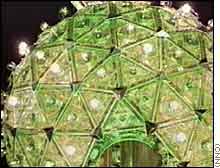 :: Times Square New Years ball ::
I hearken back to my meeting in London with Alan Kay and those other high minded people, yakking about a brighter tomorrow, for South Africa mainly, where I have ties through Quakers and family history.
I hadn't seen Idiocracy yet, but in retrospect see that movie as reflective of Alan's concerns (mine too). This isn't about genetics (that was in spoof), but memetics (transmitted ideas). One either successfully passes the torch to coming generations or one drops it.
The Renaissance I'm seeking to spark, in a conspiracy with other buckaneers, really depends on having a cerebral press, other intelligent media, willing to actually look at some mathematics and science for a change.
 :: flatworms by M.C. Escher ::
(geometry of nature)
Newspapers frequently do this, with some stories more challenging than others to wrap one's thinking around. This story is really not that difficult to relay though, at least in its basic elements. I hope this blog post is proving my point.
A high civilization might share it through buzz in the coffee shops, along with whatever retro French existentialism. This stuff works well on LCDs, which are omnipresent in gyms as well. How about on the backs of cereal boxes?
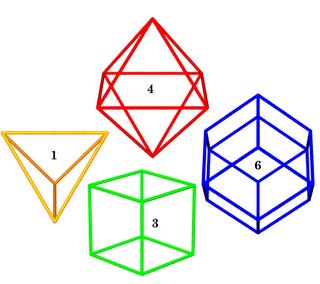
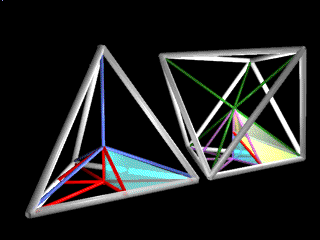
The simple whole number volume relationships I've long sought to popularize and share through the schools have by now enjoyed a half century in publication. Dr. Arthur Loeb wrote up something for The Math Teacher way back in 1965 (Remarks on Some Elementary Volume Relationships Between Familiar Solids, Vol 58:15).
Robert Williams, citing the above work, along with Fuller's Synergetics itself (still in manuscript in some St. Louis archive, dated 1960), gives the gist of our "concentric hierarchy" in his 1972 Geometrical Foundations of Natural Structure: A Source Book of Design (Dover).
 True, he messes with Fuller's meaning for A&B particles (modules), changing it slightly, but he does so consciously (page 136, footnote 20).
Posting to Synergeo, quoting from my private correspondence:
Beyond personalities however, she investigates what in Fuller's thinking might have merited the attention of such a pure-minded geometer (not an architect, not a defense contractor like Bucky was, back in those radome days).
Without specifying the formula (S = 10 * f * f + 2), she cites Coxeter's admiration for this basic discovery, simple enough to prove:
 A&B modules, by Richard Hawkins
Synergetics is dedicated to Coxeter, yes, but where does it actually cite his work directly?
Answer: in the caption to Figure 950.12, which is all about the MITE and the shapes you might build with them. He cites page 71 of Coxeter's Regular Polytopes directly. Why? Because in Fuller's own thinking, this is one of his major breakthroughs.
Furthermore, since he's the only one using these modules and since it is he who has named them, the attention to his ideas he so longed for would now be a done deal.

His ideas would accrue all the academic respectability owed to them and Synergetics would not simply be shelved and forgotten as "a lot of nonsense" (Coxeter's initial reaction, on confronting this philosophical work). His other works would remain influential by extension and we'd be off and running towards a better tomorrow, a brighter future for our Spaceship Earth (or Global University).
 Autonomous living unit, 1949
Buckminster Fuller
© Buckminster Fuller Institute
All worries about megalomania aside, one can see where Fuller would have gotten his hopes up around these A & B modules. He harps on them again in Cosmography, a posthumous work that Kiyoshi Kuromiya and E.J. Applewhite worked hard to get out there.
Any journalistic account might pick up the story here, but you see how it's somewhat difficult and cerebral. Pictures make it easier though, and the literature is sprawling and readily on tap, with much of it on-line.
I would think that some technical writer wanting to make a name for himself or herself would have no trouble getting this past an editor. But you'd need an educated readership.
Returning to King of Infinite Space, I notice Walter Whiteley, director of applied mathematics at York University in Toronto, may have views similar to Alan Kay's, regarding our descent into idiocracy. Quoting from Roberts again:
It's all about what stories one tells, or does not tell, when passing on a culture. We face time pressure, deadlines. Journalists know what I'm talking about.

Liberty Hall is throwing a party, nominally Project Omega. The politically minded groups who paid rent for this establishment are no longer able to do so. This is a good bye party. Lindsey is playing the role of music coordinator (a volunteer job).
There's this sense of shutting down all over, as we run low on ideas. Has the "invisible hand" of free market forces come disconnected from its brain? Is capitalism self-strangling?
As we roll into the New Year and start taking stock of our first 21st century decade, we have little choice but to look down the road a piece. We'll be staring at that Times Square buckyball again (by Phillips), perhaps uncomprehending of the heritage it represents.
 :: Times Square New Years ball ::
I hearken back to my meeting in London with Alan Kay and those other high minded people, yakking about a brighter tomorrow, for South Africa mainly, where I have ties through Quakers and family history.
I hadn't seen Idiocracy yet, but in retrospect see that movie as reflective of Alan's concerns (mine too). This isn't about genetics (that was in spoof), but memetics (transmitted ideas). One either successfully passes the torch to coming generations or one drops it.
The Renaissance I'm seeking to spark, in a conspiracy with other buckaneers, really depends on having a cerebral press, other intelligent media, willing to actually look at some mathematics and science for a change.
 :: flatworms by M.C. Escher ::
(geometry of nature)
Newspapers frequently do this, with some stories more challenging than others to wrap one's thinking around. This story is really not that difficult to relay though, at least in its basic elements. I hope this blog post is proving my point.
A high civilization might share it through buzz in the coffee shops, along with whatever retro French existentialism. This stuff works well on LCDs, which are omnipresent in gyms as well. How about on the backs of cereal boxes?

"relative volumes"
(Python + POV-Ray)
(Python + POV-Ray)
The simple whole number volume relationships I've long sought to popularize and share through the schools have by now enjoyed a half century in publication. Dr. Arthur Loeb wrote up something for The Math Teacher way back in 1965 (Remarks on Some Elementary Volume Relationships Between Familiar Solids, Vol 58:15).
Robert Williams, citing the above work, along with Fuller's Synergetics itself (still in manuscript in some St. Louis archive, dated 1960), gives the gist of our "concentric hierarchy" in his 1972 Geometrical Foundations of Natural Structure: A Source Book of Design (Dover).
 True, he messes with Fuller's meaning for A&B particles (modules), changing it slightly, but he does so consciously (page 136, footnote 20).
Posting to Synergeo, quoting from my private correspondence:
What amazes me so much is these simple whole number volume relationships, so central in Fuller and based on a unit volume tetrahedron, have now been in the literature for like half a century!The journalistic account is brought more up to date by Siobhan Roberts in King of Infinite Space, which details the sometimes strained, sometimes friendly relationship between Bucky Fuller and Donald Coxeter.
These seem like such elementary and basic discoveries, and yet the culture doesn't pick them up or propagate them, does not share them with children, plus bleeps over the lore (stories) behind them. The history just isn't shared.
Figuring out why this history isn't shared, and whether there's any chance of changing this status quo, is a central interest of mine.
Is it that we have to resurrect Polyhedra as a worthy topic?
Beyond personalities however, she investigates what in Fuller's thinking might have merited the attention of such a pure-minded geometer (not an architect, not a defense contractor like Bucky was, back in those radome days).
Without specifying the formula (S = 10 * f * f + 2), she cites Coxeter's admiration for this basic discovery, simple enough to prove:
Coxeter told Fuller how impressed he was with his formula -- on the cubic close-packing of balls. And he later took pleasure in proving it, noting in his diary one day in September 1970: "I saw how to prove Bucky Fuller's formula," and publishing it in a paper, "Polyhedral Numbers." Of course more than anything, Coxeter fell in love with Fuller's geodesic domes.What Siobahn does not go into, however, is Fuller's dissection of the space-filling trirectangular tetrahedron (called a MITE in Synergetics) into his own A and B modules (distinct from those in Williams). In my view, this is the more critical link, twixt the work of these two individuals.
 A&B modules, by Richard Hawkins
Synergetics is dedicated to Coxeter, yes, but where does it actually cite his work directly?
Answer: in the caption to Figure 950.12, which is all about the MITE and the shapes you might build with them. He cites page 71 of Coxeter's Regular Polytopes directly. Why? Because in Fuller's own thinking, this is one of his major breakthroughs.
Furthermore, since he's the only one using these modules and since it is he who has named them, the attention to his ideas he so longed for would now be a done deal.
:: MITEs Cube with
pg. 71 of Regular Polytopes ::
pg. 71 of Regular Polytopes ::
His ideas would accrue all the academic respectability owed to them and Synergetics would not simply be shelved and forgotten as "a lot of nonsense" (Coxeter's initial reaction, on confronting this philosophical work). His other works would remain influential by extension and we'd be off and running towards a better tomorrow, a brighter future for our Spaceship Earth (or Global University).
 Autonomous living unit, 1949
Buckminster Fuller
© Buckminster Fuller Institute
All worries about megalomania aside, one can see where Fuller would have gotten his hopes up around these A & B modules. He harps on them again in Cosmography, a posthumous work that Kiyoshi Kuromiya and E.J. Applewhite worked hard to get out there.
Any journalistic account might pick up the story here, but you see how it's somewhat difficult and cerebral. Pictures make it easier though, and the literature is sprawling and readily on tap, with much of it on-line.
I would think that some technical writer wanting to make a name for himself or herself would have no trouble getting this past an editor. But you'd need an educated readership.
Returning to King of Infinite Space, I notice Walter Whiteley, director of applied mathematics at York University in Toronto, may have views similar to Alan Kay's, regarding our descent into idiocracy. Quoting from Roberts again:
For Whitely, it all comes down to underlining how visual perception builds into reasoning in the brain... "Failure to do and teach mathematics visually is excluding numerous people and making mathematics harder," Whitely concluded. And he conjectured that the dearth of the visual, the decline in classical geometry over the last hundred years, has had a regressive effect, resulting in "the geometry gap." This is much like "the ingenuity gap," a concept raised in the book of the same name -- by Thomas Homer-Dixon, director of the University of Toronto's Trudeau Centre for Peace and Conflict Studies -- chronicling examples of people and societies facing a crisis of ingenuity or know-how, which leaves them unable to solve problems of their own creation. Whitely's thesis holds that in the realm of science, the sedentary, mathematical areas of our brains, and the consequent lack of ingenuity -- the inability to solve problems and make discoveries -- results from an ignorance of visual and geometrical tools.That sounds a lot like a passage from Jared Diamond's book Collapse: How Societies Choose to Fail or Succeed.
It's all about what stories one tells, or does not tell, when passing on a culture. We face time pressure, deadlines. Journalists know what I'm talking about.


Thursday, December 17, 2009
Seeking Work
I missed Wanderers yesterday, was grateful to sit in with the physical therapist, in the aftermath of Tara's encounter with a reckless driver.
My heart goes out to families who came to this juncture and lost a dear member, or suffered severe injuries. I lost my dad in a car accident, almost lost my mom.
Glenn reports Sheldon Renan was just back from Brussels, all hot to trot, optimistic about Portland's future.
That "capital of open source" moniker has not lost its luster after all these years. The world expects great things from our city, or at least that's the buzz in some circles.
I supplied BFI's web site with two new community postings earlier today, one about Flextegrity, which I'm hoping to use as a classroom supply in measured quantities, another about Martian Math, which repackages a lot of the Bucky stuff.
My analysis for Glenn this morning, after flipping through some art books in his collection, is that insecurity on the part of conservatives accounts for much of the hold up.
I found Haim's analysis rather telling. He's worried we're trying to turn back the clock and make sacred geometry and divination our whole kit and kaboodle, a surrender to superstition and hard won advances in science.
Our emphasis, however, is on promising careers. This isn't about churning out a vast army of astrologers and soothsayers, unless by that you simply mean wise investors with long term, not just short term horizons, readers of tea leaves. People like that always sound at least a little bit cosmic.
Rather than resist all attempts to paint Synergetics as "occult" I go along with these comic book motifs as good marketing and point to Portland's techno-occult as a source of many positive memes.
Bucky always considered the art world a source of key allies. Paul Laffoley, our special guest at Esozone, is a representative of that bridge twixt esoterica and American Transcendentalism ala Fuller.
My thanks to Suzanne Bader of Mosaic Consulting for swinging by Lyrik to check in. I was happy to report on Gordon's improving health.
Next, a meeting with Amy, the insurance adjustor.
My heart goes out to families who came to this juncture and lost a dear member, or suffered severe injuries. I lost my dad in a car accident, almost lost my mom.
Glenn reports Sheldon Renan was just back from Brussels, all hot to trot, optimistic about Portland's future.
That "capital of open source" moniker has not lost its luster after all these years. The world expects great things from our city, or at least that's the buzz in some circles.
I supplied BFI's web site with two new community postings earlier today, one about Flextegrity, which I'm hoping to use as a classroom supply in measured quantities, another about Martian Math, which repackages a lot of the Bucky stuff.
My analysis for Glenn this morning, after flipping through some art books in his collection, is that insecurity on the part of conservatives accounts for much of the hold up.
I found Haim's analysis rather telling. He's worried we're trying to turn back the clock and make sacred geometry and divination our whole kit and kaboodle, a surrender to superstition and hard won advances in science.
At any rate, whether he realizes it or not, whether he intends it or not, and certainly with no malice aforethought, Kirby is trying to repeal the Renaissance and to erase two thousand years of intellectual development in the mathematical sciences. Other than that, it's a great program.Arthur Loeb maybe expresses some similar sentiments in his introduction to Synergetics:
Platonic and Archimedean solids and such plane figures as the Pentagram were powerful tools of Applied Magic. The Age of Reason banished such configurations to the realm of superstition: their power was denied. Orthogonality prevailed, being rational and very earthbound. Interest in geometrics declined. Buckminster Fuller's search for a natural and truly rational coordinate system eventually led to the tensegrity concept and the construction of geodesic domes. Polyhedra and pentagrams, being proven useful after all, have been rescued from the limbo of superstition. Now the danger exists that geometrics will become respectable once more, and it behooves us to take a good look at the very unorthodox peregrinations of Fuller's mind before stepping into the inviting straitjacket.My view is we don't turn our backs on history and we accept the connections between art, mathematics, and psychology as part of our shared heritage.
Our emphasis, however, is on promising careers. This isn't about churning out a vast army of astrologers and soothsayers, unless by that you simply mean wise investors with long term, not just short term horizons, readers of tea leaves. People like that always sound at least a little bit cosmic.
Rather than resist all attempts to paint Synergetics as "occult" I go along with these comic book motifs as good marketing and point to Portland's techno-occult as a source of many positive memes.
Bucky always considered the art world a source of key allies. Paul Laffoley, our special guest at Esozone, is a representative of that bridge twixt esoterica and American Transcendentalism ala Fuller.
My thanks to Suzanne Bader of Mosaic Consulting for swinging by Lyrik to check in. I was happy to report on Gordon's improving health.
Next, a meeting with Amy, the insurance adjustor.
Monday, December 14, 2009
Pep Talk to Advertisers
This is actually more from my pep talk to a math teacher, but I come back to my theme of eye candy on television, in print media, used for advertising purposes.
Multiple paths is good. Not having any concentric hierarchy, even as an option, is what's keeping the USAers dull and docile, hopeless about the future. That seems like a tremendous leap, assumes a lot, could be dismissed as a kooky hypothesis. On the other hand, having more Fuller geometry on TV, even in advertising, would suggest a Renaissance culture might be emerging.
In the old days, a grid of squares or some XYZ-looking grid might signify "high tech" in some advertisement. I think today, in the age of biological sciences, the old aesthetics don't work as well, have been displaced by something more organic and 60-degree based. Yes, I sound like a "Mad Man" (a Madison Avenue guy, an advertiser). To advertise knowing your Fuller, is to advertise having done some homework and having a positive futurism to share about. Companies that do that have the opportunity to brand as pro humanity and philanthropic, thereby earning good will.
So why aren't more companies doing this? My answer is in terms of the dictatorship of the conditioned reflexes. We don't seem to have the right motor responses here, are clinging to past glories. The right motor response would be to adapt, but the over-specialization problem is also an adaptation problem. We're not finding many early adapters coming forward, which is a real concern at the species level. "No manifest ability to learn from hard won experience" might be the negative teacher comment here.
I hope you'll keep pushing and reach a point in your rhetoric where it's clear that polyhedra matter a great deal. They simply represent what's out there, spatially speaking. It's a universe of containers, things with insides and outsides.
Fuller embeds these concrete objects in a time dimension, complete with energy, is accepting of the actual artifacts as specimens to be analyzed, in terms of their angles and frequencies (shapes and sizes).
Multiple paths is good. Not having any concentric hierarchy, even as an option, is what's keeping the USAers dull and docile, hopeless about the future. That seems like a tremendous leap, assumes a lot, could be dismissed as a kooky hypothesis. On the other hand, having more Fuller geometry on TV, even in advertising, would suggest a Renaissance culture might be emerging.
In the old days, a grid of squares or some XYZ-looking grid might signify "high tech" in some advertisement. I think today, in the age of biological sciences, the old aesthetics don't work as well, have been displaced by something more organic and 60-degree based. Yes, I sound like a "Mad Man" (a Madison Avenue guy, an advertiser). To advertise knowing your Fuller, is to advertise having done some homework and having a positive futurism to share about. Companies that do that have the opportunity to brand as pro humanity and philanthropic, thereby earning good will.
So why aren't more companies doing this? My answer is in terms of the dictatorship of the conditioned reflexes. We don't seem to have the right motor responses here, are clinging to past glories. The right motor response would be to adapt, but the over-specialization problem is also an adaptation problem. We're not finding many early adapters coming forward, which is a real concern at the species level. "No manifest ability to learn from hard won experience" might be the negative teacher comment here.
I hope you'll keep pushing and reach a point in your rhetoric where it's clear that polyhedra matter a great deal. They simply represent what's out there, spatially speaking. It's a universe of containers, things with insides and outsides.
Fuller embeds these concrete objects in a time dimension, complete with energy, is accepting of the actual artifacts as specimens to be analyzed, in terms of their angles and frequencies (shapes and sizes).

Saturday, December 12, 2009
Putney Swope (movie review)
This comical spoof came out in 1969 at the same time as Easy Rider and marks a time of overturning cultural conventions.
Many of the clichés in the film involve reversing or tweaking well-known formulas.
A white ad agency with a token black guy becomes a black ad agency with token whites.
Only the commercials show up in color.
The sometimes Castro-like Putney refuses to advertise booze, cigs, and war toys, though he's under pressure to cave, burns through his credibility at a high rate, giving it his best shot.
The white director (Robert Downy) provides the raspy voice for our black star (Arnold Johnson) again adding to the "wilderness of mirrors" aspect.
The film was something of a hot potato, yet managed to become semi-popular thanks to Cinema 5 in New York and thanks to the prevailing culture of the times. There's some nudity, but by today's standards it's tamely innocuous, not that far from actual commercials (we live their dream).
Compare with Mad Men, Austin Powers, The Spook Who Sat By the Door.
Many of the clichés in the film involve reversing or tweaking well-known formulas.
A white ad agency with a token black guy becomes a black ad agency with token whites.
Only the commercials show up in color.
The sometimes Castro-like Putney refuses to advertise booze, cigs, and war toys, though he's under pressure to cave, burns through his credibility at a high rate, giving it his best shot.
The white director (Robert Downy) provides the raspy voice for our black star (Arnold Johnson) again adding to the "wilderness of mirrors" aspect.
The film was something of a hot potato, yet managed to become semi-popular thanks to Cinema 5 in New York and thanks to the prevailing culture of the times. There's some nudity, but by today's standards it's tamely innocuous, not that far from actual commercials (we live their dream).
Compare with Mad Men, Austin Powers, The Spook Who Sat By the Door.
Thursday, December 10, 2009
Work / Study
While watching The Edukators post E-Room.
JYTHONPATH=/usr/local/lib/python2.6/dist-packages (path to already installed)
Upon running the following command (line 2 below -- the first line is all prompt) I was able to get the server going. They say for production I want to put this inside a Java servlet container like Tomcat i.e. this is just for testing. I've not tried this, haven't used Tomcat.
Anyway, looks like a stable configuration here, just using Jython instead of Python against the very same Django code base (version 1.1). The Jython version takes a lot longer to boot up I'm thinking...
Kirby
Booting server, checking a few demo links in the browser....
>>>
pdx4d@system76-netbook:~/Public/downloads/Django-1.1/examples$
~/jython2.5.1/jython manage.py runserver
Validating models...
0 errors found
Django version 1.1, using settings 'examples.settings'
Development server is running at http://127.0.0.1:8000/
Quit the server with CONTROL-C.
[10/Dec/2009 01:59:38] "GET / HTTP/1.1" 200 399
[10/Dec/2009 01:59:45] "GET /hello/html/ HTTP/1.1" 200 22
[10/Dec/2009 01:59:49] "GET /hello/text/ HTTP/1.1" 200 13
[10/Dec/2009 01:59:54] "GET /hello/write/ HTTP/1.1" 200 58
[10/Dec/2009 01:59:59] "GET /hello/metadata/ HTTP/1.1" 200 5671
I also helped out diagnosing a Zimbra problem, traced it to firewall issues. And I don't even know Zimbra.
Seven billion plus people needing food, water, shelter: that's an engineering problem as much as it's a political problem. Technical shop talkers need their place in the sun. I don't care if you're a Capitalist, Socialist, Anarchist or none of the above, you'll still need your engineering, your ability to work with tools. That's your heritage as humans, not as ideologists.
Geek TV ideas seem close to Pentagon Math ideas because of the necessity of securing a future, preferably a livable one. Workers of the world need to focus on that global grid, and where the energy comes from, will come from, like on the National Geographic channel.
How many watts does a human body burn? No matter how much money you have in the piggy bank, you're still limited in what your body might burn through, in terms of joules, even when running a marathon, which is a good thing. We admire bodies and their ability to heal, regrow muscle and bone. Learning to care for one's body is a big part of health care.
Engineering and medicine are naturally allies, especially when they're both committed to philanthropic goals.
Note that to focus on the relevance of engineering, to insist it get air time, is not to muscle aside the priests, ethicists, philosophers, or theologians.
Religious structures have always been among humanity's greatest engineering feats and there's no saying this won't continue to be the case.
JYTHONPATH=/usr/local/lib/python2.6/dist-packages (path to already installed)
Upon running the following command (line 2 below -- the first line is all prompt) I was able to get the server going. They say for production I want to put this inside a Java servlet container like Tomcat i.e. this is just for testing. I've not tried this, haven't used Tomcat.
Anyway, looks like a stable configuration here, just using Jython instead of Python against the very same Django code base (version 1.1). The Jython version takes a lot longer to boot up I'm thinking...
Kirby
Booting server, checking a few demo links in the browser....
>>>
pdx4d@system76-netbook:~/
~/jython2.5.1/jython manage.py runserver
Validating models...
0 errors found
Django version 1.1, using settings 'examples.settings'
Development server is running at http://127.0.0.1:8000/
Quit the server with CONTROL-C.
[10/Dec/2009 01:59:38] "GET / HTTP/1.1" 200 399
[10/Dec/2009 01:59:45] "GET /hello/html/ HTTP/1.1" 200 22
[10/Dec/2009 01:59:49] "GET /hello/text/ HTTP/1.1" 200 13
[10/Dec/2009 01:59:54] "GET /hello/write/ HTTP/1.1" 200 58
[10/Dec/2009 01:59:59] "GET /hello/metadata/ HTTP/1.1" 200 5671
I also helped out diagnosing a Zimbra problem, traced it to firewall issues. And I don't even know Zimbra.
Seven billion plus people needing food, water, shelter: that's an engineering problem as much as it's a political problem. Technical shop talkers need their place in the sun. I don't care if you're a Capitalist, Socialist, Anarchist or none of the above, you'll still need your engineering, your ability to work with tools. That's your heritage as humans, not as ideologists.
Geek TV ideas seem close to Pentagon Math ideas because of the necessity of securing a future, preferably a livable one. Workers of the world need to focus on that global grid, and where the energy comes from, will come from, like on the National Geographic channel.
How many watts does a human body burn? No matter how much money you have in the piggy bank, you're still limited in what your body might burn through, in terms of joules, even when running a marathon, which is a good thing. We admire bodies and their ability to heal, regrow muscle and bone. Learning to care for one's body is a big part of health care.
Engineering and medicine are naturally allies, especially when they're both committed to philanthropic goals.
Note that to focus on the relevance of engineering, to insist it get air time, is not to muscle aside the priests, ethicists, philosophers, or theologians.
Religious structures have always been among humanity's greatest engineering feats and there's no saying this won't continue to be the case.
Angle & Frequency
Here's a good example of where our ET Math might seem obfuscatory, whereas the design actually holds a lot of water: what's all this ruckus about "angle vs. frequency"?
When you think "frequency", you may immediately think of a radio dial, maybe a car radio console with buttons. You may think of a microwave oven, or of cell phone towers. If you're science-minded, you know the whole visible spectrum constitutes a thin band of frequencies detected by the naked eye, with 99+% of transmissions going on outside that range.
Integral to the above concept are both time and size. Frequency has to do with periodicity, intervals, the tick tick of a clock, a beating heart. Frequency also has to do with vast time range orbitings, such as of moons around planets, planets around suns (some say Jupiter was an "almost sun"). Time and size go together, and frequency partitions same into smaller and smaller units, starting with Universe as a whole ("Universe" is a proper place name here, more like "Narnia").
When you think of "angle", you should think of something's shape, irrespective of how it shrinks or grows relative to the surroundings. Alice in Wonderland takes the red pill and gets smaller, but all the central and surface angles stay the same, such that she remains ever similar to herself. In many a state standard, it's a requirement to explain how Alice's volume is changing as a third power of her linear rate of fluctuation, whereas her surface area (skin surface) is fluctuating as a second power rate. Her shape, on the other hand, is held constant, thereby dramatizing the difference between... Angle and Frequency (shape and size).
So why didn't we just go with Shape & Size in the first place? We could, and we will, but Angle & Frequency are well chosen candidates for this distinction, precisely because of the daydreaming each might inspire. Saying "size" wouldn't get most people outside of "shoe size" and into some awareness of the electromagnetic spectrum and its photochemical interactions with luminous surfaces, excited atoms, radiating eye-tunable frequencies. Saying "shape" might keep one fixated on someone "shapely", not a bad thing in itself, but we need that "compass look", the simple V shape, and, very important, triangles (named for their three angles). Saying "omni-triangulated" so often (part of our shop talk) means harping on "angles" a lot.
In sum, there's a good case to be made that we're dealing with a consciously well-designed namespace, conducive to inventive yet realistic thinking of a scientific nature. And we're not just talking "pretty prose" in that we have these hooks into "frequency to a power" i.e. exponential rates of change relating linear, areal and volumetric rates of change.
These tie to "concrete activities" such as scripting a few lines in Python or other logic with runtime to generate a numerical growth pattern. Veteran gnu math teachers will recall how we often start with the CCP's 1, 12, 42, 92.... (cubic closest packing, check On-Line Encyclopedia of Integer Sequences).
The cumulative number of spheres will increase as a 3rd power, whereas successive layers describe a 2nd power rate of growth. Or think of other exhibits (after all, you're their teacher, so that's your job).
When you think "frequency", you may immediately think of a radio dial, maybe a car radio console with buttons. You may think of a microwave oven, or of cell phone towers. If you're science-minded, you know the whole visible spectrum constitutes a thin band of frequencies detected by the naked eye, with 99+% of transmissions going on outside that range.
Integral to the above concept are both time and size. Frequency has to do with periodicity, intervals, the tick tick of a clock, a beating heart. Frequency also has to do with vast time range orbitings, such as of moons around planets, planets around suns (some say Jupiter was an "almost sun"). Time and size go together, and frequency partitions same into smaller and smaller units, starting with Universe as a whole ("Universe" is a proper place name here, more like "Narnia").
When you think of "angle", you should think of something's shape, irrespective of how it shrinks or grows relative to the surroundings. Alice in Wonderland takes the red pill and gets smaller, but all the central and surface angles stay the same, such that she remains ever similar to herself. In many a state standard, it's a requirement to explain how Alice's volume is changing as a third power of her linear rate of fluctuation, whereas her surface area (skin surface) is fluctuating as a second power rate. Her shape, on the other hand, is held constant, thereby dramatizing the difference between... Angle and Frequency (shape and size).
So why didn't we just go with Shape & Size in the first place? We could, and we will, but Angle & Frequency are well chosen candidates for this distinction, precisely because of the daydreaming each might inspire. Saying "size" wouldn't get most people outside of "shoe size" and into some awareness of the electromagnetic spectrum and its photochemical interactions with luminous surfaces, excited atoms, radiating eye-tunable frequencies. Saying "shape" might keep one fixated on someone "shapely", not a bad thing in itself, but we need that "compass look", the simple V shape, and, very important, triangles (named for their three angles). Saying "omni-triangulated" so often (part of our shop talk) means harping on "angles" a lot.
In sum, there's a good case to be made that we're dealing with a consciously well-designed namespace, conducive to inventive yet realistic thinking of a scientific nature. And we're not just talking "pretty prose" in that we have these hooks into "frequency to a power" i.e. exponential rates of change relating linear, areal and volumetric rates of change.
These tie to "concrete activities" such as scripting a few lines in Python or other logic with runtime to generate a numerical growth pattern. Veteran gnu math teachers will recall how we often start with the CCP's 1, 12, 42, 92.... (cubic closest packing, check On-Line Encyclopedia of Integer Sequences).
The cumulative number of spheres will increase as a 3rd power, whereas successive layers describe a 2nd power rate of growth. Or think of other exhibits (after all, you're their teacher, so that's your job).
Wednesday, December 09, 2009
Slings and Arrows
State of Oregon is hunting me down on a parking (?) ticket, but the computer couldn't tell me more than my license plate on the totaled Razz (this was back in April, so yes, they had a date, but the court system was down so they didn't have details). She agreed to wait for the system to come back up so she could hack in and see what was on the record, as I have no recollection of this ticket. Indeed I was paranoid about transacting anything over the phone, so got a call back number to pursue this tomorrow (because she'd asked for more time).
Barry and Koski are both upgrading to hi-def, following Jon Bunce's lead. My refurbished Dell is shot out, but then we don't even buy new eyeglasses around here, given the shabby state of our education system. FLOSS may be free, but you still need a lot of focus to use it and that takes practice and experience. High school could be one of those times to develop these skills. We're looking at Martian Math through Reed College (as a part of a summer math camp), maybe Neolithic Math too if enough kids sign up, but one gig does not a Flying Circus make. CSN LCDs were another option, a pipeline to self schoolers, and indeed when Koski phoned he had some of our esoterica on his new big one.
I need to tell Mike D. about this offer I have to hack on an APL for the XO. People using the Red Hat internals are gonna have some of those skills. APL is a truly nifty language, had 'em star struck at IBM, and with good reason. J is a successor language in the same lineage and I often recommend it to students, as a part of my "minimum two" computer languages recommendation (if you bother to learn one, learn two). I kinda suck at J by the way, or call me a "tin man" (kinda rusted). But just having worked out in that gym gave me muscles I still use, if that makes any sense.
NCLB Polynomial and NCLB Polyhedron: those were tied together by Phi. You basically can't say you "work for the Pentagon" if you know zero Pentagon Math. Getting up to speed on that is a lot of what NCLB is about. That sounds kinda right wing, but then Phi is truly fascinating (some call her Tau). This is math you should be getting, by one route or another. It's the kind we use in Rivendale for example.
Mythological thinking: the fascist Apollonians sorta trashed the original Delphi, displacing the Athena School. Some say Apollo whipped the Python's ass (the one under the mountain), but others say that Python simply moved to Nashville. Then I compare Portland to Nashville in the sense that laptops are a kind of musical instrument, with a keyboard and everything.
I do plan to pay the ticket, even if I want to contest it in some way. The police citation probably has a check box that will jog my memory as to the infraction we're talking about. I'd just like to know what I'm charged with some days, call me Kafkaesque (I'm sure I'm not the only one).
Barry and Koski are both upgrading to hi-def, following Jon Bunce's lead. My refurbished Dell is shot out, but then we don't even buy new eyeglasses around here, given the shabby state of our education system. FLOSS may be free, but you still need a lot of focus to use it and that takes practice and experience. High school could be one of those times to develop these skills. We're looking at Martian Math through Reed College (as a part of a summer math camp), maybe Neolithic Math too if enough kids sign up, but one gig does not a Flying Circus make. CSN LCDs were another option, a pipeline to self schoolers, and indeed when Koski phoned he had some of our esoterica on his new big one.
I need to tell Mike D. about this offer I have to hack on an APL for the XO. People using the Red Hat internals are gonna have some of those skills. APL is a truly nifty language, had 'em star struck at IBM, and with good reason. J is a successor language in the same lineage and I often recommend it to students, as a part of my "minimum two" computer languages recommendation (if you bother to learn one, learn two). I kinda suck at J by the way, or call me a "tin man" (kinda rusted). But just having worked out in that gym gave me muscles I still use, if that makes any sense.
NCLB Polynomial and NCLB Polyhedron: those were tied together by Phi. You basically can't say you "work for the Pentagon" if you know zero Pentagon Math. Getting up to speed on that is a lot of what NCLB is about. That sounds kinda right wing, but then Phi is truly fascinating (some call her Tau). This is math you should be getting, by one route or another. It's the kind we use in Rivendale for example.
Mythological thinking: the fascist Apollonians sorta trashed the original Delphi, displacing the Athena School. Some say Apollo whipped the Python's ass (the one under the mountain), but others say that Python simply moved to Nashville. Then I compare Portland to Nashville in the sense that laptops are a kind of musical instrument, with a keyboard and everything.
I do plan to pay the ticket, even if I want to contest it in some way. The police citation probably has a check box that will jog my memory as to the infraction we're talking about. I'd just like to know what I'm charged with some days, call me Kafkaesque (I'm sure I'm not the only one).
Subscribe to:
Posts (Atom)
