Saturday, May 03, 2008
SA: ClassNotes 2008.5.3
Per usual for this class, I showed Warriors of the Net, in which our warriors are these intrepid little IP packets, like trucks inside of tubes, our Internet.
We went over some elementary trigonometry so these students could better appreciate how a Pythonic expression like "[(cos(radians(n)), sin(radians(n))) for n in range(0, 360)]" is actually making a list of points in a circle when plotted.
Most of our time was spent tweaking vfun.py, some beginner examples of using VPython for fun (and for learning).
Having hit some high notes around a Biotum class on day 1, we're mostly settling for function level syntax on day 3, practicing basic flow: if and loop statements.
Named arguments may be passed in any order, or dropped entirely given defaults, which is what keeps our VPython functions (for cylinder, for sphere... for pyramid) so simple and sane.
We played with my jungle.py some though, just to keep the flavor of more object oriented code (foxes eating bunnies in this case -- no visuals).
I downloaded and installed wxPython with demos while students worked on their projects, for an impromptu segment on widgets programming, having gotten some GUI-related questions. We also looked at Pygame a little, but both have a steep learning curve, so best to already know Python.
We also toured Sourceforge a little, talking about how geeks collaborate on new code, share projects. That's not really the focus of this course however. Perhaps one day soon, Saturday Academy will offer classes on CVS, Mercurial, Bazaar... on Apache.
So many topics, so few Saturdays.
IronPython 2.0 beta 2 is out today. I'm downloading for testing.
Wednesday, January 14, 2009
Mathematical Toyz
Projectile Motion in VPythonby Erik Thompson at Cal State
Calling it "progamming for everyone" ala CP4E and/or P4E may give the wrong picture, given cultural stereotypes.
TV people program, sequence our shows (lotsa loops on HBO). Go to the theater, many churches, and they hand you a program don't they. The calendar is a program, a web framework, serving events (meetings, holidays) -- ready or not a lot of the time (those wheels keep on turning).
You'll interact with our snake (Python), play with a deque, a chat bot, reach into the guts of our objects for methods (dot notation), but did you write any programs? Maybe, maybe not (sure, sometimes). We don't care that much, what you call something everybody does (dinks around? solves stuff?).
We're too busy learning about vectors and polyhedra in Vpython to care strongly if this is "computer programming" or not (what's that again?). We've got this philosophical model, a logic, of objects with attributes, and yes, it happens to be machine executable (a feature, not a bug).
We're playing with "toyz" (edgier than "toys" -- closer to real tools of the trade).
Or do we deny junior much access to toyz? Too dangerous to empower her or him with executive level skills. She might become a hacker, move to Portland, feed that open source revolution or whatever they call it. Can't have that. Must oppress, must deaden.
No Zome, no vZome, no magnetic MITEs, no StrangeAttractors, nothing much hands-on (certainly no GPS, no classes in how to use those school-issued PDAs), no YouTube... a conspiracy of idiocrats or simply obsolete programming?
Does it matter whom we blame? Only to the extent that this helps us solve the problem. Allow for upgrades (have faith), do the work, be attentive, experiment. These are some Quaker teachings as well.
Saturday, September 12, 2009
Beautiful Pizza
I went by Fine Grind today to show Joe the pictures I'd snapped of his artworks at Lizard Lounge. Tag and I checked it out a few days ago. This is mostly a retail outlet for clothing and accessories, but offers coffee and a couple workstations. Blending in some art gallery motifs works well in this ambiance.
My other work at FG was to set up a developer's workbench vis-a-vis VPython and document some of the steps on edu-sig. Those of you following my curriculum writing know that I put a lot of stress on the VPython add-on, which bridges Python to OpenGL in a manner friendly to ordinary mortals who just want a simple API for real time spatial renditions.
Over on Synergeo, I've been consolidating some of the gains we've made around the T, E and K modules and their respective rhombic triacontahedra of volumes 5, 5+ and 7.5 respectively. Of course these values are in tetravolumes, a feature of this Portland ethnomathematics I share through Coffee Shops Network, Esozone, Saturday Academy and other places. We're training a next generation of advertiser... designer.
The title of this post refers to the venue from which I'm posting. After a long day in service of my country, it's great to get some R&R listening to a favorite vocalist and friend who also happens to be a talented rock star. Life is good sometimes. The set is over now. Lindsey is having some well deserved beer and pizza with the newest fans -- all guys here tonight, with a mix of passers by checking us out through the window. She's talking solidarity with the soldiers, other policies (yes, I'm eavesdropping).
I've been working on this Starling / System76 since 8 PM, still have up to an hour of battery life. I'm so far pleased with this netbook, although it doesn't let me get away with being as ham handed as I'm used to.
Sunday, August 02, 2015
Asynchronous Learning Engine (ALE)
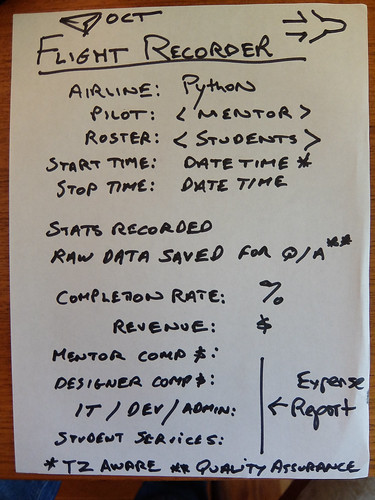
The metaphor (living at the base class level) centers on picturing airplane flights as courses of study, with a beginning, middle and end. One could do ships and cruises -- hey, they're just metaphors, feel free to mix 'em. "Geek cruises"are a reality already, including of the non-metaphoric kind.
Names like Student, Course, Mentor make up the foreground, but without leaving our extended metaphors behind. The course fills to a minimum, gets start and stop dates, but in many models students manage their own time (talking months) and finish anytime before deadline.
Some are in a hurry, some not. Some have time to study hard, others have only tiny windows in their day, to inch ahead. Few if any synchronized events are required therefore. It's not about all moving in lockstep, even if in the same course. That doesn't preclude some exercises involving a stop watch or timer.
The Flight Recorder (built in to the Course or Airplane class) saves the transactions, meaning submitted and handed back work, communications to and from a mentor. Quality Assurance (QA) is about going over these records and learning from them.
Feedback loops are the name of the game. Mentors improve by learning from each turn in the cockpit, perhaps we have co-pilots (like co-clerks, of committees). One might be the apprentice of the other in one course, the senior pilot in another. Mentors are students themselves as there's never a shortage of new stuff to learn, new skills to pick up.
Some designs encourage chatter amongst the passengers however more typical is the private one-on-one experience, with the mentor interacting individually with everyone and anyone in the course (or courses -- in this world a mentor may fly several airplanes simultaneously, called "multi-tasking", just as a student may take more than one course at a time, just like in college).
What I envision as a typical use case are EC2 / AWS (Amazon) type implementations of the Personal Studio or Personal Workspace (PWS) model, such that learners remote in to their personal Ubuntu or whatever, the instance pre-configured per whatever course design.
Are we doing 2D & 3D graphics? Is VPython installed? That all depends on the course, although presumably there are many parts of the Ux (user experience) that are common to all courses, giving a branded and perhaps eventually familiar, look and feel. A student might work on more than one course within a given PWS instance.
Containerized services at the other end of a student dashboard given the "traveler" (wanderer, browser, tourist, visitor, guest... scout) a way to "book flights" including with "connecting flights".
The mentor dashboard shows the task queues (see source outline below).
Student and mentor are connected asynchronously through the ALE. That's it's primary job, to glue together all the components required to run an airline (or railroad, if you prefer).
For example: { Ruby ↣ Rails ↣ JavaScript in the Browser (including JQuery) ↣ JS on the Server } would earn a merit badge or certificate in our "learning by doing" space (hiking trail metaphors apply also -- as in scouting).
I've been looking at { Python ↣ Java ↣ Clojure } as a set of connecting flights, perhaps spanning grades 10 to 16. The ALE does not nail down curriculum content per se. Its job is to organize students into courses, assign them mentors, and keep things moving forward towards completion. Course designers have a known framework to work with -- whatever version of ALE the client / school uses.
Mentors, like students, have different availability, different schedules, as well as areas of expertise. That's where Air Traffic Controlling (Dispatching) comes in. We need admin to help us with load balancing such that no one mentor burns out under the caseload.
"Adding to the fleet" where demand is high is easy with ALE (our in-house system, not Open Source, isn't called that). Smaller more esoteric courses may have higher marginal costs, but add to a school's luster in other ways (guest mentors may be celebs in their fields).
Colleges and universities may be set in their ways and may as yet have no internal "dog food" they might eat and/or modify, nothing Open Source to share and partake in.
Sometimes upstart companies, including not-for-profits, NGOs, are better positioned to try new things. ALE is not just another Moodle or Banner.
For further reading:
ALE Use Case
GitHub Repo
clojure-python
Thursday, May 10, 2007
Prepping for Class
Python for Wanderers, part three of four, is tonight, and I wanted to be up to date with part three for Saturday Academy, which I'm teaching @ PSU. To that end, I wanted something like VizToyz but geared to work with a ray tracer, POV-Ray, instead of VPython out the back end.
In writing povtoyz.py this afternoon, I finally noticed my polyhedra.py was eight faces shy of the full complement for my Icosahedron subclass, duh. I hadn't noticed because I was so focussed on the wireframe view, but once I got experimenting in POV-Ray, the defect became obvious, as faces, defined by POV-Ray's polygon primitive, were missing from I, Icosa (a menu option parallel to the one in viztoyz.py).
Another feature of the upcoming Wanderers class will be to review my work with Dr. Bob Fuller and team, getting that Studies in Human Motion CDR ready for the summer '04 meeting of the American Association of Physics Teachers.
I used Python + POV-Ray for my part in that project, starting from Excel spreadsheets giving the successive (x,y,z) spatial locations (rows) of several sensors (columns) affixed to a ballet student going through her moves in Lincoln, Nebraska. Each row became a frame in a POV-Ray film, with my Python code doing the conversion (included as open source on the CDR).
Monday, April 28, 2008
Calculus Mountain
Those of you who've heard me inveigh against Calculus Mountain, such as in the YouTube above, will maybe think I'm anti-calculus or think it shouldn't be taught.
This is not the case.
For one thing, teaching calculus was my bread and butter out of Princeton, my first job with a BA in philosophy (Rorty my thesis advisor, Kaufmann one of my referrals to Erhard's philo, which I studied on the side, in tandem with Wittgenstein's with Victor Preller et al, some grad work at St. Peter's in Jersey City, making the transition to a Dominican run school).
But also, I'm in agreement with many in the Physics First and First Person Physics movements, that calculus, having grown up in the context of Newtonian mechanics, has a natural context within physics, so we should use that in K-12, with "pure calculus" (minus any physics application) left for some later time, for those college majors electing such degree paths.
We currently waste way too much time on calculus in high school, in some faddish, almost occult desire to equate this subset of math concepts with the whole shebang. Strong candidate alternatives are already in field testing, with promising results. The USA is not monolithic and there will be no "one size fits all" replacement, so don't expect big headlines regarding some big switchover. That occurred years ago, as a part of the rise of digital over analog technologies more generally.
Remember, the steam engine reached its pinnacle in sophistication long after the writing on the wall had already appeared, spelling diesel (now it spells a lot of other things). Calculus as currently configured is already well past its pull date, but still hangs in there, bless its little heart.
And again, I'm not for a purge.
I'm for physics getting a better toehold, chemistry too, both united in biology, and have no problem with relaying Newtonian mechanics in a somewhat classical form, abetted with VPython, YouTubes and so on (plus maybe real visits to roller coaster parks, if we do our FPP curriculum).
Saturday, April 26, 2008
SA: ClassNotes 2008.4.26
The parking went more smoothly, plus the weather was good, got Ubuntu Dell and better speakers in harness no problem, with CodeGuardian queued. However, without support from the home team, I'd've been leaning on staff too hard, having left my logins chart on my desk or someplace.
We worked pretty hard today, through viztoyz and povtoyz, which take the real time versus render time approaches respectively. The former uses VPython, the latter POV-Ray. The point of showing a movie like CodeGuardian is how such a small team now has these powerful tools, but you also need to really sit at the feet of great directors, to pick up on small touches like camera jitter, a way to help viewers join the action.
My Fibonacci generator, designed for phi convergence (which worked eventually), got off on the wrong foot, as 0, 1, 1, 2, 3, 5, 8... yields my sequence 1/0, 1/1, 2/1, 3/2, 5/3, 8/5... So I got bitten by two gotchas: divide by zero and default integer division (this is Python 2.5). Fortunately, easy fixes were at hand.
I was able to show my I Ching source code in a font that renders the characters readably, back to explaining the ASCII to Unicode migration, also part of this 2.x to 3.x transition.
Tuesday, February 06, 2007
Synergeo #32395
In my first storyboard, I paid some attention to social service and academic achievement i.e. a design scientist is someone willing to mix it up in the real world, not just push for Ivory Tower credentials, as the latter without the former may be quite meaningless.
However, the main thrust of my storyboard was to find a bridge, starting in the known and moving towards the unknown (assuming a demographic still somewhat unfamiliar with even the basics of Fuller's metaphysics).
I start with the Qyoob (Cube) and use it to establish the 3D-hood of ordinary space. A 3-vector zig-zag on the corresponding simplex also combines these notions of "3" and "spanning basis vectors" but of course when the zig-zag is bent that way, you're thinking "spatial" the whole time, which is more the Synergetics mindset (we don't believe in Flatland per se -- a rickety old Victorian belief system, ala Abbott's scifi by that name).
Over on wittgenstein-dialognet, I'm chatting with philosophers about this namespace thing some more. coxeter.d and fuller.d aren't synonymous. That doesn't mean we put these two scorpions in a bottle and make 'em fight it out. On the contrary, both steam engines and diesel engines create torque from liquid fuels. The goal is to investigate the mechanisms, to reach an understanding of inner workings, not to prove one or the other "can't work" (as if there weren't ample evidence that they both do).
So in moving from coxeter.3d (Euclidean 3dness) to fuller.4d, I'm not trying to "make Coxeter wrong" in any important dimension. Rather, I'm juxtaposing two "ways of looking" with a nomenclature (a namespace) to suit in each case.
I think one of the gross errors in some of the secondary literature to date is this idea that "if Synergetics is right, then XYZ goes out the window". On the contrary, Synergetics is not about pushing any math to the back of the bus. Synergetics isn't going to stay at the back of the bus either though -- that's what academia is still trying to wrap its mind around (slowly, very slowly).
Anyway, I want to get more technical with the Coupler on a second pass, making this the bridge from XYZ thinking to IVM thinking. It's very easy to place 8 MITEs around (0,0,0), one per octant, and to see this as an entry point into IVM style cogitation, wherein two of the Coupler's equators become the "fish lip" rhombics connecting IVM (= CCP) balls, with the K-points as "tongues touching" perhaps.
I've segued from stickworks.py to coupler.py for the benefit of my Pythonic math teacher squadron. They'll be the first on the block to have a VPython view.
Friday, March 20, 2009
CubeSpace Anon?
The analysis coming out of Japan is typically manga-seeming: once Texans saw those homey green-style freeway signs around Baghdad on their televisions, the limbic system kicked in, truckers going "hey, we could drive on those roads, make big bucks", and the rest is history. The truckers invaded (hiding behind neocon fabrications and lies) so they could feed hungry families back home, pay for air conditioning.
There was never any "military strategy" or ideas about "saving face" -- stuff for the Pentagon and diplomats to worry about i.e. "not our department". "Don't mess with Texas" was the main thing to say, seemed to justify everything, Enron included.
Of course Iraqis know how to drive trucks, so there's an easy solution, once USAers decide it's not worth their $10B per month to act out their inner Roman imperial monster truck-driving children (the "superpower" fantasy, driven by Marvel comics). Stick to your own NAFTA highways and I-69 why don't ya?
Like I said, Japanese intelligence has these like "comic book" explanations for everything, lots of shelf space at Powell's.
Saturday, August 25, 2012
Study Hall
A blooming buzzing garden of such tools and toys, running in ensemble, with simple demo code, pared down, for teaching purposes, is what Free Geek might help staff, if not host. OSDL? There needs to be something more contemporary than a museum, although there's no rule against museums being contemporary, so maybe that's not right. Portland Knowledge Lab was how I used to refer to it, copying London's (where I'd given a presentation on my way to a meeting), but I let that go out of focus when the Active Space experiment ended, in disillusionment with Metro Wifi.
My audience or client base, updating from CUE days, are still those do-gooder nonprofits and idealists. But we're not in Kansas anymore, using WordPerfect + dBase (my "good old days"). Today, it's more about mod_wsgi (still) and Tornado and noSQL. The clay, the source, is all out there. "Use the source Luke" is the new commandment. But are we getting anywhere? Is STEM gaining in traction?
Redis has you talking through a port, I gather through sockets. Surely those aren't HTTP requests. No, it has its own protocol. Like JSON in that respect. The guarantee is transactions are atomic, as this is one thread (each redis instance). You could probably sell seats with this thing, and not promise the same one to any more than one.
Before that, I was boning up on gevent + gunicorn, a hot new way to serve processes. I couldn't tell if I'd use Celery in addition to or in lieu of, but I get the idea: lots of event loops running in user space, context switching there, rather than kernel space (the mod_wsgi solution). I watched a talk on Blip.TV comparing that dynamic duo with more traditional solutions. Where high availability is concerned, gevent + gunicorn is looking pretty good, a plus for Python.
I've got DjangoCon on my radar. Should I duplicate this WinXP configuration on Lion? Yes, that would seem prudent. The PyCharm product is something I might get an academic discount on, once we've completed a work process, but for now I'm just using on free 30 day trial. Will it use Akbar font if I like, is a next question. I'll get back to y'all when I figure that out.
Tuesday, February 10, 2009
PPUG 2009.2.10
Robin Dunn of wxPython fame has joined us, good seeing him again.
I said something about fighting a MUMPS dragon in some unspecified context, not getting into details. Nobody knew what that was.
Michel gave a really quick talk on the Python turtle module (like in Logo).
I went to some key slides in my Chicago talk, like the one showing Python Nation as a neighbor to the Programming Republic of Perl, wondering if that made sense, talking about lore, storytelling, it's importance as cultural glue. We need to tell our own history. Every age has its epics and sagas. Technical content embeds against that backdrop.
These thoughts connect with my power walk with the CSO this morning, to the top of Mt. Tabor. Glenn is into a strong mnemonic matrix relating geography, navigation and geometry. Generating the key edge lengths needed to construct the polyhedra is a part of it. Our raps dovetail quite a bit.
Back to the meeting: I mainly focussed on VPython, showing the kind of stuff I use to teach geometry, animation. I didn't mention anything about Bucky this time. I opened with my little xtranormal cartoon, which people enjoyed, shared that with Gordon Riggs as well.
I was somewhat scattered, as is my style, but entertaining and not incoherent. People expressed appreciation afterwards. I built up Saturday Academy as a headquarters for showcasing novel curriculum ideas, true enough given I teach there (ahem ahem), but it's not just about me obviously. Gordon Hofmann comes to mind, an SA: mainstay over the years.
Jason did a fine presentation on Zine, which I'd never heard of. I always come away from these meetings feeling twice as ignorant as before they start. So much I don't know.
Pocoo Development Center: check it out! Very young people are behind this high quality code.
Werkzeug isn't a full web framework. You call it, it doesn't call you. It's more a toolkit with some glue, for doing webby things. Adam Lowry is showing us his little demos.
This looks like a good framework for getting a handle on the newish MVT paradigm for web frameworks, which seems to have fallen into place. He's using Jinja2 for a template language (T), a lot like the Django's but a superset, allows more Python in the tags. He's using SQL Alchemy for an ORM (object relational mapper (M)). There's a really cool debugger. Total control, best of breed tools. But direction is often better than freedom.
Over beers I struck up a conversation about PHP, which I'd been cramming on in case my destiny demanded it (it didn't). Michelle, employed as a Django programmer, considers it like an ugly old pair of pants she keeps around because they're comfortable.
A lot of web programmers cut their teeth on PHP, a sprawling infrastructure that grew without much of a plan, a hodgepodge in many ways. Python is cleaner, a better design, but hasn't been in the web world as long, unless you count Zope (we had a couple of Zope developers tonight, including Maria).
Michelle's idea to do more outreach to newbies, maybe new to Python but not programming, or maybe new to programming, is a good one. Maybe the City of Portland needs an open source avatar (some appropriately named office)? The Chamber of Commerce?
Our Coffee Shops Network needs imaginative coders, whereas vendors need more ways to position themselves and their products as a part of the solution, as public supporters of worthy programming, including a more productive kind of Reality TV. These are ongoing themes in my blog posts.
We all agreed that universities lag the private sector 3-5 years or more, high schools even further behind. In "theory courses" it maybe doesn't matter as much, but when it comes to teaching skills... we could be doing a lot more.
I need to wake up pretty early and fetch Anna Roys from the airport, am on duty as a Wanderers escort again, plus am wearing my Quaker futurist hat.
Wednesday, March 30, 2016
Boot Camp Continues
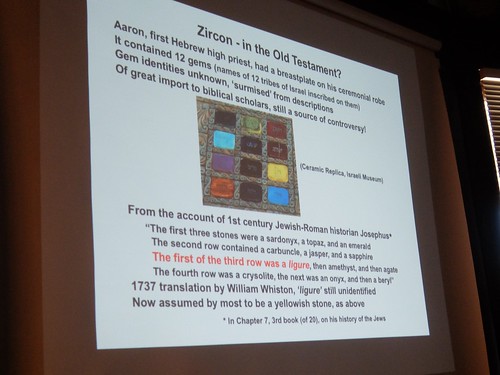
In the midst of all that, I was privileged to drop in on Wanderers, where Steve Mastin was holding forth on zircon, a mineral comprised of the element zirconium, an odd-man-out element with a cation that doesn't crystallize well with the others.
Among these would be Uranium and Thorium, which contribute a lot to zircon's properties, up to making Zirconology, in part about studying chronology.
Zircon's several ways to decay give ways of dating the mineral, a side-benefit of a long-running polonium-related controversy, again with Biblical connotations (see below).
Given earlier civilizations did not use our Periodic Table or understanding of atomic physics, their jargons don't follow ours that closely, and in the case of zircon that's especially true, as in manifests in a wide variety of colors, from vermilion to blue.
In theory it's colorless but in the wild a colorless zircon is a rare find, though some of the colored ones turn colorless with heat treatment, rather commonly applied. Just how a given specimen of zircon will respond to heat treatment is something of a gamble.
Blue is highly prized, though honey-colored is more its trademark. Dick Pugh brought an example, as did Steve but I only had time to take a look at Mr. Pugh's, then was on my errands.
A passage in the Torah about some battle vest, or breast plate, and the twelve stones thereon, probably overlaps our modern definitions. We'd expect to find a specimen of zircon thereon, along with beryl, emerald and some others.
Don't expect me to name all twelve, though if you dig you might find something more like a complete listing in the slides. Steve does a lot of homework to create these talks.
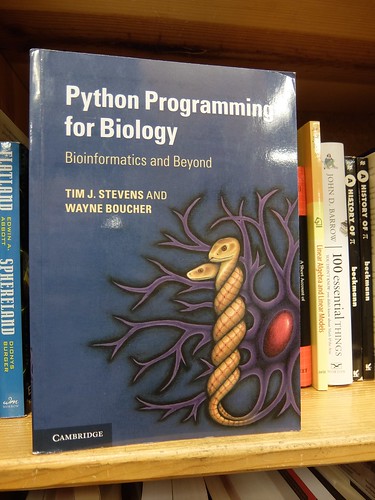
I left around the same time as Jon Bunce, off to Powell's for said biology book. Boot camp continues, with a five mile hike, including steep inclines, bruised ankles be damned.
The impromptu meetup with Dr. DiNucci at Common Ground was apropos, as concurrency concepts, taught through cooking in groups (as with Food Not Bombs) is topical within my code school network. Aside from a Horse Brass half order of Fish 'n Chips, I'm mostly subsisting on Soylent today (version 1.5).
The documentary on Puerto Rico looks interesting (rented from Movie Madness). We don't see many code schools there yet.
Back at my workspace, I made sure VPython is still working. Given the dependency on wxPython, I need to use Python 2.7, and a "Framework" 2.7 at that (to provide access to the main display). So far so good. Things are coming together.
Monday, January 11, 2010
Reality Checks
At the checkout lane in People's Food Coop this evening, I came across The Big Ideas of 2010, the latest issue of Adbusters. The centerfold or double page spread towards the center, was all about mechanized bombing with "game changing" drones, as controlled from Nevada or other cubicles. The verbiage about the weapons seemed mindless and laudatory, the familiar cruel hype. The message of the spread seemed to be that war by these means might be continued indefinitely, if for no other reason than doing something else might be considered defeatist.
I was disturbed by this nightmarish article, especially because of its context. Here we were in a mostly organic, progressive, worker owned food coop, the kind of institution Portland prides itself in supporting. Why would the magazine rack include such psychopathic propaganda? Was our world imploding this quickly?
Lindsey was stocking up on supplies (grains, beans, onions, carrots), some of which will stay at Harrison Street, some of which might go to Duke's, where she's planning to get her food handler's license and whip up a southern vegan meal during the next "private undercover party" (one of our Ignite-like events). She didn't see the article but thought it might be tongue-in-cheek, a spoof. I wasn't so sure, was feeling disoriented.
At about this time, the Clerk of Oversight phoned me, aware that I was slogging through hell in some way. I'd been at the two hour committee meeting that afternoon, left a little early when Tara texted, saying she might be coming down with something. I ferried her home from a friend's on SE Clatsop. She'd been using the bus both ways, as I'm working to conserve fuel, and promote teen independence (as a high schooler, her student ID also counts as a bus pass). She's seeming better this morning, off to school on the bus again.
I'm hoping to get together with Friends and give more of a sense of my picture over here. Just keeping these journals is not the complete practice. We have clearness committees and stuff like that.
I've been in touch with Gary Litvins about Mathematics for The Digital Age and have an OSCON proposal in draft form wherein that book gets mentioned towards the end of the abstract. Here's what I've written:
Oregon teachers have plans to start field testing a new kind of mathematics course in 2010 that would count towards fulfilling the legally mandated three year minimum mathematics requirement for a high school diploma. Learn how the Python community has been supporting these efforts and how the open source community more generally is becoming involved.From a math teaching perspective, I think the Litvins text is a breakthrough. Students use it at Phillips Academy in Andover, considered one of the nation's top schools. I've been going on Math Forum asking for advice from my peers: if we wanted to spread a course more like this around Oregon, how would we do it?
Other developments such as poster sessions at Pycons, an upgraded turtle graphics library, new on-line resources and published titles, suggest future trends in education.
The appearance of Mathematics for the Digital Age and Programming in Python, by Maria and Gary Litvin may signal a sea change in high school level mathematics teaching, or perhaps it simply represents a confluence and positive synergy of many long term trends, including the bias towards teaching more discrete math topics at the high school level.
The solution that seemed to be shaping up last August was to simply fire up the new course under the heading of discrete and/or digital math, per state standards. There's already a section in the standards for such material.
However the real question is where to find the teachers, when to equip them with the few additional skills needed to take some well-known and conservative content, and make it ready for the digital age. In the case of the Litvins text, that means learning some Python.
Would we field a small army of Python trainers then? That seems like a possible strategy, should funding become available. Or perhaps these teachers are simply learning Python on their own? Having been a high school teacher, I know there's a lot of pressure just to keep up with the existing schedule. Preparing to teach something new would mean time away from other duties and teachers on the front lines may not have that luxury, absent some institutional work flow.
I may be too out of the loop on this one. Should someone else give this talk then? Maybe this blog post will garner some feedback.
Exercise 8 in Chapter 10 (2nd edition) gets into V + F = E + 2, Euler's Law for Polyhedra. That's the kind of stuff I get into through my Oregon Curriculum Network web site, also very vested in Python. I've tended to use VPython, a 3rd party library, for my Saturday Academy classes, which makes it relatively easy to get colorful polyhedra on screen. I haven't done much with PyMol yet, another add-on our chemistry teachers might enjoy.
Having since checked that Adbusters web site, I think Lindsey is correct that I was reading a spoof. More like The Onion then? On the other hand, it just seemed too real. These drones are much worse than V-2s, plus are used against people with no air defenses to begin with (no RAF). Calling these remotely piloted know-nothing drones "weapons against blow back" is simply ridiculous, but then I could hear some faux counter-terrorism expert saying just such a thing, perhaps over a secure phone from some ski trip somewhere. Are these the same anonymous faux experts who disbelieve the NIE, think we should be bombing civilian power plants in Iran? Who put them in charge?
Once home, I focused on filling out an application form for a part time tutoring job. I wrote to Stu Quimby on Facebook, asking if I could use him as a reference. My work on a geometry toy is more relevant to math students than some of that database work for the outcomes research people at Providence Health System.
Getting a digital age math course option out to students will require innovation at the institutional level, the design of new roles, new work flows. As an army of one, all I might do is point in that positive direction and suggest this might be our ticket to a brighter tomorrow. I am quite aware that the Obama administration wants to get the focus back on education and jobs, not to mention health care. We might well have a bigger army here soon. On the other hand, innovation is a difficult process taking skilled managers. ONAMI was an inspiring, showed me that Oregonians still have that pioneering spirit.
Education in the digital age means using more viewers like Google Earth and Microsoft TerraServer. The news shows are already using those. TV has already improved in that sense.
My thanks to Carey Carlson for sending some philosophy PDFs, somewhat in the Russell-Whitehead lineage. Also thank you Tom Higgins for pointing me to Roger Ebert's blog. My prayers for John and Eve Talmadge, cousin Mary, Grace, cousing Pat and her mom.