I'm laptopping from Socorro, New Mexico, using a line of site antenna to New Mexico Tech, with an authorized static IP. I've been comparing notes with local faculty on various topics. For example: the right handed XYZ coordinate system is far more standard than the left handed one used in POV-Ray -- but we already knew that, didn't we?
So how should we improve students' education in America, make it "world class" as we say? My thinking has evolved in the direction of improving the average teacher's job description, less directly in terms of money, and more in terms of what opportunities for further education it provides.
Teachers need to role model the paradigm life long learner to their students. Inservice training, long a feature of the job, needs to become a relatively larger slice of the pie, in terms of the time and energy devoted thereto. A larger cast of players needs to take responsibility for giving teachers better overview, a better grasp of what goes on in various walks of life.
In this way, my own geek culture will get more of a footprint in K-12. More teachers will become aware of such innovative solutions as Pythonic mathematics.
Won't this approach lead to increasing rates of teacher loss to private industry and/or public service, as teachers learn programming say, on the public dime? Yes. We need to build that in to the model. Young, energetic grads, closer to grade schoolers in age and presumably culture, get into teaching as a way to continue their own educations. Perhaps only a minority stick with it as a life-long career.
Why should that be a problem?
According to this model, the job is more attractive up front, including as a stepping stone to other careers, so recruiting new teachers is suddenly that much easier. The military uses elements of this approach, with the draw of "the best toys." Civilians like toys too. A summer camp for teachers might feature newfangled shelter solutions, permaculture, hands-on access to tomorrow's high tech brands.
Master teachers that stick with it for the long haul become mentors for the relative newbies, perhaps roving the country in bizmos, helping to establish the new schema, based on what's already found to work in other regions of the country.
Relevant essays:
Re: Reality Check @ Math Forum
Re: What Is 21st Century Mathematics? @ Math Forum (Dec 19, summary, autobio)
Sunday, December 17, 2006
Saturday, December 16, 2006
Tough Choices
Another USA "education in crisis" report has bubbled up and grabbed some headlines. Some New Commission on the Skills of the American Workforce has a pseudo-plan to make it all better.
Like other such reports, it dances around, defining terms, suggesting a party line, without ever diving into hard core content in any way -- except in terms of money.
Such science fiction is so typical of Americans: if we just pay high enough salaries, we'll get the most competent people, and our problems will simply fix themselves under the management of these highly paid superheros -- just give us another fifteen years, you'll see.
This is how CEOs like to self-mythologize, in terms of high "personal net worth," and their self-centered myopic ethos has rubbed off, spread into academia, with similarly corrupting consequences.
LAWCAP chewed through the USA's military's backbone long ago, leaving it mostly paralyzed and defenseless, easy prey for high personal net worth seeking politicians and their CEO backed lobbyist friends, all looking for more ways to deplete inventory, generate reorders, no matter the cost in human suffering.
Related reading:
Re: Report Urges Drastic Change, Higher Salaries @ Math Forum
Re: PUFM - Missing the Point @ Math Forum
Re: Fwd: What Is 21st Century Mathematics? @ Math Forum (Dec 19)
Like other such reports, it dances around, defining terms, suggesting a party line, without ever diving into hard core content in any way -- except in terms of money.
Such science fiction is so typical of Americans: if we just pay high enough salaries, we'll get the most competent people, and our problems will simply fix themselves under the management of these highly paid superheros -- just give us another fifteen years, you'll see.
This is how CEOs like to self-mythologize, in terms of high "personal net worth," and their self-centered myopic ethos has rubbed off, spread into academia, with similarly corrupting consequences.
LAWCAP chewed through the USA's military's backbone long ago, leaving it mostly paralyzed and defenseless, easy prey for high personal net worth seeking politicians and their CEO backed lobbyist friends, all looking for more ways to deplete inventory, generate reorders, no matter the cost in human suffering.
Related reading:
Re: Report Urges Drastic Change, Higher Salaries @ Math Forum
Re: PUFM - Missing the Point @ Math Forum
Re: Fwd: What Is 21st Century Mathematics? @ Math Forum (Dec 19)
Wednesday, December 13, 2006
Shop Talk
We joined in the Xmas frenzy a bit today, sweeping through both a Valde*mart and a We Be Toys (names changed to protect the innocent), ending up in an upscale toy shop, Wakey's, in downtown Portland near the Multnomah County Library.
On another front, we chickened out of a "Class C" camper van opportunity, once the subject of antifreeze came up. It'd cost extra to thaw the unit, plus we'd need to commit to supplying an AC umbilical cord solution come evenings, with temperatures averaging in the low teens, well below freezing (Fahrenheit, sorry) -- otherwise her sink 'n can would freeze right up again.
Using keyboard and mouse, I morphed the camper into an SUV and felt relieved for having done so. Lining up campus housing isn't a problem. The bigger vehicle will help us lug around the O2 concentrator, useful at high altitudes.
[ When more gnu math teachers take to the road in real bizmos someday, the problem of "mooring" will have more routine solutions depending on which economic sector is being served, e.g. a brand X certified pro might snuggle up to an appropriate campus building and jack in, whereas other brands of roving road warrior might prefer the sweet seclusion of less urban sites, less smack in the middle of some academential funny farm.]
Uncle Bill swung through again in his red Aztek, bearing pie and an invitation to lunch up on Hawthorne (Bridgeport's Portland Ale House was our selection). He's done about all he might humanly do to promote his well crafted history of pre-WWI submarine building in the Pacific Northwest. He's taking some time off to just enjoy life, is looking forward to Colorado.
We're bummed about missing Laurie's and Terry's Hannukah party again this year, but still plan to celebrate. Plus there's another party I'm not mentioning, a surprise -- but we're missing that too. Turning down invitations is a part of life. Ed had to do it all the time, especially as he got older.
On another front, we chickened out of a "Class C" camper van opportunity, once the subject of antifreeze came up. It'd cost extra to thaw the unit, plus we'd need to commit to supplying an AC umbilical cord solution come evenings, with temperatures averaging in the low teens, well below freezing (Fahrenheit, sorry) -- otherwise her sink 'n can would freeze right up again.
Using keyboard and mouse, I morphed the camper into an SUV and felt relieved for having done so. Lining up campus housing isn't a problem. The bigger vehicle will help us lug around the O2 concentrator, useful at high altitudes.
[ When more gnu math teachers take to the road in real bizmos someday, the problem of "mooring" will have more routine solutions depending on which economic sector is being served, e.g. a brand X certified pro might snuggle up to an appropriate campus building and jack in, whereas other brands of roving road warrior might prefer the sweet seclusion of less urban sites, less smack in the middle of some academential funny farm.]
Uncle Bill swung through again in his red Aztek, bearing pie and an invitation to lunch up on Hawthorne (Bridgeport's Portland Ale House was our selection). He's done about all he might humanly do to promote his well crafted history of pre-WWI submarine building in the Pacific Northwest. He's taking some time off to just enjoy life, is looking forward to Colorado.
We're bummed about missing Laurie's and Terry's Hannukah party again this year, but still plan to celebrate. Plus there's another party I'm not mentioning, a surprise -- but we're missing that too. Turning down invitations is a part of life. Ed had to do it all the time, especially as he got older.
Monday, December 11, 2006
Sunday, December 10, 2006
AntiRacism
Scientific American did a cover story in December, 2003 questioning the dogma of races, zooming in to the genomic level, and finding genetic correlations among subpopulations, regionally mappable dispersions of this or that risk factor and so on, suggesting the "race" concept wasn't entirely empty.
Coming at it from another angle, the obvious superficial feature groups men hoped to capture with the Twelve Races idea (or was it Seven?), don't have any inherent genomic integrity, in the same sense that only twelve orders of a 52 card deck might be considered "the pure ones" -- except, of course, in some humanly contrived game of relatively fleeting historical interest.
Nature, however, escapes such easy schemata and gives us an exponential library of genomic possibilities, each specific human a checkout example from said digital library. Presuming humans persist with this base template, a lot like King Kong's, the flexibility of our design will continue to undergo testing by the terrestrial and extra-terrestrial environments, with many new readings constituting a response.
There is no seven reading "core syllabus" from which all the others deductively derive, not really adding anything new. This was the snobbery of the "racial purity" buffs: they wanted to typify the archetypes while branding competing readings as "mongrel" i.e. tainted by degenerative impurities, ala Dr. Strangelove. They feared a level playing field, needed this artifical bias twixt "pure" and "impure" to handicap the competition.
So yes, by all means lets correlate genes and risk factors, genes and other genes, following wherever the statistics lead us. It's an empirical science and we have much to learn. Making good on the promise of personalized medicine, wherein we craft unique treatments, depends on our getting on with these detailed genomic studies.
The science fiction layer was this "just a few pure shuffles" myth, which, even if nationally geographically based, isn't a good roadmap to the future, where inbreeding will likely reflect other proclivities, such as the desire to live with and raise other skiers, other specialized Olympians in one sport or another (to take one example of humans forming voluntary affiliate subgroupings).
Lifestyle and ethnicity go together, with genomics along for the ride, a prehistoric substrate, still very relevant to medical science, but not especially useful to the various racisms, not really leverage or ammo for would-be Ozymandius type dictators over future breeding patterns.
We don't really know what all the interattractive ethnicities will be, have lost track already, there being even today so many from which to choose.
Related reading:
Re public education @ Math Forum (December 2006)
Re teaching advise sought... @ Math Forum (December 2006)
No Race, No Class @ grunch.net/synergetics/terms.html
Coming at it from another angle, the obvious superficial feature groups men hoped to capture with the Twelve Races idea (or was it Seven?), don't have any inherent genomic integrity, in the same sense that only twelve orders of a 52 card deck might be considered "the pure ones" -- except, of course, in some humanly contrived game of relatively fleeting historical interest.
Nature, however, escapes such easy schemata and gives us an exponential library of genomic possibilities, each specific human a checkout example from said digital library. Presuming humans persist with this base template, a lot like King Kong's, the flexibility of our design will continue to undergo testing by the terrestrial and extra-terrestrial environments, with many new readings constituting a response.
There is no seven reading "core syllabus" from which all the others deductively derive, not really adding anything new. This was the snobbery of the "racial purity" buffs: they wanted to typify the archetypes while branding competing readings as "mongrel" i.e. tainted by degenerative impurities, ala Dr. Strangelove. They feared a level playing field, needed this artifical bias twixt "pure" and "impure" to handicap the competition.
So yes, by all means lets correlate genes and risk factors, genes and other genes, following wherever the statistics lead us. It's an empirical science and we have much to learn. Making good on the promise of personalized medicine, wherein we craft unique treatments, depends on our getting on with these detailed genomic studies.
The science fiction layer was this "just a few pure shuffles" myth, which, even if nationally geographically based, isn't a good roadmap to the future, where inbreeding will likely reflect other proclivities, such as the desire to live with and raise other skiers, other specialized Olympians in one sport or another (to take one example of humans forming voluntary affiliate subgroupings).
Lifestyle and ethnicity go together, with genomics along for the ride, a prehistoric substrate, still very relevant to medical science, but not especially useful to the various racisms, not really leverage or ammo for would-be Ozymandius type dictators over future breeding patterns.
We don't really know what all the interattractive ethnicities will be, have lost track already, there being even today so many from which to choose.
Related reading:
Re public education @ Math Forum (December 2006)
Re teaching advise sought... @ Math Forum (December 2006)
No Race, No Class @ grunch.net/synergetics/terms.html
Wednesday, December 06, 2006
Coffee Shop Talk
Wanderers was open agenda this morning, and we were blessed with a world traveling couple, friends of Milt's, freelancers attracted by Portland's cosmopolitan kulture, and with a lot of combined and individual experience in organizational development.
Our conversation veered through the Khyber Pass, from Pakistan to Afghanistan, to Ken Wilber, to Lesotho, to South Africa (protea in particular), to Cape Town, where it turned out we'd overlapped as attenders at the 1999 Parliament of World Religions, our family as Quaker delegates, and guests of the Deputy Minister of Defense at the time, Nozizwe Madlala- Routledge, also Quaker.
When the discussion turned to coffee shops, given Nirel's project, we learned about The Great Good Place, a book helping to define the role such institutions might play in our culture, or already do in some cases. The Communknitty in San Jose also typifies this pattern language, which doesn't have to center around coffee.
Dawn filtered the newspaper for me this morning, before getting her toes done with Aimée, pointed me to a Math Wars report on B2, and to an email address on C1 for reporting "early user impressions" of the new Metro-Fi service. I'll forward a link to my recent report on that subject.
Our conversation veered through the Khyber Pass, from Pakistan to Afghanistan, to Ken Wilber, to Lesotho, to South Africa (protea in particular), to Cape Town, where it turned out we'd overlapped as attenders at the 1999 Parliament of World Religions, our family as Quaker delegates, and guests of the Deputy Minister of Defense at the time, Nozizwe Madlala- Routledge, also Quaker.
When the discussion turned to coffee shops, given Nirel's project, we learned about The Great Good Place, a book helping to define the role such institutions might play in our culture, or already do in some cases. The Communknitty in San Jose also typifies this pattern language, which doesn't have to center around coffee.
Dawn filtered the newspaper for me this morning, before getting her toes done with Aimée, pointed me to a Math Wars report on B2, and to an email address on C1 for reporting "early user impressions" of the new Metro-Fi service. I'll forward a link to my recent report on that subject.
Friday, December 01, 2006
A New Beginning
Many thanks to Patrick for the use of his truck, and to Derek, for lending a hand. Today the Portland Knowledge Lab vacated its first home, an ActivSpace incubator on 8th & SE Main.
Now I'm sitting in the above depicted chair (foreground), using wireless from the Toshiba Satellite laptop.
The wall design was made for Dawn by her friends: some 10K cranes glued to a repainted crafts table she'd used for Turning the Wheel, a small business for teaching rituals around the eight Celtic high holy days: Samhain, Winter Solstice, Imbolc, Spring Equinox, Beltaine, Summer Solstice, Lughnassad, and the Fall Equinox.
In front of me: a cuboctahedron atop an icosahedron, symbolizing the ascendency of Mind over Brain (a theme in Synergetics, an important philosophical work on our syllabus).
Bridge City Friends have been celebrating Advent for some years now. We've been less active in the life of our Meeting of late, but are continuing the tradition, which includes reading aloud, lighting a candle, and opening these little doors in an Advent Calendar in the days before Christmas.
Now I'm sitting in the above depicted chair (foreground), using wireless from the Toshiba Satellite laptop.
The wall design was made for Dawn by her friends: some 10K cranes glued to a repainted crafts table she'd used for Turning the Wheel, a small business for teaching rituals around the eight Celtic high holy days: Samhain, Winter Solstice, Imbolc, Spring Equinox, Beltaine, Summer Solstice, Lughnassad, and the Fall Equinox.
In front of me: a cuboctahedron atop an icosahedron, symbolizing the ascendency of Mind over Brain (a theme in Synergetics, an important philosophical work on our syllabus).
Bridge City Friends have been celebrating Advent for some years now. We've been less active in the life of our Meeting of late, but are continuing the tradition, which includes reading aloud, lighting a candle, and opening these little doors in an Advent Calendar in the days before Christmas.
Wednesday, November 29, 2006
Wanderers 2006.11.28
Terry Bristol (foreground) feedingvideo signal of Micheal Sunanda (background)
to Doug Strain (on screen)
Other Wanderers chimed in, both supportively and with skeptical wise cracks. Micheal was very engaged, the opposite of a shrinking violet. He's a credit to his hippie ethnicity.
Doug Strain, metrologist, joining us by closed circuit TV, reminded us that words in a vacuum are difficult to control, meaning-wise, which is why sharing measurements and observations is so important -- we need shared access to lots of raw global data to find common ground, even before we pinpoint any areas of real disagreement.
But it wasn't as if Micheal was avoiding all data, plus he's right that lots of relevant empirical info is shrouded in secrecy, locked away from public view (motivations vary as to why), so "establishment scientists" don't always appear to be playing with a full deck either.
The game is to get some dots (data points) out there, then edge-connect them into some credible model, the more omnitriangulated the better. The result is always full of holes (dots + holes = connections + 2). That's just in the nature of thinking. We improve our models over time, provided we're still open to feedback.
Science should be in a relationship of friendly banter with its own fringe, participating in the give and take, not hunkering down defensively in humorless silence. Micheal's emotive polemics, his wild theories about the Earth actively synthesizing matter from energy, physically growing as a result, deserve continual reality checking. Science is an ongoing enterprise, not a completed body of work.
It's these feedback loops that we need, intelligent cybernetics, not one side or another proclaiming eternal victory, picking up its marbles and going home, outwardly prideful, aloof, disengaged, snooty to the max.
The best way to showcase mature theories is to compare and contrast them with competing alternatives. Simply dismissing the competition out of hand with a haughty sniff robs onlookers of educational opportunities. Micheal wants to be grappled with. Wanderers provide a good venue for him.
We had a great turnout, including dear Nancy, to whom I waved from my darkened alcove off to the side of our packed meeting room. Then she vanished into the night as stealthily as she'd arrived.
I got home late, after hobnobbing with principals, stopping by Glenn's new apartment, closer to his work. I donned my wireless headphones, so as not to disturb sleeping family members, and caught up with Couric and her CBS team (example story: the dying Dead Sea).
Sunday, November 26, 2006
Wednesday, November 22, 2006
More on Thanksgiving
In the original telling, the colonists were ill prepared, after a life in the English countryside, ala Wind in the Willows, for the challenges of harvesting before winter, surviving 'til spring, in their magnificent New World.
In neighborhoods where Anglos and Navams got along, the theme was fellowship and mutual enjoyment of the fruits of one's labor, and, overwhelmingly greater, the generosity of Nature herself, to those who respect her.
Yes, Navams were romanticized, then as now, as the early pioneers of American cultures. They'd had many generations to get it right, through trial and error, through encoding their findings, before those colonists arrived from over the Atlantic.
Other immigrants didn't respect the Navams much and assumed all along the challenge was to just get rid of 'em or, failing that, to pen them inside of demarcated areas, cut off from adjacent lands, there to be forgotten, neglected. Of course this strategy was doomed on many levels, but did spawn a large bureaucracy and lots of map drawing.
Today, in 2006, many of the original nations have reconstituted sufficiently to set up self-sustaining businesses, casinos in particular, in some cases as stepping stones to further ventures. For example, in the State of Oregon we have the Confederated Tribes of the Grande Ronde and its Spirit Mountain casino, a funds-generator for many worthy causes, including grants to OMSI, our science museum.
Further north, in the State of Washington, in Stillaguamish country where I'm writing this, the Angel of the Winds casino performs similar community service, helping to revitalize both the tribe, and the surrounding ecosystem (a large percentage of the profit is earmarked for wild salmon restoration).
Thanksgiving is a time to take some time off to just celebrate what we already have (so many treasures) versus what we still have ahead of us, both to be and to do.
In neighborhoods where Anglos and Navams got along, the theme was fellowship and mutual enjoyment of the fruits of one's labor, and, overwhelmingly greater, the generosity of Nature herself, to those who respect her.
Yes, Navams were romanticized, then as now, as the early pioneers of American cultures. They'd had many generations to get it right, through trial and error, through encoding their findings, before those colonists arrived from over the Atlantic.
Other immigrants didn't respect the Navams much and assumed all along the challenge was to just get rid of 'em or, failing that, to pen them inside of demarcated areas, cut off from adjacent lands, there to be forgotten, neglected. Of course this strategy was doomed on many levels, but did spawn a large bureaucracy and lots of map drawing.
Today, in 2006, many of the original nations have reconstituted sufficiently to set up self-sustaining businesses, casinos in particular, in some cases as stepping stones to further ventures. For example, in the State of Oregon we have the Confederated Tribes of the Grande Ronde and its Spirit Mountain casino, a funds-generator for many worthy causes, including grants to OMSI, our science museum.
Further north, in the State of Washington, in Stillaguamish country where I'm writing this, the Angel of the Winds casino performs similar community service, helping to revitalize both the tribe, and the surrounding ecosystem (a large percentage of the profit is earmarked for wild salmon restoration).
Thanksgiving is a time to take some time off to just celebrate what we already have (so many treasures) versus what we still have ahead of us, both to be and to do.
Tuesday, November 21, 2006
Swordplay with Zorro
Some of you old fogeys may remember TV's original Zorro series, another take on the masked man lone ranger theme, this time with a more Mexican flavor.
Swordplay is also a metaphor for flashy debates, wherein each player attemps to best his opponent with rapier sharp wit (another cliché).
So there's this guy Haim over on math-teach whom I spar with a lot, and whom I've nicknamed Zorro (a compliment). We do the Y-chromo thing (fight), but I think in ways even some X-filed Pam and Betty types will find entertaining.
Here's an excerpt:
I might have said "emerging digitally savvy ethnicities" (more showing off) but that's in the nature of fast-paced think on your feet debates: lotsa coulda- shoulda- woulda- saids in retrospect. So save it for the rematch?Cyber-curricula have a leveling aspect, as kids
nearer Katrina's epicenter tune in and bliss out
on 'Warriors of the Net' (why wait for stupid big
dummy textbooks to catch up?). They feel more
empowered by Python and Ubuntu than by any
King's English I'd warrant, given how the latter
has been dumbed down (slowed, degraded) by
unimaginative bankers who can't fathom open
source and its math-teaching significance to
our digitally savvy ethnicities.
Wanna read more? Here's a link to the full text (typos elided), plus a tie-back to the contextualizing thread @ Math Forum (now at Drexel University, but started at Swarthmore College).
Sunday, November 19, 2006
Fast Food Nation (movie review)
This hard edged study in bleakness pits a powerless good against a dreadful evil: cows to the slaughter on an industrial scale with humans likewise objects of gross indignities, behind a cosmetic, antisceptic veneer (of mostly lies, unless you stick to just fries, and even they may be tainted).
The cruel bullheaded engineers, descending tiers of lesser bovines, contrast with the stunning innocence, vulnerability and apparent naïveté of the cows at the bottom of this food chain.
A horror film and psychological study, without much to lighten the mood (even what's funny is grim). Many will dismiss it as preachy propaganda.
I was reminded of El Norte and Elephant.
The cruel bullheaded engineers, descending tiers of lesser bovines, contrast with the stunning innocence, vulnerability and apparent naïveté of the cows at the bottom of this food chain.
A horror film and psychological study, without much to lighten the mood (even what's funny is grim). Many will dismiss it as preachy propaganda.
I was reminded of El Norte and Elephant.
Wednesday, November 15, 2006
Loose Ends
Regarding that shower drain, I did end up asking Dex ("dex knows") for a professional plumber, went with Rescue Rooter with its multi-page ad.
At first he described it as a nightmare job, as both the shower and tub drain to the same T, meaning he'd need to make a 90 degree turn into the T's bottom -- a difficult maneuver for his power snake.
But then he realized the bathroom sink also drains to the same pipe, lower down but still above the likely clotting point. This became his point of access.
I wondered if "scare then relief" was a typical rollercoaster before closing the deal -- the customer is just glad it'll be easy / routine and signs gratefully.
No, it's not quite like balloon angioplasty, but there are some analogies, especially from a Monster House perspective.
I felt OK about shelling out the $167, as it was obvious to me that my skillset and toolset just weren't up to the job i.e. I wasn't being redundant (sometimes another form of irrelevant -- not always though).
As for that paint job, they said they'd come back for a couple loose ends I might find, plus put another coat of weather proofing on the front door. I said I'd gladly pay 'em then but then went up to Hawthorne. By the time I'd come back, the check had been cut. I blame myself for not communicating more clearly with my wife.
One of the guys was a former Navy submarine divemaster and I got into sharing about my uncle's new book, now with a US-based publisher. Another member of the team, I think the company president, fell off a ladder at another site and hurt his hand really badly meaning time in the ER.
I hope he's OK by now. I liked their energy and the house looks great -- they did a good job for the price I paid. I'd recommend 'em to others.

At first he described it as a nightmare job, as both the shower and tub drain to the same T, meaning he'd need to make a 90 degree turn into the T's bottom -- a difficult maneuver for his power snake.
But then he realized the bathroom sink also drains to the same pipe, lower down but still above the likely clotting point. This became his point of access.
I wondered if "scare then relief" was a typical rollercoaster before closing the deal -- the customer is just glad it'll be easy / routine and signs gratefully.
No, it's not quite like balloon angioplasty, but there are some analogies, especially from a Monster House perspective.
I felt OK about shelling out the $167, as it was obvious to me that my skillset and toolset just weren't up to the job i.e. I wasn't being redundant (sometimes another form of irrelevant -- not always though).
As for that paint job, they said they'd come back for a couple loose ends I might find, plus put another coat of weather proofing on the front door. I said I'd gladly pay 'em then but then went up to Hawthorne. By the time I'd come back, the check had been cut. I blame myself for not communicating more clearly with my wife.
One of the guys was a former Navy submarine divemaster and I got into sharing about my uncle's new book, now with a US-based publisher. Another member of the team, I think the company president, fell off a ladder at another site and hurt his hand really badly meaning time in the ER.
I hope he's OK by now. I liked their energy and the house looks great -- they did a good job for the price I paid. I'd recommend 'em to others.

Tuesday, November 14, 2006
Synergeo 30547
Re: the effect of the environment
--- In synergeo@yahoogroups.com, tim stockton
> politics is really fragmenting-
Lots of phoney baloney scapegoating going on here in the US.
Trying to blame everything on GWB's inner circle is a silly cop out though he does make a fun lightning rod in a storm with that What Me Worry?™ attitude.
It's been an oppressive period, a lot of it backlash (reactionary).
When a Medal of Freedom winner's inventive thinking is kept away from public school kids, it oughta be obvious to any astute observer that moronic monkey brains are in the control room (or so they fancy themselves).
Anyway, didn't we already see all this in Planet of the Apes?
Fortunately, the Iraqis and Iranians have an easier time following, as they never lost touch with geometry so completely. NCLB owes a lot to Arab and Persian cultures. Sound familiar?
Kirby
Sunday, November 12, 2006
Peer Group Networking
Of course there is any number of ways to resequence topics in a logical progression, especially since maths form a network, not a linear stairway, so it's really a matter of deepening over time, by retracing a lot of the same ground over and over, adding in new topics as they arise (this is of course an organic ideal rarely attained without caveats).
However, there's a comfort zone that goes with one's ethnicity as a math teacher that prevents resequencing too deeply and disruptively, which expresses itself with this clinging to physical hardcopy textbooks as the embodiment of any serious-minded approach to math teaching.
More emphemeral digital alternatives, including hard media such as CD and DVD, get shunted into a holding pattern (mañana syndrome) while in practice each year is much like the last, for at least a half generation (a decade or so), again because of the comfort zone of the math teaching ethnicity.
In competition with the math teachers, we now have the emergence of self-teaching peer groups who forsake the more traditional textbooks in favor of cyber-curricula of one flavor or another.
Traditionally, these peer groups have formed in the adult world as teams within companies, in order to share inhouse proprietary knowledge and trade secrets related to the business. However, with the emergence of social networking software such as MySpace (Orkut an early pioneer in the genre), college and grade school aged kids in the K16 pipeline are finding increasing opportunities to do more than just socialize.
They're colluding to form study groups, other intelligence gathering machinery for the purpose of practicing the social skills they'll need to survive in tomorrow's cyberspatially aware business networking environments.
Multiuser online gaming is another vehicle for this kind of personal development, and I'm not just talking about first person shooters and their limited appeal among girlz, Lara Croft notwithstanding (CBS News correspondents Lara Logan and Kimberly Dozier more define the archetype -- intelligent and compassionate, not unabomber gun-toting thugs).
In any case, marvels and superheros abound in this cartoon world of shared imagination, resulting in an explosion of new ethnicities and subcultures, many of them shared internationally i.e. across the political lines drawn by earlier generations of world game player.
However, there's a comfort zone that goes with one's ethnicity as a math teacher that prevents resequencing too deeply and disruptively, which expresses itself with this clinging to physical hardcopy textbooks as the embodiment of any serious-minded approach to math teaching.
More emphemeral digital alternatives, including hard media such as CD and DVD, get shunted into a holding pattern (mañana syndrome) while in practice each year is much like the last, for at least a half generation (a decade or so), again because of the comfort zone of the math teaching ethnicity.
In competition with the math teachers, we now have the emergence of self-teaching peer groups who forsake the more traditional textbooks in favor of cyber-curricula of one flavor or another.
Traditionally, these peer groups have formed in the adult world as teams within companies, in order to share inhouse proprietary knowledge and trade secrets related to the business. However, with the emergence of social networking software such as MySpace (Orkut an early pioneer in the genre), college and grade school aged kids in the K16 pipeline are finding increasing opportunities to do more than just socialize.
They're colluding to form study groups, other intelligence gathering machinery for the purpose of practicing the social skills they'll need to survive in tomorrow's cyberspatially aware business networking environments.
Multiuser online gaming is another vehicle for this kind of personal development, and I'm not just talking about first person shooters and their limited appeal among girlz, Lara Croft notwithstanding (CBS News correspondents Lara Logan and Kimberly Dozier more define the archetype -- intelligent and compassionate, not unabomber gun-toting thugs).
In any case, marvels and superheros abound in this cartoon world of shared imagination, resulting in an explosion of new ethnicities and subcultures, many of them shared internationally i.e. across the political lines drawn by earlier generations of world game player.
Saturday, November 11, 2006
Some Overview
In contrast to batch compiling decks of punch cards, interactive shells provided a command line experience. Logo and Scheme, both influenced by LISP, Iverson's APL (and later J), Guido's Python, all share this feature, as does xBase (e.g. dBase, FoxPro), another language that's been important to me.
Sometimes sharing autobiography is helpful. Above I'm sketching my trajectory from a 1958 birth in Chicago, through my Princeton chapter (Class of 1980), where I majored in philosophy, but also dove into computer science to some degree.
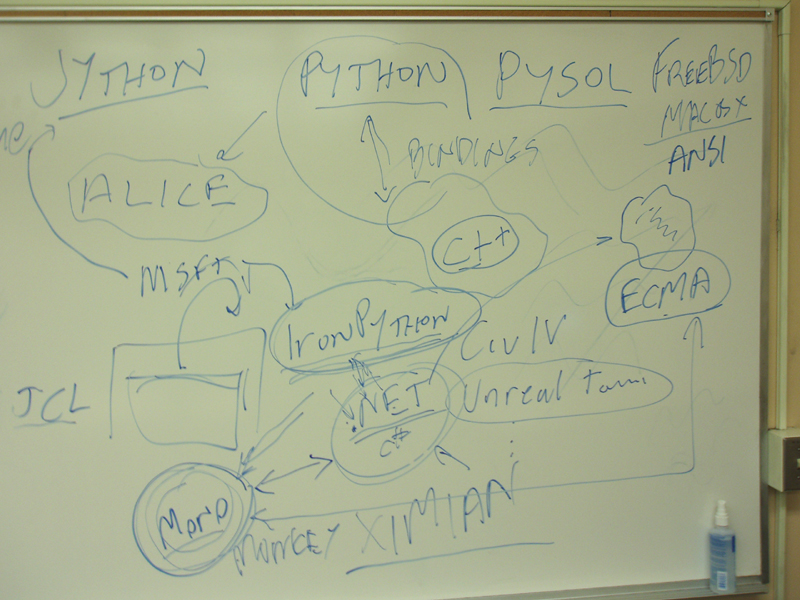
Today's picture is rather complicated, Python being implemented in at least three system languages: C, Java and C# (plus whatever those Nokia cell phones use). The C# version, called IronPython, sits atop the .NET engine with its Common Language Infrastructure (CLI).
Since Microsoft defined much of the .NET API as a public standard through ECMA, a Linux version, named Mono ("moe no" not "mah no" i.e. monkey in Spanish) is evolving to bring .NET ("dot net") capability to the Linux platform as well.
IronPython should provide a lot of cross-platform capability twixt Linux and Windows, if Mono keeps up to speed.
A student wanted to know to what extent Python is used to make quality games. I talked about game engines, written in a faster system language, supporting Python bindings for higher level scripting, and about Pygame as a good example.
During this same class, I demonstrated getting Fibonacci Numbers from a Python generator and their convergence to 1/phi, phi being the ratio of a regular pentagon's diagonal to its edge. Note that some authors switch the meanings of phi and tau, plus many use the Greek letters φ and τ.
Most student coding time was spent modifying orbits.py, a module I wrote while on vacation in sunny Florida at Bud's house. I've published more information about this module and its context in the Math Forum archives.
Related blog posts: More Pythonic Mathematics, Whiteboard Doodles, Next Generation, New Wings
Sometimes sharing autobiography is helpful. Above I'm sketching my trajectory from a 1958 birth in Chicago, through my Princeton chapter (Class of 1980), where I majored in philosophy, but also dove into computer science to some degree.
Today's picture is rather complicated, Python being implemented in at least three system languages: C, Java and C# (plus whatever those Nokia cell phones use). The C# version, called IronPython, sits atop the .NET engine with its Common Language Infrastructure (CLI).
Since Microsoft defined much of the .NET API as a public standard through ECMA, a Linux version, named Mono ("moe no" not "mah no" i.e. monkey in Spanish) is evolving to bring .NET ("dot net") capability to the Linux platform as well.
IronPython should provide a lot of cross-platform capability twixt Linux and Windows, if Mono keeps up to speed.
A student wanted to know to what extent Python is used to make quality games. I talked about game engines, written in a faster system language, supporting Python bindings for higher level scripting, and about Pygame as a good example.
During this same class, I demonstrated getting Fibonacci Numbers from a Python generator and their convergence to 1/phi, phi being the ratio of a regular pentagon's diagonal to its edge. Note that some authors switch the meanings of phi and tau, plus many use the Greek letters φ and τ.
Most student coding time was spent modifying orbits.py, a module I wrote while on vacation in sunny Florida at Bud's house. I've published more information about this module and its context in the Math Forum archives.
Related blog posts: More Pythonic Mathematics, Whiteboard Doodles, Next Generation, New Wings
Wednesday, November 08, 2006
No Problems in Houston
I'm watching a flatscreen in the Houston airport, seeing exDCI Gates ('91-'93) is replacing Rumsfeld @ DoD -- watching GWB spar with the press.
My seat mate on the plane had overview brokering architectural services, e.g. to a BBQ selling chain. CNN had an interesting Life in a Box feature about a design firm recycling shipping containers into homes and offices -- reminded me of Cape Town, that school we visited.
Houston's airport makes me appreciate PDX's no hassles free wireless. Here I'm being nickle and dimed, still the norm in most USA airports. Dawn and I are sharing a Wendys burger, Frostie™ and fries. They didn't sit next to me because of the Exit Row stipulations (I really appreciated the extra leg room). Inflight movie: Little Man (goo goo).
Is Synergetics really a philosophy then? That's what I tell people, who ask what I'm teaching on Synergeo these days.
My seat mate on the plane had overview brokering architectural services, e.g. to a BBQ selling chain. CNN had an interesting Life in a Box feature about a design firm recycling shipping containers into homes and offices -- reminded me of Cape Town, that school we visited.
Houston's airport makes me appreciate PDX's no hassles free wireless. Here I'm being nickle and dimed, still the norm in most USA airports. Dawn and I are sharing a Wendys burger, Frostie™ and fries. They didn't sit next to me because of the Exit Row stipulations (I really appreciated the extra leg room). Inflight movie: Little Man (goo goo).
Is Synergetics really a philosophy then? That's what I tell people, who ask what I'm teaching on Synergeo these days.
Monday, November 06, 2006
Revamping Remedial Math
So I'm chawing through a list of "to do's" today, including buying a plumbers' snake, practicing on my shower drain (right now I'm just waiting for the poisons to work -- trying to avoid phoning a specialist from the Yellow Pages).
In the midst of such chores, I managed to kick out Revamping Remedial Math, a typos-ridden (but still highly readable) triptych regarding my three pronged strategy for upgrading remedial math (the one you get the second time through the wringer):
I've been thinking of ways to promote master teachers into such responsible roles, primarily by forming alliances with the open source movement, as we want a lot of transparency and freedom in this picture (not forgetting competent engineering) both to build trust and to provide ample opportunities for selfless public service within high performance, challenging scenarios ("be all you can be" in other words).
If you're a long time reader of this blog, you've already seen a lot of the blueprints, which also involve promoting closer ties between Native Americans (navams) and the various migrant occupying populations (Anglos, Euros, Afros... Filipinos).
So-called Indian Reservations offer naturally attractive training grounds for those wishing to stage a trully American renaissance in our education establishments. Our heritage in its broadest, most inclusive sense (Mahayana) will by definition include the more cliquey / exclusive sub- and counter- cultures (Hinayana).
We have so many treasures.
In the midst of such chores, I managed to kick out Revamping Remedial Math, a typos-ridden (but still highly readable) triptych regarding my three pronged strategy for upgrading remedial math (the one you get the second time through the wringer):
- have computer science and mathematics vie for the same talent, agreeing with economists that competition breeds out complacency
- make it easier for students to vote with their feet, by staging some version of this competition in their local area and
- let schools wishing to opt out of this sporting spectacle do so, i.e. remain on the sidelines
I've been thinking of ways to promote master teachers into such responsible roles, primarily by forming alliances with the open source movement, as we want a lot of transparency and freedom in this picture (not forgetting competent engineering) both to build trust and to provide ample opportunities for selfless public service within high performance, challenging scenarios ("be all you can be" in other words).
If you're a long time reader of this blog, you've already seen a lot of the blueprints, which also involve promoting closer ties between Native Americans (navams) and the various migrant occupying populations (Anglos, Euros, Afros... Filipinos).
So-called Indian Reservations offer naturally attractive training grounds for those wishing to stage a trully American renaissance in our education establishments. Our heritage in its broadest, most inclusive sense (Mahayana) will by definition include the more cliquey / exclusive sub- and counter- cultures (Hinayana).
We have so many treasures.
Thursday, November 02, 2006
Voting Machine Story
I wasn't satisfied by the Diebold employee's verbal assurances in response to CBS News chief investigative correspondent Armen Keteyian's question as to why we should trust a private company that's only willing to provide verbal assurances. Is that the best the American people deserve, when it comes to customer service? [story]
Computer science faculties have gotten adversarial responses, instead of full cooperation, and if they're not completely satisfied, I'm not either.
In fact, most of us who're serious about security recognize that open source transparency is probably the best way to go in these circumstances. For example, just because RSA is both public key and open source, doesn't mean it's crackable (i.e. insecure).
At the very least, Diebold should by now have produced feature length documentaries about the vote counting process, and distributed these free to public schools on DVD, so that teachers might answer their students with confidance regarding what happens to a vote after you push the button (check the check box or whatever).
Just saying it's "high tech" and therefore over the heads of young children, is both a cop out and a smoke screen. Given the ambient level of distrust is so high (i.e. you can't lock us all up as crazy for questioning the integrity of the process), this level of arrogance is simply unacceptable.
I got the impression from Keteyian's report that the plan is to blame early Alzheimers among seniors if for some reason the rigging fails this time through. That seems like a lame strategy and I hope Diebold gets reamed if they try it (Congress first though, as they're the ones who sold us out for cheap).
Anyway, I'm glad we have vote by mail in Oregon, plus a culture that encourages whistle-blowing.
Also, if any patriot within Diebold is aware of any funny business (and I sincerely hope there is none), then I'm sure it's only a matter of time before we get full testimony on camera -- may have it in the can already for all I know (domestic politics is not my area of chief competence, although rigging elections is not a completely unfamiliar topic for me).
Computer science faculties have gotten adversarial responses, instead of full cooperation, and if they're not completely satisfied, I'm not either.
In fact, most of us who're serious about security recognize that open source transparency is probably the best way to go in these circumstances. For example, just because RSA is both public key and open source, doesn't mean it's crackable (i.e. insecure).
At the very least, Diebold should by now have produced feature length documentaries about the vote counting process, and distributed these free to public schools on DVD, so that teachers might answer their students with confidance regarding what happens to a vote after you push the button (check the check box or whatever).
Just saying it's "high tech" and therefore over the heads of young children, is both a cop out and a smoke screen. Given the ambient level of distrust is so high (i.e. you can't lock us all up as crazy for questioning the integrity of the process), this level of arrogance is simply unacceptable.
I got the impression from Keteyian's report that the plan is to blame early Alzheimers among seniors if for some reason the rigging fails this time through. That seems like a lame strategy and I hope Diebold gets reamed if they try it (Congress first though, as they're the ones who sold us out for cheap).
Anyway, I'm glad we have vote by mail in Oregon, plus a culture that encourages whistle-blowing.
Also, if any patriot within Diebold is aware of any funny business (and I sincerely hope there is none), then I'm sure it's only a matter of time before we get full testimony on camera -- may have it in the can already for all I know (domestic politics is not my area of chief competence, although rigging elections is not a completely unfamiliar topic for me).
Wednesday, November 01, 2006
Subscribe to:
Posts (Atom)